
Data Migration Strategies: Streamlining ERP Moves

by Uzlifat Mir
- Jan 27, 2026
- 0
- Category: ERP Software
System upgrades and changing business needs often leave IT managers making tough decisions about legacy data. For Texas manufacturing companies moving to Odoo ERP, having a clear strategy for data migration is not just a technical task, but the foundation for future operational efficiency. Getting this process right means your crucial production schedules, inventory records, and customer orders make a clean, reliable transition—setting you up for success with the new platform.
Table of Contents
- Defining Data Migration for ERP Systems
- Comparing Big Bang and Phased Migration
- Key Steps in Odoo ERP Transition
- Risks, Legal Requirements, and Security Concerns
- Mistakes to Avoid and Managing Costs
Key Takeaways
| Point | Details |
|---|---|
| Data Migration is Critical | Data migration involves meticulous processes to ensure accurate transfer of information without data loss or corruption, which is essential for successful ERP implementation. |
| Choose the Right Migration Strategy | Opting for either Big Bang or phased migration impacts risk and complexity, with phased migration typically offering higher success rates for mid-sized manufacturers. |
| Follow a Structured Transition Process | A defined eight-stage approach to transitioning to Odoo ERP enhances data integrity and staff preparedness, ensuring smoother operations during the change. |
| Proactive Risk Management is Essential | Identifying potential risks related to data integrity, compliance, and security during migration is crucial to maintaining operational stability and legal compliance. |
Defining Data Migration for ERP Systems
Data migration is the process of moving data from one system to another. At its core, it involves selecting, preparing, extracting, and transforming data, then transferring it from your current storage system to a new one. For manufacturing companies in Texas planning a transition to Odoo ERP, this concept becomes more than just a technical definition. It’s the bridge between your legacy systems and the streamlined operations you’re trying to achieve.
When you move to Odoo ERP, data migration isn’t simply about copying information from point A to point B. The process requires assessment of your current data landscape, clear objective definition, careful data mapping, validation checks, and comprehensive testing before anything goes live. Consider your manufacturing environment: you have years of production schedules, inventory counts, customer orders, and financial records scattered across multiple systems. All of that needs to move accurately into Odoo without losing critical information or corrupting existing relationships between datasets. This is why exploring comprehensive ERP migration strategies becomes essential when planning your transition.
The key phases of any data migration include planning, execution, and post-migration validation. During planning, you analyze dependencies between systems and identify what data actually needs to move versus what can be archived. Execution involves the actual transfer of data with real-time monitoring for errors. Post-migration includes thorough verification that all data arrived intact, that business logic remains intact, and that your team can access what they need in the new system. For mid-sized manufacturing operations, this typically spans weeks rather than days, with careful attention paid to production data integrity and historical records that inform forecasting.
The reason data migration matters so much for your ERP implementation is simple: bad data going into Odoo means bad decisions coming out. You might have inventory quantities that don’t reconcile, customer records with duplicate information, or financial data that doesn’t balance. Bista Solutions brings over 350 successful ERP implementations to the table, which means our team has seen every type of data quality issue and knows how to resolve it before it becomes a problem in your live system. We handle the assessment, transformation, validation, and post-migration support that keeps your operations running smoothly during the transition.
Pro tip: Audit your current data quality at least three months before your planned migration date. Identifying and cleaning up duplicates, incorrect entries, and incomplete records now saves you from painful corrections after Odoo goes live.
Comparing Big Bang and Phased Migration
When you’re planning your move to Odoo ERP, one of the biggest decisions you’ll make is whether to go all-in at once or roll out gradually. These two approaches, called Big Bang and phased migration, represent fundamentally different philosophies about managing risk and operational continuity. Understanding the differences between them is critical because this choice will shape your entire implementation timeline, budget, and resource allocation.
A Big Bang migration means cutting over from your legacy systems to Odoo on a single date with no transition period. Everything goes live at once across all modules and all locations. Your manufacturing plant stops using the old system on Friday afternoon and starts using Odoo on Monday morning. The upside is straightforward: you avoid the complexity of running parallel systems, you get immediate full access to all Odoo functionality, and your team doesn’t get stranded in a hybrid environment. But the downside carries real weight. If something goes wrong, you don’t have a fallback. Your production scheduling might fail, inventory counts could be inaccurate, or financial records might not reconcile. For a manufacturing operation that needs to keep running, this creates serious operational risk.

Phased migration takes the opposite approach. You implement Odoo module by module, location by location, or department by department over weeks or months. Maybe you start with inventory management in your main warehouse, then add production scheduling once the team knows the system, then layer in accounting. This gradual approach gives your team time to learn, gives you chances to catch issues before they cascade through your entire operation, and lets you adjust your implementation based on real-world feedback. The trade-off is longer complexity. You’re managing two systems simultaneously during the transition period, which requires more staffing, more training, and more careful coordination.
For most mid-sized Texas manufacturers, phased migration works better. Your operation can’t afford significant downtime, your team needs time to adapt to new workflows, and production data integrity matters too much to risk in a single cutover event. Bista Solutions has successfully managed both approaches across 350+ implementations, and our experience shows that phased migrations have higher success rates with manufacturing clients. You maintain operational continuity, reduce risk, and give your people breathing room to master Odoo before moving to the next phase. You can also validate data quality at each stage before proceeding further.
Here’s a quick visual comparison of Big Bang and Phased migration approaches for ERP projects:
| Factor | Big Bang Migration | Phased Migration |
|---|---|---|
| Cutover Timing | Single-Event Switch | Gradual, Over Weeks or Months |
| Operational Risk | High; No Fallback | Lower; Staged Rollout |
| Team Learning Curve | Intense, Compressed | Steady, Incremental |
| System Complexity | Simpler After Cutover | More Complex During Transition |
| Downtime Impact | Potentially Significant | Minimized and Controlled |
| Data Validation Opportunities | Few, All-at-Once | Multiple, Throughout Transition |
Pro tip: Start with your least critical but data-heavy process first, such as inventory management. This lets your team learn Odoo workflows with lower operational risk while you validate your data migration approach before moving to core production systems.
Key Steps in Odoo ERP Transition
Moving to Odoo ERP isn’t something that happens overnight, and successful transitions follow a structured approach that minimizes disruption to your manufacturing operations. The process involves eight critical stages that work together to ensure your data moves cleanly, your team gets prepared, and your business keeps running smoothly during the changeover. Understanding these steps upfront helps you manage expectations, allocate resources properly, and avoid the costly mistakes that derail implementations.
The journey starts with assembling the right project team. This isn’t just your IT department. You need people from production, accounting, inventory management, and quality control who understand how your manufacturing business actually works day to day. Next comes discovery and planning, where you map out your current processes, identify gaps between how you work now and how Odoo works, and define what customization or configuration you’ll actually need. Then comes system design and customization, where Bista Solutions works with your team to configure Odoo modules and build any custom solutions that fit your specific workflows. This stage is where you’re building the bridge that takes your legacy processes into Odoo.
Data migration and cleanup is where the rubber meets the road. You’re extracting data from your old systems, validating it for completeness and accuracy, transforming it into Odoo-compatible formats, and loading it into your new environment. This step demands extreme care because bad data here cascades into every report and decision you make in Odoo. The 9 phases of ERP implementation outline how data migration fits into the broader timeline. After data loads, you run comprehensive testing to verify everything works as expected, production schedules run correctly, inventory counts are accurate, and financial records reconcile. Then comes deployment and go-live, where you actually switch from your old systems to Odoo, either through Big Bang or phased cutover depending on your strategy. The final stages involve staff training and support to help your team use Odoo effectively, followed by ongoing maintenance to keep the system running smoothly and handle any issues that emerge.
For Texas manufacturers, this eight-stage process typically takes three to six months depending on complexity and whether you choose phased or Big Bang migration. Bista Solutions brings proven methodologies and experienced team members who have guided companies through every stage successfully. Your project team stays focused on business continuity while our experts handle the technical heavy lifting of configuration, data transformation, and system validation.
To help manage a successful Odoo ERP transition, here are the eight key steps summarized:
| Stage | Description | Key Outcome |
|---|---|---|
| Team Assembly | Build a cross-functional project team | Diverse expertise mobilized |
| Discovery & Planning | Map processes, define requirements | Clear migration blueprint |
| System Design | Configure modules, develop customizations | Tailored ERP setup |
| Data Cleanup & Migration | Extract, validate, transform, load data | Clean, reliable data in Odoo |
| Testing | Simulate real operations in Odoo | Confidence in new system |
| Deployment | Switch over fully or by phase | Odoo goes live for users |
| Training & Support | Educate staff, provide helpdesk | Team ready for new workflows |
| Ongoing Maintenance | Regular updates and troubleshooting | Long-term ERP performance |
Pro tip: Schedule your comprehensive testing phase to include at least two full weeks of production runs using actual data and real-world scenarios, not just test cases. This catches integration issues and process problems before your team depends on Odoo for daily operations.
Risks, Legal Requirements, and Security Concerns
Data migration carries real risks that go beyond simple technical failures. When you move from your legacy system to Odoo ERP, you’re handling sensitive information: customer data, financial records, production details, and employee information. If this data gets corrupted, lost, or exposed during migration, you face operational chaos, regulatory penalties, and damage to customer trust. The stakes are high enough that skipping proper risk management isn’t an option. Manufacturing companies in Texas operate in an environment where data integrity directly affects compliance, liability, and operational credibility.
The primary risks during migration fall into three categories. Data integrity risks include data loss, transformation errors where information gets corrupted during conversion, and mapping inaccuracies where fields don’t translate correctly between systems. A production schedule that disappears or an inventory count that becomes inaccurate can halt operations. Compliance and legal risks stem from regulatory requirements around data handling, record retention, and reporting accuracy. If you’re subject to industry standards or regulations, your migration must preserve audit trails and maintain data quality to meet those requirements. Security risks involve protecting data during the transition when systems are open for migration activities. Sensitive customer information, financial data, and proprietary manufacturing processes need protection against unauthorized access or breach.
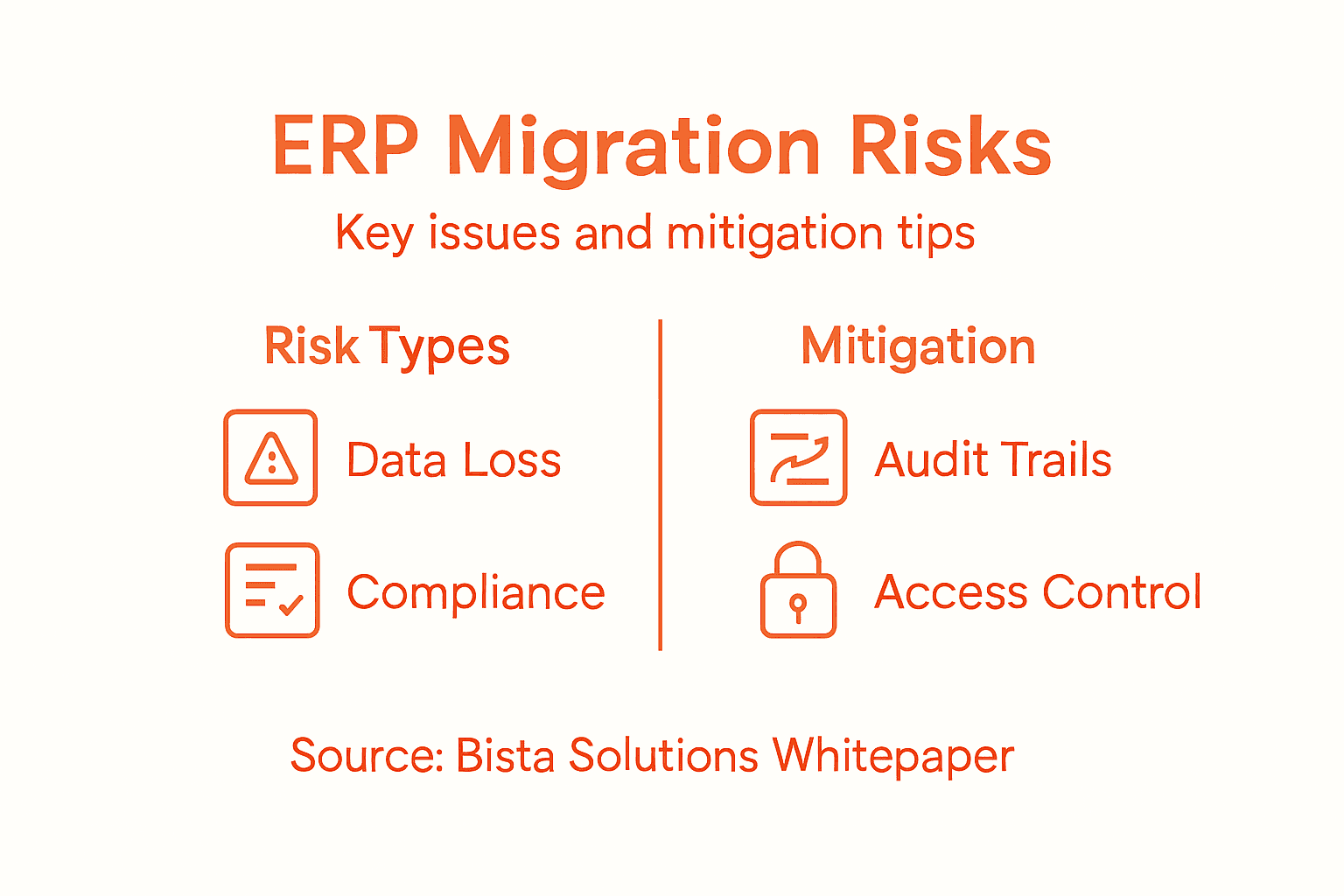
Mitigation starts with proper data governance frameworks that define how data moves, who has access at each stage, and how validation happens. Automated validation tools catch transformation errors before they propagate through your system. You need cross functional collaboration between your IT team, business stakeholders, and security experts to identify what data actually needs to move versus what can be archived. Bista Solutions implements security controls aligned with standards like ISO/IEC 27002 and NIST Cybersecurity Framework to protect confidentiality, integrity, and availability of your data throughout the migration process. We conduct thorough testing to verify that all data arrives complete and accurate, and we maintain detailed audit documentation of every step for compliance purposes.
For Texas manufacturers, staying compliant with industry regulations while protecting operational data isn’t optional. Our team of 300+ ERP resources brings experience managing sensitive manufacturing data across hundreds of implementations. We understand the specific compliance requirements your industry faces and build those protections directly into your migration strategy from day one.
Pro tip: Create a detailed data inventory before migration starts, documenting what data exists, where it lives, why you need it, and what legal or regulatory requirements apply to it. This prevents surprise discoveries of critical data midway through migration.
Mistakes to Avoid and Managing Costs
ERP migration projects fail more often because of preventable mistakes than because of technical problems. You can have the best technology and the most skilled team, but if you skip critical planning steps or underestimate the scope of work ahead, your project spirals into delays, budget overruns, and operational disruption. The good news is that these mistakes are predictable, and knowing about them upfront lets you avoid the costly lessons other companies have learned the hard way.
The biggest mistake is inadequate documentation of your current state. You need to thoroughly understand how your existing systems work, what data they contain, and how your business processes actually operate day to day. Many manufacturers skip this step because it feels tedious, then discover halfway through migration that critical processes aren’t documented and data mappings are incomplete. This leads to scope creep, timeline delays, and budget increases. Another common mistake is underestimating the actual scope of migration. You think you’re moving three modules and discover you have dependencies, customizations, and workarounds built into your legacy system that nobody documented. Suddenly the project is 40 percent larger than expected. Ignoring risk management is equally dangerous. You need proactive identification of what could go wrong, clear contingency plans, and realistic timelines that account for testing and validation. The gap between your current “AS IS” state and your future “TO BE” state determines your migration complexity far more than system features do.
Cost control requires honest scope definition and experienced personnel who understand both your business and ERP systems. Bista Solutions brings data from 350+ implementations that shows how similar manufacturing operations typically scope their migrations, which helps you budget realistically. We align project goals with your actual business processes rather than forcing your operations to fit generic ERP workflows. We also ensure sufficient stakeholder buy-in by involving people from production, accounting, and quality control in planning. When key stakeholders understand why decisions were made, they support the implementation rather than resist it.
For mid-sized Texas manufacturers, the difference between a well-planned migration and a chaotic one often comes down to 15 to 20 percent of total project cost. That’s your investment in proper assessment, documentation, and planning upfront. Skip it and you’ll spend three times that amount fixing problems during and after go-live. Our experienced team structures implementations to catch issues early when they’re inexpensive to fix, not after they’ve cascaded through your operation.
Pro tip: Build a 20 percent contingency buffer into your project timeline and budget from the start, then track what actually consumes that buffer as the project progresses. This prevents false economy decisions that cause delays later.
Master Your ERP Data Migration with Expert Guidance from Bista Solutions
Data migration challenges can turn even the most promising ERP implementation into a costly ordeal. If your manufacturing business in Texas is facing the critical task of streamlining data migration strategies while minimizing operational risks and ensuring data integrity, you are not alone. This process requires thorough planning, expert data mapping, and continuous validation to avoid pitfalls like data loss, incorrect transformations, or system downtime. Our experienced team understands the unique complexities involved in migrating to Odoo ERP, from choosing between Big Bang and phased migration approaches to managing compliance and security concerns.
Contact Us For A Free Demo
Do not let data migration risks stall your digital transformation. Partner with Bista Solutions, the largest Odoo ERP implementer in North America, with over 350 successful implementations and a dedicated team of 300+ ERP professionals. We provide tailored solutions designed to maintain business continuity while delivering a seamless transition. Discover how our proven methodologies and comprehensive support can safeguard your data and empower your team to master Odoo ERP with confidence. Start your smooth ERP journey today by reaching out to our experts via Contact Us. Explore our insights on ERP Migrations, Data Migration Strategy, and 9 ERP Implementation Phases to learn more about how Bista Solutions supports your success.
Frequently Asked Questions
What is data migration for ERP systems?
Data migration for ERP systems involves transferring data from one system to another, ensuring accurate selection, preparation, extraction, and transformation of data before its transfer to a new ERP environment like Odoo.
Why is data migration important when transitioning to Odoo ERP?
Data migration is crucial because bad data can lead to inaccurate decision-making and operational issues. Ensuring high data quality during migration helps maintain data integrity and supports smooth business operations within Odoo.
What are the key phases of data migration?
The key phases of data migration include planning, execution, and post-migration validation. This involves analyzing dependencies, transferring data, and verifying accuracy to ensure successful implementation in the new system.
What are the common migration strategies: Big Bang vs. Phased?
Big Bang migration involves a single, immediate cutover from existing systems to Odoo, while Phased migration implements the new system incrementally over time. Phased migration reduces risk and allows for adjustments, making it preferable for most mid-sized manufacturers.