
Steps to Digital Transformation for Texas Businesses

by Uzlifat Mir
- Mar 09, 2026
- 0
- Category: ERP Software
Most American mid-sized businesses in Texas face constant pressure to keep up with rapid technological changes. While digital transformation promises greater efficiency, many owners feel stuck with outdated tools and disconnected workflows. In fact, studies show that nearly 60 percent of mid-sized companies struggle with integrating new solutions across departments. This guide breaks down the path to adopting Odoo ERP, showing practical steps that help your team adapt, improve processes, and stay competitive.
Table of Contents
- Step 1: Assess Current Systems And Identify Digital Needs
- Step 2: Align Business Strategy And Define Transformation Goals
- Step 3: Select Odoo ERP Modules And Plan Implementation
- Step 4: Customize Solutions And Migrate Business Data
- Step 5: Test Workflows And Verify Operational Improvements
- Step 6: Train Teams And Launch The Transformed Processes
Quick Summary
| Key Takeaway | Explanation |
|---|---|
| 1. Perform a Digital Maturity Assessment | Assess current systems to identify digital needs and inefficiencies. Engage stakeholders to recognize areas for improvement. |
| 2. Align Strategy with Transformation Goals | Map technology investments to business objectives to create a strategic roadmap for digital evolution. Define KPIs for success measurement. |
| 3. Select Appropriate Odoo ERP Modules | Choose Odoo modules that address your specific operational challenges and align with established goals for effective integration. |
| 4. Customize and Migrate Data Effectively | Tailor your Odoo solution and ensure smooth data migration, focusing on data integrity and minimal disruption through careful planning. |
| 5. Train Teams for a Smooth Transition | Develop a comprehensive training strategy that equips staff with the skills needed to utilize the new system effectively, ensuring user adoption and support. |
Step 1: Assess current systems and identify digital needs
Before launching into a digital transformation journey, you need a comprehensive understanding of your current technological landscape. The Texas Department of Information Resources recommends starting with a structured digital maturity assessment that evaluates your existing systems, workflows, and technological capabilities.
Begin by conducting a thorough inventory of your current technology infrastructure. This means mapping out all software applications, hardware systems, network configurations, and digital tools currently used across different departments. Engage key stakeholders from IT, operations, finance, and management to gather insights into existing processes and pain points. Look for inefficiencies like manual data entry, disconnected systems, redundant workflows, and communication bottlenecks that signal potential areas for digital improvement.
The Digital Maturity Assessment Tool provided by Texas state resources can help you systematically score your organization’s readiness for digital transformation. Pay special attention to areas like data integration, cloud readiness, cybersecurity protocols, and scalability of current systems. Document not just what technologies you have, but how effectively they support your business objectives and customer experiences.
Here’s a summary table comparing key digital transformation focus areas for Texas businesses:
| Focus Area | Primary Challenge | Technology Impact | Typical Benefit |
|---|---|---|---|
| Data Integration | Disconnected systems | Data centralization | Improved decision making |
| Cloud Readiness | Legacy infrastructure | Scalable solutions | Enhanced flexibility |
| Cybersecurity | Outdated protocols | Modern security layers | Reduced risk of breaches |
| Workflow Efficiency | Manual data entry | Automation tools | Increased productivity |
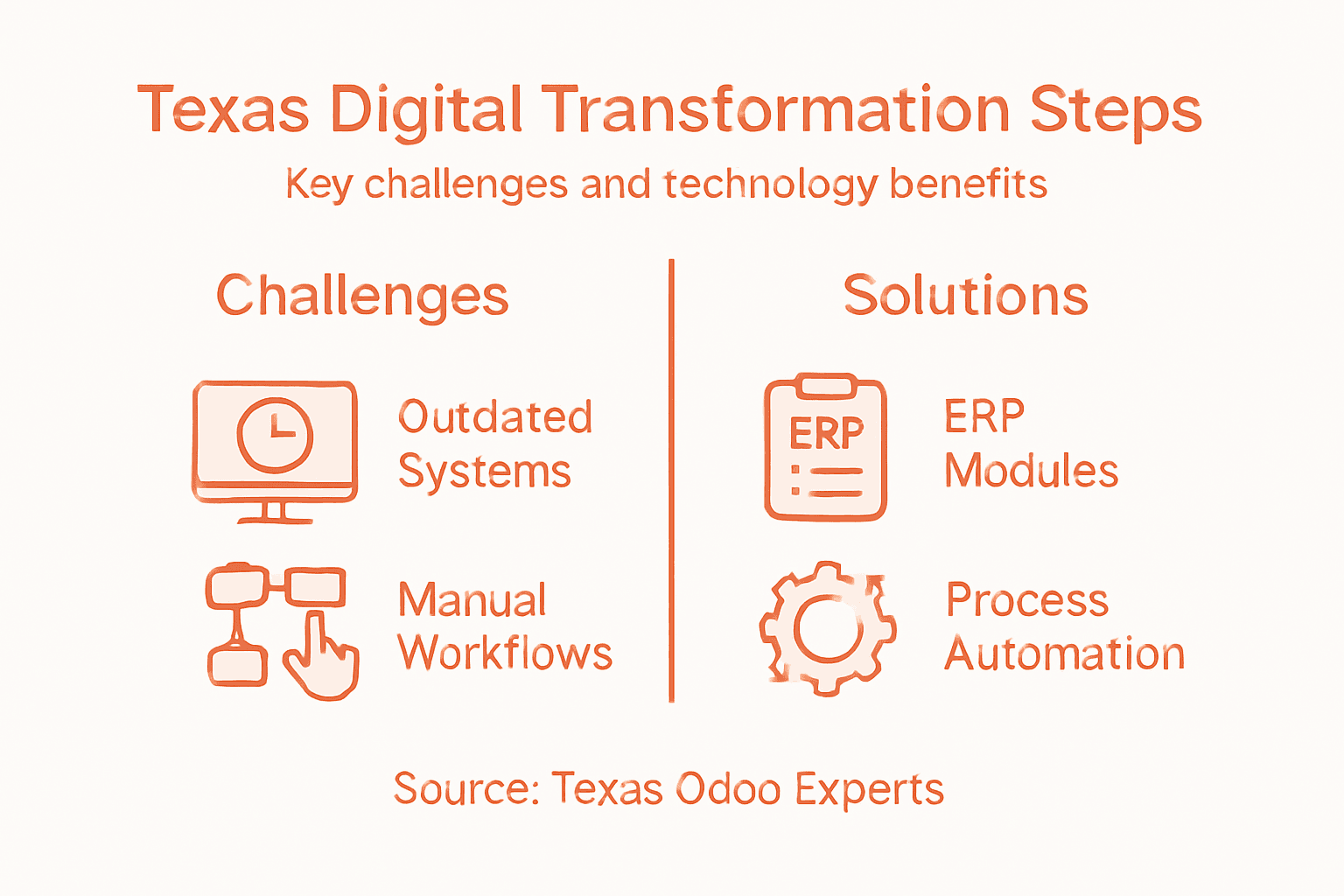
Pro tip: Create a visual workflow diagram that highlights current system connections and potential integration opportunities to make your assessment more actionable and easier to communicate across your organization.
Step 2: Align business strategy and define transformation goals
To successfully transform your business digitally, you must create a strategic roadmap that bridges your current operations with your future vision. The goal is to design a transformation strategy that goes beyond simple technology implementation and fundamentally reimagines how your business creates value.
Start by conducting a comprehensive strategic planning session with key leadership from across your organization. Identify your core business drivers, those critical objectives like efficiency improvements, cost reduction, market expansion, or customer experience enhancement. Texas enterprises are aggressively pursuing digital strategies that embed technology across operations to optimize and innovate. Map each potential technology investment directly to these strategic goals and quantify potential impacts. This means developing clear key performance indicators (KPIs) that will help you measure the success of your digital transformation efforts.
Consider how digital technologies can reinvent your business model and increase organizational agility. Texas businesses benefit from a pro-business environment that encourages innovation through data and automation. Evaluate how emerging technologies like cloud computing, artificial intelligence, and advanced analytics can help you achieve your specific business objectives. Create a flexible transformation framework that allows for iterative improvements and can adapt as your business and technology landscape evolve.
Pro tip: Develop a digital transformation scorecard that tracks both technological implementation and business outcome metrics to ensure your strategy remains aligned with your core organizational goals.
Step 3: Select Odoo ERP modules and plan implementation
Selecting the right Odoo ERP modules is critical to ensuring a successful digital transformation for your Texas business. You will map your unique operational requirements to specific Odoo applications that can streamline and optimize your organizational processes.

Begin by conducting a comprehensive review of your current business workflows across different departments. Carefully evaluate which ERP implementation phases are most crucial for your specific industry and organizational needs. Odoo offers a wide range of modules covering areas like accounting, sales, inventory management, human resources, and customer relationship management. Prioritize modules that directly address your most significant operational challenges and align with the strategic goals you established in previous steps. For Texas businesses, this might mean focusing on modules that enhance efficiency, reduce manual processes, and provide real-time data insights.
Work closely with your Odoo implementation partner to create a detailed implementation roadmap. This should include a phased approach that allows for gradual module integration, comprehensive staff training, and continuous feedback loops. Consider starting with core modules that provide immediate value and can demonstrate quick wins to your team. Document your expected outcomes for each module and establish clear metrics to measure their effectiveness. Remember that successful implementation is not just about technology but about creating a holistic solution that transforms how your business operates.
Below is a reference table outlining major Odoo ERP modules and their business value for Texas organizations:
| Odoo Module | Primary Function | Business Value |
|---|---|---|
| Accounting | Financial management | Streamlined bookkeeping |
| Inventory Management | Stock tracking | Reduced excess inventory |
| Sales | Sales order automation | Faster revenue cycles |
| CRM | Customer relationship | Improved client retention |
| Human Resources | Employee data management | Efficient HR administration |
Pro tip: Develop a prioritized module selection matrix that ranks potential Odoo applications based on their expected impact, implementation complexity, and alignment with your strategic business objectives.
Step 4: Customize solutions and migrate business data
Customizing your Odoo ERP solution and migrating existing business data are critical steps that will determine the success of your digital transformation strategy. You will need to transform your current business information into a format that seamlessly integrates with your new Odoo ecosystem while ensuring data integrity and minimal operational disruption.
Begin the customization process by conducting a thorough analysis of your existing systems and identifying specific workflows that require tailored modifications. Collaborate closely with your implementation partner to develop custom modules, dashboards, and reporting tools that address your unique business requirements. When considering data migration strategies, focus on mapping out precise data transfer protocols. This involves carefully extracting data from legacy systems, cleansing and validating information, and strategically mapping fields to ensure accurate translation into the Odoo environment. Texas businesses often require localized customizations that account for specific regulatory compliance and industry-specific reporting standards.
Implement a phased data migration approach that minimizes risks and allows for comprehensive testing at each stage. Create multiple data migration test scenarios that simulate real-world business operations, allowing you to identify and resolve potential issues before full system cutover. Develop a robust backup strategy and maintain parallel system access during the transition to ensure business continuity. Engage key stakeholders from different departments to validate data accuracy and functionality, ensuring that the customized Odoo solution truly meets your organizational needs.
Pro tip: Develop a detailed data migration validation checklist that includes data completeness, accuracy, and system performance metrics to systematically verify your migration process.
Step 5: Test workflows and verify operational improvements
Testing your newly implemented Odoo ERP system is a critical phase that validates the effectiveness of your digital transformation strategy. Your goal is to systematically evaluate each workflow, ensuring that the new system not only functions correctly but also delivers the operational improvements you designed.
Begin by developing a comprehensive testing strategy that covers multiple dimensions of system performance. Create detailed test scenarios that simulate real-world business processes across different departments. This means mapping out specific workflows in workflow management systems and rigorously testing each module to confirm functionality, data accuracy, and performance. Focus on both automated and manual testing approaches that challenge the system under various conditions. Pay special attention to integration points between different modules, verifying that data flows seamlessly and business rules are consistently applied.
Engage key stakeholders from each department to participate in user acceptance testing. Their direct involvement will help validate that the new Odoo ERP system meets specific operational requirements and addresses unique business challenges. Document any discrepancies or performance issues meticulously, working closely with your implementation partner to resolve them before full system rollout. Remember that testing is an iterative process designed to refine and optimize your digital solution. Collect quantitative metrics that demonstrate improvements in efficiency, processing times, and overall operational performance to validate the success of your digital transformation initiative.
Pro tip: Create a structured testing matrix that assigns clear ownership for each test scenario and includes specific performance benchmarks to objectively measure system improvements.
Step 6: Train teams and launch the transformed processes
Launching your newly transformed Odoo ERP system requires a strategic approach to team training and organizational change management. Your objective is to empower your workforce with the knowledge and confidence to effectively leverage the new digital processes and technology.
Develop a comprehensive training strategy that addresses the unique needs of different departments and user roles. Begin with a functional gap analysis to identify specific training requirements and create role-based learning paths. This means designing training modules that range from fundamental system navigation to advanced workflow optimization. Utilize a mix of training methods, including live workshops, interactive online tutorials, detailed documentation, and hands-on practice sessions. Ensure that your training program not only covers technical system usage but also helps team members understand how the new processes will improve their daily work efficiency.
Implement a phased rollout approach that allows for gradual system adoption and continuous learning. Schedule multiple training rounds with built-in support mechanisms like dedicated help desks, quick reference guides, and ongoing consultation from your implementation partner. Encourage feedback and create channels for team members to share their experiences and challenges. Monitor user adoption rates and system performance closely during the initial launch period, being prepared to provide additional support or make rapid adjustments. The goal is to create a smooth transition that minimizes disruption and maximizes user engagement with your new Odoo ERP system.
Pro tip: Create a peer champion program by identifying tech-savvy team members who can provide immediate onsite support and help accelerate learning across different departments.
Drive Your Texas Business Digital Transformation with Expert Odoo ERP Solutions
Digital transformation can uncover hidden challenges like disconnected systems, manual workflows, and outdated infrastructure that slow your Texas business down. You want to achieve true agility by aligning your business strategy with scalable technology like Odoo ERP modules tailored to your needs. At Bista Solutions, we understand these pain points and deliver custom Odoo solutions designed to enhance efficiency, data integration, and secure workflows while enabling seamless ERP implementation phases that truly support your strategic goals.
Request A Free Consultation
Take control of your business future today by partnering with a recognized Odoo Gold Partner with over 350 successful ERP implementations and 300+ expert team members ready to customize, migrate, and optimize your systems. Don’t wait to empower your workforce, streamline workflows, and boost operational performance. Contact us now at Bista Solutions and start your digital transformation journey with proven expertise and unwavering support.
Frequently Asked Questions
What is the first step to digital transformation for Texas businesses?
Start by assessing your current systems and identifying your digital needs. Conduct a digital maturity assessment to evaluate your existing technology, workflows, and capabilities within the next 30 days.
How do I determine which Odoo ERP modules to implement?
Evaluate your unique operational requirements and map them to specific Odoo applications. Prioritize modules that directly address your most significant challenges and align with your business goals to achieve immediate improvements in efficiency.
What should I include in my data migration strategy for Odoo?
Your data migration strategy should focus on carefully extracting, cleansing, and validating data before transferring it into Odoo. Develop clear mapping protocols and conduct phased data migration testing to minimize disruption and ensure data accuracy.
How can I effectively train my team on the new digital processes?
Develop a comprehensive training strategy tailored to different departments and roles. Utilize a mix of training methods like workshops, online tutorials, and hands-on sessions within 60 days after system launch to ensure users are confident in using the new system.
What are the key performance indicators to measure digital transformation success?
Focus on clear key performance indicators (KPIs) that reflect operational improvements such as processing times, efficiency gains, and user adoption rates. Establish these metrics early in the process to track progress and validate the impact of your digital initiatives.