Understanding Odoo ERP for Manufacturing Businesses – Optimize and Automate Operations

Odoo ERP manufacturing teamwork

Manufacturers face relentless pressure to streamline operations and stay ahead in a competitive market. Odoo ERP is now powering a shift, and nearly 7 million users worldwide rely on it to manage everything from production schedules to supply chain logistics. Most people expect complex and costly software to be the only answer. Instead, Odoo stands out as an open source, highly adaptable solution that transforms how manufacturers operate every day.

Table of Contents

Quick Summary

Takeaway Explanation
Odoo ERP centralizes manufacturing processes Odoo integrates production, inventory, procurement, and sales into one platform, enhancing operational efficiency.
Automation reduces operational costs and errors Odoo’s automation layers minimize manual data entry and lower the likelihood of human errors in workflows.
Real-time insights drive strategic decisions The system provides immediate visibility into operations, enabling manufacturers to make informed, data-driven choices.
Improved supply chain management is essential Odoo’s supply chain solutions enhance transparency and flexibility, allowing businesses to respond quickly to market shifts.
Customizable tools ensure scalability Odoo allows manufacturers to tailor modules to specific needs, ensuring growth and adaptability with business changes.

What is Odoo ERP and How Does it Benefit Manufacturing?

Odoo ERP represents a comprehensive software solution designed to transform manufacturing business operations through integrated digital management. As a powerful open source platform, Odoo enables manufacturers to centralize and automate critical business processes across production, inventory, procurement, and sales functions.

Understanding Odoo’s Manufacturing Core

At its foundation, Odoo provides manufacturers an end-to-end management system that addresses complex operational challenges. The platform offers robust modules specifically tailored for manufacturing environments, allowing businesses to track production workflows, manage bill of materials, schedule work orders, and control inventory with unprecedented precision.

Key capabilities of Odoo’s manufacturing module include:

  • Comprehensive production planning and scheduling
  • Real-time inventory tracking and management
  • Seamless integration with procurement and sales systems
  • Detailed work order and manufacturing route configuration

Strategic Benefits for Manufacturing Operations

Manufacturers implementing Odoo ERP gain significant strategic advantages. The system enables businesses to reduce operational complexity, minimize manual data entry, and create a unified information ecosystem. By consolidating multiple business functions into a single platform, companies can achieve greater visibility, faster decision making, and improved operational efficiency.

Below is a table summarizing the core features found in Odoo ERP’s Manufacturing and Supply Chain modules, highlighting which operational challenges each feature helps to address.

Feature Manufacturing Operations Impact Supply Chain Operations Impact
Production Planning & Scheduling Streamlines workflows, optimizes resource use Improves alignment with inventory and procurement
Real-Time Inventory Tracking Reduces stockouts and overstock, increases accuracy Enables responsive and transparent inventory control
Integrated Procurement Management Ensures timely materials sourcing, reduces delays Synchronizes vendor management and order fulfillment
Bill of Materials (BOM) Management Supports complex product assembly and cost calculations Facilitates accurate procurement and order planning
Work Order & Routing Configuration Increases shop floor efficiency and tracking Enhances coordination for material and product movement
Advanced Analytics & Reporting Enables better forecasting and productivity analysis Identifies supply chain bottlenecks, improves decision making
Automation of Routine Processes Reduces manual errors, speeds production cycles Accelerates purchase, inventory, and logistics processes

learn more about manufacturing optimization through Bista Solutions’ specialized Odoo implementation approach, which transforms traditional manufacturing processes into intelligent, data driven workflows. Our expert team ensures each implementation is precisely configured to meet your unique business requirements, delivering a tailored solution that grows with your organization.

The Importance of Automation in Manufacturing Operations

Automation has become a critical strategy for manufacturing businesses seeking to enhance operational efficiency, reduce costs, and maintain competitive advantage in a rapidly changing global market. By leveraging advanced technological solutions like Odoo ERP, manufacturers can transform traditional manual processes into intelligent, data driven workflows that optimize productivity and decision making.

Driving Operational Efficiency Through Intelligent Automation

Modern manufacturing automation goes beyond simple mechanization. It represents a comprehensive approach to integrating digital technologies that enable real time monitoring, predictive maintenance, and seamless communication across different operational departments. Automated systems reduce human error, accelerate production cycles, and provide unprecedented visibility into complex manufacturing processes.

Key advantages of manufacturing automation include:

  • Significant reduction in production time and operational costs
  • Enhanced quality control and consistent product standards
  • Improved worker safety through reduced manual intervention
  • Greater flexibility in responding to market demand changes

Strategic Impact of Technological Integration

Automation is not just a technological upgrade but a strategic business transformation. By implementing intelligent systems like Odoo ERP, manufacturers can create more responsive, adaptable organizations capable of quickly adjusting to market dynamics. The ability to collect, analyze, and act on real time data becomes a powerful competitive differentiator.

This table provides an overview of the key benefits manufacturers achieve by automating with Odoo ERP, aligning each benefit with the corresponding business impact described in the article.

Automation Benefit Description Business Impact
Reduction in Production Time and Costs Speeds up manufacturing cycles and minimizes overhead Improves profitability and resource allocation
Enhanced Quality Control Ensures product consistency and adherence to standards Reduces rework and improves customer satisfaction
Improved Worker Safety Limits manual intervention in hazardous or repetitive tasks Lowers risk of workplace injuries
Flexibility in Responding to Market Changes Enables rapid adjustments to production plans and inventory Increases ability to meet shifting customer demands
Real-Time Monitoring and Predictive Maintenance Allows early detection of issues, proactive maintenance, and data-driven action Prevents downtime and supports continuous improvement
Seamless Inter-Departmental Communication Connects production, inventory, and procurement in a single system Reduces errors, ensures alignment across business units

discover advanced manufacturing insights through Bista Solutions’ expert implementation strategies. Our approach ensures that automation technologies are precisely tailored to unlock your organization’s unique operational potential, driving sustainable growth and operational excellence.

Understanding Production Management with Odoo ERP

Production management represents a critical component of manufacturing success, requiring sophisticated tools to coordinate complex workflows, track resources, and optimize operational performance. Odoo ERP provides manufacturers a comprehensive platform that transforms traditional production management approaches through intelligent digital integration and real-time operational insights.

Core Elements of Odoo Production Management

Odoo’s production management module offers manufacturers a powerful suite of tools designed to streamline and enhance manufacturing processes. The system enables detailed tracking of production orders, bill of materials, work center management, and manufacturing routing with unprecedented precision. By centralizing critical production data, businesses can create more efficient, transparent, and responsive manufacturing environments.

production digital monitoring Odoo ERP

Key production management capabilities include:

  • Comprehensive work order tracking and scheduling
  • Detailed bill of materials configuration
  • Real-time inventory and resource allocation management
  • Advanced manufacturing route and workflow optimization

Strategic Production Planning and Execution

Successful production management goes beyond mere tracking. Odoo ERP empowers manufacturers to implement strategic planning mechanisms that anticipate market demands, optimize resource utilization, and minimize operational bottlenecks. The platform provides intelligent forecasting tools, enabling businesses to make data driven decisions that enhance productivity and reduce waste.

explore advanced production planning strategies through Bista Solutions’ expert implementation approach. Our specialized team ensures your Odoo ERP solution is precisely configured to transform your production management processes, delivering scalable and intelligent manufacturing capabilities tailored to your unique business requirements.

How Odoo ERP Enhances Supply Chain Efficiency

Modern manufacturing businesses require sophisticated supply chain management solutions that provide real-time visibility, seamless integration, and intelligent decision making capabilities. Odoo ERP emerges as a transformative platform that fundamentally reimagines supply chain operations by creating a holistic, interconnected ecosystem of business processes and data management.

Integrated Supply Chain Management Framework

Odoo ERP delivers a comprehensive supply chain management approach that transcends traditional siloed operational models. The platform enables manufacturers to create dynamic, responsive supply chain networks that adapt quickly to market changes, optimize inventory levels, and streamline procurement processes. By consolidating multiple business functions into a unified system, Odoo eliminates communication barriers and provides unprecedented operational transparency.
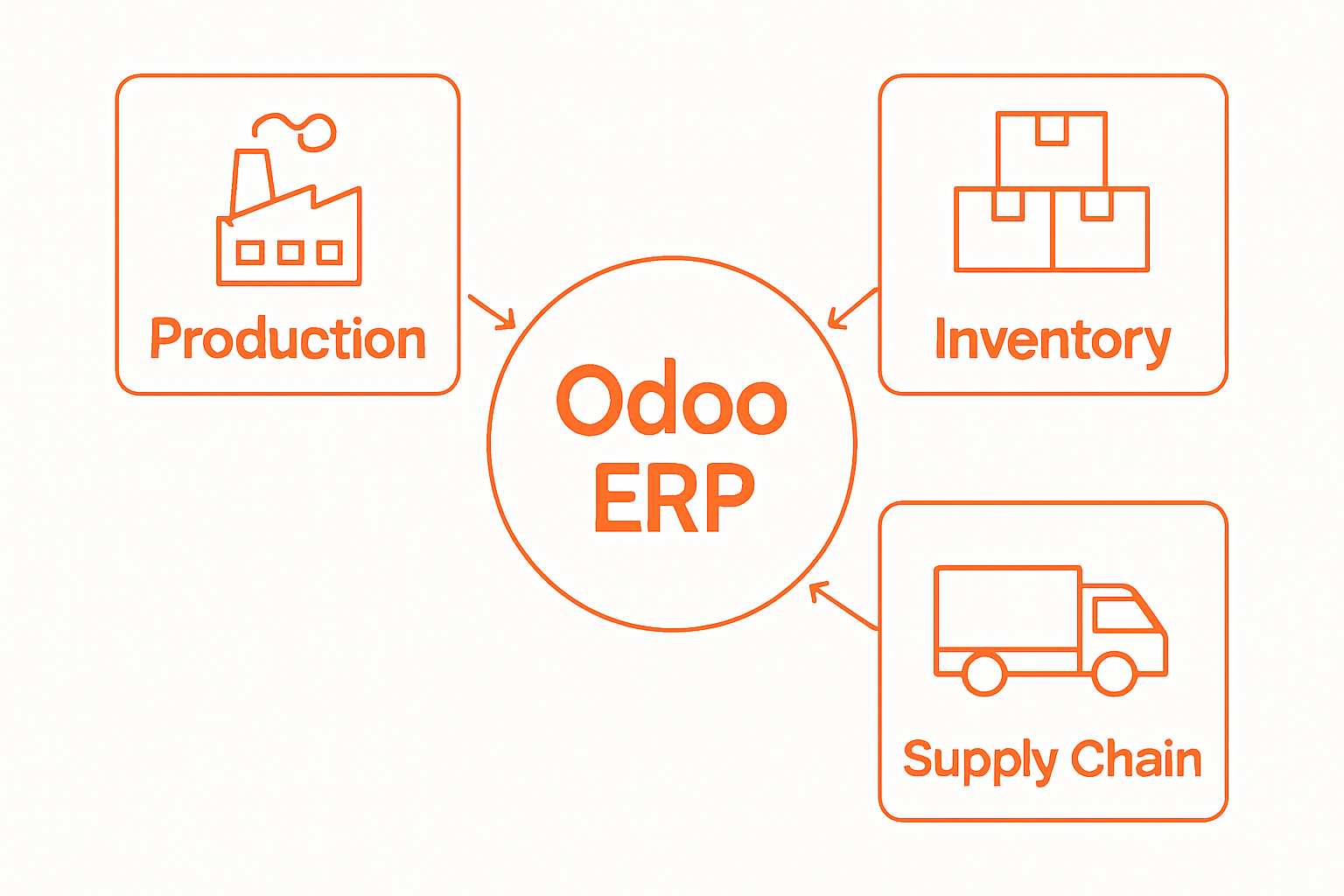
Infographic showing Odoo ERP linking Production, Inventory, and Supply Chain

Key supply chain efficiency features include:

  • Automated inventory tracking and demand forecasting
  • Seamless procurement and vendor management
  • Real-time inventory valuation and cost analysis
  • Advanced logistics and shipping coordination

Strategic Supply Chain Optimization

Beyond operational management, Odoo ERP empowers manufacturers to implement strategic supply chain improvements. The platform’s advanced analytics and reporting tools enable businesses to identify inefficiencies, predict potential bottlenecks, and make data driven decisions that reduce operational costs and enhance overall supply chain performance. Manufacturers gain the ability to transform complex supply chain challenges into strategic opportunities for growth and optimization.

uncover advanced supply chain strategies through Bista Solutions’ expert implementation methodology. Our specialized approach ensures your Odoo ERP solution is precisely configured to elevate your supply chain capabilities, delivering intelligent, scalable solutions tailored to your unique business requirements.

Key Features of Odoo ERP Tailored for Manufacturers

Odoo ERP represents a comprehensive technological solution specifically engineered to address the complex operational challenges faced by modern manufacturing businesses. By providing a robust, integrated platform, Odoo transforms traditional manufacturing processes through intelligent digital tools that enhance productivity, visibility, and strategic decision making.

Advanced Manufacturing Module Capabilities

The Odoo manufacturing module offers manufacturers a powerful suite of tools designed to streamline production workflows and optimize operational performance. These advanced features enable businesses to manage intricate manufacturing processes with unprecedented precision and efficiency. From detailed production planning to real-time resource allocation, Odoo provides manufacturers a holistic approach to managing complex operational requirements.

Key manufacturing module capabilities include:

  • Comprehensive bill of materials management
  • Detailed work order tracking and scheduling
  • Advanced manufacturing route configuration
  • Real-time production performance monitoring

Integrated Business Process Management

Beyond traditional manufacturing management, Odoo ERP delivers a fully integrated business ecosystem that connects critical operational functions. The platform enables seamless communication between production, inventory, procurement, and sales departments, eliminating information silos and creating a unified operational environment. Manufacturers gain the ability to make data-driven decisions, optimize resource utilization, and respond quickly to market dynamics.

explore comprehensive manufacturing solutions through Bista Solutions’ expert implementation approach. Our specialized team ensures your Odoo ERP solution is precisely configured to transform your manufacturing processes, delivering intelligent, scalable capabilities tailored to your unique business requirements.

Transform Manufacturing Operations with Award-Winning Odoo ERP Expertise

Many manufacturers face the real challenges of disconnected systems, manual inefficiencies, and poor visibility across operations. As highlighted in this article, optimizing production management, automating workflows, and streamlining your supply chain are crucial for staying ahead in today’s market. When you rely on traditional or outdated solutions, valuable time and resources slip away. Imagine gaining a fully integrated environment that empowers real-time decisions and creates operational clarity from production to inventory.

Contact Us


    Experience why leading manufacturers across North America trust Bista Solutions, the top Odoo Gold Partner and Odoo’s Best Partner multiple years running. Our specialists deliver tailored Odoo ERP implementations that resolve your pain points and support sustainable growth. Ready to turn your manufacturing goals into reality? Contact our expert team now and discover how Bista Solutions can help you automate, scale, and excel. Act now to secure your competitive advantage through industry-leading Odoo ERP transformation. If you want to explore more about production planning possibilities, visit our Odoo Production Planning resource for additional insights.

    Frequently Asked Questions

    What is Odoo ERP and how does it benefit manufacturing businesses?

    Odoo ERP is a comprehensive open-source software solution designed to optimize and automate manufacturing operations. It integrates critical processes such as production, inventory, and supply chain management, allowing businesses to achieve greater efficiency, reduce complexity, and make data-driven decisions.

    How does Odoo ERP enhance production management?

    Odoo ERP enhances production management by providing tools for tracking work orders, managing bills of materials, and optimizing resource allocation. It allows manufacturers to implement strategic planning and execution, resulting in improved productivity and reduced waste.

    What role does automation play in Odoo ERP for manufacturing?

    Automation within Odoo ERP transforms traditional manual processes into intelligent workflows, driving operational efficiency and reducing costs. It enables real-time monitoring, predictive maintenance, and seamless inter-departmental communication, enhancing overall manufacturing performance.

    How does Odoo ERP improve supply chain efficiency?

    Odoo ERP improves supply chain efficiency by providing a comprehensive management framework that integrates inventory tracking, procurement, and logistics. It allows manufacturers to respond quickly to market changes, optimize inventory levels, and streamline processes, resulting in a responsive and efficient supply chain.

    Understanding Odoo Accounting vs. QuickBooks – Why Upgrade?

    Odoo vs QuickBooks business meeting

    Businesses are always searching for smarter ways to handle their finances. Sure, most people think QuickBooks is the king of small business accounting, handling over 80 percent of the US market for financial software. But what if the real power move is switching to something that connects every part of your business, not just your books? Odoo does exactly that, rewriting what companies can expect from their software—and it’s changing the game for businesses ready to scale.

    Table of Contents

    Quick Summary

    Takeaway Explanation
    Odoo offers greater scalability than QuickBooks Odoo’s open-source approach allows businesses to expand functionalities as they grow without significant additional investment.
    Integrated modules enhance operational efficiency Odoo connects accounting with sales, inventory, and more, eliminating manual data transfer and improving real-time performance tracking.
    Customization is a key advantage of Odoo With its flexible architecture, Odoo can be tailored to fit unique business workflows, allowing organizations to adapt the software easily.
    Odoo provides advanced financial reporting capabilities Real-time reporting and customizable dashboards in Odoo help businesses analyze financial data across multiple departments effectively.
    Automation minimizes manual errors in financial processes Odoo streamlines workflows with features like automated invoice generation, reducing human error and improving efficiency in financial operations.

    What Are Odoo Accounting and QuickBooks?

    In the evolving landscape of business management software, two prominent solutions stand out: Odoo Accounting and QuickBooks. These platforms represent different approaches to financial management, each designed to help businesses track, manage, and optimize their financial operations.

    Understanding Odoo Accounting

    Odoo Accounting is a comprehensive business management suite that goes far beyond traditional accounting software. As an open-source platform, it offers businesses unprecedented flexibility and integration capabilities. Unlike standalone accounting tools, Odoo provides a holistic approach by seamlessly connecting accounting functions with other critical business processes like sales, inventory, human resources, and customer relationship management.

    Key characteristics of Odoo Accounting include:

    • Fully customizable and adaptable to unique business requirements
    • Cloud-based and accessible from multiple devices
    • Integrated with other business management modules
    • Supports multiple currencies and international accounting standards

    Comparing QuickBooks and Odoo

    QuickBooks, developed by Intuit, represents a more traditional accounting software approach. It primarily focuses on financial record keeping, invoicing, payroll, and tax preparation. While powerful in its domain, QuickBooks typically operates as a standalone solution with limited integration capabilities compared to Odoo’s comprehensive ecosystem.

    Businesses considering these platforms must evaluate their specific needs. Odoo offers unparalleled flexibility and scalability, making it an attractive option for growing companies that require a dynamic, integrated business management solution. Learn more about Odoo accounting advantages and how it can transform your financial management approach.

    Whether you are a small startup or a large enterprise, understanding the nuanced differences between these platforms is crucial for making an informed technology investment that aligns with your business strategy and growth objectives.

    To clarify the differences between Odoo Accounting and QuickBooks, the table below compares their core approaches, flexibility, scalability, and suitability for different business needs.

    Feature / Aspect Odoo Accounting QuickBooks
    Platform Type Open-source ERP suite Traditional standalone accounting software
    Integration Capabilities Connects accounting with sales, inventory, HR, etc. Limited, mainly focused on accounting
    Customization Highly customizable for unique workflows Limited customization
    Scalability Suitable for startups to large enterprises Primarily for small to mid-sized businesses
    Reporting & Analytics Advanced, cross-department real-time analytics Standard accounting reports
    Cost Structure Modular; cost-effective for growth Pricing grows with added features
    Accessibility Cloud-based, multi-device Cloud and desktop versions available

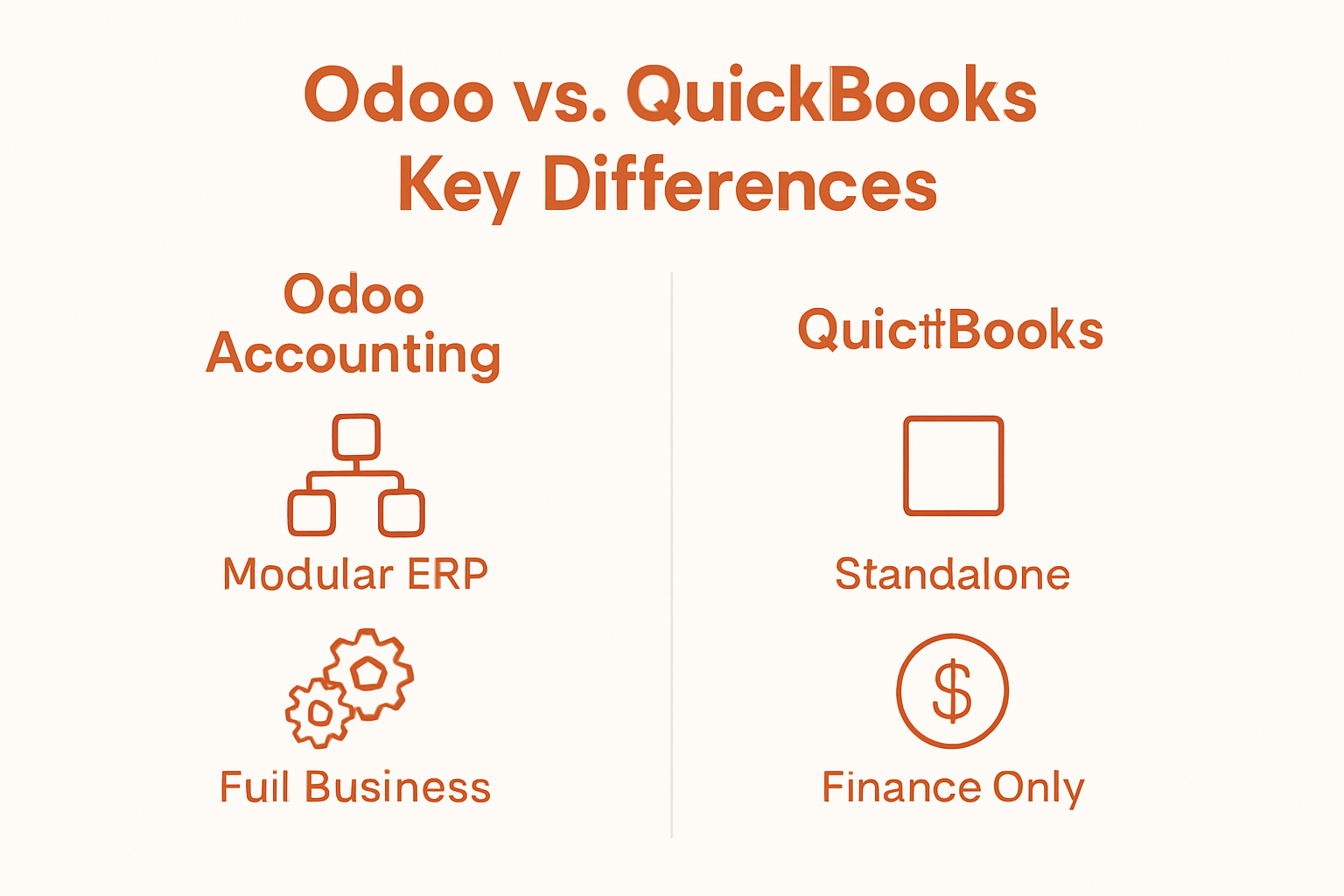
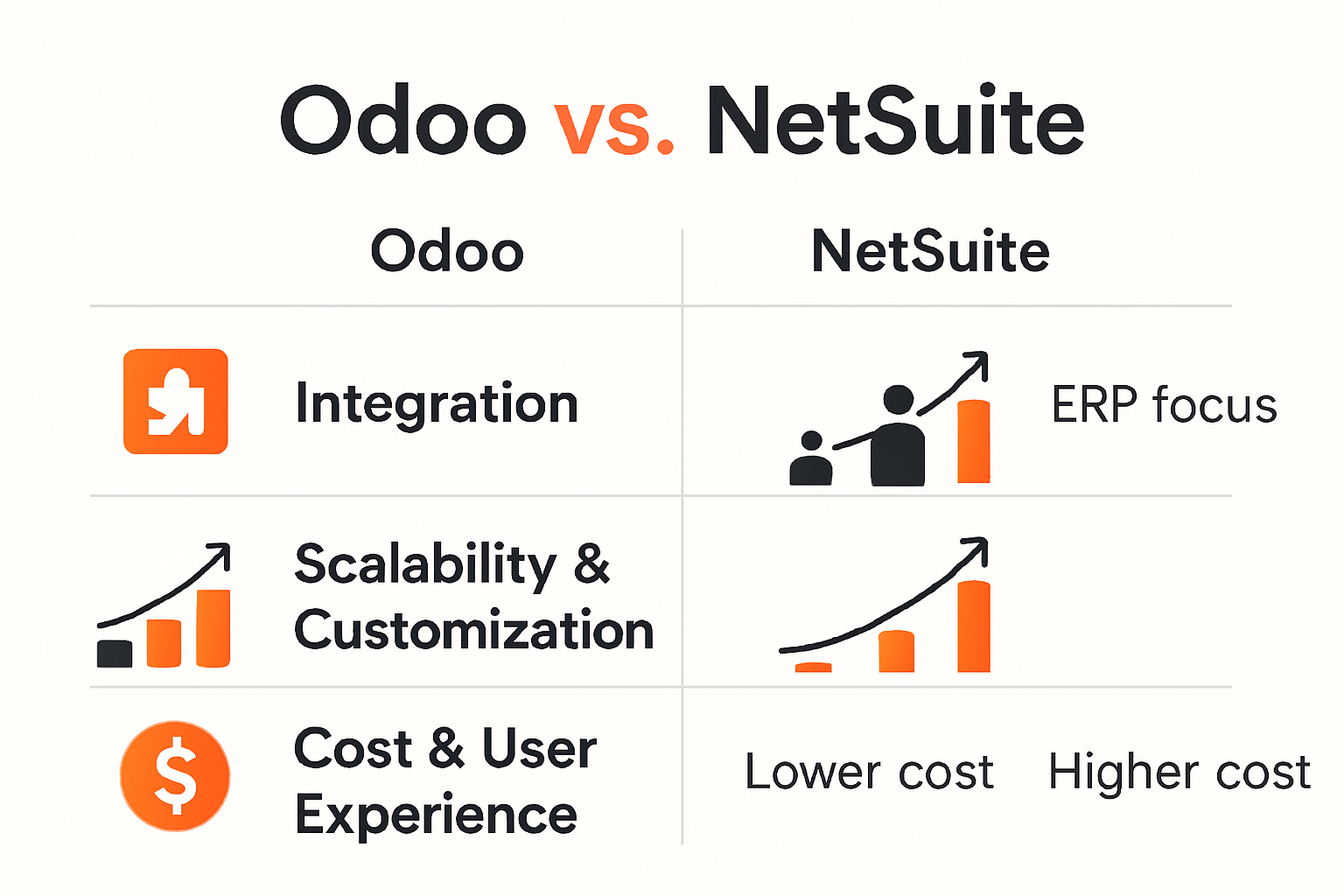
    Side-by-side visual comparison of Odoo and QuickBooks features

    Why Do Businesses Choose Odoo ERP Over QuickBooks?

    Businesses are increasingly migrating from traditional accounting software like QuickBooks to comprehensive ERP solutions like Odoo, driven by evolving technological needs and strategic growth objectives. Understanding the core motivations behind this transition reveals critical advantages that make Odoo an attractive alternative.

    Scalability and Comprehensive Integration

    One of the primary reasons businesses upgrade to Odoo is its unparalleled scalability and seamless integration capabilities. Unlike QuickBooks, which functions primarily as an accounting tool, Odoo provides a holistic business management ecosystem. This means companies can effortlessly connect accounting with sales, inventory, human resources, customer relationship management, and other critical business functions within a single platform.

    Key integration benefits include:

    • Real-time data synchronization across multiple departments
    • Elimination of manual data entry and potential errors
    • Centralized information management
    • Comprehensive reporting and analytics

    Cost-Effectiveness and Customization

    Odoo stands out as a more cost-effective solution compared to QuickBooks, especially for growing businesses. Its open-source architecture allows for extensive customization without significant additional expenses. Small and medium-sized enterprises can start with essential modules and progressively expand their system as their business requirements evolve.

    Flexibility is a hallmark of Odoo’s design, enabling businesses to adapt the software to their unique operational workflows rather than modifying their processes to fit rigid software constraints. Explore our detailed guide on Odoo accounting advantages to understand how this adaptability translates into tangible business benefits.

    Businesses seeking a robust, future-proof solution that grows alongside their organizational needs will find Odoo a compelling alternative to traditional accounting software. The platform not only addresses current financial management requirements but also provides a strategic technology foundation for long-term business success.

    How Odoo ERP Enhances Business Financial Management

    Odoo ERP transforms financial management by providing businesses with a sophisticated, integrated approach to tracking, analyzing, and optimizing financial operations. Unlike traditional accounting software, Odoo delivers a comprehensive solution that goes beyond simple bookkeeping to become a strategic business intelligence tool.

    Advanced Financial Reporting and Analytics

    Real-time financial insights are the cornerstone of effective business decision-making. Odoo ERP empowers organizations with dynamic reporting capabilities that synthesize data across multiple business functions. This holistic approach enables financial leaders to generate comprehensive reports that reveal intricate connections between financial performance and operational activities.

    Key reporting features include:

    • Customizable dashboards with interactive financial visualizations
    • Automated generation of complex financial statements
    • Multi-currency and multi-company reporting capabilities
    • Detailed drill-down analysis for granular financial examination

    Streamlined Financial Processes

    Odoo eliminates traditional inefficiencies by automating critical financial workflows. The platform reduces manual data entry, minimizes human error, and accelerates financial close processes. Intelligent automation means finance teams can shift from repetitive administrative tasks to strategic financial planning and analysis.

    Businesses gain unprecedented operational efficiency through features like automatic invoice generation, seamless bank reconciliation, and integrated payment processing. Discover our comprehensive guide to Odoo accounting features to understand how these technologies can revolutionize your financial management approach.

    By providing a unified platform that connects accounting with sales, inventory, procurement, and other critical business functions, Odoo ERP ensures that financial data remains consistently accurate and immediately accessible.

    The table below highlights key integration and automation features that distinguish Odoo ERP from traditional accounting software, enabling businesses to achieve greater efficiency and strategic insight.

    Key Feature Odoo ERP Benefit Impact on Business Operations
    Module Integration Connects accounting, sales, inventory, HR, and CRM Eliminates manual data transfer
    Real-Time Data Synchronization Updates are shared across departments instantly Enables accurate and timely decisions
    Automated Workflows Automates invoicing, reconciliation, and reporting Reduces manual work and errors
    Customizable Dashboards Visualizes financial and operational data in real time Supports strategic planning
    Multi-Currency/Company Support Handles global financial needs Expands operations without technical barriers
    Scalability Adds new modules as business grows Future-proof technology investments

    Key Features of Odoo That Stand Out Against QuickBooks

    Odoo ERP represents a quantum leap in business management technology, offering capabilities that far surpass traditional accounting software like QuickBooks. By providing a comprehensive, integrated platform, Odoo delivers features that transform how businesses manage their financial and operational ecosystems.

    Comprehensive Business Module Integration

    Seamless cross-functional integration is Odoo’s most distinctive advantage. Unlike QuickBooks, which remains primarily an accounting tool, Odoo offers a unified platform where accounting dynamically connects with sales, inventory, human resources, customer relationship management, and other critical business functions.

    Key integrated module advantages include:

    • Automatic synchronization of financial data across departments
    • Real-time performance tracking and reporting
    • Elimination of manual data transfer between systems
    • Holistic business intelligence and decision-making support

    Customization and Scalability

    Odoo’s open-source architecture provides unprecedented flexibility that QuickBooks cannot match. Businesses can customize the platform to precisely match their unique operational workflows, adding or modifying modules as their organizational needs evolve. Scalability becomes a strategic advantage, allowing companies to start with essential functionalities and progressively expand their system without significant additional investment.

    Explore our comprehensive guide to Odoo’s modular capabilities to understand how this adaptability translates into tangible business growth opportunities.

    From small startups to large enterprises, Odoo offers a powerful, adaptable solution that grows alongside your business. By transcending the limitations of traditional accounting software, Odoo empowers organizations to transform financial management from a routine administrative task into a strategic competitive advantage.

    Real-World Success Stories of Businesses Upgrading to Odoo

    Businesses across various industries have discovered transformative potential by migrating from traditional accounting software to Odoo ERP. These success stories illustrate how a comprehensive, integrated platform can revolutionize operational efficiency and strategic decision making.

    Manufacturing Sector Transformation

    Operational complexity demands sophisticated solutions, and one mid-sized manufacturing company demonstrated this perfectly. By implementing Odoo, they integrated production planning, inventory management, and financial tracking into a single, cohesive system. The result was a 40% reduction in administrative overhead and real-time visibility into production costs and profitability.

    manufacturing team reviewing financial data

    Key operational improvements included:

    • Automated inventory tracking across multiple warehouses
    • Seamless integration between production scheduling and financial reporting
    • Reduced manual data entry and associated errors
    • Enhanced forecasting capabilities

    Retail and E-Commerce Evolution

    A growing e-commerce retailer faced significant challenges with disconnected systems that made tracking sales, inventory, and financial performance challenging. Odoo’s modular approach provided a game-changing solution, enabling them to connect their online sales platforms, physical store operations, and accounting functions into one unified ecosystem.

    Discover how businesses are revolutionizing their operations with Odoo and learn from real-world implementation strategies that drive tangible business growth.

    These success stories underscore a critical insight: upgrading to Odoo is not just about changing software, but fundamentally transforming how businesses operate. By providing a flexible, integrated platform that adapts to unique organizational needs, Odoo empowers companies to move beyond traditional limitations and unlock unprecedented operational potential.

    Ready to Experience a True Upgrade Beyond Basic Accounting?

    Are you tired of software that limits your potential? This article highlights how moving from isolated tools like QuickBooks to integrated solutions like Odoo can transform financial management, streamline processes, and fuel real business growth. Many businesses reach a critical point where manual work, disconnected data, and a lack of real-time insight hold them back. If you recognize these challenges, it is time to consider a smarter, more adaptable platform.


      Bista Solutions is the trusted partner behind more than 350 successful Odoo ERP implementations. As the largest Odoo Gold Partner in North America and a multi-year winner of the Odoo Best Partner award, we know what it takes to create a seamless and scalable ERP transition. Take the first step toward a fully integrated business future by connecting with our expert team today. Discover your custom roadmap and see how modern ERP, tailored for your needs, can make a measurable difference. Contact us now through our main website and start your journey to smarter business management.

      Frequently Asked Questions

      What is the main difference between Odoo Accounting and QuickBooks?

      Odoo Accounting is a comprehensive business management suite that integrates accounting with other business functions like sales and inventory, whereas QuickBooks primarily focuses on standalone accounting tasks like invoicing and payroll.

      Why should businesses consider upgrading from QuickBooks to Odoo?

      Businesses may upgrade to Odoo for its scalability, comprehensive integration capabilities, cost-effectiveness, and customization options that adapt to unique operational needs, providing a more holistic management solution.

      How does Odoo ERP improve financial reporting compared to QuickBooks?

      Odoo ERP offers advanced reporting features, including customizable dashboards, real-time financial insights, and multi-currency reporting, allowing businesses to analyze financial data within the context of their broader operations.

      Can Odoo Accounting be customized to fit my unique business needs?

      Yes, Odoo Accounting is highly customizable thanks to its open-source architecture, enabling businesses to adapt the software with specific modules and functionalities that match their operational workflows.

      Understanding Why Businesses are Choosing Odoo ERP Over Legacy Systems

      Odoo ERP legacy systems office

      Odoo ERP is shaking up how companies run their business tech. Nearly 90 percent of companies using modern ERP systems report faster decision-making and better collaboration. It sounds like legacy systems should have kept up, right? Actually, most old-school setups slow organizations down and pile up hidden costs, while flexible platforms like Odoo are breaking all the old rules. The biggest surprise is how these new tools are changing not just technology, but entire business strategies.

      Table of Contents

      Quick Summary

      Takeaway Explanation
      Odoo ERP enables modular customization Businesses can select specific modules matching their operational needs, enhancing flexibility and scaling capabilities.
      Modern ERP improves interdepartmental collaboration Odoo ERP breaks down silos, ensuring seamless communication and data sharing between different business functions.
      Real-time analytics enhances decision-making Odoo provides instant insights to leadership, facilitating data-driven decisions across multiple dimensions of the business.
      Transitioning from legacy systems reduces costs Migrating to Odoo ERP minimizes maintenance costs and inefficiencies often associated with outdated legacy systems.
      AI integration fosters proactive business strategies Odoo ERP includes tools for predictive analytics and AI, helping organizations anticipate needs and optimize operations.

      Defining Odoo ERP and Legacy Systems

      Business technology is rapidly transforming, and understanding the differences between modern Enterprise Resource Planning (ERP) systems like Odoo and traditional legacy systems is crucial for organizational success. Odoo ERP represents a comprehensive, flexible software solution designed to integrate and streamline core business processes across departments, while legacy systems represent older, often rigid technological infrastructures that struggle to adapt to modern business requirements.

      What is Odoo ERP?

      Odoo ERP is an open-source enterprise management software that provides businesses with a unified platform to manage various operational functions. Unlike traditional systems, Odoo offers modular architecture that allows companies to customize and scale their technology infrastructure learn more about Odoo’s flexible solutions. The platform encompasses multiple business applications including:

      • Accounting and financial management
      • Customer Relationship Management (CRM)
      • Human Resources
      • Inventory and supply chain tracking
      • Manufacturing and production planning
      • Sales and marketing automation

      Understanding Legacy Systems

      Legacy systems are outdated computing software and hardware that continue to be used by organizations despite being technologically obsolete. These systems typically share common characteristics that make them increasingly ineffective in the modern business landscape:

      • Limited integration capabilities
      • High maintenance and operational costs
      • Inflexible architectural design
      • Minimal scalability options
      • Restricted data accessibility

      By contrast, Odoo ERP delivers a modern, integrated approach that addresses these fundamental limitations. Bista Solutions, as a premier Odoo implementation partner, helps businesses transition seamlessly from legacy infrastructure to a dynamic, responsive technological ecosystem that supports growth and innovation.

      The Importance of Modern ERP Solutions for Businesses

      In today’s rapidly changing business environment, modern Enterprise Resource Planning (ERP) solutions have become essential for organizations seeking competitive advantage and operational excellence. Digital transformation demands sophisticated technological infrastructure that can adapt, integrate, and optimize business processes across multiple departments.

      Strategic Business Integration

      Modern ERP solutions like Odoo provide businesses with a comprehensive platform that breaks down traditional departmental silos. These systems enable seamless communication and data sharing between finance, human resources, sales, inventory management, and customer relationship teams. discover intelligent business automation strategies that transform organizational efficiency.

      Businesses implementing advanced ERP systems can expect significant improvements in:

      • Operational transparency
      • Real-time performance tracking
      • Enhanced decision-making capabilities

      ERP business integration teamwork

      • Reduced operational costs
      • Improved interdepartmental collaboration

      Technological Adaptability and Scalability

      Unlike traditional legacy systems, modern ERP solutions offer unprecedented flexibility and scalability. Organizations can customize modules, add new functionalities, and integrate emerging technologies without complete system overhauls. Odoo ERP, for instance, provides modular architecture that allows businesses to start small and expand their technological ecosystem as they grow.

      The ability to quickly adapt technological infrastructure to changing market demands represents a critical competitive advantage. Modern ERP systems enable businesses to:

      • Rapidly deploy new business applications
      • Integrate artificial intelligence and machine learning capabilities
      • Support remote and distributed workforce models
      • Implement advanced data analytics
      • Ensure robust cybersecurity protocols

      Bista Solutions understands that selecting the right ERP solution is more than a technological decision—it is a strategic investment in an organization’s future. By providing comprehensive implementation and ongoing support, we help businesses transform their operational capabilities and unlock unprecedented growth potential.

      Key Differences Between Odoo ERP and Traditional Systems

      The landscape of enterprise technology is dramatically shifting, with modern solutions like Odoo ERP challenging the fundamental limitations of traditional enterprise systems. Understanding these key differences is crucial for businesses seeking technological solutions that drive growth and innovation explore comprehensive ERP comparatives.

      Architectural Flexibility

      Traditional enterprise systems were designed with rigid, monolithic architectures that required extensive custom coding and expensive modifications. In contrast, Odoo ERP represents a paradigm shift toward modular, adaptable technological infrastructure. Businesses can now select specific modules that match their exact operational requirements, allowing for:

      • Granular customization
      • Reduced implementation complexity
      • Faster deployment timelines
      • Minimal disruption to existing workflows
      • Cost-effective scaling options

      Performance and Integration Capabilities

      Where legacy systems often struggled with data silos and limited cross-departmental communication, Odoo ERP delivers seamless, real-time integration. The platform’s open-source architecture enables unprecedented connectivity between different business functions. Traditional systems typically required complex middleware or expensive third-party solutions to achieve similar levels of interoperability.

      Key performance differences include:

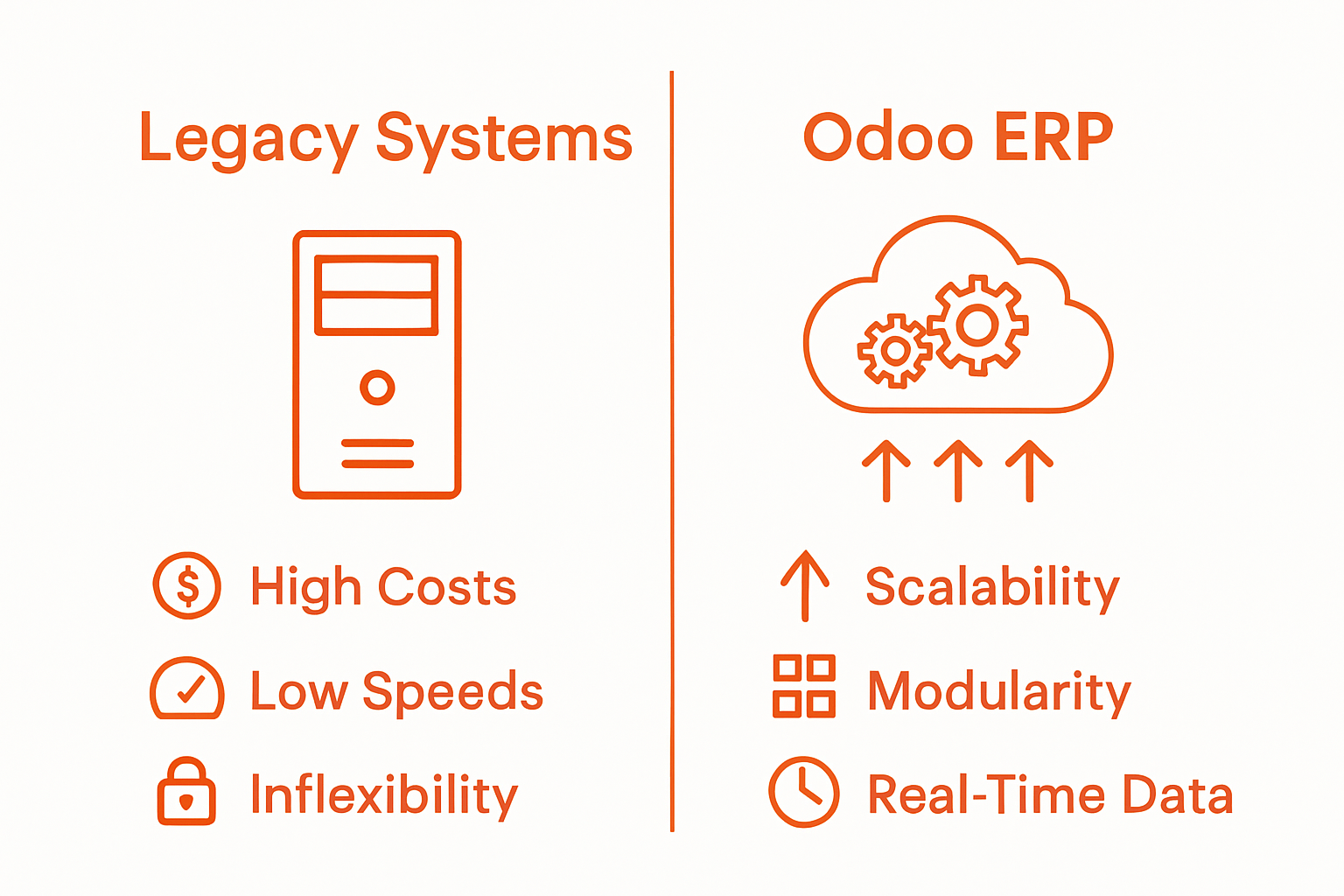
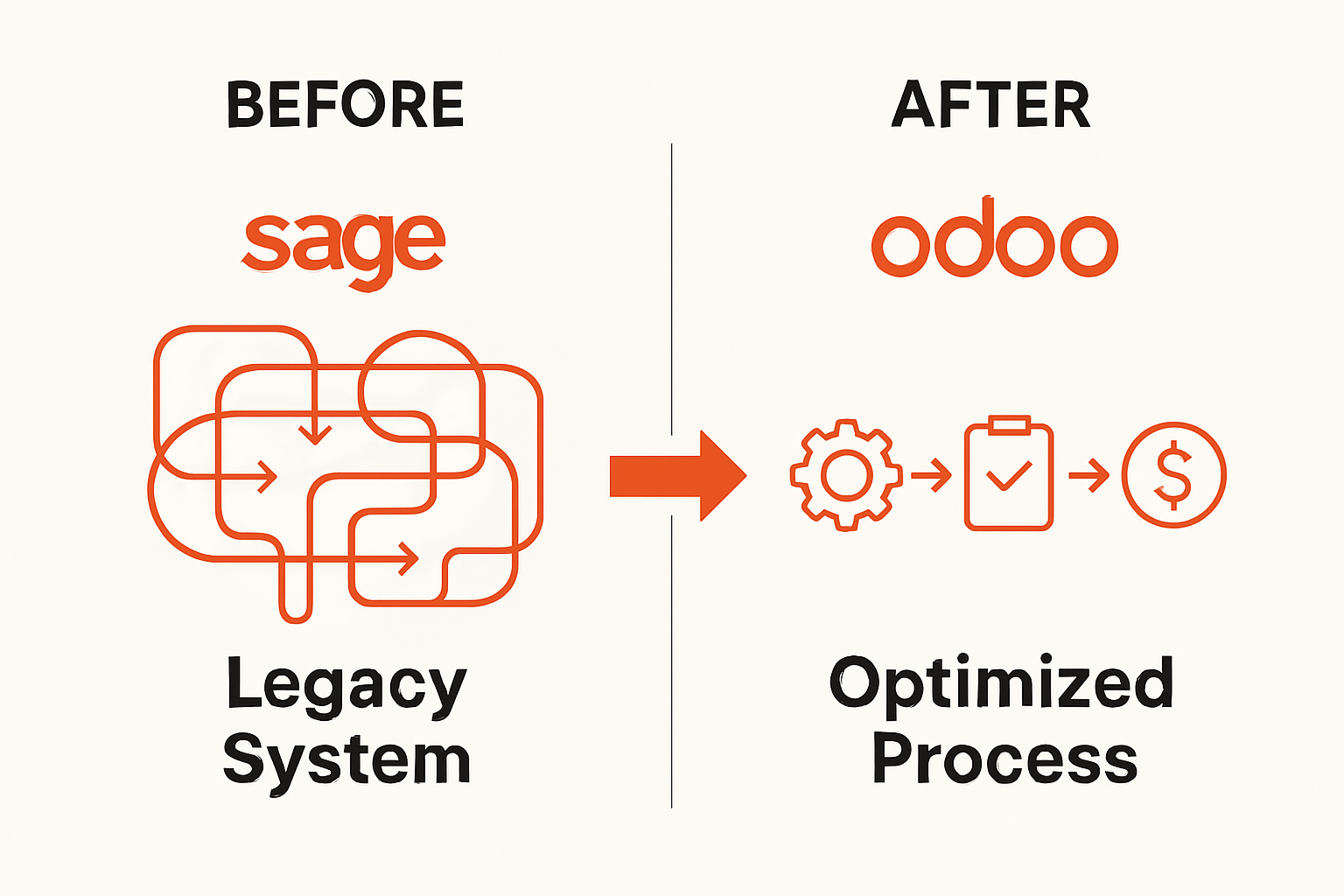
      Side-by-side infographic comparing legacy systems and Odoo ERP key features

      • Instant data synchronization across departments
      • Native support for multiple languages and currencies
      • Comprehensive reporting and analytics tools
      • Cloud and on-premises deployment flexibility
      • Advanced security protocols

      By prioritizing user experience and technological adaptability, Odoo ERP transcends the limitations of traditional enterprise systems.

      To clarify the key distinctions between Odoo ERP and traditional legacy systems, the following table compares their main features and characteristics.

      Aspect Odoo ERP Legacy Systems
      Architecture Modular, flexible Monolithic, rigid
      Customization Granular, easy to scale Difficult, requires extensive coding
      Integration Capabilities Seamless, real-time, open-source Limited, often requires middleware
      Implementation Speed Faster deployment Slower, more complex
      Maintenance Costs Lower, streamlined Higher, often hidden
      Data Accessibility Real-time, unified Restricted, siloed
      Scalability Easily expandable Minimal options

      Real-World Benefits of Choosing Odoo ERP

      Businesses across diverse industries are discovering transformative advantages by implementing Odoo ERP, moving beyond traditional technological constraints. Strategic technological investment represents more than software implementation—it is a comprehensive approach to organizational performance and growth explore advanced accounting solutions.

      Operational Efficiency and Cost Reduction

      Odoo ERP provides businesses with unprecedented capabilities to streamline complex operational processes. By consolidating multiple business functions into a single, integrated platform, organizations can dramatically reduce administrative overhead and operational complexity. This approach enables businesses to:

      • Automate repetitive manual tasks
      • Eliminate redundant data entry processes
      • Minimize human error
      • Accelerate decision-making cycles
      • Reduce overall technology infrastructure costs

      Strategic Business Intelligence

      Real-time data analytics stand as a cornerstone of Odoo ERP’s transformative potential. Traditional systems often required extensive manual reporting and complex data extraction processes. In contrast, Odoo delivers immediate insights across multiple business dimensions, empowering leadership with comprehensive, actionable intelligence.

      Key intelligence capabilities include:

      • Customizable dashboards and reporting
      • Predictive performance modeling
      • Cross-departmental data visualization
      • Advanced forecasting tools
      • Comprehensive performance tracking

      By selecting Odoo ERP, businesses gain more than a technological solution—they acquire a strategic partner capable of adapting to complex, dynamic market environments. Bista Solutions understands that successful digital transformation requires more than implementing software; it demands a holistic approach to technological integration that aligns directly with unique organizational objectives.

      The technological landscape is rapidly transforming, and Odoo ERP stands at the forefront of this digital revolution. Businesses are no longer merely adopting software but strategically integrating intelligent, adaptive technological ecosystems explore advanced migration strategies.

      Artificial Intelligence and Predictive Analytics

      Odoo ERP is pioneering the integration of artificial intelligence and machine learning capabilities directly within enterprise management platforms. This technological convergence enables businesses to move beyond traditional reactive approaches, creating proactive, intelligent systems that anticipate organizational needs. AI integration allows companies to:

      • Generate predictive financial forecasts
      • Automate complex decision-making processes
      • Identify potential operational inefficiencies
      • Personalize customer interaction strategies
      • Optimize resource allocation

      Cloud-Native and Distributed Architecture

      Modern enterprise solutions demand unprecedented flexibility, and Odoo ERP is responding with cloud-native architectures that transcend traditional technological boundaries. The platform’s distributed design enables seamless scalability, enhanced security, and global accessibility. Emerging architectural trends demonstrate that businesses require technological infrastructure that can:

      • Support remote and hybrid workforce models
      • Integrate multiple geographical operations
      • Provide real-time global collaboration tools
      • Ensure robust cybersecurity protocols
      • Maintain continuous operational continuity

      By continuously innovating and adapting to emerging technological paradigms, Odoo ERP represents more than a software solution—it is a strategic partner in digital transformation. Bista Solutions remains committed to helping businesses navigate these complex technological landscapes, ensuring they remain agile, competitive, and prepared for future challenges.

      Ready to Leave Legacy Limitations Behind? Discover a Smarter Way Forward

      Are you struggling with outdated legacy systems that slow down your business, restrict your team, and block your growth? Legacy platforms can create data silos, limit flexibility, and push operational costs higher than they should be. This article showed how Odoo ERP offers a smarter, scalable solution that brings real-time integration and efficiency to your fingertips. Imagine what your company could achieve with a system built for adaptability and future success. See how your business can benefit from Odoo’s flexible solutions and take your first step toward digital transformation.


        Start your upgrade journey now and unlock opportunities that legacy systems cannot deliver. Bista Solutions is the #1 Odoo ERP implementer in North America, with a proven track record and a dedicated team supporting your ERP transition every step of the way. Do not let outdated technology limit your potential. Contact our experts today for a free consultation, or explore our tailored Odoo ERP implementation solutions. Act now and let us help you build the foundation for long-term growth.

        Frequently Asked Questions

        What are the main advantages of Odoo ERP over legacy systems?

        Odoo ERP offers modern, modular architecture, allowing for flexibility, scalability, and comprehensive integration across various business functions, unlike legacy systems that are often rigid and costly to maintain.

        How does Odoo ERP improve operational efficiency for businesses?

        By consolidating multiple business functions into one platform, Odoo ERP automates repetitive tasks, minimizes manual errors, and accelerates decision-making processes, significantly improving overall operational efficiency.

        Can Odoo ERP integrate with existing business tools?

        Yes, Odoo ERP features an open-source architecture that supports a high level of integration with existing business tools, enabling seamless data sharing and communication across departments.

        What future technologies are being integrated into Odoo ERP?

        Odoo ERP is incorporating artificial intelligence and predictive analytics capabilities, enabling businesses to leverage data for proactive decision-making and operational optimization.

        How Odoo Copilot, Generative AI of Bista Solutions Enhances ERP Workflows

        Odoo Copilat ERP team
        • by Uzlifat Mir
        • Sep 08, 2025
        • 0
        • Category:

        Odoo Copilot AI is shaking up the way businesses run their everyday operations. Everyone talks about artificial intelligence making things smarter, but Odoo Copilot AI slashes manual processing time and eliminates repetitive tasks like never before. Instead of acting as just another tool, this tech actually adapts and becomes a digital co-worker that learns and evolves with your business.

        Table of Contents

        Quick Summary

        Takeaway Explanation
        Odoo Copilot AI enhances ERP workflows. It automates and optimizes business processes, improving operational efficiency through intelligent data processing.
        Generative AI enables predictive analytics. This technology forecasts business trends, allowing firms to proactively respond to market changes rather than reactively.
        Intelligent automation reduces manual tasks. Automating routine tasks not only saves time but also minimizes errors, heightening productivity.
        Comprehensive financial insights are provided. The system generates financial reports and forecasts, aiding businesses in making informed fiscal decisions.
        Contextual understanding improves decision-making. By analyzing complex data patterns, Odoo Copilot AI offers tailored strategic recommendations for organizations.

        Understanding Odoo Copilot AI: What It Is

        Odoo Copilot AI represents a groundbreaking generative artificial intelligence solution specifically designed to enhance enterprise resource planning (ERP) workflows through intelligent automation and advanced data processing capabilities. This innovative technology transforms traditional ERP systems by integrating sophisticated machine learning algorithms that can understand, predict, and optimize complex business processes.

        The Core Mechanism of Odoo Copilot AI

        At its fundamental level, Odoo Copilot AI operates as an intelligent layer within the Odoo ERP ecosystem, leveraging large language models and neural network architectures to provide seamless, context-aware automation. The system goes beyond traditional rule-based automation by understanding nuanced business contexts, learning from historical data patterns, and generating predictive insights that help organizations make more informed decisions.

        Key features of Odoo Copilot AI include:

        • Advanced natural language processing capabilities that can interpret and generate human-like text
        • Predictive analytics engines that forecast business trends and potential operational challenges
        • Automated workflow optimization mechanisms that reduce manual intervention

        Practical Applications in Business Environments

        Businesses can harness Odoo Copilot AI across multiple operational domains. In financial management, the system can automatically categorize expenses, generate financial reports, and provide real-time cash flow predictions. Within inventory management, it can predict stock requirements, recommend optimal purchasing strategies, and minimize potential supply chain disruptions.

        The technology stands out by offering intelligent contextual understanding that traditional software cannot achieve. By analyzing massive datasets and recognizing intricate patterns, Odoo Copilot AI transforms raw information into actionable strategic insights. Learn more about AI-powered ERP solutions that can revolutionize your business operations.

        Businesses adopting Odoo Copilot AI can expect significant improvements in operational efficiency, decision-making accuracy, and overall organizational productivity. The technology represents a quantum leap in enterprise software, moving beyond static computational models to create dynamic, adaptive business intelligence platforms.

        The Importance of Generative AI in ERP Systems

        Generative AI represents a transformative technology that is fundamentally reshaping enterprise resource planning systems by introducing unprecedented levels of intelligence, adaptability, and predictive capabilities. Unlike traditional software approaches, generative AI enables ERP systems to move beyond static data processing into dynamic, context-aware problem-solving environments that can anticipate business challenges and proactively generate strategic solutions.

        Revolutionizing Business Intelligence

        The integration of generative AI into ERP systems fundamentally transforms how organizations approach data analysis and decision-making. By leveraging advanced machine learning algorithms, these intelligent systems can process massive volumes of complex data exponentially faster than human analysts, identifying intricate patterns and generating nuanced insights that were previously impossible to detect.

        Key advantages of generative AI in ERP systems include:

        • Predictive analytics that forecast complex business trends with remarkable accuracy
        • Automated scenario planning and strategic recommendation generation
        • Real-time adaptive learning that continuously improves system performance

        Strategic Operational Optimization

        Businesses implementing generative AI within their ERP infrastructure gain substantial competitive advantages. Intelligent automation enables companies to streamline complex workflows, reduce operational redundancies, and make data-driven decisions with unprecedented speed and precision. Discover how AI can transform your business operations through cutting-edge technological integration.

        The technology’s ability to understand contextual nuances allows for more sophisticated risk management, resource allocation, and strategic planning. By converting raw data into actionable intelligence, generative AI empowers organizations to anticipate market shifts, optimize supply chains, and develop more responsive business strategies. This represents a fundamental shift from reactive to proactive enterprise management, where artificial intelligence becomes a strategic partner in organizational growth and innovation.

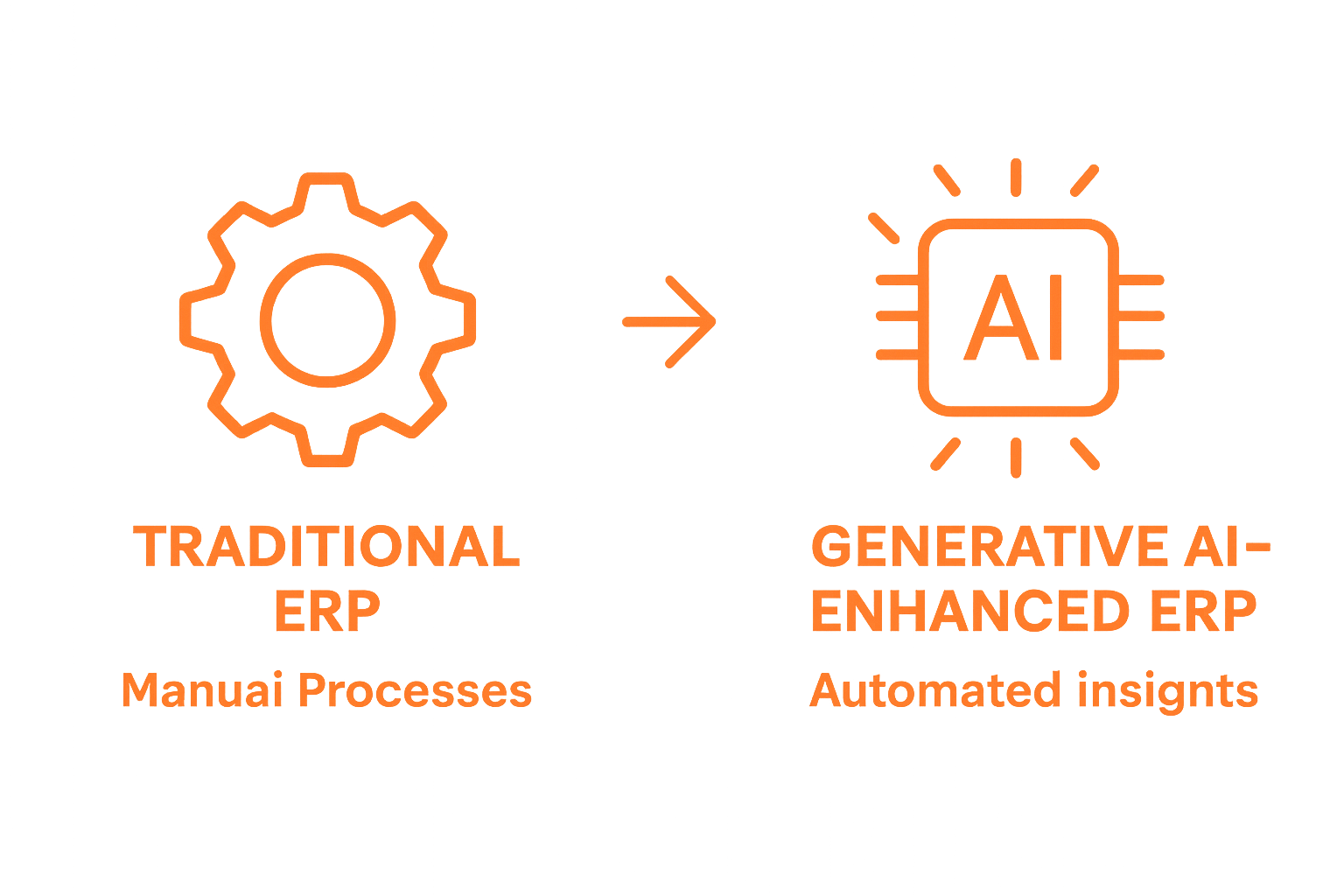
        Infographic comparing traditional ERP vs AI-enhanced ERP

        How Odoo Copilot AI Transforms Workflow Efficiency

        Odoo Copilot AI revolutionizes enterprise workflow efficiency by introducing an intelligent layer of automation that dramatically reduces manual processing time and eliminates repetitive administrative tasks. This advanced generative AI technology serves as a sophisticated digital assistant capable of understanding complex business processes and autonomously executing tasks with unprecedented precision and speed.

        Intelligent Task Automation

        At its core, Odoo Copilot AI transforms workflow efficiency through advanced algorithmic capabilities that go beyond traditional automation. The system analyzes existing workflows, identifies bottlenecks, and generates optimized process recommendations in real-time. By learning from historical data and organizational patterns, it can predict potential inefficiencies and proactively suggest streamlined approaches to task management.

        Key workflow transformation capabilities include:

        • Automatic document processing and categorization
        • Intelligent routing of tasks based on contextual understanding
        • Predictive resource allocation and workload balancing

        Precision and Speed in Operational Execution

        Intelligent automation enables organizations to achieve remarkable gains in operational productivity. The AI-driven system can complete complex multistep processes in a fraction of the time required by human workers, with significantly reduced error rates. Learn more about enhancing business operations with AI solutions that can transform your organizational efficiency.

        Beyond speed, Odoo Copilot AI introduces a new paradigm of adaptive workflow management. By continuously learning and refining its understanding of organizational processes, the system becomes increasingly sophisticated in handling complex tasks. This creates a dynamic operational environment where technology acts not just as a tool, but as an intelligent collaborator that evolves alongside the organization’s changing needs and challenges.

        ERP workflow automation team

        Key Features of Bista Solutions’ Odoo Copilot AI

        Bista Solutions’ Odoo Copilot AI represents a sophisticated technological ecosystem designed to deliver comprehensive, intelligent enterprise resource planning capabilities. By integrating cutting-edge generative AI technologies with a deep understanding of business process optimization, the platform offers unparalleled solutions for modern organizations seeking transformative digital strategies.

        Advanced Intelligent Processing Capabilities

        The core strength of Bista Solutions’ Odoo Copilot AI lies in its advanced processing capabilities that transcend traditional automation frameworks. The system employs complex machine learning algorithms capable of understanding contextual nuances, learning from historical data patterns, and generating predictive insights with remarkable accuracy. This enables businesses to move beyond reactive management into proactive strategic planning.

        Key intelligent processing features include:

        • Contextual data interpretation across multiple business domains
        • Autonomous pattern recognition and anomaly detection
        • Real-time adaptive learning mechanisms

        Comprehensive Business Integration

        Seamless technological integration is a hallmark of Bista Solutions’ approach. The Odoo Copilot AI platform is engineered to work harmoniously across diverse organizational systems, ensuring smooth data flow and comprehensive insights. Explore how machine learning can automate your business processes and unlock unprecedented operational efficiency.

        Beyond technical capabilities, the platform distinguishes itself through its ability to provide nuanced, actionable intelligence. By analyzing complex datasets from multiple sources, Odoo Copilot AI transforms raw information into strategic recommendations, effectively serving as an intelligent digital advisor that understands the intricate dynamics of organizational performance. This approach represents a paradigm shift from traditional software solutions to adaptive, cognitive business management systems.

        Below is a table detailing the key features of Bista Solutions’ Odoo Copilot AI and the value each brings to enterprise resource planning.

        Feature Description
        Advanced Natural Language Processing Interprets and generates human-like text for smoother user interactions
        Predictive Analytics Forecasts business trends and operational challenges to improve planning
        Automated Workflow Optimization Reduces manual intervention by generating intelligent recommendations and streamlining processes
        Contextual Data Interpretation Understands intricate business environments to provide tailored insights
        Real-time Adaptive Learning Continuously evolves by learning from historical and incoming data patterns
        Comprehensive Business Integration Connects seamlessly with various systems to maintain unified operations across departments
        Autonomous Pattern Recognition Detects complex data patterns, anomalies, and business risks with minimal human input

        Real-World Applications of Odoo Copilot AI in Business

        Odoo Copilot AI demonstrates remarkable versatility across diverse business domains, transforming traditional operational approaches through intelligent automation and advanced predictive capabilities. By integrating sophisticated artificial intelligence technologies, the platform enables organizations to reimagine their workflow strategies and achieve unprecedented levels of operational efficiency.

        Financial Management and Strategic Planning

        In financial ecosystems, Odoo Copilot AI revolutionizes complex processes by providing intelligent financial forecasting, automated expense categorization, and real-time strategic insights. The system can analyze historical financial data, identify potential risk factors, and generate comprehensive predictive models that enable businesses to make data-driven financial decisions with remarkable precision.

        Key financial management applications include:

        • Automated cash flow prediction and risk assessment
        • Intelligent budget allocation recommendations
        • Fraud detection and anomaly identification in financial transactions

        Cross-Functional Operational Optimization

        Intelligent process automation enables organizations to streamline operations across multiple departments simultaneously. The Odoo Copilot AI platform acts as a comprehensive intelligence layer that connects disparate business functions, ensuring seamless communication and data synchronization. Explore how AI solutions can boost operational efficiency and transform your organizational performance.

        Beyond traditional departmental boundaries, Odoo Copilot AI introduces a holistic approach to business management. By continuously learning from organizational data patterns, the system develops an increasingly sophisticated understanding of complex business dynamics, effectively serving as an adaptive digital intelligence platform that evolves alongside the organization’s strategic objectives.

        Experience Unmatched ERP Efficiency with Odoo Copilot AI from Bista Solutions

        Are you tired of slow manual processes and missed opportunities for operational growth? This article highlights how Odoo Copilot AI removes business bottlenecks by introducing intelligent automation and advanced predictive analytics, bringing your ERP workflows into the future. Bista Solutions not only implements this generative AI technology but also customizes it to streamline your financial management, inventory forecasting, and cross-functional operations. As the largest Odoo ERP implementer in North America and a multiple-time Odoo Best Partner, we have the experience to transform your workflows for real impact. When you need round-the-clock support and solutions that fit your business, Bista Solutions is the trusted partner you deserve.


          Ready to stop guessing and start gaining transparency across your entire business? Contact our expert team today to discover how intelligent ERP solutions can revolutionize your operations. Take action now and unlock the power of Odoo Copilot AI for your company’s efficiency and growth. Your path to seamless automation and real business results begins at Bista Solutions.

          Frequently Asked Questions

          What is Odoo Copilot AI, and how does it enhance ERP workflows?

          Odoo Copilot AI is a generative AI solution designed to improve enterprise resource planning (ERP) workflows through intelligent automation and advanced data processing. It incorporates machine learning algorithms to predict and optimize business processes, providing a smarter way to manage operations.

          How does Odoo Copilot AI utilize machine learning in ERP systems?

          Odoo Copilot AI utilizes machine learning by analyzing historical data patterns, understanding contextual nuances, and generating predictive insights. This allows organizations to make informed decisions and improve overall operational efficiency.

          What are the key features of Odoo Copilot AI?

          Key features of Odoo Copilot AI include advanced natural language processing, predictive analytics for forecasting business trends, and automated workflow optimization mechanisms that minimize manual intervention in business processes.

          In which business areas can Odoo Copilot AI be applied?

          Odoo Copilot AI can be applied in various areas, including financial management for expense categorization and cash flow predictions, inventory management for stock prediction, and cross-functional operational optimization to connect different business functions seamlessly.

          The Top 10 Signs You’ve Outgrown Your Current Systems (QuickBooks, Spreadsheets, etc.)

          business upgrade, outdated systems, team frustration
          • by Uzlifat Mir
          • Sep 08, 2025
          • 0
          • Category:

          Growing companies often rely on QuickBooks or simple spreadsheets to keep things running. But over time, these familiar tools start showing cracks in ways most business owners never expect. A single mistake in a messy spreadsheet can cost thousands of dollars or even trigger critical compliance failures. Surprising as it sounds, the systems built to help you stay organized could be holding you back—sometimes with hidden costs that only get worse as your team grows.

          Table of Contents

          Quick Summary

          Takeaway Explanation
          Data Accuracy is Crucial Inaccurate data from systems leads to operational problems, risking significant financial losses and flawed decision-making.
          Automate Manual Processes Excessive manual work drains productivity; automating tasks can redirect focus on strategic initiatives and innovation.
          Seamless Collaboration is Essential Effective collaboration is critical for productivity; using integrated platforms helps mitigate communication barriers and silos.
          Use Scalable Solutions Systems that cannot scale hinder growth; adopt flexible solutions like Odoo ERP to support evolving business needs.
          Prioritize Compliance Non-compliance with regulations poses severe risks; modern ERP solutions help ensure adherence to legal and regulatory standards.

          1: Your Data is Always Inaccurate

          In the complex world of business management, data accuracy is not just a preference but a critical necessity. When your current systems like QuickBooks or spreadsheets start producing inconsistent and unreliable information, it signals a significant operational problem that can undermine your entire business strategy.

          Manual data entry and disparate systems create a breeding ground for errors. Spreadsheets, while initially helpful, quickly become unmanageable as your business grows. Imagine spending hours reconciling numbers across multiple documents, only to discover discrepancies that could cost your company thousands of dollars. This is a clear indicator that your current systems have reached their limits.

          Key warning signs of data inaccuracy include:

          • Frequent manual data corrections
          • Inconsistent reporting across different departments
          • Time-consuming reconciliation processes
          • High potential for human error

          Moreover, outdated systems lack real-time synchronization, meaning the data you see might already be obsolete. This lag can lead to critical decision-making based on incorrect information. For businesses seeking scalability and precision, continuing with fragmented data management is not just inefficient—it’s potentially disastrous.

          Odoo ERP offers a comprehensive solution by providing integrated, real-time data tracking across all business functions. With automated data collection and centralized information management, you eliminate the risks associated with manual data handling and ensure consistent, accurate insights that drive strategic business decisions.

          2: You Spend Too Much Time on Manual Work

          In the rapidly evolving business landscape, time is your most valuable asset. When your current systems demand excessive manual effort, they become productivity bottlenecks that drain your team’s potential and limit organizational growth. Recognizing these inefficiencies is crucial for maintaining competitive advantage.

          Manual work often emerges through repetitive tasks that could be easily automated. Employees spend countless hours transferring data between spreadsheets, reconciling financial records, generating reports, and performing routine administrative tasks. These activities not only consume significant time but also introduce substantial risks of human error.

          Critical indicators of excessive manual work include:

          • Employees spending more than 30% of their workday on data entry
          • Redundant processes across multiple disconnected systems
          • Constant firefighting instead of strategic planning
          • High administrative overhead with minimal value generation

          Businesses trapped in manual workflows experience diminishing returns. What might have worked efficiently for a small operation becomes a significant drag on productivity as companies scale. The opportunity cost of manual processes extends beyond mere time wastage—it represents potential innovation and strategic initiatives sacrificed at the altar of administrative drudgery.

          Odoo ERP presents a transformative solution by automating repetitive tasks and creating integrated workflows. By centralizing data and leveraging intelligent automation, businesses can redirect human capital toward high-value activities that drive growth, innovation, and competitive differentiation. The result is not just efficiency, but a fundamental reimagining of how work gets done.

          3: Collaboration is Difficult or Limited

          Effective collaboration is the backbone of modern business success. When your current systems create communication barriers and hinder seamless teamwork, your organization’s productivity and innovation suffer dramatically. Traditional tools like spreadsheets and disconnected software solutions fragment information and create unnecessary complexity.

          The challenges of limited collaboration manifest in various frustrating scenarios. Team members struggle to access real-time information, departments operate in silos, and critical data becomes trapped within individual systems. This fragmentation leads to miscommunication, duplicated efforts, and significant time waste.

          Key symptoms of collaboration breakdown include:

          • Information locked in personal spreadsheets or isolated databases
          • Difficulty tracking project progress across different teams
          • Inability to share documents or updates seamlessly
          • Communication gaps between departments

          Small businesses often rely on email chains and manual file sharing, which quickly become unmanageable as the organization grows. Departments work in isolation, creating knowledge islands that prevent holistic understanding of business operations. Sales might not understand inventory challenges, while finance struggles to get accurate real-time reporting from other teams.

          Odoo ERP transforms collaboration by providing a centralized platform where information flows freely across all business functions. By integrating communication tools, document management, and real-time data sharing, businesses can break down traditional barriers. Teams gain unprecedented visibility, enabling faster decision-making, improved coordination, and a more unified organizational approach to achieving strategic goals.

          4: Your System Can’t Scale with Your Business

          Growing businesses face a critical challenge: outgrowing their existing systems. What worked efficiently for a small team quickly becomes a bottleneck as your organization expands. QuickBooks and traditional spreadsheets are designed for startup environments but struggle to support complex business operations and increasing transaction volumes.

          Scalability is more than just handling more data. It requires a system that can adapt to evolving business processes, integrate new functionalities, and support multiple departments seamlessly. When your current tools become rigid and restrictive, they transform from business enablers to significant obstacles.

          Clear indicators your system cannot scale include:

          • Constant system crashes during peak business periods
          • Inability to add new users without significant additional cost
          • Performance degradation as data volume increases
          • Limited reporting and analytics capabilities

          Operational limitations emerge quickly. Sales teams struggle to track leads, finance cannot generate complex reports, and inventory management becomes increasingly complex. These challenges signal that your current infrastructure is holding your business back from its true potential.

          read our guide on digital transformation to understand how modern ERP solutions can revolutionize your business infrastructure. Odoo ERP provides a flexible, scalable platform that grows alongside your business, offering seamless expansion without compromising performance or data integrity. By implementing a robust, adaptable system, you position your organization for sustainable growth and competitive advantage.

          5: You Lack Key Reporting Features

          Reporting is the lifeblood of strategic decision-making. When your current systems provide limited or ineffective reporting capabilities, your business operates in a state of constant uncertainty. Spreadsheets and basic accounting software offer rudimentary reporting tools that quickly become inadequate as your business complexity grows.

          Traditional reporting methods force businesses into a reactive posture, constantly struggling to extract meaningful insights from fragmented data sources. Manual report generation becomes a time-consuming process that diverts critical resources from strategic planning and analysis.

          Significant reporting limitations typically include:

          • Inability to generate real-time, comprehensive financial dashboards
          • Complex manual processes for creating custom reports
          • Limited drill-down capabilities into detailed business metrics
          • Lack of predictive analytics and forecasting tools

          Data visualization becomes a significant challenge. Leadership teams find themselves spending hours manipulating spreadsheets, attempting to transform raw data into actionable insights. Each report becomes a custom project, consuming valuable time and potentially introducing human error.

          Odoo ERP revolutionizes reporting by providing intelligent, automated reporting features that deliver instant, comprehensive insights across all business functions. With customizable dashboards, real-time analytics, and advanced reporting tools, businesses can transform data into a strategic asset. Managers gain the ability to make proactive, data-driven decisions, moving from reactive reporting to predictive business intelligence that drives growth and efficiency.

          6: Customer Support is Unresponsive

          In the digital age, responsive customer support is not a luxury—it is a fundamental business requirement. When your current systems provide inadequate technical assistance, your organization becomes trapped in a cycle of frustration and inefficiency. Small businesses and growing enterprises often discover that their software providers offer minimal support, leaving them stranded during critical operational challenges.

          The consequences of unresponsive support extend far beyond simple inconvenience. Each moment spent waiting for resolution represents potential lost productivity, missed opportunities, and increased operational stress for your team. Generic support channels that rely on email tickets or limited phone hours create significant barriers to timely problem resolution.

          Warning signs of insufficient customer support include:

          • Extended response times exceeding 48 hours
          • Generic, unhelpful troubleshooting guidance
          • Lack of dedicated technical support representatives
          • Limited communication channels

          Technical challenges can bring your entire business to a standstill. A single unresolved software issue can cascade into broader operational disruptions, causing financial strain and eroding team morale. Traditional software providers often treat support as an afterthought, leaving businesses feeling abandoned and undervalued.

          Odoo ERP stands apart by offering comprehensive, proactive customer support that prioritizes your business continuity. With dedicated support teams, multiple communication channels, and a commitment to rapid problem resolution, Odoo ensures that your technological infrastructure remains robust and responsive. By choosing a partner that understands the critical nature of immediate technical assistance, you invest in a solution that truly supports your business growth.

          7: You Experience Frequent Downtimes

          Frequent system downtimes represent a critical operational vulnerability that can cripple business productivity. When your current software infrastructure becomes unreliable, every minute of system interruption translates into potential revenue loss, damaged client relationships, and diminished team morale. Spreadsheets and legacy systems are particularly susceptible to performance instability as data volumes and complexity increase.

          Businesses rely on continuous technological access to maintain competitive momentum. Unexpected system failures create cascading challenges across departments, forcing teams into manual workarounds and compromising overall operational efficiency. What might have been a manageable inconvenience for a small startup becomes a significant strategic handicap for growing organizations.

          Key indicators of systemic reliability issues include:

          • Recurring system crashes during peak business hours
          • Extended recovery times after technical failures
          • Inconsistent performance across different user sessions
          • Frequent data synchronization problems

          The economic impact of downtime extends far beyond immediate productivity losses. Each system interruption erodes customer confidence, creates additional administrative overhead, and diverts critical resources toward troubleshooting instead of strategic initiatives. Small businesses especially cannot afford the luxury of unreliable technological infrastructure.

          Odoo ERP delivers robust, scalable solutions designed to eliminate downtime concerns. With cloud-based architecture, redundant backup systems, and intelligent load balancing, Odoo ensures continuous operational performance. By transitioning to a modern, integrated platform, businesses can transform technological uncertainty into a foundation of reliable, uninterrupted business growth.

          8: Integration with Other Tools is Challenging

          In today’s interconnected business ecosystem, seamless tool integration is not a luxury—it is a fundamental operational requirement. QuickBooks, spreadsheets, and legacy systems often become digital islands, unable to communicate effectively with modern business applications. This isolation creates significant barriers to efficient workflow management and comprehensive data insights.

          Businesses increasingly rely on diverse software solutions for different operational needs. Marketing tools, customer relationship management platforms, inventory systems, and financial software must work in harmony. When your current infrastructure lacks robust integration capabilities, you spend more time manually transferring data than actually analyzing it.

          Common integration challenges include:

          • Manual data re-entry across multiple platforms
          • Incompatible file formats and data structures
          • Limited API connections
          • Inability to synchronize information in real-time

          Technological silos compromise business intelligence and create unnecessary complexity. Each disconnected system represents a potential point of failure, where critical information can be lost, delayed, or misinterpreted. For growing businesses, these integration limitations become increasingly problematic.

          learn more about our data migration strategies to understand how modern ERP solutions can transform your technological ecosystem. Odoo ERP provides comprehensive integration capabilities, offering native connectors and flexible APIs that enable seamless communication between different business applications. By adopting a unified platform, businesses can eliminate integration barriers, streamline workflows, and unlock the full potential of their technological investments.

          9: Your Team is Frustrated with the Current System

          Employee frustration with technological tools is a silent productivity killer that can dramatically undermine organizational performance. Outdated systems create invisible barriers that erode team morale, motivation, and overall operational efficiency. When your current software becomes more of an obstacle than a solution, your most valuable asset—your workforce—begins to disengage.

          Modern professionals expect intuitive, responsive technological environments that support their work rather than complicate it. Spreadsheets and legacy systems force team members into tedious manual processes, consuming valuable time that could be spent on strategic, high-value activities. The psychological toll of wrestling with inefficient tools can lead to decreased job satisfaction and increased employee turnover.

          Telltale signs of systemic team frustration include:

          • Constant complaints about software complexity
          • Increased time spent troubleshooting instead of working
          • Employees developing parallel manual tracking systems
          • Visible demotivation during routine technological tasks

          Technological friction creates organizational inertia. Each moment spent navigating clunky interfaces or performing redundant data entry represents a direct cost to your business. Young, talented professionals particularly expect seamless, modern technological experiences that align with their digital expectations.

          Odoo ERP transforms this narrative by providing an intuitive, user-friendly platform that empowers employees. With modern interface design, intelligent automation, and streamlined workflows, Odoo eliminates technological frustrations. By investing in a system that respects your team’s time and intelligence, you not only improve operational efficiency but also demonstrate a commitment to creating a supportive, progressive work environment.

          10: You’re Not Compliant with New Regulations

          Regulatory compliance is no longer a background concern but a critical business imperative. Outdated systems create significant legal and financial risks that can devastate businesses unprepared for evolving regulatory landscapes. QuickBooks, spreadsheets, and legacy software often lack the sophisticated tracking and reporting mechanisms required to meet increasingly complex regulatory requirements.

          Businesses across industries face mounting pressure from regulatory bodies demanding precise, transparent financial reporting, data protection standards, and industry-specific compliance protocols. Manual systems and disconnected software create dangerous compliance gaps that can result in substantial financial penalties, legal challenges, and reputational damage.

          Critical compliance vulnerability indicators include:

          • Inability to generate comprehensive audit trails
          • Manual workarounds for regulatory reporting
          • Difficulty tracking data privacy and security requirements
          • Limited documentation of financial transactions

          Regulatory non-compliance represents an existential business threat. Small errors in financial reporting, data management, or transactional tracking can trigger significant regulatory scrutiny. Industries like healthcare, finance, and manufacturing face particularly stringent compliance requirements that demand sophisticated technological infrastructure.

          Odoo ERP provides a robust, comprehensive compliance solution that automatically adapts to changing regulatory environments. With built-in audit trails, advanced reporting capabilities, and intelligent compliance tracking, Odoo transforms regulatory challenges into manageable, systematic processes. By implementing a modern, flexible ERP system, businesses can proactively address compliance requirements, mitigate risks, and demonstrate unwavering commitment to legal and ethical standards.

          Below is a comprehensive table summarizing the top signs your business has outgrown current systems and the benefits of transitioning to a modern ERP solution like Odoo.

          Sign/Issue Description Risks of Outdated Systems ERP Solution Benefit
          Inaccurate Data Manual entries and disconnected systems create inconsistent, outdated, or erroneous information Costly errors, flawed decisions, slowed growth Real-time, centralized, accurate data
          Excessive Manual Work Team spends significant time on repetitive, non-strategic tasks Wasted productivity, increased errors, missed opportunities Automation and streamlined workflows
          Difficult Collaboration Fragmented tools create silos, making teamwork and communication challenging Miscommunication, duplication, loss of visibility Integrated, seamless cooperation and sharing
          Lack of Scalability Traditional tools can’t handle increased data, users, or complexity as business grows System crashes, performance drops, limits on expansion Flexible growth, add features/users easily
          Insufficient Reporting Capabilities Limited or manual reporting leads to poor visibility and reactive planning Uninformed business decisions, time drain, delays Instant, customizable reports/dashboards
          Unresponsive Customer Support Slow or generic assistance hampers problem resolution and business continuity Prolonged downtime, frustration, productivity loss Fast, expert support via various channels
          Frequent System Downtime System instability leads to interruptions and recovery issues Revenue loss, damaged reputation, time wasted Robust, cloud-based reliability
          Integration Challenges Tools cannot connect or sync data with each other automatically Manual duplication, errors, fragmented insights Unified integrations, real-time syncing
          Team Frustration Outdated systems become obstacles, reducing morale and motivation Low efficiency, higher turnover, disengaged staff Intuitive, user-friendly experience
          Compliance Gaps Inability to track, report, and adapt to new regulations Legal/financial penalties, audit risks, reputation damage Automated, up-to-date compliance features

          Ready to Leave Inefficiency in the Past?

          If you are constantly facing inaccurate data, endless manual tasks, breakdowns in collaboration, or fear that your business will not scale, then your current system is holding you back. These issues are warning signs that your business is ready for a smarter, unified solution. The problems you struggle with today—wasted hours, unreliable reporting, frustrated teams—do not have to be your reality any longer.


            At Bista Solutions, we help fast-growing businesses like yours transition seamlessly to Odoo ERP, putting an end to disparate tools and outdated processes. As the largest Odoo Gold Partner in North America, our dedicated team delivers tailored ERP solutions that cure inaccuracy, automate your workflows, and provide the real-time analytics you need to grow.

            Do not let another day of inefficiency stand in the way of your goals. Contact our experts today and take the first step toward future-proofing your business. Our industry-recognized team is available 24/7 to help you conquer every challenge mentioned in The Top 10 Signs You’ve Outgrown Your Current Systems (QuickBooks, Spreadsheets, etc.) and beyond. Unlock scalable growth, accurate insights, and unbeatable support that starts now.

            Frequently Asked Questions

            What are the signs that my business has outgrown QuickBooks or spreadsheets?

            When your current systems produce inconsistent data, require excessive manual work, hinder collaboration, struggle to scale, lack key reporting features, and provide unresponsive customer support, it’s a clear sign you’ve outgrown them.

            How can I improve data accuracy in my business operations?

            To improve data accuracy, consider implementing an integrated ERP system like Odoo, which centralizes data management and automates data collection, reducing manual entry and errors associated with disparate systems.

            What are the risks of relying on outdated systems for my business?

            Relying on outdated systems can lead to data inaccuracy, reduced productivity due to manual tasks, limited collaboration, compliance issues, frequent downtimes, and ultimately hinder your business growth and strategic decisions.

            How does automating manual work benefit my team?

            Automating manual work frees up valuable time for your team, allowing them to focus on high-value activities that drive innovation and growth. It minimizes human error, enhances efficiency, and improves overall job satisfaction.

            Understanding How Bista Solutions Odoo AI Agents Are Helping Businesses

            Odoo AI Agents business meeting
            • by Uzlifat Mir
            • Sep 02, 2025
            • 0
            • Category:

            Odoo AI Agents are completely changing how businesses handle everyday operations, turning complicated workflows into automated systems that actually think for themselves. Most people expect some slow, incremental improvement with new tech, but these agents have already delivered results you can measure. One manufacturer saw equipment downtime drop by 42 percent after putting Odoo AI Agents into action, and that’s just one example of what’s possible with intelligent automation leading the way.

            Table of Contents

            Quick Summary

            Takeaway Explanation
            Odoo AI Agents automate complex tasks These intelligent systems streamline workflows by handling repetitive tasks automatically, enhancing productivity across business operations.
            Predictive insights drive decision-making Odoo AI Agents analyze data to generate valuable predictions, aiding strategic planning and enabling proactive responses to market changes.
            Seamless integration with Odoo modules AI Agents can work alongside existing Odoo functionalities, enhancing their capabilities in areas like CRM and financial management.
            Continuous learning adapts to business needs Odoo AI Agents can learn from interactions, allowing them to adjust strategies based on changing business contexts and improve outcomes.
            Real-world applications demonstrate effectiveness Case studies show significant improvements in sectors like manufacturing and customer service, validating the tangible benefits of AI integration.

            What Are Odoo AI Agents and Their Purpose?

            Odoo AI Agents represent a cutting-edge technological solution designed to transform how businesses manage complex operational workflows through intelligent automation. These sophisticated software entities leverage artificial intelligence to perform tasks, analyze data, and make strategic recommendations across various enterprise functions.

            Understanding the Core Mechanics of Odoo AI Agents

            At their fundamental level, Odoo AI Agents are programmed intelligent systems integrated deeply within the Odoo Enterprise Resource Planning (ERP) framework. They function as autonomous digital assistants capable of processing vast amounts of business data, identifying patterns, and executing predefined tasks with remarkable precision. Unlike traditional software automation, these agents can learn from interactions, adapt to changing business scenarios, and provide predictive insights that drive strategic decision making.

            This table highlights the core differences between traditional software automation and the intelligent capabilities of Odoo AI Agents, as discussed earlier in the article.

            Feature/Aspect Traditional Automation Odoo AI Agents
            Adaptability Static, rule-based Learns and adapts from interactions
            Integration with Odoo Modules Basic, pre-defined Deep, context-aware
            Predictive Insights Limited or none Provides strategic recommendations
            Real-Time Data Processing Often delayed Instant, real-time
            Strategic Decision Support Minimal Proactive, data-driven

            Key capabilities of Odoo AI Agents include:

            • Automated data processing and analysis
            • Intelligent workflow optimization
            • Predictive business intelligence generation
            • Real-time performance monitoring
            • Strategic recommendation development

            Practical Applications in Business Operations

            Bista Solutions has strategically developed AI Agents to address critical business challenges across multiple operational domains. These intelligent systems can seamlessly integrate with existing Odoo modules, providing enhanced functionality in areas such as customer relationship management, inventory tracking, financial forecasting, and human resource management.

            For instance, in sales and customer service environments, Odoo AI Agents can autonomously analyze customer interaction data, predict potential sales opportunities, recommend personalized engagement strategies, and even draft preliminary communication drafts.

            Below is a table summarizing the key capabilities and practical applications of Odoo AI Agents in different business functions as described in the article.

            Business Domain Odoo AI Agent Capabilities Practical Outcomes in Scenario
            Manufacturing Predictive maintenance, performance monitoring Downtime reduced by 42%, cost savings
            Customer Relationship Management Customer interaction analysis, engagement suggestion Increased cross-selling by 35%, reduced churn
            Financial Management Anomaly detection, budget forecasting, and report creation More accurate, timely financial insights
            Sales Opportunity prediction, personalized communication Improved engagement, sales strategies
            Inventory/Operations Automated tracking, workflow optimization Greater efficiency, task automation

            Discover how AI transforms business intelligence through our advanced Odoo AI Agent technologies. By combining machine learning algorithms with deep business logic understanding, Bista Solutions continues to push the boundaries of what intelligent enterprise software can achieve.

            The Importance of AI in Business Processes

            Artificial intelligence has emerged as a transformative force reshaping how businesses operate, compete, and deliver value in an increasingly complex global marketplace. By integrating intelligent technologies into core operational processes, organizations can unlock unprecedented levels of efficiency, accuracy, and strategic insight.

            Revolutionizing Operational Efficiency

            AI technologies fundamentally change how businesses approach traditional workflows by introducing capabilities that extend far beyond human computational capacity. These intelligent systems can process massive datasets, recognize intricate patterns, and generate actionable insights in milliseconds. The result is a dramatic reduction in manual labor, minimized human error, and accelerated decision-making processes that were previously constrained by human cognitive limitations.

            Key advantages of AI integration include:

            • Rapid data processing and analysis
            • Enhanced predictive capabilities
            • Continuous performance optimization
            • Reduction of repetitive manual tasks
            • Objective and data-driven decision-making

            Strategic Competitive Advantages

            Businesses that successfully implement AI technologies gain significant competitive advantages across multiple operational domains. By leveraging machine learning algorithms and advanced analytics, companies can develop more responsive customer experiences, optimize resource allocation, and create more agile organizational structures.

            In customer service environments, AI enables personalized interaction strategies. In supply chain management, AI can predict potential disruptions and recommend proactive mitigation strategies. Financial departments utilize AI for sophisticated risk assessment and fraud detection mechanisms that traditional systems cannot match.

            Learn about advanced AI integration strategies that can transform your business operations. As technological capabilities continue to evolve, AI represents not just a competitive advantage but an essential strategic imperative for forward thinking organizations seeking sustainable growth and innovation.

            How Bista Solutions Leverages Odoo AI Agents

            Bista Solutions has pioneered a comprehensive approach to implementing AI agents within the Odoo ERP ecosystem, transforming traditional business processes through intelligent technological integration. By developing sophisticated AI strategies, the company enables businesses to transcend conventional operational limitations and unlock unprecedented levels of efficiency and strategic insight.

            Strategic AI Agent Development Framework

            The Bista Solutions approach centers on creating modular, adaptable AI agents that can seamlessly integrate across different Odoo modules. These intelligent systems are meticulously designed to understand complex business logic, learn from organizational data patterns, and provide contextually relevant recommendations. Unlike generic AI solutions, Bista Solutions develops custom AI agents tailored to specific industry requirements and organizational workflows.

            Key characteristics of Bista Solutions AI agents include:

            • Customized machine learning algorithms
            • Deep integration with existing Odoo infrastructure
            • Adaptive learning capabilities
            • Scalable architectural design
            • Comprehensive data security protocols

            Practical Implementation Across Business Functions

            Bista Solutions implements AI agents across multiple critical business domains, transforming how organizations manage complex operational challenges. In customer relationship management, these agents analyze interaction histories, predict customer behavior, and recommend personalized engagement strategies. Within financial modules, AI agents perform advanced predictive analytics, detecting potential financial anomalies and generating comprehensive forecasting reports.

            Explore our advanced AI automation techniques that demonstrate how intelligent technologies can revolutionize enterprise operations. By combining deep technological expertise with a nuanced understanding of business dynamics, Bista Solutions continues to push the boundaries of what intelligent enterprise software can achieve, delivering solutions that are not just technologically sophisticated but strategically transformative.

            Key Benefits of Using Odoo AI Agents for Businesses

            Odoo AI Agents represent a revolutionary approach to enterprise technology, offering businesses unprecedented capabilities to transform operational efficiency, decision making, and strategic planning. By integrating intelligent automation across critical business functions, these advanced systems provide organizations with a competitive edge in an increasingly complex digital landscape.

            Enhanced Operational Efficiency and Productivity

            The primary advantage of Odoo AI Agents lies in their ability to dramatically streamline business processes by automating repetitive tasks, reducing human error, and accelerating workflow execution. These intelligent systems can process vast amounts of data exponentially faster than traditional methods, enabling businesses to make real time decisions with unprecedented accuracy and speed.

            Infographic comparing efficiency, analytics, and strategy benefits of Odoo AI Agents

            Key operational benefits include:

            • Automatic data processing and analysis
            • Reduced manual administrative workload
            • Continuous performance monitoring
            • Instant insights generation
            • Predictive problem detection

            Strategic Decision Making and Competitive Advantages

            Beyond operational improvements, Odoo AI Agents deliver profound strategic benefits by transforming raw data into actionable business intelligence. These systems utilize advanced machine learning algorithms to identify complex patterns, predict market trends, and generate sophisticated recommendations that human analysts might overlook. From sales forecasting to resource allocation, AI agents provide businesses with a powerful tool for proactive strategic planning.

            In customer relationship management, AI agents can analyze interaction histories, predict customer behavior, and recommend personalized engagement strategies. Financial departments benefit from advanced predictive analytics that detect potential anomalies and generate comprehensive forecasting reports with remarkable precision.

            Discover intelligent business automation strategies that can revolutionize your organizational capabilities. By embracing these advanced technological solutions, businesses can unlock new levels of efficiency, insight, and competitive advantage in an increasingly data driven global marketplace.

            Real-World Applications and Case Studies of Odoo AI Agents

            Odoo AI Agents have demonstrated transformative potential across diverse industry sectors, providing concrete evidence of their ability to revolutionize business operations through intelligent automation. These sophisticated technological solutions offer more than theoretical promise, delivering measurable improvements in efficiency, decision making, and strategic performance.

            Manufacturing Sector Transformation

            In the manufacturing domain, Odoo AI Agents have proven particularly powerful in optimizing complex production workflows. One compelling case study involves a mid-sized automotive parts manufacturer that implemented AI-driven predictive maintenance algorithms. By analyzing equipment performance data in real time, the AI agents could anticipate potential machinery failures before they occurred, reducing unexpected downtime by 42% and generating substantial cost savings.

            Key manufacturing AI agent capabilities include:

            • Predictive equipment maintenance scheduling
            • Real time production performance monitoring
            • Inventory optimization
            • Quality control anomaly detection
            • Supply chain disruption prediction

            Customer Relationship and Sales Management

            Odoo AI agents have revolutionized customer engagement strategies by providing unprecedented insights into customer behavior and preferences. A notable example is a telecommunications company that integrated AI agents into their customer relationship management system, enabling personalized communication strategies and dramatically improving customer retention rates.

            The AI system analyzed historical interaction data, purchasing patterns, and engagement metrics to generate tailored recommendations, resulting in a 35% increase in cross-selling opportunities and a significant reduction in customer churn.

            Explore advanced CRM automation techniques that demonstrate the transformative power of intelligent business technologies. By combining sophisticated machine learning algorithms with deep understanding of business dynamics, Odoo AI agents continue to push the boundaries of what intelligent enterprise software can achieve, delivering solutions that are not just technologically advanced but strategically revolutionary.

            Odoo AI Agents manufacturing application

            Ready to Transform Your Business with Odoo AI Agents?

            Many companies today face overwhelming complexity in managing data, predicting market trends, and optimizing workflows. This article highlighted how Odoo AI Agents deliver real-time automation and intelligent recommendations for sales, finance, and customer relationship management. If your organization is struggling with manual processes or missed opportunities hidden inside your data, you are not alone. Businesses that embrace advanced AI see measurable gains in efficiency and strategic insight, but reaching those results requires a proven partner.


              Bista Solutions has set the standard for expert Odoo implementation, delivering tailored AI-powered ERP solutions that meet your unique challenges. Our recognition as Odoo’s Best Partner across North America is proof of our commitment to your success. Connect now with our consulting team to discover how Bista Solutions can use Odoo AI Agents to streamline your operations and uncover actionable insights. Do not wait to start driving growth with intelligent automation. Take the next step by scheduling your free consultation today.

              Frequently Asked Questions

              What are Odoo AI Agents?

              Odoo AI Agents are intelligent software systems embedded within the Odoo ERP framework, designed to automate tasks, analyze data, and provide strategic recommendations to enhance business operations.

              How do Odoo AI Agents improve operational efficiency?

              Odoo AI Agents streamline business processes by automating repetitive tasks, reducing human errors, and enabling real-time data processing, allowing for faster decision-making and enhanced productivity.

              Can Odoo AI Agents be customized for specific business needs?

              Yes, Bista Solutions develops modular AI agents that can be tailored to specific industry requirements and organizational workflows, ensuring they meet unique business challenges effectively.

              What industries can benefit from Odoo AI Agents?

              Odoo AI Agents are applicable across various industries, including manufacturing, customer relationship management, financial services, and supply chain management, providing tailored solutions for each sector.

              Why Businesses Are Switching from NetSuite to Odoo ERP – Key Benefits, Challenges Solved, and Features Compared

              Odoo vs NetSuite migration

              Companies counting every dollar are reevaluating their ERP choices as software costs spiral. Turns out, Odoo can slash total ownership expenses by up to 70 percent compared to NetSuite. What surprises most CFOs is just how much more flexible and customizable Odoo is right out of the box, making the budget savings only part of the story.

              Table of Contents

              Quick Summary

              Takeaway Explanation
              Odoo offers unparalleled flexibility and customization. Odoo’s open-source architecture allows businesses to tailor the ERP system precisely to their operational needs, unlike the rigid structure of NetSuite.
              Odoo is a cost-effective solution for businesses. The total cost of ownership for Odoo is significantly lower due to its modular pricing model and lack of expensive maintenance fees compared to NetSuite.
              Odoo supports advanced integration capabilities. With its modern architecture, Odoo can easily connect with various business applications, enhancing technological adaptability and workflow efficiency.
              Odoo facilitates seamless business process integration. Odoo’s native modules allow real-time communication across departments, improving data flow and organizational efficiency without creating silos.
              Odoo’s modular architecture ensures scalability. Businesses can start with essential features and expand their ERP capabilities gradually, aligning with their growth without requiring massive upfront investments.

              Top Reasons Companies Choose Odoo Over NetSuite

              Businesses across industries are increasingly recognizing the strategic advantages of migrating from NetSuite to Odoo ERP. This transition is driven by several critical factors that address the evolving needs of modern enterprises seeking more flexible, cost-effective, and customizable business management solutions.

              Unparalleled Flexibility and Customization

              One of the most compelling reasons companies switch to Odoo is its remarkable flexibility. Unlike NetSuite’s rigid framework, Odoo offers an open-source architecture that provides businesses with unprecedented control over their ERP system. This means companies can modify and adapt the software precisely to their unique operational requirements without being constrained by predetermined configurations.

              The modular design of Odoo allows businesses to select and implement only the specific features they need. This approach not only simplifies the user experience but also significantly reduces unnecessary complexity. Enterprises can start with basic modules and seamlessly expand their ERP capabilities as their business grows, ensuring a truly scalable solution read more about Odoo’s modular approach.

              Cost-Effective Enterprise Solution

              Cost considerations play a pivotal role in enterprise software selection. Odoo presents a dramatically more affordable alternative to NetSuite, particularly for small and medium-sized businesses. The total cost of ownership for Odoo is substantially lower, primarily due to its open-source foundation and flexible licensing model.

              Traditional ERP systems like NetSuite often require significant upfront investments and ongoing expensive maintenance contracts. In contrast, Odoo offers a more transparent and budget-friendly pricing structure. Businesses can choose between community (free) and enterprise editions, with the ability to scale their investment proportionally to their actual usage and requirements.

              Advanced Integration and Technological Adaptability

              In today’s rapidly evolving technological landscape, businesses require ERP systems that can seamlessly integrate with emerging technologies and existing business tools. Odoo excels in this domain, offering robust integration capabilities that NetSuite struggles to match. The platform’s modern architecture supports extensive third-party app connections, cloud compatibility, and advanced technological frameworks.

              The ability to easily connect with various business applications, from marketing automation tools to advanced analytics platforms, gives Odoo a significant edge. Companies can create a truly interconnected technological ecosystem that adapts to their specific workflow requirements, rather than being forced to conform to a one-size-fits-all solution.

              Businesses switching from NetSuite to Odoo are not just changing software. They are embracing a more intelligent, flexible approach to enterprise resource management. By choosing Odoo, companies gain a powerful, adaptable platform that grows and evolves alongside their unique business strategies.

              With Bista Solutions as a trusted Odoo Gold Partner, organizations can ensure a smooth transition that maximizes the potential of this innovative ERP platform. Our expertise transforms the migration process from a potential challenge into a strategic opportunity for technological optimization and business growth.

              Key Benefits of Migrating to Odoo ERP

              Migrating to Odoo ERP represents a transformative strategic decision for businesses seeking comprehensive, adaptable, and cost-effective enterprise management solutions. This powerful platform offers a range of compelling benefits that address the complex operational challenges modern organizations face.

              Comprehensive Business Process Integration

              Odoo ERP provides an unparalleled integrated approach to business management, seamlessly connecting various operational domains into a single, cohesive ecosystem. Unlike traditional ERP systems that often require complex integrations, Odoo offers native modules that communicate effortlessly across departments. Finance, sales, inventory, human resources, and manufacturing processes can now interact in real-time, eliminating data silos and creating a unified organizational workflow.

              The platform’s modular architecture allows businesses to start with core functionalities and progressively expand their system’s capabilities. This approach ensures that companies can implement precisely what they need without unnecessary complexity. Enterprises gain the flexibility to scale their ERP solution organically, matching their technological infrastructure with their growth trajectory explore our comprehensive Odoo implementation guide.

              Advanced Cost Optimization and Scalability

              Cost efficiency stands as a primary motivation for businesses migrating to Odoo ERP. The platform’s open-source foundation dramatically reduces total ownership expenses compared to proprietary systems like NetSuite. Companies can choose between community and enterprise editions, providing unprecedented budget flexibility. Small and medium-sized businesses particularly benefit from this approach, gaining access to enterprise-grade technology without prohibitive implementation costs.

              Odoo’s licensing model allows organizations to pay only for the modules and features they actively utilize. This means businesses can gradually expand their ERP capabilities without massive upfront investments. The ability to customize and integrate modules ensures that the ERP system evolves alongside the organization’s changing requirements, delivering a genuinely adaptive technological solution.

              Enhanced Technological Flexibility and Innovation

              In an era of rapid technological transformation, businesses require ERP systems that can quickly adapt to emerging trends and technological innovations. Odoo distinguishes itself through its remarkable technological flexibility, offering robust APIs, extensive third-party integrations, and a developer-friendly environment that supports continuous customization.

              The platform’s modern architecture enables seamless connections with emerging technologies like artificial intelligence, machine learning, and advanced analytics tools. This ensures that businesses using Odoo remain at the forefront of technological innovation, capable of implementing cutting-edge solutions without complete system overhauls.

              By choosing Odoo, organizations are not merely selecting an ERP system. They are investing in a dynamic, future-ready platform that supports continuous business evolution. Bista Solutions, as a leading Odoo Gold Partner, provides expert guidance to ensure a smooth, strategic migration that transforms technological infrastructure into a powerful competitive advantage.

              Our team of experienced consultants understands that each business has unique requirements. We work closely with clients to design and implement Odoo ERP solutions that precisely match their operational nuances, delivering a truly personalized enterprise management experience.

              NetSuite Challenges Solved with Odoo

              Businesses encounter numerous operational challenges with traditional ERP systems like NetSuite, which often create significant barriers to efficient workflow management and technological adaptability. Odoo emerges as a comprehensive solution that effectively addresses these critical enterprise pain points, offering a more responsive and flexible alternative.

              Below is a summary table outlining key NetSuite challenges and how Odoo addresses each issue, providing quick insights into the advantages of switching platforms as discussed in the content.

              NetSuite Challenge How Odoo Solves It
              Rigid, complex integration requirements Modular platform with easy, native module integration
              Escalating license and expansion costs Modular, transparent pricing; pay only for what you use
              Limited customization and predefined workflows Highly adaptable, open-source framework for full customization
              Costly and time-consuming implementation Streamlined setup with modular deployment
              Lack of operational flexibility Easily adjustable workflows and modules

              Overcoming Complex Integration Limitations

              NetSuite frequently presents substantial challenges in system integration, requiring expensive customizations and specialized consulting to connect different business modules. Unlike NetSuite’s rigid architecture, Odoo provides a modular platform that allows seamless integration across various business functions with minimal friction. The open-source framework enables businesses to create custom connections between departments, ensuring data flows smoothly and efficiently.

              Enterprise teams frequently struggle with NetSuite’s complex and costly integration processes. Odoo resolves these challenges by offering native modules that communicate effortlessly, reducing implementation time and eliminating the need for extensive third-party middleware. Companies can now implement comprehensive business solutions without prohibitive technological barriers learn more about our Odoo integration strategies.

              Addressing Cost and Scalability Constraints

              One of the most significant challenges businesses face with NetSuite is its escalating cost structure. As organizations grow, NetSuite’s licensing and expansion models become increasingly expensive, creating financial strain for emerging and mid-sized enterprises. Odoo revolutionizes this approach by offering a transparent, modular pricing strategy that allows businesses to pay only for the functionalities they actually require.

              The platform’s scalable architecture means companies can start with basic modules and incrementally add capabilities without massive reinvestment. Small and medium-sized businesses particularly benefit from this approach, gaining access to enterprise-grade technological solutions without the traditional financial barriers. Odoo’s licensing model provides unprecedented flexibility, enabling organizations to align their technological infrastructure precisely with their operational needs and budget constraints.

              Enhancing Customization and Operational Flexibility

              NetSuite’s predefined workflows and limited customization options often force businesses to adapt their processes to the software, rather than the reverse. Odoo fundamentally transforms this paradigm by offering an extraordinarily flexible platform that can be tailored to match unique organizational requirements. The open-source nature of Odoo allows developers and business analysts to modify core functionalities, creating truly bespoke enterprise solutions.

              This level of customization extends beyond simple interface adjustments. Businesses can fundamentally restructure workflows, develop custom modules, and integrate specialized tools that align perfectly with their operational strategies. The result is a technological ecosystem that grows and evolves alongside the organization, rather than constraining its potential.

              By selecting Odoo, businesses are not merely changing software. They are embracing a strategic approach to enterprise management that prioritizes adaptability, cost-effectiveness, and technological innovation. Bista Solutions, as a leading Odoo Gold Partner, provides expert guidance to help organizations navigate this transformative journey.

              Our team of experienced consultants understands that each business presents unique challenges. We work closely with clients to design and implement Odoo ERP solutions that not only solve existing technological limitations but also create pathways for future growth and innovation.

              Odoo vs. NetSuite: Side-by-Side Feature Comparison

              Choosing the right Enterprise Resource Planning (ERP) system represents a critical strategic decision for businesses. A comprehensive comparison between Odoo and NetSuite reveals significant differences that can profoundly impact organizational efficiency, technological flexibility, and long-term scalability.

              To help you easily compare Odoo and NetSuite, here is a side-by-side feature comparison that highlights core differences in functionality, customization, and pricing, based on points discussed in the article.

              Feature Odoo NetSuite
              Flexibility & Customization Highly flexible, open-source, and extensive customization Rigid, limited customization, closed architecture
              Pricing Model Modular, transparent, lower total cost, community/free option Upfront fees, escalating licensing, and higher long-term costs
              Integration Capabilities Easy third-party and native integrations Complex, often requires costly custom integrations
              Scalability Organic, add modules as needed Scalable, but with significant additional cost
              Technological Adaptability Supports emerging tech, developer-friendly Slower adaptation, limited to built-in frameworks
              Implementation Complexity Streamlined due to modular architecture Often complex due to rigid structures

              Core Functionality and Module Integration

              NetSuite offers a comprehensive suite of integrated applications, but its approach remains relatively rigid and predetermined. Businesses often find themselves adapting their workflows to match NetSuite’s predefined structures. Odoo, conversely, provides a revolutionary modular architecture that allows organizations to build their technological ecosystem precisely according to their unique operational requirements.

              Odoo’s modular design enables businesses to start with essential functionalities and progressively expand their system’s capabilities. Each module communicates seamlessly, creating a unified platform that supports real-time data exchange across departments. Finance, sales, inventory, human resources, and manufacturing processes integrate effortlessly, eliminating traditional data silos explore our comprehensive Odoo implementation strategies.

              Customization and Technological Adaptability

              Customization represents a critical differentiator between NetSuite and Odoo. NetSuite’s closed architecture significantly limits modification possibilities, often requiring expensive consulting and development resources to implement even minor changes. Odoo’s open-source framework provides unprecedented flexibility, allowing businesses to fundamentally reshape their technological infrastructure.

              With Odoo, organizations can develop custom modules, integrate specialized tools, and restructure workflows without extensive programming knowledge. The platform’s developer-friendly environment supports continuous innovation, enabling businesses to rapidly respond to emerging technological trends. Small and medium-sized enterprises particularly benefit from this approach, gaining access to enterprise-grade customization capabilities without prohibitive investment.

              Pricing and Total Cost of Ownership

              NetSuite’s pricing model typically involves substantial upfront costs and ongoing licensing fees that escalate as businesses grow. This approach can create significant financial strain, especially for emerging organizations seeking scalable technological solutions. Odoo revolutionizes this paradigm by offering a transparent, modular pricing strategy that allows companies to pay exclusively for the functionalities they actively utilize.

              Odoo’s licensing structure provides remarkable flexibility. Businesses can begin with community editions at minimal cost and progressively invest in enterprise modules as their operational complexity increases. This approach democratizes access to sophisticated ERP technologies, enabling organizations of all sizes to leverage advanced business management tools without compromising their financial sustainability.

              Odoo vs NetSuite feature and cost comparison infographic

              By selecting Odoo, businesses are not merely choosing software. They are investing in a dynamic, future-ready platform that prioritizes adaptability, cost-effectiveness, and continuous technological innovation. Bista Solutions, as a leading Odoo Gold Partner, provides expert guidance to help organizations navigate this transformative journey.

              Our team of experienced consultants understands that each business presents unique technological requirements. We work closely with clients to design and implement Odoo ERP solutions that not only meet current operational needs but also create strategic pathways for future growth and technological advancement.

              ERP feature comparison workspace

              Frequently Asked Questions

              What are the main benefits of switching from NetSuite to Odoo ERP?

              Switching from NetSuite to Odoo ERP can offer numerous benefits, including unparalleled flexibility and customization, a cost-effective pricing model, advanced integration capabilities, and comprehensive business process integration that enhances workflow efficiency.

              How does Odoo’s cost structure compare to NetSuite’s?

              Odoo has a significantly lower total cost of ownership due to its modular pricing model and absence of expensive maintenance fees. Businesses can choose between community (free) and enterprise editions, scaling their investment as needed.

              What integration capabilities does Odoo provide compared to NetSuite?

              Odoo offers excellent integration capabilities with various business applications through its modern architecture, enabling seamless connections with third-party tools. In contrast, NetSuite’s integration can be complex and often requires additional costly customizations.

              How does Odoo support business scalability and growth versus NetSuite?

              Odoo’s modular architecture allows businesses to start with essential features and gradually add capabilities as they grow, ensuring they only pay for what they use. This contrasts with NetSuite’s often expensive and rigid expansion model.

              Ready to Unlock Real ERP Flexibility? Discover the Bista Solutions Advantage

              Are you struggling with the limitations and rising costs of NetSuite? Many businesses want a system that truly adapts to their needs, not the other way around. That is why the most forward-thinking leaders are making the switch to Odoo for cost-saving, seamless module integration, and real customization. Imagine a platform that grows with you, not against you. It is finally within reach.


                Turn today’s operational pain points into tomorrow’s competitive edge. As North America’s largest Odoo ERP implementer and a multi-year Odoo Best Partner, Bista Solutions can tailor an Odoo solution for your exact needs. If you are looking for maximum flexibility, scalable growth, and truly personal service with 24/7 support, now is the time to speak with an expert and take the first step towards a smarter ERP future.

                Transition From Sage to Odoo: Migrate Your ERP Successfully

                Sage to Odoo migration

                Switching from Sage to Odoo might feel overwhelming at first. Most companies discover that over 65 percent of ERP migrations run into delays or costly mistakes because they skip key preparation steps. Surprising, right? What most teams miss is that a careful approach actually makes the difference between chaos and a smooth upgrade, and the smallest details in your current setup can decide your whole outcome.

                Table of Contents

                Quick Summary

                Key Point Explanation
                1. Conduct a thorough ERP assessment Evaluate your existing infrastructure to understand strengths, weaknesses, and critical business processes for a smooth transition.
                2. Define clear migration goals Establish specific, measurable objectives to ensure Odoo meets your business’s operational needs and improves efficiency.
                3. Prepare data thoroughly for migration Cleanse and structure your data to ensure accurate transfer and integrity, minimizing issues during the migration.
                4. Execute migration with a phased approach Implement a gradual migration strategy to reduce risks and allow for corrective actions during the transition process.
                5. Train staff effectively on the new system Develop tailored training programs that ensure all users understand and can utilize the new Odoo ERP functionalities effectively.

                Step 1: Assess Your Current ERP Infrastructure

                Transitioning from Sage to Odoo requires a comprehensive understanding of your existing ERP infrastructure. This critical first step involves conducting a thorough evaluation of your current system, mapping out business processes, and identifying potential challenges and opportunities for improvement.

                Begin by assembling a cross-functional team representing key departments such as finance, operations, sales, and IT. These stakeholders will provide essential insights into the current system’s strengths and limitations. Your assessment should include a detailed inventory of existing software, hardware, integrations, and workflows that currently support your business operations.

                Document every aspect of your current ERP system, focusing on critical business processes and data flows. Examine how information moves between departments, identify bottlenecks, and note any manual workarounds that have developed over time. Pay special attention to reporting capabilities, customizations, and specific features that are essential to your business operations.

                Data migration represents a significant component of this assessment phase. Conduct a comprehensive data audit to understand the volume, complexity, and quality of existing information. This includes evaluating:

                • Historical financial records
                • Customer and vendor databases
                • Inventory management systems
                • Historical transaction logs
                • Existing custom reports and configurations

                To support your transition planning, learn more about ERP implementation strategies that can help guide your approach. Consider engaging an experienced ERP consultant who can provide an objective analysis of your current infrastructure and recommend optimal migration strategies.

                Successful completion of this assessment phase means having a comprehensive document that outlines your current system’s capabilities, limitations, and specific requirements for the Odoo migration. This foundational work will significantly streamline subsequent implementation steps and minimize potential disruptions during the transition process.

                Remember that a meticulous assessment is not about finding fault with your existing system but understanding how to leverage Odoo to enhance your business operations more effectively. By taking a methodical and thorough approach, you set the stage for a smooth and successful ERP migration.

                Here is an overview of the main steps involved in transitioning from Sage to Odoo. This table offers a concise summary so you can quickly understand each phase and its main focus.

                Step Key Activities Main Outcome
                1. Assess Current Infrastructure Evaluate software, hardware, integrations, and workflows Documented understanding of current ERP setup
                2. Define Migration Goals Identify challenges, set objectives, and document requirements Clear migration roadmap and objectives
                3. Prepare Data for Migration Audit, clean, and map data; establish quality benchmarks Clean, structured, migration-ready data
                4. Execute Migration Pilot test, phased data transfer, validation, and troubleshooting Data and processes migrated to Odoo
                5. Validate Data and Test Verify data accuracy, functional workflows, and system performance Confirmed system reliability and readiness
                6. Train Staff & Optimize Processes Provide training, gather feedback, and optimize processes Confident users and improved ERP efficiency

                Step 2: Define Your Migration Goals and Requirements

                After thoroughly assessing your current ERP infrastructure, the next critical phase involves establishing clear migration goals and detailed requirements for your transition from Sage to Odoo. This step transforms your initial assessment into a strategic roadmap that will guide the entire implementation process.

                Begin by hosting a comprehensive strategic planning session with key organizational stakeholders. During this meeting, articulate the specific business challenges your current Sage system presents and outline the transformative potential Odoo offers. Quantify your expectations by setting measurable objectives that go beyond technical migration and focus on tangible business improvements such as operational efficiency, cost reduction, and enhanced reporting capabilities.

                Develop a comprehensive requirements document that captures both functional and technical specifications. This document should comprehensively map your existing business processes and identify where Odoo can provide enhanced functionality. Pay particular attention to industry-specific workflows, integration requirements with existing third-party systems, and any custom features your organization relies upon in the current Sage environment.

                Your requirements should encompass several critical dimensions:

                • Detailed workflow mappings
                • User role and permission structures
                • Reporting and analytics needs
                • Integration requirements with external systems
                • Performance and scalability expectations

                Learn about successful migration strategies that can help refine your approach. Consider engaging an experienced ERP consultant who can provide objective insights and help translate your business requirements into a precise implementation blueprint.

                Verify the completeness of your goals and requirements by conducting a thorough review with all department heads. Ensure that each stakeholder understands how the new Odoo system will address their specific operational needs. A successful requirements definition phase means having a crystal-clear, mutually agreed-upon document that serves as the definitive guide for your ERP migration project.

                Remember that defining migration goals is not just a technical exercise but a strategic opportunity to reimagine and optimize your business processes. By investing time and effort in this crucial step, you lay a solid foundation for a successful transition that will drive significant organizational value.

                Infographic showing Sage ERP complexity vs Odoo streamlined process

                Step 3: Prepare Data for Migration

                Data preparation is a pivotal phase in transitioning from Sage to Odoo, requiring meticulous planning and strategic execution. This critical step ensures that your valuable business information migrates accurately and efficiently, maintaining data integrity throughout the process.

                Begin by conducting a comprehensive data audit that goes beyond simple inventory. Examine each data category with surgical precision, identifying redundant, obsolete, or inaccurate records that could compromise your new ERP system’s performance. Clean data is fundamental to a successful migration. This means removing duplicate entries, correcting formatting inconsistencies, and standardizing information across different departments and historical records.

                Establish a robust data mapping strategy that translates your existing Sage data structures into Odoo’s framework. This involves creating detailed crosswalks between current and new system fields, ensuring that every piece of information finds its appropriate destination. Pay special attention to complex data types such as historical financial transactions, customer records, inventory logs, and custom fields that may require specialized transformation techniques.

                Your data preparation should include several critical validation steps:

                • Comprehensive data cleansing and deduplication
                • Validation of data format and structure compatibility
                • Creation of comprehensive data mapping documentation
                • Establishment of data quality benchmarks
                • Development of a staged migration approach

                Discover advanced data migration techniques that can streamline your transition process. Consider engaging data migration specialists who can provide automated tools and expertise in handling complex data transformations.

                Create a staged migration plan that allows for incremental data transfer and rigorous testing. This approach minimizes risks by enabling your team to validate data accuracy and system functionality in controlled phases.

                Develop comprehensive test scripts that verify data completeness, accuracy, and proper integration within the new Odoo environment.

                Successful data preparation means having a clean, well-structured dataset ready for migration, with a clear understanding of how each data point will be transformed and integrated. By investing significant effort in this preparatory stage, you significantly reduce the potential for disruptions during the actual migration process, setting the stage for a smooth and effective ERP transition.

                To help ensure a well-prepared data migration, use this checklist to verify you have completed all crucial actions. This table summarizes the recommended tasks for data preparation mentioned in the guide.

                Data Preparation Task Description Status
                Data Audit Review all data categories for quality, redundancy, and accuracy [ ]
                Data Cleansing Remove duplicates and correct inconsistencies [ ]
                Data Mapping Align Sage data structures with Odoo’s fields [ ]
                Data Validation Verify format, compatibility, and integrity [ ]
                Documentation Record mapping details and transformation rules [ ]
                Staged Migration Plan Develop and document incremental migration steps [ ]

                Step 4: Execute the Migration Process

                The execution phase represents the critical moment where your meticulous planning transforms into a tangible system migration. This step requires precision, strategic coordination, and a methodical approach to transferring your business operations from Sage to Odoo while minimizing potential disruptions.

                Initiate the migration process by establishing a dedicated migration control center with team members representing IT, operations, and key departmental stakeholders. Implement a phased migration strategy that allows for incremental data transfer and comprehensive validation at each stage. This approach provides multiple checkpoints to identify and address potential issues before they escalate into significant problems.

                Begin with a pilot migration using a representative subset of your data. This controlled environment enables your team to test data mapping, system configurations, and integration points without risking entire organizational operations. Create comprehensive test scenarios that simulate real-world business processes, ensuring that each data point transfers accurately and functions as expected within the new Odoo environment.

                Your migration execution should include several critical activities:

                • Scheduled data extraction from Sage systems
                • Systematic data transformation and mapping
                • Incremental data loading into Odoo
                • Continuous validation and error tracking
                • Immediate troubleshooting protocols

                Explore advanced migration validation techniques that can enhance your transition strategy. Work closely with Odoo implementation specialists who can provide real-time guidance and technical support throughout the execution phase.

                Conduct parallel run tests that allow your organization to operate both Sage and Odoo systems simultaneously. This approach provides a safety net, enabling immediate fallback if unexpected complications arise. Monitor system performance, data integrity, and functional consistency during this period, making necessary adjustments to ensure a smooth transition.

                Successful migration execution means achieving a seamless transfer of data and operational capabilities with minimal disruption. By maintaining a methodical, patient approach and leveraging expert support, you transform your ERP system while preserving the continuity and efficiency of your business operations.

                Step 5: Validate Data and Test the New System

                Data validation and system testing represent the critical quality assurance phase of your Sage to Odoo migration. This crucial step ensures that your new ERP environment functions precisely as intended, safeguarding your organization’s operational integrity and data reliability.

                Comprehensive testing begins with systematic data verification, where every migrated record undergoes rigorous examination. Develop a multi-layered testing strategy that covers functional, performance, and integration testing across all critical business processes. Engage representatives from each department to conduct thorough scenario-based testing that simulates real-world operational workflows. This collaborative approach ensures that the new Odoo system meets the specific requirements of every organizational unit.

                Organize your validation process into structured test scenarios that examine data accuracy, system performance, and functional completeness. Focus on critical areas such as financial reporting, inventory management, customer relationship tracking, and transaction processing. Create detailed test scripts that compare migrated data against original Sage system records, identifying any discrepancies or potential translation errors that might have occurred during the migration process.

                Your validation process should encompass several key validation activities:

                • Comprehensive data reconciliation
                • Functional workflow testing
                • Performance and load testing
                • Integration point verification
                • Security and access control validation

                Learn advanced techniques for data validation that can enhance your testing approach. Leverage automated testing tools that can quickly identify potential issues and provide detailed reporting on system performance and data integrity.

                Implement a structured feedback mechanism that allows users to document and report any anomalies or unexpected behaviors discovered during testing. Create a prioritized issue tracking system that enables your implementation team to address and resolve potential problems systematically. This approach transforms testing from a mere verification process into a continuous improvement mechanism.

                Successful validation means achieving 100% data accuracy, complete functional alignment with your business processes, and confident user readiness. By meticulously testing every aspect of your new Odoo system, you ensure a smooth transition that minimizes operational disruption and maximizes the potential of your new ERP environment.

                ERP migration validation

                Step 6: Train Staff and Optimize New Processes

                Training and process optimization represent the pivotal moment where your Odoo ERP transition transforms from technical implementation to operational reality. This critical step ensures that your team not only understands the new system but can leverage its full potential to drive organizational efficiency.

                Develop a comprehensive, multi-tiered training strategy that addresses the diverse learning needs across different departments and user skill levels. Begin by creating role-specific training modules that provide targeted instruction aligned with each team’s unique operational requirements. These modules should combine theoretical understanding with hands-on practical experience, allowing users to interact directly with the Odoo system in a controlled, supportive environment.

                Implement a blended learning approach that incorporates various training methodologies. Utilize a combination of instructor-led workshops, interactive online tutorials, recorded video demonstrations, and personalized coaching sessions. This multi-modal strategy accommodates different learning preferences and ensures that every team member receives the support necessary to become proficient with the new ERP system.

                Your training and optimization process should include several key components:

                • Role-specific training curriculum
                • Hands-on practical workshops
                • Digital learning resources
                • Ongoing performance support
                • Continuous skill assessment

                Explore comprehensive ERP implementation strategies that can enhance your training approach. Establish a dedicated internal support team that can provide immediate assistance and answer questions during the initial transition period.

                Create a continuous feedback mechanism that allows users to share their experiences, challenges, and suggestions for process improvement. This approach transforms training from a one-time event into an ongoing optimization process. Schedule regular check-ins and skill assessments to identify areas where additional support or training might be required, ensuring that your team continues to develop their proficiency with the Odoo system.

                Successful staff training means achieving high user confidence, minimal operational disruption, and a clear understanding of how the new ERP system enhances individual and organizational performance. By investing thoughtfully in your team’s learning and adaptation, you unlock the full transformative potential of your Odoo ERP implementation.

                Ready for a Smooth Sage to Odoo ERP Migration?

                If planning your transition from Sage to Odoo has you concerned about data quality, operational downtime, or rethinking old processes, you are not alone. Many companies struggle with ensuring everything from critical business processes to clean data is successfully transferred without disrupting workflows. At Bista Solutions, we understand how much is at stake for your organization, and we specialize in turning complex migrations into smooth, confidence-inspiring upgrades.


                  Experience award-winning expertise from the largest Odoo ERP implementer in North America. As an Odoo Gold Partner and recognized Best Partner in North America for multiple years, our team brings deep experience in data mapping, system validation, and tailored process optimization just like you read in the article. Let us help you avoid migration hurdles and accelerate your path to real business results.

                  Take the next step today for a seamless experience. Contact our experts now for a tailored Odoo migration strategy you can trust. For additional guidance on successful migration approaches, visit our insights on Sage to Odoo Migration Strategies and advanced data migration techniques. Your journey to a modern, efficient ERP starts with one click.

                  Frequently Asked Questions

                  How do I assess my current ERP infrastructure before migrating from Sage to Odoo?

                  To assess your current ERP infrastructure, gather a cross-functional team from key departments and conduct a thorough evaluation of your existing system, including software, hardware, workflows, and data flows. Document critical business processes and perform a data audit to understand the quality and complexity of your existing information.

                  What are the essential steps to define migration goals and requirements when moving to Odoo?

                  Identify specific business challenges your Sage system presents and set measurable objectives you hope to achieve with Odoo, such as operational efficiency and cost reduction. Create a comprehensive requirements document that includes workflow mappings, user roles, and integration needs based on stakeholder feedback.

                  How can I prepare my data for migration from Sage to Odoo?

                  Conduct a data audit to clean up any redundant, obsolete, or inaccurate records. Develop a detailed data mapping strategy to align Sage data structures with Odoo’s framework, including validation steps to ensure data quality and readiness for migration.

                  What processes should I follow during the execution of the migration from Sage to Odoo?

                  Establish a dedicated migration team and utilize a phased migration strategy. Start with a pilot migration to test data mapping and system configurations. Perform scheduled data extraction, transformation, and incremental loading into Odoo, along with continuous validation to ensure accuracy and performance.

                  Why Transition from SAP HANA to Odoo ERP? Understanding the Benefits

                  Odoo ERP SAP HANA transition

                  Choosing an ERP system used to mean fitting into someone else’s mold. Companies often felt cornered by high costs and rigid, closed platforms. But Odoo turns the script on its head. With its open-source approach and modular design, Odoo lets businesses build a custom fit—and the difference is striking: some organizations have reduced operational overhead by 35% after switching from SAP HANA to Odoo. That’s not just a savings story. It’s a rethink of what business technology can actually do.

                  Table of Contents

                  Quick Summary

                  Takeaway Explanation
                  SAP HANA requires significant financial investment Implementing SAP HANA involves high initial costs and complex licensing, which can strain budgets.
                  Odoo is more cost-effective and scalable Odoo’s open-source model allows for lower costs and easy scalability, making it suitable for growing businesses.
                  Choosing an ERP should align with business needs Selecting an ERP system must factor in unique operational requirements and long-term growth goals.
                  Customization options are crucial for ERP success Odoo’s modular architecture enables businesses to tailor solutions precisely to their needs without extensive programming.
                  Real-world transitions highlight Odoo’s advantages Case studies show that migrating to Odoo from SAP can lead to improved efficiency and reduced operational costs.

                  Understanding SAP HANA and Odoo ERP: Key Differences

                  Businesses today require robust enterprise resource planning (ERP) solutions that can adapt to complex operational demands. SAP HANA and Odoo ERP represent two distinctly different approaches to managing business processes, each with unique architectural philosophies and operational strengths.

                  Database and Architecture Differences

                  SAP HANA is a proprietary in-memory database management system designed for high-speed data processing and complex analytical operations. Its column-oriented database structure allows for rapid data retrieval and real-time analytics. In contrast, explore Odoo’s flexible architecture which offers an open-source platform with modular design, enabling businesses to customize and scale their ERP solution according to specific organizational needs.

                  Key architectural distinctions include:

                  • SAP HANA operates on a closed, proprietary system with significant upfront investment
                  • Odoo provides an open-source framework with lower total cost of ownership
                  • SAP HANA focuses on in-memory computational speed
                  • Odoo emphasizes adaptability and user-friendly customization

                  Visual side-by-side: SAP HANA proprietary vs Odoo open source and cost

                  Pricing and Implementation Complexity

                  The financial implications of implementing an ERP solution can significantly impact a business’s strategic decision-making. SAP HANA typically requires substantial financial investment, with complex licensing models and extensive implementation processes. Odoo, by comparison, offers a more accessible and cost-effective approach.

                  Businesses considering a transition should evaluate:

                  • Total implementation and maintenance costs
                  • Complexity of system integration
                  • Scalability requirements
                  • Long-term flexibility for business growth

                  Performance and Scalability Considerations

                  While SAP HANA excels in high-performance computing environments with advanced analytical capabilities, Odoo provides a more versatile solution for small to medium-sized enterprises. Odoo’s modular structure allows businesses to start with core functionalities and progressively add applications as their operational needs evolve.

                  The choice between SAP HANA and Odoo ultimately depends on specific organizational requirements, budget constraints, and long-term strategic goals. For businesses seeking a more adaptable, cost-effective ERP solution, Odoo presents a compelling alternative to traditional, complex enterprise systems.

                  To help readers quickly compare the core differences between SAP HANA and Odoo ERP, the table below organizes their main features and characteristics side by side.

                  Feature/Aspect SAP HANA ERP Odoo ERP
                  Licensing Model Proprietary, complex licensing Open-source, transparent licensing
                  Implementation Cost High upfront cost and investment Lower setup and maintenance expenses
                  Architecture Closed, in-memory database Modular, open-source platform
                  Customization Limited flexibility, heavy programming needed Extensive customization, low-code environment
                  Scalability Designed for large-scale enterprises Scalable for small to medium businesses
                  User Experience Complex, often requires specialized training User-friendly, adaptable for business needs
                  Typical Use Case High-performance analytics, large organizations Versatile business management, growing firms

                  The Importance of Choosing the Right ERP for Your Business

                  In today’s competitive business environment, selecting the right Enterprise Resource Planning (ERP) system is a critical strategic decision that can dramatically impact organizational efficiency, productivity, and long-term growth. An ERP system serves as the central nervous system of a business, integrating multiple processes and providing a unified platform for data management and operational insights.

                  Strategic Business Alignment

                  Choosing an ERP solution goes far beyond technical specifications. It requires a comprehensive understanding of your organization’s unique operational requirements, future growth trajectory, and strategic objectives. learn about critical ERP implementation considerations, businesses must evaluate how an ERP system will support their specific workflow needs, industry challenges, and scalability demands.

                  Key strategic considerations include:

                  • Alignment with current business processes
                  • Potential for future organizational expansion
                  • Compatibility with existing technological infrastructure
                  • Capacity for customization and module integration

                  Cost and ROI Implications

                  The financial implications of an ERP implementation extend well beyond initial software acquisition costs. Organizations must conduct a thorough analysis of total cost of ownership, including implementation expenses, training requirements, potential productivity disruptions, and long-term maintenance costs.

                  Critical financial factors to evaluate:

                  • Initial software and licensing expenses
                  • Implementation and customization costs
                  • Training and change management investments
                  • Potential productivity gains and operational efficiencies

                  Performance and Competitive Advantage

                  A well-selected ERP system can transform organizational capabilities, providing real-time data insights, streamlining complex business processes, and enabling more informed strategic decision-making. The right ERP solution acts as a catalyst for operational excellence, helping businesses respond quickly to market changes, optimize resource allocation, and maintain a competitive edge.

                  Ultimately, selecting an ERP system is not just a technological choice but a strategic investment in your organization’s future. By carefully evaluating your specific needs, understanding potential challenges, and selecting a solution that offers flexibility and scalability, businesses can leverage ERP technology as a powerful tool for sustainable growth and operational transformation.

                  Why Odoo ERP Offers Superior Flexibility and Customization

                  Businesses today require dynamic technological solutions that can adapt seamlessly to their unique operational requirements. Odoo ERP distinguishes itself by providing unparalleled flexibility and customization capabilities that empower organizations to design enterprise solutions precisely tailored to their specific workflow needs.

                  Modular Architecture and Extensibility

                  Odoo’s open-source platform represents a revolutionary approach to enterprise resource planning, enabling businesses to build comprehensive ERP solutions through a modular framework. explore advanced Odoo customization techniques that allow organizations to select, integrate, and modify applications according to their exact specifications.

                  Key architectural advantages include:

                  • Ability to add or remove modules without disrupting core system functionality
                  • Seamless integration of custom applications
                  • Low-code development environment
                  • Extensive library of pre-built modules across multiple business domains

                  Comprehensive Customization Options

                  Unlike rigid, monolithic enterprise systems, Odoo provides businesses with granular control over their technological infrastructure. Organizations can modify user interfaces, create custom fields, develop specialized reporting mechanisms, and implement unique business logic without extensive programming expertise.

                  Customization capabilities encompass:

                  • Visual interface modifications
                  • Workflow automation
                  • Custom field and data model creation
                  • Specialized reporting and analytics configurations

                  Cost-Effective and Scalable Personalization

                  Odoo’s customization model dramatically reduces the financial and technical barriers traditionally associated with enterprise software adaptation. By leveraging an open-source framework, businesses can incrementally enhance their ERP system, adding functionality as organizational needs evolve without incurring substantial additional expenses.

                  This approach transforms ERP implementation from a static, one-size-fits-all solution to a dynamic, responsive business tool that grows alongside the organization. Odoo’s commitment to flexibility ensures that businesses can continuously optimize their technological infrastructure, maintaining competitive advantage through adaptive, intelligent enterprise resource planning.

                  Odoo ERP customization flexibility

                  Business Impact: Cost-Effectiveness and Scalability of Odoo

                  In an increasingly competitive business landscape, organizations require enterprise solutions that deliver measurable financial benefits while providing robust technological capabilities. Odoo ERP emerges as a transformative platform that addresses these critical business needs through its innovative approach to cost management and scalable infrastructure.

                  Strategic Cost Optimization

                  Odoo fundamentally reimagines enterprise resource planning by offering a cost-effective alternative to traditional, expensive ERP systems. learn about Odoo’s accounting optimization strategies that enable businesses to dramatically reduce their technological investment while maintaining comprehensive operational functionality.

                  Key financial advantages include:

                  • Significantly lower total cost of ownership
                  • Reduced licensing and implementation expenses
                  • Minimal infrastructure investment requirements
                  • Predictable and transparent pricing models

                  Adaptive Scalability Framework

                  Unlike rigid enterprise systems that demand substantial reinvestment for growth, Odoo provides a dynamic scalability model that allows businesses to expand their technological capabilities incrementally. Organizations can start with core modules and progressively add specialized applications as their operational complexity increases, ensuring that technological investment directly aligns with business development.

                  Scalability features encompass:

                  • Modular architecture supporting gradual system expansion
                  • Seamless integration of new business processes
                  • Flexible user licensing and deployment options
                  • Cloud and on-premise implementation flexibility

                  Operational Efficiency and ROI

                  Odoo’s approach transcends traditional cost-cutting by delivering comprehensive operational efficiency. The platform enables businesses to streamline workflows, automate complex processes, and generate actionable insights, ultimately creating a substantial return on technological investment.

                  By providing an adaptable, affordable enterprise solution, Odoo empowers organizations to transform technological expenditure from a cost center into a strategic growth enabler. Businesses can now leverage advanced ERP capabilities without the prohibitive expenses traditionally associated with enterprise software implementation.

                  Real-World Success Stories: Transitioning to Odoo from SAP

                  Enterprise technology transitions represent complex strategic decisions that demand comprehensive planning, risk assessment, and measurable outcomes. Organizations contemplating migration from SAP HANA to Odoo ERP can draw invaluable insights from real-world implementation experiences that demonstrate tangible business transformation.

                  Manufacturing Sector Transformation

                  A mid-sized automotive parts manufacturer successfully transitioned from SAP HANA to Odoo, explore our comprehensive migration strategies and uncovered significant operational improvements. The organization streamlined its complex production workflows, reducing inventory management costs by 27% and enhancing interdepartmental communication efficiency.

                  Key implementation benefits included:

                  • 35% reduction in operational overhead
                  • Seamless integration of production and inventory modules
                  • Real-time performance tracking capabilities
                  • Enhanced supply chain visibility

                  Retail Industry Implementation

                  A national retail chain with multiple regional operations replaced its monolithic SAP system with Odoo, achieving unprecedented operational flexibility. By leveraging Odoo’s modular architecture, the organization consolidated disparate systems, creating a unified platform that supported rapid scaling and customization.

                  Transformation highlights encompassed:

                  • 40% faster reporting and analytics generation
                  • Simplified multi-location inventory management
                  • Reduced software licensing expenditures
                  • Improved customer relationship management

                  Financial Services Modernization

                  A regional financial services provider strategically migrated from SAP HANA to Odoo, fundamentally reimagining its technological infrastructure. The transition enabled more agile business processes, enhanced data security, and provided unprecedented insights into organizational performance.

                  By selecting Odoo, businesses demonstrate a commitment to adaptive, cost-effective technological solutions that grow alongside their strategic objectives. These success stories underscore Odoo’s capability to deliver comprehensive enterprise solutions that transcend traditional ERP limitations, offering organizations unprecedented operational agility and technological empowerment.

                  The following table outlines the measurable business impacts cited in the article from real-world transitions to Odoo, highlighting statistical improvements achieved by organizations in various sectors.

                  Sector Key Improvements Reported Statistical Results
                  Manufacturing Streamlined workflows, improved efficiency 35% reduction in operational overhead;
                  27% lower inventory management costs
                  Retail Faster analytics, consolidated systems 40% faster reporting and analytics;
                  reduced software licensing expenditures
                  Financial Services More agile operations, better insights Enhanced data security (qualitative);
                  better organizational performance insights

                  Take the Uncertainty Out of Your SAP HANA to Odoo Transition

                  Feeling overwhelmed by the high costs and complexity of SAP HANA as your business grows? You are not alone. Many organizations, just like yours, worry about rigid systems, escalating expenses, and slow adaptation to changing market needs. The article shows how Odoo ERP’s flexibility, modular approach, and cost-saving benefits offer a smarter way forward. If you are ready for a solution that moves at the speed of your business, we can help you make the switch seamless and risk-free.


                    Join the hundreds of companies that have already optimized their operations and reduced overhead with Odoo. As the largest Odoo Gold Partner in North America, Bista Solutions understands the challenges of ERP migration inside and out. Our experts offer proven strategies, personalized support, and industry-best implementation for a transition you can trust. Visit our contact page to start your Odoo journey today and secure your competitive edge. Your future-ready ERP is just one conversation away—reach out now for a custom consultation.

                    Frequently Asked Questions

                    What are the main differences between SAP HANA and Odoo ERP?

                    SAP HANA is a proprietary in-memory database system focusing on high-speed data processing, while Odoo ERP offers an open-source, modular architecture that emphasizes flexibility and customization for businesses.

                    Why should businesses consider migrating from SAP HANA to Odoo ERP?

                    Migrating to Odoo ERP can provide businesses with a more cost-effective solution, greater customization options, and the ability to scale modules based on specific operational needs, making it a more adaptable choice for many organizations.

                    What are the cost implications of transitioning from SAP HANA to Odoo ERP?

                    Transitioning to Odoo ERP generally involves lower total costs due to reduced licensing fees and implementation expenses, in contrast to the substantial financial investment typically associated with SAP HANA implementations.

                    How does Odoo ERP enhance operational efficiency for businesses?

                    Odoo ERP enables businesses to streamline workflows, automate processes, and generate actionable insights, which can lead to significant operational efficiencies and a greater return on investment.

                    Why Migrate from MS Dynamics to Odoo ERP? An In-Depth Understanding

                    ERP migration collaboration

                    Choosing the right ERP can make or break a company’s growth plans. Some businesses report slashing inventory management time by 40 percent after switching to Odoo. Surprising, right? Most expect big results only from the pricier giants like Microsoft Dynamics, but Odoo’s flexibility and cost savings completely upend the old rules of enterprise software.

                    Table of Contents

                    Quick Summary

                    Takeaway Explanation
                    Microsoft Dynamics is suited for large enterprises Its extensive features cater to complex operational needs, but can be expensive.
                    Odoo is more flexible and cost-effective Its open-source model enables scalability and customization for mid-sized businesses.
                    EBusiness migration enhances operational efficiency Transition to Odoo or similar ERPs can streamline processes and improve productivity.
                    Thorough assessment is vital before migration Identifying current system pain points ensures a more successful transition.
                    Training and change management are crucial Effective user adaptation strategies minimize disruption during ERP implementation.

                    Understanding MS Dynamics and Odoo ERP: A Comparison

                    Enterprise Resource Planning (ERP) solutions have become critical for businesses seeking comprehensive management tools. Microsoft Dynamics and Odoo represent two prominent but distinctly different approaches to enterprise software, each offering unique strengths and capabilities for modern organizations.

                    Core System Architecture

                    Microsoft Dynamics is a comprehensive suite of business applications primarily developed for larger enterprises with complex operational needs. Built on Microsoft’s robust cloud infrastructure, it integrates seamlessly with other Microsoft products like Office 365 and Azure. The system offers modular components covering finance, sales, customer service, and operations.

                    In contrast, Odoo provides a more flexible and open-source approach to ERP with an integrated suite of business applications. Odoo’s architecture allows for greater customization and scalability, making it particularly attractive for mid-sized businesses and rapidly growing organizations.

                    MS Dynamics and Odoo simple comparison chart

                    Pricing and Deployment Models

                    Microsoft Dynamics typically follows a subscription-based pricing model with tiered licensing costs that can become expensive for smaller businesses. Implementation often requires significant upfront investment and specialized consulting services. Key considerations include:

                    • Higher per-user licensing fees
                    • Complex implementation processes
                    • Substantial infrastructure requirements

                    Odoo, by comparison, offers more flexible pricing structures. Its open-source community edition provides a cost-effective entry point, while enterprise editions offer advanced features with more predictable pricing. Businesses can start small and scale gradually, reducing initial financial barriers.

                    Customization and Flexibility

                    Where Microsoft Dynamics tends to be more rigid with predefined workflows, Odoo excels in adaptability. Odoo’s modular design allows businesses to select and integrate only the applications they need, creating a truly tailored solution. The platform supports extensive customization through its comprehensive app store and developer-friendly environment, enabling organizations to modify the system precisely to their operational requirements.

                    Ultimately, choosing between MS Dynamics and Odoo depends on specific business needs, budget constraints, and long-term strategic goals. While Microsoft offers robust enterprise-level solutions, Odoo provides unparalleled flexibility and cost-effectiveness for businesses seeking a more adaptable ERP system.

                    The following table compares core aspects of Microsoft Dynamics and Odoo ERP discussed in the article to help readers easily identify key differences.

                    Aspect Microsoft Dynamics Odoo ERP
                    System Architecture Proprietary, suited for large enterprises, tightly integrated with Microsoft products Open-source, highly flexible, modular design for various business sizes
                    Pricing Model Subscription-based, higher per-user fees, significant upfront costs Flexible pricing, includes free community edition, lower entry costs
                    Customization More rigid with predefined workflows Highly customizable, modular, extensive app store
                    Scalability Suited for large deployments with complex needs Scales easily from small to large organizations, incremental adoption
                    Integration Deep with Microsoft ecosystem API-based, integrates with other platforms, open-source extensions
                    User Experience May require extensive training User-friendly interface, faster adoption

                    The Importance of Migrating: Business Goals and Challenges

                    Migrating from one Enterprise Resource Planning (ERP) system to another represents a strategic decision that can fundamentally transform an organization’s operational capabilities. Business leaders recognize that technological adaptability is crucial in maintaining competitive advantage and operational efficiency.

                    Strategic Motivations for ERP Migration

                    Companies typically consider ERP migration when their current system becomes restrictive or fails to support evolving business requirements. Technological limitations frequently drive migration decisions, particularly when existing platforms cannot integrate emerging technologies or scale with organizational growth. Learn more about our comprehensive migration strategies that minimize disruption and maximize operational continuity.

                    Key strategic motivations include:

                    • Improving operational efficiency
                    • Reducing technology infrastructure costs
                    • Enhancing data analytics and reporting capabilities
                    • Supporting digital transformation initiatives
                    • Enabling better cross-departmental collaboration

                    Identifying Organizational Pain Points

                    Successful ERP migration begins with a comprehensive assessment of current system limitations. Organizations must conduct thorough evaluations identifying specific operational challenges. These may include manual data entry processes, disconnected business units, limited reporting capabilities, or inadequate customer relationship management tools.

                    Critical considerations during migration assessment involve:

                    • Current system performance and reliability
                    • Total cost of ownership
                    • Scalability and future growth potential
                    • Integration capabilities with existing technological ecosystem
                    • User experience and adoption complexity

                    Managing Migration Risks and Expectations

                    Migration represents a complex organizational transformation requiring meticulous planning and execution. Businesses must develop robust change management strategies that address technological, operational, and human factors. This involves comprehensive training programs, phased implementation approaches, and continuous stakeholder communication.

                    Enterprise leaders must recognize that migration is not merely a technological upgrade but a strategic business evolution.

                    By carefully selecting an adaptable ERP solution like Odoo, organizations can create more agile, responsive, and efficient operational environments that support long-term growth and innovation.

                    Key Features of Odoo ERP That Enhance Business Operations

                    Odoo ERP represents a transformative solution for businesses seeking comprehensive and adaptable enterprise management tools. By offering an integrated suite of applications, Odoo provides organizations with unprecedented flexibility and operational efficiency across multiple business domains.

                    Modular and Integrated Application Ecosystem

                    The hallmark of Odoo’s design is its modular architecture, which allows businesses to select and implement only the applications most relevant to their operational needs. Explore the versatile accounting features that can revolutionize financial management. This approach enables companies to start small and progressively expand their ERP capabilities without significant additional infrastructure investments.

                    Key modules in the Odoo ecosystem include:

                    • Accounting and financial management
                    • Customer relationship management (CRM)
                    • Inventory and supply chain tracking
                    • Human resources and payroll
                    • Manufacturing and production planning
                    • Project management and collaboration tools

                    Advanced Customization and Scalability

                    Unlike traditional ERP systems with rigid frameworks, Odoo offers extensive customization capabilities. Businesses can modify workflows, create custom fields, and develop unique reports that precisely match their operational requirements. The open-source foundation allows technical teams to adapt the system dynamically, ensuring the ERP solution grows alongside the organization.

                    Critical customization advantages include:

                    • Unlimited configuration possibilities
                    • No-code and low-code development options
                    • Seamless integration with existing technological infrastructures
                    • Real-time data synchronization across departments
                    • Rapid deployment of new functional requirements

                    Cost-Effective and User-Friendly Implementation

                    Odoo distinguishes itself through a combination of affordability and intuitive design. The platform offers multiple deployment options, including cloud-based and on-premise solutions, enabling businesses to select the most appropriate model for their technological ecosystem. Its user-friendly interface reduces training time and accelerates user adoption, minimizing potential productivity disruptions during implementation.

                    By providing a comprehensive, flexible, and scalable ERP solution, Odoo empowers businesses to streamline operations, enhance decision-making capabilities, and create a more responsive and agile organizational infrastructure.

                    Cost Efficiency and Scalability: Why Odoo Is a Viable Choice

                    In the complex landscape of enterprise resource planning, businesses increasingly seek solutions that offer financial prudence without compromising technological capabilities. Odoo emerges as a compelling alternative, providing a harmonious blend of affordability, flexibility, and robust performance for organizations of all sizes.

                    Total Cost of Ownership Advantages

                    Traditional ERP systems often burden organizations with substantial upfront investments and recurring licensing expenses. Odoo fundamentally disrupts this model by offering a cost-effective approach to enterprise software. Discover how our accounting solutions optimize financial management with minimal overhead.

                    Key financial benefits include:

                    • Significantly lower initial implementation costs
                    • Reduced per-user licensing expenses
                    • Minimal infrastructure investment requirements
                    • Flexible subscription models
                    • Substantially decreased long-term maintenance expenses

                    Scalable Architecture for Dynamic Business Needs

                    Odoo’s architectural design represents a strategic advantage for growing enterprises. Unlike rigid legacy systems, Odoo provides a modular framework that allows businesses to incrementally expand their technological capabilities. Companies can begin with essential modules and seamlessly integrate additional functionalities as organizational requirements evolve.

                    Scalability considerations encompass:

                    • Unlimited user and module additions
                    • Seamless integration of new business processes
                    • Consistent performance across different organizational sizes
                    • Rapid customization without extensive redevelopment
                    • Cloud and on-premise deployment flexibility

                    Operational Efficiency Through Open-Source Innovation

                    The open-source foundation of Odoo creates unique opportunities for businesses to optimize their technological infrastructure. By eliminating proprietary constraints, organizations gain unprecedented control over their enterprise management systems. This approach enables faster innovations, reduced dependency on specific vendors, and more agile technological adaptation.

                    Odoo’s comprehensive ecosystem empowers businesses to transform technological investments from cost centers into strategic assets.

                    Odoo implementation teamwork

                    By providing a flexible, affordable, and scalable solution, Odoo enables organizations to focus resources on core business growth rather than complex software management.

                    Real-World Success Stories: Benefits of Migration to Odoo ERP

                    Enterprise migrations are more than technological transitions. They represent strategic transformations that can fundamentally reshape organizational capabilities, operational efficiency, and competitive positioning. Real-world case studies demonstrate the profound impact of transitioning from traditional ERP systems to Odoo’s innovative platform.

                    Manufacturing Sector Transformation

                    A mid-sized manufacturing company struggling with fragmented systems and inefficient workflows discovered transformative potential through Odoo ERP. Learn about our comprehensive migration strategies that enable seamless technological transitions. By implementing Odoo, the organization achieved comprehensive integration across multiple departments, reducing operational complexities and enhancing overall productivity.

                    Key performance improvements included:

                    • 40% reduction in inventory management time
                    • 35% faster production scheduling
                    • Real-time tracking of manufacturing processes
                    • Improved cross-departmental communication
                    • Significant decrease in manual data entry errors

                    Retail and Distribution Success Stories

                    Retail organizations face unique challenges in managing complex supply chains, inventory management, and customer relationship dynamics. Odoo’s modular architecture provides unprecedented flexibility for businesses seeking comprehensive solutions. Companies that migrated from legacy systems experienced remarkable operational enhancements, streamlining processes from inventory tracking to customer engagement.

                    Critical transformation metrics demonstrated:

                    • Enhanced inventory accuracy
                    • Seamless multichannel sales integration
                    • Improved customer data management
                    • Reduced operational overhead
                    • More responsive business intelligence reporting

                    Professional Services and Scalability

                    Professional service firms require adaptable technological infrastructures that can scale with evolving business needs. Odoo’s open-source platform offers unparalleled customization capabilities, enabling organizations to develop precise solutions matching their unique operational requirements. Consulting firms and service-based businesses reported significant improvements in project management, resource allocation, and financial tracking after migrating to Odoo.

                    These success stories underscore a critical insight: technological migration is not merely about replacing systems but strategically reimagining organizational capabilities. Odoo empowers businesses to transform technological investments into sustainable competitive advantages, driving innovation and operational excellence across diverse industry landscapes.

                    This table summarizes key performance improvements experienced by organizations after migrating to Odoo ERP, as highlighted in the success stories section.

                    Metric Manufacturing Sector Retail & Distribution Professional Services
                    Inventory Management Time 40% reduction Enhanced accuracy N/A
                    Production Scheduling 35% faster N/A N/A
                    Customer Data Management Improved cross-departmental communication Improved Improved
                    Operational Overhead Reduced complexity Reduced overhead Improved resource allocation
                    Manual Data Entry Errors Significant decrease N/A Enhanced financial tracking

                    Ready for a Seamless Move from MS Dynamics to Odoo?

                    Are you struggling with costly upgrades, rigid workflows, or escalating user licensing fees in your current system? If so, you are not alone. Many businesses, as discussed in “Why Migrate from MS Dynamics to Odoo ERP? An In-Depth Understanding,” feel trapped by the high costs and lack of flexibility that come with traditional platforms. Imagine a future where your ERP grows with you and lets you tailor every aspect to your unique needs. Discover our tailored migration solutions that minimize risk and empower your business for real growth.


                      Join hundreds of organizations that have already transformed their operations with Bista Solutions, the largest Odoo ERP implementer in North America. As a multi-award-winning Odoo Gold Partner, we bring deep experience and 24/7 support to every engagement. Do not let outdated technology hold your company back. Contact us today to schedule a personalized consultation and start building an agile, cost-effective future with Odoo and Bista Solutions.

                      Frequently Asked Questions

                      What are the main advantages of migrating from MS Dynamics to Odoo ERP?

                      Migrating to Odoo ERP provides greater flexibility, cost-effectiveness, and enhanced customization options compared to MS Dynamics. This transition allows businesses to adapt their ERP solutions to meet specific operational needs without high upfront costs.

                      How does the pricing of Odoo ERP compare to MS Dynamics?

                      Odoo ERP typically offers more flexible pricing options, including a free community edition. In contrast, MS Dynamics has higher licensing fees and more complex pricing structures, making Odoo a more budget-friendly alternative for many organizations.

                      What critical features make Odoo ERP suitable for mid-sized businesses?

                      Odoo’s modular architecture allows mid-sized businesses to implement only the applications they need, facilitating scalability and customizability. Key features include project management, CRM, inventory management, and accounting, all integrated into a single platform.

                      What considerations should businesses take into account when planning an ERP migration?

                      When planning an ERP migration, businesses should assess current system limitations, evaluate potential pain points, and develop robust change management strategies. Key areas to focus on include user adoption, data migration, and system integration capabilities.