
ERP Cost Breakdown – Building a Solid Business Case

by Uzlifat Mir
- Jan 28, 2026
- 0
- Category: ERP Software
Facing a complex mix of direct labor, materials, and technology investments is familiar territory for Texas manufacturers. Untangling the true cost of ERP goes far beyond just software licensing and impacts ongoing compliance, operational efficiency, and competitiveness throughout the United States. For CFOs aiming to build a credible business case, understanding every category that drives ERP cost clarifies budgeting, cash flow projections, and long-term financial returns.
Table of Contents
- Defining ERP Costs For Manufacturers
- ERP Pricing Models And Cost Factors
- Hidden Fees And Budget Busters
- ROI Essentials And Financial Justification
- Building Your Case With Bista Solutions
Key Takeaways
| Point | Details |
|---|---|
| Understanding ERP Costs | ERP costs encompass more than software licensing, including implementation, training, customization, and ongoing support. An accurate cost breakdown is crucial for building a credible business case. |
| Choosing Pricing Models | Evaluate pricing models carefully as they significantly impact the total cost of ownership and cash flow. Consider SaaS for flexibility or perpetual licensing for predictability. |
| Anticipating Hidden Fees | Plan for potential hidden costs such as data migration, integrations, and additional training to avoid budget overruns. A contingency reserve is advisable. |
| Calculating ROI Effectively | Establish baseline metrics pre-implementation to accurately measure improvements in productivity and cost savings, ensuring realistic ROI projections for decision-making. |
Defining ERP Costs for Manufacturers
When manufacturing leaders talk about ERP costs, they’re often looking at a price tag that seems impossibly large. But here’s the reality: that number represents far more than just software licensing. For manufacturers in Texas and across the United States, understanding what actually goes into an ERP cost breakdown is the foundation of building a credible business case that executives will actually approve. The Manufacturing Institute reports that manufacturers must carefully manage multiple cost categories to maintain competitiveness, and ERP implementation falls squarely into that strategic investment category alongside direct labor costs and materials management.
Let’s break down what actually comprises your ERP costs. Most manufacturers think ERP means only the software license, but that’s like thinking a car’s cost is just the engine. The real expense includes several interconnected pieces:
- Software licensing fees: Your annual or multi-year subscription costs for the ERP platform (in Odoo’s case, these are typically module-based rather than all-or-nothing enterprise licensing)
- Implementation and consulting: The professional services required to configure the system, migrate your data, and customize workflows to match your manufacturing processes
- Training and change management: Getting your team comfortable with new systems, including initial training and ongoing support during the transition
- Infrastructure and IT resources: Cloud hosting fees, security upgrades, network modifications, and IT staff hours dedicated to the implementation
- Customization and integration: Connecting your ERP to existing systems like your quality management software, supply chain tools, or accounting platforms
- Ongoing support and maintenance: Post-implementation support contracts, bug fixes, and regular system updates
- Hidden costs that catch people off guard: Data cleanup before migration, business process redesign, temporary staffing during transition periods, and unexpected system downtime
The challenge for most Texas manufacturers is that these costs don’t arrive all at once. You’ll see large expenses upfront during implementation, then ongoing costs that continue indefinitely. Understanding this timing matters because it affects your cash flow projections and ROI calculations.
One critical insight: the way you structure your ERP implementation dramatically affects your total cost. A phased rollout costs differently than a big bang approach. A highly customized solution costs differently than adopting standard configurations. This is where proper ERP implementation guidance becomes invaluable for manufacturers planning their deployment strategy. At Bista Solutions, we’ve guided more than 350 successful ERP implementations globally, and our team consistently finds that manufacturers who understand these cost categories upfront avoid the painful surprises that derail budgets by 20 to 40 percent.
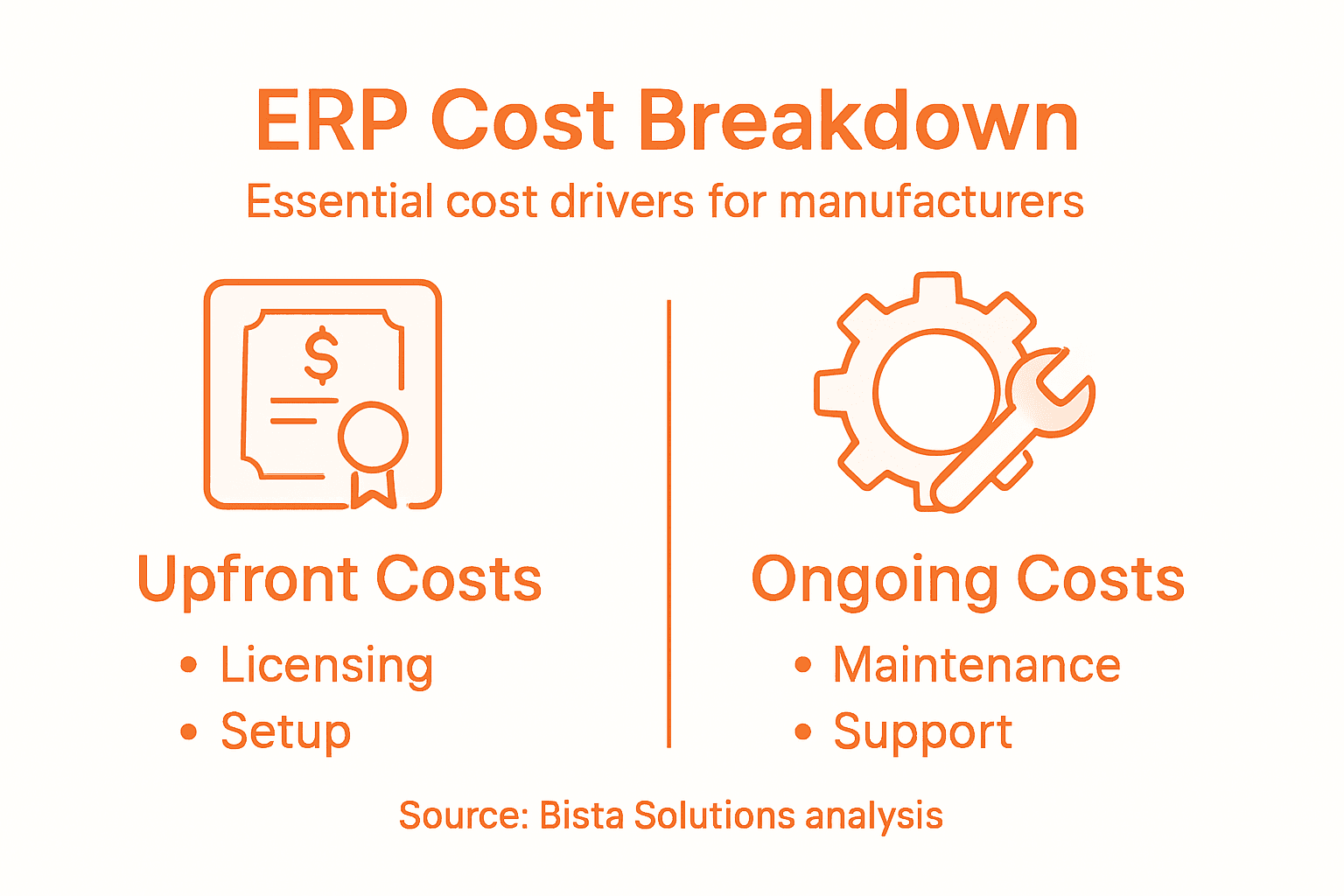
When you’re evaluating different ERP platforms, your costs will also depend on whether you choose a solution that’s already optimized for manufacturing workflows. Some platforms require extensive customization to handle your bill of materials, production scheduling, and inventory management. Others, like Odoo ERP with its dedicated manufacturing module, come with these capabilities built in, which often reduces your implementation complexity and cost.
Pro tip: Start by calculating your current pain costs, meaning what you’re spending on workarounds, manual processes, and inefficiencies in your existing system. When this number is higher than your projected ERP cost, your business case becomes self-evident, and justifying the investment to leadership becomes significantly easier.
ERP Pricing Models and Cost Factors
ERP pricing models have evolved dramatically over the past decade, and understanding which model fits your manufacturing operation is critical to building an accurate financial forecast. The days of massive upfront license purchases are fading, replaced by more flexible arrangements that can actually work with your cash flow instead of against it. For Texas manufacturers evaluating their options, knowing the differences between these models determines not just what you’ll spend, but when you’ll spend it and how predictable those costs become.
The primary pricing models you’ll encounter break down into three main categories that fundamentally change your financial picture:
Perpetual Licensing Model
This is the traditional approach where you purchase the software once and own it indefinitely. You pay a large upfront fee, then annual maintenance costs (typically 15 to 20 percent of the original license cost) keep the software updated and supported. Sounds simple, but here’s the catch: that massive initial investment hits your balance sheet immediately. For a mid-sized manufacturer, perpetual licenses might run $150,000 to $500,000 upfront, depending on modules and users. The advantage is predictability after year one. The disadvantage is that your IT infrastructure becomes your responsibility, and upgrades require separate purchases.

Software-as-a-Service (SaaS) Model
This is where most modern manufacturers are gravitating, and for good reason. You pay monthly or annual subscription fees based on the number of users, modules, or transactions. Odoo ERP operates on this model, allowing you to pay only for what you actually use. Instead of $300,000 upfront, you might pay $1,500 to $3,000 per month, depending on your module selection and user count. The beauty here is cash flow flexibility. The software provider handles all updates, security patches, and infrastructure. You don’t need a large IT department managing servers. The trade-off is that costs continue indefinitely, and you never own the software outright.
Hybrid Models
Some vendors offer a combination where you pay upfront for certain modules but subscribe to others. This gives you flexibility to commit to core functionality while staying agile on less critical systems.
Here is a comparison of the most common ERP pricing models for manufacturers:
| Pricing Model | Upfront Costs | Ongoing Costs | Infrastructure Responsibility |
|---|---|---|---|
| Perpetual Licensing | High, one-time | Annual maintenance required | Manufacturer-owned |
| SaaS Subscription | Low to moderate | Monthly/annual subscriptions | Vendor-managed (cloud) |
| Hybrid | Mixed upfront | Combination of subscriptions | Shared between vendor/client |
Beyond which pricing model you choose, several cost factors directly influence your total investment. User count matters significantly because most ERP systems charge per user. A manufacturing operation with 50 users versus 200 users will see dramatically different costs. Module selection is equally important. If you need advanced supply chain planning, it costs more than basic inventory management. Customization requirements can multiply your costs rapidly. A manufacturer with highly specialized workflows may need extensive custom development, while another manufacturer using standard configurations might implement it at half the cost.
Company size and complexity shape your costs too. A 75-person job shop manufacturer faces different pricing than a 500-person operation with multiple facilities. The implementation timeline affects your consulting costs. A phased rollout across six months costs differently than a compressed three-month implementation that requires premium consulting rates. Integration requirements with existing systems like your accounting software, warehouse management system, or quality management platform add professional services hours and specialized expertise.
Here’s what catches many manufacturers off guard: the pricing model itself often obscures hidden flexibility. With SaaS models like Odoo, you can add modules as you mature your processes, scale user counts up or down seasonally, and avoid being locked into annual commitments that don’t match your actual growth. This contrasts sharply with perpetual licensing, where adding a module means another major purchase.
The cost factor that matters most to your CFO is the total cost of ownership over a defined period, typically five years. A SaaS solution might cost $36,000 per year, totaling $180,000 over five years, while a perpetual model costs $250,000 upfront plus $50,000 in ongoing maintenance, totaling $300,000 over the same period. But if you factor in infrastructure costs you avoid with SaaS, the comparison shifts again. Understanding how different ERP modules like sales management integrate helps you make accurate module selections that directly impact your pricing.
Key factors impacting ERP total cost of ownership over five years:
| Cost Factor | Description | Potential Impact on Budget | Important for Texas Manufacturers |
|---|---|---|---|
| User Count | Number of active system users | Directly increases subscription | Essential for scaling teams |
| Module Selection | Features and capabilities chosen | Advanced modules cost more | Aligns with production needs |
| Customization | Adapting ERP to unique workflows | Can multiply costs | Critical for competitiveness |
| Integration Needs | Connecting with existing systems | Professional services required | Ensures seamless operations |
| Implementation Timeline | Duration and approach (phased/big bang) | Impacts consulting rates | Affects risk and cash flow |
At Bista Solutions, we help manufacturers compare these models against their specific operational realities rather than relying on vendor quotes alone. Our experience across 350 implementations shows that the right pricing model for one manufacturer is often wrong for another. The key is matching the model to your growth trajectory, cash flow situation, and technology maturity level.
Pro tip: Request pricing from vendors based on your actual user count and required modules for years one through five, then calculate the total cost of ownership, including infrastructure, training, and ongoing support, before comparing models. This prevents the sticker shock of discovering hidden costs after you’ve already committed.
Hidden Fees and Budget Busters
Every manufacturing CFO has experienced that moment. You approved an ERP budget based on a vendor quote, felt confident about the numbers, and then six months into implementation, your project manager dropped a bomb: the budget needs another $75,000 because of integration work nobody mentioned. Or the training took twice as long as planned. Or the data migration revealed quality issues that required professional cleanup before you could even load the system. These aren’t surprises in the sense that they’re unusual. They’re surprises because most manufacturers don’t plan for them. Hidden fees and budget busters are predictable once you know where to look.
Let’s talk about the fees that consistently blindside manufacturers. Data migration and cleanup top the list of overlooked costs. Your current system has been running for 15 years, accumulating duplicate records, incomplete information, obsolete customers, and inconsistent formatting. Before Odoo ERP can process this data effectively, it needs to be cleaned, deduplicated, and standardized. A manufacturer with 50,000 customer records might need 200 to 400 hours of specialized data work just to get to a usable starting point. That’s $15,000 to $40,000 in professional services right there, and most budgets don’t account for it.
Integration and API work is another category where costs multiply quickly. You have an existing accounting system, a warehouse management system, perhaps a quality management platform, and maybe a custom spreadsheet tool that somehow became critical to operations. Connecting these systems to your new ERP requires technical expertise that extends beyond standard implementation work. Each integration is custom work. Each API connection requires testing. A manufacturer with four to five major system integrations should budget an additional $20,000 to $60,000 beyond the base implementation cost.
Here’s where many manufacturers get caught off guard: infrastructure costs. If you choose a perpetual licensing model with on-premise deployment, you need servers, network security upgrades, backup systems, and potentially additional IT staffing. A small manufacturing operation might need a $30,000 to $50,000 infrastructure investment that doesn’t appear on the ERP vendor’s quote. Cloud based solutions like Odoo reduce this burden significantly, but if you’re migrating from an on-premise legacy system, your IT team might still want redundancy and security enhancements that add costs.
Training and change management costs escalate faster than anyone predicts. You plan for two days of training per department. Turns out your manufacturing floor team needs more hands-on practice because they’re not comfortable with computer-based processes. Your accounting department needs extended training on the new financial workflows. Your quality team needs specialized training on the inspection module. Your sales team discovers the system works differently from their old tools and needs additional support. Suddenly, you’ve gone from 40 hours of training to 120 hours. That’s $6,000 to $15,000 in additional training costs, plus lost productivity while people are away from their normal work.
Then there’s custom development and configuration. You have a specific manufacturing process that’s core to your competitive advantage. The standard Odoo ERP manufacturing module doesn’t handle your bill of materials structure exactly the way you need it. Your production scheduling has unique requirements. Your quality checks follow a process nobody else uses. These aren’t insurmountable problems, but they require custom development work. Budget 80 to 200 hours of custom development at $100 to $200 per hour. That’s $8,000 to $40,000 in costs that might not show up in the initial quote.
Contingency and scope creep deserve their own mention. Implementation rarely follows the plan exactly. A consultant discovers a business process that nobody documented. You realize you need a report that wasn’t originally planned. A team member suggests a feature that would save two hours per week across the department. Each of these represents scope creep, and each costs money. The manufacturers who stay on budget build in a 15 to 20 percent contingency reserve from the start.
One cost that often gets completely overlooked is temporary staffing during transition. When you’re implementing an ERP, your key people are tied up in implementation activities. Someone still needs to run the manufacturing operation. Many manufacturers hire temporary staff or pull existing employees into double duty during the transition period. A six-month implementation might require one temporary person at $25 per hour for the entire duration, which adds $13,000 to your costs.
Pro tip: Build a detailed budget that includes a line item for each major cost category we discussed, then add a 20 percent contingency reserve labeled as “Implementation Contingency.” When Bista Solutions helps you scope your project, we account for these hidden costs upfront so your actual spend matches your forecast rather than exceeding it by surprise.
ROI Essentials and Financial Justification
Your CFO is sitting across from you, asking the question that makes or breaks your ERP project: “What’s the return on investment?” This isn’t a rhetorical question. It’s the gatekeeper question that determines whether your budget gets approved or gets shelved. Building a solid ROI case requires more than optimistic projections. You need concrete metrics, realistic timelines, and a clear understanding of which operational improvements actually translate into financial gains. According to research on ERP implementations, ROI is achieved through improved operational efficiency, reduced manual workloads, enhanced data accuracy, and better decision-making capabilities. The manufacturers who articulate these benefits with specific numbers are the ones who get their projects approved.
Let’s start with the core ROI calculation. Return on investment is calculated as (Total Benefits minus Total Costs) divided by Total Costs, then multiplied by 100 to get a percentage. Sounds straightforward, but here’s where most manufacturers stumble: quantifying the benefits. A cost is easy to calculate because someone writes a check. A benefit is harder because it’s often indirect and requires you to make assumptions. Here’s where you need to focus your analysis:
Labor productivity gains represent the largest ROI component for most manufacturers. When your team spends less time on manual data entry, report generation, and process workarounds, they spend more time on value-added activities. For example, if your accounting team currently spends 15 hours per week on month-end close procedures and Odoo ERP reduces that to 8 hours per week, you’ve freed up 7 hours of labor per week. At a fully loaded labor cost of $45 per hour, that’s $16,380 annually from one department. Multiply this across all departments that benefit from automation, and you’re looking at $60,000 to $150,000 per year in labor productivity gains, depending on your organization’s size.
Inventory cost reduction directly impacts your bottom line. Better visibility into inventory levels means you can reduce safety stock. More accurate demand forecasting means fewer rush orders and expedited shipments. Obsolete inventory gets identified faster and written off before it becomes a larger problem. For a mid-sized manufacturer with $2 million in average inventory value, reducing inventory by just 10 percent through better management frees up $200,000 in working capital. Across a five-year implementation payback period, that’s $40,000 per year in value.
Reduced downtime and expediting costs matter more in manufacturing than in most industries. When your production schedule is optimized, and your supply chain visibility improves, you experience fewer rush orders, emergency shipments, and production delays. These disruptions typically cost 15 to 25 percent premiums over standard operations. If you currently experience $300,000 annually in expediting and rush fees, reducing that by 40 percent through better planning saves $120,000 per year.
Improved order accuracy and reduced rework costs cascade through your operation. When your manufacturing orders are clearer, your quality improves. When your invoicing is accurate the first time, you spend less time on customer disputes and payment delays. These indirect benefits might represent $20,000 to $50,000 annually, depending on your current error rates.
Here’s the critical part: establish baseline metrics before implementation. You can’t calculate your ROI improvement if you don’t know where you started. Track these key performance indicators for at least three months before your ERP goes live. Measure your current month-end close time. Measure your current inventory turns. Measure your current scrap and rework rates. Measure your current order fill rate. Document your average days’ sales outstanding (DSO) for accounts receivable. These become your baseline.
Then track the same metrics monthly for 12 months after implementation. Most manufacturers see significant improvements in months 3 through 6 as the team becomes proficient with the system. Expect an uptick in months 1 and 2 as people adjust to new processes. By month 12, you should be able to point to concrete improvements in each metric and quantify them in financial terms.
The financial justification requires honesty about timing. Your initial costs hit immediately. A $250,000 implementation cost appears in year one. Your benefits accrue gradually and build over time. Year one might show only 40 percent of your projected annual benefits as the team ramps up. Year two typically shows 80 to 90 percent of benefits. Year three and beyond show full realization. This means your payback period is typically 18 to 30 months for most manufacturers, not 12 months. Build this timeline into your business case rather than misrepresenting it.
With Odoo ERP, there’s an additional financial benefit that often gets overlooked: scalability. As your manufacturing operation grows, your system grows with you. Adding 10 new users to a perpetual licensed legacy system might cost $50,000 in new licensing. Adding 10 users to Odoo costs the incremental monthly subscription fees. This flexibility matters for manufacturers planning growth.
When building your financial justification, consider how better financial visibility through Odoo accounting enables faster and more accurate financial reporting. Faster reporting means faster decision-making. Better visibility means fewer surprises at month. These operational improvements support your ROI calculation by reducing the time your finance team spends on reconciliation and analysis.
Bista Solutions helps manufacturers quantify these ROI components by comparing your current state metrics against industry benchmarks for your company size and product type. This gives your CFO confidence that your projected benefits are realistic rather than optimistic. We’ve guided 350 implementations, and we know which benefit categories typically deliver results and which ones require more cautious assumptions.
Pro tip: Create a conservative ROI model that assumes you’ll realize only 70 percent of your projected benefits in year one and 90 percent in year two, then build in a 12-month payback expectation rather than claiming 12-month payback in reality. When you exceed these conservative projections, you look like a hero. When you hit them exactly, you still look credible. When actual benefits exceed projections, you’ve created organizational momentum for continuous improvement.
Building Your Case with Bista Solutions
You’ve done the research. You understand your ERP costs. You know where the hidden fees hide. You’ve calculated your ROI projections. Now comes the part that separates successful implementations from stalled projects: actually building the business case that convinces your executive team to move forward. This is where having the right partner matters enormously. Bista Solutions isn’t just a software vendor throwing a quote over the fence and walking away. We’re a strategic partner who helps you build an airtight financial and operational justification that gets approvals and delivers results.
Here’s what happens when a manufacturer tries to build their ERP business case alone. They assemble their costs based on vendor quotes. They project their benefits based on what the ERP vendor claims is possible. They build a timeline based on what sounds reasonable. Then they present this to their CFO, and the CFO picks it apart because it lacks the specificity that comes from real-world implementation experience. When we build a business case with you, we’re bringing 350 successful implementations into that conversation. We know what costs actually materialize versus what remains theoretical. We know which benefits typically deliver value and which ones require more cautious assumptions. We know which timelines are realistic for manufacturers of your size and complexity.
Our approach starts with a comprehensive discovery process. We spend time understanding your current operations, your pain points, your growth trajectory, and your financial constraints. We don’t just ask “What do you want from an ERP?” We ask the harder questions: “What’s costing you money right now that you’re not measuring?” “Where are your processes so manual that they’re creating errors?” “Where do you have visibility gaps that are leading to bad decisions?” This discovery becomes the foundation of your business case because it transforms vague operational complaints into quantified financial problems that an ERP solves.
We then conduct a detailed cost analysis specific to your situation. Rather than using industry average costs, we look at the actual complexity of your manufacturing operation. We count your users. We map your system integrations. We identify your customization needs. We assess your data quality. We evaluate your current IT infrastructure. Based on this analysis, we provide a cost estimate that reflects your reality, not a generic template. This specificity gives your CFO confidence because the costs match your actual situation rather than representing some theoretical company.
The ROI component is where our experience really differentiates the business case. We help you identify which productivity gains apply to your operation and which ones don’t. We help you calculate the financial impact of reducing downtime in your specific production environment. We quantify what reduced expediting costs mean for your company based on your current expediting spend. We model your inventory reduction potential based on your current inventory turns and safety stock levels. When you present these ROI projections to your CFO, they’re not generic industry benchmarks. They’re specific calculations tied to your operation.
We also help you structure your implementation timeline and phasing strategy in a way that optimizes costs and manages risk. A phased implementation costs differently than a big bang approach. Sometimes a phased approach makes financial sense because it spreads costs and risk. Sometimes a big bang approach is more cost-effective because it eliminates the transition period costs. We model both scenarios so you understand the financial implications of your chosen approach. Understanding common ERP myths versus reality helps us avoid building business cases based on incorrect assumptions about what ERP implementations require or deliver.
One critical advantage we bring is our understanding of Odoo ERP’s cost structure versus traditional enterprise ERP platforms. Many Texas manufacturers compare Odoo against expensive enterprise solutions and conclude that ERP is unaffordable. When we build your business case, we show you specifically how Odoo’s module-based pricing, cloud infrastructure approach, and lower customization requirements translate into a significantly lower total cost of ownership compared to traditional ERP platforms. This cost advantage becomes a major component of your ROI justification.
We don’t just hand you a business case document and disappear. We help you present it to your executive team. We provide the technical credibility that answers the tough questions. We help you anticipate the objections your CFO will raise and build responses into your presentation. We’ve done this hundreds of times, and we know which concerns are legitimate and which ones are based on outdated perceptions about ERP implementations.
Most importantly, we take accountability for the numbers. If we help you build a business case that projects $100,000 in annual labor productivity gains, we track whether you actually achieve those gains post implementation. We help you measure the metrics that matter. We adjust your processes if the gains aren’t materializing. We identify new opportunities if you’re exceeding projections. This accountability extends beyond the implementation into the ongoing optimization phase, where the real value compounds.
Pro tip: Before you meet with your CFO to discuss an ERP business case, have Bista Solutions conduct a preliminary cost and ROI assessment specific to your operation. Bringing a credible third-party perspective to your meeting, rather than relying solely on vendor quotes, dramatically increases the likelihood your executive team approves the investment with confidence.
Secure Your ERP Investment with Bista Solutions
Understanding the full scope of ERP costs and building a strong business case is essential for manufacturers aiming to streamline operations and improve financial outcomes. If you are facing challenges such as hidden fees, complex pricing models, or uncertain ROI calculations, Bista Solutions offers the expertise you need. Our seasoned team specializes in guiding manufacturers through cost analysis, implementation strategies, and tailored Odoo ERP configurations that align with your unique workflows and growth plans.
Request A Free Demo
Take control of your ERP journey today with a partner who has delivered over 350 successful implementations. Connect with us to get a detailed cost and ROI assessment designed specifically for your operation. Learn how to avoid budget surprises and build a compelling business case that convinces leadership. Contact Bista Solutions now to start your path toward a scalable, cost-effective ERP solution that drives real business value. Reach out through our contact page and explore more about the benefits of Odoo sales management integration and sound ERP implementation practices. Your ERP success begins with informed decisions and trusted guidance.
Frequently Asked Questions
What are the main components of ERP costs for manufacturers?
The main components of ERP costs for manufacturers include software licensing fees, implementation and consulting services, training and change management, infrastructure and IT resources, customization and integration, ongoing support and maintenance, as well as hidden costs like data cleanup and business process redesign.
How do different ERP pricing models affect total cost?
Different ERP pricing models, such as perpetual licensing, Software-as-a-Service (SaaS), and hybrid models, affect total costs by influencing upfront fees, ongoing expenses, and infrastructure responsibilities. SaaS models offer flexibility with lower upfront costs but ongoing subscription fees, while perpetual licensing requires a significant upfront investment with annual maintenance fees.
What should I consider to avoid hidden costs during ERP implementation?
To avoid hidden costs during ERP implementation, you should account for data migration and cleanup, integration work, infrastructure expenses, and additional training requirements. It’s wise to build a contingency reserve of 15-20% in your budget to manage scope creep and unexpected expenses.
How can I measure the ROI of an ERP investment?
To measure the ROI of an ERP investment, calculate the return on investment as (Total Benefits minus Total Costs) divided by Total Costs, then multiply by 100 for a percentage. Key areas to assess include labor productivity gains, inventory cost reductions, reduced downtimes, and improved order accuracy. Establish baseline metrics before implementation for accurate comparisons.