
Advantages of Process Automation in Manufacturing

by Uzlifat Mir
- Mar 09, 2026
- 0
- Category: Manufacturing Industry
Every Texas manufacturer faces tough choices when juggling output, cost, and quality under daily pressure. With competition intensifying across the American market, your team can no longer afford manual tasks that waste precious time and resources. By turning to intelligent process automation powered by Odoo, you give your operation the power to adapt and respond instantly to production challenges, all while freeing your workforce for higher-impact roles.
Table of Contents
- Process Automation Defined For Manufacturing
- Major Types Of Manufacturing Automation
- How Odoo ERP Enables Automation
- Key Benefits For Operations Managers
- Cost Savings And Error Reduction Insights
- Common Pitfalls And Integration Challenges
Key Takeaways
| Point | Details |
|---|---|
| Importance of Process Automation | Process automation in manufacturing enhances efficiency, allowing teams to focus on strategic tasks rather than repetitive work. |
| Types of Automation | Understanding fixed, programmable, and flexible automation helps manufacturers choose the right approach for their specific needs. |
| Integration with Data | Combining automation with real-time data insights leads to proactive issue resolution and enhanced visibility in production processes. |
| Benefits for Operations Managers | Automation increases productivity, improves quality, reduces labor costs, and provides real-time data for better decision-making. |
Process Automation Defined for Manufacturing
Process automation in manufacturing means using technology to make your production operations intelligent and efficient. At its core, it combines machinery, sensors, systems, and human expertise to handle repetitive tasks automatically, freeing your team to focus on strategic work. Think of it as giving your factory a nervous system that can sense problems and respond without constant human intervention.
The scope of manufacturing automation ranges from basic, fully automated systems to interactive setups where humans and machines work together. Your facility might use legacy automation built into existing equipment or greenfield automation when installing new systems from scratch. Both approaches integrate data collection and real-time monitoring, which means you gain better visibility into every step of your production process.
Intelligent Process Automation (IPA) takes this further by adding AI capabilities to your automation strategy. This means your systems don’t just repeat the same task; they learn and adapt. IPA implementation involves analyzing your current processes, selecting the right AI technologies, and designing architectures that fit your specific needs. For instance, manufacturers use IPA to optimize production order routing and reduce waste at the source.
When you implement process automation correctly, several things happen. You improve traceability across your supply chain, increase flexibility to handle changing demands, and achieve better sustainability by cutting waste. Since companies like those in Texas rely on precise operations to stay competitive, automation becomes essential for maintaining margins while scaling production.
The real power emerges when you combine automation with data insights. Your systems collect information constantly, enabling you to spot bottlenecks before they cost you money. With Odoo’s manufacturing automation capabilities, you can integrate your entire operation into one platform, creating that intelligent, responsive factory environment.
Process automation isn’t about eliminating people, it’s about redirecting their talent toward higher-value work like quality control, process improvement, and customer relationships. This shift is what separates manufacturers who merely survive from those who thrive.
Pro tip: Start by mapping your most repetitive, time-consuming processes before investing in automation, then work with an ERP partner like Bista Solutions to identify which tasks will deliver the fastest return on investment.
Major Types of Manufacturing Automation
Manufacturing automation comes in three main flavors, each designed for different production scenarios. Understanding which type matches your operation is crucial because choosing the wrong one wastes money and creates bottlenecks. Let’s break down what each type does and when to use it.
Fixed automation handles high-volume production of identical products with zero variation. Think automotive assembly lines where cars move through the same sequence of operations repeatedly. Once you set it up, the process stays locked in place. This approach maximizes speed and efficiency for one specific product, but changing it costs serious time and money. Fixed automation makes sense when you’re producing thousands of units of the same item.
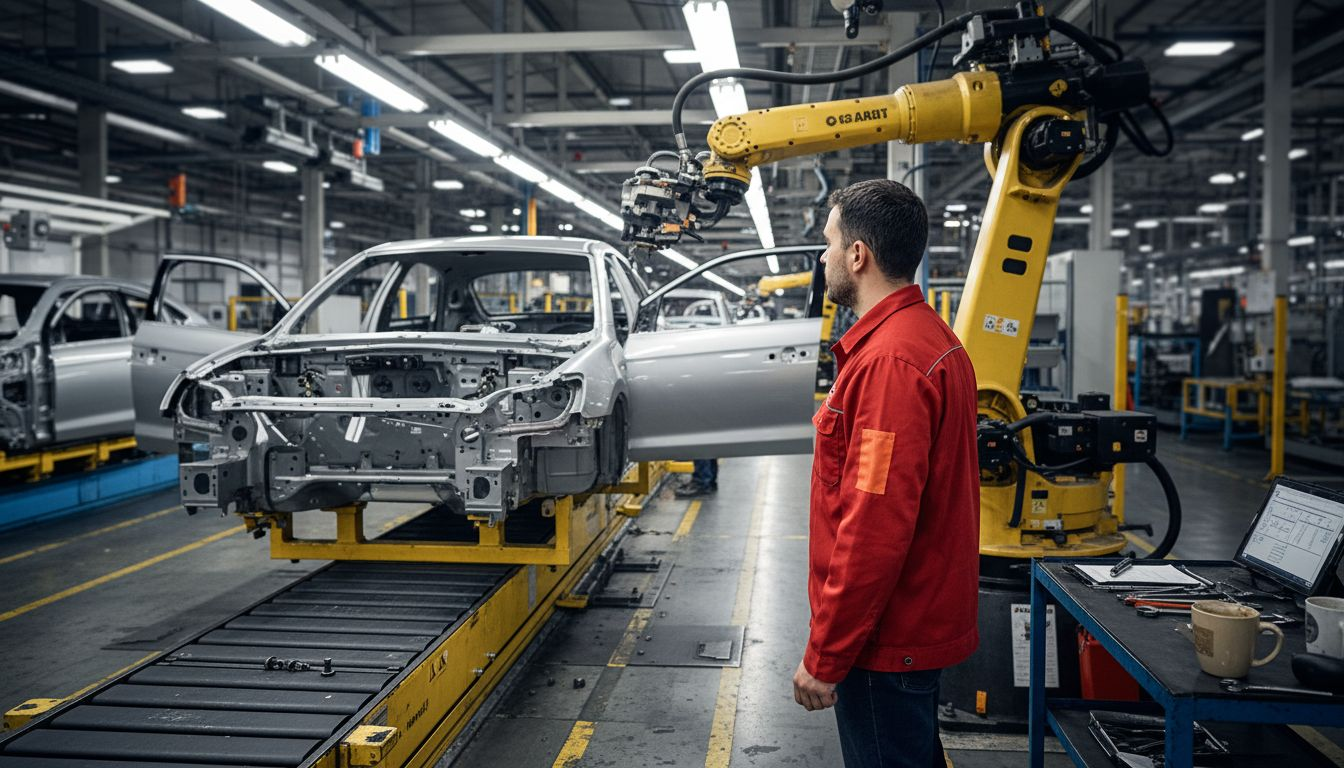
Programmable automation gives you flexibility without the expense of complete retooling. Your machines can be reprogrammed to handle different tasks, making it perfect for batch production. You might produce 500 units of Product A, then reprogram and produce 300 units of Product B using the same equipment. Setup takes longer than fixed automation, but you avoid buying new machinery for each product variant. This option fits manufacturers who need to produce different items in manageable quantities.
Flexible automation represents the next evolution. These systems achieve rapid changeover between products with minimal downtime, allowing you to switch from one product style to another almost instantly. While the initial investment is higher, you gain the ability to respond quickly to customer demands and market shifts. Flexible automation is where intelligent automation and ERP integration become powerful, because your systems automatically adjust scheduling and resources based on real-time data.
Most manufacturing operations actually blend these approaches. Your facility might use fixed automation for core components and flexible automation for customization stages. The key is matching your automation type to your production volume, product variety, and market demands.
Here’s the reality: manufacturers in Texas often compete on speed and customization, not just price. That’s why understanding these three types helps you make smarter investment decisions that align with your actual business needs.
Here’s a concise comparison of the main types of manufacturing automation and their ideal use cases:
| Automation Type | Ideal For | Setup Complexity | Changeover Flexibility |
|---|---|---|---|
| Fixed | Mass production of identical goods | Complex, high initial effort | Very low; costly adjustments |
| Programmable | Batch production, varied products | Moderate; can repurpose equipment | Moderate; requires reprogramming |
| Flexible | Customizable, high-mix production | High; advanced systems needed | High; rapid transitions possible |
Pro tip: Audit your product line first, analyze production volumes for each item, then select automation types that match your specific mix, rather than forcing one approach across your entire operation.
How Odoo ERP Enables Automation
Odoo ERP transforms your manufacturing operation by centralizing all your data into one unified platform. Instead of information scattered across spreadsheets, disconnected systems, and email chains, Odoo creates a single source of truth. This centralization is the foundation that makes automation possible, because your automated processes need accurate, accessible data to function properly.
When you implement Odoo, your manufacturing workflows become programmable and intelligent. Orders flow directly from your sales system into production planning without manual data entry. Inventory levels update automatically as materials move through your facility. Purchase orders generate themselves based on predetermined thresholds and demand forecasts. These aren’t just nice conveniences, they’re significant time savers that reduce human error by 80 to 90 percent.
Odoo’s manufacturing module orchestrates your entire production cycle. You define your workflows once, and the system executes them consistently every single time. Setup times shrink because job scheduling optimizes automatically. Quality checks trigger at the right moments without someone remembering to run them. Cost tracking happens in real time rather than weeks later when you’re trying to figure out where money went.
The platform connects your manufacturing operations with other business functions seamlessly. Your production team’s work automatically feeds into accounting systems that calculate costs and profitability instantly. Customer demand from your sales pipeline informs production priorities. This integration eliminates the bottlenecks that typically slow down manufacturing businesses and create unnecessary delays.
Bista Solutions has implemented Odoo for hundreds of manufacturers across North America, fine tuning these automation features to match specific industry needs. We customize workflows based on your actual processes, not forcing you into generic templates. This means your automation works for your business, not the other way around.
The real advantage emerges over time as Odoo learns your patterns and optimizes continuously. Your team stops fighting the system and starts leveraging it to make better decisions faster.
Pro tip: Start by automating your highest volume, most repetitive processes first, then gradually expand automation to other workflows as your team becomes comfortable with the system.
Key Benefits for Operations Managers
As an operations manager, your job revolves around keeping production moving smoothly while managing costs and quality. Process automation tackles the biggest headaches you face daily. It directly addresses your pain points without requiring you to become a technology expert yourself.
Productivity skyrockets because machines run continuously without fatigue or breaks. Your facility operates 24/7 if needed, producing at consistent speeds that humans simply cannot maintain. This means higher output from the same floor space and equipment investment. In Texas manufacturing, where competition is fierce, that productivity advantage translates directly to your bottom line.
Quality becomes bulletproof. Machines execute the same task with precision every single time, eliminating the human errors that plague manual processes. Your defect rates drop, which means fewer customer complaints and warranty claims. Consistent quality also strengthens your reputation, making it easier to win and retain contracts.
Labor costs decrease significantly while paradoxically improving worker safety. Automation handles repetitive, dangerous tasks, removing your team from hazardous conditions. Your people shift toward skilled work like maintenance, quality oversight, and process improvement. With Odoo manufacturing module tools, you gain real-time visibility into where costs are actually occurring, enabling better decision-making about resource allocation.
Real-time data transforms how you manage. Automation systems collect continuous information about production speed, downtime, material usage, and quality metrics. You stop guessing about bottlenecks and start knowing exactly where problems exist. This visibility lets you respond immediately rather than discovering issues weeks later in production reports.
Flexibility improves dramatically. Automated systems adjust to market changes faster than manual operations. When customer demand shifts or you need to run a special order, your systems reconfigure quickly with minimal downtime. This responsiveness is critical in today’s market.
The table below summarizes how process automation influences common operations manager concerns:
| Concern | Without Automation | With Automation |
|---|---|---|
| Productivity | Manual, slower output | Machines run continuously |
| Quality Consistency | Frequent errors | Precise, repeatable quality |
| Labor Costs | High, repetitive tasks | Reduced, more skilled focus |
| Data Visibility | Limited, delayed | Real-time, actionable insights |
Pro tip: Track your current baseline metrics for productivity, defect rates, and labor costs before implementing automation, then measure actual improvements every 30 days to justify the investment and identify additional optimization opportunities.
Cost Savings and Error Reduction Insights
Here’s what keeps operations managers up at night: errors that cost thousands of dollars and labor expenses that eat into margins. Process automation directly attacks both problems simultaneously. The numbers are compelling because they reflect real money staying in your pocket instead of disappearing into waste and rework.
Human errors drop by over 70 percent when you implement intelligent process automation. Think about what that means for your operation. Incorrect material counts, scheduling mistakes, quality oversights, and data entry blunders simply vanish. Each error typically triggers a cascade of problems, from production delays to customer dissatisfaction. When you eliminate the error source, you eliminate the entire downstream mess.
Production stoppages decrease by 40 percent through predictive automation and intelligent process controls. Instead of your facility grinding to a halt when something breaks, your systems anticipate problems and flag them before failure occurs. Preventive maintenance happens on schedule, not emergency maintenance on a Friday night. This consistency translates to dollars because every minute of downtime costs you money.
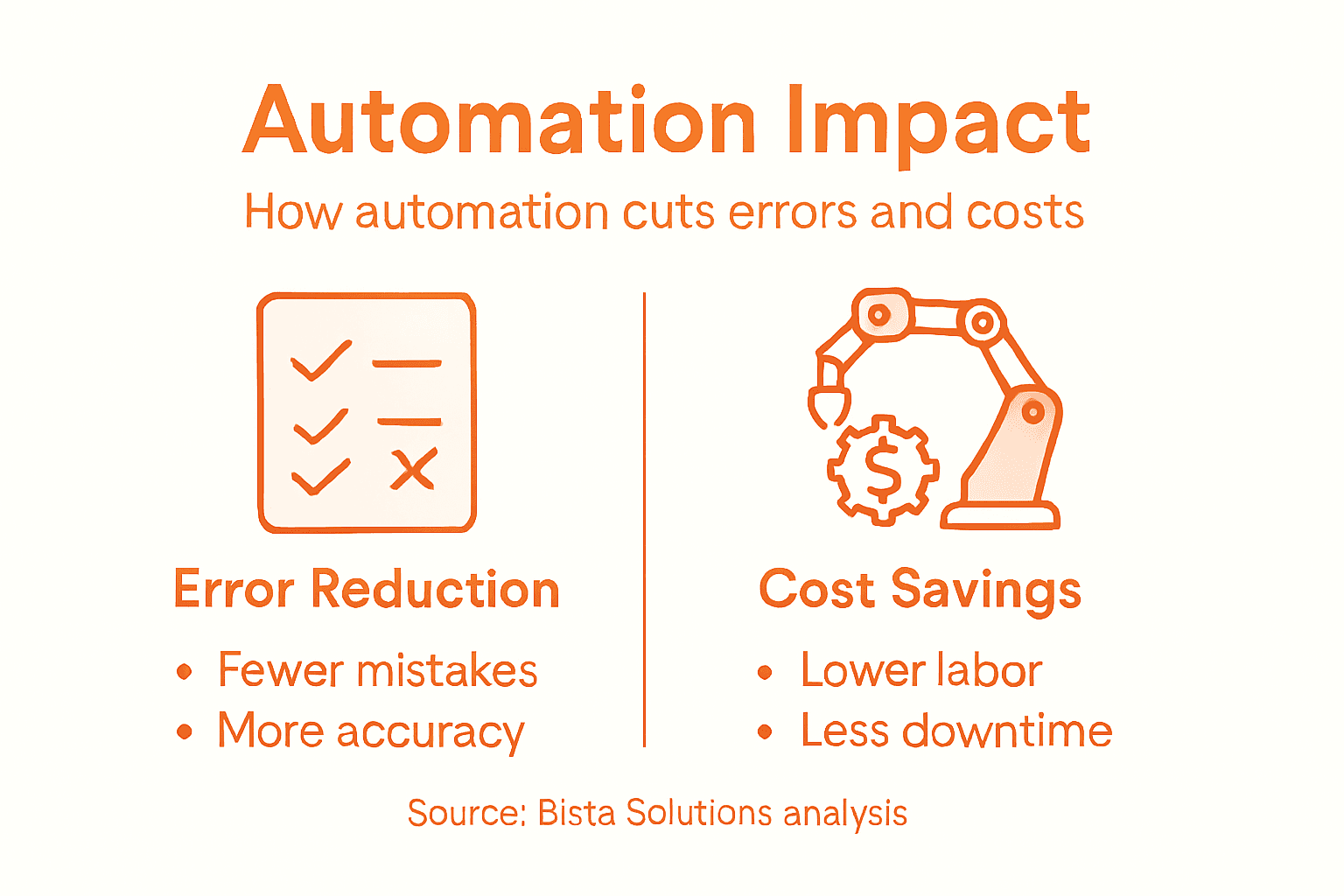
Labor costs shrink without cutting your workforce. Automation handles repetitive tasks, freeing your team to do higher-value work that actually requires human judgment. You’re not losing jobs, you’re redirecting people toward activities that improve profitability. Training costs drop because workers focus on meaningful tasks rather than rote work. Turnover decreases because people prefer engaging work to monotonous repetition.
Maintenance expenses fall dramatically because predictive analytics catch problems early. You replace components before they fail catastrophically, avoiding expensive emergency repairs and extended downtime periods. Your equipment lasts longer when operated consistently by machines that never get tired or distracted.
Inventory accuracy improves substantially through automated tracking and real-time data integration. You maintain less safety stock because you know exactly what you have. Working capital gets tied up less in excess inventory sitting in your warehouse. These freed up resources can fund growth or improve your cash position.
The financial impact compounds over time. Year one shows impressive improvements. Year two shows even better results as your systems optimize further and your team masters the technology.
Pro tip: Calculate your current error rate cost by tracking scrap, rework, and delay incidents for 30 days, then use this baseline to quantify savings from automation implementation in terms your finance team understands immediately.
Common Pitfalls and Integration Challenges
Process automation isn’t plug-and-play. Most manufacturing operations discover this the hard way when they attempt implementation without proper planning. Understanding common pitfalls upfront helps you avoid expensive mistakes that delay benefits and frustrate your team.
Legacy systems create the biggest integration headache. Your existing equipment might be 15 years old, running on outdated software that doesn’t communicate with modern automation platforms. These systems rarely have built-in compatibility layers. Getting them to share data requires custom bridges, specialized expertise, and significant time investment. The good news: solutions exist, but you need to identify these compatibility issues before signing contracts.
Workforce skill gaps derail implementations faster than technology problems. Your team needs training on new systems, but many manufacturers underestimate how much training is actually required. Workers accustomed to manual processes sometimes resist change. Without proper change management and education, even the best automation system fails because people won’t use it effectively. This isn’t a technology issue, it’s a human one.
Data management becomes overwhelming quickly. Automation systems generate massive amounts of information continuously. Without proper data architecture and governance, you drown in useless numbers. You collect everything but understand nothing. Setting up data collection strategies before implementation prevents this chaos.
Initial investment costs scare decision makers away. Automation requires upfront capital for equipment, software licenses, integration work, and training. The return takes time to materialize. Many companies abandon projects midway because they didn’t budget properly or set realistic timelines for payback.
Cybersecurity risks increase when systems connect. Every connection point becomes a potential vulnerability. Your production floor wasn’t designed with network security in mind. Adding connectivity without proper security protocols exposes you to operational disruptions and data theft.
System inflexibility creates lock-in problems. Poor architectural choices early on limit your ability to adapt later. Using rigid, proprietary solutions instead of modular, standards-based approaches makes future changes expensive and painful.
Bista Solutions addresses these challenges by implementing phased approaches that match your current capabilities. We integrate with legacy systems rather than forcing immediate replacement. We prioritize workforce training throughout implementation, not just at launch.
Pro tip: Conduct a detailed legacy system audit before choosing an automation solution, then work with implementation partners experienced in your specific equipment and industry to develop a realistic phased approach that addresses integration challenges systematically.
Unlock the Full Potential of Process Automation with Bista Solutions
Struggling with legacy system integration, workforce training, or maximizing the return on your manufacturing automation investments? This article highlights the critical challenges many operations managers face when adopting process automation — from reducing costly errors and downtime to achieving real-time data visibility and adaptive flexibility. At Bista Solutions, we understand these pain points and bring unmatched experience as the largest Odoo ERP implementer in North America to tailor solutions that empower your factory to operate smarter and faster.
Imagine eliminating up to 70 percent of human errors and cutting production stoppages by 40 percent while redirecting your workforce toward higher-value activities. With our deep expertise in implementing the Odoo manufacturing module, we seamlessly connect your operations with real-time data and intelligent automation. Our team ensures smooth integration with your existing equipment, comprehensive workforce training, and a phased strategy to deliver rapid ROI.
Schedule A Free Consultation
Don’t let integration challenges or upfront costs stall your transformation. Take the first step toward an intelligent, connected factory by contacting Bista Solutions today. Discover how our customized automation solutions can solve your specific manufacturing challenges and accelerate growth. Start your journey here: Contact Us.
Frequently Asked Questions
What is process automation in manufacturing?
Process automation in manufacturing involves using technology to streamline production operations by automatically handling repetitive tasks. This integration of machinery, sensors, and human expertise enhances efficiency and allows teams to focus on strategic work.
What are the main types of manufacturing automation?
The main types of manufacturing automation are fixed automation, programmable automation, and flexible automation. Fixed automation is suitable for high-volume production of identical products, programmable automation allows for reprogramming of machines for different tasks, and flexible automation enables rapid changeover between products with minimal downtime.
How does Odoo ERP facilitate manufacturing automation?
Odoo ERP centralizes manufacturing data into a single platform, allowing for seamless integration of workflows. Automated processes such as order management and inventory updates significantly reduce manual data entry and human error, resulting in more efficient operations.
What are the key benefits of implementing process automation?
Implementing process automation leads to increased productivity, improved quality and consistency, reduced labor costs, enhanced real-time data visibility, and greater flexibility to adapt to market changes. These advantages position manufacturers for long-term success.