Shopify B2B for U.S. Manufacturers: Transforming Wholesale

 by Uzlifat Mir
Bold moves in digital sales are becoming a necessity for American manufacturers, with nearly 65 percent of wholesale businesses shifting to dedicated B2B ecommerce in recent years. For those looking to keep pace, Shopify B2B offers a direct path toward modernizing wholesale operations and satisfying complex customer demands. This guide breaks down how the right Shopify B2B features help American companies cut through inefficiency, manage buyer relationships, and compete effectively in the changing business market.
Table of Contents
- Defining Shopify B2B For Manufacturers
- Types Of Shopify B2B Storefronts
- Core Features For Wholesale Operations
- Integration With ERP And Other Systems
- Pricing, Payment, And Buyer Management
- Compliance, Costs, And Common Pitfalls
Key Takeaways
| Point | Details |
|---|---|
| Shopify B2B Enhances Wholesale Efficiency | The platform provides specialized tools for manufacturers, streamlining complex sales processes and improving digital storefront capabilities. |
| Flexible Storefront Options | Manufacturers can choose between blended stores for dual markets or dedicated B2B stores for exclusive wholesale transactions to optimize their sales strategies. |
| Advanced Integration Necessity | Successful implementation relies on seamless integration with existing ERP and business systems to enhance operational efficiency and data accuracy. |
| Compliance and Cost Considerations | Manufacturers must address regulatory compliance and carefully manage costs associated with implementation to ensure a smooth transition to digital wholesale practices. |
Defining Shopify B2B for Manufacturers
Shopify B2B represents a digital transformation platform specifically designed to help manufacturers modernize their wholesale operations through advanced online selling capabilities. Unlike traditional consumer ecommerce platforms, Shopify B2B offers specialized features tailored for business-to-business transactions, enabling manufacturers to create sophisticated digital storefronts that meet complex wholesale purchasing requirements.
At its core, Shopify B2B provides manufacturers with powerful tools to streamline complex sales processes. These platforms support critical wholesale functionalities such as volume-based pricing, custom contract rates, company-specific payment terms, and restricted access portals for different business customers. By integrating manufacturing execution systems, manufacturers can automate order processing, reduce manual administrative work, and create more efficient sales channels that directly connect production capabilities with business buyers.
The platform enables manufacturers to overcome traditional wholesale distribution limitations by offering digital solutions that expand market reach. Key features include custom price lists for different customer segments, bulk ordering capabilities, quick reorder options, and comprehensive account management tools. This digital transformation allows manufacturers to serve multiple business customers simultaneously, track order histories, manage complex pricing structures, and provide personalized purchasing experiences that traditional sales models cannot match.
Pro tip: When implementing Shopify B2B, start by mapping out your most complex customer pricing and ordering scenarios to ensure the platform can accommodate your specific wholesale business requirements.
Types of Shopify B2B Storefronts
Manufacturers exploring Shopify B2B have multiple storefront configurations to choose from, each designed to meet unique wholesale business requirements. The two primary storefront models are Blended Stores and Dedicated B2B Stores, offering manufacturers flexible digital sales strategies that can be customized to their specific operational needs.
Blended stores represent a hybrid approach where manufacturers can simultaneously serve both business and direct-to-consumer markets within a single digital platform. These storefronts allow businesses to showcase different product catalogs, pricing structures, and access levels for wholesale and retail customers. By leveraging ecommerce integration, manufacturers can create seamless purchasing experiences that adapt to varied customer segments while maintaining centralized inventory and order management.
Dedicated B2B storefronts, in contrast, provide a specialized environment exclusively for wholesale transactions. These platforms enable manufacturers to create comprehensive buying experiences with advanced features like company-specific pricing, bulk ordering capabilities, custom payment terms, and restricted access portals. Custom storefronts using headless commerce approaches offer even greater flexibility, allowing manufacturers to build unique buyer interfaces that integrate precisely with existing enterprise resource planning systems and complex sales workflows.
Pro tip: Carefully analyze your current sales processes and customer segments before selecting a Shopify B2B storefront model to ensure maximum alignment with your specific wholesale business requirements.
Here’s a quick comparison of Shopify B2B storefront models for manufacturers:
| Storefront Model | Target Customers | Key Benefits | Typical Use Case |
|---|---|---|---|
| Blended Store | Both wholesale and retail | Centralized channel, diversified reach | Manufacturers serving multiple markets |
| Dedicated B2B Store | Wholesale only | Custom buying experience, strict controls | Businesses with complex B2B needs |
| Headless Commerce | Highly customized B2B | Unique interface, deep ERP integration | Enterprises with strict workflows |
Core Features for Wholesale Operations
Shopify B2B platforms offer manufacturers a comprehensive suite of advanced features specifically designed to streamline wholesale operations and create sophisticated digital purchasing experiences. Core wholesale capabilities encompass a range of tools that transform traditional sales processes, enabling manufacturers to manage complex business transactions with unprecedented efficiency and flexibility.
Key features include advanced pricing mechanisms that allow manufacturers to establish company-specific pricing structures, volume-based discounts, and customized contract rates. These platforms support intricate bulk ordering capabilities that enable business buyers to purchase large quantities with streamlined workflows. Vendor lead time calculation modules help manufacturers optimize inventory management and provide accurate delivery estimates, ensuring transparent and predictable supply chain interactions.

The platform’s robust account management system introduces powerful tools like self-service customer portals, draft order management, and granular permission settings. Manufacturers can create unique buying experiences by implementing features such as restricted product catalogs, company-specific payment terms, and automated purchase approval workflows. These sophisticated capabilities allow businesses to tailor their digital storefront to meet the nuanced requirements of different wholesale customers, transforming traditional sales approaches into dynamic, data-driven interactions.
Pro tip: Conduct a comprehensive audit of your current wholesale sales processes before implementation to identify specific customization needs and maximize the potential of your Shopify B2B storefront.
The table below summarizes the most impactful features of Shopify B2B for wholesale operations:
| Feature | What It Does | Business Impact |
|---|---|---|
| Volume-based Pricing | Auto-applies discounts for large orders | Encourages higher order volume |
| Self-service Customer Portals | Allows buyers to manage orders themselves | Reduces admin workload |
| Automated Approval Workflows | Simplifies multi-level purchasing signoff | Speeds up order processing |
| ERP Integration | Syncs sales with backend systems | Ensures data accuracy and efficiency |
Integration With ERP and Other Systems
Successful Shopify B2B implementations for manufacturers hinge on seamless enterprise application integration (EAI), which enables sophisticated communication between digital sales platforms and core business systems. By bridging Shopify B2B storefronts with existing enterprise resource planning (ERP) infrastructure, manufacturers can create a unified technological ecosystem that eliminates data silos and enhances operational efficiency.
The integration process involves connecting multiple critical business systems, including inventory management, accounting, customer relationship management, and production planning platforms. Understanding ERP implementation phases becomes crucial for manufacturers seeking to establish robust, interconnected digital workflows. These integrations enable real-time data synchronization, allowing wholesale transactions on Shopify to automatically update inventory levels, trigger financial reconciliation, and generate comprehensive reporting across different organizational departments.
Advanced integration strategies leverage middleware and API-based connections that facilitate complex data exchanges between Shopify B2B platforms and legacy enterprise systems. Manufacturers can implement custom integration solutions that support specialized wholesale requirements, such as configuring unique pricing structures, managing complex product catalogs, and maintaining precise inventory tracking. The result is a dynamic, responsive digital infrastructure that transforms traditional wholesale operations into agile, data-driven business processes.
Pro tip: Conduct a comprehensive system audit and map out all current data workflows before initiating ERP integration to identify potential compatibility challenges and optimize your technological ecosystem.
Pricing, Payment, and Buyer Management
Shopify B2B platforms provide manufacturers with sophisticated pricing and payment management tools that transform traditional wholesale transaction processes. These advanced systems enable businesses to create complex pricing structures tailored to specific customer segments, supporting intricate wholesale pricing models that go far beyond simple fixed-rate approaches.
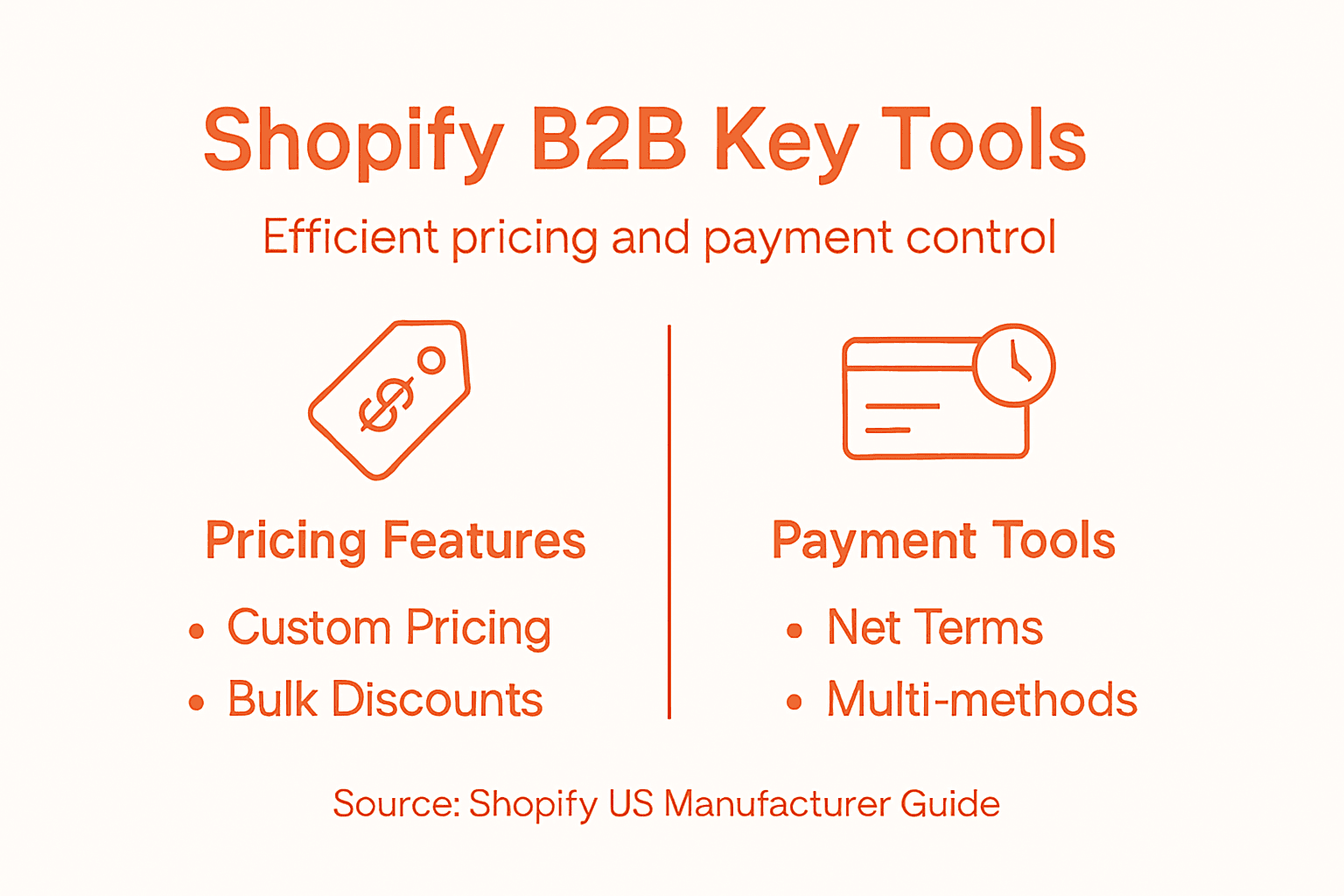
The platform’s buyer management capabilities allow manufacturers to establish granular controls over company profiles, user permissions, and purchasing workflows. Manufacturers can configure unique pricing tiers, volume-based discounts, and customer-specific contract rates that reflect the nuanced relationships typical in business-to-business transactions. Odoo accounting features further enhance these capabilities by providing comprehensive financial tracking and reporting mechanisms that integrate seamlessly with wholesale pricing strategies.
Payment processing in Shopify B2B environments supports multiple sophisticated approaches, including net payment terms, invoicing workflows, and integrated payment gateways that accommodate complex business purchasing requirements. Manufacturers can implement flexible payment options such as credit lines, scheduled payments, and multi-currency support, enabling smoother financial interactions with wholesale customers. The system’s robust permission management allows sales teams to create detailed buyer hierarchies, control access levels, and maintain precise oversight of purchasing activities across different organizational levels.
Pro tip: Develop a comprehensive pricing strategy that considers customer volume, historical purchasing behavior, and long-term relationship potential before configuring your Shopify B2B storefront pricing models.
Compliance, Costs, and Common Pitfalls
U.S. manufacturers implementing Shopify B2B platforms must navigate a complex landscape of regulatory compliance and potential implementation challenges. Regulatory requirements can impose significant financial burdens, with compliance costs typically ranging from 1.3% to 3.3% of total wage expenses, creating substantial overhead for businesses transitioning to digital wholesale platforms.
Accessibility compliance represents a critical legal consideration for digital storefronts. Manufacturers must ensure their Shopify B2B platforms meet Web Content Accessibility Guidelines (WCAG) 2.1 AA standards to mitigate potential legal risks. Common pitfalls include relying on superficial accessibility widgets and failing to conduct comprehensive manual audits. Comprehensive ERP implementation strategies can help manufacturers proactively address these compliance challenges by integrating robust accessibility and regulatory monitoring mechanisms into their digital infrastructure.
Cost management becomes paramount when implementing Shopify B2B solutions. Manufacturers should anticipate expenses beyond platform licensing, including integration costs, staff training, potential custom development, and ongoing maintenance. These investments require careful financial planning, with successful implementations focusing on long-term efficiency gains and expanded market capabilities. Strategic approaches involve thoroughly evaluating platform features, conducting pilot testing, and developing phased implementation strategies that minimize disruption to existing business operations.
Pro tip: Conduct a comprehensive risk assessment and budget analysis before implementing your Shopify B2B platform, accounting for potential compliance expenses and technological adaptation costs.
Unlock Your Manufacturing Potential with Expert Shopify B2B Integration
Navigating the complex demands of Shopify B2B for U.S. manufacturers requires more than just a platform. The challenges of managing volume-based pricing, ERP integration, and compliance can slow your growth and create costly inefficiencies. If you are striving to transform your wholesale processes into a scalable, digital powerhouse, then expert guidance is essential. Bista Solutions specializes in delivering tailored ERP and e-commerce integration strategies that align perfectly with your unique wholesale workflows, helping you streamline pricing models, automate approval workflows, and maintain regulatory compliance.
Request A Demo
Partner with a proven industry leader recognized as the top Odoo ERP implementer in North America. With over 350 successful ERP implementations worldwide, our team of 300+ experts ensures your Shopify B2B transformation is smooth and resilient. Start today by connecting with our consultants to build a customized roadmap that fully leverages your Shopify B2B capabilities while integrating seamlessly with your existing enterprise systems. Don’t wait to reduce administrative workload and unlock new revenue streams. Contact us now at Bista Solutions Contact and discover how our innovative solutions can revolutionize your wholesale business.
Frequently Asked Questions
What are the key features of Shopify B2B for manufacturers?
Shopify B2B offers advanced pricing mechanisms, bulk ordering capabilities, self-service customer portals, and automated approval workflows, all designed to streamline wholesale operations and enhance purchasing experiences.
How can manufacturers integrate Shopify B2B with their existing ERP systems?
Manufacturers can achieve integration through middleware and API-based connections, allowing real-time data synchronization between Shopify and their ERP systems to enhance inventory management, financial reconciliation, and reporting.
What are the benefits of using a dedicated B2B storefront compared to a blended store?
A dedicated B2B storefront focuses solely on wholesale transactions with features like customized pricing, bulk ordering, and restricted access, while a blended store serves both wholesale and retail customers within a single platform.
How does pricing management work in Shopify B2B environments?
Shopify B2B allows manufacturers to create complex pricing structures tailored to specific customer segments, including volume-based discounts and customer-specific contract rates, ensuring flexibility and accuracy in wholesale transactions.