Celebrating Excellence: Bista Solutions Awarded Best Odoo Partner North America 2025

Bista Solutions is Awarded The Best Odoo Partner North America 2025

A testament to our unwavering commitment to client success, innovation, and the Odoo ecosystem.

It is with immense pride and excitement that we, Bista Solutions, have been awarded the Best Odoo Partner in North America for 2025. This esteemed recognition, presented directly by Odoo S.A., is not just an award; it’s a powerful validation of the hard work, dedication, and client-first philosophy that every single member of our team lives by.

This accolade places us at the pinnacle of the Odoo partner network across the entire continent, highlighting our exceptional performance in delivering transformative business solutions that drive growth, efficiency, and innovation for our clients.

What Does “Best Odoo Partner” Really Mean?

The title of “Best Odoo Partner” is awarded based on a rigorous set of criteria that measure a partner’s overall impact and excellence. This isn’t a popularity contest; it’s a data-driven assessment of performance across key areas:

  • Client Success & Satisfaction: Our highest priority has always been the success of our clients. This award reflects the overwhelmingly positive feedback, successful go-lives, and tangible ROI our clients have achieved through our partnership.
  • Sales Growth & Performance: We have demonstrated significant and consistent growth, bringing the power of Odoo to a diverse range of businesses across North America, from budding startups to established enterprises.
  • Technical Expertise & Certification: Our team boasts some of the most certified and skilled Odoo experts in the industry. This deep reservoir of knowledge ensures we can tackle any business challenge, no matter how complex.
  • Contribution to the Odoo Community: We believe in giving back. Through developing innovative modules, sharing knowledge via webinars and blogs, and actively participating in the Odoo community, we strive to push the platform forward for everyone.

This Award is For Our Clients

While we are honored to accept this award, we see it first and foremost as a testament to our clients’ success. Your trust in us to be your digital transformation partner is the fuel that drives our innovation. Your challenges become our projects, and your successes become our milestones. Thank you for partnering with us on this journey. This award is as much yours as it is ours.

A Look Back at the Journey: The Pillars of Our Success

This achievement is the result of a deliberate strategy built on a foundation of core values:

  1. Deep Industry Knowledge: We don’t just implement software; we solve business problems. Our consultants take the time to understand your industry’s unique nuances, ensuring your Odoo system is tailored for your specific needs.
  2. The Bista Advantage: Our proprietary project methodology ensures implementations are on time, on budget, and exceed expectations. We emphasize clear communication, collaborative planning, and comprehensive training.
  3. Innovation as a Standard: Our dedicated development center continuously innovates, creating custom solutions and integrations that extend Odoo’s functionality to meet even the most specialized requirements.
  4. A Culture of Partnership: We view ourselves as an extension of your team. Our long-term support and advisory services are designed to ensure your Odoo investment continues to deliver value as your business evolves.

The Future is Integrated, The Future is Bright

Being named the Best Odoo Partner 2025 is an incredible milestone, but it is not the destination. It is a springboard for the future. This award reinforces our commitment to:

  • Pushing the Boundaries of ERP: We will continue to invest in R&D, exploring the potential of AI, IoT, and deeper analytics within the Odoo framework.
  • Expanding Our Reach: We are more determined than ever to help businesses across North America unlock their potential with integrated, scalable, and affordable ERP solutions.
  • Setting a Higher Standard: We will continue to raise the bar for what it means to be a true strategic partner, setting new standards for excellence in the ERP implementation space.

Ready to Experience the Best?

Are you considering Odoo for your business? Or perhaps your current implementation isn’t living up to its promise? Partner with the best.

Let us show you why we were awarded this honor. Contact Bista Solutions today for a free consultation and discover how our award-winning team can drive your business forward.

Understanding How Odoo ERP Enables Lean Manufacturing and JIT

Odoo ERP lean manufacturing

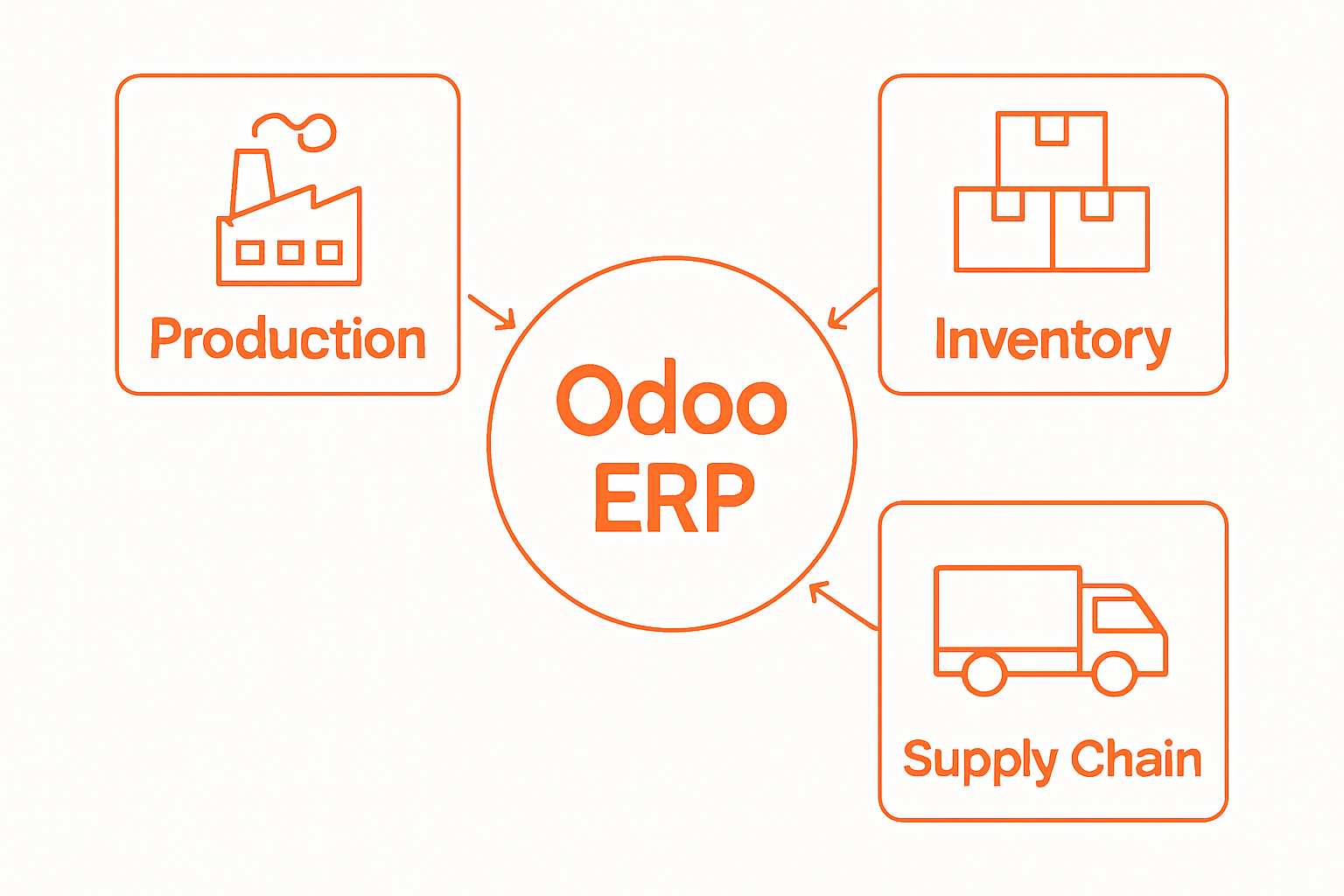
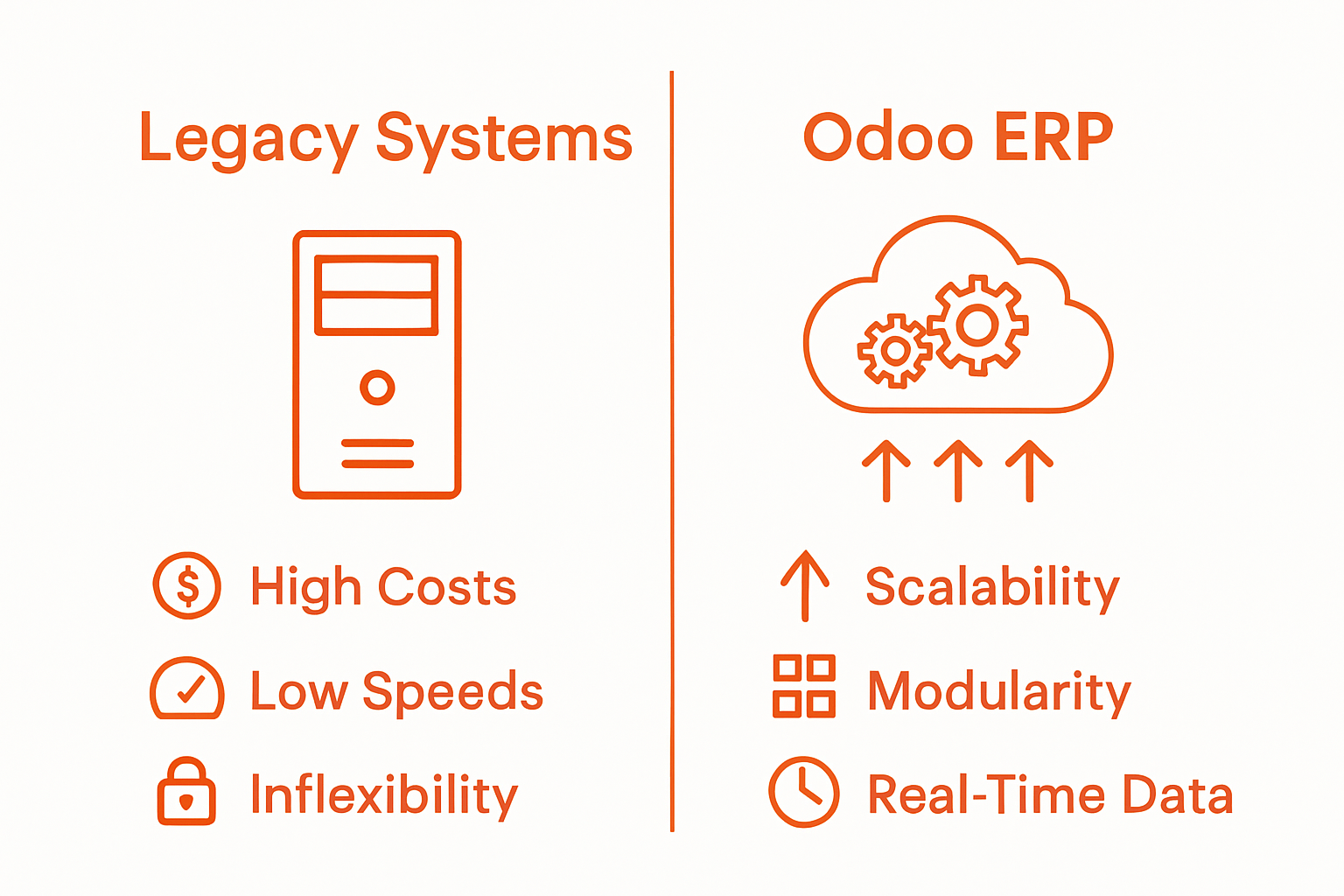
Odoo ERP is often praised for its flexibility and open-source roots, letting companies manage everything from accounting to inventory in one place. Yet, what surprises most people is just how much it can be customized—Odoo offers hundreds of modules, letting you tailor the system to match any workflow. Most business software forces you into rigid processes but Odoo flips the script and lets your business call the shots, not the other way around.

Table of Contents

Quick Summary

Takeaway Explanation
Odoo ERP offers flexible, modular solutions Companies can customize Odoo ERP to fit unique operational processes and improve efficiency across departments.
Lean manufacturing minimizes waste effectively Lean principles focus on identifying and eliminating waste, ensuring resources are used efficiently while maximizing productivity.
Just-in-Time production improves resource allocation JIT manufacturing aligns production schedules with demand, reducing excess inventory and enhancing responsiveness to market changes.
Integration of Odoo ERP with lean practices enhances performance Utilizing Odoo ensures data-driven decision-making and precise management of lean methodologies, leading to operational excellence.
Real-time insights drive strategic transformation Odoo ERP’s capabilities provide detailed analytics that support proactive management and continuous improvement initiatives in manufacturing.

What is Odoo ERP and How Does It Function?

Odoo ERP represents a comprehensive, integrated software solution designed to help businesses streamline their operational processes across multiple departments. As an open-source enterprise resource planning platform, Odoo provides organizations with a flexible and scalable system that can adapt to diverse business requirements.

Core Architecture and Functionality

At its foundation, Odoo ERP functions as a modular platform that enables businesses to manage critical operations through interconnected applications. These applications cover essential business domains such as:

  • Accounting and financial management
  • Customer relationship management (CRM)
  • Human resources and payroll
  • Manufacturing and inventory control
  • Sales and purchase management
  • Project tracking and collaboration

The system’s unique architecture allows seamless integration between these modules, creating a unified ecosystem where data flows smoothly across different organizational functions. Unlike traditional rigid ERP systems, Odoo offers unprecedented customization capabilities, enabling businesses to tailor the platform precisely to their operational workflows.

Understanding Odoo’s Technical Framework

Odoo operates on a powerful technical framework built using Python programming language and PostgreSQL database management system. This combination provides robust performance, security, and scalability. The platform supports multiple deployment models including on-premise, cloud-based, and hybrid configurations, giving businesses the flexibility to choose an implementation strategy that best suits their technological infrastructure.

For businesses seeking comprehensive ERP solutions, learn more about Odoo’s powerful modular approach and how it can transform organizational efficiency. Bista Solutions specializes in helping companies implement and optimize Odoo ERP systems, ensuring seamless digital transformation and operational excellence.

By offering an integrated, adaptable platform, Odoo ERP empowers organizations to centralize their data, automate complex processes, and make informed strategic decisions with real-time insights and comprehensive reporting capabilities.

The Principles of Lean Manufacturing Explained

Lean manufacturing is a systematic approach to production that focuses on minimizing waste while maximizing productivity and value creation. Originating from Toyota’s production philosophy in the mid-20th century, this methodology has transformed manufacturing processes across global industries by emphasizing efficiency, continuous improvement, and waste elimination.

Core Philosophical Foundations

At its essence, lean manufacturing is built on five fundamental principles that guide organizational transformation. These principles are not merely operational strategies but represent a comprehensive philosophy of production and organizational management:

  • Value Identification: Understanding what customers truly value
  • Value Stream Mapping: Analyzing and optimizing entire production processes
  • Creating Continuous Flow: Eliminating interruptions and bottlenecks
  • Establishing Pull Systems: Producing only what is immediately required
  • Pursuing Continuous Improvement: Constantly seeking operational enhancements

These principles challenge traditional manufacturing paradigms by shifting focus from mass production to precision-driven, customer-centric manufacturing. Instead of generating excessive inventory, lean manufacturing aims to create exactly what customers need, precisely when they need it.

Waste Reduction Strategies

Waste reduction represents the cornerstone of lean manufacturing. Organizations practicing lean methodologies systematically identify and eliminate eight primary forms of waste: overproduction, waiting times, transportation inefficiencies, excessive processing, inventory surplus, unnecessary movement, defects, and underutilized human potential.

By exploring advanced lean manufacturing techniques, businesses can transform their operational models. The goal is not merely cost reduction but creating a responsive, adaptive manufacturing ecosystem that continuously evolves to meet changing market demands.

The table below summarizes the eight types of waste targeted by lean manufacturing, as described in the article, and gives a brief explanation of each.

Type of Waste Explanation
Overproduction Making more than is needed or before it is needed
Waiting Times Idle time caused by delays between production steps
Transportation Unnecessary movement of materials or products
Excessive Processing Performing more work or using more resources than required
Inventory Surplus Holding extra raw materials, work-in-progress, or finished goods
Unnecessary Movement Extra motion by people, equipment, or machinery
Defects Errors or flaws that require rework or result in waste
Underutilized Potential Not using employee skills, talents, or ideas effectively

Lean manufacturing transcends traditional cost-cutting approaches. It represents a holistic philosophy of organizational excellence, emphasizing respect for human resources, continuous learning, and systemic efficiency. Through disciplined implementation, companies can achieve remarkable improvements in productivity, quality, and customer satisfaction.

Understanding Just-in-Time (JIT) Manufacturing

Just-in-Time (JIT) manufacturing represents a revolutionary production strategy that fundamentally transforms traditional inventory management and manufacturing processes. By focusing on producing goods exactly when they are needed and in the precise quantities required, JIT challenges conventional mass production paradigms and delivers unprecedented operational efficiency.

Core Principles and Methodology

JIT manufacturing operates on several critical principles that distinguish it from traditional production approaches:

  • Minimal Inventory: Maintaining only essential materials and components
  • Precise Production Scheduling: Manufacturing products based on immediate demand
  • Reduced Waste: Eliminating excess inventory and associated storage costs
  • Streamlined Supply Chain: Creating direct, responsive connections between production and customer needs
  • Quality-Driven Processes: Emphasizing defect prevention over defect detection

The fundamental goal of JIT is to transform manufacturing from a push-based to a pull-based system.

This means production is triggered by actual customer demand rather than speculative forecasting, dramatically reducing waste and improving resource allocation.

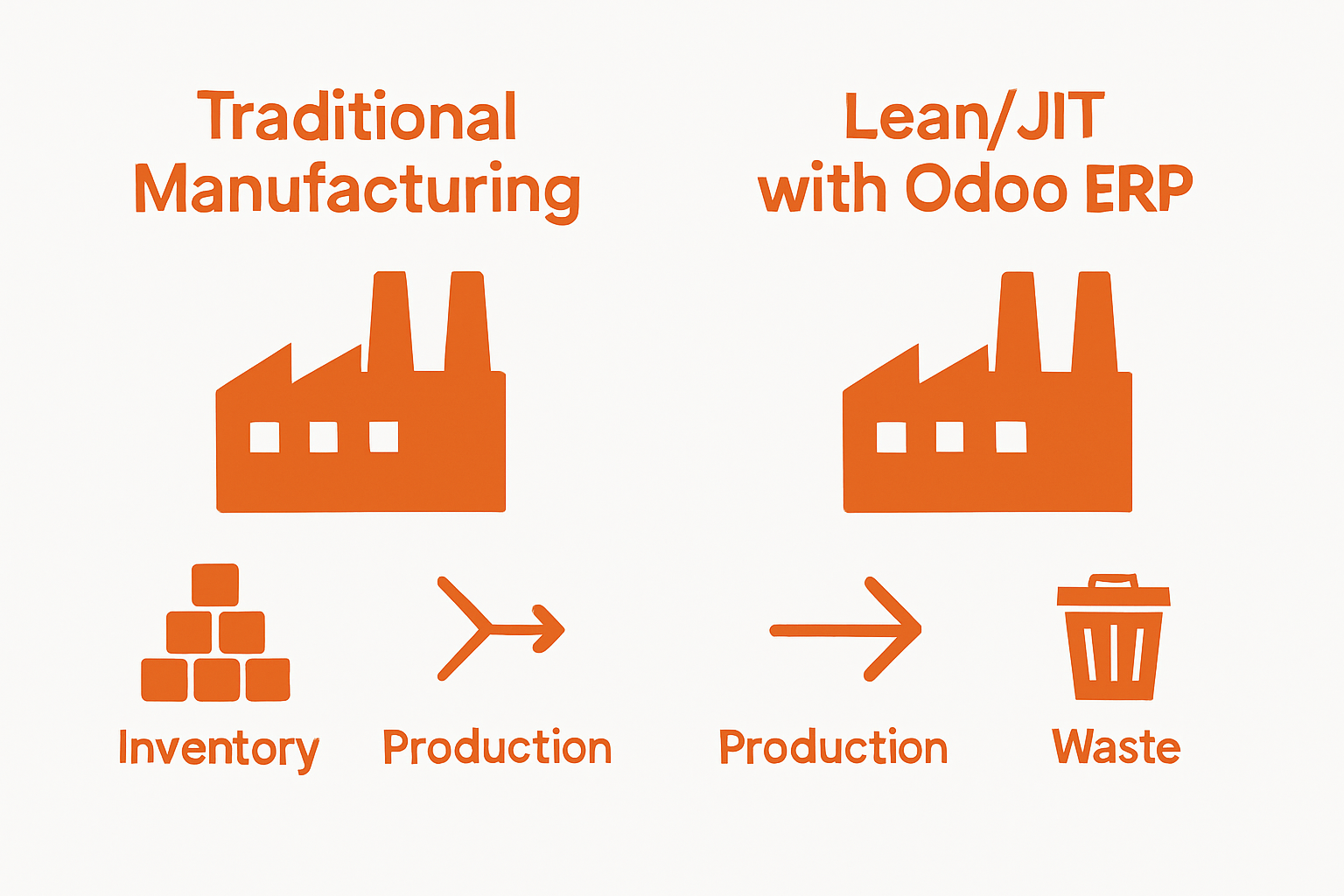
Side-by-side comparison of traditional manufacturing vs lean JIT with Odoo ERP using icons

Strategic Implementation and Benefits

Successful JIT implementation requires sophisticated coordination across multiple organizational functions. Manufacturers must develop robust communication channels, precise demand forecasting capabilities, and agile production systems. Explore advanced manufacturing optimization techniques to understand how technology enables these complex operational strategies.

By adopting JIT principles, organizations can achieve significant competitive advantages. The approach reduces capital tied up in inventory, minimizes storage expenses, improves product quality, and creates a more responsive manufacturing ecosystem. Companies implementing JIT often experience reduced production cycle times, lower operational costs, and enhanced ability to meet rapidly changing market demands.

While JIT manufacturing presents complex challenges, its potential to revolutionize production processes makes it an increasingly critical strategy for businesses seeking operational excellence in competitive global markets.

This table provides a side-by-side comparison of Lean Manufacturing and Just-in-Time (JIT) Manufacturing based on principles and focus areas highlighted in the article.

Concept Primary Focus Key Principles Main Outcomes
Lean Manufacturing Waste reduction, process efficiency Value Identification, Flow, Pull, Continuous Improvement Higher productivity, reduced waste
JIT Manufacturing Producing only as needed, inventory minimization Minimal Inventory, Demand-based Production, Streamlined Supply Chain Lower inventory costs, faster response to demand

The Integration of Odoo ERP with Lean Manufacturing

Odoo ERP represents a powerful technological solution that seamlessly aligns with lean manufacturing principles, offering manufacturers an integrated platform to optimize production processes, reduce waste, and enhance operational efficiency. By providing comprehensive tools that support continuous improvement and real-time data management, Odoo transforms traditional manufacturing approaches.

Technological Alignment with Lean Principles

The integration of Odoo ERP with lean manufacturing creates a sophisticated ecosystem that enables organizations to implement core lean strategies with unprecedented precision:

  • Real-Time Inventory Tracking: Monitoring material usage and consumption
  • Automated Production Planning: Generating precise manufacturing schedules
  • Waste Identification: Detecting inefficiencies through comprehensive analytics
  • Resource Optimization: Allocating human and material resources strategically
  • Performance Measurement: Tracking key performance indicators continuously

Odoo’s modular architecture allows seamless customization, enabling manufacturers to design workflows that precisely match their unique operational requirements. This flexibility transforms traditional manufacturing management from reactive to proactively predictive.

Advanced Manufacturing Capabilities

Through its robust manufacturing module, discover comprehensive manufacturing execution strategies that enable businesses to implement sophisticated lean principles. Odoo provides advanced features like Bill of Materials management, work order tracking, and production planning that directly support lean methodologies.

The platform’s ability to integrate multiple operational functions creates a holistic approach to manufacturing management. By connecting inventory, procurement, production, and sales modules, Odoo ensures that every organizational process contributes to waste reduction and continuous improvement.

Ultimately, Odoo ERP does more than manage manufacturing processes. It becomes a strategic partner in organizational transformation, empowering businesses to adopt lean principles with technological precision and data-driven insights.

Real-World Benefits of Odoo ERP for Lean and JIT

Odoo ERP delivers transformative benefits for manufacturers seeking to implement lean and Just-in-Time (JIT) production strategies. By providing a comprehensive technological ecosystem, Odoo enables businesses to dramatically improve operational efficiency, reduce waste, and create more responsive manufacturing environments.

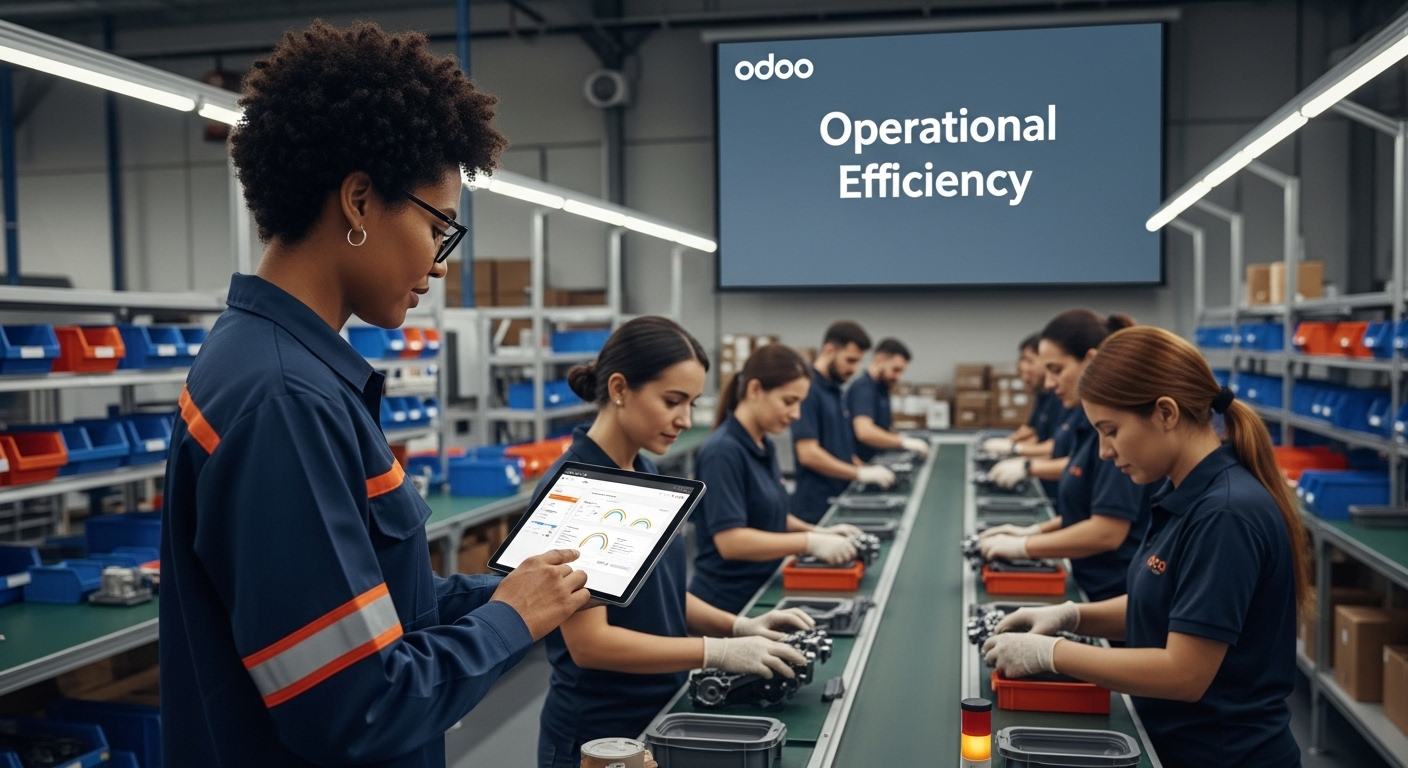
Odoo ERP factory efficiency

Operational Performance Enhancement

The practical advantages of implementing Odoo ERP in lean manufacturing contexts extend across multiple critical business dimensions:

  • Inventory Precision: Reducing excess stock and associated carrying costs
  • Production Flexibility: Rapidly adapting manufacturing schedules to demand changes
  • Resource Allocation: Optimizing human and material resources with unprecedented accuracy
  • Waste Minimization: Identifying and eliminating inefficiencies in real time
  • Cost Reduction: Streamlining processes to decrease overall operational expenses

Granular data tracking represents a fundamental breakthrough, allowing manufacturers to make informed decisions based on comprehensive, instantaneous insights. This capability transforms traditional reactive management into a proactive, predictive approach.

Strategic Business Transformation

Explore advanced warehouse management strategies that demonstrate how technology can revolutionize manufacturing operations. Odoo’s integrated platform goes beyond traditional ERP functionality, serving as a strategic partner in organizational transformation.

By connecting multiple operational modules including procurement, inventory, production, and sales, Odoo creates a holistic ecosystem where every process contributes to continuous improvement. Manufacturers gain the ability to implement lean principles with technological precision, reducing manual interventions and minimizing human error.

Ultimately, Odoo ERP empowers businesses to transcend traditional manufacturing limitations. It provides a robust, flexible framework that supports lean and JIT methodologies, enabling organizations to compete more effectively in increasingly complex global markets.

Unlock Real Results With Odoo ERP and Bista Solutions

Struggling to bring true lean manufacturing and Just-in-Time (JIT) efficiency to your production floor? Many companies hit roadblocks when trying to minimize waste, streamline data, or react quickly to market changes. This article explained how the integration of Odoo ERP with lean and JIT strategies solves these challenges by connecting processes, cutting inefficiencies, and delivering actionable insights. But success depends on the right expertise and technology partner.


    Experience what seamless implementation feels like. Bista Solutions is the largest Odoo ERP partner in North America with a proven record of transforming operations through comprehensive manufacturing execution and advanced warehouse management strategies. Our award-winning team has helped 350+ companies achieve real-time inventory precision and flexible production with Odoo. Ready to finally achieve your lean and JIT goals? Contact Bista Solutions now and see how we can turn efficiency into your competitive edge.

    Frequently Asked Questions

    What is Odoo ERP and how does it relate to lean manufacturing?

    Odoo ERP is an integrated software solution that helps businesses optimize their operational processes. It aligns with lean manufacturing principles by providing tools for waste reduction, real-time data tracking, and continuous improvement.

    How does Odoo ERP support Just-in-Time (JIT) manufacturing?

    Odoo ERP supports JIT manufacturing by allowing businesses to maintain minimal inventory levels, produce items based on immediate demand, and streamline supply chain processes to minimize waste.

    What are the key features of Odoo ERP that enhance lean manufacturing?

    Key features include real-time inventory tracking, automated production planning, waste identification through analytics, and performance measurement capabilities that promote continuous improvement in manufacturing operations.

    Can Odoo ERP be customized to fit specific lean manufacturing needs?

    Yes, Odoo ERP’s modular architecture allows for extensive customization, enabling businesses to tailor the platform to their unique operational workflows and lean manufacturing practices.

    DEA Compliance

    DEA Compliance with Odoo ERP
    • by Uzlifat Mir
    • Sep 16, 2025
    • 0
    • Category:

    DEA Compliance

    Why DEA Compliance Matters

    The Controlled Substances Act (CSA) gives the Drug Enforcement Administration (DEA) authority over the management of controlled substances. This responsibility covers registration, licensing, record-keeping, reporting, storage, security, and disposal. In simple terms, the DEA ensures that any organization or individual handling controlled substances does so under strict rules to protect public safety.

    Pharmacies and prescribing practices must maintain complete and accurate inventories of all prescription drugs. These records must not only be kept up to date at all times but also preserved for at least two years. Failure to comply with these requirements can lead to serious consequences, including civil fines and the loss of DEA registration.

    Whether a drug is being prescribed in a clinic, dispensed at a pharmacy, or stored in a healthcare facility, compliance with the CSA is mandatory.

    Core Compliance Requirements

    Registration: Any provider who wishes to prescribe or handle controlled substances must be registered with the DEA in the state or jurisdiction where they practice. Without registration, prescribing controlled substances is not legally permitted.

    Record-keeping: Every DEA registrant is responsible for keeping detailed and accurate records of all controlled substances they manufacture, receive, distribute, sell, or dispose of. This includes documenting every step, from procurement to dispensing. Common compliance failures often stem from incomplete or inaccurate records, which is why systems like our Portal are designed to support error-free documentation.

    Accurate record-keeping means tracking inventory levels, expiration dates, dispensing histories, and patient information. Prescriptions must meet federal requirements, clearly specifying drug quantities, patient details, and storage locations. This level of precision reduces risks and ensures compliance.

    Security: Our Portal enhances security by requiring prescribers to digitally sign prescriptions using a NIST-validated cryptographic module. Prescription data is encrypted and decrypted through trusted hashing, ensuring integrity.

    In addition, every prescriber must use DEA-compliant two-factor authentication before issuing controlled prescriptions. We integrate Identrust with the HID Approve app for secure 2FA. The Portal automatically handles refill limits and enforces federal and state rules. All activity is logged at both the record and field level, creating reliable audit trails.

    Key DEA EPCS Compliance Features

    To meet Electronic Prescriptions for Controlled Substances (EPCS) requirements, the system incorporates several safeguards:

    • Role-based access controls
    • Configurable user permissions
    • Digital signing and secure archiving
    • Validated cryptographic modules
    • Prescriber DEA number display
    • Controlled access to prescription data
    • Comprehensive audit logs
    • Secure backups with long-term retention
    • Full system certification

    Security and Oversight

    Access Control: Role-based access ensures that only authorized individuals, such as prescribers and pharmacists, can create, modify, or dispense prescriptions. Each user’s access rights are tailored to their responsibilities, preventing misuse of sensitive functions.

    Digital Signing and Validation: Every prescription must be digitally signed to verify authenticity. The system uses government-approved cryptographic modules to confirm the validity of each signature. Any missing or invalid signatures are flagged as compromised.

    Dispensing Controls: The system enforces strict federal rules for controlled substances. Schedule II prescriptions cannot be refilled, while Schedule III and IV prescriptions can only be refilled as permitted by law. Any attempt to exceed these limits is automatically blocked.

    Audit and Reporting: The Portal tracks every significant event, including prescription creation, modification, and access attempts. Logs capture user IDs, timestamps, and actions taken. Security incidents such as failed logins are also recorded. Audit logs are securely maintained for at least two years, ensuring they are available for investigations or compliance reviews.

    System Reliability: All records are time-stamped using synchronized NIST-approved sources to maintain accuracy. Prescriptions are backed up securely to prevent data loss from technical failures or cyberattacks. If the system is hosted externally, the service provider must uphold strong safeguards for reliability and accuracy.

    Safeguarding Trust Through Compliance

    DEA compliance is more than a regulatory requirement; it is a framework that protects patient safety, preserves prescription integrity, and upholds accountability in healthcare. A secure prescription management system must integrate accurate record-keeping, strong access controls, digital verification, and detailed audit tracking. By combining these measures, providers can operate confidently, knowing they meet both federal standards and ethical responsibilities.

    At Bista Solutions, we understand the complexity of maintaining strict DEA compliance and the risks that come with even minor oversights. Our solutions are built to support secure prescription workflows, robust record-keeping, and audit-ready reporting, all while streamlining day-to-day operations for healthcare providers. Whether you are looking to strengthen your existing systems or implement a new compliance framework, Bista has the tools and expertise to make it happen. 

    Contact us to learn more about how we can help your organization achieve and sustain DEA compliance.

    Understanding The Hidden Costs of ERP Implementation: A Guide to Budgeting. Why Bista Solutions is Better ERP Implementor and Don’t Hide Any ERP Cost

    ERP implementation hidden costs

    ERP implementation sounds like a straightforward tech upgrade every company should eventually tackle. But here’s a shocker. Nearly half of all ERP projects run into hidden costs and unplanned budget overruns. Most leaders expect a simple digital transformation yet find themselves caught by surprise expenses and complex organizational changes. The real story is not just about installing software. It’s about navigating unpredictable financial waters that can either sink your project or turn it into a strategic advantage if you know where to look.

    Table of Contents

    Quick Summary

    Takeaway Explanation
    ERP implementation is complex and strategic. It involves more than just software; it requires careful planning, alignment, and integration of business processes.
    Understand hidden costs in ERP projects. Consider expenses like staff training, system integration, and productivity losses, which often exceed initial budget estimates.
    Plan for budget flexibility. Comprehensive financial forecasting is essential to accommodate unexpected costs and ensure a smoother implementation process.
    Choose the right ERP implementation partner. Selecting experienced consultants can enhance your implementation success by aligning technology with organizational culture and goals.
    Learn from real-world ERP challenges. Analyzing case studies can prepare businesses for potential financial surprises and complexities in their own implementation journeys.

    What is ERP Implementation and Why It Matters

    Enterprise Resource Planning (ERP) implementation represents a comprehensive digital transformation strategy that enables businesses to centralize and streamline their operational processes across multiple departments. At its core, ERP implementation involves deploying an integrated software system that connects various business functions like finance, human resources, supply chain management, and customer relationship management into a single, unified platform.

    Understanding ERP Implementation Complexity

    ERP implementation is far more than just installing new software. It is a strategic process that requires careful planning, organizational alignment, and significant technological infrastructure. Businesses undertake this complex journey to achieve several critical objectives:

    • Consolidate disparate business processes into a single, integrated system
    • Enhance operational efficiency and reduce manual data entry
    • Provide real-time insights and reporting capabilities
    • Standardize workflows across different organizational units

    Implementing an ERP system demands substantial investments in technology, training, and organizational change management. Companies must carefully evaluate their current processes, identify potential gaps, and design a comprehensive implementation strategy that minimizes disruption while maximizing technological benefits.

    The Strategic Importance of ERP Implementation

    Modern businesses operate in an increasingly complex and competitive environment where agility and information accuracy are paramount. Learn more about our comprehensive ERP implementation approach to understand how Bista Solutions transforms technological challenges into strategic opportunities.

    ERP systems serve as the technological backbone for organizations, enabling them to make data-driven decisions quickly and efficiently. By integrating multiple business functions into a cohesive platform, companies can:

    • Reduce operational redundancies
    • Improve cross-departmental communication
    • Enhance financial reporting and compliance
    • Scale business processes more effectively

    While ERP implementation represents a significant undertaking, the potential benefits far outweigh the initial challenges. Organizations that successfully implement ERP solutions gain a competitive advantage through improved operational visibility, streamlined processes, and the ability to adapt rapidly to changing market dynamics.

    Choosing the right implementation partner becomes crucial in this transformative journey. Experienced ERP consultants like Bista Solutions understand that successful implementation goes beyond technical deployment and requires a holistic approach that considers organizational culture, existing workflows, and long-term strategic goals.

    Identifying Hidden Costs in ERP Implementation

    ERP implementation involves substantial financial investments that extend far beyond the initial software licensing and deployment expenses. Many organizations underestimate the comprehensive financial commitment required for a successful digital transformation, leading to budget overruns and unexpected financial strain.

    Unseen Expenses in ERP Implementation

    Businesses often focus on direct software costs while overlooking the multifaceted financial implications of comprehensive ERP integration. Learn more about detailed ERP implementation cost breakdown to understand the nuanced financial landscape of enterprise technology investments.

    The hidden costs of ERP implementation typically emerge across several critical areas:

    • Extensive staff training and skill development programs
    • Custom software configuration and integration expenses
    • Data migration and system compatibility investments
    • Hardware infrastructure upgrades
    • Potential productivity losses during transition periods

    Financial Impact and Strategic Considerations

    Enterprise technology transformation requires a holistic financial perspective that goes beyond simple software acquisition. Organizations must anticipate and budget for indirect expenses that can significantly impact overall implementation costs. These expenses often include:

    • Organizational change management initiatives
    • Ongoing technical support and maintenance
    • Potential consultant and implementation partner fees
    • Additional software modules or functionalities
    • Continuous employee skill enhancement

    Successful ERP implementation demands a comprehensive financial strategy that accounts for both immediate and long-term investments. Proactive financial planning involves creating flexible budgets that accommodate unexpected challenges and technological adaptations.

    Enterprise leaders must recognize that ERP implementation is not a one-time expense but a continuous investment in organizational efficiency and technological capabilities.

    Below is a comparison table summarizing common hidden ERP implementation costs and their impacts, helping readers visualize areas that often lead to budget overruns.

    Hidden Cost Category Description Potential Impact
    Staff Training Expenses for upskilling employees on new ERP systems Increased project duration and costs
    Custom Configuration & Integration Costs for adapting ERP to unique business requirements Scope creep and higher technical expenses
    Data Migration Resources for transferring and validating legacy data Project delays and unexpected fees
    Hardware Upgrades Investment in servers and technical infrastructure Capital outlay beyond software costs
    Productivity Loss During Transition Reduced efficiency as teams adjust to new processes Short-term revenue or operational impact
    Change Management Initiatives Programs to support organizational adaptation Extra consulting and training fees
    Ongoing Support & Maintenance Post-launch technical support and system updates Continued operational expenditure

    The Impact of Underestimating ERP Budgets

    Underestimating ERP implementation budgets can create significant financial and operational challenges for organizations. What begins as a strategic technological investment can quickly transform into a complex and costly endeavor that strains organizational resources and disrupts business continuity.

    Financial Risks of Budget Miscalculation

    The consequences of inadequate budget planning extend far beyond simple monetary constraints. Learn more about ERP implementation considerations for specific industries to understand the nuanced financial implications across different business contexts.

    Businesses that fail to comprehensively assess implementation costs often encounter substantial financial risks:

    • Unexpected technology integration expenses
    • Extended implementation timelines
    • Increased consulting and technical support fees
    • Potential operational disruptions
    • Unplanned software customization costs

    Operational and Strategic Implications

    Budget underestimation can trigger a cascading series of operational challenges that compromise an organization’s technological transformation objectives. The financial strain created by unexpected expenses can lead to:

    • Reduced implementation scope
    • Compromised system functionality

    Poor financial planning transforms ERP implementation from a strategic investment into a potential organizational liability. Comprehensive budget forecasting becomes crucial in mitigating potential risks and ensuring successful technological integration.

    Successful ERP implementation requires a holistic approach that anticipates potential financial challenges and creates flexible budgetary frameworks. Organizations must move beyond traditional linear budgeting models and develop dynamic financial strategies that accommodate technological complexity and organizational variability.

    Enterprise leaders must recognize that ERP budgets are not static documents but living financial frameworks that require continuous refinement and strategic adaptation. By adopting a proactive and comprehensive approach to financial planning, businesses can transform potential budget challenges into opportunities for technological innovation and organizational growth.

    Bista Solutions: Transparency in ERP Costs

    Bista Solutions distinguishes itself in the ERP implementation landscape through an unwavering commitment to financial transparency and comprehensive cost management. By prioritizing clear communication and detailed cost breakdowns, the company helps organizations navigate the complex financial terrain of enterprise technology investments.

    A Holistic Approach to Cost Transparency

    Discover our top strategies for managing ERP implementation costs and understand how Bista Solutions transforms potential financial challenges into strategic opportunities. The company’s approach goes beyond traditional implementation models by providing clients with:

    • Comprehensive initial cost assessments
    • Detailed breakdown of direct and indirect expenses
    • Proactive financial risk management strategies
    • Continuous budget tracking and optimization
    • Transparent communication throughout the implementation process

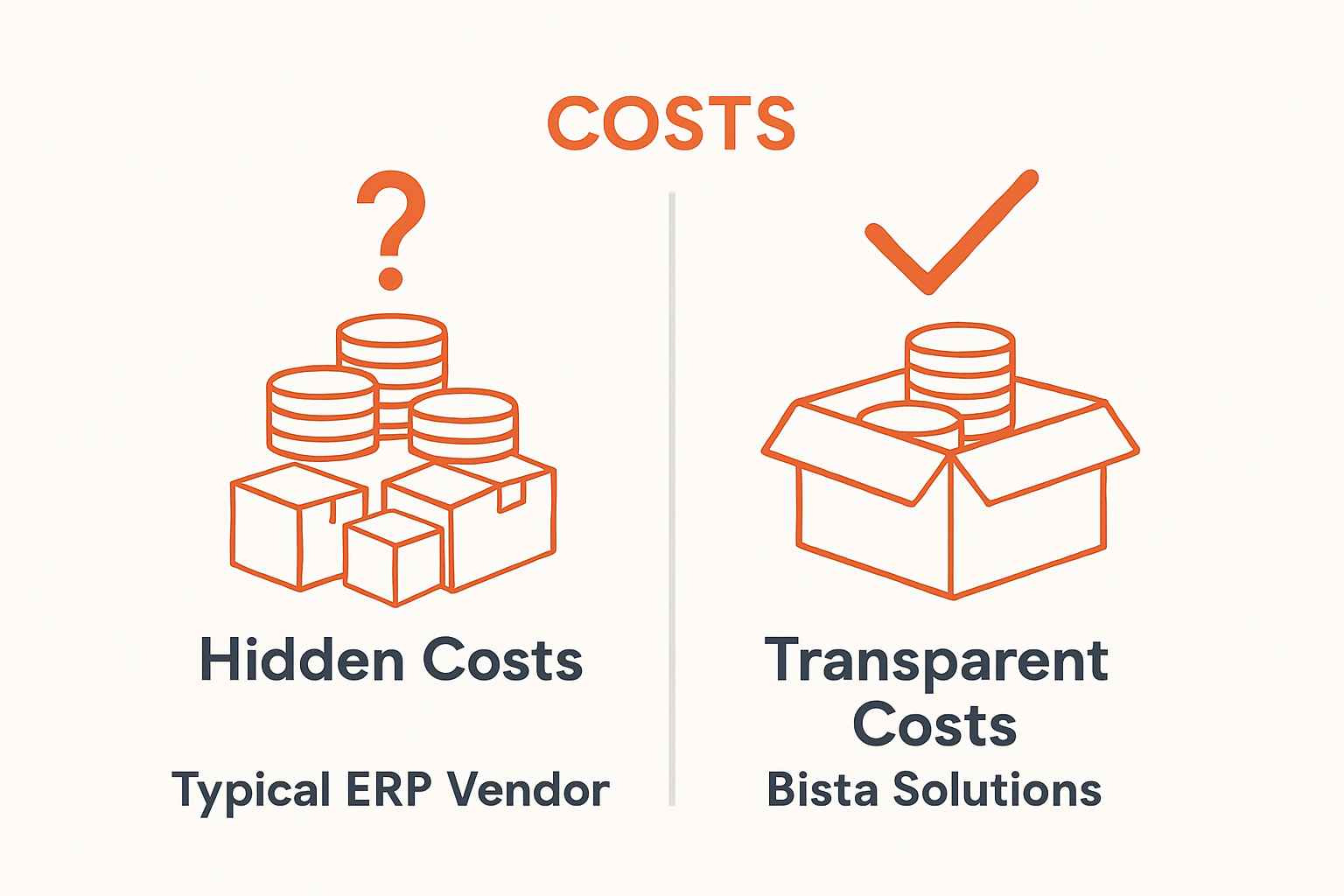
    Infographic comparing ERP hidden costs versus transparent costs

    Mitigating Financial Uncertainties

    Bista Solutions recognizes that ERP implementation represents a significant organizational investment. The company’s unique methodology focuses on eliminating financial surprises by developing meticulously crafted implementation frameworks that account for potential variabilities and unexpected challenges.

    Key elements of Bista Solutions’ transparent cost management include:

    • Preliminary comprehensive financial assessments
    • Customized budgeting frameworks
    • Regular financial progress reporting
    • Adaptive cost management strategies
    • Detailed post-implementation financial reviews

    By providing clients with a clear, predictable financial pathway, Bista Solutions transforms ERP implementation from a potentially risky venture into a strategic, well-managed technological investment. The company’s commitment to transparency ensures that organizations can make informed decisions, minimize financial risks, and achieve their technological transformation objectives with confidence.

    Enterprise leaders seeking a reliable ERP implementation partner will find Bista Solutions’ approach refreshingly direct and strategically comprehensive.

    The following table compares Bista Solutions’ approach to ERP cost transparency with common industry practices, highlighting how Bista addresses financial uncertainties that often challenge organizations.

    Aspect Typical Industry Approach Bista Solutions Approach
    Initial Cost Assessment Limited or high-level estimate Comprehensive and detailed breakdown
    Expense Transparency Often unclear, possible hidden charges Full disclosure of direct & indirect expenses
    Budget Tracking Infrequent updates Regular progress reporting
    Risk Management Reactive to challenges Proactive, adaptive strategic planning
    Communication Ad hoc or only when issues arise Continuous and transparent communication
    Post-Implementation Review Rarely included Detailed post-implementation financial review

    ERP cost transparency meeting

    Real-World Examples of ERP Cost Surprises

    Real-world ERP implementation experiences reveal the complex financial challenges organizations encounter when transitioning to integrated enterprise systems. These case studies underscore the critical importance of comprehensive budget planning and anticipating potential hidden expenses.

    Unexpected Financial Challenges

    Recognize the signs that indicate your business needs an ERP system to understand the potential transformative and financial implications of technological investments. Organizations across various sectors have experienced significant budget overruns due to unforeseen implementation complexities:

    • Higher education institutions reporting 30-50% budget increases
    • Government agencies experiencing multi-million dollar cost escalations
    • Manufacturing companies encountering substantial unexpected integration expenses
    • Healthcare organizations facing extended implementation timelines
    • Financial service providers struggling with customization costs

    Financial Impact Analysis

    Multiple organizations have documented substantial financial challenges during ERP implementation. Comprehensive cost surprises often emerge through several critical areas:

    • Underestimated training and change management expenses
    • Complex data migration requirements
    • Extensive system customization needs
    • Additional hardware and infrastructure investments
    • Prolonged implementation periods

    These real-world examples demonstrate that ERP implementation is rarely a straightforward process. Financial surprises can dramatically impact an organization’s technological transformation strategy, potentially compromising operational efficiency and strategic objectives.

    Successful ERP implementation requires a proactive approach that anticipates potential financial challenges. Organizations must develop flexible budgetary frameworks, maintain open communication channels with implementation partners, and continuously reassess technological investment strategies.

    Enterprise leaders must recognize that ERP implementation represents a complex, multifaceted financial journey. By learning from others’ experiences and adopting a strategic, comprehensive approach to budgeting, businesses can minimize financial risks and maximize technological investment returns.

    Take the Guesswork Out of ERP Costs With Bista Solutions

    Many organizations begin their ERP journey only to discover hidden costs and financial surprises that threaten their budgets and progress. If you have struggled with confusing quotes or unexpected expenses during ERP implementation, you are not alone. The article reveals how underestimated budgets, unclear financial planning, and surprise fees can hold your business back. Our proven transparency and dedication eliminate these unknowns so you can focus on results.

      Let Bista Solutions show you what real cost clarity looks like. As the largest Odoo ERP implementer in North America and a recognized Odoo Gold Partner, we break down each expense so there are no unpleasant surprises. We offer a detailed approach from initial assessment through to support, helping you make strategic decisions with confidence. Want to understand exactly what you will invest and why? Discover our transparent ERP cost management or contact our team now for your comprehensive cost breakdown. If you are ready to protect your budget and accelerate success, reach out today.

      Frequently Asked Questions

      What are the hidden costs associated with ERP implementation?

      Hidden costs can include extensive staff training, custom software configuration, data migration expenses, hardware upgrades, and potential productivity losses during the transition period.

      How can businesses effectively budget for ERP implementation?

      Businesses should conduct a comprehensive financial assessment, anticipate indirect expenses, and create flexible budgets that accommodate unexpected challenges to ensure successful ERP implementation.

      Why is it important to choose the right ERP implementation partner?

      Choosing the right partner like Bista Solutions is crucial as they provide a holistic approach, considering organizational culture, existing workflows, and long-term strategic goals while ensuring transparency in cost management.

      What can organizations do to mitigate financial uncertainties during ERP implementation?

      Organizations can mitigate financial uncertainties by developing meticulous budgeting frameworks, maintaining clear communication with implementation partners, and continuously reassessing financial strategies throughout the implementation process.

      ERP Vendor Evaluation: 20 Must-Ask Questions to Consider

      ERP vendor evaluation, business meeting, team decision

      Choosing the right ERP software is a turning point for any organization looking to grow and stay competitive. Companies face thousands of options, yet hidden costs often make up 70-80 percent of the total investment after the initial purchase. Most leaders assume only the sticker price really matters. The truth is, small oversights in things like support or training can quietly turn a smart investment into a headache that drags your business down.

      Table of Contents

      Quick Summary

      Takeaway Explanation
      Understand your ERP needs first. Assess your organization’s specific requirements to ensure a suitable ERP selection and implementation.
      Evaluate ERP flexibility carefully. The software should adapt to your business processes without extensive coding, ensuring long-term compatibility.
      Analyze total cost of ownership. Look beyond initial costs to include implementation, training, and ongoing maintenance expenses in your budgeting.
      Prioritize strong customer support. Choose vendors with robust support structures that provide proactive assistance and comprehensive resources.
      Examine scalability of the solution. Ensure the ERP can grow with your business, adapting to increased complexity without requiring major overhauls.

      1: What are your company’s specific ERP needs?

      Before selecting an ERP vendor, understanding your organization’s unique requirements is crucial. Every business operates differently, and a one-size-fits-all approach can lead to significant implementation challenges and wasted resources.

      Starting with a comprehensive internal assessment helps identify the precise functionalities and capabilities your organization needs. This process involves analyzing current business processes, pain points, and strategic objectives. Conducting a thorough needs assessment requires collaboration across multiple departments to capture a holistic view of organizational requirements.

      Key areas to evaluate include:

      • Financial management and reporting needs
      • Inventory and supply chain tracking capabilities
      • Human resources and workforce management requirements
      • Customer relationship management integration
      • Manufacturing and production process automation

      Successful ERP implementation begins with understanding your specific operational challenges. Engage stakeholders from finance, operations, IT, and other critical departments to map out existing workflows and identify areas requiring improvement. Learn more about our comprehensive ERP implementation approach to guide your evaluation process.

      Documenting these requirements creates a clear blueprint for vendor selection. Each organization will have unique priorities, whether it’s improving financial reporting, streamlining inventory management, or enhancing customer engagement. By defining these needs upfront, you can ensure the selected ERP solution aligns precisely with your business objectives and growth strategies.

      2: How flexible is the ERP software?

      Flexibility is a critical consideration when evaluating ERP software. Not all ERP solutions are created equal, and the ability to adapt to your unique business processes can significantly impact long-term success and return on investment.

      A truly flexible ERP system should offer robust customization options that allow you to modify workflows, reports, and interfaces without extensive coding or external support. This means the software can grow and evolve alongside your business, accommodating changing operational requirements and industry dynamics.

      Key flexibility indicators include:

      • Ability to add or modify modules without complete system redesign
      • Customizable dashboards and reporting tools
      • Support for multiple business units and operational models
      • Scalable architecture that can handle business growth

      Technological adaptability is equally important. Modern ERP solutions should integrate seamlessly with existing software systems, support cloud and on-premise deployments, and provide APIs for custom integrations. Check out our detailed guide on ERP system requirements to understand more about system compatibility.

      When assessing ERP flexibility, consider both immediate needs and potential future scenarios. A system that appears adequate today might become restrictive as your business expands or pivots. Engage with potential vendors to understand their customization capabilities, upgrade paths, and long-term support strategies. Robust ERP solutions should offer configuration options that allow you to tailor the system without compromising core functionality or requiring extensive manual intervention.

      3: What is the total cost of ownership?

      Total cost of ownership represents far more than the initial software licensing fee. Business leaders must look beyond surface-level pricing and understand the comprehensive financial investment required for successful ERP implementation and maintenance.

      Companies frequently underestimate the multifaceted expenses associated with enterprise resource planning systems. These costs extend well beyond software purchase and include critical components that impact long-term financial planning.

      Key cost considerations include:

      • Initial software and hardware acquisition expenses
      • Implementation and configuration fees
      • Staff training and change management costs
      • Ongoing maintenance and support subscriptions
      • Potential customization and integration expenses

      Hidden expenses can quickly accumulate, making thorough financial assessment crucial. Implementation typically represents only 20-30% of the total investment, with recurring annual expenses consuming a significant portion of technology budgets. Organizations should anticipate potential costs related to system upgrades, additional user licenses, and potential performance optimization requirements.

      Learn more about strategic ERP investment planning to develop a comprehensive financial strategy. Transparent discussions with potential vendors about long-term costs, scalability, and potential return on investment are essential. A robust ERP solution should not only meet current operational needs but also provide measurable economic value that justifies its comprehensive financial commitment.

      4: How is customer support structured?

      Effective customer support is a critical component of any ERP implementation, yet its structure varies significantly among vendors. Understanding the depth and quality of support services can make or break your long-term software experience.

      A comprehensive support framework goes beyond basic troubleshooting. Organizations should seek vendors that offer multi-tiered support options addressing technical challenges, user training, and strategic guidance. The most robust support models provide proactive assistance that anticipates potential issues before they disrupt business operations.

      Key support structure considerations include:

      • Availability of 24/7 technical assistance
      • Multiple communication channels (phone, email, chat)
      • Dedicated account management
      • Response time guarantees for different severity levels

      Technical expertise matters immensely. Your support team should demonstrate deep understanding of your industry’s specific challenges and the ability to provide nuanced solutions. Explore our comprehensive ERP services and support approach to understand what world-class support looks like.

      Beyond immediate technical resolution, exceptional support includes continuous learning resources, regular system updates, and strategic consultations that help businesses maximize their ERP investment. Evaluate potential vendors not just on their ability to fix problems, but on their commitment to your organization’s long-term technological success and operational efficiency.

      5: What is the vendor’s implementation timeline?

      Implementation timelines are critical decision-making factors when selecting an ERP solution. A well-structured, realistic implementation plan can mean the difference between a smooth digital transformation and a prolonged, costly disruption.

      Vendors should provide a transparent, detailed roadmap that outlines each phase of the implementation process. This roadmap must account for your organization’s unique complexity, existing technological infrastructure, and specific business requirements.

      Key implementation timeline considerations include:

      • Comprehensive discovery and requirements gathering phase
      • Realistic migration and configuration expectations
      • Training and change management schedules
      • Potential go-live dates and contingency planning

      Realistic timelines typically range from 4 to 18 months, depending on organizational size and system complexity. Smaller businesses might complete implementation within 4-6 months, while large enterprises could require 12-18 months for a comprehensive rollout. Explore our detailed vendor implementation strategies to understand potential timeframes.

      Beyond the schedule, assess the vendor’s implementation methodology. Do they offer a phased approach? Can they demonstrate successful implementations in your industry? Experienced vendors will provide clear milestones, regular progress updates, and a structured approach that minimizes business disruption. Remember that an aggressive timeline isn’t always better – thoroughness and accuracy matter more than speed.

      6: Can you provide client testimonials or case studies?

      Client testimonials and case studies offer invaluable insights into an ERP vendor’s real-world performance and implementation capabilities. These documented experiences provide a transparent window into the vendor’s strengths, potential challenges, and actual results achieved by organizations similar to yours.

      When evaluating testimonials, look beyond generic praise and seek substantive narratives that demonstrate measurable business improvements. Credible case studies should highlight specific challenges, implementation strategies, and quantifiable outcomes. Pay attention to details that reflect your organization’s potential pain points and strategic objectives.

      Key elements to scrutinize in client testimonials include:

      • Specific industry relevance
      • Measurable business performance improvements
      • Technical challenges successfully addressed
      • Return on investment metrics

      Learn more about our implementation methodologies and how we approach client success. Authentic testimonials should provide a nuanced perspective, revealing not just the positive aspects but also how the vendor navigated complex implementation challenges.

      Request references from clients with similar business scale, industry, and technological complexity. Direct conversations with these references can uncover insights that written testimonials might not fully capture. A reputable vendor will be transparent, offering multiple reference points and encouraging direct dialogue to validate their claims of success.

      7: How often are updates and new features released?

      Technology evolves rapidly, and your ERP system must keep pace with emerging business challenges and technological advancements. Understanding a vendor’s update frequency and feature release strategy is crucial for long-term digital transformation and operational efficiency.

      Modern ERP solutions should demonstrate a consistent commitment to innovation, offering regular updates that address security vulnerabilities, introduce performance improvements, and integrate cutting-edge technologies. The ideal vendor provides predictable, transparent update cycles that minimize disruption while continuously enhancing system capabilities.

      Key considerations for evaluating update strategies include:

      • Predictability of release schedules
      • Complexity of update implementation
      • Backward compatibility of new features
      • Impact on existing customizations

      Explore our approach to continuous system improvement and understand how we manage technological evolution. Reputable vendors typically offer quarterly or bi-annual major updates, supplemented by monthly security patches and minor enhancements. These updates should not only introduce new functionalities but also demonstrate a strategic roadmap aligned with emerging industry trends like artificial intelligence, machine learning, and advanced analytics.

      Additionally, evaluate the vendor’s communication process during updates. Transparent documentation, advance notification, and comprehensive change logs are indicators of a mature, customer-centric update strategy that respects your organization’s operational continuity.

      8: What are the data security measures in place?

      Data security is not an optional feature but a critical requirement for modern enterprise systems. Organizations must scrutinize potential ERP vendors’ comprehensive security strategies to protect sensitive business information from evolving cyber threats.

      A robust security framework extends far beyond basic password protection. Sophisticated ERP solutions implement multi-layered security approaches that safeguard data throughout its entire lifecycle, from storage to transmission and access.

      Key data security considerations include:

      • Advanced encryption protocols
      • Role-based access controls
      • Regular security vulnerability assessments
      • Comprehensive audit logging mechanisms

      Learn about preventing potential data breaches and understanding comprehensive security strategies. Modern ERP vendors should demonstrate compliance with international security standards like ISO 27001, offering features such as multi-factor authentication, advanced intrusion detection systems, and real-time threat monitoring.

      Beyond technological measures, evaluate the vendor’s incident response protocols. A mature security approach includes transparent communication about potential vulnerabilities, rapid patch deployment, and proactive threat mitigation strategies. Your chosen ERP solution should provide granular control over data access, ensuring that employees can only view and interact with information directly relevant to their organizational roles.

      9: How does the ERP handle integrations with existing tools?

      Seamless system integration is fundamental to modern business technology. An effective ERP solution must communicate effortlessly with your existing software ecosystem, ensuring data flows smoothly and eliminating manual intervention.

      Integration capabilities represent more than technical compatibility – they are the nervous system connecting different organizational technologies. Your ERP should act as a central hub, enabling real-time data exchange across various platforms without disrupting established workflows.

      Key integration considerations include:

      • API availability and flexibility
      • Support for standard communication protocols
      • Real-time data synchronization capabilities
      • Compatibility with legacy and modern systems

      Explore how AI is transforming ERP integration strategies and understand the future of intelligent system connectivity. Robust ERP solutions offer comprehensive integration frameworks that support multiple connection methods, including REST APIs, webhooks, and enterprise service bus architectures.

      Beyond technical specifications, evaluate the vendor’s integration philosophy. A forward-thinking ERP provider will not just offer connection points but provide strategic guidance on optimizing your technological ecosystem. They should demonstrate experience integrating with systems similar to yours and offer clear documentation, support resources, and potentially pre-built connectors for common business applications.

      10: What kind of training is available for your team?

      Effective training determines the success of your ERP implementation. A comprehensive training strategy transforms software from a complex tool into a powerful business enabler, ensuring your team can leverage the system’s full potential.

      Training should extend beyond basic button clicking, focusing on practical application of system capabilities within your specific business context. The most valuable training programs bridge the gap between technical functionality and real-world operational scenarios.

      Key training considerations include:

      • Variety of learning formats (online, in-person, video tutorials)
      • Role-specific training modules
      • Ongoing learning and skill development resources
      • Certification programs for advanced users

      Discover our approach to comprehensive ERP training and support to understand how we empower teams. Exceptional vendors offer multi-tiered training solutions that accommodate different learning styles, from hands-on workshops to self-paced online modules.

      Beyond initial implementation, look for vendors providing continuous learning opportunities. The best training programs include periodic refresher courses, advanced user workshops, and resources that evolve with system updates. Your chosen ERP partner should demonstrate a commitment to your team’s long-term skill development, ensuring your organization remains technologically agile and proficient.

      11: How scalable is the ERP solution?

      Scalability represents the heartbeat of future-proof enterprise technology. Your ERP solution must adapt dynamically to your organization’s evolving business landscape, expanding seamlessly as operational complexity grows and market demands shift.

      Genuine scalability transcends simple user or transaction volume increases. It encompasses the system’s ability to maintain performance, integrate new functionalities, and support increasingly sophisticated business processes without requiring complete system redesign or disruptive migrations.

      Key scalability considerations include:

      • Cloud and on premise deployment flexibility
      • Performance under increased computational load
      • Module addition without system disruption
      • Cost effectiveness of scaling infrastructure

      Explore how intelligent automation transforms scalable business solutions and understand technological adaptability. A truly scalable ERP solution provides architectural flexibility, allowing organizations to add users, integrate new departments, or expand into additional markets without compromising system integrity or performance.

      Beyond technical specifications, evaluate the vendor’s track record of supporting organizational growth. The most robust ERP platforms offer modular architectures that enable incremental expansion, sophisticated data management capabilities, and seamless integration potential. Your chosen solution should feel less like a rigid system and more like an adaptive technological ecosystem that evolves in lockstep with your business strategy.

      12: What customization options are available?

      Customization represents the bridge between standard software and your unique business requirements. Not all ERP solutions offer the same level of adaptability, making it crucial to understand the extent and complexity of potential modifications.

      Effective customization goes beyond surface level adjustments, enabling organizations to align software precisely with their operational workflows. The goal is not wholesale system transformation but strategic, targeted enhancements that amplify existing capabilities.

      Key customization considerations include:

      • Configurability of user interfaces
      • Ability to create custom workflows
      • Flexibility in reporting and dashboard design
      • Integration with existing business processes

      Discover intelligent approaches to ERP system customization and understand the potential of adaptive technologies. Sophisticated ERP platforms provide multiple customization layers, allowing businesses to modify system behavior without compromising core functionality or future upgrade potential.

      Beyond technical capabilities, evaluate the vendor’s philosophy toward customization. The most progressive ERP solutions offer modular architectures that support targeted modifications, providing configuration tools that empower business users to adapt systems without extensive coding knowledge. Your chosen solution should feel like a flexible framework that can be precisely tuned to your organizational DNA.

      13: How does the vendor handle downtime or outages?

      System reliability is the foundation of enterprise technology. Understanding a vendor’s approach to managing downtime and potential system outages is crucial for maintaining continuous business operations and minimizing potential financial losses.

      Robust incident management goes beyond simple reactive measures. The most dependable ERP vendors provide comprehensive strategies that include proactive monitoring, rapid response protocols, and transparent communication during unexpected system interruptions.

      Key considerations for evaluating downtime management include:

      • Guaranteed system uptime percentages
      • Documented incident response timelines
      • Automated failover and recovery mechanisms
      • Clear communication protocols during outages

      Explore our comprehensive approach to system reliability and understand how we minimize operational disruptions. Leading vendors offer service level agreements (SLAs) that specify precise response times, provide real-time system status updates, and demonstrate a commitment to minimizing potential business impact.

      Beyond technical specifications, evaluate the vendor’s historical performance in handling system interruptions. Transparent vendors will share detailed incident reports, demonstrate continuous improvement in their resilience strategies, and provide clear escalation paths for critical issues. Your chosen ERP solution should inspire confidence through its systematic approach to maintaining operational continuity.

      14: What analytics and reporting capabilities does it offer?

      Analytics transform raw data into strategic business intelligence, serving as the critical lens through which organizations make informed decisions. A robust ERP solution must offer more than basic reporting – it should provide intelligent, actionable insights that drive organizational performance.

      Modern analytics go beyond traditional dashboard presentations, integrating predictive modeling, real-time data visualization, and sophisticated trend analysis. The most advanced systems leverage artificial intelligence to uncover hidden patterns and generate forward-looking recommendations.

      Key analytics and reporting considerations include:

      • Customizable dashboard configurations
      • Real-time data visualization capabilities
      • Predictive modeling and trend analysis
      • Cross-departmental reporting functionality

      Discover how advanced analytics can transform your business insights and understand the power of intelligent reporting. Exceptional ERP platforms provide granular drill-down capabilities, enabling users to explore data from multiple perspectives and extract nuanced operational intelligence.

      Beyond technical features, evaluate the system’s ability to translate complex data into clear, actionable narratives. Your chosen ERP solution should empower decision makers with intuitive, comprehensive reporting tools that illuminate performance metrics, identify potential challenges, and highlight strategic opportunities across your entire organizational ecosystem.

      15: How mobile-friendly is the ERP system?

      Mobile accessibility has transformed enterprise technology, shifting from a convenience to a critical business requirement. Modern ERP solutions must provide seamless functionality across smartphones, tablets, and various mobile devices to support today’s dynamic workforce.

      True mobile friendliness extends beyond responsive design, encompassing comprehensive feature parity and intuitive user experiences tailored for smaller screens. The most advanced systems offer native mobile applications that replicate desktop capabilities without compromising performance or security.

      Key mobile accessibility considerations include:

      • Responsive user interface design
      • Full functional capabilities on mobile platforms
      • Offline data synchronization features
      • Touch-friendly navigation and interaction

      Learn more about our mobile ERP application strategies and understand how mobile technology can transform business operations. Exceptional mobile ERP solutions provide instantaneous access to critical business data, enabling real-time decision making regardless of physical location.

      Beyond technical specifications, evaluate the vendor’s commitment to mobile innovation. The ideal ERP platform should offer a consistent, secure, and powerful mobile experience that empowers users to manage complex business processes directly from their mobile devices, ensuring productivity is never constrained by physical boundaries.

      16: Are there limitations on users or data?

      Understanding system constraints is crucial for effective enterprise resource planning. Not all ERP solutions offer unlimited user access or unrestricted data management, making it essential to thoroughly examine potential limitations before implementation.

      Comprehensive user and data management go beyond simple numerical restrictions. Organizations must evaluate nuanced aspects of system architecture that could impact scalability, performance, and organizational flexibility.

      Key user and data limitation considerations include:

      • Maximum concurrent user capacity
      • Data storage volume restrictions
      • Role-based access control complexity
      • Performance degradation thresholds

      Explore strategic approaches to managing system limitations and understand how to optimize your technological infrastructure. Advanced ERP platforms provide granular control mechanisms that allow businesses to define precise user permissions, manage data access hierarchies, and maintain system performance under varying computational loads.

      Beyond technical specifications, assess how potential limitations might impact your long-term business strategy. The ideal ERP solution offers transparent documentation about system constraints, provides clear upgrade paths, and demonstrates flexibility in accommodating organizational growth. Your chosen system should feel like a dynamic framework that expands alongside your business needs, not a restrictive technological barrier.

      17: How does the software support compliance?

      Compliance is not a checkbox but a comprehensive organizational strategy, and your ERP system must serve as a robust technological guardian of regulatory requirements. Modern enterprises operate in increasingly complex regulatory landscapes, demanding sophisticated software solutions that proactively address compliance challenges.

      Effective compliance support transcends basic record-keeping, integrating intelligent monitoring, automatic documentation, and comprehensive audit trail capabilities. The most advanced ERP systems transform compliance from a potential liability into a strategic organizational advantage.

      Key compliance support considerations include:

      • Automated regulatory reporting mechanisms
      • Configurable audit logging capabilities
      • Role-based access control frameworks
      • Industry-specific compliance templates

      Explore our comprehensive approach to regulatory compliance and understand how technology can simplify complex compliance requirements. Sophisticated ERP solutions provide granular control mechanisms that enable organizations to demonstrate adherence to complex regulatory standards while maintaining operational efficiency.

      Beyond technical features, evaluate the vendor’s commitment to ongoing compliance evolution. The ideal ERP platform should offer flexible configuration options, regular updates reflecting changing regulatory landscapes, and transparent documentation that supports your organization’s compliance objectives across multiple jurisdictions and industry standards.

      18: What is the vendor’s market position?

      Market position represents more than simple industry rankings – it reflects a vendor’s ability to innovate, sustain long-term technological development, and consistently meet evolving business needs. Understanding a vendor’s market standing provides critical insights into their potential future performance and reliability.

      Strategic market evaluation goes beyond current market share, examining factors like research investment, customer satisfaction rates, and technological adaptability. The most resilient vendors demonstrate consistent growth, robust customer retention, and a forward-looking product development strategy.

      Key market position considerations include:

      • Total market share in ERP sector
      • Annual research and development investments
      • Customer retention and satisfaction rates
      • Innovation track record and product evolution

      Explore strategic approaches to vendor management and understand how to evaluate technological partnerships. Reputable vendors will provide transparent documentation about their market performance, including independent analyst reports, customer testimonials, and industry recognition.

      Beyond numerical metrics, assess the vendor’s reputation for customer support, technological adaptation, and commitment to continuous improvement. The ideal ERP partner should not just occupy a strong market position today, but demonstrate the strategic vision and technological agility to remain a leader in an increasingly dynamic business technology landscape.

      19: Are there community forums or user groups for support?

      Community forums represent far more than casual discussion platforms – they are critical knowledge ecosystems that provide real-world insights, troubleshooting strategies, and peer-to-peer learning opportunities for ERP users across diverse industries.

      Robust user communities transform software implementation from a technical challenge into a collaborative learning experience. These platforms enable organizations to leverage collective intelligence, sharing experiences and solutions that extend beyond vendor-provided documentation.

      Key community forum considerations include:

      • Active participation from experienced users
      • Regular knowledge sharing and problem-solving discussions
      • Vendor-moderated engagement channels
      • Diverse representation across industries and use cases

      Learn more about building effective support networks and understand the power of collaborative learning. Exceptional user groups offer not just technical support, but strategic insights into system optimization, emerging best practices, and innovative implementation approaches.

      Beyond online interactions, evaluate whether these communities host periodic conferences, webinars, or networking events. The most valuable user groups provide multiple engagement channels, allowing members to connect through forums, live events, specialized interest groups, and direct peer-to-peer communication platforms. Your chosen ERP solution should come with a vibrant, supportive community that accelerates your organization’s technological learning and adaptation.

      20: What is the process for future upgrades?

      Upgrade processes represent the technological lifeline of your enterprise system, determining how efficiently your ERP solution can evolve alongside your organization’s changing business requirements. A well-structured upgrade strategy ensures continuous innovation without disruptive implementation challenges.

      Mature ERP platforms offer predictable, methodical upgrade pathways that minimize operational interruptions while introducing cutting-edge features. The most sophisticated solutions provide seamless migration mechanisms that preserve existing customizations and data integrity.

      Key upgrade process considerations include:

      • Predictable release scheduling
      • Backward compatibility preservation
      • Minimal system downtime during transitions
      • Comprehensive testing and validation protocols

      Explore strategic approaches to system evolution and understand how technological adaptation can drive business growth. Reputable vendors will provide transparent documentation detailing upgrade trajectories, potential impacts, and recommended migration strategies.

      Beyond technical specifications, evaluate the vendor’s commitment to continuous improvement. The ideal ERP solution should offer upgrade processes that feel like natural technological progressions rather than disruptive overhauls. Look for vendors who demonstrate a track record of maintaining system stability while introducing innovative features that directly address emerging business challenges.

      Below is a comprehensive table summarizing the key factors, evaluation areas, and strategic outcomes of the ERP vendor selection process covered in the article.

      Evaluation Area What to Ask / Assess Why It Matters Strategic Outcome
      Organization Needs What are your unique requirements and challenges? Ensures the ERP aligns with core business objectives Tailored, successful implementation
      Flexibility & Customization How adaptable and configurable is the ERP? Enables process alignment and future growth Long-term adaptability and reduced disruption
      Total Cost of Ownership What is the full investment, including hidden costs? Prevents budget surprises and guides financial planning Accurate ROI; informed budgeting
      Support & Training How robust is vendor support and are training resources strong? Improves user adoption, system uptime, and long-term satisfaction Maximized value, reduced downtime
      Implementation & Upgrades What is the timeline and process for go-live and future upgrades? Sets expectations, reduces disruption, and ensures continued innovation Predictable progress; smooth evolution
      Integration & Scalability Can the ERP integrate with current tools and scale easily? Maintains data flow as the business grows Unified systems, future-proof operations
      Security & Compliance What security and compliance features are in place? Protects sensitive data and supports regulatory adherence Risk mitigation; easier audits and reporting
      Community & Vendor Reputation Are there active user forums, references, and a strong vendor market position? Offers ongoing peer learning and vendor stability Reliable partnership, ongoing improvement
      Analytics & Mobile Capabilities Does the ERP provide advanced reporting and mobile access? Empowers better decisions and supports a mobile workforce Data-driven agility; increased productivity

      Ready to Get Clear Answers to Your ERP Vendor Questions?

      Choosing the right ERP system is overwhelming when you face issues like unclear implementation timelines, hidden costs, and worries about long-term support. This article highlights the practical questions smart companies ask, from data security and upgrades to customization and training. Making the right choice protects your investment and drives your business forward, but figuring it out alone can leave you stuck with uncertainty and risk.

      Contact Us:


        Bring certainty to your ERP journey by partnering with industry leaders. As the largest Odoo implementer in North America, Bista Solutions offers award-winning expertise proven by hundreds of ERP success stories. Our team helps you address each of the must-ask questions in the article with tailored solutions that fit your needs, not generic answers. Experience our hands-on approach at every stage, from assessment to ongoing support. Take action now and start your personalized consultation with our ERP experts. Secure your business future with confidence—contact Bista Solutions today.

        Frequently Asked Questions

        What are the key areas to evaluate when assessing ERP vendor flexibility?

        Look for the ability to customize dashboards, modify workflows, add or modify modules, support for multiple business units, and scalable architecture that can handle business growth.

        How can I determine the total cost of ownership for an ERP system?

        Consider not only the initial licensing fee but also implementation costs, training, support subscriptions, customization expenses, and any ongoing maintenance fees to understand the full financial commitment.

        Why is effective customer support important for ERP implementation?

        Effective customer support is crucial for resolving technical issues, providing user training, and ensuring long-term success with the software. A well-structured support system can enhance user experience and improve system utilization.

        What should I consider about an ERP vendor’s implementation timeline?

        Evaluate the vendor’s roadmap for implementation phases, including discovery, configuration, training, and go-live dates. Timelines can vary based on organizational complexity, with realistic implementations typically ranging from 4 to 18 months.

        Understanding Odoo ERP for Manufacturing Businesses – Optimize and Automate Operations

        Odoo ERP manufacturing teamwork

        Manufacturers face relentless pressure to streamline operations and stay ahead in a competitive market. Odoo ERP is now powering a shift, and nearly 7 million users worldwide rely on it to manage everything from production schedules to supply chain logistics. Most people expect complex and costly software to be the only answer. Instead, Odoo stands out as an open source, highly adaptable solution that transforms how manufacturers operate every day.

        Table of Contents

        Quick Summary

        Takeaway Explanation
        Odoo ERP centralizes manufacturing processes Odoo integrates production, inventory, procurement, and sales into one platform, enhancing operational efficiency.
        Automation reduces operational costs and errors Odoo’s automation layers minimize manual data entry and lower the likelihood of human errors in workflows.
        Real-time insights drive strategic decisions The system provides immediate visibility into operations, enabling manufacturers to make informed, data-driven choices.
        Improved supply chain management is essential Odoo’s supply chain solutions enhance transparency and flexibility, allowing businesses to respond quickly to market shifts.
        Customizable tools ensure scalability Odoo allows manufacturers to tailor modules to specific needs, ensuring growth and adaptability with business changes.

        What is Odoo ERP and How Does it Benefit Manufacturing?

        Odoo ERP represents a comprehensive software solution designed to transform manufacturing business operations through integrated digital management. As a powerful open source platform, Odoo enables manufacturers to centralize and automate critical business processes across production, inventory, procurement, and sales functions.

        Understanding Odoo’s Manufacturing Core

        At its foundation, Odoo provides manufacturers an end-to-end management system that addresses complex operational challenges. The platform offers robust modules specifically tailored for manufacturing environments, allowing businesses to track production workflows, manage bill of materials, schedule work orders, and control inventory with unprecedented precision.

        Key capabilities of Odoo’s manufacturing module include:

        • Comprehensive production planning and scheduling
        • Real-time inventory tracking and management
        • Seamless integration with procurement and sales systems
        • Detailed work order and manufacturing route configuration

        Strategic Benefits for Manufacturing Operations

        Manufacturers implementing Odoo ERP gain significant strategic advantages. The system enables businesses to reduce operational complexity, minimize manual data entry, and create a unified information ecosystem. By consolidating multiple business functions into a single platform, companies can achieve greater visibility, faster decision making, and improved operational efficiency.

        Below is a table summarizing the core features found in Odoo ERP’s Manufacturing and Supply Chain modules, highlighting which operational challenges each feature helps to address.

        Feature Manufacturing Operations Impact Supply Chain Operations Impact
        Production Planning & Scheduling Streamlines workflows, optimizes resource use Improves alignment with inventory and procurement
        Real-Time Inventory Tracking Reduces stockouts and overstock, increases accuracy Enables responsive and transparent inventory control
        Integrated Procurement Management Ensures timely materials sourcing, reduces delays Synchronizes vendor management and order fulfillment
        Bill of Materials (BOM) Management Supports complex product assembly and cost calculations Facilitates accurate procurement and order planning
        Work Order & Routing Configuration Increases shop floor efficiency and tracking Enhances coordination for material and product movement
        Advanced Analytics & Reporting Enables better forecasting and productivity analysis Identifies supply chain bottlenecks, improves decision making
        Automation of Routine Processes Reduces manual errors, speeds production cycles Accelerates purchase, inventory, and logistics processes

        learn more about manufacturing optimization through Bista Solutions’ specialized Odoo implementation approach, which transforms traditional manufacturing processes into intelligent, data driven workflows. Our expert team ensures each implementation is precisely configured to meet your unique business requirements, delivering a tailored solution that grows with your organization.

        The Importance of Automation in Manufacturing Operations

        Automation has become a critical strategy for manufacturing businesses seeking to enhance operational efficiency, reduce costs, and maintain competitive advantage in a rapidly changing global market. By leveraging advanced technological solutions like Odoo ERP, manufacturers can transform traditional manual processes into intelligent, data driven workflows that optimize productivity and decision making.

        Driving Operational Efficiency Through Intelligent Automation

        Modern manufacturing automation goes beyond simple mechanization. It represents a comprehensive approach to integrating digital technologies that enable real time monitoring, predictive maintenance, and seamless communication across different operational departments. Automated systems reduce human error, accelerate production cycles, and provide unprecedented visibility into complex manufacturing processes.

        Key advantages of manufacturing automation include:

        • Significant reduction in production time and operational costs
        • Enhanced quality control and consistent product standards
        • Improved worker safety through reduced manual intervention
        • Greater flexibility in responding to market demand changes

        Strategic Impact of Technological Integration

        Automation is not just a technological upgrade but a strategic business transformation. By implementing intelligent systems like Odoo ERP, manufacturers can create more responsive, adaptable organizations capable of quickly adjusting to market dynamics. The ability to collect, analyze, and act on real time data becomes a powerful competitive differentiator.

        This table provides an overview of the key benefits manufacturers achieve by automating with Odoo ERP, aligning each benefit with the corresponding business impact described in the article.

        Automation Benefit Description Business Impact
        Reduction in Production Time and Costs Speeds up manufacturing cycles and minimizes overhead Improves profitability and resource allocation
        Enhanced Quality Control Ensures product consistency and adherence to standards Reduces rework and improves customer satisfaction
        Improved Worker Safety Limits manual intervention in hazardous or repetitive tasks Lowers risk of workplace injuries
        Flexibility in Responding to Market Changes Enables rapid adjustments to production plans and inventory Increases ability to meet shifting customer demands
        Real-Time Monitoring and Predictive Maintenance Allows early detection of issues, proactive maintenance, and data-driven action Prevents downtime and supports continuous improvement
        Seamless Inter-Departmental Communication Connects production, inventory, and procurement in a single system Reduces errors, ensures alignment across business units

        discover advanced manufacturing insights through Bista Solutions’ expert implementation strategies. Our approach ensures that automation technologies are precisely tailored to unlock your organization’s unique operational potential, driving sustainable growth and operational excellence.

        Understanding Production Management with Odoo ERP

        Production management represents a critical component of manufacturing success, requiring sophisticated tools to coordinate complex workflows, track resources, and optimize operational performance. Odoo ERP provides manufacturers a comprehensive platform that transforms traditional production management approaches through intelligent digital integration and real-time operational insights.

        Core Elements of Odoo Production Management

        Odoo’s production management module offers manufacturers a powerful suite of tools designed to streamline and enhance manufacturing processes. The system enables detailed tracking of production orders, bill of materials, work center management, and manufacturing routing with unprecedented precision. By centralizing critical production data, businesses can create more efficient, transparent, and responsive manufacturing environments.

        production digital monitoring Odoo ERP

        Key production management capabilities include:

        • Comprehensive work order tracking and scheduling
        • Detailed bill of materials configuration
        • Real-time inventory and resource allocation management
        • Advanced manufacturing route and workflow optimization

        Strategic Production Planning and Execution

        Successful production management goes beyond mere tracking. Odoo ERP empowers manufacturers to implement strategic planning mechanisms that anticipate market demands, optimize resource utilization, and minimize operational bottlenecks. The platform provides intelligent forecasting tools, enabling businesses to make data driven decisions that enhance productivity and reduce waste.

        explore advanced production planning strategies through Bista Solutions’ expert implementation approach. Our specialized team ensures your Odoo ERP solution is precisely configured to transform your production management processes, delivering scalable and intelligent manufacturing capabilities tailored to your unique business requirements.

        How Odoo ERP Enhances Supply Chain Efficiency

        Modern manufacturing businesses require sophisticated supply chain management solutions that provide real-time visibility, seamless integration, and intelligent decision making capabilities. Odoo ERP emerges as a transformative platform that fundamentally reimagines supply chain operations by creating a holistic, interconnected ecosystem of business processes and data management.

        Integrated Supply Chain Management Framework

        Odoo ERP delivers a comprehensive supply chain management approach that transcends traditional siloed operational models. The platform enables manufacturers to create dynamic, responsive supply chain networks that adapt quickly to market changes, optimize inventory levels, and streamline procurement processes. By consolidating multiple business functions into a unified system, Odoo eliminates communication barriers and provides unprecedented operational transparency.

        Infographic showing Odoo ERP linking Production, Inventory, and Supply Chain

        Key supply chain efficiency features include:

        • Automated inventory tracking and demand forecasting
        • Seamless procurement and vendor management
        • Real-time inventory valuation and cost analysis
        • Advanced logistics and shipping coordination

        Strategic Supply Chain Optimization

        Beyond operational management, Odoo ERP empowers manufacturers to implement strategic supply chain improvements. The platform’s advanced analytics and reporting tools enable businesses to identify inefficiencies, predict potential bottlenecks, and make data driven decisions that reduce operational costs and enhance overall supply chain performance. Manufacturers gain the ability to transform complex supply chain challenges into strategic opportunities for growth and optimization.

        uncover advanced supply chain strategies through Bista Solutions’ expert implementation methodology. Our specialized approach ensures your Odoo ERP solution is precisely configured to elevate your supply chain capabilities, delivering intelligent, scalable solutions tailored to your unique business requirements.

        Key Features of Odoo ERP Tailored for Manufacturers

        Odoo ERP represents a comprehensive technological solution specifically engineered to address the complex operational challenges faced by modern manufacturing businesses. By providing a robust, integrated platform, Odoo transforms traditional manufacturing processes through intelligent digital tools that enhance productivity, visibility, and strategic decision making.

        Advanced Manufacturing Module Capabilities

        The Odoo manufacturing module offers manufacturers a powerful suite of tools designed to streamline production workflows and optimize operational performance. These advanced features enable businesses to manage intricate manufacturing processes with unprecedented precision and efficiency. From detailed production planning to real-time resource allocation, Odoo provides manufacturers a holistic approach to managing complex operational requirements.

        Key manufacturing module capabilities include:

        • Comprehensive bill of materials management
        • Detailed work order tracking and scheduling
        • Advanced manufacturing route configuration
        • Real-time production performance monitoring

        Integrated Business Process Management

        Beyond traditional manufacturing management, Odoo ERP delivers a fully integrated business ecosystem that connects critical operational functions. The platform enables seamless communication between production, inventory, procurement, and sales departments, eliminating information silos and creating a unified operational environment. Manufacturers gain the ability to make data-driven decisions, optimize resource utilization, and respond quickly to market dynamics.

        explore comprehensive manufacturing solutions through Bista Solutions’ expert implementation approach. Our specialized team ensures your Odoo ERP solution is precisely configured to transform your manufacturing processes, delivering intelligent, scalable capabilities tailored to your unique business requirements.

        Transform Manufacturing Operations with Award-Winning Odoo ERP Expertise

        Many manufacturers face the real challenges of disconnected systems, manual inefficiencies, and poor visibility across operations. As highlighted in this article, optimizing production management, automating workflows, and streamlining your supply chain are crucial for staying ahead in today’s market. When you rely on traditional or outdated solutions, valuable time and resources slip away. Imagine gaining a fully integrated environment that empowers real-time decisions and creates operational clarity from production to inventory.

        Contact Us


          Experience why leading manufacturers across North America trust Bista Solutions, the top Odoo Gold Partner and Odoo’s Best Partner multiple years running. Our specialists deliver tailored Odoo ERP implementations that resolve your pain points and support sustainable growth. Ready to turn your manufacturing goals into reality? Contact our expert team now and discover how Bista Solutions can help you automate, scale, and excel. Act now to secure your competitive advantage through industry-leading Odoo ERP transformation. If you want to explore more about production planning possibilities, visit our Odoo Production Planning resource for additional insights.

          Frequently Asked Questions

          What is Odoo ERP and how does it benefit manufacturing businesses?

          Odoo ERP is a comprehensive open-source software solution designed to optimize and automate manufacturing operations. It integrates critical processes such as production, inventory, and supply chain management, allowing businesses to achieve greater efficiency, reduce complexity, and make data-driven decisions.

          How does Odoo ERP enhance production management?

          Odoo ERP enhances production management by providing tools for tracking work orders, managing bills of materials, and optimizing resource allocation. It allows manufacturers to implement strategic planning and execution, resulting in improved productivity and reduced waste.

          What role does automation play in Odoo ERP for manufacturing?

          Automation within Odoo ERP transforms traditional manual processes into intelligent workflows, driving operational efficiency and reducing costs. It enables real-time monitoring, predictive maintenance, and seamless inter-departmental communication, enhancing overall manufacturing performance.

          How does Odoo ERP improve supply chain efficiency?

          Odoo ERP improves supply chain efficiency by providing a comprehensive management framework that integrates inventory tracking, procurement, and logistics. It allows manufacturers to respond quickly to market changes, optimize inventory levels, and streamline processes, resulting in a responsive and efficient supply chain.

          Understanding Odoo Accounting vs. QuickBooks – Why Upgrade?

          Odoo vs QuickBooks business meeting

          Businesses are always searching for smarter ways to handle their finances. Sure, most people think QuickBooks is the king of small business accounting, handling over 80 percent of the US market for financial software. But what if the real power move is switching to something that connects every part of your business, not just your books? Odoo does exactly that, rewriting what companies can expect from their software—and it’s changing the game for businesses ready to scale.

          Table of Contents

          Quick Summary

          Takeaway Explanation
          Odoo offers greater scalability than QuickBooks Odoo’s open-source approach allows businesses to expand functionalities as they grow without significant additional investment.
          Integrated modules enhance operational efficiency Odoo connects accounting with sales, inventory, and more, eliminating manual data transfer and improving real-time performance tracking.
          Customization is a key advantage of Odoo With its flexible architecture, Odoo can be tailored to fit unique business workflows, allowing organizations to adapt the software easily.
          Odoo provides advanced financial reporting capabilities Real-time reporting and customizable dashboards in Odoo help businesses analyze financial data across multiple departments effectively.
          Automation minimizes manual errors in financial processes Odoo streamlines workflows with features like automated invoice generation, reducing human error and improving efficiency in financial operations.

          What Are Odoo Accounting and QuickBooks?

          In the evolving landscape of business management software, two prominent solutions stand out: Odoo Accounting and QuickBooks. These platforms represent different approaches to financial management, each designed to help businesses track, manage, and optimize their financial operations.

          Understanding Odoo Accounting

          Odoo Accounting is a comprehensive business management suite that goes far beyond traditional accounting software. As an open-source platform, it offers businesses unprecedented flexibility and integration capabilities. Unlike standalone accounting tools, Odoo provides a holistic approach by seamlessly connecting accounting functions with other critical business processes like sales, inventory, human resources, and customer relationship management.

          Key characteristics of Odoo Accounting include:

          • Fully customizable and adaptable to unique business requirements
          • Cloud-based and accessible from multiple devices
          • Integrated with other business management modules
          • Supports multiple currencies and international accounting standards

          Comparing QuickBooks and Odoo

          QuickBooks, developed by Intuit, represents a more traditional accounting software approach. It primarily focuses on financial record keeping, invoicing, payroll, and tax preparation. While powerful in its domain, QuickBooks typically operates as a standalone solution with limited integration capabilities compared to Odoo’s comprehensive ecosystem.

          Businesses considering these platforms must evaluate their specific needs. Odoo offers unparalleled flexibility and scalability, making it an attractive option for growing companies that require a dynamic, integrated business management solution. Learn more about Odoo accounting advantages and how it can transform your financial management approach.

          Whether you are a small startup or a large enterprise, understanding the nuanced differences between these platforms is crucial for making an informed technology investment that aligns with your business strategy and growth objectives.

          To clarify the differences between Odoo Accounting and QuickBooks, the table below compares their core approaches, flexibility, scalability, and suitability for different business needs.

          Feature / Aspect Odoo Accounting QuickBooks
          Platform Type Open-source ERP suite Traditional standalone accounting software
          Integration Capabilities Connects accounting with sales, inventory, HR, etc. Limited, mainly focused on accounting
          Customization Highly customizable for unique workflows Limited customization
          Scalability Suitable for startups to large enterprises Primarily for small to mid-sized businesses
          Reporting & Analytics Advanced, cross-department real-time analytics Standard accounting reports
          Cost Structure Modular; cost-effective for growth Pricing grows with added features
          Accessibility Cloud-based, multi-device Cloud and desktop versions available

          Side-by-side visual comparison of Odoo and QuickBooks features

          Why Do Businesses Choose Odoo ERP Over QuickBooks?

          Businesses are increasingly migrating from traditional accounting software like QuickBooks to comprehensive ERP solutions like Odoo, driven by evolving technological needs and strategic growth objectives. Understanding the core motivations behind this transition reveals critical advantages that make Odoo an attractive alternative.

          Scalability and Comprehensive Integration

          One of the primary reasons businesses upgrade to Odoo is its unparalleled scalability and seamless integration capabilities. Unlike QuickBooks, which functions primarily as an accounting tool, Odoo provides a holistic business management ecosystem. This means companies can effortlessly connect accounting with sales, inventory, human resources, customer relationship management, and other critical business functions within a single platform.

          Key integration benefits include:

          • Real-time data synchronization across multiple departments
          • Elimination of manual data entry and potential errors
          • Centralized information management
          • Comprehensive reporting and analytics

          Cost-Effectiveness and Customization

          Odoo stands out as a more cost-effective solution compared to QuickBooks, especially for growing businesses. Its open-source architecture allows for extensive customization without significant additional expenses. Small and medium-sized enterprises can start with essential modules and progressively expand their system as their business requirements evolve.

          Flexibility is a hallmark of Odoo’s design, enabling businesses to adapt the software to their unique operational workflows rather than modifying their processes to fit rigid software constraints. Explore our detailed guide on Odoo accounting advantages to understand how this adaptability translates into tangible business benefits.

          Businesses seeking a robust, future-proof solution that grows alongside their organizational needs will find Odoo a compelling alternative to traditional accounting software. The platform not only addresses current financial management requirements but also provides a strategic technology foundation for long-term business success.

          How Odoo ERP Enhances Business Financial Management

          Odoo ERP transforms financial management by providing businesses with a sophisticated, integrated approach to tracking, analyzing, and optimizing financial operations. Unlike traditional accounting software, Odoo delivers a comprehensive solution that goes beyond simple bookkeeping to become a strategic business intelligence tool.

          Advanced Financial Reporting and Analytics

          Real-time financial insights are the cornerstone of effective business decision-making. Odoo ERP empowers organizations with dynamic reporting capabilities that synthesize data across multiple business functions. This holistic approach enables financial leaders to generate comprehensive reports that reveal intricate connections between financial performance and operational activities.

          Key reporting features include:

          • Customizable dashboards with interactive financial visualizations
          • Automated generation of complex financial statements
          • Multi-currency and multi-company reporting capabilities
          • Detailed drill-down analysis for granular financial examination

          Streamlined Financial Processes

          Odoo eliminates traditional inefficiencies by automating critical financial workflows. The platform reduces manual data entry, minimizes human error, and accelerates financial close processes. Intelligent automation means finance teams can shift from repetitive administrative tasks to strategic financial planning and analysis.

          Businesses gain unprecedented operational efficiency through features like automatic invoice generation, seamless bank reconciliation, and integrated payment processing. Discover our comprehensive guide to Odoo accounting features to understand how these technologies can revolutionize your financial management approach.

          By providing a unified platform that connects accounting with sales, inventory, procurement, and other critical business functions, Odoo ERP ensures that financial data remains consistently accurate and immediately accessible.

          The table below highlights key integration and automation features that distinguish Odoo ERP from traditional accounting software, enabling businesses to achieve greater efficiency and strategic insight.

          Key Feature Odoo ERP Benefit Impact on Business Operations
          Module Integration Connects accounting, sales, inventory, HR, and CRM Eliminates manual data transfer
          Real-Time Data Synchronization Updates are shared across departments instantly Enables accurate and timely decisions
          Automated Workflows Automates invoicing, reconciliation, and reporting Reduces manual work and errors
          Customizable Dashboards Visualizes financial and operational data in real time Supports strategic planning
          Multi-Currency/Company Support Handles global financial needs Expands operations without technical barriers
          Scalability Adds new modules as business grows Future-proof technology investments

          Key Features of Odoo That Stand Out Against QuickBooks

          Odoo ERP represents a quantum leap in business management technology, offering capabilities that far surpass traditional accounting software like QuickBooks. By providing a comprehensive, integrated platform, Odoo delivers features that transform how businesses manage their financial and operational ecosystems.

          Comprehensive Business Module Integration

          Seamless cross-functional integration is Odoo’s most distinctive advantage. Unlike QuickBooks, which remains primarily an accounting tool, Odoo offers a unified platform where accounting dynamically connects with sales, inventory, human resources, customer relationship management, and other critical business functions.

          Key integrated module advantages include:

          • Automatic synchronization of financial data across departments
          • Real-time performance tracking and reporting
          • Elimination of manual data transfer between systems
          • Holistic business intelligence and decision-making support

          Customization and Scalability

          Odoo’s open-source architecture provides unprecedented flexibility that QuickBooks cannot match. Businesses can customize the platform to precisely match their unique operational workflows, adding or modifying modules as their organizational needs evolve. Scalability becomes a strategic advantage, allowing companies to start with essential functionalities and progressively expand their system without significant additional investment.

          Explore our comprehensive guide to Odoo’s modular capabilities to understand how this adaptability translates into tangible business growth opportunities.

          From small startups to large enterprises, Odoo offers a powerful, adaptable solution that grows alongside your business. By transcending the limitations of traditional accounting software, Odoo empowers organizations to transform financial management from a routine administrative task into a strategic competitive advantage.

          Real-World Success Stories of Businesses Upgrading to Odoo

          Businesses across various industries have discovered transformative potential by migrating from traditional accounting software to Odoo ERP. These success stories illustrate how a comprehensive, integrated platform can revolutionize operational efficiency and strategic decision making.

          Manufacturing Sector Transformation

          Operational complexity demands sophisticated solutions, and one mid-sized manufacturing company demonstrated this perfectly. By implementing Odoo, they integrated production planning, inventory management, and financial tracking into a single, cohesive system. The result was a 40% reduction in administrative overhead and real-time visibility into production costs and profitability.

          manufacturing team reviewing financial data

          Key operational improvements included:

          • Automated inventory tracking across multiple warehouses
          • Seamless integration between production scheduling and financial reporting
          • Reduced manual data entry and associated errors
          • Enhanced forecasting capabilities

          Retail and E-Commerce Evolution

          A growing e-commerce retailer faced significant challenges with disconnected systems that made tracking sales, inventory, and financial performance challenging. Odoo’s modular approach provided a game-changing solution, enabling them to connect their online sales platforms, physical store operations, and accounting functions into one unified ecosystem.

          Discover how businesses are revolutionizing their operations with Odoo and learn from real-world implementation strategies that drive tangible business growth.

          These success stories underscore a critical insight: upgrading to Odoo is not just about changing software, but fundamentally transforming how businesses operate. By providing a flexible, integrated platform that adapts to unique organizational needs, Odoo empowers companies to move beyond traditional limitations and unlock unprecedented operational potential.

          Ready to Experience a True Upgrade Beyond Basic Accounting?

          Are you tired of software that limits your potential? This article highlights how moving from isolated tools like QuickBooks to integrated solutions like Odoo can transform financial management, streamline processes, and fuel real business growth. Many businesses reach a critical point where manual work, disconnected data, and a lack of real-time insight hold them back. If you recognize these challenges, it is time to consider a smarter, more adaptable platform.


            Bista Solutions is the trusted partner behind more than 350 successful Odoo ERP implementations. As the largest Odoo Gold Partner in North America and a multi-year winner of the Odoo Best Partner award, we know what it takes to create a seamless and scalable ERP transition. Take the first step toward a fully integrated business future by connecting with our expert team today. Discover your custom roadmap and see how modern ERP, tailored for your needs, can make a measurable difference. Contact us now through our main website and start your journey to smarter business management.

            Frequently Asked Questions

            What is the main difference between Odoo Accounting and QuickBooks?

            Odoo Accounting is a comprehensive business management suite that integrates accounting with other business functions like sales and inventory, whereas QuickBooks primarily focuses on standalone accounting tasks like invoicing and payroll.

            Why should businesses consider upgrading from QuickBooks to Odoo?

            Businesses may upgrade to Odoo for its scalability, comprehensive integration capabilities, cost-effectiveness, and customization options that adapt to unique operational needs, providing a more holistic management solution.

            How does Odoo ERP improve financial reporting compared to QuickBooks?

            Odoo ERP offers advanced reporting features, including customizable dashboards, real-time financial insights, and multi-currency reporting, allowing businesses to analyze financial data within the context of their broader operations.

            Can Odoo Accounting be customized to fit my unique business needs?

            Yes, Odoo Accounting is highly customizable thanks to its open-source architecture, enabling businesses to adapt the software with specific modules and functionalities that match their operational workflows.

            Understanding Why Businesses are Choosing Odoo ERP Over Legacy Systems

            Odoo ERP legacy systems office

            Odoo ERP is shaking up how companies run their business tech. Nearly 90 percent of companies using modern ERP systems report faster decision-making and better collaboration. It sounds like legacy systems should have kept up, right? Actually, most old-school setups slow organizations down and pile up hidden costs, while flexible platforms like Odoo are breaking all the old rules. The biggest surprise is how these new tools are changing not just technology, but entire business strategies.

            Table of Contents

            Quick Summary

            Takeaway Explanation
            Odoo ERP enables modular customization Businesses can select specific modules matching their operational needs, enhancing flexibility and scaling capabilities.
            Modern ERP improves interdepartmental collaboration Odoo ERP breaks down silos, ensuring seamless communication and data sharing between different business functions.
            Real-time analytics enhances decision-making Odoo provides instant insights to leadership, facilitating data-driven decisions across multiple dimensions of the business.
            Transitioning from legacy systems reduces costs Migrating to Odoo ERP minimizes maintenance costs and inefficiencies often associated with outdated legacy systems.
            AI integration fosters proactive business strategies Odoo ERP includes tools for predictive analytics and AI, helping organizations anticipate needs and optimize operations.

            Defining Odoo ERP and Legacy Systems

            Business technology is rapidly transforming, and understanding the differences between modern Enterprise Resource Planning (ERP) systems like Odoo and traditional legacy systems is crucial for organizational success. Odoo ERP represents a comprehensive, flexible software solution designed to integrate and streamline core business processes across departments, while legacy systems represent older, often rigid technological infrastructures that struggle to adapt to modern business requirements.

            What is Odoo ERP?

            Odoo ERP is an open-source enterprise management software that provides businesses with a unified platform to manage various operational functions. Unlike traditional systems, Odoo offers modular architecture that allows companies to customize and scale their technology infrastructure learn more about Odoo’s flexible solutions. The platform encompasses multiple business applications including:

            • Accounting and financial management
            • Customer Relationship Management (CRM)
            • Human Resources
            • Inventory and supply chain tracking
            • Manufacturing and production planning
            • Sales and marketing automation

            Understanding Legacy Systems

            Legacy systems are outdated computing software and hardware that continue to be used by organizations despite being technologically obsolete. These systems typically share common characteristics that make them increasingly ineffective in the modern business landscape:

            • Limited integration capabilities
            • High maintenance and operational costs
            • Inflexible architectural design
            • Minimal scalability options
            • Restricted data accessibility

            By contrast, Odoo ERP delivers a modern, integrated approach that addresses these fundamental limitations. Bista Solutions, as a premier Odoo implementation partner, helps businesses transition seamlessly from legacy infrastructure to a dynamic, responsive technological ecosystem that supports growth and innovation.

            The Importance of Modern ERP Solutions for Businesses

            In today’s rapidly changing business environment, modern Enterprise Resource Planning (ERP) solutions have become essential for organizations seeking competitive advantage and operational excellence. Digital transformation demands sophisticated technological infrastructure that can adapt, integrate, and optimize business processes across multiple departments.

            Strategic Business Integration

            Modern ERP solutions like Odoo provide businesses with a comprehensive platform that breaks down traditional departmental silos. These systems enable seamless communication and data sharing between finance, human resources, sales, inventory management, and customer relationship teams. discover intelligent business automation strategies that transform organizational efficiency.

            Businesses implementing advanced ERP systems can expect significant improvements in:

            • Operational transparency
            • Real-time performance tracking
            • Enhanced decision-making capabilities

            ERP business integration teamwork

            • Reduced operational costs
            • Improved interdepartmental collaboration

            Technological Adaptability and Scalability

            Unlike traditional legacy systems, modern ERP solutions offer unprecedented flexibility and scalability. Organizations can customize modules, add new functionalities, and integrate emerging technologies without complete system overhauls. Odoo ERP, for instance, provides modular architecture that allows businesses to start small and expand their technological ecosystem as they grow.

            The ability to quickly adapt technological infrastructure to changing market demands represents a critical competitive advantage. Modern ERP systems enable businesses to:

            • Rapidly deploy new business applications
            • Integrate artificial intelligence and machine learning capabilities
            • Support remote and distributed workforce models
            • Implement advanced data analytics
            • Ensure robust cybersecurity protocols

            Bista Solutions understands that selecting the right ERP solution is more than a technological decision—it is a strategic investment in an organization’s future. By providing comprehensive implementation and ongoing support, we help businesses transform their operational capabilities and unlock unprecedented growth potential.

            Key Differences Between Odoo ERP and Traditional Systems

            The landscape of enterprise technology is dramatically shifting, with modern solutions like Odoo ERP challenging the fundamental limitations of traditional enterprise systems. Understanding these key differences is crucial for businesses seeking technological solutions that drive growth and innovation explore comprehensive ERP comparatives.

            Architectural Flexibility

            Traditional enterprise systems were designed with rigid, monolithic architectures that required extensive custom coding and expensive modifications. In contrast, Odoo ERP represents a paradigm shift toward modular, adaptable technological infrastructure. Businesses can now select specific modules that match their exact operational requirements, allowing for:

            • Granular customization
            • Reduced implementation complexity
            • Faster deployment timelines
            • Minimal disruption to existing workflows
            • Cost-effective scaling options

            Performance and Integration Capabilities

            Where legacy systems often struggled with data silos and limited cross-departmental communication, Odoo ERP delivers seamless, real-time integration. The platform’s open-source architecture enables unprecedented connectivity between different business functions. Traditional systems typically required complex middleware or expensive third-party solutions to achieve similar levels of interoperability.

            Key performance differences include:

            Side-by-side infographic comparing legacy systems and Odoo ERP key features

            • Instant data synchronization across departments
            • Native support for multiple languages and currencies
            • Comprehensive reporting and analytics tools
            • Cloud and on-premises deployment flexibility
            • Advanced security protocols

            By prioritizing user experience and technological adaptability, Odoo ERP transcends the limitations of traditional enterprise systems.

            To clarify the key distinctions between Odoo ERP and traditional legacy systems, the following table compares their main features and characteristics.

            Aspect Odoo ERP Legacy Systems
            Architecture Modular, flexible Monolithic, rigid
            Customization Granular, easy to scale Difficult, requires extensive coding
            Integration Capabilities Seamless, real-time, open-source Limited, often requires middleware
            Implementation Speed Faster deployment Slower, more complex
            Maintenance Costs Lower, streamlined Higher, often hidden
            Data Accessibility Real-time, unified Restricted, siloed
            Scalability Easily expandable Minimal options

            Real-World Benefits of Choosing Odoo ERP

            Businesses across diverse industries are discovering transformative advantages by implementing Odoo ERP, moving beyond traditional technological constraints. Strategic technological investment represents more than software implementation—it is a comprehensive approach to organizational performance and growth explore advanced accounting solutions.

            Operational Efficiency and Cost Reduction

            Odoo ERP provides businesses with unprecedented capabilities to streamline complex operational processes. By consolidating multiple business functions into a single, integrated platform, organizations can dramatically reduce administrative overhead and operational complexity. This approach enables businesses to:

            • Automate repetitive manual tasks
            • Eliminate redundant data entry processes
            • Minimize human error
            • Accelerate decision-making cycles
            • Reduce overall technology infrastructure costs

            Strategic Business Intelligence

            Real-time data analytics stand as a cornerstone of Odoo ERP’s transformative potential. Traditional systems often required extensive manual reporting and complex data extraction processes. In contrast, Odoo delivers immediate insights across multiple business dimensions, empowering leadership with comprehensive, actionable intelligence.

            Key intelligence capabilities include:

            • Customizable dashboards and reporting
            • Predictive performance modeling
            • Cross-departmental data visualization
            • Advanced forecasting tools
            • Comprehensive performance tracking

            By selecting Odoo ERP, businesses gain more than a technological solution—they acquire a strategic partner capable of adapting to complex, dynamic market environments. Bista Solutions understands that successful digital transformation requires more than implementing software; it demands a holistic approach to technological integration that aligns directly with unique organizational objectives.

            The technological landscape is rapidly transforming, and Odoo ERP stands at the forefront of this digital revolution. Businesses are no longer merely adopting software but strategically integrating intelligent, adaptive technological ecosystems explore advanced migration strategies.

            Artificial Intelligence and Predictive Analytics

            Odoo ERP is pioneering the integration of artificial intelligence and machine learning capabilities directly within enterprise management platforms. This technological convergence enables businesses to move beyond traditional reactive approaches, creating proactive, intelligent systems that anticipate organizational needs. AI integration allows companies to:

            • Generate predictive financial forecasts
            • Automate complex decision-making processes
            • Identify potential operational inefficiencies
            • Personalize customer interaction strategies
            • Optimize resource allocation

            Cloud-Native and Distributed Architecture

            Modern enterprise solutions demand unprecedented flexibility, and Odoo ERP is responding with cloud-native architectures that transcend traditional technological boundaries. The platform’s distributed design enables seamless scalability, enhanced security, and global accessibility. Emerging architectural trends demonstrate that businesses require technological infrastructure that can:

            • Support remote and hybrid workforce models
            • Integrate multiple geographical operations
            • Provide real-time global collaboration tools
            • Ensure robust cybersecurity protocols
            • Maintain continuous operational continuity

            By continuously innovating and adapting to emerging technological paradigms, Odoo ERP represents more than a software solution—it is a strategic partner in digital transformation. Bista Solutions remains committed to helping businesses navigate these complex technological landscapes, ensuring they remain agile, competitive, and prepared for future challenges.

            Ready to Leave Legacy Limitations Behind? Discover a Smarter Way Forward

            Are you struggling with outdated legacy systems that slow down your business, restrict your team, and block your growth? Legacy platforms can create data silos, limit flexibility, and push operational costs higher than they should be. This article showed how Odoo ERP offers a smarter, scalable solution that brings real-time integration and efficiency to your fingertips. Imagine what your company could achieve with a system built for adaptability and future success. See how your business can benefit from Odoo’s flexible solutions and take your first step toward digital transformation.


              Start your upgrade journey now and unlock opportunities that legacy systems cannot deliver. Bista Solutions is the #1 Odoo ERP implementer in North America, with a proven track record and a dedicated team supporting your ERP transition every step of the way. Do not let outdated technology limit your potential. Contact our experts today for a free consultation, or explore our tailored Odoo ERP implementation solutions. Act now and let us help you build the foundation for long-term growth.

              Frequently Asked Questions

              What are the main advantages of Odoo ERP over legacy systems?

              Odoo ERP offers modern, modular architecture, allowing for flexibility, scalability, and comprehensive integration across various business functions, unlike legacy systems that are often rigid and costly to maintain.

              How does Odoo ERP improve operational efficiency for businesses?

              By consolidating multiple business functions into one platform, Odoo ERP automates repetitive tasks, minimizes manual errors, and accelerates decision-making processes, significantly improving overall operational efficiency.

              Can Odoo ERP integrate with existing business tools?

              Yes, Odoo ERP features an open-source architecture that supports a high level of integration with existing business tools, enabling seamless data sharing and communication across departments.

              What future technologies are being integrated into Odoo ERP?

              Odoo ERP is incorporating artificial intelligence and predictive analytics capabilities, enabling businesses to leverage data for proactive decision-making and operational optimization.

              How Odoo Copilot, Generative AI of Bista Solutions Enhances ERP Workflows

              Odoo Copilat ERP team
              • by Uzlifat Mir
              • Sep 08, 2025
              • 0
              • Category:

              Odoo Copilot AI is shaking up the way businesses run their everyday operations. Everyone talks about artificial intelligence making things smarter, but Odoo Copilot AI slashes manual processing time and eliminates repetitive tasks like never before. Instead of acting as just another tool, this tech actually adapts and becomes a digital co-worker that learns and evolves with your business.

              Table of Contents

              Quick Summary

              Takeaway Explanation
              Odoo Copilot AI enhances ERP workflows. It automates and optimizes business processes, improving operational efficiency through intelligent data processing.
              Generative AI enables predictive analytics. This technology forecasts business trends, allowing firms to proactively respond to market changes rather than reactively.
              Intelligent automation reduces manual tasks. Automating routine tasks not only saves time but also minimizes errors, heightening productivity.
              Comprehensive financial insights are provided. The system generates financial reports and forecasts, aiding businesses in making informed fiscal decisions.
              Contextual understanding improves decision-making. By analyzing complex data patterns, Odoo Copilot AI offers tailored strategic recommendations for organizations.

              Understanding Odoo Copilot AI: What It Is

              Odoo Copilot AI represents a groundbreaking generative artificial intelligence solution specifically designed to enhance enterprise resource planning (ERP) workflows through intelligent automation and advanced data processing capabilities. This innovative technology transforms traditional ERP systems by integrating sophisticated machine learning algorithms that can understand, predict, and optimize complex business processes.

              The Core Mechanism of Odoo Copilot AI

              At its fundamental level, Odoo Copilot AI operates as an intelligent layer within the Odoo ERP ecosystem, leveraging large language models and neural network architectures to provide seamless, context-aware automation. The system goes beyond traditional rule-based automation by understanding nuanced business contexts, learning from historical data patterns, and generating predictive insights that help organizations make more informed decisions.

              Key features of Odoo Copilot AI include:

              • Advanced natural language processing capabilities that can interpret and generate human-like text
              • Predictive analytics engines that forecast business trends and potential operational challenges
              • Automated workflow optimization mechanisms that reduce manual intervention

              Practical Applications in Business Environments

              Businesses can harness Odoo Copilot AI across multiple operational domains. In financial management, the system can automatically categorize expenses, generate financial reports, and provide real-time cash flow predictions. Within inventory management, it can predict stock requirements, recommend optimal purchasing strategies, and minimize potential supply chain disruptions.

              The technology stands out by offering intelligent contextual understanding that traditional software cannot achieve. By analyzing massive datasets and recognizing intricate patterns, Odoo Copilot AI transforms raw information into actionable strategic insights. Learn more about AI-powered ERP solutions that can revolutionize your business operations.

              Businesses adopting Odoo Copilot AI can expect significant improvements in operational efficiency, decision-making accuracy, and overall organizational productivity. The technology represents a quantum leap in enterprise software, moving beyond static computational models to create dynamic, adaptive business intelligence platforms.

              The Importance of Generative AI in ERP Systems

              Generative AI represents a transformative technology that is fundamentally reshaping enterprise resource planning systems by introducing unprecedented levels of intelligence, adaptability, and predictive capabilities. Unlike traditional software approaches, generative AI enables ERP systems to move beyond static data processing into dynamic, context-aware problem-solving environments that can anticipate business challenges and proactively generate strategic solutions.

              Revolutionizing Business Intelligence

              The integration of generative AI into ERP systems fundamentally transforms how organizations approach data analysis and decision-making. By leveraging advanced machine learning algorithms, these intelligent systems can process massive volumes of complex data exponentially faster than human analysts, identifying intricate patterns and generating nuanced insights that were previously impossible to detect.

              Key advantages of generative AI in ERP systems include:

              • Predictive analytics that forecast complex business trends with remarkable accuracy
              • Automated scenario planning and strategic recommendation generation
              • Real-time adaptive learning that continuously improves system performance

              Strategic Operational Optimization

              Businesses implementing generative AI within their ERP infrastructure gain substantial competitive advantages. Intelligent automation enables companies to streamline complex workflows, reduce operational redundancies, and make data-driven decisions with unprecedented speed and precision. Discover how AI can transform your business operations through cutting-edge technological integration.

              The technology’s ability to understand contextual nuances allows for more sophisticated risk management, resource allocation, and strategic planning. By converting raw data into actionable intelligence, generative AI empowers organizations to anticipate market shifts, optimize supply chains, and develop more responsive business strategies. This represents a fundamental shift from reactive to proactive enterprise management, where artificial intelligence becomes a strategic partner in organizational growth and innovation.

              Infographic comparing traditional ERP vs AI-enhanced ERP

              How Odoo Copilot AI Transforms Workflow Efficiency

              Odoo Copilot AI revolutionizes enterprise workflow efficiency by introducing an intelligent layer of automation that dramatically reduces manual processing time and eliminates repetitive administrative tasks. This advanced generative AI technology serves as a sophisticated digital assistant capable of understanding complex business processes and autonomously executing tasks with unprecedented precision and speed.

              Intelligent Task Automation

              At its core, Odoo Copilot AI transforms workflow efficiency through advanced algorithmic capabilities that go beyond traditional automation. The system analyzes existing workflows, identifies bottlenecks, and generates optimized process recommendations in real-time. By learning from historical data and organizational patterns, it can predict potential inefficiencies and proactively suggest streamlined approaches to task management.

              Key workflow transformation capabilities include:

              • Automatic document processing and categorization
              • Intelligent routing of tasks based on contextual understanding
              • Predictive resource allocation and workload balancing

              Precision and Speed in Operational Execution

              Intelligent automation enables organizations to achieve remarkable gains in operational productivity. The AI-driven system can complete complex multistep processes in a fraction of the time required by human workers, with significantly reduced error rates. Learn more about enhancing business operations with AI solutions that can transform your organizational efficiency.

              Beyond speed, Odoo Copilot AI introduces a new paradigm of adaptive workflow management. By continuously learning and refining its understanding of organizational processes, the system becomes increasingly sophisticated in handling complex tasks. This creates a dynamic operational environment where technology acts not just as a tool, but as an intelligent collaborator that evolves alongside the organization’s changing needs and challenges.

              ERP workflow automation team

              Key Features of Bista Solutions’ Odoo Copilot AI

              Bista Solutions’ Odoo Copilot AI represents a sophisticated technological ecosystem designed to deliver comprehensive, intelligent enterprise resource planning capabilities. By integrating cutting-edge generative AI technologies with a deep understanding of business process optimization, the platform offers unparalleled solutions for modern organizations seeking transformative digital strategies.

              Advanced Intelligent Processing Capabilities

              The core strength of Bista Solutions’ Odoo Copilot AI lies in its advanced processing capabilities that transcend traditional automation frameworks. The system employs complex machine learning algorithms capable of understanding contextual nuances, learning from historical data patterns, and generating predictive insights with remarkable accuracy. This enables businesses to move beyond reactive management into proactive strategic planning.

              Key intelligent processing features include:

              • Contextual data interpretation across multiple business domains
              • Autonomous pattern recognition and anomaly detection
              • Real-time adaptive learning mechanisms

              Comprehensive Business Integration

              Seamless technological integration is a hallmark of Bista Solutions’ approach. The Odoo Copilot AI platform is engineered to work harmoniously across diverse organizational systems, ensuring smooth data flow and comprehensive insights. Explore how machine learning can automate your business processes and unlock unprecedented operational efficiency.

              Beyond technical capabilities, the platform distinguishes itself through its ability to provide nuanced, actionable intelligence. By analyzing complex datasets from multiple sources, Odoo Copilot AI transforms raw information into strategic recommendations, effectively serving as an intelligent digital advisor that understands the intricate dynamics of organizational performance. This approach represents a paradigm shift from traditional software solutions to adaptive, cognitive business management systems.

              Below is a table detailing the key features of Bista Solutions’ Odoo Copilot AI and the value each brings to enterprise resource planning.

              Feature Description
              Advanced Natural Language Processing Interprets and generates human-like text for smoother user interactions
              Predictive Analytics Forecasts business trends and operational challenges to improve planning
              Automated Workflow Optimization Reduces manual intervention by generating intelligent recommendations and streamlining processes
              Contextual Data Interpretation Understands intricate business environments to provide tailored insights
              Real-time Adaptive Learning Continuously evolves by learning from historical and incoming data patterns
              Comprehensive Business Integration Connects seamlessly with various systems to maintain unified operations across departments
              Autonomous Pattern Recognition Detects complex data patterns, anomalies, and business risks with minimal human input

              Real-World Applications of Odoo Copilot AI in Business

              Odoo Copilot AI demonstrates remarkable versatility across diverse business domains, transforming traditional operational approaches through intelligent automation and advanced predictive capabilities. By integrating sophisticated artificial intelligence technologies, the platform enables organizations to reimagine their workflow strategies and achieve unprecedented levels of operational efficiency.

              Financial Management and Strategic Planning

              In financial ecosystems, Odoo Copilot AI revolutionizes complex processes by providing intelligent financial forecasting, automated expense categorization, and real-time strategic insights. The system can analyze historical financial data, identify potential risk factors, and generate comprehensive predictive models that enable businesses to make data-driven financial decisions with remarkable precision.

              Key financial management applications include:

              • Automated cash flow prediction and risk assessment
              • Intelligent budget allocation recommendations
              • Fraud detection and anomaly identification in financial transactions

              Cross-Functional Operational Optimization

              Intelligent process automation enables organizations to streamline operations across multiple departments simultaneously. The Odoo Copilot AI platform acts as a comprehensive intelligence layer that connects disparate business functions, ensuring seamless communication and data synchronization. Explore how AI solutions can boost operational efficiency and transform your organizational performance.

              Beyond traditional departmental boundaries, Odoo Copilot AI introduces a holistic approach to business management. By continuously learning from organizational data patterns, the system develops an increasingly sophisticated understanding of complex business dynamics, effectively serving as an adaptive digital intelligence platform that evolves alongside the organization’s strategic objectives.

              Experience Unmatched ERP Efficiency with Odoo Copilot AI from Bista Solutions

              Are you tired of slow manual processes and missed opportunities for operational growth? This article highlights how Odoo Copilot AI removes business bottlenecks by introducing intelligent automation and advanced predictive analytics, bringing your ERP workflows into the future. Bista Solutions not only implements this generative AI technology but also customizes it to streamline your financial management, inventory forecasting, and cross-functional operations. As the largest Odoo ERP implementer in North America and a multiple-time Odoo Best Partner, we have the experience to transform your workflows for real impact. When you need round-the-clock support and solutions that fit your business, Bista Solutions is the trusted partner you deserve.


                Ready to stop guessing and start gaining transparency across your entire business? Contact our expert team today to discover how intelligent ERP solutions can revolutionize your operations. Take action now and unlock the power of Odoo Copilot AI for your company’s efficiency and growth. Your path to seamless automation and real business results begins at Bista Solutions.

                Frequently Asked Questions

                What is Odoo Copilot AI, and how does it enhance ERP workflows?

                Odoo Copilot AI is a generative AI solution designed to improve enterprise resource planning (ERP) workflows through intelligent automation and advanced data processing. It incorporates machine learning algorithms to predict and optimize business processes, providing a smarter way to manage operations.

                How does Odoo Copilot AI utilize machine learning in ERP systems?

                Odoo Copilot AI utilizes machine learning by analyzing historical data patterns, understanding contextual nuances, and generating predictive insights. This allows organizations to make informed decisions and improve overall operational efficiency.

                What are the key features of Odoo Copilot AI?

                Key features of Odoo Copilot AI include advanced natural language processing, predictive analytics for forecasting business trends, and automated workflow optimization mechanisms that minimize manual intervention in business processes.

                In which business areas can Odoo Copilot AI be applied?

                Odoo Copilot AI can be applied in various areas, including financial management for expense categorization and cash flow predictions, inventory management for stock prediction, and cross-functional operational optimization to connect different business functions seamlessly.

                The Top 10 Signs You’ve Outgrown Your Current Systems (QuickBooks, Spreadsheets, etc.)

                business upgrade, outdated systems, team frustration
                • by Uzlifat Mir
                • Sep 08, 2025
                • 0
                • Category:

                Growing companies often rely on QuickBooks or simple spreadsheets to keep things running. But over time, these familiar tools start showing cracks in ways most business owners never expect. A single mistake in a messy spreadsheet can cost thousands of dollars or even trigger critical compliance failures. Surprising as it sounds, the systems built to help you stay organized could be holding you back—sometimes with hidden costs that only get worse as your team grows.

                Table of Contents

                Quick Summary

                Takeaway Explanation
                Data Accuracy is Crucial Inaccurate data from systems leads to operational problems, risking significant financial losses and flawed decision-making.
                Automate Manual Processes Excessive manual work drains productivity; automating tasks can redirect focus on strategic initiatives and innovation.
                Seamless Collaboration is Essential Effective collaboration is critical for productivity; using integrated platforms helps mitigate communication barriers and silos.
                Use Scalable Solutions Systems that cannot scale hinder growth; adopt flexible solutions like Odoo ERP to support evolving business needs.
                Prioritize Compliance Non-compliance with regulations poses severe risks; modern ERP solutions help ensure adherence to legal and regulatory standards.

                1: Your Data is Always Inaccurate

                In the complex world of business management, data accuracy is not just a preference but a critical necessity. When your current systems like QuickBooks or spreadsheets start producing inconsistent and unreliable information, it signals a significant operational problem that can undermine your entire business strategy.

                Manual data entry and disparate systems create a breeding ground for errors. Spreadsheets, while initially helpful, quickly become unmanageable as your business grows. Imagine spending hours reconciling numbers across multiple documents, only to discover discrepancies that could cost your company thousands of dollars. This is a clear indicator that your current systems have reached their limits.

                Key warning signs of data inaccuracy include:

                • Frequent manual data corrections
                • Inconsistent reporting across different departments
                • Time-consuming reconciliation processes
                • High potential for human error

                Moreover, outdated systems lack real-time synchronization, meaning the data you see might already be obsolete. This lag can lead to critical decision-making based on incorrect information. For businesses seeking scalability and precision, continuing with fragmented data management is not just inefficient—it’s potentially disastrous.

                Odoo ERP offers a comprehensive solution by providing integrated, real-time data tracking across all business functions. With automated data collection and centralized information management, you eliminate the risks associated with manual data handling and ensure consistent, accurate insights that drive strategic business decisions.

                2: You Spend Too Much Time on Manual Work

                In the rapidly evolving business landscape, time is your most valuable asset. When your current systems demand excessive manual effort, they become productivity bottlenecks that drain your team’s potential and limit organizational growth. Recognizing these inefficiencies is crucial for maintaining competitive advantage.

                Manual work often emerges through repetitive tasks that could be easily automated. Employees spend countless hours transferring data between spreadsheets, reconciling financial records, generating reports, and performing routine administrative tasks. These activities not only consume significant time but also introduce substantial risks of human error.

                Critical indicators of excessive manual work include:

                • Employees spending more than 30% of their workday on data entry
                • Redundant processes across multiple disconnected systems
                • Constant firefighting instead of strategic planning
                • High administrative overhead with minimal value generation

                Businesses trapped in manual workflows experience diminishing returns. What might have worked efficiently for a small operation becomes a significant drag on productivity as companies scale. The opportunity cost of manual processes extends beyond mere time wastage—it represents potential innovation and strategic initiatives sacrificed at the altar of administrative drudgery.

                Odoo ERP presents a transformative solution by automating repetitive tasks and creating integrated workflows. By centralizing data and leveraging intelligent automation, businesses can redirect human capital toward high-value activities that drive growth, innovation, and competitive differentiation. The result is not just efficiency, but a fundamental reimagining of how work gets done.

                3: Collaboration is Difficult or Limited

                Effective collaboration is the backbone of modern business success. When your current systems create communication barriers and hinder seamless teamwork, your organization’s productivity and innovation suffer dramatically. Traditional tools like spreadsheets and disconnected software solutions fragment information and create unnecessary complexity.

                The challenges of limited collaboration manifest in various frustrating scenarios. Team members struggle to access real-time information, departments operate in silos, and critical data becomes trapped within individual systems. This fragmentation leads to miscommunication, duplicated efforts, and significant time waste.

                Key symptoms of collaboration breakdown include:

                • Information locked in personal spreadsheets or isolated databases
                • Difficulty tracking project progress across different teams
                • Inability to share documents or updates seamlessly
                • Communication gaps between departments

                Small businesses often rely on email chains and manual file sharing, which quickly become unmanageable as the organization grows. Departments work in isolation, creating knowledge islands that prevent holistic understanding of business operations. Sales might not understand inventory challenges, while finance struggles to get accurate real-time reporting from other teams.

                Odoo ERP transforms collaboration by providing a centralized platform where information flows freely across all business functions. By integrating communication tools, document management, and real-time data sharing, businesses can break down traditional barriers. Teams gain unprecedented visibility, enabling faster decision-making, improved coordination, and a more unified organizational approach to achieving strategic goals.

                4: Your System Can’t Scale with Your Business

                Growing businesses face a critical challenge: outgrowing their existing systems. What worked efficiently for a small team quickly becomes a bottleneck as your organization expands. QuickBooks and traditional spreadsheets are designed for startup environments but struggle to support complex business operations and increasing transaction volumes.

                Scalability is more than just handling more data. It requires a system that can adapt to evolving business processes, integrate new functionalities, and support multiple departments seamlessly. When your current tools become rigid and restrictive, they transform from business enablers to significant obstacles.

                Clear indicators your system cannot scale include:

                • Constant system crashes during peak business periods
                • Inability to add new users without significant additional cost
                • Performance degradation as data volume increases
                • Limited reporting and analytics capabilities

                Operational limitations emerge quickly. Sales teams struggle to track leads, finance cannot generate complex reports, and inventory management becomes increasingly complex. These challenges signal that your current infrastructure is holding your business back from its true potential.

                read our guide on digital transformation to understand how modern ERP solutions can revolutionize your business infrastructure. Odoo ERP provides a flexible, scalable platform that grows alongside your business, offering seamless expansion without compromising performance or data integrity. By implementing a robust, adaptable system, you position your organization for sustainable growth and competitive advantage.

                5: You Lack Key Reporting Features

                Reporting is the lifeblood of strategic decision-making. When your current systems provide limited or ineffective reporting capabilities, your business operates in a state of constant uncertainty. Spreadsheets and basic accounting software offer rudimentary reporting tools that quickly become inadequate as your business complexity grows.

                Traditional reporting methods force businesses into a reactive posture, constantly struggling to extract meaningful insights from fragmented data sources. Manual report generation becomes a time-consuming process that diverts critical resources from strategic planning and analysis.

                Significant reporting limitations typically include:

                • Inability to generate real-time, comprehensive financial dashboards
                • Complex manual processes for creating custom reports
                • Limited drill-down capabilities into detailed business metrics
                • Lack of predictive analytics and forecasting tools

                Data visualization becomes a significant challenge. Leadership teams find themselves spending hours manipulating spreadsheets, attempting to transform raw data into actionable insights. Each report becomes a custom project, consuming valuable time and potentially introducing human error.

                Odoo ERP revolutionizes reporting by providing intelligent, automated reporting features that deliver instant, comprehensive insights across all business functions. With customizable dashboards, real-time analytics, and advanced reporting tools, businesses can transform data into a strategic asset. Managers gain the ability to make proactive, data-driven decisions, moving from reactive reporting to predictive business intelligence that drives growth and efficiency.

                6: Customer Support is Unresponsive

                In the digital age, responsive customer support is not a luxury—it is a fundamental business requirement. When your current systems provide inadequate technical assistance, your organization becomes trapped in a cycle of frustration and inefficiency. Small businesses and growing enterprises often discover that their software providers offer minimal support, leaving them stranded during critical operational challenges.

                The consequences of unresponsive support extend far beyond simple inconvenience. Each moment spent waiting for resolution represents potential lost productivity, missed opportunities, and increased operational stress for your team. Generic support channels that rely on email tickets or limited phone hours create significant barriers to timely problem resolution.

                Warning signs of insufficient customer support include:

                • Extended response times exceeding 48 hours
                • Generic, unhelpful troubleshooting guidance
                • Lack of dedicated technical support representatives
                • Limited communication channels

                Technical challenges can bring your entire business to a standstill. A single unresolved software issue can cascade into broader operational disruptions, causing financial strain and eroding team morale. Traditional software providers often treat support as an afterthought, leaving businesses feeling abandoned and undervalued.

                Odoo ERP stands apart by offering comprehensive, proactive customer support that prioritizes your business continuity. With dedicated support teams, multiple communication channels, and a commitment to rapid problem resolution, Odoo ensures that your technological infrastructure remains robust and responsive. By choosing a partner that understands the critical nature of immediate technical assistance, you invest in a solution that truly supports your business growth.

                7: You Experience Frequent Downtimes

                Frequent system downtimes represent a critical operational vulnerability that can cripple business productivity. When your current software infrastructure becomes unreliable, every minute of system interruption translates into potential revenue loss, damaged client relationships, and diminished team morale. Spreadsheets and legacy systems are particularly susceptible to performance instability as data volumes and complexity increase.

                Businesses rely on continuous technological access to maintain competitive momentum. Unexpected system failures create cascading challenges across departments, forcing teams into manual workarounds and compromising overall operational efficiency. What might have been a manageable inconvenience for a small startup becomes a significant strategic handicap for growing organizations.

                Key indicators of systemic reliability issues include:

                • Recurring system crashes during peak business hours
                • Extended recovery times after technical failures
                • Inconsistent performance across different user sessions
                • Frequent data synchronization problems

                The economic impact of downtime extends far beyond immediate productivity losses. Each system interruption erodes customer confidence, creates additional administrative overhead, and diverts critical resources toward troubleshooting instead of strategic initiatives. Small businesses especially cannot afford the luxury of unreliable technological infrastructure.

                Odoo ERP delivers robust, scalable solutions designed to eliminate downtime concerns. With cloud-based architecture, redundant backup systems, and intelligent load balancing, Odoo ensures continuous operational performance. By transitioning to a modern, integrated platform, businesses can transform technological uncertainty into a foundation of reliable, uninterrupted business growth.

                8: Integration with Other Tools is Challenging

                In today’s interconnected business ecosystem, seamless tool integration is not a luxury—it is a fundamental operational requirement. QuickBooks, spreadsheets, and legacy systems often become digital islands, unable to communicate effectively with modern business applications. This isolation creates significant barriers to efficient workflow management and comprehensive data insights.

                Businesses increasingly rely on diverse software solutions for different operational needs. Marketing tools, customer relationship management platforms, inventory systems, and financial software must work in harmony. When your current infrastructure lacks robust integration capabilities, you spend more time manually transferring data than actually analyzing it.

                Common integration challenges include:

                • Manual data re-entry across multiple platforms
                • Incompatible file formats and data structures
                • Limited API connections
                • Inability to synchronize information in real-time

                Technological silos compromise business intelligence and create unnecessary complexity. Each disconnected system represents a potential point of failure, where critical information can be lost, delayed, or misinterpreted. For growing businesses, these integration limitations become increasingly problematic.

                learn more about our data migration strategies to understand how modern ERP solutions can transform your technological ecosystem. Odoo ERP provides comprehensive integration capabilities, offering native connectors and flexible APIs that enable seamless communication between different business applications. By adopting a unified platform, businesses can eliminate integration barriers, streamline workflows, and unlock the full potential of their technological investments.

                9: Your Team is Frustrated with the Current System

                Employee frustration with technological tools is a silent productivity killer that can dramatically undermine organizational performance. Outdated systems create invisible barriers that erode team morale, motivation, and overall operational efficiency. When your current software becomes more of an obstacle than a solution, your most valuable asset—your workforce—begins to disengage.

                Modern professionals expect intuitive, responsive technological environments that support their work rather than complicate it. Spreadsheets and legacy systems force team members into tedious manual processes, consuming valuable time that could be spent on strategic, high-value activities. The psychological toll of wrestling with inefficient tools can lead to decreased job satisfaction and increased employee turnover.

                Telltale signs of systemic team frustration include:

                • Constant complaints about software complexity
                • Increased time spent troubleshooting instead of working
                • Employees developing parallel manual tracking systems
                • Visible demotivation during routine technological tasks

                Technological friction creates organizational inertia. Each moment spent navigating clunky interfaces or performing redundant data entry represents a direct cost to your business. Young, talented professionals particularly expect seamless, modern technological experiences that align with their digital expectations.

                Odoo ERP transforms this narrative by providing an intuitive, user-friendly platform that empowers employees. With modern interface design, intelligent automation, and streamlined workflows, Odoo eliminates technological frustrations. By investing in a system that respects your team’s time and intelligence, you not only improve operational efficiency but also demonstrate a commitment to creating a supportive, progressive work environment.

                10: You’re Not Compliant with New Regulations

                Regulatory compliance is no longer a background concern but a critical business imperative. Outdated systems create significant legal and financial risks that can devastate businesses unprepared for evolving regulatory landscapes. QuickBooks, spreadsheets, and legacy software often lack the sophisticated tracking and reporting mechanisms required to meet increasingly complex regulatory requirements.

                Businesses across industries face mounting pressure from regulatory bodies demanding precise, transparent financial reporting, data protection standards, and industry-specific compliance protocols. Manual systems and disconnected software create dangerous compliance gaps that can result in substantial financial penalties, legal challenges, and reputational damage.

                Critical compliance vulnerability indicators include:

                • Inability to generate comprehensive audit trails
                • Manual workarounds for regulatory reporting
                • Difficulty tracking data privacy and security requirements
                • Limited documentation of financial transactions

                Regulatory non-compliance represents an existential business threat. Small errors in financial reporting, data management, or transactional tracking can trigger significant regulatory scrutiny. Industries like healthcare, finance, and manufacturing face particularly stringent compliance requirements that demand sophisticated technological infrastructure.

                Odoo ERP provides a robust, comprehensive compliance solution that automatically adapts to changing regulatory environments. With built-in audit trails, advanced reporting capabilities, and intelligent compliance tracking, Odoo transforms regulatory challenges into manageable, systematic processes. By implementing a modern, flexible ERP system, businesses can proactively address compliance requirements, mitigate risks, and demonstrate unwavering commitment to legal and ethical standards.

                Below is a comprehensive table summarizing the top signs your business has outgrown current systems and the benefits of transitioning to a modern ERP solution like Odoo.

                Sign/Issue Description Risks of Outdated Systems ERP Solution Benefit
                Inaccurate Data Manual entries and disconnected systems create inconsistent, outdated, or erroneous information Costly errors, flawed decisions, slowed growth Real-time, centralized, accurate data
                Excessive Manual Work Team spends significant time on repetitive, non-strategic tasks Wasted productivity, increased errors, missed opportunities Automation and streamlined workflows
                Difficult Collaboration Fragmented tools create silos, making teamwork and communication challenging Miscommunication, duplication, loss of visibility Integrated, seamless cooperation and sharing
                Lack of Scalability Traditional tools can’t handle increased data, users, or complexity as business grows System crashes, performance drops, limits on expansion Flexible growth, add features/users easily
                Insufficient Reporting Capabilities Limited or manual reporting leads to poor visibility and reactive planning Uninformed business decisions, time drain, delays Instant, customizable reports/dashboards
                Unresponsive Customer Support Slow or generic assistance hampers problem resolution and business continuity Prolonged downtime, frustration, productivity loss Fast, expert support via various channels
                Frequent System Downtime System instability leads to interruptions and recovery issues Revenue loss, damaged reputation, time wasted Robust, cloud-based reliability
                Integration Challenges Tools cannot connect or sync data with each other automatically Manual duplication, errors, fragmented insights Unified integrations, real-time syncing
                Team Frustration Outdated systems become obstacles, reducing morale and motivation Low efficiency, higher turnover, disengaged staff Intuitive, user-friendly experience
                Compliance Gaps Inability to track, report, and adapt to new regulations Legal/financial penalties, audit risks, reputation damage Automated, up-to-date compliance features

                Ready to Leave Inefficiency in the Past?

                If you are constantly facing inaccurate data, endless manual tasks, breakdowns in collaboration, or fear that your business will not scale, then your current system is holding you back. These issues are warning signs that your business is ready for a smarter, unified solution. The problems you struggle with today—wasted hours, unreliable reporting, frustrated teams—do not have to be your reality any longer.


                  At Bista Solutions, we help fast-growing businesses like yours transition seamlessly to Odoo ERP, putting an end to disparate tools and outdated processes. As the largest Odoo Gold Partner in North America, our dedicated team delivers tailored ERP solutions that cure inaccuracy, automate your workflows, and provide the real-time analytics you need to grow.

                  Do not let another day of inefficiency stand in the way of your goals. Contact our experts today and take the first step toward future-proofing your business. Our industry-recognized team is available 24/7 to help you conquer every challenge mentioned in The Top 10 Signs You’ve Outgrown Your Current Systems (QuickBooks, Spreadsheets, etc.) and beyond. Unlock scalable growth, accurate insights, and unbeatable support that starts now.

                  Frequently Asked Questions

                  What are the signs that my business has outgrown QuickBooks or spreadsheets?

                  When your current systems produce inconsistent data, require excessive manual work, hinder collaboration, struggle to scale, lack key reporting features, and provide unresponsive customer support, it’s a clear sign you’ve outgrown them.

                  How can I improve data accuracy in my business operations?

                  To improve data accuracy, consider implementing an integrated ERP system like Odoo, which centralizes data management and automates data collection, reducing manual entry and errors associated with disparate systems.

                  What are the risks of relying on outdated systems for my business?

                  Relying on outdated systems can lead to data inaccuracy, reduced productivity due to manual tasks, limited collaboration, compliance issues, frequent downtimes, and ultimately hinder your business growth and strategic decisions.

                  How does automating manual work benefit my team?

                  Automating manual work frees up valuable time for your team, allowing them to focus on high-value activities that drive innovation and growth. It minimizes human error, enhances efficiency, and improves overall job satisfaction.