Top ERP Features Impacting Discrete Manufacturing Success

Manager reviewing ERP dashboard in factory office

Most American manufacturers lose as much as 20 percent of production capacity every year due to inefficient processes and compliance issues. For operations managers at mid-sized discrete manufacturing firms in Texas, the pressure to meet high standards while driving efficiency never lets up. Advanced ERP systems deliver the adaptability and real-time visibility needed to stay ahead, helping your team manage complexity and ensure regulatory compliance without missing a beat.

Table of Contents

Key Takeaways

Point Details
ERP Systems Support Discrete Manufacturing Modern ERP systems are essential for managing discrete manufacturing processes by providing real-time tracking, advanced inventory management, and comprehensive reporting capabilities.
Integration of Key Modules Is Crucial Core ERP modules such as production planning, inventory management, and quality control work together to optimize manufacturing efficiency and enhance responsiveness to market demands.
Importance of Compliance and Quality Management Integrating quality management processes within ERP systems is vital for maintaining compliance and enhancing product quality, which ultimately protects brand reputation.
Mitigating Common Implementation Risks Strategic planning and thorough change management are necessary to avoid common ERP implementation challenges that can disrupt business operations.

ERP Systems in Discrete Manufacturing Explained

Discrete manufacturing demands precision, adaptability, and comprehensive operational visibility – requirements that modern Enterprise Resource Planning (ERP) systems are uniquely designed to address. Unlike process manufacturing with continuous production, discrete manufacturing involves creating distinct, countable products like automobiles, electronics, or machinery, which require intricate tracking, configuration, and production management.

The following table compares discrete and process manufacturing to clarify why ERP needs differ across industries:

Aspect Discrete Manufacturing Process Manufacturing
Product Type Distinct, countable items Continuous or batch materials
Example Output Automobiles, electronics Chemicals, beverages
Production Flexibility Frequent configuration changes Standardized processes
Inventory Tracking Lot/serial number focus Bulk, weight, or volume-based
ERP Feature Emphasis Configuration, tracking, scheduling Recipe management, batch control

At its core, an ERP system serves as the central nervous system for discrete manufacturers, integrating critical business functions from shop floor operations to supply chain management. The Odoo Manufacturing Module enables manufacturers to track production processes with granular detail, connecting inventory management, production planning, quality control, and financial reporting into a seamless ecosystem. National Institute of Standards and Technology (NIST) research highlights that modern ERP solutions facilitate data flow across product lifecycles, dramatically improving responsiveness and operational efficiency.

Key features that distinguish high-performance discrete manufacturing ERP systems include:

  • Real-time production tracking and monitoring
  • Advanced inventory management with precise lot and serial number tracking
  • Comprehensive bill of materials (BOM) management
  • Integrated quality control processes
  • Flexible production scheduling capabilities
  • Accurate cost calculation and financial reporting

Pro tip: When selecting an ERP system for discrete manufacturing, prioritize solutions offering modular flexibility and robust integration capabilities to accommodate your specific operational requirements.

Core ERP Modules for Production Optimization

Modern discrete manufacturing relies on comprehensive Enterprise Resource Planning (ERP) modules that transform complex production processes into streamlined, data-driven operations. These integrated systems provide manufacturers with unprecedented visibility and control across multiple critical business functions, enabling more responsive and efficient production strategies.

The core ERP modules essential for production optimization encompass several interconnected functions. Production planning and scheduling represents a critical module that enables manufacturers to synchronize resource allocation, equipment utilization, and workforce management. This module allows companies to predict production bottlenecks, optimize workflow, and adjust manufacturing schedules in real-time to meet dynamic market demands.

Key production optimization modules include:

  • Production Planning Module: Enables precise scheduling and resource allocation
  • Inventory Management Module: Tracks raw materials, work-in-progress, and finished goods
  • Quality Control Module: Monitors product standards and manages compliance
  • Supply Chain Management Module: Coordinates procurement, vendor relationships, and logistics
  • Shop Floor Control Module: Provides real-time tracking of manufacturing processes
  • Cost Management Module: Analyzes and controls production expenses

These modules work synergistically to transform raw data into actionable insights, helping manufacturers make informed decisions that drive operational excellence and competitive advantage.

Here is a summary of how key ERP modules directly impact manufacturing performance:

ERP Module Key Benefit Example Impact
Production Planning Optimized resource use Fewer bottlenecks, smoother deadlines
Inventory Management Accurate stock tracking Lower shortages, reduced overstock
Quality Control Consistent standards Early defect detection, fewer recalls
Cost Management Detailed expense analysis Better budget control, higher margins

Pro tip: When implementing ERP modules, prioritize solutions that offer seamless integration and customization to align precisely with your specific manufacturing workflow and business objectives.

Integrating Shop Floor and Inventory Control

Integrating shop floor operations with inventory control represents a critical strategic imperative for discrete manufacturers seeking to optimize production efficiency and minimize operational costs. Modern manufacturing demands real-time synchronization between production activities and material availability, transforming traditional inventory management into a dynamic, responsive system.
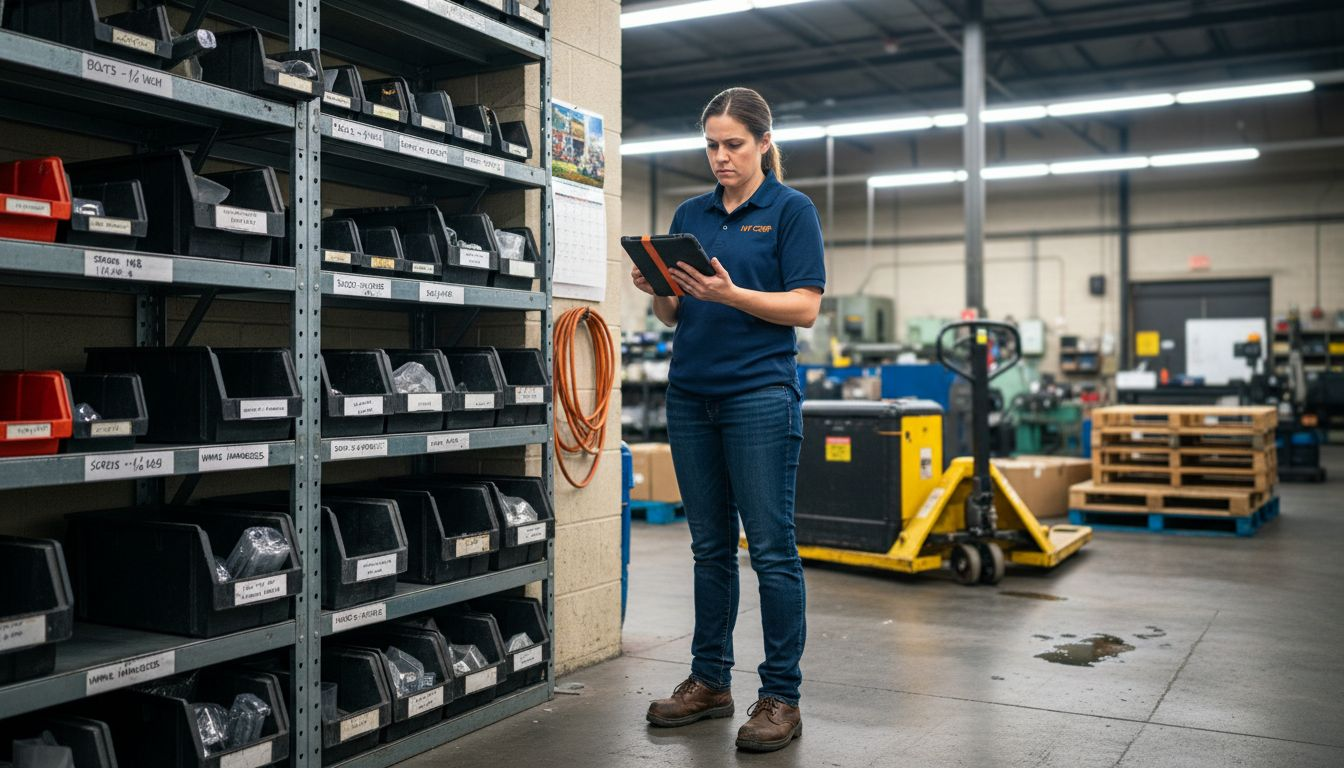
Supervisor verifying inventory near shop floor bins

The convergence of shop floor management and inventory control systems enables manufacturers to achieve unprecedented visibility and precision in production planning. Advanced technologies like barcode tracking, RFID sensors, and integrated ERP modules allow companies to monitor material consumption, predict potential shortages, and adjust production schedules instantaneously. This seamless integration reduces waste, minimizes downtime, and ensures that manufacturing processes remain fluid and responsive to changing market demands.

Key benefits of integrated shop floor and inventory control include:

  • Real-time Material Tracking: Instant visibility into material availability and consumption
  • Automated Inventory Replenishment: Proactive stock management based on actual production needs
  • Reduced Production Delays: Minimized interruptions caused by material shortages
  • Accurate Demand Forecasting: Better prediction of material requirements
  • Cost Optimization: Reduced carrying costs and inventory holding expenses
  • Enhanced Production Planning: Dynamic scheduling based on current inventory levels

These integrated systems transform raw data into actionable insights, enabling manufacturers to make informed decisions that drive operational excellence and competitive advantage in a rapidly evolving marketplace.

Pro tip: Implement a robust ERP system that offers seamless integration between shop floor operations and inventory management to create a unified, data-driven manufacturing ecosystem.

Ensuring Compliance and Quality Management

In the complex landscape of discrete manufacturing, quality management and regulatory compliance are no longer optional—they are fundamental strategic imperatives that directly impact operational success and market reputation. Advanced ERP systems have transformed these critical functions from manual, retrospective processes into dynamic, proactive mechanisms that integrate quality controls seamlessly across entire production ecosystems.

The integration of quality management modules enables manufacturers to implement sophisticated monitoring strategies that extend far beyond traditional inspection techniques. By leveraging advanced technologies like statistical process control, machine learning algorithms, and real-time data analytics, manufacturers can detect potential quality deviations before they escalate, ensuring consistent product performance and minimizing costly rework or recalls.

Critical components of comprehensive quality management and compliance include:

  • Real-time Defect Detection: Immediate identification of production anomalies
  • Statistical Process Control: Quantitative analysis of manufacturing variation
  • Automated Compliance Reporting: Streamlined documentation for regulatory requirements
  • Predictive Quality Analytics: Proactive identification of potential quality risks
  • Comprehensive Audit Trails: Detailed documentation of production processes
  • Continuous Improvement Tracking: Systematic approach to quality enhancement

These integrated quality management strategies transform compliance from a bureaucratic burden into a strategic advantage, enabling manufacturers to consistently meet—and exceed—industry standards while maintaining operational efficiency.

Pro tip: Implement a robust quality management system that provides end-to-end visibility, integrates seamlessly with your production workflows, and enables data-driven continuous improvement.

Project Costing and Real-Time Reporting Benefits

In discrete manufacturing, project costing and real-time reporting represent transformative capabilities that separate high-performance organizations from traditional operational models. These advanced ERP functionalities provide unprecedented transparency into financial performance, enabling manufacturers to make data-driven decisions with unprecedented precision and agility.
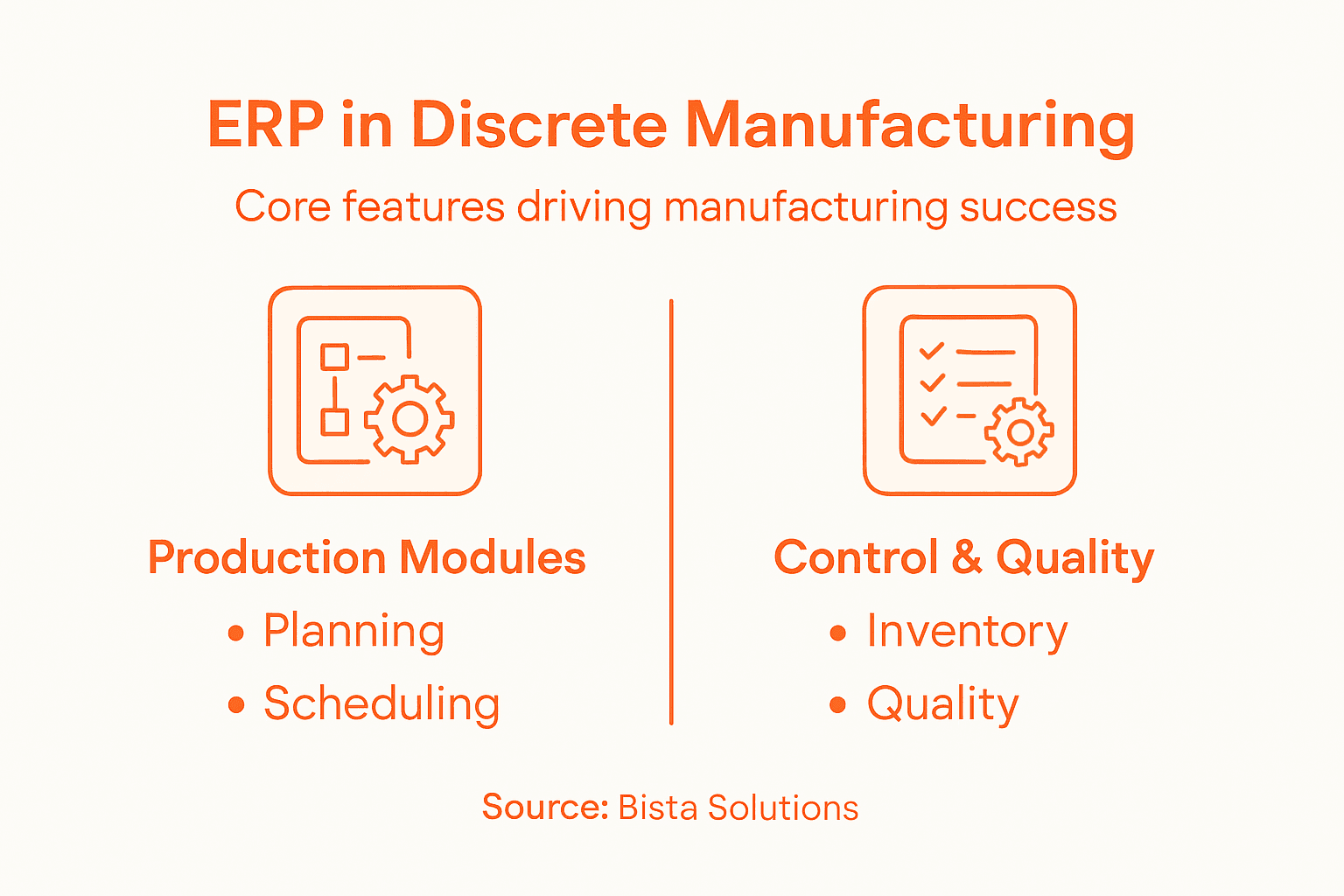
Infographic with ERP modules and key features

Modern project management modules revolutionize how manufacturers track, analyze, and optimize project expenditures across complex production environments. By integrating granular cost tracking with real-time reporting mechanisms, companies can instantaneously monitor resource allocation, identify potential budget overruns, and make proactive adjustments that protect profitability and operational efficiency.

Key benefits of advanced project costing and reporting include:

  • Instantaneous Financial Visibility: Comprehensive cost tracking across production stages
  • Resource Allocation Optimization: Precise monitoring of labor, materials, and overhead expenses
  • Predictive Budget Management: Early identification of potential cost deviations
  • Performance Benchmarking: Comparative analysis of project performance metrics
  • Automated Expense Tracking: Elimination of manual data entry and reconciliation
  • Strategic Decision Support: Data-driven insights for executive planning

These integrated reporting capabilities transform project financial management from a retrospective accounting exercise into a dynamic, forward-looking strategic tool that drives operational excellence and competitive advantage.

Pro tip: Implement a robust ERP system with comprehensive project costing modules that provide real-time, granular financial insights and enable proactive decision-making across your manufacturing operations.

Avoiding Common ERP Implementation Pitfalls

Successful ERP implementation in discrete manufacturing requires strategic planning, a nuanced understanding of organizational dynamics, and proactive risk management. Many manufacturers underestimate the complexity of transitioning to a comprehensive enterprise system, leading to costly implementation failures that can disrupt entire production ecosystems.

Navigating the intricate landscape of ERP implementation challenges demands a holistic approach that addresses technological, organizational, and human factors. Research consistently reveals that failed implementations often stem from predictable yet overlooked issues such as inadequate change management, insufficient user training, and misalignment between system capabilities and business processes.

Critical pitfalls manufacturers must anticipate and mitigate include:

  • Incomplete Requirements Analysis: Failing to document precise business needs
  • Insufficient Stakeholder Engagement: Neglecting input from key operational teams
  • Inadequate User Training: Not preparing employees for system transition
  • Poor Data Migration Strategies: Incorrect transfer of historical business data
  • Unrealistic Implementation Timelines: Setting overly aggressive deployment schedules
  • Limited Post-Implementation Support: Lack of ongoing system optimization

By recognizing and proactively addressing these common challenges, manufacturers can transform ERP implementation from a potential risk into a strategic opportunity for operational transformation.

Pro tip: Develop a comprehensive implementation roadmap that includes detailed change management protocols, phased rollout strategies, and continuous user training to ensure smooth ERP system adoption.

Unlock the Full Potential of Your Discrete Manufacturing with Proven ERP Expertise

Discrete manufacturing requires precision and seamless integration across production planning, inventory control, quality management, and cost reporting. If your challenges include optimizing real-time production tracking, ensuring regulatory compliance, and avoiding costly ERP implementation pitfalls, you are not alone. The article highlights critical ERP features such as advanced inventory management, integrated shop floor control, and comprehensive project costing that are essential for achieving operational excellence and competitive advantage.

At Bista Solutions, we understand the unique demands of discrete manufacturers like you. As the largest Odoo ERP implementer in North America and a trusted Odoo Gold Partner, we specialize in delivering scalable, tailored ERP solutions that align with your specific production workflows and business goals. With over 350 successful ERP implementations worldwide and a dedicated team of 300+ experts, we offer end-to-end support designed to drive efficiency, reduce costs, and improve quality consistently.

Ready to transform your manufacturing operations with a customized ERP system that addresses your toughest challenges in production planning and quality control?

Request A Free Demo

    Explore how our expertise can empower your business to operate smarter and faster. Contact us today at Bista Solutions Contact to schedule a consultation. Take the first step toward elevating your discrete manufacturing success with proven ERP innovation.

    Learn more about optimizing your production workflow with our Odoo Manufacturing Module and improve efficiency through effective production planning and scheduling. Start your journey now.

    Frequently Asked Questions

    What are the key features of ERP systems for discrete manufacturing?

    High-performance ERP systems for discrete manufacturing emphasize features like real-time production tracking, advanced inventory management, comprehensive bill of materials (BOM) management, integrated quality control, flexible production scheduling, and accurate cost calculation.

    How do ERP systems improve inventory management in discrete manufacturing?

    ERP systems enhance inventory management by allowing precise tracking of raw materials, work-in-progress, and finished goods, thereby minimizing shortages and overstock situations while enabling automated inventory replenishment based on actual production needs.

    Why is production planning and scheduling important in ERP for discrete manufacturing?

    Production planning and scheduling modules in ERP systems synchronize resource allocation, equipment utilization, and workforce management, allowing manufacturers to predict bottlenecks and optimize workflow to meet dynamic market demands efficiently.

    How does an integrated quality management system benefit discrete manufacturers?

    An integrated quality management system ensures consistent product standards through real-time defect detection, predictive quality analytics, and automated compliance reporting, which improves operational efficiency and minimizes costly rework or recalls.


    Shopify B2B for U.S. Manufacturers: Transforming Wholesale

    Sales manager presenting wholesale documents
    • by Uzlifat Mir
    • Jan 14, 2026
    • 0
    • Category:

    Bold moves in digital sales are becoming a necessity for American manufacturers, with nearly 65 percent of wholesale businesses shifting to dedicated B2B ecommerce in recent years. For those looking to keep pace, Shopify B2B offers a direct path toward modernizing wholesale operations and satisfying complex customer demands. This guide breaks down how the right Shopify B2B features help American companies cut through inefficiency, manage buyer relationships, and compete effectively in the changing business market.

    Table of Contents

    Key Takeaways

    Point Details
    Shopify B2B Enhances Wholesale Efficiency The platform provides specialized tools for manufacturers, streamlining complex sales processes and improving digital storefront capabilities.
    Flexible Storefront Options Manufacturers can choose between blended stores for dual markets or dedicated B2B stores for exclusive wholesale transactions to optimize their sales strategies.
    Advanced Integration Necessity Successful implementation relies on seamless integration with existing ERP and business systems to enhance operational efficiency and data accuracy.
    Compliance and Cost Considerations Manufacturers must address regulatory compliance and carefully manage costs associated with implementation to ensure a smooth transition to digital wholesale practices.

    Defining Shopify B2B for Manufacturers

    Shopify B2B represents a digital transformation platform specifically designed to help manufacturers modernize their wholesale operations through advanced online selling capabilities. Unlike traditional consumer ecommerce platforms, Shopify B2B offers specialized features tailored for business-to-business transactions, enabling manufacturers to create sophisticated digital storefronts that meet complex wholesale purchasing requirements.

    At its core, Shopify B2B provides manufacturers with powerful tools to streamline complex sales processes. These platforms support critical wholesale functionalities such as volume-based pricing, custom contract rates, company-specific payment terms, and restricted access portals for different business customers. By integrating manufacturing execution systems, manufacturers can automate order processing, reduce manual administrative work, and create more efficient sales channels that directly connect production capabilities with business buyers.

    The platform enables manufacturers to overcome traditional wholesale distribution limitations by offering digital solutions that expand market reach. Key features include custom price lists for different customer segments, bulk ordering capabilities, quick reorder options, and comprehensive account management tools. This digital transformation allows manufacturers to serve multiple business customers simultaneously, track order histories, manage complex pricing structures, and provide personalized purchasing experiences that traditional sales models cannot match.

    Pro tip: When implementing Shopify B2B, start by mapping out your most complex customer pricing and ordering scenarios to ensure the platform can accommodate your specific wholesale business requirements.

    Types of Shopify B2B Storefronts

    Manufacturers exploring Shopify B2B have multiple storefront configurations to choose from, each designed to meet unique wholesale business requirements. The two primary storefront models are Blended Stores and Dedicated B2B Stores, offering manufacturers flexible digital sales strategies that can be customized to their specific operational needs.

    Blended stores represent a hybrid approach where manufacturers can simultaneously serve both business and direct-to-consumer markets within a single digital platform. These storefronts allow businesses to showcase different product catalogs, pricing structures, and access levels for wholesale and retail customers. By leveraging ecommerce integration, manufacturers can create seamless purchasing experiences that adapt to varied customer segments while maintaining centralized inventory and order management.

    Dedicated B2B storefronts, in contrast, provide a specialized environment exclusively for wholesale transactions. These platforms enable manufacturers to create comprehensive buying experiences with advanced features like company-specific pricing, bulk ordering capabilities, custom payment terms, and restricted access portals. Custom storefronts using headless commerce approaches offer even greater flexibility, allowing manufacturers to build unique buyer interfaces that integrate precisely with existing enterprise resource planning systems and complex sales workflows.

    Pro tip: Carefully analyze your current sales processes and customer segments before selecting a Shopify B2B storefront model to ensure maximum alignment with your specific wholesale business requirements.

    Here’s a quick comparison of Shopify B2B storefront models for manufacturers:

    Storefront Model Target Customers Key Benefits Typical Use Case
    Blended Store Both wholesale and retail Centralized channel, diversified reach Manufacturers serving multiple markets
    Dedicated B2B Store Wholesale only Custom buying experience, strict controls Businesses with complex B2B needs
    Headless Commerce Highly customized B2B Unique interface, deep ERP integration Enterprises with strict workflows

    Core Features for Wholesale Operations

    Shopify B2B platforms offer manufacturers a comprehensive suite of advanced features specifically designed to streamline wholesale operations and create sophisticated digital purchasing experiences. Core wholesale capabilities encompass a range of tools that transform traditional sales processes, enabling manufacturers to manage complex business transactions with unprecedented efficiency and flexibility.

    Key features include advanced pricing mechanisms that allow manufacturers to establish company-specific pricing structures, volume-based discounts, and customized contract rates. These platforms support intricate bulk ordering capabilities that enable business buyers to purchase large quantities with streamlined workflows. Vendor lead time calculation modules help manufacturers optimize inventory management and provide accurate delivery estimates, ensuring transparent and predictable supply chain interactions.

    Supervisor reviewing Shopify B2B pricing tools

    The platform’s robust account management system introduces powerful tools like self-service customer portals, draft order management, and granular permission settings. Manufacturers can create unique buying experiences by implementing features such as restricted product catalogs, company-specific payment terms, and automated purchase approval workflows. These sophisticated capabilities allow businesses to tailor their digital storefront to meet the nuanced requirements of different wholesale customers, transforming traditional sales approaches into dynamic, data-driven interactions.

    Pro tip: Conduct a comprehensive audit of your current wholesale sales processes before implementation to identify specific customization needs and maximize the potential of your Shopify B2B storefront.

    The table below summarizes the most impactful features of Shopify B2B for wholesale operations:

    Feature What It Does Business Impact
    Volume-based Pricing Auto-applies discounts for large orders Encourages higher order volume
    Self-service Customer Portals Allows buyers to manage orders themselves Reduces admin workload
    Automated Approval Workflows Simplifies multi-level purchasing signoff Speeds up order processing
    ERP Integration Syncs sales with backend systems Ensures data accuracy and efficiency

    Integration With ERP and Other Systems

    Successful Shopify B2B implementations for manufacturers hinge on seamless enterprise application integration (EAI), which enables sophisticated communication between digital sales platforms and core business systems. By bridging Shopify B2B storefronts with existing enterprise resource planning (ERP) infrastructure, manufacturers can create a unified technological ecosystem that eliminates data silos and enhances operational efficiency.

    The integration process involves connecting multiple critical business systems, including inventory management, accounting, customer relationship management, and production planning platforms. Understanding ERP implementation phases becomes crucial for manufacturers seeking to establish robust, interconnected digital workflows. These integrations enable real-time data synchronization, allowing wholesale transactions on Shopify to automatically update inventory levels, trigger financial reconciliation, and generate comprehensive reporting across different organizational departments.

    Advanced integration strategies leverage middleware and API-based connections that facilitate complex data exchanges between Shopify B2B platforms and legacy enterprise systems. Manufacturers can implement custom integration solutions that support specialized wholesale requirements, such as configuring unique pricing structures, managing complex product catalogs, and maintaining precise inventory tracking. The result is a dynamic, responsive digital infrastructure that transforms traditional wholesale operations into agile, data-driven business processes.

    Pro tip: Conduct a comprehensive system audit and map out all current data workflows before initiating ERP integration to identify potential compatibility challenges and optimize your technological ecosystem.

    Pricing, Payment, and Buyer Management

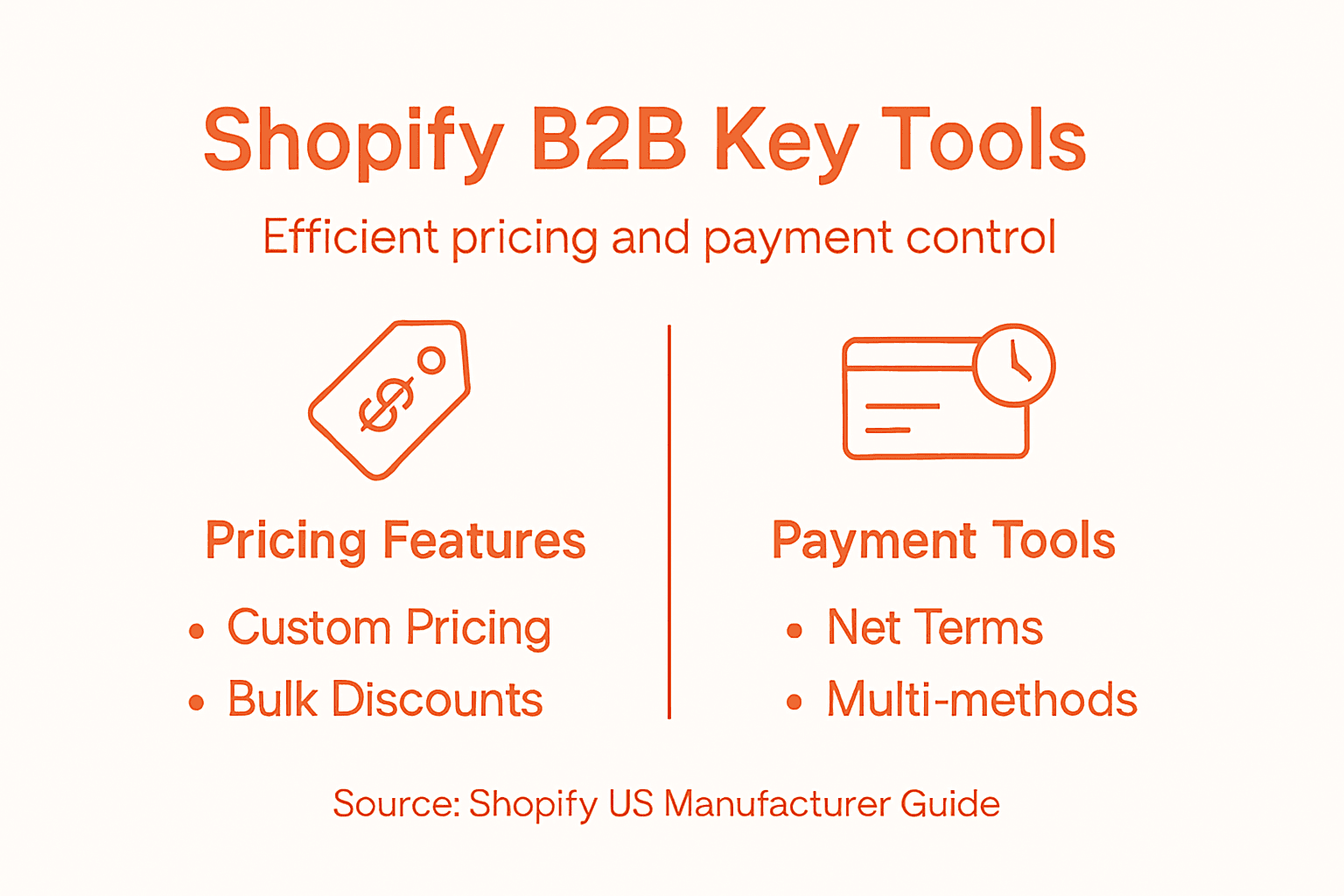
    Shopify B2B platforms provide manufacturers with sophisticated pricing and payment management tools that transform traditional wholesale transaction processes. These advanced systems enable businesses to create complex pricing structures tailored to specific customer segments, supporting intricate wholesale pricing models that go far beyond simple fixed-rate approaches.

    Infographic showing Shopify B2B pricing and payment

    The platform’s buyer management capabilities allow manufacturers to establish granular controls over company profiles, user permissions, and purchasing workflows. Manufacturers can configure unique pricing tiers, volume-based discounts, and customer-specific contract rates that reflect the nuanced relationships typical in business-to-business transactions. Odoo accounting features further enhance these capabilities by providing comprehensive financial tracking and reporting mechanisms that integrate seamlessly with wholesale pricing strategies.

    Payment processing in Shopify B2B environments supports multiple sophisticated approaches, including net payment terms, invoicing workflows, and integrated payment gateways that accommodate complex business purchasing requirements. Manufacturers can implement flexible payment options such as credit lines, scheduled payments, and multi-currency support, enabling smoother financial interactions with wholesale customers. The system’s robust permission management allows sales teams to create detailed buyer hierarchies, control access levels, and maintain precise oversight of purchasing activities across different organizational levels.

    Pro tip: Develop a comprehensive pricing strategy that considers customer volume, historical purchasing behavior, and long-term relationship potential before configuring your Shopify B2B storefront pricing models.

    Compliance, Costs, and Common Pitfalls

    U.S. manufacturers implementing Shopify B2B platforms must navigate a complex landscape of regulatory compliance and potential implementation challenges. Regulatory requirements can impose significant financial burdens, with compliance costs typically ranging from 1.3% to 3.3% of total wage expenses, creating substantial overhead for businesses transitioning to digital wholesale platforms.

    Accessibility compliance represents a critical legal consideration for digital storefronts. Manufacturers must ensure their Shopify B2B platforms meet Web Content Accessibility Guidelines (WCAG) 2.1 AA standards to mitigate potential legal risks. Common pitfalls include relying on superficial accessibility widgets and failing to conduct comprehensive manual audits. Comprehensive ERP implementation strategies can help manufacturers proactively address these compliance challenges by integrating robust accessibility and regulatory monitoring mechanisms into their digital infrastructure.

    Cost management becomes paramount when implementing Shopify B2B solutions. Manufacturers should anticipate expenses beyond platform licensing, including integration costs, staff training, potential custom development, and ongoing maintenance. These investments require careful financial planning, with successful implementations focusing on long-term efficiency gains and expanded market capabilities. Strategic approaches involve thoroughly evaluating platform features, conducting pilot testing, and developing phased implementation strategies that minimize disruption to existing business operations.

    Pro tip: Conduct a comprehensive risk assessment and budget analysis before implementing your Shopify B2B platform, accounting for potential compliance expenses and technological adaptation costs.

    Unlock Your Manufacturing Potential with Expert Shopify B2B Integration

    Navigating the complex demands of Shopify B2B for U.S. manufacturers requires more than just a platform. The challenges of managing volume-based pricing, ERP integration, and compliance can slow your growth and create costly inefficiencies. If you are striving to transform your wholesale processes into a scalable, digital powerhouse, then expert guidance is essential. Bista Solutions specializes in delivering tailored ERP and e-commerce integration strategies that align perfectly with your unique wholesale workflows, helping you streamline pricing models, automate approval workflows, and maintain regulatory compliance.

    Request A Demo


      Partner with a proven industry leader recognized as the top Odoo ERP implementer in North America. With over 350 successful ERP implementations worldwide, our team of 300+ experts ensures your Shopify B2B transformation is smooth and resilient. Start today by connecting with our consultants to build a customized roadmap that fully leverages your Shopify B2B capabilities while integrating seamlessly with your existing enterprise systems. Don’t wait to reduce administrative workload and unlock new revenue streams. Contact us now at Bista Solutions Contact and discover how our innovative solutions can revolutionize your wholesale business.

      Frequently Asked Questions

      What are the key features of Shopify B2B for manufacturers?

      Shopify B2B offers advanced pricing mechanisms, bulk ordering capabilities, self-service customer portals, and automated approval workflows, all designed to streamline wholesale operations and enhance purchasing experiences.

      How can manufacturers integrate Shopify B2B with their existing ERP systems?

      Manufacturers can achieve integration through middleware and API-based connections, allowing real-time data synchronization between Shopify and their ERP systems to enhance inventory management, financial reconciliation, and reporting.

      What are the benefits of using a dedicated B2B storefront compared to a blended store?

      A dedicated B2B storefront focuses solely on wholesale transactions with features like customized pricing, bulk ordering, and restricted access, while a blended store serves both wholesale and retail customers within a single platform.

      How does pricing management work in Shopify B2B environments?

      Shopify B2B allows manufacturers to create complex pricing structures tailored to specific customer segments, including volume-based discounts and customer-specific contract rates, ensuring flexibility and accuracy in wholesale transactions.

      Shopify and Complex B2B Sales: Real-World Advantages

      Team reviewing Shopify sales data in office
      • by Uzlifat Mir
      • Jan 14, 2026
      • 0
      • Category:

      More than 60 percent of American manufacturing companies still struggle with outdated sales processes that slow down decision making and hurt profit margins. For B2B sales managers in Texas, the pressure to compete and deliver fast, accurate quotes is greater than ever. Shopify offers a practical solution that blends advanced technology with everyday usability, helping businesses in America navigate the complexity of modern sales operations with greater efficiency.

      Table of Contents

      Key Takeaways

      Point Details
      Shopify’s Transformation of B2B Sales Shopify offers a scalable platform that supports complex sales workflows, enabling personalized customer experiences and advanced pricing options.
      Dynamic Pricing and Custom Catalogs Implementing flexible pricing models and tailored catalogs can significantly enhance customer engagement and meet varied purchasing needs.
      Automation in Account Management Utilizing intelligent automation tools streamlines account management, allowing sales teams to focus on strategic relationship-building.
      Importance of Integration Seamless integration of Shopify with ERP and CRM systems provides a unified view of operations, improving decision-making and operational efficiency.

      Shopify’s Role in Modern B2B Sales

      B2B sales have undergone a radical transformation with digital platforms like Shopify redefining how companies approach complex sales processes. Unlike traditional sales models, modern B2B transactions require sophisticated digital infrastructure that can handle intricate customer relationships, customized pricing structures, and seamless integration across multiple business systems. Shopify has emerged as a powerful solution that addresses these nuanced requirements by providing a flexible, scalable platform designed specifically for business-to-business transactions.

      The platform’s strength lies in its ability to manage complex sales workflows that extend beyond simple transactional exchanges. Research from MIT Sloan highlights Shopify’s capacity to facilitate technology enablement and data collaboration, which are critical components in modern B2B sales environments. By offering advanced features like custom pricing rules, bulk ordering capabilities, and integrated customer management tools, Shopify enables manufacturers and distributors to create more responsive and adaptive sales processes.

      Key advantages of Shopify in B2B sales include:

      • Personalized customer account portals
      • Advanced pricing and volume discount configurations
      • Seamless integration with enterprise resource planning systems
      • Robust payment and credit management tools
      • Sophisticated quoting and negotiation workflows

      Companies leveraging Shopify can transform their sales strategies by implementing more dynamic, data-driven approaches that respond quickly to evolving market demands. The platform’s advanced eCommerce platform capabilities enable businesses to create tailored experiences that meet the complex expectations of modern B2B buyers.

      Pro tip: Configure custom price lists and customer-specific catalogs to create more personalized purchasing experiences for your B2B clients.

      B2B Pricing Structures and Custom Catalogs

      In the complex world of B2B commerce, pricing strategies and product catalogs are far more sophisticated than traditional retail models. Custom pricing structures have become a critical differentiator for businesses seeking to create tailored experiences that meet diverse customer needs. Shopify’s advanced platform enables companies to implement dynamic pricing models that go beyond simple one-size-fits-all approaches, allowing for intricate pricing configurations that reflect the nuanced relationships in business-to-business transactions.

      The research from Shopify highlights the importance of flexible pricing strategies that support multi-year agreements, tiered quotes, and negotiated rebates. Odoo Sales Management systems complement these capabilities by providing additional tools for managing complex sales workflows. B2B pricing models now require granular control, including:

      • Volume-based discounts
      • Customer-specific pricing tiers
      • Contract-based pricing variations
      • Seasonal and promotional pricing adjustments
      • Bulk order pricing configurations

      Custom catalogs represent another critical aspect of B2B digital commerce. Unlike B2C platforms, B2B environments demand highly specialized product visibility and access controls. Companies can now create market-specific, company-specific, and even individual customer-specific catalogs that enhance relevance and purchasing efficiency. These tailored catalogs allow businesses to manage product visibility, ensure compliance, and provide precise pricing control across different customer segments.

      The integration of advanced pricing and catalog management tools transforms how companies approach B2B sales. By leveraging technology that supports complex, data-driven pricing strategies, organizations can create more responsive and personalized purchasing experiences that align with specific customer requirements and market dynamics.

      Account manager browsing digital B2B catalog

      Pro tip: Implement dynamic pricing rules that automatically adjust based on customer volume, historical purchasing patterns, and negotiated contract terms.

      Automating Account Management and Workflows

      The landscape of B2B sales is rapidly transforming through advanced automation technologies that streamline complex account management processes. Workflow automation has emerged as a critical strategy for businesses seeking to optimize their sales interactions, reduce manual administrative tasks, and create more efficient customer engagement models. By leveraging intelligent automation tools, companies can dramatically improve their operational efficiency and focus their human resources on strategic relationship-building activities.

      Artificial intelligence and machine learning technologies are revolutionizing how businesses approach account management workflows. Workflow management systems now enable sophisticated automation capabilities that can handle multiple critical functions, including:

      • Automatic lead qualification and scoring
      • Personalized communication tracking
      • Customer interaction documentation
      • Scheduled follow-up processes
      • Intelligent task routing and assignment

      Research from the National CIO Review highlights how agentic AI technologies are transforming B2B sales workflows by anticipating tasks and personalizing communication strategies. These advanced systems can handle top-of-funnel outreach, qualify potential leads, and even schedule initial meetings, allowing sales professionals to concentrate on high-value relationship development and strategic decision-making. The result is a more responsive, efficient sales process that can adapt quickly to changing customer needs and market dynamics.

      The integration of sophisticated automation tools represents a fundamental shift in how companies manage customer relationships. By reducing repetitive administrative tasks and providing intelligent insights, these technologies enable sales teams to create more meaningful, personalized interactions that drive long-term business success. Advanced workflow automation goes beyond simple task management, creating a comprehensive ecosystem that supports more strategic, data-driven sales approaches.

      Pro tip: Implement a comprehensive workflow automation strategy that integrates AI-driven insights with your existing customer relationship management systems to maximize efficiency and personalization.

      Integrating Shopify With ERP and CRM Systems

      In the complex world of B2B sales, seamless integration between Shopify, Enterprise Resource Planning (ERP), and Customer Relationship Management (CRM) systems has become a critical competitive advantage. System integration transforms fragmented business processes into a cohesive, data-driven ecosystem that enables more intelligent decision-making and enhanced operational efficiency. By creating a unified platform, businesses can break down traditional data silos and create a more holistic view of their sales and customer interactions.

      ERP implementation strategies are fundamental to achieving comprehensive business system integration. These advanced integration approaches enable real-time synchronization across multiple business functions, providing critical capabilities such as:

      • Instant inventory tracking
      • Automated order processing
      • Centralized customer data management
      • Seamless financial reporting
      • Dynamic pricing and discount management

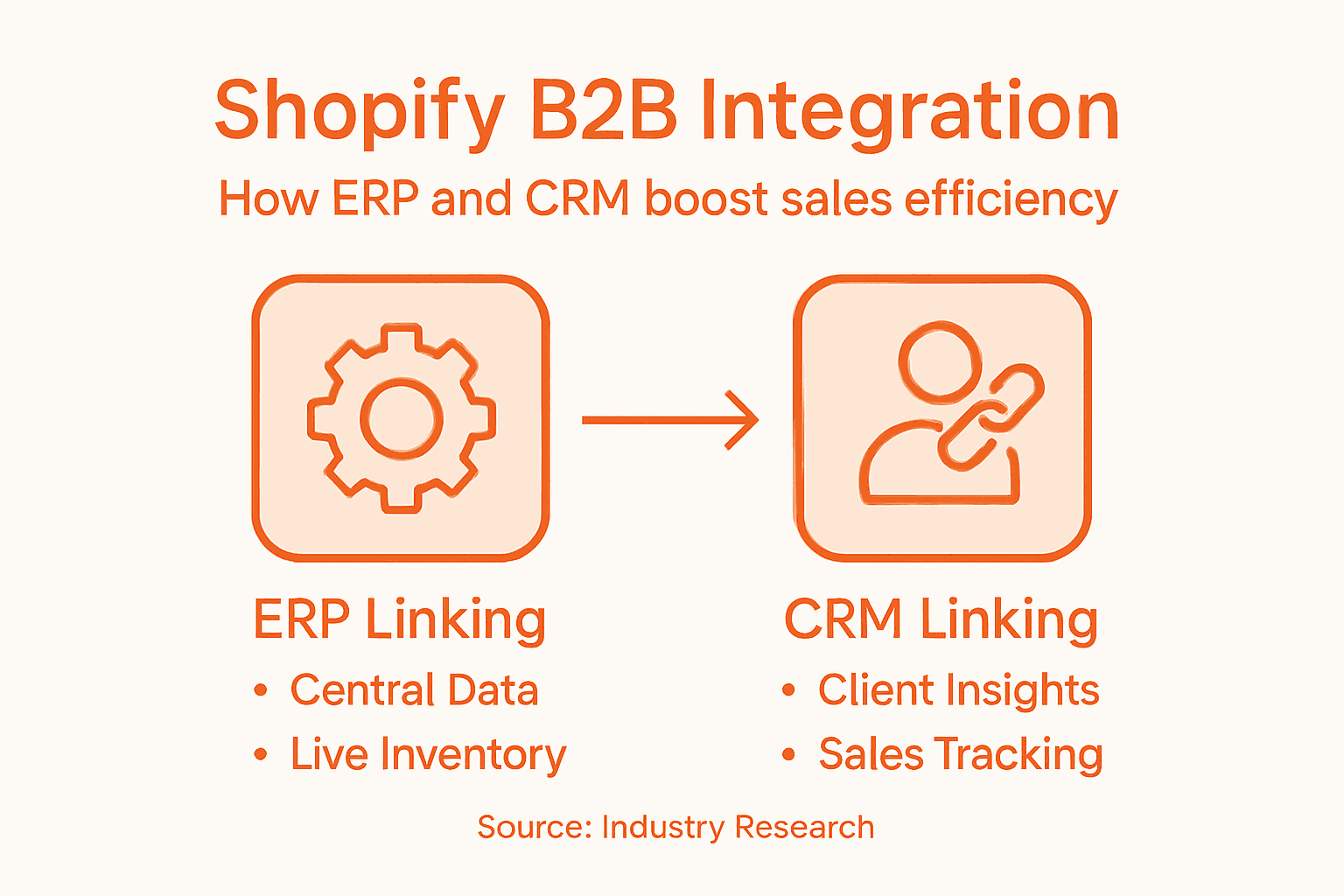
      Research from IEEE highlights the transformative potential of integrating Shopify with ERP systems. By creating a central data repository that synchronizes inventory, orders, and customer information, businesses can achieve unprecedented operational visibility. This integration allows companies to move beyond traditional transaction-based interactions, developing more responsive and adaptive sales strategies that can quickly adjust to changing market conditions and customer requirements.

      Infographic showing Shopify integration with ERP and CRM

      CRM integration takes these capabilities even further by enabling sophisticated customer relationship management. Through advanced data synchronization, businesses can create personalized customer journeys, track interaction histories, and develop more targeted marketing and sales approaches. The seamless flow of information between Shopify, ERP, and CRM systems enables a comprehensive understanding of customer behaviors, preferences, and potential opportunities, transforming raw data into actionable business intelligence.

      Here’s a summary of key integration benefits when connecting Shopify with ERP and CRM systems:

      Integration Area Business Impact Example Outcome
      Inventory Management Reduces stockouts and errors Real-time product availability updates
      Order Processing Speeds up fulfillment Automated order entry and tracking
      Customer Data Sync Enables personalized sales Unified customer profiles for marketing
      Financial Reporting Improves decision-making Fast, accurate revenue analysis

      Pro tip: Prioritize middleware solutions that offer robust, flexible API connections to ensure smooth data exchange between your Shopify platform, ERP, and CRM systems.

      Mitigating B2B Sales Risks and Challenges

      Complex B2B sales environments are fraught with inherent risks that can significantly impact business performance and long-term sustainability. Sales risk management has become a critical strategic imperative for companies seeking to navigate the intricate landscape of business-to-business transactions. Understanding and proactively addressing these challenges requires a comprehensive approach that combines data-driven insights, technological innovation, and strategic relationship building.

      Small business security strategies play a crucial role in mitigating potential risks. The most prevalent challenges in B2B sales include:

      • Extended sales cycles
      • Complex multi-stakeholder decision processes
      • Unpredictable customer retention
      • High customer acquisition costs
      • Market volatility and economic uncertainties

      Research from the International Journal of Contemporary Research and Technology highlights critical strategies for risk mitigation. By adopting customer-centric approaches and leveraging advanced data analytics, businesses can develop more resilient sales models. Implementing account-based marketing techniques allows companies to create more targeted, personalized engagement strategies that address specific customer needs and reduce the likelihood of sales failures.

      The Harvard Business Review emphasizes the importance of developing sophisticated customer health monitoring systems. These advanced frameworks enable businesses to assess relationship quality through comprehensive metrics that track product usage, value realization, and long-term partnership potential. By proactively managing these dimensions, companies can create more stable revenue streams and build more resilient business relationships that can withstand market fluctuations and economic challenges.

      Compare traditional B2B sales risks with modern mitigation strategies:

      Sales Risk Challenge Modern Mitigation Strategy Expected Benefit
      Long sales cycles Account-based marketing techniques Faster deal closings
      High acquisition cost Data-driven lead scoring Lower marketing expenses
      Unpredictable retention Customer health monitoring Improved renewal rates
      Multi-stakeholder decisions Personalized engagement workflows Higher stakeholder satisfaction

      Pro tip: Develop a robust customer health scoring system that tracks multiple interaction points and provides early warning indicators of potential relationship risks.

      Unlock the Full Potential of B2B Sales with Expert ERP Integration

      Navigating complex B2B sales challenges like custom pricing structures, dynamic catalogs, and automated workflows demands a robust digital backbone. The article highlights how platforms like Shopify transform sales processes but also underlines the critical need for seamless integration with powerful ERP and CRM systems to truly excel. If you’re struggling to streamline multi-stakeholder transactions or manage intricate customer relationships, the right technology partner can make all the difference.

      At Bista Solutions, we specialize in delivering tailored ERP implementations designed to complement and enhance your Shopify ecosystem. With over 350 successful ERP deployments and recognized as North America’s largest Odoo ERP implementer, we empower businesses to automate account management, integrate critical systems, and implement data-driven pricing strategies that align perfectly with the complex demands of modern B2B sales.

      Embrace intelligent automation and unlock real-time inventory and order management to reduce errors and boost customer satisfaction. Discover how our end-to-end solutions can transform your sales workflows and mitigate risks before they impact revenue.

      Looking to accelerate your sales transformation with proven ERP expertise?

      Contact Us For A Free Demo


        Contact our experienced team today to create a scalable, integrated platform that drives efficiency, personalization, and growth. Visit Bista Solutions Contact Page and explore how our ERP implementation strategies and workflow management systems services can deliver real-world results. Take the first step toward mastering complex B2B sales now.

        Frequently Asked Questions

        What are the key advantages of using Shopify for B2B sales?

        Shopify offers personalized customer account portals, advanced pricing configurations, seamless integration with ERP systems, robust payment management tools, and sophisticated quoting workflows, enabling companies to create more adaptive sales processes.

        How can businesses implement custom pricing structures on Shopify?

        Businesses can leverage Shopify’s advanced platform to create dynamic pricing models, including volume-based discounts and customer-specific pricing tiers, allowing for tailored pricing strategies that meet diverse customer needs.

        What role does workflow automation play in B2B sales with Shopify?

        Workflow automation helps streamline complex account management processes, improving operational efficiency and enabling sales teams to focus on high-value relationship-building, thanks to automated lead qualification, personalized communication tracking, and intelligent task routing.

        How does integrating Shopify with ERP and CRM systems benefit B2B sales?

        Integrating Shopify with ERP and CRM systems creates a unified platform for real-time data synchronization across inventory, orders, and customer information, enhancing operational visibility and enabling personalized customer journeys that drive better sales outcomes.

        Quality Control & Maintenance in Odoo Manufacturing

        Engineers reviewing manufacturing quality checklist

        Over eighty percent of American manufacturers report that strong quality control systems directly impact their bottom line. In an industry where even a small mistake can carry huge costs, understanding how to set up rigorous checks is critical. This guide explores how Odoo Manufacturing helps American businesses achieve higher consistency, reduce costly errors, and meet compliance demands with smarter, integrated quality control practices.

        Table of Contents

        Key Takeaways

        Point Details
        Proactive Quality Control Odoo Manufacturing integrates quality management into production workflows, enabling real-time monitoring and corrective actions to prevent defects.
        Comprehensive Inspection Types Quality checks encompass incoming materials, in-process evaluations, and final product inspections to ensure consistent quality.
        Robust Maintenance Practices Systematic monitoring and preventative maintenance within Odoo help reduce equipment failures and production disruptions.
        Regulatory Compliance Tracking Odoo provides tools to automate and document compliance with safety, quality, and environmental regulations, simplifying audit processes.

        Defining Quality Control In Odoo Manufacturing

        Quality control in Odoo Manufacturing represents a comprehensive, systematic approach to ensuring product excellence and consistency throughout the production process. At its core, this process involves rigorous inspection, testing, and verification protocols designed to meet stringent manufacturing standards. Odoo Quality Management enables businesses to implement structured quality checks that minimize defects, reduce waste, and maintain exceptional product integrity.

        The Odoo Manufacturing module provides manufacturers with powerful tools to define and execute quality control processes across multiple stages of production. Key quality control features include:

        • Defining specific quality control points in manufacturing workflows
        • Creating customizable quality alert mechanisms
        • Generating detailed quality control documentation
        • Tracking quality metrics and performance indicators
        • Implementing statistical process control techniques

        Quality control within Odoo Manufacturing ERP Solution goes beyond traditional inspection methods. It integrates quality management directly into production workflows, enabling real-time monitoring and immediate corrective actions. This approach transforms quality control from a reactive process to a proactive strategy that anticipates and prevents potential manufacturing issues.

        Here is a summary of the main Odoo Manufacturing quality control features and their business impact:

        Quality Control Feature Purpose Business Impact
        Custom Quality Points Define specific checkpoints in production Reduces defects and increases efficiency
        Quality Alert Mechanisms Trigger alerts for nonconformance Enables fast issue resolution
        Quality Control Documentation Maintain detailed inspection records Simplifies audits and traceability
        Metrics & Performance Tracking Monitor production quality in real time Supports continuous improvement
        Statistical Process Control Analyze trends and deviations in processes Minimizes long-term quality issues

        Pro Manufacturing Insight: Design your quality control processes with flexibility and specificity, allowing for granular inspection points that match your unique production requirements and industry standards.

        Types Of Quality Checks And Maintenance Tasks

        In the Odoo Manufacturing environment, quality checks and maintenance tasks represent critical components of a robust production management strategy. Quality Control Inspections encompass multiple specialized techniques designed to validate product standards, detect potential manufacturing deficiencies, and ensure consistent output quality. These inspections range from preliminary material assessments to final product evaluations, creating a comprehensive quality assurance framework.

        Odoo Manufacturing supports several distinct types of quality checks:

        • Incoming Material Inspection
          • Verifying raw material specifications
          • Checking material quality before production
          • Measuring conformance to predefined standards
        • In-Process Quality Checks
          • Monitoring production stages
          • Measuring dimensional accuracy
          • Validating intermediate product characteristics
        • Final Product Inspection
          • Conducting comprehensive final evaluations
          • Testing complete product functionality
          • Ensuring compliance with customer requirements

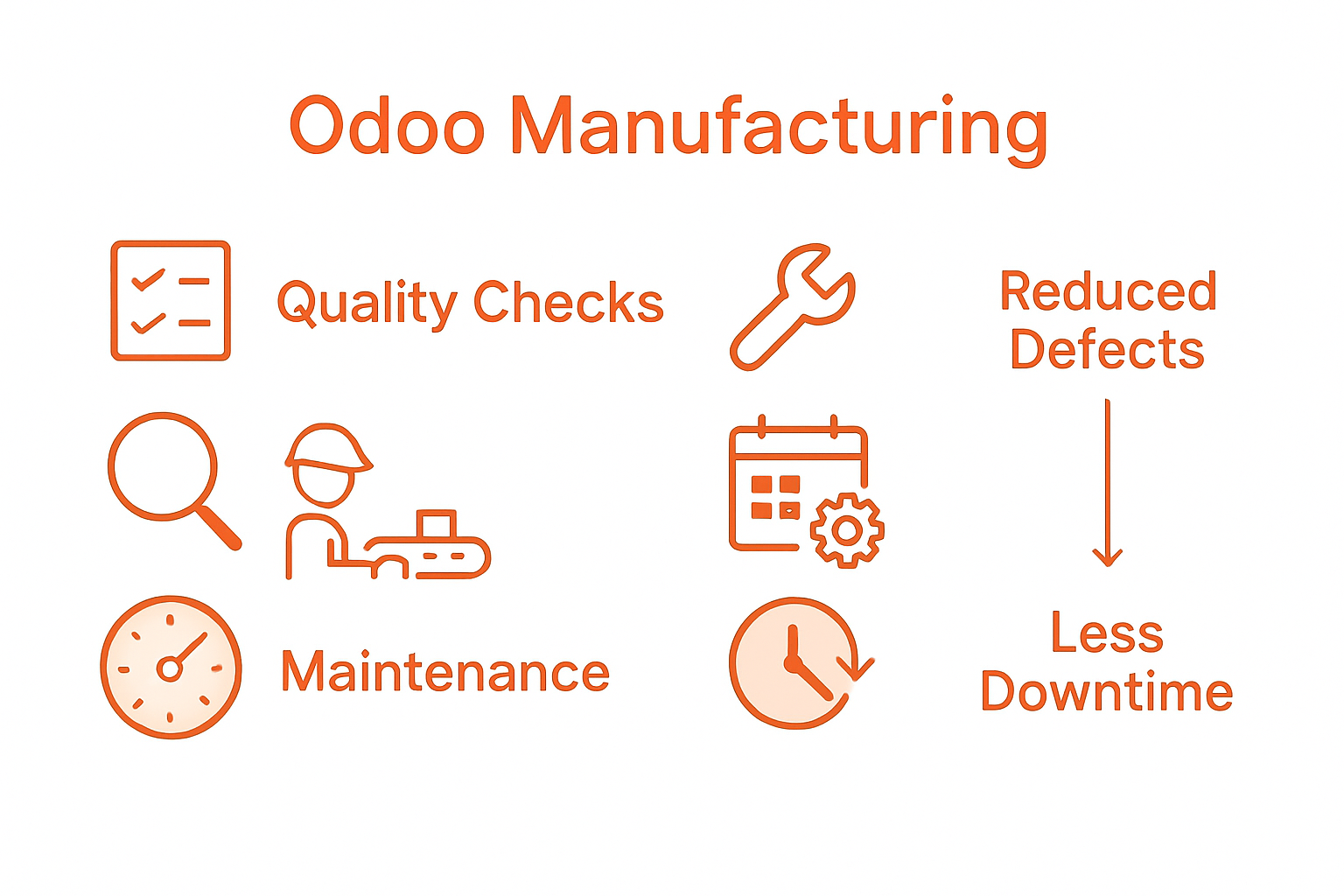
        Maintenance tasks in Odoo Quality Management extend beyond traditional inspection protocols. These tasks involve systematic equipment monitoring, preventative maintenance scheduling, and performance tracking. By integrating maintenance workflows directly into manufacturing processes, businesses can proactively identify potential equipment failures, schedule strategic interventions, and minimize unexpected production disruptions.

        Technician updating maintenance logs in factory

        Pro Manufacturing Insight: Develop a risk-based approach to quality checks, prioritizing inspection points that have the highest potential impact on product quality and customer satisfaction.

        The following table compares the focus areas of quality checks versus maintenance tasks in Odoo Manufacturing:

        Aspect Quality Checks Focus Maintenance Tasks Focus
        Objective Assure product conformance Ensure equipment reliability
        Key Activities Inspection, testing, validation Monitoring, scheduling, preventive measures
        Business Benefit Consistent product quality Reduced downtime, longer equipment lifespan
        Risk Mitigated Defective or noncompliant products Equipment failures and production disruptions

        Infographic comparing quality and maintenance tasks

        Configuring Workflows For Quality And Maintenance

        Configuring effective workflows for quality and maintenance in Odoo Manufacturing requires a strategic approach that integrates multiple operational components into a seamless, automated system. Workflow Configuration represents a critical process of defining precise sequences, triggers, and validation protocols that ensure consistent product quality and equipment performance. These workflows transform manufacturing processes from reactive management to proactive, data-driven strategies.

        Key elements of workflow configuration in Odoo Manufacturing include:

        • Inspection Point Definition
          • Creating customizable quality checkpoints
          • Establishing specific validation criteria
          • Setting automated approval/rejection mechanisms
        • Maintenance Scheduling
          • Defining preventative maintenance intervals
          • Creating automatic equipment health tracking
          • Generating maintenance task assignments
        • Performance Monitoring
          • Configuring real-time quality metrics tracking
          • Establishing performance benchmark thresholds
          • Implementing automated reporting systems

        Configuring workflows within Odoo Production Planning & Scheduling ERP enables manufacturers to develop highly customized quality control and maintenance protocols. By leveraging Odoo’s flexible workflow management capabilities, businesses can design intricate processes that adapt to unique manufacturing requirements, ensuring comprehensive quality management across production environments.

        Pro Manufacturing Insight: Design workflow configurations with scalability in mind, creating modular processes that can be easily modified as your manufacturing requirements evolve.

        Regulatory Compliance In U.S. Manufacturing

        Regulatory compliance represents a complex and critical aspect of manufacturing operations in the United States, requiring manufacturers to navigate intricate legal frameworks that ensure worker safety, product quality, and environmental responsibility. Manufacturing Compliance encompasses a comprehensive set of standards and regulations designed to protect workers, consumers, and the broader industrial ecosystem. These regulations span multiple domains, including workplace safety, product standards, environmental protection, and labor practices.

        Key regulatory compliance areas for U.S. manufacturers include:

        • Occupational Safety Requirements
          • Adhering to OSHA workplace safety standards
          • Implementing comprehensive safety training programs
          • Maintaining detailed documentation of safety protocols
        • Product Quality Standards
          • Meeting federal and industry-specific manufacturing regulations
          • Ensuring consistent product performance and reliability
          • Conducting rigorous quality control inspections
        • Environmental Compliance
          • Following Environmental Protection Agency (EPA) regulations
          • Minimizing industrial waste and environmental impact
          • Implementing sustainable manufacturing practices

        Odoo Manufacturing’s robust Electronic Repair ERP solutions provide manufacturers with powerful tools to track, document, and demonstrate regulatory compliance. By integrating compliance tracking directly into manufacturing workflows, businesses can generate comprehensive audit trails, automate reporting processes, and proactively manage regulatory requirements across complex operational environments.

        Pro Compliance Insight: Develop a systematic approach to regulatory documentation, creating standardized templates and digital tracking mechanisms that simplify compliance reporting and reduce administrative overhead.

        Common Mistakes And How To Prevent Them

        Manufacturing quality control and maintenance processes are often undermined by recurring systematic errors that can significantly impact operational efficiency and product reliability. Quality Management Pitfalls represent critical vulnerabilities that can compromise entire production workflows, leading to increased costs, reduced product quality, and potential regulatory complications. Understanding and proactively addressing these common mistakes is essential for maintaining high-performance manufacturing operations.

        Key common mistakes in quality control and maintenance include:

        • Inadequate Documentation
          • Inconsistent record-keeping
          • Incomplete inspection logs
          • Lack of standardized reporting mechanisms
        • Reactive Instead of Preventive Maintenance
          • Waiting for equipment failures
          • Ignoring early warning signs
          • Neglecting regular equipment health assessments
        • Poor Communication Protocols
          • Siloed departmental information
          • Ineffective cross-team reporting
          • Delayed problem escalation processes

        Navigating these challenges requires a comprehensive approach. Getting The Most From Workflow Management System provides manufacturers with strategic insights into developing robust quality control frameworks that minimize operational risks. By implementing systematic prevention strategies, businesses can transform potential vulnerabilities into opportunities for continuous improvement and operational excellence.

        Pro Prevention Insight: Create a culture of continuous improvement by establishing regular review cycles that systematically identify, analyze, and address potential quality control and maintenance vulnerabilities.

        Elevate Your Manufacturing Quality Control and Maintenance with Bista Solutions

        Manufacturers face challenges like inconsistent product quality and unexpected equipment downtime that can disrupt operations and increase costs. As highlighted in the article, implementing flexible quality control points, proactive maintenance scheduling, and real-time performance tracking are critical to achieving seamless production workflows. At Bista Solutions, we understand these pain points and specialize in delivering tailored Odoo ERP solutions that integrate quality management directly into your manufacturing processes.

        Contact Us


          Experience the difference of working with the largest Odoo ERP implementer in North America. Our expert team will help you design scalable, quality, and maintenance workflows that reduce defects and prevent costly disruptions. Don’t wait until problems escalate. Reach out today to secure your manufacturing future with Bista Solutions. Learn more about how we can empower your operations by visiting Workflow Management System insights and our Electronic Repair ERP solutions.

          Frequently Asked Questions

          What is quality control in Odoo Manufacturing?

          Quality control in Odoo Manufacturing is a structured approach to ensuring product excellence by implementing rigorous inspection, testing, and verification protocols throughout the production process. It minimizes defects and maintains product integrity.

          What types of quality checks are supported in Odoo Manufacturing?

          Odoo Manufacturing supports several types of quality checks, including incoming material inspections, in-process quality checks, and final product inspections, ensuring consistent output quality at every production stage.

          How do I configure workflows for quality and maintenance in Odoo Manufacturing?

          To configure workflows in Odoo, you define inspection points, schedule maintenance tasks, and establish performance monitoring metrics that integrate seamlessly into your manufacturing processes for improved quality management.

          What are common mistakes in quality control and maintenance, and how can I prevent them?

          Common mistakes include inadequate documentation, reactive maintenance, and poor communication protocols. Prevent them by maintaining consistent record-keeping, adopting preventative maintenance strategies, and fostering effective communication across teams.

          Project Management with Capacity Planning in Odoo ERP

          Project Management with Capacity Planning in Odoo ERP

          Over half of all American companies report that poor capacity planning leads to missed deadlines or project overruns. Balancing resources while juggling multiple projects is a daily struggle that can impact team performance and business growth. By understanding the basics of project management and capacity planning, you can discover how American businesses use smarter strategies and digital tools to improve productivity, prevent overload, and keep their projects on track from the start.

          Table of Contents

          Key Takeaways

          Point Details
          Effective Capacity Planning Utilize Odoo ERP’s tools for real-time resource tracking and workload balancing to optimize team performance.
          Integrated Project Management Leverage Odoo’s modular architecture to synchronize project timelines and resource allocation, enhancing operational efficiency.
          Understanding Capacity Types Recognize the three types of capacity planning (strategic, tactical, operational) to apply appropriate management strategies at different time horizons.
          Avoiding Pitfalls Proactively assess and adjust for common challenges like resource overallocation and skills mismatching to maintain productivity and morale.

          Project Management and Capacity Planning Basics

          Capacity planning represents a strategic approach for businesses to align their organizational resources with project demands, ensuring optimal performance and efficiency. In the context of Odoo ERP, capacity planning transforms how organizations manage their project workflows by providing intelligent resource allocation mechanisms that prevent overloading and maximize productivity.

          At its core, capacity planning involves analyzing current workforce capabilities, forecasting future project requirements, and strategically distributing tasks across available human and technological resources. This process helps project managers anticipate potential bottlenecks, balance workloads, and make data-driven decisions about staffing and resource utilization. Odoo project management modules enable businesses to track team capacities, skill sets, and availability with remarkable precision.

          Key components of effective capacity planning in Odoo ERP include:

          • Real-time resource tracking
          • Skill-based task allocation
          • Predictive workload forecasting
          • Performance metrics visualization
          • Automated scheduling recommendations

          Pro Tip: Resource Optimization Strategy: Regularly review your team’s capacity utilization reports in Odoo ERP to identify underused or overwhelmed team members, allowing proactive rebalancing of project assignments before burnout occurs.

          How Odoo Integrates Project and Resource Planning

          Odoo ERP delivers a comprehensive solution for seamlessly integrating project management and resource planning through its innovative modular architecture. By leveraging resource planning modules, businesses can create a unified ecosystem that synchronizes task allocation, workforce capabilities, and project timelines with unprecedented precision.

          The integration framework in Odoo enables dynamic resource management by connecting multiple organizational components. Project managers can track team skills, availability, and workload distribution in real-time, allowing for intelligent task assignments that optimize human capital and prevent potential bottlenecks. This approach transforms traditional project management by providing a holistic view of organizational capacity, enabling proactive decision-making and strategic resource optimization.

          Key features of Odoo’s integrated project and resource planning include:

          • Centralized resource tracking
          • Skill-based task matching
          • Real-time capacity visualization
          • Automated workload balancing
          • Cross-departmental project coordination
          • Predictive resource allocation algorithms

          Pro Tip: Strategic Resource Management: Configure your Odoo resource planning modules to generate weekly capacity reports, enabling your team to identify potential overallocation and redistribute tasks before project timelines become compromised.

          Types of Capacity Planning in Odoo ERP

          Odoo ERP offers a sophisticated approach to capacity planning, categorizing resource management into distinct types that address different organizational needs. Odoo Production Planning modules enable businesses to implement comprehensive strategies that align workforce capabilities with project demands, ensuring optimal resource utilization across multiple planning dimensions.

          The primary types of capacity planning in Odoo ERP include strategic, tactical, and operational approaches. Strategic capacity planning focuses on long-term resource allocation, helping organizations forecast future workforce requirements and align human capital with overarching business goals. Tactical capacity planning operates on a medium-term basis, addressing departmental resource needs and balancing team capabilities across different projects. Operational capacity planning provides real-time resource management, enabling immediate task assignment and workload distribution.

          Team plans project capacity around conference table

          Key characteristics of each capacity planning type in Odoo ERP include:

          Here is a comparison of the three main types of capacity planning in Odoo ERP, highlighting their unique focus and business impact:

          Planning Type Focus Area Time Horizon Business Impact
          Strategic Long-term resource goals 12-36 months Supports expansion and market shifts
          Tactical Department optimization 3-12 months Balances teams for project success
          Operational Day-to-day workloads Daily to weekly Prevents bottlenecks and overload
          • Strategic Capacity Planning:
            • 12-36 month resource forecasting
            • Alignment with organizational growth strategies
            • High-level skill gap analysis
          • Tactical Capacity Planning:
            • 3-12-month resource optimization
            • Department-level resource allocation
            • Skill matching and team composition
          • Operational Capacity Planning:
            • Daily and weekly resource tracking
            • Real-time task assignment
            • Immediate workload balancing

          Pro Tip: Integrated Planning Approach: Implement cross-functional capacity planning meetings using Odoo’s reporting tools, ensuring seamless communication and alignment between strategic, tactical, and operational resource management teams.

          Key Benefits for US-Based Businesses

          For US-based businesses navigating complex project management landscapes, Odoo ERP provides a robust solution that addresses critical operational challenges. Cloud-based ERP solutions enable organizations to streamline resource allocation, enhance productivity, and maintain competitive edge in rapidly evolving market environments.

          The capacity planning features in Odoo ERP specifically benefit American businesses by offering unprecedented visibility into workforce capabilities and project demands. Small to medium enterprises can optimize resource utilization, reduce operational costs, and make data-driven decisions that align with strategic business objectives. The platform’s ability to provide real-time insights helps US companies quickly adapt to changing market conditions, minimize project risks, and maximize human capital efficiency.

          Key benefits for US-based businesses include:

          To better understand Odoo ERP’s value for US-based organizations, here is a summary of its key business benefits and their real-world impact:

          Benefit Area What Odoo Delivers Real-World Impact
          Cost Control Smart resource assignments Reduces staff costs and waste
          Productivity Gains Automated workload management Increases output with less manual effort
          Strategic Flexibility Data-driven decision insights Quick response to market changes
          Risk Reduction Real-time capacity reporting Minimizes project delays and overruns
          • Cost Optimization:
            • Precise resource allocation
            • Reduced overhead expenses
            • Minimized project budget overruns
          • Operational Efficiency:
            • Enhanced workforce productivity
            • Streamlined project management
            • Reduced administrative overhead
          • Strategic Advantages:
            • Data-driven decision making
            • Scalable resource planning
            • Competitive market positioning

          Pro Tip: Strategic Resource Alignment: Conduct quarterly capacity planning reviews using Odoo’s reporting tools to ensure your workforce skills continuously match evolving project requirements and business goals.

          Common Pitfalls and How to Avoid Them

          Capacity planning in project management presents numerous challenges that can derail organizational efficiency, making proactive identification and mitigation critical. Odoo Production Planning modules provide robust tools to address these potential obstacles, enabling businesses to navigate complex resource management landscapes with greater precision and strategic insight.

          Infographic showing pitfalls solved by Odoo ERP

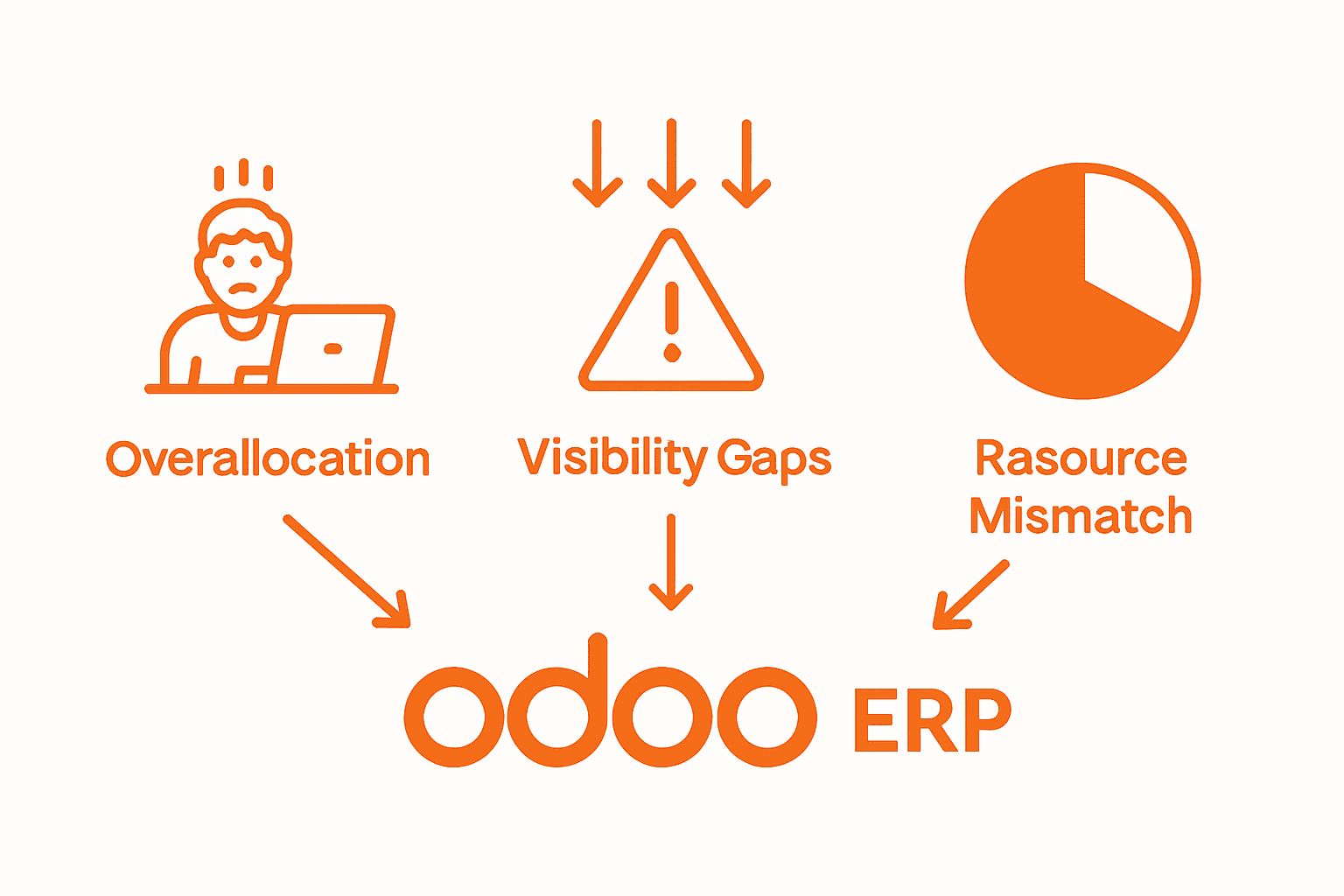
          The most prevalent pitfalls in capacity planning stem from inaccurate resource forecasting, skills misalignment, and inadequate communication across departments. Organizations frequently encounter issues like resource overallocation, where team members are assigned more work than they can realistically complete, leading to burnout and decreased productivity. Ineffective capacity planning can result in project delays, increased operational costs, and diminished team morale, ultimately compromising an organization’s competitive positioning.

          Common capacity planning pitfalls and their prevention strategies include:

          • Resource Overallocation:
            • Identify team member bandwidth
            • Implement realistic workload distribution
            • Use automated scheduling tools
          • Skills Mismatching:
            • Conduct regular skills assessments
            • Create comprehensive skill databases
            • Develop targeted training programs
          • Communication Breakdowns:
            • Establish cross-departmental communication channels
            • Use centralized project management platforms
            • Implement transparent reporting mechanisms

          Pro Tip: Proactive Mitigation Strategy: Develop a quarterly skills inventory and cross-training program to ensure your team maintains flexibility and can dynamically redistribute workloads during unexpected capacity constraints.

          Unlock Efficient Project Management with Expert Capacity Planning

          The article highlights the critical challenge of balancing workloads, avoiding resource overallocation, and aligning strategic, tactical, and operational capacity planning within your projects. If you are struggling with forecasting resource needs or preventing project delays because of poor capacity visibility, you are not alone. Many businesses face these issues as they grow and adapt to changing demands. By leveraging Odoo ERP’s powerful resource planning features, such as real-time capacity visualization and automated workload balancing, your organization can gain precision, prevent bottlenecks, and optimize team performance.

          Boost your efficiency and gain a competitive edge with solutions tailored to your unique business needs. At Bista Solutions, the largest Odoo ERP implementer in North America and a trusted Odoo Gold Partner recognized year after year, we provide expert consulting and implementation services designed specifically for resolving these exact project management hurdles. Our experienced team delivers scalable and customizable ERP solutions that integrate capacity planning, resource allocation, and project tracking seamlessly.

          Contact Us


            Ready to overcome capacity planning roadblocks and elevate your project management success? Discover how our innovative Odoo resource planning modules and comprehensive support can transform your workflows today. Contact us at Bista Solutions to start your journey toward smarter, more strategic project execution.

            Frequently Asked Questions

            What is capacity planning in Odoo ERP?

            Capacity planning in Odoo ERP is a strategic approach to aligning organizational resources with project demands. It involves analyzing current workforce capabilities and forecasting future project requirements to optimize resource allocation and prevent overloading.

            How can Odoo ERP enhance project management?

            Odoo ERP enhances project management by providing integrated resource planning features that allow for real-time tracking of team capacities, skill sets, and availability, facilitating intelligent task assignments and proactive decision-making.

            What are the different types of capacity planning available in Odoo ERP?

            Odoo ERP categorizes capacity planning into three types: strategic (long-term resource allocation), tactical (medium-term departmental needs), and operational (real-time resource management focused on daily workloads).

            What are the key benefits of using Odoo ERP for capacity planning?

            Key benefits of using Odoo ERP for capacity planning include improved cost control, increased productivity through automated workload management, enhanced strategic flexibility with data-driven insights, and reduced risks through real-time capacity reporting.

            Digital Transformation Manufacturing: Essential Strategies

            digital transformation manufacturing

            Manufacturing is heading into an era where smart machines and real time data are changing every rule in the book. You might think upgrading equipment is the main event here. The real surprise is that companies jumping on digital transformation can actually cut operational costs by up to 30 percent and see productivity gains most people thought impossible. Yes, the real value comes from blending new tech with smarter strategies and a workforce that knows exactly how to use it.

            Table of Contents

            Quick Summary

            Takeaway Explanation
            Leverage strategic technology integration Connecting systems and adopting advanced technologies is essential for competitive advantage in manufacturing.
            Focus on operational efficiency Implement real-time monitoring and intelligent automation to reduce waste and downtime significantly.
            Invest in workforce skill development Provide comprehensive training programs to equip employees for interacting with advanced technologies effectively.
            Adopt phased implementation strategies Start with pilot projects to minimize risks and validate technology solutions before full-scale deployment.
            Embrace continuous optimization Use advanced analytics to monitor performance and adapt strategies for ongoing improvements in operational efficiency.

            Key Drivers of Digital Transformation Manufacturing

            Manufacturing businesses face unprecedented challenges in 2025. Digital transformation emerges as the critical strategy for survival and growth. The core drivers propelling this transformation go beyond simple technological upgrades.

            Strategic Technology Integration

            Technology integration represents the foundational driver of digital transformation in manufacturing. Manufacturers recognize that advanced technologies are not optional but essential for competitive advantage. insights into intelligent manufacturing solutions reveal how strategic technology adoption transforms operational capabilities.

            Odoo ERP plays a significant role in this transformation. By connecting disparate systems and providing real time data analytics, manufacturers can make faster strategic decisions. The integration enables businesses to track production processes precisely, predict maintenance requirements, and optimize resource allocation.

            Key technological components driving this transformation include artificial intelligence, machine learning, internet of things sensors, and advanced data analytics platforms. These technologies enable manufacturers to move from reactive to predictive operational models. Companies can now anticipate equipment failures, optimize supply chain dynamics, and create more resilient production environments.

            Operational Efficiency and Productivity

            Operational efficiency stands as another critical driver of digital transformation. Manufacturers seek solutions that dramatically reduce waste, minimize downtime, and accelerate production cycles. Advanced digital tools provide unprecedented visibility into manufacturing processes.

            Traditional manufacturing models relied on manual tracking and retrospective analysis. Modern digital transformation strategies leverage real time monitoring and intelligent automation. Sensors embedded in production equipment can detect micro level variations, enabling immediate corrective actions. This approach transforms how manufacturers understand and optimize their operational workflows.

            The economic implications are substantial. Companies implementing comprehensive digital transformation strategies can reduce operational costs by 20 to 30 percent. These savings stem from more intelligent resource allocation, reduced maintenance expenses, and significantly improved production efficiency.

            Workforce Skill Transformation

            The human element remains crucial in digital transformation. Manufacturing organizations recognize that technology implementation requires corresponding workforce skill development. Employees must transition from traditional manual roles to becoming technology-enabled professionals who can interact with advanced digital systems.

            Training programs focused on digital literacy, data interpretation, and technological adaptation become essential. Workers need to understand how to leverage new technologies effectively. This involves developing skills in data analytics, machine learning interfaces, and complex system management.

            Bista Solutions understands this workforce transformation challenge. By providing comprehensive implementation support, we help manufacturers not just adopt new technologies but also develop the human capabilities required to maximize these technological investments.

            Digital transformation in manufacturing is not a destination but a continuous journey. Successful companies will be those that view technological integration as an ongoing strategic initiative, continuously adapting to emerging technologies and market dynamics.


            To help compare the core drivers for digital transformation in manufacturing, the following table summarizes their focus and expected organizational impact.

            Driver Focus Expected Impact
            Strategic Technology Integration Connecting systems, adopting advanced technologies Enhanced decision-making, predictive operations
            Operational Efficiency Real-time monitoring, intelligent automation Cost reduction (20–30%), reduced downtime/waste
            Workforce Skill Transformation Training and upskilling employees Workforce adapts to tech, maximized tech ROI

            Top Technologies Shaping Manufacturing in 2025

            Infographic illustrating key technologies driving manufacturing transformation in 2025

            The manufacturing landscape is rapidly evolving, driven by groundbreaking technological innovations that redefine production capabilities. In 2025, manufacturers are witnessing a technological revolution that transforms traditional processes into intelligent, adaptive systems.

            Artificial Intelligence and Machine Learning

            Artificial intelligence represents the cornerstone of manufacturing transformation. AI technologies enable manufacturers to create predictive models that anticipate equipment failures, optimize production schedules, and enhance quality control processes. Machine learning algorithms analyze massive datasets, identifying patterns that human analysts might miss.

            explore intelligent manufacturing solutions to understand how these technologies revolutionize production environments. Odoo ERP integrates AI capabilities that allow manufacturers to make data driven decisions with unprecedented precision.

            Advanced machine learning models can now predict maintenance requirements, reducing unexpected equipment downtime by up to 50 percent. These intelligent systems continuously learn from production data, creating increasingly sophisticated optimization strategies that adapt in real time.

            Internet of Things and Advanced Sensor Technologies

            The Internet of Things represents another transformative technology in manufacturing. Connected sensors embedded throughout production environments provide granular insights into every aspect of manufacturing processes. These IoT devices collect real time data on equipment performance, environmental conditions, and production metrics.

            Manufacturers can now create digital twins of entire production lines, allowing for sophisticated simulation and optimization. Sensors track everything from temperature variations to micro level equipment vibrations, enabling proactive maintenance and quality control strategies.

            The economic impact is substantial. Companies implementing comprehensive IoT strategies can reduce operational costs by 25 percent while improving overall production efficiency. These technologies transform manufacturing from reactive maintenance models to predictive and preventative approaches.

            Advanced Robotics and Automation

            Robotics and automation technologies continue to revolutionize manufacturing capabilities. Modern robotic systems go beyond simple repetitive tasks, incorporating advanced artificial intelligence and machine learning capabilities. Collaborative robots work alongside human workers, enhancing productivity and safety.

            These advanced robotic systems can adapt to complex manufacturing environments, learning and improving their performance continuously. They handle intricate tasks with precision impossible for human workers, from microscopic assembly processes to complex quality control inspections.

            Bista Solutions recognizes the transformative potential of these technologies. By providing comprehensive implementation strategies, we help manufacturers integrate these advanced technologies seamlessly into existing production environments.

            The technological landscape of manufacturing in 2025 is defined by intelligence, connectivity, and adaptive capabilities. Manufacturers who embrace these technologies will create more efficient, responsive, and competitive production systems. The future of manufacturing is not just about producing goods but about creating intelligent, self-optimizing production ecosystems.


            The following table summarizes the leading technologies shaping manufacturing in 2025, highlighting their key capabilities and the measurable benefits they bring to manufacturers.

            Technology Key Capabilities Notable Benefits
            Artificial Intelligence & Machine Learning Predictive models, real-time optimization Up to 50% reduction in equipment downtime
            Internet of Things & Sensors Real-time data collection, digital twins Up to 25% operational cost reduction
            Advanced Robotics & Automation Adaptive, collaborative, precision robotics Accelerated production, improved quality

            Smart Implementation Steps for US Manufacturers

            Digital transformation in manufacturing requires strategic planning and methodical execution. US manufacturers must approach this complex journey with a comprehensive roadmap that addresses technological, organizational, and human factors.

            Strategic Technology Assessment and Selection

            Successful digital transformation begins with a rigorous technology assessment. Manufacturers must evaluate their current technological infrastructure and identify specific gaps that require modernization. discover comprehensive ERP implementation strategies to understand the foundational steps of technological integration.

            Odoo ERP offers manufacturers a flexible platform for assessing and implementing digital solutions. The key is not just selecting advanced technologies but choosing solutions that align precisely with specific business objectives. Manufacturers should conduct thorough evaluations that consider scalability, compatibility with existing systems, and potential long-term return on investment.

            Key technological considerations include interoperability between different systems, data migration capabilities, and the potential for future upgrades. Manufacturers must create a technology roadmap that allows for incremental implementation, enabling continuous improvement and minimizing disruption to existing operations.

            Workforce Development and Change Management

            Technology implementation is fundamentally a human process. Successful digital transformation requires comprehensive workforce development strategies that prepare employees for technological change. This involves creating robust training programs that build digital literacy and technical skills across all organizational levels.

            Manufacturers must develop multi-tier training approaches. Entry-level workers need basic digital skills, while technical teams require advanced training in specific technological platforms. Leadership teams need a strategic understanding of how digital technologies can drive business transformation.

            Bista Solutions recognizes the critical role of change management in digital transformation. Organizations must create a culture of continuous learning that embraces technological innovation. This involves developing clear communication strategies, providing ongoing support, and creating incentive structures that encourage technological adaptation.

            Phased Implementation and Continuous Optimization

            A methodical approach to digital transformation involves phased implementation rather than sudden, comprehensive changes. Manufacturers should start with pilot projects in specific departments or production lines, allowing for controlled testing and refinement of digital strategies.

            This approach enables organizations to:

            • Minimize Risk: Test technologies in controlled environments
            • Validate Performance: Measure actual impact before full-scale deployment
            • Build Organizational Confidence: Demonstrate tangible benefits of digital transformation

            Continuous optimization becomes crucial after initial implementation. Manufacturers must develop robust monitoring systems that track technological performance, measure key performance indicators, and enable rapid adjustments. Advanced analytics and machine learning can help organizations continuously refine their digital transformation strategies.

            US manufacturers stand at a critical juncture. Those who approach digital transformation as a strategic, incremental journey will create more resilient, efficient, and competitive organizations. Success depends not just on technological investment but on creating a holistic approach that integrates technology, people, and organizational culture.

            Success Stories from Auto and Equipment Businesses

            Digital transformation is not a theoretical concept but a tangible reality for forward-thinking auto and equipment manufacturers. Real-world success stories demonstrate the profound impact of strategic technological integration across industrial sectors.

            Automotive Manufacturing Breakthroughs

            The automotive industry exemplifies digital transformation potential. Major manufacturers have successfully implemented advanced technologies that revolutionize production processes. Explore automotive ERP transformation strategies to understand how technology drives industry innovation.

            One prominent automotive manufacturer implemented an integrated digital platform that connected design, production, and supply chain systems. By utilizing advanced machine learning algorithms, they reduced product development cycles by 40 percent. The system enabled real-time collaboration between engineering teams, dramatically reducing prototype development time and associated costs.

            Odoo ERP played a critical role in these transformations. The platform allowed manufacturers to create seamless communication channels between different departments, enabling faster decision-making and more responsive production strategies. Predictive maintenance technologies integrated into these systems helped reduce unexpected equipment downtime by up to 55 percent.

            Equipment Manufacturing Digital Transformation

            Equipment manufacturers have demonstrated equally impressive digital transformation outcomes. Advanced sensor technologies and intelligent monitoring systems have transformed traditional production approaches. Manufacturers now utilize comprehensive digital twins that simulate entire production environments before physical implementation.

            A leading industrial equipment manufacturer developed a comprehensive digital transformation strategy focusing on three key areas: production optimization, quality control, and workforce training. By implementing advanced robotics and machine learning technologies, they achieved a 30 percent improvement in overall equipment efficiency.

            The implementation involved creating interconnected systems that could communicate and adjust in real time. Sensors embedded throughout production lines collected granular performance data, enabling immediate adjustments and predictive maintenance strategies. This approach transformed traditional reactive maintenance models into proactive, intelligent systems.

            Small and Medium Enterprise Success Stories

            manufacturing success stories

            Digital transformation is not limited to large corporations. Small and medium equipment manufacturers have also successfully implemented advanced technologies. Bista Solutions has supported numerous businesses in developing tailored digital transformation strategies that match their specific operational requirements.

            One mid-sized equipment manufacturer implemented a modular digital transformation approach. They started with specific departments, gradually expanding their technological capabilities. This strategy allowed them to manage implementation risks while demonstrating tangible benefits to stakeholders.

            Key outcomes for these businesses included:

            • Increased Productivity: 25 to 40 percent improvement in operational efficiency
            • Reduced Costs: Significant reductions in maintenance and operational expenses
            • Enhanced Quality Control: More precise monitoring and immediate defect detection

            These success stories demonstrate that digital transformation is not about wholesale technological replacement but strategic, thoughtful integration. Manufacturers who approach digital transformation as a comprehensive journey focused on creating value will achieve the most significant competitive advantages.

            The future of manufacturing belongs to organizations that can effectively blend human expertise with intelligent technological systems. Those who embrace this approach will create more resilient, efficient, and adaptive business models.

            Frequently Asked Questions

            What is digital transformation in manufacturing?

            Digital transformation in manufacturing refers to the integration of advanced technologies and smart systems into production processes to enhance operational efficiency, reduce costs, and improve overall productivity.

            How can manufacturers reduce operational costs through digital transformation?

            Manufacturers can reduce operational costs by implementing digital tools that improve resource allocation, minimize waste, and reduce downtime, potentially achieving cost savings of 20% to 30%.

            What are the key technologies shaping manufacturing in 2025?

            Key technologies include Artificial Intelligence (AI), Internet of Things (IoT) devices, advanced sensor technologies, and robotics, all of which enhance productivity and efficiency through intelligent automation and real-time data analysis.

            Why is workforce skill transformation important in digital manufacturing?

            Workforce skill transformation is crucial as employees need to develop new digital skills to effectively interact with advanced technologies, ensuring the success of digital transformation initiatives and maximizing the return on technology investments.

            Ready to Accelerate Your Manufacturing Success?

            Are you struggling with outdated processes and siloed data as you look to embrace digital transformation in manufacturing? The article highlights just how vital it is to bring together advanced technologies and train your team for the future. Achieving real-time insights and predictive operational control is no longer optional if your goal is to stay ahead in 2025 and beyond.

            Contact Us For A Free Consultation

              Take action now and turn these challenges into new opportunities. As the leading Odoo ERP implementer in North America, Bista Solutions has guided over 350 manufacturers just like you through successful digital transformations. Boost productivity and gain a true competitive edge by exploring intelligent manufacturing solutions from our experts or learn more about what sets Bista apart as the Odoo Best Partner in North America. If you are ready to drive growth and unlock the power of a connected, data-driven manufacturing operation, contact our team today at https://www.bistasolutions.com/contact-us/. Your smarter factory starts with a single step.

              Bista Solutions at SHOT Show Supplier Showcase 2026

              Shot Show Supplier case 2026
              • by Uzlifat Mir
              • Dec 15, 2025
              • 0
              • Category:

              Bista Solutions is excited to announce our participation in the SHOT Show Supplier Showcase 2026, taking place January 19-20, 2026. You’ll find us at Booth 52133, where we’ll be connecting with manufacturers, distributors, and retailers across the firearms, ammunition, and defense ecosystem.

              What is the SHOT Show Supplier Showcase?

              The SHOT Show Supplier Showcase is a dedicated two-day event designed specifically for suppliers that support the shooting sports, firearms, ammunition, law enforcement, outdoor, and defense industries. It brings together companies that provide materials, machinery, technology, software, and services that keep the industry moving.

              Focused conversations, targeted networking, and access to key decision-makers make the Supplier Showcase a high-value event for both exhibitors and attendees. It is built for companies looking to strengthen supply chains, modernize operations, and adopt solutions that meet strict regulatory standards.

              Why This Event Matters

              The firearms and ammunition industry operates under some of the most complex regulatory and operational requirements of any manufacturing sector. Events like the Supplier Showcase give industry leaders a space to explore tools and technologies that improve efficiency while maintaining full compliance.

              For Bista Solutions, this event is a chance to directly engage with businesses facing real-world challenges around compliance, traceability, inventory control, and scalability. It also allows us to demonstrate how modern ERP systems can be purpose-built for regulated industries instead of forcing businesses to rely on fragmented or manual processes.

              Why an ERP Is Essential for the Firearms Industry

              As highlighted in our event materials, the firearms industry faces unique challenges driven by strict ATF regulations and the need to maintain operational efficiency across manufacturing, distribution, and retail segments.

              A scalable ERP system helps firearms businesses:

              • Centralize and standardize operations
              • Improve efficiency across manufacturing and supply chain processes
              • Ensure security and data integrity
              • Maintain complete regulatory compliance
              • Support business growth without increasing risk

              This is exactly where Bista Solutions focuses.

              How Bista Solutions Serves the Arms and Ammunition Industry

              Bista Solutions is an Odoo Gold Partner delivering Odoo-based business management systems (ERP) specifically configured for the arms, ammunition, and defense industries. Our solutions are designed to handle the complexity of regulated products while giving businesses a single, unified system to manage operations.

              Key Features and Integrations

              Our ERP offering supports critical industry needs, including:

              • LogBook Integrations
                • Integration with systems like Easy Bound Book and FastBound to ensure accurate ATF recordkeeping and audit readiness.
              • Shipping Carrier Integrations
                • Seamless integration with major carriers like UPS and FedEx for efficient and compliant shipping workflows.
              • eCommerce Integrations
                • Support for leading eCommerce platforms, including Shopify, WooCommerce, and Magento, allowing compliant online sales and real-time synchronization of orders and inventory.
              • Vendor Portals
                • Self-service vendor portals that streamline procurement and supply chain management while improving visibility and collaboration.

              Built for Every Segment of the Industry

              Our ERP solutions are designed to support the full firearms value chain:

              • Manufacturers: Simplify production with Odoo MRP for production planning, quality checks, shop floor control, and ATF compliance.
              • Retailers: Manage point of sale, eCommerce, reservations, and memberships while maintaining efficiency and regulatory compliance.
              • Distributors: Track inventory, automate procurement, and ensure ATF compliance through accurate bound book reporting and tax tools.

              And much more.

              Our Shopify Partnership

              Bista Solutions is a Shopify partner, enabling businesses to operate compliant and scalable eCommerce stores connected directly to their ERP. This allows firearms and ammunition companies to manage online sales, inventory, fulfillment, and compliance from one integrated platform instead of juggling disconnected systems.

              Visit Bista Solutions at Booth 52133

              At the SHOT Show Supplier Showcase 2026, Bista Solutions will be showcasing how our ERP solutions help firearms and ammunition businesses modernize operations, maintain compliance, and scale with confidence.

              Booth: 52133
              Dates: January 19–20, 2026

              We look forward to meeting you, learning about your challenges, and showing how Bista Solutions can support your growth.

              Bista Solutions at HDAW 2026: Powering the Future of Heavy-Duty Aftermarket Auto Parts

              HDAW Event 2026
              • by Uzlifat Mir
              • Dec 15, 2025
              • 0
              • Category:

              We’re excited to announce that Bista Solutions will be attending HDAW 2026 and showcasing our expertise in ERP and eCommerce solutions for the heavy-duty aftermarket auto parts industry. Join us January 20–21, 2026, at Booth 845 to see how integrated ERP, B2B, and D2C commerce, and automation can simplify even the most complex aftermarket operations.

              What Is HDAW?

              The Heavy Duty Aftermarket Week (HDAW) is North America’s premier event dedicated exclusively to the heavy-duty aftermarket. Hosted by the Auto Care Association, HDAW brings together manufacturers, distributors, suppliers, technology providers, and industry leaders.

              HDAW is more than a trade show. It’s a focused, high-value environment designed for strategic conversations, relationship building, and solution discovery. Attendees gain:

              • Direct access to aftermarket decision-makers
              • Insight into emerging industry trends
              • Exposure to operational and technology innovations
              • Opportunities to build partnerships that drive growth

              For businesses navigating scale, complexity, and margin pressure, HDAW is where the industry aligns on what’s next.

              Why HDAW Matters to the Heavy-Duty Aftermarket Industry

              Heavy-duty aftermarket companies face challenges that standard ERP and eCommerce platforms weren’t built to handle:

              • Multi-warehouse inventory visibility
              • Complex purchasing and supplier processes
              • Core tracking and returns management
              • Disconnected systems across ERP, accounting, and online sales
              • Limited reporting and real-time insights

              HDAW creates the space for these challenges to be addressed with practical, industry-specific solutions. That focus makes it a natural fit for Bista Solutions.

              How Bista Solutions Serves the Heavy-Duty Aftermarket Parts Industry

              Bista Solutions provides ERP software purpose-built for heavy-duty aftermarket auto parts businesses. Our all-in-one business management platform is designed to solve real industry problems such as inventory accuracy, operational scalability, and system integration.

              We help aftermarket companies:

              • Maintain accurate inventory across multiple locations
              • Streamline complex purchasing and vendor management
              • Handle core tracking efficiently
              • Eliminate data silos between departments
              • Scale operations without sacrificing control
              • Gain clear operational and financial visibility

              ERP Features and Benefits Built for Aftermarket Demands

              Our ERP solutions support the full operational lifecycle with powerful, integrated modules, including:

              Core ERP Modules

              • CRM
              • Accounting
              • Sales
              • Inventory
              • Manufacturing
              • Purchase

              Extended Business Capabilities

              • eCommerce
              • Website management
              • Employee management
              • Planning and forecasting
              • Advanced reporting and spreadsheets
              • Location and logistics support

              Our ERP Services

              • Consultation
              • Business analysis
              • Implementation
              • Customization
              • Integration
              • Migration
              • Automation
              • Training
              • Ongoing support

              Everything is designed to support high-volume, high-complexity aftermarket operations.

              Shopify Partnership Powering B2B and D2C Commerce

              As an Odoo Gold Partner and Shopify Partner, Bista Solutions delivers fully integrated ERP and eCommerce solutions that support both B2B and D2C sales models.

              Through our Shopify partnership, heavy-duty aftermarket businesses can:

              • Run B2B portals with custom pricing, customer-specific catalogs, credit terms, and bulk ordering
              • Launch and scale D2C storefronts without manual workarounds
              • Sync inventory, pricing, orders, and customer data in real time between Shopify and ERP
              • Improve order accuracy, fulfillment speed, and customer experience

              Whether selling to distributors, fleets, repair shops, or end customers, our solutions enable businesses to operate multiple sales channels from a single, unified system.

              Visit Bista Solutions at Booth 845

              If you’re attending HDAW 2026, we’d love to connect.

              Booth: 845
              Dates: January 20–21, 2026

              Stop by to discuss your operational challenges, explore ERP solutions designed for the heavy-duty aftermarket, and see how integrated B2B and D2C commerce can drive efficiency and growth.

              Bista Solutions Is Heading to PPAI Expo 2026

              PPAI Show 2026
              • by Uzlifat Mir
              • Dec 15, 2025
              • 0
              • Category:

              Booth 5459 | January 13–15, 2026

              Bista Solutions is excited to announce our participation in PPAI Expo 2026, the largest and most influential trade show dedicated to the promotional products industry. We will be exhibiting at Booth 5459 from January 13 to January 15, 2026, where attendees can see firsthand how our all-in-one ERP solution helps distributors and manufacturers run smarter, faster, and more efficiently.

              What Is PPAI Expo?

              PPAI Expo is hosted by the Promotional Products Association International (PPAI) and is widely recognized as the must-attend event for professionals in the promotional products space. Each year, it brings together thousands of distributors, manufacturers, suppliers, decorators, and technology partners to explore innovation, education, and strategic growth opportunities.

              The event serves as a central hub for:

              • Industry networking and relationship-building
              • Discovering new technology and operational tools
              • Learning best practices and upcoming trends
              • Evaluating platforms that improve speed, accuracy, and profitability

              For promotional products companies, PPAI Expo is where operational transformation begins.

              Why Attending PPAI 2026 Matters

              The promotional products industry involves complex workflows across quoting, artwork approvals, decoration, production, inventory, shipping, and billing. As order volumes increase and customer expectations rise, businesses need systems built specifically for this environment.

              PPAI Expo offers decision-makers a chance to see purpose-built solutions in action, compare approaches, and connect with partners who understand the industry’s real-world challenges. Bista Solutions’ presence reflects our deep focus and long-term investment in this space.

              How Bista Solutions Serves the Promotional Products Industry

              Bista Solutions delivers an all-in-one business management ERP tailored specifically for the promotional products industry. Built on Odoo and customized extensively for promo workflows, our solution supports both distributors and manufacturers from start to finish.

              As an Odoo Gold Partner, with more than 350 ERP implementations and 300+ resources across the U.S., Canada, and globally, Bista brings proven expertise and industry-specific execution.

              Solutions for Distributors

              Our ERP enables distributors to:

              • Source, customize, and resell promotional products with confidence
              • Manage customer expectations, tight deadlines, and approvals
              • Coordinate decorators, suppliers, and shipping in one system

              Key distributor-focused features include:

              • Customer-specific decoration pricing and markup
              • Online portals for artwork uploads and e-signature approvals
              • Credit limit enforcement with flexible billing and shipping options
              • Integrated shipping with FedEx, UPS, USPS, and drop-shipping support
              • Branded customer portals with real-time order and approval visibility

              Solutions for Manufacturers

              For manufacturers, our ERP supports:

              • In-house or third-party decorated production
              • Oversight of production timelines, work orders, and quality control
              • Optimization of inventory, operations, and vendor workflows

              Key manufacturing features include:

              • Auto-generated manufacturing orders with artwork and decoration steps
              • Defined operation sequences and cooling times
              • Uploading, previewing, and tracking production files per order
              • Internal artwork and decoration tracking for multi-step jobs
              • Inventory control, vendor POs, and in-house or outsourced workflow management

              What Our ERP Solves

              Bista’s ERP centralizes and automates core processes across:

              • Sales, art, production, and procurement
              • In-house and vendor-based decoration workflows
              • Artwork versions, product variants, and service add-ons

              By providing real-time visibility and structured approvals through branded portals, our solution helps reduce delays, miscommunication, and fulfillment errors while improving operational accuracy and scalability.

              Shopify Partnership and Industry Integrations

              Bista Solutions is a Shopify Partner, delivering seamless integration between Shopify storefronts and our ERP platform. This allows promotional products businesses to synchronize orders, customers, inventory, pricing, and fulfillment without manual re-entry or disconnected systems.

              In addition to Shopify, our ERP integrates with a wide range of industry platforms and tools, including:

              • PromoStandards
              • ASI (Advertising Specialty Institute)
              • Web-to-Print Solutions
              • Sage
              • Authorize.net
              • Coupa
              • And much more

              These integrations allow businesses to connect sales channels, suppliers, and financial systems into one unified operational ecosystem.

              Why Bista Solutions

              Bista Solutions has been recognized multiple times as Odoo Best Partner across North America, including recent awards in 2024 and 2025. We are an end-to-end, full implementation ERP partner with deep expertise in high-volume, fast-turn industries.

              With offices across North America and offshore delivery capabilities, we support clients from initial implementation through long-term growth.

              Visit Us at Booth 5459

              If you are attending PPAI Expo 2026, we invite you to visit Bista Solutions at Booth 5459 from January 13 to January 15, 2026. Whether you are a distributor looking to modernize approvals and eCommerce integration, or a manufacturer seeking stronger production and inventory control, our team is ready to show how a purpose-built ERP can transform your business.

              How To Avoid Pitfalls In Your Next AI Project: A Thought Article

              Avoid Pitfalls In Your Next AI Project
              • by Uzlifat Mir
              • Dec 10, 2025
              • 0
              • Category:

              Most teams believe their biggest risk in an AI project is the technology. They obsess over models, architectures, and tools. The irony is that none of those is the real problem. AI fails for reasons that have nothing to do with intelligence and everything to do with human behavior. If you want your next AI project to survive contact with reality, you need to understand the psychology and the messy decision-making behind it.

              Avoid Pitfalls In Your Next AI ProjectThe first pitfall is starting with the fantasy instead of the problem. People fall in love with the idea of AI and skip the part where they actually articulate what needs to change. They want transformation with no clarity. They want automation without confronting what they even do today. Any project built on a vague desire to be innovative eventually collapses under its own ambiguity. AI cannot fix a lack of direction.

              Avoid Pitfalls In Your Next AI ProjectThe second pitfall is an expectation problem. Stakeholders imagine AI as an oracle rather than a statistical system that will always be imperfect. They want certainty where only probability exists. They want guarantees where only tradeoffs are possible. Teams then shrink under the pressure and start overpromising. The moment the project becomes a performance to impress the organization rather than a tool to solve a real problem, failure is locked in.

              Avoid Pitfalls In Your Next AI ProjectThe third pitfall is data denial. Everyone knows data quality is essential, yet almost every project pretends the data is fine until it becomes painfully obvious it is not. Teams behave as if the truth will ruin the momentum. They hope the model will magically overcome gaps in the data. It never does. AI exposes every flaw in your information ecosystem. If the data is a mess, the project inherits the mess.

              Avoid Pitfalls In Your Next AI ProjectAnother pitfall lies in the way people avoid simplicity. Complexity feels like progress, so teams dive into sophisticated architectures before proving that the basic idea even works. They mistake technical difficulty for strategic value. The smartest teams do the opposite. They reduce the idea to its simplest form, test it quickly, and let the results dictate whether complexity is needed. They respect the fact that AI rewards clarity, not ego.

              Avoid Pitfalls In Your Next AI ProjectThen there is the human side of deployment. The unspoken truth is that most AI systems fail because the intended users simply do not use them. The output does not fit into their workflow, or it requires them to change habits they have no intention of changing. People adopt tools that make life easier, not tools that introduce more steps. If AI does not meet them where they already are, it becomes another unused dashboard that dies quietly.

              Avoid Pitfalls In Your Next AI ProjectEthics and governance are another place where avoidance shows up. Teams ignore risk until the final stage, then scramble when someone asks a difficult question about bias or privacy. By that point, it is expensive to fix. Responsible design is not a formality. It is pragmatic risk management. It prevents late-stage surprises that drain time and credibility.

              Avoid Pitfalls In Your Next AI ProjectThe final pitfall is treating deployment as the finish line. AI decays the moment it meets the real world. Data shifts. Behavior changes. Business needs evolve. If a team has no plan for monitoring, recalibration, or ownership, the model drifts into irrelevance. It becomes a silent failure that no one notices until someone finally checks the numbers months later.

              Avoiding these pitfalls is not about being perfect. It is about being honest. Honest about the problem. Honest about the limits of the technology. Honest about the data you have. Honest about how people actually work. AI does not reward fantasy. It rewards teams that look reality in the face and design accordingly.

              If you want an AI project that succeeds, anchor it in truth and discipline. Everything else is noise.