Why Healthcare and Life Sciences Need Odoo ERP

hospital erp integration

Healthcare organizations across american medical sectors face growing pressure to modernize their operations while safeguarding sensitive patient data. With over 90 percent of hospitals seeking integrated digital solutions, the right enterprise resource planning system can make a measurable difference. Odoo ERP stands out by offering modular tools that help clinics and hospitals simplify tasks, strengthen compliance, and improve care. Explore what sets this platform apart in addressing the real needs of today’s healthcare and life sciences providers.

Table of Contents

Key Takeaways

Point Details
Comprehensive Integration Odoo ERP provides a unified platform that streamlines multiple healthcare systems and workflows, enhancing operational efficiency.
Modular Features for Customization The platform’s modular architecture allows healthcare organizations to tailor applications to meet their specific operational needs.
Strong Compliance and Security Odoo incorporates robust HIPAA compliance measures and security protocols to ensure patient data protection and regulatory adherence.
Significant ROI Potential While requiring an initial investment, Odoo ERP leads to long-term benefits such as reduced operational errors and enhanced patient care efficiency.

Defining Odoo ERP for Healthcare and Life Sciences

Odoo ERP represents a comprehensive software solution specifically designed to address the complex technological challenges faced by healthcare and life sciences organizations. As an integrated enterprise resource planning platform, Odoo offers healthcare providers a robust suite of tools that streamline operational efficiency, enhance patient management, and optimize critical business processes. Healthcare ERP Solutions by Bista Solutions demonstrate the transformative potential of this technology in medical environments.

At its core, Odoo provides healthcare organizations with modular applications that cover multiple critical functions. These include patient record management, inventory tracking for medical supplies, financial reporting, human resources management, and compliance documentation. The platform’s flexibility allows medical institutions to customize modules precisely to their unique operational requirements, whether they are small clinics or large hospital networks. The open-source architecture means healthcare providers can adapt the software without expensive custom development.

The most significant advantage of Odoo ERP for healthcare organizations is its comprehensive approach to data management and regulatory compliance. With specialized modules addressing HIPAA requirements and Odoo HIPAA Compliance Implementation, medical institutions can ensure patient data remains secure while maintaining seamless operational workflows. Key features specifically beneficial to healthcare settings include:

  • Real-time patient record tracking
  • Secure document management systems
  • Integrated billing and insurance claim processing
  • Advanced reporting and analytics tools
  • Scalable infrastructure supporting growth

By leveraging Odoo’s integrated platform, healthcare organizations can transform complex administrative processes into streamlined, efficient operations. The software’s ability to centralize diverse functions reduces operational overhead, minimizes human error, and allows medical professionals to focus more on patient care rather than administrative tasks.

medical office erp

Key Features Tailored for Medical Businesses

Odoo ERP provides healthcare organizations with a sophisticated set of specialized features designed to address the unique operational challenges of medical businesses. The platform’s modular architecture allows medical institutions to implement precise technological solutions that enhance patient care, streamline administrative processes, and maintain strict regulatory compliance. Understanding these tailored features can help healthcare leaders make informed technology investment decisions.

One of the most critical feature sets for medical businesses is patient data management. Odoo ERP offers comprehensive patient record tracking systems that enable healthcare providers to securely store, manage, and retrieve complex medical information. These modules support detailed patient histories, treatment records, insurance documentation, and billing information while maintaining HIPAA compliance standards. Medical practices can customize patient management workflows to match their specific operational requirements, whether managing a small clinic or a large hospital network. Odoo accounting features further complement these capabilities by integrating financial tracking directly with patient management systems.

The platform’s advanced features extend beyond basic record management to provide robust operational support for medical businesses. Key technological capabilities include:

  • Real-time medical inventory tracking
  • Advanced scheduling and appointment management
  • Integrated billing and insurance claim processing
  • Secure document management systems
  • Comprehensive reporting and analytics tools
  • Multi-location support for healthcare networks

By leveraging Odoo’s flexible infrastructure, medical businesses can create a unified technological ecosystem that reduces administrative overhead, minimizes potential errors, and allows healthcare professionals to focus more effectively on patient care. The software’s ability to integrate multiple critical functions provides medical organizations with unprecedented operational efficiency and data management capabilities.

Regulatory Compliance and Security Considerations

In the highly regulated healthcare industry, maintaining stringent security and compliance standards is not just a recommendation but an absolute necessity. Odoo ERP addresses these critical requirements through comprehensive security features specifically designed for medical businesses, ensuring that patient data remains protected while meeting complex regulatory mandates. Odoo HIPAA Compliance Implementation demonstrates the platform’s commitment to maintaining the highest levels of data protection and regulatory adherence.

The HIPAA compliance framework embedded within Odoo ERP provides multiple layers of security protection. This includes advanced access control mechanisms that restrict sensitive patient information to authorized personnel only. Healthcare organizations can implement granular user permissions, ensuring that each staff member can access only the specific data required for their professional responsibilities. Encryption protocols, secure data transmission methods, and comprehensive audit trails further enhance the platform’s ability to protect patient confidentiality and meet strict healthcare data protection standards.

Key security and compliance features of Odoo ERP for healthcare organizations include:

  • Role-based access control systems
  • End-to-end data encryption
  • Comprehensive user activity logging
  • Secure patient record management
  • Automatic compliance reporting
  • Multi-factor authentication protocols
  • Secure cloud and on-premise deployment options

Beyond technical safeguards, Odoo ERP offers healthcare organizations a proactive approach to regulatory compliance. The platform’s built-in reporting tools enable medical businesses to generate detailed compliance documentation, track potential security risks, and demonstrate adherence to complex regulatory requirements. By integrating security directly into the operational workflow, Odoo helps medical institutions minimize potential compliance vulnerabilities and maintain the highest standards of patient data protection.

Integration With Healthcare Systems and Workflows

Odoo ERP revolutionizes healthcare technological integration by providing a seamless, comprehensive platform that connects multiple complex systems and workflows. The platform’s advanced integration capabilities enable healthcare organizations to create a unified technological ecosystem that eliminates data silos, reduces manual processes, and enhances overall operational efficiency. EDI HIPAA integration solutions demonstrate the platform’s ability to bridge critical communication gaps within healthcare infrastructures.

The workflow management system within Odoo ERP offers healthcare organizations unprecedented flexibility in designing and implementing custom operational processes. Medical institutions can create sophisticated, automated workflows that streamline patient management, administrative tasks, and interdepartmental communication. These integrations support real-time data synchronization across various critical healthcare systems, including electronic health records (EHR), billing platforms, inventory management, and scheduling applications. This comprehensive approach ensures that healthcare professionals have immediate access to accurate, up-to-date information across multiple operational domains.

Key integration capabilities for healthcare workflows include:

  • Seamless electronic health record (EHR) integration
  • Automated insurance claim processing
  • Real-time patient scheduling synchronization
  • Integrated medical inventory management
  • Cross-platform data sharing
  • Customizable interdepartmental communication protocols
  • Advanced reporting and analytics integration

Beyond technical integration, Odoo ERP provides healthcare organizations with a transformative approach to operational management. By creating a centralized platform that connects disparate systems and workflows, medical institutions can dramatically reduce administrative overhead, minimize potential errors, and create a more responsive, patient-centered healthcare environment. The platform’s modular design allows for continuous adaptation and expansion, ensuring that technological infrastructure can evolve alongside changing healthcare delivery models.

Cost, ROI, and Common Implementation Pitfalls

Navigating the financial landscape of ERP implementation requires a strategic approach that balances initial investment with long-term organizational benefits. Healthcare organizations must carefully evaluate the total cost of ownership, potential return on investment, and potential challenges associated with implementing an enterprise resource planning solution. ERP implementation costs breakdown provides crucial insights into the financial considerations that healthcare leaders must examine when considering technological transformation.

The return on investment for Odoo ERP in healthcare settings extends far beyond immediate monetary gains. While the initial implementation requires significant investment, medical organizations typically experience substantial long-term benefits, including reduced administrative overhead, minimized operational errors, enhanced patient care coordination, and improved data management efficiency. Most healthcare institutions report a comprehensive ROI within 12-24 months, with continued financial advantages emerging through increased operational productivity, streamlined processes, and more effective resource allocation.

Common implementation challenges that healthcare organizations must anticipate include:

  • Complex data migration processes
  • Resistance to technological change among staff
  • Insufficient initial workflow analysis
  • Inadequate staff training programs
  • Customization complexity
  • Integration challenges with existing systems
  • Scalability concerns

Successful ERP implementation in healthcare requires a holistic approach that combines technological expertise, organizational change management, and strategic planning. By understanding potential pitfalls and developing comprehensive implementation strategies, medical institutions can maximize their technological investment and create a robust, adaptable operational infrastructure that supports continuous improvement and patient-centered care.

Unlock the Full Potential of Healthcare with Trusted Odoo ERP Solutions

The complex demands of healthcare and life sciences require more than just software. You need an ERP solution that ensures secure patient data management, regulatory compliance, and streamlined workflows tailored to your unique challenges. Bista Solutions understands these pain points and delivers scalable, tailored Odoo ERP implementations that empower your organization to reduce administrative burdens and focus on what really matters: patient care.


Contact Us For A Free Demo


    Partner with Bista Solutions, the largest Odoo ERP implementer in North America and a recognized Odoo Gold Partner. With over 350 successful implementations and a dedicated team of experts, we provide end-to-end support that transforms your healthcare operations while maintaining strict compliance and boosting operational efficiency. Don’t let complex integration and costly errors hold your organization back. Take the first step today and connect with us at https://bistasolutions.com/contact-us to start your journey toward a more efficient and patient-focused future.

    Frequently Asked Questions

    What is Odoo ERP, and how does it benefit healthcare organizations?

    Odoo ERP is a comprehensive software solution designed to address the complex challenges of healthcare organizations. It streamlines operational efficiency, enhances patient management, and optimizes business processes through integrated modular applications like patient record management, inventory tracking, and billing.

    How does Odoo ERP ensure compliance with healthcare regulations?

    Odoo ERP includes specialized modules that support HIPAA requirements, ensuring patient data security and regulatory compliance. Key features include role-based access control, end-to-end encryption, and automated compliance reporting.

    What are the key features of Odoo ERP tailored for medical businesses?

    Odoo ERP offers specialized features for healthcare, such as real-time patient record tracking, advanced scheduling, integrated billing and insurance processing, and comprehensive reporting tools, all customizable to meet unique operational needs.

    What should healthcare organizations consider before implementing Odoo ERP?

    Organizations should evaluate the total cost of ownership, potential ROI, and prepare for challenges such as data migration, staff training, and integration with existing systems. Successful implementation requires strategic planning and management of organizational change.

    How Distributors Use Odoo ERP Efficiently

    odoo erp distribution

    More than half of small distributors struggle to keep their operations organized as business demands grow. When daily tasks like inventory tracking, order management, and accounting become overwhelming, efficiency drops and profits shrink. Odoo ERP offers a clear solution by bringing everything into one easy-to-use system. With integrated tools for sales, inventory, and finances, distributors gain a unified view of their business, reduce mistakes, and make smarter decisions backed by real-time data.

    Table of Contents

    Key Takeaways

    Point Details
    Integrated Modules Odoo ERP provides a unified system that enhances inventory, sales, purchasing, and accounting processes for distributors.
    Order Management Efficiency Odoo automates complex order management workflows, reducing manual data entry and errors while providing real-time visibility.
    Customization and Flexibility The open-source architecture allows businesses to tailor and integrate Odoo ERP to meet unique operational needs.
    Support for Adoption Odoo anticipates common implementation challenges, offering training, migration tools, and continuous support for a smoother transition.

    Core Functions of Odoo ERP for Distributors

    Distributors face complex operational challenges that require robust technological solutions. Odoo ERP provides a comprehensive software platform designed to streamline core business functions, specifically tailored for distribution companies. By integrating multiple departments and processes into one unified system, Odoo enables small distributors to optimize their operations with unprecedented efficiency.

    The core functions of Odoo ERP for distributors include powerful modules that address critical business needs:

    • Inventory Management: Real-time tracking of product quantities, locations, and movement across multiple warehouses
    • Sales Management: Comprehensive order processing, quotation generation, and customer relationship tracking
    • Purchasing Module: Automated vendor management, purchase order creation, and supplier performance analysis
    • Accounting Integration: Seamless financial tracking, invoicing, and reporting capabilities

    These integrated modules work together to provide distributors with a holistic view of their business operations. For instance, the Odoo Sales Management module allows companies to track customer interactions, generate precise quotations, and manage the entire sales pipeline from lead generation to final transaction.

    Implementing Odoo ERP transforms how small distributors manage their daily operations. The system’s modular design means businesses can start with essential functions and gradually expand their digital infrastructure as they grow. By centralizing data and automating repetitive tasks, distributors can reduce operational costs, minimize human errors, and make more strategic decisions based on real-time insights.

    What sets Odoo apart is its flexibility and scalability. Whether you’re managing a small regional distribution network or planning significant expansion, the ERP system adapts to your specific business requirements. Each module can be customized, integrated, and configured to match your unique workflow, ensuring that technology serves your business goals rather than constraining them.

    Order Management Workflows in Odoo ERP

    Small distributors require sophisticated yet intuitive order management systems that can handle complex business processes efficiently. Odoo ERP provides a comprehensive solution that transforms traditional order handling into a streamlined, automated workflow. By capturing order details from multiple sales channels and integrating them seamlessly, Odoo eliminates manual data entry and reduces potential human errors.

    The order management workflow in Odoo ERP encompasses several critical stages:

    • Order Entry: Automated capture of customer orders from multiple channels
    • Inventory Verification: Real-time stock availability checks
    • Order Processing: Instant confirmation and routing to appropriate departments
    • Procurement Management: Automatic generation of purchase orders for out-of-stock items
    • Shipping Coordination: Integration with shipping providers and tracking systems

    Small distributors can leverage these advanced capabilities to optimize their entire sales cycle. For deeper insights into managing sales processes, our step-by-step guide to Odoo CRM provides comprehensive strategies for sales team effectiveness.

    What makes Odoo’s order management truly powerful is its ability to provide end-to-end visibility. From the moment an order is placed to its final delivery, businesses can track every stage of the process. The system automatically generates necessary documentation, updates inventory levels in real-time, and provides detailed analytics that help managers make informed decisions quickly.

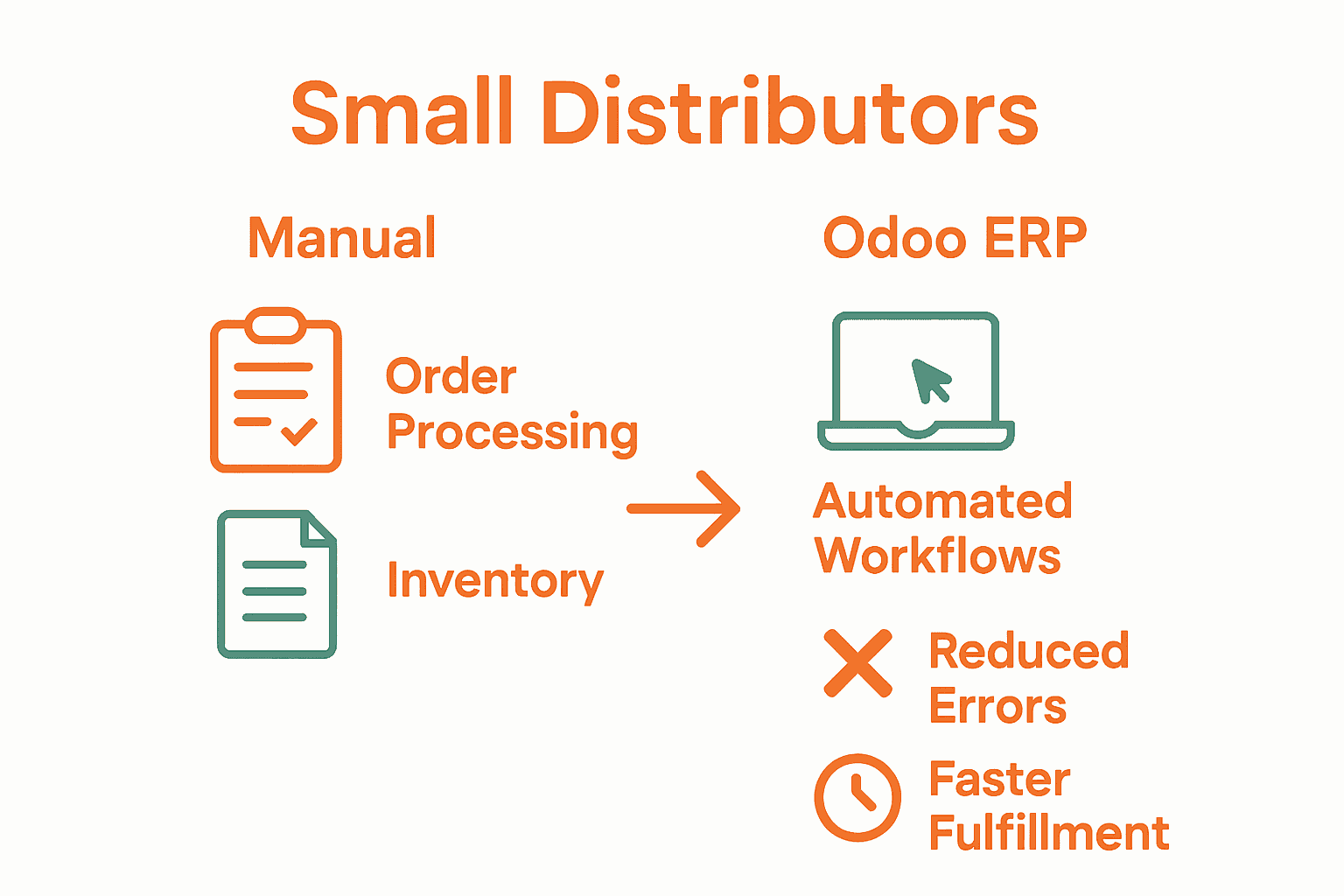
    Infographic comparing manual distribution workflow with Odoo ERP workflow for small distributors

    Moreover, the flexibility of Odoo allows distributors to customize workflows according to their unique business requirements. Whether you’re dealing with complex product configurations, multiple pricing structures, or intricate shipping protocols, the ERP system adapts seamlessly. This means your technology works for you, not the other way around – enabling small distributors to compete effectively in increasingly complex market environments.

    Warehouse and Inventory Control Features

    Effective warehouse and inventory management represents the backbone of successful distribution operations. Odoo ERP provides small distributors with a comprehensive suite of inventory control features that transform complex logistics into streamlined, data-driven processes. By offering real-time visibility and intelligent tracking mechanisms, the system empowers businesses to optimize their inventory management strategies with unprecedented precision.

    warehouse odoo inventory

    Key warehouse and inventory control features in Odoo ERP include:

    • Multi-Warehouse Management: Track inventory across multiple physical locations simultaneously
    • Real-Time Stock Tracking: Instant updates on product quantities, locations, and movements
    • Automatic Reordering: Intelligent algorithms that trigger purchase orders based on predefined stock levels
    • Barcode and RFID Integration: Seamless scanning and tracking of inventory items
    • Lot and Serial Number Tracking: Detailed monitoring of specific product batches and individual items

    To gain deeper insights into optimizing warehouse operations, our Odoo Warehouse Management guide provides comprehensive strategies for inventory efficiency. The system’s advanced features enable distributors to move beyond traditional inventory management, transforming warehouses from cost centers into strategic business assets.

    What sets Odoo’s warehouse control apart is its ability to provide granular, actionable intelligence. The platform generates sophisticated reports that help managers understand inventory turnover, identify potential bottlenecks, and make data-driven decisions. Predictive analytics built into the system can forecast inventory needs, suggest optimal stocking levels, and even recommend distribution strategies based on historical performance.

    Moreover, the flexibility of Odoo’s inventory management means that small distributors can customize the system to match their unique operational requirements. Whether you’re managing complex product configurations, dealing with seasonal variations, or operating across multiple sales channels, the ERP system adapts seamlessly. This level of customization ensures that your inventory management technology evolves alongside your business, providing a sustainable technological foundation for growth and operational excellence.

    Customization and Integration With Other Tools

    Small distributors require flexible technological solutions that can adapt to their unique business ecosystems. Odoo ERP stands out as a powerful platform that offers unprecedented customization capabilities and seamless integration with diverse business tools. By providing a modular, open-source architecture, Odoo enables businesses to create a truly personalized technological infrastructure that grows and evolves alongside their operational needs.

    The customization and integration features of Odoo ERP include:

    • Custom Module Development: Create bespoke functionality specific to your business processes
    • Third-Party App Connections: Integrate with popular business tools and software platforms
    • API-Based Integrations: Connect with external systems through robust application programming interfaces
    • Workflow Automation: Design custom automated processes across different business functions
    • Data Migration Tools: Seamlessly transfer information from legacy systems

    For businesses looking to dive deeper into integration strategies, our guide on ERP customizations provides comprehensive insights into tailoring technological solutions to specific business requirements.

    What truly distinguishes Odoo’s integration capabilities is its ability to create a unified technological ecosystem. Unlike rigid, monolithic systems, Odoo allows distributors to build a flexible technological framework that can incorporate tools from accounting, customer relationship management, e-commerce, and other critical business domains. This approach means that instead of forcing your business to adapt to software limitations, the software adapts to your unique operational landscape.

    Moreover, the open-source nature of Odoo provides an additional layer of customization potential. Businesses are not confined to pre-defined modules but can leverage a global community of developers to create truly innovative solutions. Whether you need to integrate specialized reporting tools, connect with unique industry-specific platforms, or develop completely custom modules, Odoo provides the technological flexibility to transform your distributed business operations into a seamlessly integrated, highly efficient system.

    Common Challenges and Solutions for Adoption

    Implementing an Enterprise Resource Planning (ERP) system can be a daunting task for small distributors, often fraught with potential obstacles that can derail technological transformation. Odoo ERP addresses these challenges through a strategic, user-centric approach that recognizes the unique pain points businesses experience during digital migration. By anticipating and proactively solving common implementation hurdles, Odoo ensures a smoother, more manageable transition for distribution companies.

    Key challenges and their corresponding solutions include:

    • Resistance to Change: Provide comprehensive training and phased implementation strategies
    • Data Migration Complexity: Offer robust migration tools and expert support during transition
    • Cost Concerns: Deliver a modular implementation allowing gradual system expansion
    • Integration Difficulties: Supply flexible API connections and extensive third-party app support
    • User Adoption: Design intuitive interfaces and provide continuous learning resources

    To help businesses navigate these challenges more effectively, our team recommends consulting our comprehensive guide on ERP customizations, which offers deeper insights into successful technological transformations.

    What distinguishes Odoo’s approach is its commitment to understanding that ERP adoption is not just a technological shift, but a comprehensive organizational change. The platform provides extensive support mechanisms, including dedicated implementation consultants, detailed documentation, and a global community of developers and users who can offer real-world guidance. This holistic support system ensures that businesses are not merely purchasing software but gaining a strategic partner committed to their long-term technological success.

    Ultimately, successful ERP adoption requires a mindset of continuous learning and adaptation. Odoo recognizes that each distribution business has unique operational nuances, which is why the system is designed with unprecedented flexibility. By offering scalable solutions, comprehensive training resources, and a support ecosystem that extends beyond traditional software implementation, Odoo transforms potential challenges into opportunities for operational excellence and technological innovation.

    Unlock the Full Potential of Odoo ERP with Expert Guidance

    Small distributors often struggle with complex inventory management, order workflows, and seamless integration. This article highlights common challenges like real-time stock tracking, customized workflows, and smooth ERP adoption that can make or break your operational success. If you want to eliminate manual errors and automate business processes with confidence, you need a partner who understands these unique demands.

    At Bista Solutions, we specialize in delivering scalable Odoo ERP implementations that address exactly these pain points. As the largest Odoo ERP implementer in North America and a trusted Gold Partner recognized repeatedly since 2015, our team of over 300 experts creates tailored solutions that grow with your business. From custom module development to full end-to-end deployment including comprehensive support, we help transform your distribution operations with precision and ease.

    Ready to see how Odoo ERP can elevate your distribution business today?

    Schedule A Free Odoo ERP Demo

      Contact our experienced consultants at Bista Solutions to get a personalized strategy. Don’t wait until operational bottlenecks slow you down. Discover how our proven approach to Odoo Sales Management and Odoo Warehouse Management can streamline your processes from day one. Take the next step toward efficient, automated growth now.

      Frequently Asked Questions

      How does Odoo ERP help in inventory management for small distributors?

      Odoo ERP provides real-time tracking of product quantities, locations, and movements across multiple warehouses, allowing small distributors to optimize their inventory management and reduce operational costs.

      What are the key features of the sales management module in Odoo ERP?

      The sales management module in Odoo ERP includes comprehensive order processing, quotation generation, and customer relationship tracking, enabling distributors to manage their entire sales pipeline efficiently.

      Can Odoo ERP integrate with other business tools?

      Yes, Odoo ERP offers seamless integration with popular business tools and provides API-based connections to external systems, allowing small distributors to create a unified technological ecosystem.

      What challenges might small distributors face when adopting Odoo ERP?

      Common challenges include resistance to change, data migration complexity, cost concerns, integration difficulties, and user adoption. Odoo addresses these through comprehensive training, robust migration tools, and flexible implementation strategies.

      Odoo ERP for Construction: Complete Transformation Guide

      construction ERP team

      Construction firms lose an estimated 35 percent of project costs to poor communication and process inefficiencies. With complex teams, tight deadlines, and rapidly shifting project needs, finding a system that brings clarity and control can be tough. Odoo ERP stands out for its ability to replace outdated workflows with real-time tracking, seamless data sharing, and tailored tools that help businesses turn those hidden losses into measurable gains.

      Table of Contents

      Key Takeaways

      Point Details
      Modular Architecture Odoo ERP’s modular design allows construction firms to customize and scale their software solutions as needed, facilitating greater operational flexibility.
      Real-Time Data Integration The platform promotes synchronized communication among contractors, subcontractors, and project managers, streamlining project management and reducing inefficiencies.
      Tailored Implementation Bista Solutions emphasizes a customized approach to Odoo ERP, focusing on a comprehensive analysis of unique business processes to enhance operational performance.
      Cost Efficiency Odoo offers a cost-effective alternative to traditional ERP systems, with lower total ownership costs and faster implementation timelines.

      Defining Odoo ERP for Construction Firms

      Odoo ERP represents a comprehensive software solution specifically engineered to transform how construction firms manage complex business operations. At its core, Odoo provides a modular architecture that enables construction companies to streamline labor management, project tracking, and intricate approval workflows with unprecedented precision.

      The power of Odoo ERP for construction lies in its ability to create synchronized data exchange between general contractors, subcontractors, and project managers. By maintaining operational independence while ensuring robust security protocols, Odoo breaks down traditional communication barriers that have long plagued construction project management. Learn more about ERP implementation phases to understand how this transformative technology works.

      Key features of Odoo ERP for construction firms include:

      • Integrated project management tools
      • Real-time financial tracking and reporting
      • Comprehensive resource allocation tracking
      • Seamless communication channels between teams
      • Advanced inventory and procurement management
      • Customizable workflows tailored to specific construction processes

      Bista Solutions, as the largest Odoo ERP implementer in North America, understands that each construction firm has unique operational needs. Our approach focuses on delivering a tailored ERP solution that adapts to your specific business requirements, ensuring maximum efficiency and strategic growth. By leveraging Odoo’s flexible platform, construction firms can transform their operational landscape, reducing administrative overhead and focusing more on delivering exceptional project outcomes.

      odoo construction workflow

      Key Modules and Features in Odoo ERP

      Odoo ERP offers a comprehensive suite of interconnected modules designed to streamline business operations across multiple domains, providing construction firms with an integrated solution that tackles complex operational challenges. Each module functions as a powerful tool that can be customized and scaled according to specific business requirements, ensuring maximum flexibility and operational efficiency.

      The core modules critical for construction firms include:

      • Project Management Module: Enables detailed project tracking, resource allocation, and timeline management
      • Accounting Module: Provides real-time financial reporting, budget tracking, and expense management
      • Human Resources Module: Facilitates workforce management, payroll processing, and employee performance tracking
      • Inventory Management Module: Tracks material procurement, warehouse inventory, and supply chain logistics
      • Sales Management Module: Streamlines sales processes and customer relationship management

      What sets Odoo ERP apart is its remarkable modular architecture that allows seamless integration between different business functions. Construction firms can select and implement only the modules they need, creating a tailored solution that grows alongside their business. The platform’s open-source nature means continuous updates and community-driven improvements, ensuring that your ERP system remains cutting-edge and responsive to evolving industry demands.

      Bista Solutions specializes in helping construction firms leverage these modules effectively, providing expert consultation to ensure each module is configured to match unique operational workflows. Our approach goes beyond simple software implementation; we design a comprehensive digital transformation strategy that empowers your team to work smarter, not harder. By combining Odoo’s robust features with our deep industry expertise, we help construction firms unlock unprecedented levels of operational efficiency and strategic insight.

      How Odoo ERP Solves Construction Challenges

      Construction firms face a complex web of operational challenges that traditional management systems struggle to address. Fragmented communication, inconsistent project tracking, and manual data management create significant inefficiencies that can derail project timelines and budgets. Odoo ERP emerges as a comprehensive solution designed to systematically dismantle these operational bottlenecks, providing construction companies with a unified platform that transforms how they manage projects, resources, and financial workflows.

      The most critical challenges Odoo ERP resolves for construction firms include:

      • Project Communication Gaps: Centralizes communication between contractors, subcontractors, and project managers
      • Resource Allocation: Provides real-time tracking of equipment, materials, and human resources
      • Budget Overrun Prevention: Offers detailed financial tracking and predictive budgeting tools
      • Compliance Management: Ensures adherence to regulatory requirements and documentation standards
      • Inventory Control: Streamlines manufacturing and inventory management processes to minimize waste and optimize procurement

      Odoo’s modular architecture allows construction firms to implement targeted solutions that directly address their unique operational pain points. By integrating multiple business functions into a single platform, the ERP system eliminates data silos and creates a transparent, real-time view of project performance. This holistic approach enables managers to make data-driven decisions, anticipate potential challenges, and proactively manage project risks.

      Bista Solutions specializes in customizing Odoo ERP to meet the nuanced needs of construction firms. Our implementation strategy goes beyond software installation; we conduct comprehensive workflow analysis to ensure that each module is precisely configured to your operational requirements. We understand that every construction business is unique, which is why our approach focuses on creating a flexible, scalable solution that grows alongside your company. Through strategic Odoo ERP implementation, we help construction firms transition from reactive management to a proactive, insights-driven operational model that drives efficiency, reduces costs, and accelerates project delivery.

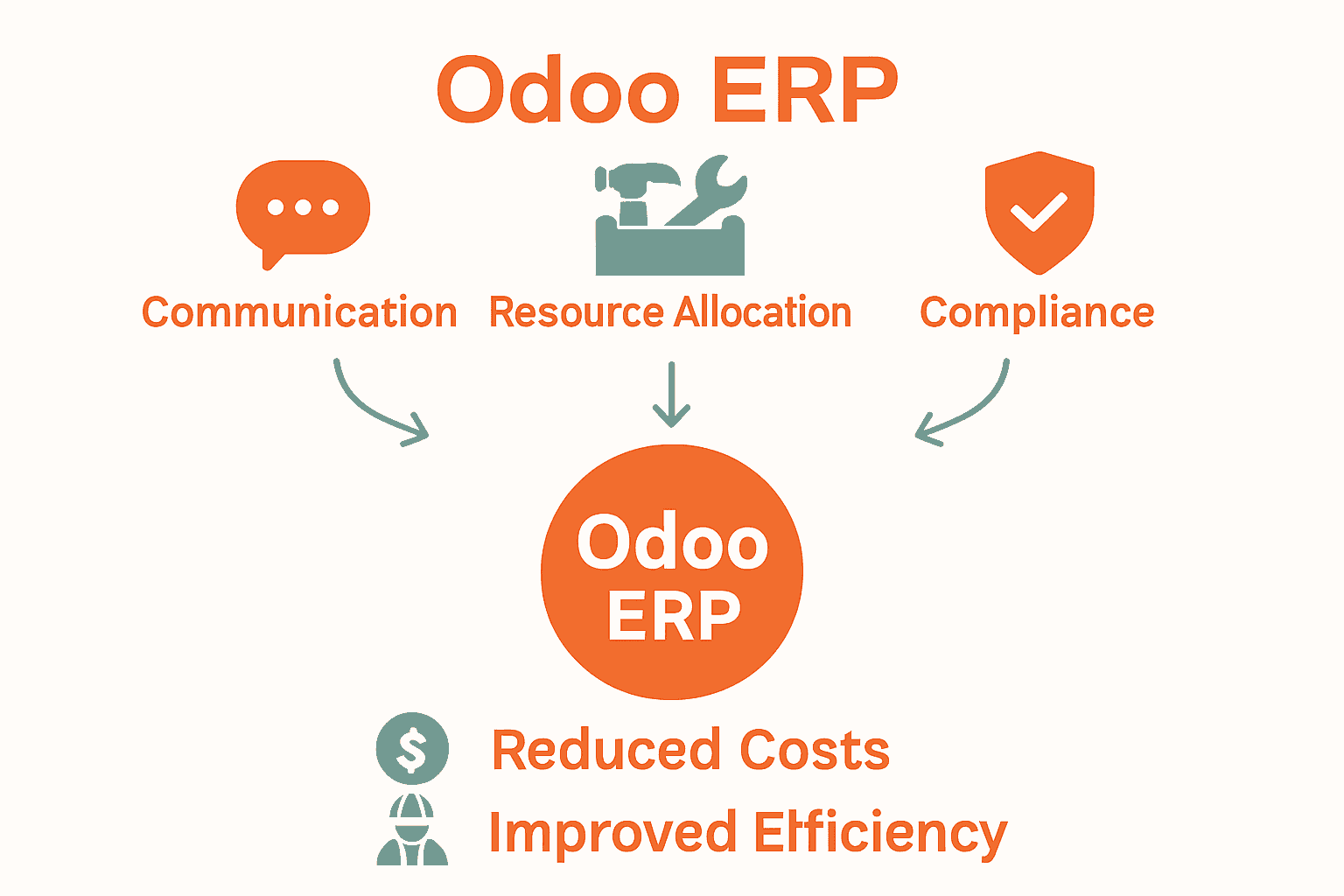
      Visual comparison of challenges vs. Odoo ERP solutions for construction firms.

      Implementation Process and Best Practices

      Implementing Odoo ERP for construction firms requires a strategic, phased approach that goes far beyond simple software installation. Digital transformation is a complex journey that demands careful planning, comprehensive stakeholder engagement, and a deep understanding of your organization’s unique operational workflows. Navigating the 9 phases of ERP implementation is crucial to ensuring a smooth, successful digital transition.

      The core best practices for successful Odoo ERP implementation in construction firms include:

      • Comprehensive Business Process Analysis: Thoroughly map existing workflows and identify optimization opportunities
      • Stakeholder Engagement: Involve key team members from different departments throughout the implementation process
      • Customization with Precision: Configure modules to match specific operational requirements
      • Phased Rollout Strategy: Implement modules incrementally to minimize operational disruption
      • Robust Training Program: Develop comprehensive training protocols for all user levels
      • Continuous Performance Monitoring: Establish key performance indicators to track system effectiveness

      Our research indicates that successful implementation involves creating a subsystem with a modular architecture that streamlines labor management, task tracking, and approval workflows. This approach ensures synchronized data exchange between general contractors and subcontractors while maintaining operational independence and robust security protocols. The key is creating a flexible implementation strategy that adapts to the unique complexities of construction project management.

      Bista Solutions brings unparalleled expertise to the Odoo ERP implementation process. Our approach goes beyond technical installation; we provide a holistic transformation strategy that considers your organization’s specific operational nuances. With over 350 successful global implementations and a dedicated team of 300+ ERP resources, we ensure that your digital transformation is not just a technical upgrade but a comprehensive operational enhancement. We work closely with your team to design a tailored implementation roadmap that minimizes disruption, maximizes user adoption, and delivers tangible business value from day one.

      Comparing Odoo ERP to Alternative Solutions

      Navigating the complex landscape of ERP solutions for construction firms requires a nuanced understanding of how different platforms compare in real-world performance. Competitive differentiation is not just about features, but about adaptability, scalability, and true operational value. Comparing Odoo with alternative ERP solutions reveals why construction firms are increasingly choosing this flexible, comprehensive platform.

      Key comparative advantages of Odoo ERP include:

      • Cost-Effectiveness: Significantly lower total cost of ownership compared to traditional ERP systems
      • Modular Flexibility: Unprecedented ability to customize and scale modules
      • Open-Source Architecture: Continuous improvements driven by a global developer community
      • Seamless Integration: Superior interoperability with existing business tools
      • User-Friendly Interface: More intuitive design, reducing training complexity
      • Rapid Deployment: Faster implementation timelines compared to legacy systems

      Traditional ERP solutions often struggle with the unique complexities of construction project management. These systems typically offer rigid, one-size-fits-all approaches that fail to address the dynamic workflows of modern construction businesses. Odoo stands out by providing a truly adaptive platform that can be precisely tailored to each organization’s specific operational requirements, from small contractors to large-scale engineering firms.

      Bista Solutions brings unparalleled expertise in helping construction firms make this critical technology transition. Our implementation strategy goes beyond software selection; we provide a comprehensive evaluation that considers your unique operational landscape. With over 350 successful global implementations and recognition as the top Odoo ERP partner in North America, we ensure that your ERP solution is not just a software upgrade, but a strategic business transformation tool that drives efficiency, reduces costs, and creates sustainable competitive advantage.

      Unlock Your Construction Firm’s Full Potential with Tailored Odoo ERP Solutions

      Managing multiple projects, coordinating subcontractors, and tracking budgets demand a powerful, flexible system designed for the unique challenges of construction firms. This article highlights how Odoo ERP’s modular architecture can bridge communication gaps, optimize resource allocation, and provide real-time financial visibility. If you are ready to reduce costly inefficiencies and gain full control over complex projects, customized Odoo ERP implementation is the key.

      Bista Solutions, the largest Odoo ERP implementer in North America and a trusted Odoo Gold Partner recognized for excellence year after year, specializes in transforming construction operations just like yours. Our team leverages deep industry expertise to deliver precisely tailored ERP modules that match your workflows, ensuring smoother project management and stronger compliance.

      Schedule A Free Demo


        Ready to experience a transformative solution that grows with your business? Don’t wait to bring clarity and efficiency to your construction operations. Contact Bista Solutions today to begin your journey. Discover how our custom ERP implementation services align with your goals and how our proven track record can turn your challenges into lasting competitive advantages.

        Frequently Asked Questions

        What is Odoo ERP, and how does it benefit construction firms?

        Odoo ERP is a comprehensive software solution designed to transform how construction firms manage operations. It offers a modular architecture that streamlines labor management, project tracking, and approval workflows, facilitating synchronized data exchange among contractors and project managers.

        What key features does Odoo ERP provide for construction project management?

        Odoo ERP includes features such as integrated project management tools, real-time financial tracking and reporting, resource allocation tracking, seamless team communication, advanced inventory management, and customizable workflows tailored to construction processes.

        How does Odoo ERP address common challenges in the construction industry?

        Odoo ERP tackles challenges such as project communication gaps, resource allocation issues, budget overruns, compliance management, and inefficient inventory control by centralizing data and providing real-time tracking and insights.

        What steps are essential for successfully implementing Odoo ERP in a construction firm?

        Successful implementation of Odoo ERP requires a comprehensive analysis of business processes, stakeholder engagement, precise customization of modules, a phased rollout strategy, robust training programs, and continuous performance monitoring to ensure the system meets specific operational needs.

        How SMEs Can Leverage Odoo AI Agents: Essential Guide

        Odoo AI SME office
        • by Uzlifat Mir
        • Nov 20, 2025
        • 0
        • Category:

        More than half of small and medium businesses struggle to keep up with manual processes and data overload. Every wasted hour chips away at growth, while big companies gain ground with advanced automation. Odoo AI Agents are changing this reality. By harnessing artificial intelligence within the Odoo ecosystem, these digital assistants help smaller businesses save time, reduce errors, and make smarter decisions across finance, sales, and more. Discover how this technology puts enterprise-level automation within everyone’s reach.

        Table of Contents

        Key Takeaways

        Point Details
        Odoo AI Agents Revolutionize SME Operations These intelligent systems automate complex tasks, enabling SMEs to gain enterprise-level capabilities and improve operational efficiency.
        Enhanced Decision Making Through Predictive Analytics Odoo AI Agents leverage historical data to provide actionable insights, improving strategic planning in areas like sales, inventory, and finance.
        Systematic Integration Is Key to Success A structured approach to integrating AI agents ensures compatibility with existing systems, mitigating risks and enhancing overall performance.
        Daily Automation Boosts Productivity Automating routine tasks saves time and reduces errors, allowing employees to focus on higher-value activities, ultimately driving business growth.

        Defining Odoo AI Agents for SMEs

        Odoo AI Agents represent a cutting-edge technological solution designed to transform how small and medium enterprises (SMEs) approach business process automation and intelligent decision-making. These sophisticated digital assistants leverage artificial intelligence to streamline complex operational tasks, providing SMEs with enterprise-grade capabilities previously accessible only to large corporations. Odoo AI Agents function as intelligent middleware, seamlessly integrating machine learning algorithms with core business management processes.

        At their core, Odoo AI Agents are advanced algorithmic systems that can autonomously analyze data, predict trends, and recommend strategic actions across multiple business domains. They operate within the Odoo ERP ecosystem, enabling businesses to automate routine tasks, reduce manual intervention, and enhance overall operational efficiency. By utilizing machine learning techniques, these agents can learn from historical business data, continuously improving their predictive accuracy and decision-making capabilities.

        inventory AI automation

        The key functionalities of Odoo AI Agents span several critical business areas. These include intelligent sales forecasting with machine learning software, automated customer relationship management, predictive inventory management, and smart financial reporting. Small businesses can leverage these AI agents to:

        • Automate repetitive administrative tasks
        • Generate real-time business insights
        • Reduce human error in data processing
        • Optimize resource allocation
        • Enhance customer engagement strategies

        By integrating AI agents into their Odoo ERP environment, SMEs gain a competitive technological advantage, transforming complex data into actionable intelligence that drives strategic growth and operational excellence.

        Types of Odoo AI Agents and Functions

        Odoo AI Agents represent a sophisticated ecosystem of intelligent digital assistants, each designed to address specific operational challenges for small and medium enterprises. These agents can be categorized into distinct functional types that leverage advanced machine learning algorithms to transform business processes. Boosting efficiency through AI-powered ERP solutions is at the core of their design, enabling SMEs to compete more effectively in a data-driven business landscape.

        Predictive Analytics Agents focus on transforming raw data into strategic insights. These agents specialize in analyzing historical business data, identifying patterns, and generating forward-looking predictions across multiple domains such as sales forecasting, inventory management, and financial planning. By continuously learning from past performance, these agents help businesses make more informed, data-driven decisions with remarkable accuracy.

        The primary types of Odoo AI Agents include:

        • Customer Relationship Management (CRM) Agents
          • Automate lead scoring and qualification
          • Predict customer behavior and potential churn
          • Personalize customer interaction strategies
        • Sales Optimization Agents
          • Recommend optimal pricing strategies
          • Identify cross-selling and upselling opportunities
          • Analyze sales pipeline performance
        • Inventory and Supply Chain Agents
          • Predict inventory requirements
          • Optimize stock levels dynamically
          • Suggest efficient procurement strategies
        • Financial Management Agents
          • Detect potential financial risks
          • Automate expense categorization
          • Provide real-time financial health assessments

        By integrating these specialized AI agents, SMEs can transform their operational capabilities, turning complex data streams into actionable intelligence that drives strategic growth and operational efficiency.

        Integration Process With Existing SME Systems

        Integrating Odoo AI Agents into existing SME systems requires a strategic, methodical approach that ensures seamless compatibility and minimal operational disruption. Understanding the phases of ERP implementation is crucial for businesses seeking to leverage these advanced technological solutions effectively. The integration process involves careful assessment, planning, and execution across multiple organizational layers.

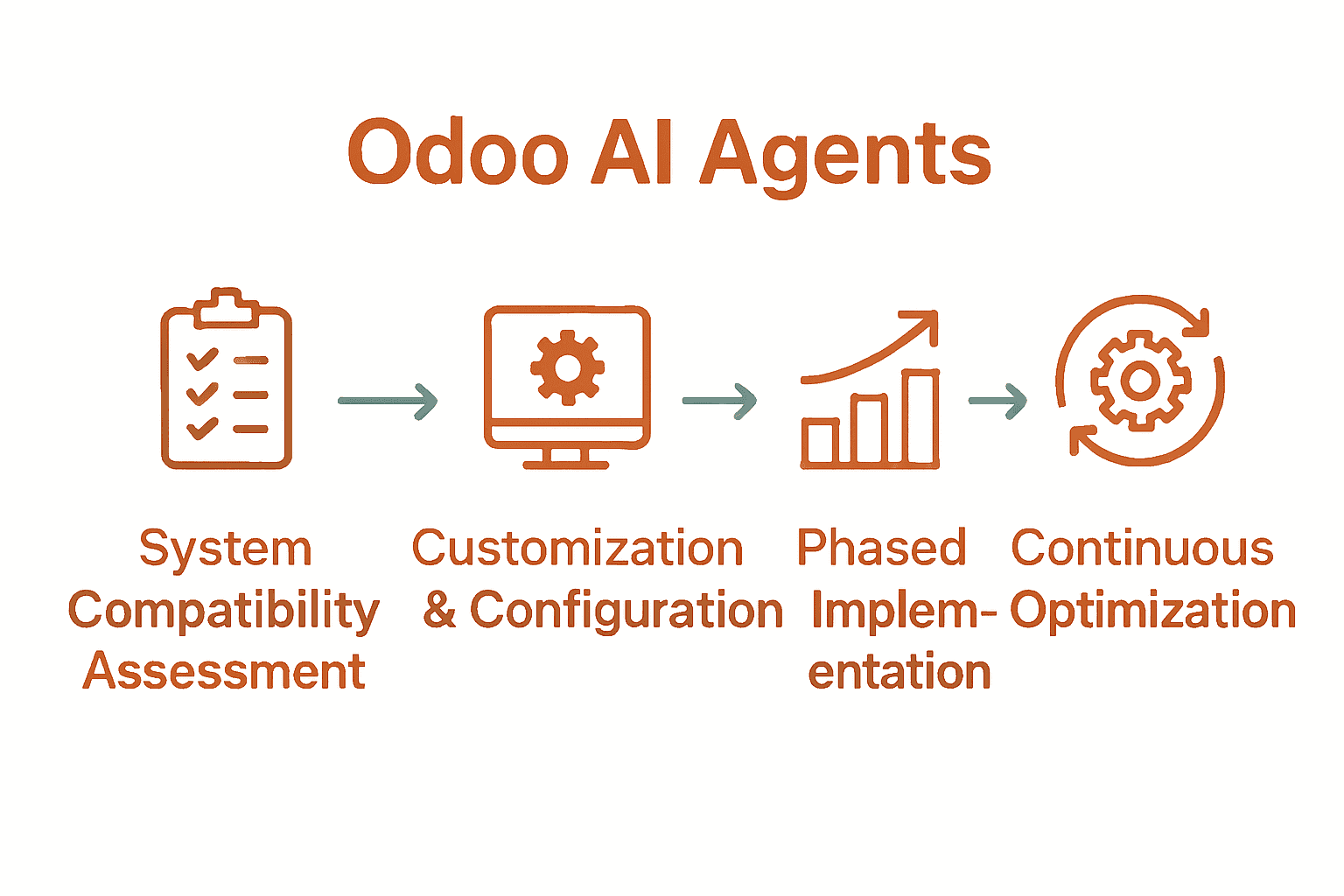
        System Compatibility Assessment is the critical first stage of integration. SMEs must conduct a comprehensive audit of their existing technological infrastructure, identifying potential compatibility challenges and mapping out specific integration requirements. This involves analyzing current software ecosystems, data structures, communication protocols, and potential technical limitations that might impact AI agent deployment. Advanced machine learning algorithms enable Odoo AI Agents to adapt dynamically, creating intelligent workflows that can bridge gaps between legacy systems and modern technological platforms.

        The integration process typically follows these strategic steps:

        1. Initial System Diagnostic
          • Comprehensive technology infrastructure review
          • Identify existing software and hardware configurations
          • Evaluate current data management practices
        2. Customization and Configuration
          • Design tailored integration blueprints
          • Configure AI agents to match specific business requirements
          • Develop custom middleware for seamless data exchange
        3. Phased Implementation
          • Implement AI agents in controlled, incremental stages
          • Begin with low-risk, non-critical business processes
          • Continuously monitor performance and system interactions
        4. Continuous Optimization
          • Regular performance monitoring
          • Machine learning-driven system adjustments
          • Periodic compatibility and security assessments

        By following a structured integration approach, SMEs can transform their operational capabilities, leveraging Odoo AI Agents to create intelligent, adaptive business ecosystems that drive efficiency, reduce manual intervention, and unlock unprecedented insights across organizational functions.

        Infographic showing four-step Odoo AI Agent integration process for SMEs

        Key Benefits of Daily Task Automation

        Daily task automation through Odoo AI Agents represents a transformative approach to business productivity, enabling small and medium enterprises to revolutionize their operational efficiency. Boosting efficiency through AI-powered ERP solutions is no longer a futuristic concept but a pragmatic strategy for businesses seeking competitive advantage. By systematically eliminating repetitive manual processes, SMEs can redirect human resources toward more strategic, value-generating activities.

        Time Optimization emerges as the most immediate and tangible benefit of daily task automation. Odoo AI Agents can execute complex, time-consuming tasks within seconds that would traditionally require hours of manual labor. These intelligent systems operate continuously, processing data, generating reports, scheduling activities, and managing communications with unprecedented speed and accuracy. The cumulative time savings can translate into significant productivity gains, allowing teams to focus on innovation, customer relationships, and core business development.

        The key benefits of daily task automation encompass multiple operational dimensions:

        • Operational Efficiency
          • Reduce manual data entry errors
          • Accelerate workflow processing times
          • Standardize repetitive business processes
        • Cost Management
          • Minimize labor costs associated with routine tasks
          • Optimize resource allocation
          • Reduce overhead expenses through intelligent automation
        • Strategic Decision Making
          • Generate real-time, data-driven insights
          • Enable faster response to market changes
          • Provide comprehensive performance analytics
        • Employee Productivity
          • Eliminate monotonous administrative work
          • Create opportunities for higher-value contributions
          • Improve overall job satisfaction

        By embracing daily task automation, SMEs can create a more agile, responsive, and intelligent business environment that adapts quickly to changing market dynamics and maintains a competitive edge through technological innovation.

        Risks, Challenges, and Best Practices

        Implementing Odoo AI Agents requires a nuanced approach that balances technological innovation with strategic risk management. Understanding the complexities of ERP implementation is crucial for SMEs seeking to leverage these advanced technological solutions while mitigating potential challenges. The integration of AI agents presents a complex landscape of opportunities and potential pitfalls that demand careful navigation.

        Ethical and Trust Considerations represent a critical dimension of AI agent deployment. Research indicates that embedding trust and ethical principles throughout the AI lifecycle is essential for responsible implementation. SMEs must establish robust governance frameworks that address potential risks such as data privacy, algorithmic bias, and transparency. This involves creating clear protocols for AI decision-making, ensuring human oversight, and maintaining comprehensive audit trails that demonstrate the reliability and fairness of AI-driven processes.

        Key risks and mitigation strategies include:

        1. Data Security Risks
          • Implement end-to-end encryption
          • Establish strict access control protocols
          • Conduct regular security audits
          • Develop comprehensive data protection policies
        2. Algorithmic Bias Mitigation
          • Regularly test AI agents for potential biases
          • Ensure diverse data sets for training
          • Maintain human oversight in critical decision-making
          • Implement transparent evaluation mechanisms
        3. Integration Challenges
          • Conduct thorough system compatibility assessments
          • Develop phased implementation strategies
          • Create robust backup and rollback protocols
          • Provide comprehensive staff training
        4. Performance and Reliability
          • Establish clear performance benchmarks
          • Implement continuous monitoring systems
          • Create mechanisms for ongoing AI agent refinement
          • Develop contingency plans for system failures

        By adopting a proactive, strategic approach to risk management, SMEs can harness the transformative power of Odoo AI Agents while maintaining operational integrity, protecting sensitive information, and ensuring sustainable technological innovation.

        Unlock the Full Potential of Odoo AI Agents for Your SME Today

        Small and medium enterprises face challenges such as automating daily tasks, integrating new AI technology smoothly, and ensuring data security. The article highlights how Odoo AI Agents can drive operational efficiency, predictive analytics, and intelligent automation. If you want to overcome manual workload, improve decision-making, and safeguard your business from implementation risks, expert support is essential.

        Bista Solutions specializes in helping SMEs implement tailored Odoo ERP solutions with intelligent AI integration. With our proven track record as the largest Odoo ERP implementer in North America and multiple Best Partner awards, we deliver trusted, scalable, and secure setups designed to meet your unique needs and maximize the benefits of AI automation.

        Explore how our team can guide you through every phase from system compatibility assessment to continuous AI optimization, ensuring a seamless experience that transforms your operations with confidence.

        Boost your productivity, reduce costs, and gain real-time insights by partnering with experts who understand your challenges.

        Schedule A Free Demo

          Ready to revolutionize your SME with advanced Odoo AI Agents and trusted ERP expertise? Visit Bista Solutions Contact Us to start your journey with the top Odoo Gold Partner in North America. Explore our insights on AI-powered ERP solutions and learn more about the 9 ERP implementation phases that ensure your success. Act now to secure a competitive edge with tailored automation solutions designed just for you

          Frequently Asked Questions

          What are Odoo AI Agents, and how do they benefit SMEs?

          Odoo AI Agents are sophisticated digital assistants that leverage artificial intelligence to automate business processes, analyze data, and improve decision-making. They benefit SMEs by increasing operational efficiency, generating real-time insights, optimizing resource allocation, and enhancing customer engagement.

          How do I integrate Odoo AI Agents into my existing SME systems?

          Integrating Odoo AI Agents involves a systematic approach that includes assessing system compatibility, customizing configurations, implementing in phases, and continuously optimizing performance. Proper planning ensures seamless integration with existing systems.

          What are the key functionalities of Odoo AI Agents for small businesses?

          Key functionalities include intelligent sales forecasting, automated customer relationship management, predictive inventory management, and smart financial reporting, enabling SMEs to automate tasks, gain insights, and enhance operational efficiency.

          What challenges should SMEs anticipate when implementing Odoo AI Agents?

          SMEs may face challenges such as data security risks, algorithmic bias, integration issues, and performance reliability. It’s important to establish governance frameworks, conduct thorough assessments, and implement continuous monitoring to mitigate these risks.

          7 Ways to Reduce Production Costs with Odoo ERP Automation in the Defense Sector

          defense manufacturing, Odoo ERP, cost reduction automation

          Odoo ERP is changing the way defense manufacturers cut production costs. Some organizations have reported cost reductions of up to 30 percent after adopting Odoo’s automated solutions. Most people expect technology like this to be complicated or hard to fit into strict military environments. Instead, Odoo’s biggest advantage is how easily its system molds itself to the unique workflows and tight regulations of the defense sector.

          Table of Contents

          Quick Summary

          Takeaway Explanation
          Leverage Centralized Data Management Use Odoo ERP to eliminate information silos for real-time communication across departments, enhancing efficiency.
          Implement Automated Procurement Processes Streamline procurement to reduce cycle times and manual intervention, leading to faster production workflows.
          Utilize Predictive Analytics for Decision-Making Leverage advanced analytics in Odoo to forecast equipment needs and optimize resource allocation effectively.
          Adopt Intelligent Inventory Management Automate inventory tracking to minimize waste and ensure optimal resource allocation in production environments.
          Focus on Comprehensive Staff Training Invest in targeted training programs to empower employees and maximize Odoo ERP’s capabilities for operational excellence.

          1: Understand Odoo ERP Basics and Benefits

          Reducing production costs in the defense sector demands strategic technological solutions. Odoo ERP presents a comprehensive automation platform that transforms complex manufacturing processes. By understanding its fundamental capabilities, defense organizations can unlock significant operational efficiencies.

          Odoo ERP represents an integrated suite of business applications designed to streamline multiple organizational functions. For defense sector manufacturers, this means consolidating critical workflows into a single, powerful system. Read more about Odoo ERP implementation strategies and how it can revolutionize production management.

          The core benefits of Odoo ERP for the defense sector production cost reduction include:

          • Centralized Data Management: Eliminate information silos and ensure real-time communication across departments
          • Advanced Inventory Tracking: Monitor equipment, spare parts, and production resources with unprecedented precision
          • Automated Procurement Processes: Reduce manual intervention and minimize procurement cycle times
          • Precise Resource Allocation: Optimize workforce deployment and equipment utilization

          Bista Solutions specializes in tailoring Odoo ERP solutions specifically for defense manufacturing environments. Our approach focuses on understanding unique operational challenges and designing custom implementations that drive immediate cost savings and long term strategic advantages.

          By leveraging Odoo ERP’s modular architecture, defense organizations can progressively implement automation strategies. This allows for incremental improvements and minimizes disruption to existing workflows. The platform’s scalability ensures that as production requirements evolve, the ERP system can adapt seamlessly.

          Critical to cost reduction is the system’s ability to provide granular insights into production inefficiencies. Through advanced reporting and analytics, manufacturers can identify bottlenecks, predict maintenance requirements, and make data driven decisions that directly impact the bottom line.

          2: Analyze Current Production Costs and Processes

          In defense sector manufacturing, comprehensive cost analysis represents the cornerstone of operational optimization. Odoo ERP provides robust diagnostic tools that enable manufacturers to conduct granular examinations of existing production workflows and associated expenses. Learn more about advanced production planning techniques that can transform your operational strategy.

          Effective cost analysis demands a systematic approach focused on identifying inefficiencies and potential areas of improvement. Defense manufacturers must evaluate multiple critical dimensions to achieve meaningful insights:

          • Direct Labor Costs: Measure workforce productivity and utilization rates
          • Material Procurement Expenses: Track raw material acquisition and inventory management expenditures
          • Equipment Maintenance Overheads: Calculate downtime and repair-related financial impacts
          • Energy Consumption Metrics: Assess power and resource utilization across production environments

          Odoo ERP’s integrated analytics platform enables real-time tracking of these complex financial parameters. By aggregating data from multiple organizational touchpoints, manufacturers gain unprecedented visibility into their operational economics. Detailed reporting mechanisms allow leadership to make informed strategic decisions based on accurate, contemporaneous information.

          The diagnostic process involves comprehensive data collection and sophisticated computational analysis. Manufacturers must examine historical performance records, current operational metrics, and predictive modeling scenarios. Odoo ERP facilitates this through advanced algorithms that transform raw data into actionable intelligence.

          Crucial to successful cost analysis is the ability to establish benchmark performance standards. Defense sector manufacturers can leverage Odoo’s modular architecture to create customized performance indicators that reflect their unique operational requirements. This approach ensures that cost reduction strategies are precisely calibrated to organizational objectives.

          Ultimately, systematic cost analysis serves as the foundation for strategic transformation. By understanding existing inefficiencies and potential improvement vectors, defense manufacturers can deploy targeted automation strategies that deliver substantial economic benefits.

          3: Integrate Odoo Modules for Streamlined Operations

          Streamlining defense sector production demands strategic module integration within the Odoo ERP ecosystem. Modular architecture enables manufacturers to create comprehensive, interconnected operational frameworks that minimize redundancies and maximize efficiency. Discover advanced accounting strategies for defense manufacturing that complement operational optimization.

          Successful module integration requires a holistic approach that considers the unique requirements of defense manufacturing environments. Manufacturers must select and configure modules that provide seamless communication across critical organizational functions.

          Key modules essential for defense sector production optimization include:

          • Inventory Management Module: Track specialized equipment and component lifecycles with precision
          • Procurement Automation Module: Streamline complex supply chain interactions and vendor management processes
          • Production Planning Module: Enable dynamic scheduling and resource allocation strategies
          • Quality Control Module: Implement rigorous inspection and compliance tracking mechanisms

          The strategic benefit of Odoo’s modular approach lies in its ability to create customized technological ecosystems. Defense manufacturers can select specific modules that address their unique operational challenges, ensuring that technological solutions are precisely tailored to organizational requirements.

          Integration goes beyond mere technical configuration. Successful implementation demands comprehensive change management strategies that align technological capabilities with existing workforce competencies. Bista Solutions specializes in facilitating smooth technological transitions, ensuring that module integration delivers immediate and sustainable operational improvements.

          Advanced module integration enables real time data synchronization across production environments. This means procurement teams can instantly communicate with inventory management systems, production planners can access immediate resource allocation insights, and quality control teams can implement instantaneous compliance tracking.

          Ultimately, module integration transforms Odoo ERP from a technological tool into a strategic operational platform. By creating interconnected, intelligent systems, defense manufacturers can achieve unprecedented levels of operational efficiency and cost optimization.

          4: Automate Inventory Management to Reduce Waste

          In defense manufacturing, precise inventory management represents a critical strategy for reducing production costs. Odoo ERP provides sophisticated automation tools that transform traditional inventory tracking into an intelligent, proactive system. Learn more about advanced warehouse management solutions to optimize your operational efficiency.

          Automated inventory management goes beyond simple tracking. It involves creating a comprehensive ecosystem that predicts, monitors, and optimizes resource allocation with unprecedented accuracy. Defense manufacturers can leverage Odoo’s capabilities to minimize waste and maximize operational readiness.

          Key benefits of automated inventory management include:

          • Real Time Asset Tracking: Monitor specialized equipment and components with instant precision
          • Predictive Maintenance Scheduling: Anticipate equipment replacement needs before critical failures occur
          • Automated Reorder Point Calculations: Prevent stockouts while avoiding excessive inventory buildup
          • Comprehensive Lifecycle Management: Track equipment from acquisition through retirement

          Intelligent inventory systems enable defense manufacturers to establish granular control over complex material ecosystems. By implementing advanced tracking mechanisms, organizations can reduce unnecessary procurement expenses and minimize redundant resource allocation.

          Odoo ERP’s automation capabilities extend beyond simple record keeping. The platform provides sophisticated analytics that transform raw inventory data into strategic insights. Manufacturers can identify historical usage patterns, predict future resource requirements, and develop targeted procurement strategies.

          Critical to waste reduction is the ability to implement dynamic inventory management protocols. Odoo allows manufacturers to establish sophisticated rules that automatically trigger procurement processes, adjust inventory levels, and provide comprehensive reporting mechanisms.

          By embracing automated inventory management, defense sector manufacturers can achieve a transformative approach to resource optimization. The combination of real time tracking, predictive analytics, and intelligent automation creates a powerful framework for reducing operational waste and improving overall economic performance.

          5: Utilize Data Analytics for Better Decision-Making

          In defense sector manufacturing, strategic decision making demands more than intuition. Odoo ERP’s advanced analytics platform transforms raw operational data into actionable intelligence. Explore how predictive analytics can revolutionize business intelligence and drive organizational performance.

          Data analytics represents a critical tool for understanding complex operational dynamics. By leveraging Odoo’s comprehensive reporting mechanisms, defense manufacturers can gain unprecedented insights into production efficiency, resource allocation, and potential cost reduction strategies.

          Key analytical capabilities that drive strategic decision making include:

          • Predictive Performance Modeling: Forecast equipment maintenance requirements and potential production bottlenecks
          • Comparative Cost Analysis: Identify inefficiencies across different production workflows
          • Resource Utilization Tracking: Measure workforce and equipment productivity with granular precision
          • Trend Identification: Detect emerging operational patterns that impact overall economic performance

          Intelligent data processing enables manufacturers to move beyond reactive management. Odoo’s analytics tools provide real-time insights that allow leadership to anticipate challenges and implement proactive optimization strategies.

          The platform’s sophisticated algorithms transform complex datasets into clear, actionable visualizations. Defense sector leaders can quickly understand intricate operational metrics, enabling rapid strategic adjustments that directly impact production costs.

          Critical to effective decision-making is the ability to integrate data from multiple organizational touchpoints. Odoo ERP creates a unified analytical framework that consolidates information from inventory management, procurement, production planning, and human resource systems.

          By embracing comprehensive data analytics, defense manufacturers can transition from traditional decision-making models to an intelligence-driven approach. The result is a more agile, responsive, and economically efficient production environment that continuously adapts to emerging operational challenges.

          6: Improve Supplier Management with Odoo Tools

          Effective supplier management represents a critical strategy for reducing production costs in the defense sector manufacturing. Odoo ERP provides comprehensive tools that transform traditional vendor interactions into strategic, data-driven partnerships. Learn more about advanced vendor lead time calculations to optimize your procurement processes.

          Supplier management goes beyond simple transactional relationships. It requires a holistic approach that integrates performance tracking, financial analysis, and strategic collaboration. Odoo’s sophisticated modules enable defense manufacturers to create intelligent vendor ecosystems that drive operational efficiency.

          Key capabilities for optimizing supplier management include:

          • Automated Vendor Performance Scoring: Evaluate suppliers based on multiple performance metrics
          • Real Time Price Comparison: Track and analyze vendor pricing across multiple procurement channels
          • Predictive Delivery Forecasting: Anticipate potential supply chain disruptions
          • Comprehensive Vendor Communication Tracking: Monitor and document all vendor interactions

          Intelligent procurement strategies enable defense manufacturers to move beyond reactive vendor management. Odoo ERP provides tools that transform supplier relationships from transactional interactions to strategic partnerships. The platform allows organizations to establish clear performance expectations, track vendor capabilities, and make data-driven procurement decisions.

          The system’s advanced analytics capabilities provide unprecedented visibility into supplier performance. Manufacturers can quickly identify potential risks, evaluate vendor reliability, and develop targeted strategies for optimizing procurement processes. This approach enables organizations to reduce procurement costs while maintaining high-quality standards.

          By implementing comprehensive supplier management tools, defense sector manufacturers can create more resilient, efficient procurement ecosystems. Odoo ERP enables organizations to establish dynamic vendor relationships that adapt to changing operational requirements, ultimately driving significant cost reductions and operational improvements.

          7: Train Staff on Odoo to Maximize Productivity

          In the defense sector manufacturing, technological adoption requires comprehensive staff training to unlock the full potential of Odoo ERP. Workforce enablement represents a critical strategy for maximizing technological investments and driving operational efficiency. Explore advanced human resource management strategies to transform your organizational capabilities.

          Effective training goes beyond simple software instruction. It involves creating a holistic learning ecosystem that empowers employees to leverage Odoo’s advanced capabilities strategically. Defense manufacturers must develop targeted training approaches that address both technical skills and broader operational understanding.

          Key training strategies for maximizing Odoo ERP productivity include:

          • Modular Learning Approaches: Develop customized training programs for different organizational roles
          • Hands-On Practical Workshops: Provide immersive learning experiences that simulate real-world scenarios
          • Continuous Learning Platforms: Establish ongoing skill development mechanisms
          • Performance Tracking Integration: Link training outcomes to operational metrics

          Comprehensive skill development enables organizations to transform technological tools into strategic advantages. Odoo ERP’s intuitive interface allows for rapid knowledge transfer, but structured training programs accelerate workforce adoption and proficiency.

          The training process must address multiple learning dimensions. Technical training should cover system navigation, data entry, and reporting functionalities. Strategic training must help employees understand how Odoo ERP transforms traditional workflows, enabling more intelligent decision-making.

          Bista Solutions recommends a phased approach to workforce enablement. Initial training focuses on foundational skills, while advanced programs explore sophisticated analytics, automation strategies, and cross-functional integration capabilities.

          By investing in targeted staff training, defense manufacturers can create a technologically empowered workforce. The result is an organizational culture that views Odoo ERP not as a complex tool, but as a strategic partner in achieving operational excellence and driving continuous improvement.

          The table below provides a comprehensive summary of the main strategies, benefits, and actions for reducing production costs using Odoo ERP automation in the defense sector as discussed in the article.

          Strategy / Step Key Actions & Features Core Benefits for Defense Manufacturing
          Understand Odoo ERP Basics & Benefits Leverage centralized data, advanced inventory tracking, automated procurement, and resource allocation Eliminates silos, improves efficiency, and enables scalability
          Analyze Current Production Costs & Processes Use Odoo analytics for deep cost diagnostics (labor, procurement, maintenance, energy) Identifies inefficiencies, enables informed strategic decisions
          Integrate Odoo Modules for Streamlined Operations Deploy modules for inventory, procurement, planning, and quality control; link organizational workflows Reduces redundancy, maximizes operational efficiency
          Automate Inventory Management to Reduce Waste Real-time asset tracking, predictive maintenance, automated reorders, lifecycle management Minimizes waste, decreases procurement cost, boosts readiness
          Utilize Data Analytics for Better Decision-Making Predictive modeling, cost analysis, utilization tracking, and trend identification Enables data-driven, agile, and proactive management
          Improve Supplier Management with Odoo Tools Vendor scoring, price comparison, delivery forecasting, and vendor communication tracking Strengthens supplier relationships, reduces risk and costs
          Train Staff on Odoo to Maximize Productivity Modular training, practical workshops, continuous learning, and tracking training outcomes Increases adoption, empowers workforce, maximizes ROI

          Transform Your Defense Manufacturing with Proven Odoo ERP Automation

          If you are struggling with rising production costs in the defense sector, you know how vital precise inventory management, automated workflows, and data-driven decision-making are to staying competitive. This article highlighted how modern solutions like Odoo ERP directly address these urgent challenges by targeting inefficiencies and reducing waste throughout your operations.


          Schedule A Free Demo

            Bista Solutions has guided more than 350 organizations through successful ERP implementations, earning Odoo’s Best Partner title across multiple years. Our North American team delivers fully customized Odoo ERP automation, designed specifically for defense manufacturing demands. We can help you unlock accurate data insights, streamline supplier management, and empower your staff for higher productivity. Discover why so many leaders trust our expertise. Contact Bista Solutions today to discuss your next steps or explore how predictive analytics enhances decision-making and see the benefits of advanced Odoo warehouse management. Act now to transform your cost structure and secure long-term operational excellence.

            Frequently Asked Questions

            How can Odoo ERP reduce production costs in the defense sector?

            Odoo ERP reduces production costs by centralizing data management, providing advanced inventory tracking, automating procurement processes, and optimizing resource allocation.

            What are the key features of Odoo ERP that benefit defense manufacturing?

            Key features include real-time data management, automated workflows, predictive analytics, and customization capabilities that cater to specific operational needs in defense manufacturing.

            How does Odoo ERP’s analytics platform aid decision-making?

            Odoo ERP’s analytics platform transforms raw data into actionable insights, enabling manufacturers to identify inefficiencies and optimize operations through predictive modeling and comparative cost analysis.

            What training is necessary for staff to effectively use Odoo ERP in defense manufacturing?

            Staff training should include modular learning approaches, hands-on practical workshops, continuous learning platforms, and performance tracking to ensure employees can effectively utilize Odoo’s features for operational excellence.

            7 Steps to Managing Arms & Ammunition Production with Odoo Manufacturing Module

            arms production, manufacturing ERP, Odoo software

            Managing arms and ammunition production can look overwhelming. Especially when every single component and process demands flawless tracking and compliance. But what most manufacturers miss is that the right digital tools can make this easier than you think. The Odoo Manufacturing Module brings everything into sharp focus, offering features like real-time inventory tracking and granular quality control that are not just for big operations—any producer can benefit immediately.

            Table of Contents

            Quick Summary

            Takeaway Explanation
            Utilize Odoo’s Manufacturing Module Odoo offers tools for production planning, inventory management, and resource allocation to enhance manufacturing efficiency.
            Implement a Comprehensive Bill of Materials (BoM) Create detailed BoMs that track every component with precise specifications and options to improve production accuracy.
            Establish Detailed Product Structures Develop a clear organizational framework for products to ensure efficient tracking and compliance in arms manufacturing.
            Adopt Robust Quality Control Measures Integrate stringent testing and documentation protocols within production to meet regulatory requirements and ensure product safety.
            Leverage Advanced Analytics for Improvements Use data metrics to identify efficiency bottlenecks and enhance continuous improvement in production processes.

            1: Understand the Odoo Manufacturing Module Basics

            Managing Arms & Ammunition Production with Odoo Manufacturing Module requires a comprehensive understanding of the module’s fundamental capabilities and strategic implementation approach. At its core, the Odoo Manufacturing Module represents a powerful solution designed to streamline complex production workflows specific to arms and ammunition manufacturing.

            The module provides robust tools for production planning, inventory management, and resource allocation. When working with sensitive manufacturing sectors like arms and ammunition, precision and control become paramount. Odoo’s Manufacturing Module offers granular tracking mechanisms that enable manufacturers to monitor every stage of production with exceptional detail.

            Key foundational concepts within this module include:

            • Bill of Materials (BoM): Detailed breakdown of components required for manufacturing specific ammunition or weapon systems
            • Work Center Configuration: Defining precise operational zones and equipment specifications for different production stages
            • Quality Control Parameters: Establishing rigorous testing and verification protocols is essential in arms manufacturing

            Bista Solutions, as a leading Odoo implementation partner, understands the nuanced requirements of arms and ammunition production. Our expertise ensures manufacturers can leverage Odoo’s Manufacturing Module to achieve maximum operational efficiency while maintaining strict compliance and quality standards.

            The module’s architecture supports complex manufacturing scenarios, allowing businesses to create detailed production orders, manage raw material procurement, track manufacturing routes, and generate comprehensive production reports. By integrating inventory management, procurement, and production planning into a single unified platform, manufacturers can significantly reduce operational complexities and minimize potential errors.

            Successful implementation demands a strategic approach that goes beyond technical configuration. It requires deep understanding of your specific manufacturing workflow, potential bottlenecks, and unique operational challenges. Manufacturers must invest time in mapping their existing processes and configuring the Odoo Manufacturing Module to align precisely with their production requirements.

            2: Set Up Your Product Structure for Arms & Ammunition

            Establishing a comprehensive product structure within the Odoo Manufacturing Module is critical for arms and ammunition production. This foundational step involves meticulously defining product categories, variants, and detailed specifications that align with precise manufacturing requirements.

            Product Master Data Configuration requires detailed attention to multiple technical parameters. Manufacturers must create comprehensive product templates that capture intricate details such as caliber specifications, material compositions, production tolerances, and regulatory compliance markers.

            The Odoo Manufacturing Module enables sophisticated product structuring through advanced features that support complex inventory management. Our specialized Odoo Firearms ERP solution provides manufacturers with unparalleled flexibility in product definition and tracking.

            Critical considerations for product structure setup include:

            • Detailed Product Categorization: Develop granular product categories for different ammunition types, weapon systems, and component classifications
            • Variant Management: Configure product variants with specific technical specifications, ensuring accurate representation of manufacturing diversity

            Manufacturers must implement robust product coding systems that facilitate precise tracking and identification. Each product within the Odoo system should have unique identifiers that correspond to internal manufacturing protocols and external regulatory requirements.

            The product structure serves as the backbone for subsequent manufacturing processes. By investing time in meticulous configuration, arms and ammunition manufacturers can establish a solid foundation for efficient production management. This approach ensures that every product variant, from small arms ammunition to specialized weapon components, can be accurately tracked, produced, and managed within a unified system.

            Additionally, the Odoo Manufacturing Module supports complex bill of materials (BoM) configurations. This functionality allows manufacturers to define intricate product recipes, mapping out precise component requirements, production sequences, and quality control parameters for each specific product variant.

            Successful product structure implementation demands a holistic approach that balances technical precision with operational flexibility. Manufacturers must collaborate closely with their implementation partners to develop a configuration that reflects their unique production ecosystem.

            3: Implement Bill of Materials for Efficient Production

            Implementing a comprehensive Bill of Materials (BoM) is crucial for arms and ammunition manufacturing, representing the technical blueprint that transforms raw materials into finished products. The Odoo Manufacturing Module provides sophisticated tools for creating intricate and precise BoM configurations specific to complex production requirements.

            In arms and ammunition manufacturing, BoM development demands extraordinary attention to detail. Each component must be meticulously tracked, with precise quantities, specifications, and potential alternative material options carefully documented within the system.

            Key strategic considerations for BoM implementation include:

            • Multilevel Component Tracking: Develop comprehensive hierarchical structures that capture every subassembly and individual component
            • Precision Material Specification: Define exact material requirements, including metallurgical compositions, tolerances, and quality standards

            Our equipment manufacturing ERP solution enables manufacturers to create dynamic, flexible BoM structures that adapt to evolving production needs.

            The Odoo Manufacturing Module supports multiple BoM types, allowing manufacturers to create:

            • Flexible BoMs with interchangeable components
            • Phantom BoMs for complex subassemblies
            • Alternative material routing configurations

            Successful BoM implementation requires collaboration between engineering, procurement, and production teams. Each BoM must accurately represent the intricate manufacturing processes unique to arms and ammunition production, accounting for regulatory compliance, material traceability, and stringent quality control requirements.

            Advanced features within the Odoo system enable real-time cost calculations, material consumption tracking, and automated procurement recommendations. These capabilities ensure manufacturers maintain optimal inventory levels while minimizing waste and reducing production bottlenecks.

            By investing time in developing robust, detailed Bills of Materials, arms and ammunition manufacturers can transform their production processes, achieving unprecedented levels of operational efficiency, quality control, and regulatory compliance. The Odoo Manufacturing Module serves as a powerful platform for translating complex technical specifications into streamlined, repeatable manufacturing workflows.

            4: Streamline Inventory Management and Tracking

            Streamlining inventory management for arms and ammunition production requires a sophisticated approach that balances precision, regulatory compliance, and operational efficiency. The Odoo Manufacturing Module offers comprehensive tools designed to transform complex inventory tracking into a seamless, transparent process.

            Real-time inventory monitoring becomes critical in arms and ammunition manufacturing, where precise material tracking can mean the difference between successful production and potential regulatory complications. Our advanced warehouse management solution enables manufacturers to implement granular tracking mechanisms that provide unprecedented visibility into inventory levels, material consumption, and supply chain dynamics.

            Key strategic inventory management considerations include:

            • Serialization and Batch Tracking: Implement comprehensive tracking systems that capture unique identifiers for every component and finished product
            • Regulatory Compliance Tracking: Develop robust documentation protocols that meet stringent government and industry reporting requirements

            The Odoo Manufacturing Module supports multi-location inventory management, allowing manufacturers to track materials across different warehouses, production facilities, and storage zones. This functionality proves especially crucial for arms and ammunition producers who must maintain strict accountability for sensitive materials.

            Advanced inventory features enable manufacturers to:

            • Establish automated reorder rules
            • Generate detailed inventory valuation reports
            • Track material consumption rates

            Precise inventory management extends beyond simple material tracking. It involves creating a comprehensive system that supports predictive procurement, quality control, and regulatory compliance. Manufacturers can leverage Odoo’s powerful reporting tools to generate detailed insights into material utilization, potential supply chain disruptions, and production efficiency.

            Successful implementation demands a holistic approach that integrates inventory management with production planning, procurement strategies, and regulatory reporting requirements. By utilizing the Odoo Manufacturing Module’s sophisticated tracking capabilities, arms and ammunition manufacturers can transform inventory management from a potential operational challenge into a strategic competitive advantage.

            5: Optimize Production Planning with Odoo Tools

            Optimizing production planning for arms and ammunition manufacturing demands a sophisticated approach that leverages advanced technological capabilities. The Odoo Manufacturing Module provides powerful tools designed to transform complex production scheduling into a precise, predictable, and efficient process.

            Strategic production planning requires comprehensive visibility into manufacturing workflows, resource allocation, and potential bottlenecks. Our advanced vendor lead time calculation tools enable manufacturers to develop more accurate production forecasts and minimize potential disruptions.

            Key strategic production planning considerations include:

            • Work Center Configuration: Define precise operational zones, equipment capabilities, and production capacity for each manufacturing stage
            • Production Route Mapping: Create detailed workflow sequences that capture every critical step in the manufacturing process

            The Odoo Manufacturing Module supports advanced scheduling algorithms that enable manufacturers to:

            • Simulate production scenarios
            • Optimize resource utilization
            • Balance workload across different production centers

            Predictive scheduling becomes a critical competitive advantage in arms and ammunition production. By leveraging Odoo’s sophisticated planning tools, manufacturers can anticipate potential production challenges, allocate resources more effectively, and maintain consistent output quality.

            The system’s capabilities extend beyond basic scheduling, offering manufacturers the ability to:

            • Track real-time production progress
            • Generate comprehensive performance reports
            • Identify potential efficiency improvements

            Successful production planning requires a holistic approach that integrates multiple organizational elements. Manufacturers must combine technical capabilities with a deep understanding of their unique production ecosystem. The Odoo Manufacturing Module provides the flexibility to adapt planning strategies to evolving operational requirements, ensuring that arms and ammunition producers can maintain peak performance across changing market conditions.

            By implementing these advanced production planning tools, manufacturers can transform their operational approach from reactive management to proactive strategic optimization. The result is a more efficient, responsive, and competitive manufacturing environment that can quickly adapt to emerging challenges and opportunities.

            6: Ensure Compliance and Quality Control Measures

            Ensuring rigorous compliance and quality control measures is paramount in arms and ammunition manufacturing, where precision and safety represent non-negotiable operational imperatives. The Odoo Manufacturing Module provides comprehensive tools designed to establish and maintain stringent quality management protocols.

            Regulatory compliance demands meticulous documentation, precise tracking, and transparent reporting mechanisms. Manufacturers must implement systems that not only meet current standards but also anticipate potential future regulatory requirements.

            Key strategic quality control considerations include:

            • Comprehensive Testing Protocols: Develop detailed quality inspection workflows for every production stage
            • Traceability Documentation: Create robust tracking systems that capture every component’s origin, manufacturing details, and quality verification

            Our specialized manufacturing compliance solutions enable manufacturers to integrate sophisticated quality management strategies directly within the production ecosystem.

            The Odoo Manufacturing Module supports advanced quality control features that allow manufacturers to:

            • Establish automated quality checkpoints
            • Generate detailed compliance reports
            • Track non-conformance incidents

            Quality management in arms and ammunition production extends beyond simple inspection processes. It requires a holistic approach that integrates technical verification, regulatory compliance, and continuous improvement methodologies.

            Successful implementation involves creating a comprehensive quality management framework that encompasses:

            • Detailed material specification verification
            • Rigorous performance testing protocols
            • Systematic documentation of quality metrics

            By leveraging the Odoo Manufacturing Module’s advanced quality control tools, manufacturers can transform compliance from a potential operational burden into a strategic competitive advantage. The system enables real-time quality tracking, predictive non-conformance detection, and comprehensive reporting capabilities that support both internal quality standards and external regulatory requirements.

            Ultimately, effective quality control in arms and ammunition manufacturing is about creating a proactive, data-driven approach to ensuring product safety, reliability, and performance. The Odoo Manufacturing Module provides the technological infrastructure to support this critical operational objective.

            7: Analyze Production Metrics for Continuous Improvement

            Analyzing production metrics represents the critical final step in managing arms and ammunition production through the Odoo Manufacturing Module. Advanced data analytics transform raw operational information into strategic insights that drive meaningful organizational improvements.

            Performance measurement goes beyond simple numerical tracking. It requires a comprehensive approach that integrates multiple operational dimensions, providing manufacturers with a holistic view of their production ecosystem. Our advanced manufacturing analytics tools enable manufacturers to unlock a deeper understanding of their operational performance.

            Key strategic metric analysis considerations include:

            • Comprehensive Performance Dashboards: Create real-time visualizations that capture critical production parameters
            • Comparative Performance Analysis: Develop benchmarking capabilities to identify improvement opportunities

            The Odoo Manufacturing Module supports sophisticated analytical capabilities that enable manufacturers to:

            • Track production efficiency rates
            • Identify potential bottlenecks
            • Measure resource utilization

            Continuous improvement requires a data-driven approach that transforms historical performance data into actionable strategic insights. Manufacturers must develop robust analytical frameworks that:

            • Capture granular operational metrics
            • Provide contextual performance interpretations
            • Support predictive operational planning

            Successful metric analysis involves more than generating reports. It demands creating a culture of data-informed decision-making that empowers organizational leaders to make strategic choices based on comprehensive, real-time insights.

            By leveraging the Odoo Manufacturing Module’s advanced analytical tools, arms and ammunition manufacturers can transition from reactive management to proactive strategic optimization. The system provides the technological infrastructure to transform complex operational data into clear, actionable intelligence that drives continuous improvement across every aspect of the production ecosystem.

            Ultimately, effective production metric analysis is about creating a dynamic, responsive manufacturing environment that can quickly adapt to changing market demands, technological innovations, and operational challenges.

            The table below offers a comprehensive summary of the 7 key steps to managing arms and ammunition production using the Odoo Manufacturing Module, highlighting the core focus, actions, and benefits of each step for manufacturers.

            Step Core Focus Key Actions/Features Main Benefits for Manufacturers
            1. Understand Odoo Manufacturing Basics Overview of Odoo Module capabilities Grasp production planning, inventory, resource allocation, and granular tracking tools Streamlined workflows, improved control, reliable compliance
            2. Set Up Product Structure Detailed product configuration Define product categories and variants, configure templates, robust coding system Accurate tracking, regulatory adherence, seamless process integration
            3. Implement Bill of Materials (BoM) Precise component tracking Build multi-level BoMs, define specs, allow alternatives and subassemblies Enhanced accuracy, optimal material use, regulatory compliance
            4. Streamline Inventory Management Real-time inventory visibility Serialization, batch tracking, multi-location support, automated reorder, compliance docs Reduced errors, transparent tracking, better supply chain decisions
            5. Optimize Production Planning Advanced scheduling and resource use Configure work centers, map production routes, simulate scenarios, predictive scheduling Minimized bottlenecks, improved output quality, responsive operations
            6. Ensure Compliance & Quality Control Regulatory and quality management Testing protocols, traceability, automated checkpoints, compliance reports Consistent product safety, meets strict standards, proactive issue identification
            7. Analyze Production Metrics Data-driven performance improvement Use dashboards, track metrics, identify bottlenecks, enable benchmarking Continuous improvement, strategic optimization, faster adaptation to challenges

            Turn Your Arms and Ammunition Manufacturing Challenges Into Strengths

            If you are facing constant struggles with complex production workflows, compliance pressures, and the need for detailed traceability outlined in our ‘7 Steps to Managing Arms & Ammunition Production with Odoo Manufacturing Module,’ you are not alone. Manufacturers in this industry know that success relies on precise Bill of Materials setup, strict quality control parameters, and effective inventory tracking. Any misstep can disrupt operations and put your compliance at risk. The goal is clear: you want robust processes that guarantee accuracy, regulatory adherence, and efficiency from planning to analytics.

            Book A Free Demo Today


              Ready to experience the difference that deep industry expertise and tailored technology can make? As North America’s largest Odoo ERP implementer, Bista Solutions delivers end-to-end ERP solutions designed specifically for complex manufacturing needs. Our team can help you configure everything from advanced Bill of Materials and real-time inventory management to custom compliance workflows. Do not let complexity slow your growth. Contact us today and take the next step toward safer, faster, and fully compliant arms and ammunition production.

              Frequently Asked Questions

              How does the Odoo Manufacturing Module support arms and ammunition production?

              The Odoo Manufacturing Module provides robust tools for production planning, inventory management, and resource allocation, allowing for precise tracking and management of complex production workflows in arms and ammunition manufacturing.

              What is the significance of the Bill of Materials (BoM) in ammunition manufacturing?

              The Bill of Materials (BoM) serves as the technical blueprint that details the components required for producing specific ammunition or weapon systems, capturing quantities, specifications, and potential alternatives for materials.

              How can manufacturers ensure regulatory compliance within Odoo?

              Manufacturers can implement comprehensive quality control measures and rigorous documentation protocols within the Odoo Manufacturing Module to meet current and anticipated regulatory requirements in arms and ammunition production.

              What role does production planning play in optimizing manufacturing processes?

              Production planning is critical for efficient operations as it provides visibility into workflows, resource allocation, and potential bottlenecks, enabling manufacturers to optimize scheduling and maintain consistent output quality.

              Best ERP Systems for Manufacturers – Expert Comparison

              erp systems for manufacturers hero header image

              Choosing the right system to manage your business operations can feel like unlocking a puzzle. Each option promises its own mix of features, support, and strengths. From powerful analytics to automation tools and industry expertise, there are solutions built for every size of company and every type of workflow. Some focus on rapid setup and flexibility, while others offer deep customization and advanced technology. With so much variety and potential, finding the perfect fit can reveal new possibilities you never expected. Which one stands out for your needs

              Table of Contents

              Bista Solutions


              At a Glance

              Bista Solutions is a multi-award-winning software consulting and implementation company that specializes in enterprise-grade ERP and business automation solutions, with a clear focus on Odoo. The firm combines deep implementation experience with global support capabilities, positioning itself as a strategic partner for manufacturers and mid-to-large enterprises looking to modernize operations. Bottom line: if you need an Odoo-led, end-to-end digital transformation partner with proven scale and 24/7 support, Bista is built for that mission.

              Core Features

              Bista delivers full-spectrum ERP consulting and Odoo implementation and support, backed by complementary services in business analytics (Power BI, Tableau, Jaspersoft, Talend) and business automation (RPA, AI agents, UiPath, Power Automate). They also offer digital transformation and compliance services such as CCPA readiness. This combination lets Bista handle discovery, implementation, integration, analytics, automation, and ongoing managed support—so a manufacturer can move from process mapping to automated, data-driven operations without stitching multiple vendors together.

              Pros

              • Deep Odoo expertise and market leadership: Bista is the largest Odoo ERP implementer in North America, which gives clients a rich vault of best practices and reusable implementation assets.
              • Award-winning credibility: As an Odoo Gold Partner recognized as Odoo Best Partner across North America in 2024, 2023, 2022, 2021, 2018, 2016, and 2015, Bista demonstrates consistent industry recognition and delivery quality.
              • Extensive implementation track record: With over 350 successful ERP implementations globally, the team has repeatedly solved manufacturing and distribution challenges at scale.
              • Broad technical bench: A 300+ ERP resource pool of developers, functional consultants, and technical consultants ensures projects get the right skills at every stage.
              • End-to-end capability: Combining ERP, automation, analytics, and compliance services lets customers consolidate vendors and shorten time-to-value.

              Who It’s For

              Bista Solutions is ideal for medium to large manufacturers, distributors, and enterprise operations teams that need a robust, scalable ERP rollout—especially organizations choosing Odoo as their platform. If you run complex supply chains, need compliance and analytics built into your systems, or want to automate repetitive processes at scale, Bista fits. Smaller firms with limited IT resources may find the breadth of services more than they need, but for growth-oriented organizations, the depth is an advantage.

              Unique Value Proposition

              Bista’s unique value lies in combining market-leading Odoo implementation scale with full-stack professional services: consulting, implementation, analytics, automation, and compliance. Their status as the largest Odoo implementer in North America and repeated Odoo Best Partner recognitions validate both technical skill and delivery consistency. More importantly, their 350+ global implementations and a 300+ strong team mean playbooks, accelerators, and specialized industry templates that reduce risk and accelerate deployment. Add 24/7 North American and offshore support, and you get continuous operational coverage that many competitors can’t match. In short: Bista doesn’t just install ERP—it engineers a production-ready, automated, analytics-driven ecosystem tailored to manufacturer KPIs, which translates to faster ROI and predictable outcomes.

              Real World Use Case

              A manufacturing client engaged Bista to implement an Odoo-based ERP to improve inventory accuracy, automate supply chain processes, and centralize reporting. Bista delivered integrated automation and analytics that reduced stock discrepancies, lowered carrying costs, and sped order-to-fulfillment times—producing measurable cost reductions and productivity gains within the first year.

              Pricing

              Quote-based pricing is not specified on the website, and Bista encourages prospective clients to request a free quote.

              Website: https://bistasolutions.com

              Odoo
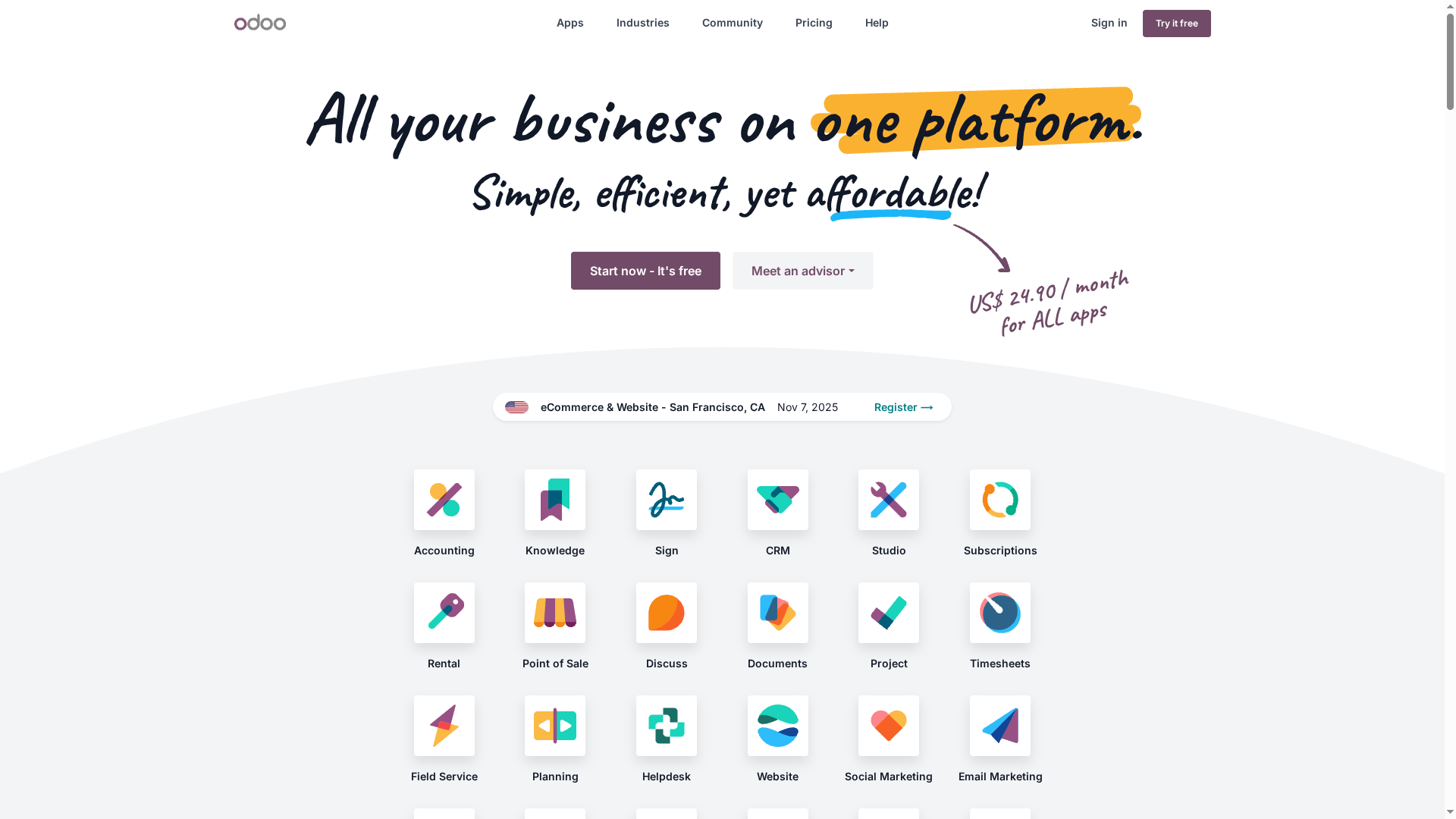
              Product Screenshot

              At a Glance

              Odoo is an open source ERP and CRM platform that brings a wide range of business applications into a single, integrated system. It offers two editions — Community (free) and Enterprise (paid) — and a massive community ecosystem with over 40,000 apps. In short, highly flexible and extensible, but it can feel complex if you try to adopt everything at once.

              Core Features

              Odoo combines ERP and CRM capabilities on one platform: accounting, sales, inventory, HR, and more are available as modular apps. Key technical strengths include open source architecture, a large community app store, and tools for customization such as Odoo Studio. The dual-edition model (Community vs. Enterprise) lets organizations choose between a free, open source base and a paid tier with additional features and services.

              Pros

              • Highly customizable and scalable: Businesses can tailor workflows, add modules, and scale the system as operations grow without forcing a one-size-fits-all setup.
              • No vendor lock-in, open source: The platform’s open source nature reduces dependency on a single vendor and allows for self-hosting or third-party hosting options.
              • Large app store with diverse applications: With over 40,000 community apps, you can extend functionality to cover niche processes or industry-specific needs.
              • Transparent pricing, no hidden costs: Pricing is presented openly, helping teams forecast TCO without surprises.
              • Includes hosting, support, and upgrades in plans: Paid plans bundle operational services, which lowers the burden on internal IT for maintenance and updates.

              Cons

              • Complexity can be overwhelming for beginners: The breadth of modules and configuration options creates a steep initial learning curve for teams without ERP experience.
              • May require technical expertise for customization: Implementing meaningful customizations often needs developer or technical consultant involvement rather than point-and-click changes alone.
              • Some advanced features are only available in the paid Enterprise edition: Organizations relying solely on the Community edition may find important capabilities gated behind the Enterprise tier.

              Who It’s For

              Odoo is best for businesses of all sizes that need an integrated ERP and CRM solution and want the freedom to customize their system. If you value open source flexibility and plan to extend or adapt the platform for multiple business processes, Odoo fits well — especially when you can invest in implementation expertise.

              Unique Value Proposition

              Odoo’s strength is the combination of an open source core, a vast community-driven app ecosystem, and a modular design that lets you assemble a single, unified system for most business functions. That mix gives you both breadth and control: you pick what you need and modify it.

              Real World Use Case

              A retail chain uses Odoo to synchronize sales, inventory, and customer records across multiple locations, leveraging modular apps to standardize processes and adding custom modules where their workflows diverge from the defaults.

              Pricing

              Starting at $24.90/month per user for the standard online plan, with various plans and custom options available.


              NetSuite
              Product Screenshot

              At a Glance

              NetSuite is a unified, cloud-based business management suite that combines ERP, CRM, eCommerce, and financials with AI-driven features to support smarter decisions and operational efficiency. Its single-source-of-truth approach and real-time analytics make it a strong option for organizations that need centralized visibility across multiple functions. Expect a robust, scalable platform that fits medium to large enterprises but can feel complex for smaller teams. Pricing isn’t published up front, so budgeting requires a direct conversation with sales.

              Core Features

              NetSuite’s core capabilities center on integration and real-time insight: an AI-powered business management suite that unifies data across ERP, financials, CRM, and eCommerce; real-time dashboards and analytics for operational visibility; inventory and fulfillment management to streamline supply chain activities; and financial management and accounting solutions to centralize reporting. Together, these elements are designed to replace disconnected systems and provide on-demand access to live data across core business functions.

              Pros

              • Integrated platform providing a single source of truth: NetSuite consolidates ERP, CRM, eCommerce, and financials so teams work from the same dataset, reducing reconciliation and data latency.
              • AI capabilities to enhance decision-making: Built-in AI features help surface insights and automate routine analysis, improving forecasting and operational responsiveness.
              • Cloud-based with on-demand access to resources: Being cloud-native enables remote access and reduces on-premises infrastructure overhead.
              • Designed for scalability and comprehensive business management: The suite supports broad functional coverage, making it suitable as a long-term platform as businesses grow.
              • Offers a free product tour and extensive resources: Prospective buyers can evaluate core functionality through tours and documentation before committing.

              Cons

              • Potential complexity for new users due to extensive features: The platform’s breadth can result in a steep learning curve and longer implementation timelines.
              • Pricing details are not specified directly, which may require direct inquiry. Lack of transparent pricing means you must contact sales to get cost estimates and scope.
              • It may be more suitable for medium to large enterprises: Smaller organizations may find the feature set and total cost of ownership disproportionate to their needs.

              Who It’s For

              NetSuite is aimed at medium to large enterprises seeking a comprehensive, AI-enabled cloud ERP solution that unifies business processes and data. If your organization needs consolidated financials, CRM, eCommerce, and inventory control under one platform and can support the implementation effort, NetSuite is a strong candidate.

              Unique Value Proposition

              NetSuite’s unique value lies in combining broad functional coverage with AI-enhanced analytics and a cloud-first architecture to deliver a unified operational and financial platform. That single-suite approach reduces integration overhead and positions companies to scale without cobbling together multiple point solutions.

              Real World Use Case

              A company implements NetSuite to integrate financials, CRM, and eCommerce into a single platform and uses the suite’s AI capabilities to improve demand forecasting, inventory management, and financial reporting, replacing legacy accounting software and fragmented operational tools.

              Pricing

              Quote-based — pricing details are not specified publicly and typically require direct contact with NetSuite for a tailored quote.

              SAP

              Product Screenshot

              At a Glance

              SAP offers a broad, enterprise-grade portfolio that combines ERP, AI-enabled platforms, and industry-focused applications to support large-scale digital transformation. Its strength lies in integrating finance, supply chain, procurement, and customer experience through cloud and data-driven services. Adoption often yields stronger operational visibility and responsiveness, but the platform’s depth requires deliberate planning and investment. Bottom line: powerful and comprehensive — best suited to sizable organizations ready for a significant transformation effort.

              Core Features

              SAP Business Suite brings together AI, data, applications, and a platform designed to drive business innovation, while cloud ERP options emphasize analytics-driven processes. Financial management tools aim to maintain compliance and manage uncertainty, and spend management uses AI to increase visibility and savings. Supply chain solutions focus on resilience and sustainability, supporting collaboration across procurement, logistics, and manufacturing. The suite also includes customer experience and human capital management capabilities and a global partner network and events program to accelerate adoption and continuous improvement.

              Pros

              • Comprehensive enterprise coverage: SAP delivers solutions that span ERP, finance, supply chain, HCM, and CX, enabling a single-vendor approach across core business functions.
              • Strong AI and data focus: The product line is built around AI-enabled platforms and analytics that support smarter, data-driven decision making.
              • Cloud-first ERP options: SAP offers cloud deployments designed to modernize operations and provide real-time insights across processes.
              • Global support and partner ecosystem: A wide partner network and regular events mean ongoing innovation, training, and implementation resources are available.
              • Continuous innovation showcased publicly: SAP frequently updates its roadmap and highlights new capabilities through events, keeping customers informed of new possibilities.

              Cons

              • High complexity for smaller organizations: The breadth and depth of SAP’s offerings can overwhelm small or nascent teams and require significant expertise to manage effectively.
              • Potentially high implementation and maintenance costs: Deployments often involve extensive customization and partner services, which can increase total cost of ownership.
              • Significant change management required: Upgrading or adopting SAP solutions typically demands process redesign, training, and cultural adoption efforts across the business.

              Who It’s For

              SAP is targeted at large and enterprise-level organizations that need integrated, scalable systems to manage complex operations and global footprints. If you are leading a sizable manufacturing, logistics, or multi-national company and you need deep functional coverage across finance, supply chain, and customer experience, SAP fits the bill — provided you have the budget and change capability.

              Unique Value Proposition

              SAP’s unique value lies in its end-to-end ecosystem: deep functional modules combined with AI and data platforms, plus a mature partner network and event-driven community. That combination helps organizations centralize data, apply analytics across domains, and iteratively innovate at scale.

              Real World Use Case

              A multinational manufacturer implements SAP Business Suite to unify disparate regional systems, consolidate finance and procurement data, and apply AI-driven insights to reduce supply chain risk and improve customer engagement. The result: clearer visibility across plants, better forecasting, and a single source of operational truth.

              Pricing

              Quote-based — SAP typically customizes pricing based on product mix, deployment scale, and implementation scope.

              Epicor

              At a Glance

              Epicor delivers industry-specific ERP and supply chain solutions built to simplify complexity for manufacturers and distributors while embedding AI and cloud capabilities. Its strength lies in tailored modules for manufacturing, distribution, retail, and automotive sectors, combined with supply chain optimization and real-time analytics. Expect a robust, enterprise-grade platform that accelerates operational visibility — but plan on a meaningful implementation and training effort. This is a heavyweight system designed for scale, not a lightweight plug-and-play tool.

              Core Features

              Epicor’s core centers on industry-specific ERP functionality, cloud deployment options, AI-driven applications and automation, and supply chain management tools tied to real-time analytics and business intelligence. These capabilities work together to streamline procurement, production, inventory, and omnichannel retail processes while providing dashboards and insights for operational and sustainability reporting. The product is positioned to replace disparate systems by consolidating transactional workflows, analytics, and automation under a single vendor architecture.

              Pros

              • Tailored industry solutions: Epicor provides ERP modules designed specifically for manufacturing, distribution, retail, and automotive use cases, reducing the need for heavy customization.
              • AI and machine learning integration: Built-in AI-driven applications and automation help teams identify inefficiencies and reduce manual work through predictive and prescriptive insights.
              • Supply chain focus: The platform emphasizes supply chain optimization and sustainability, enabling teams to tighten logistics, inventory, and supplier management.
              • Global experience and scale: Epicor’s extensive customer base and global footprint mean mature processes, best-practice templates, and broad implementation experience.
              • Comprehensive support and consultation: The vendor offers strong consultation and support services to guide complex implementations and ongoing optimization.

              Cons

              • Complexity requiring specialized training: The breadth and depth of Epicor’s solutions mean users and administrators typically need specialized training to extract full value from the platform.
              • Cost considerations for smaller organizations: Pricing and implementation resource requirements can be a challenge for small businesses or startups with limited budgets and staff.
              • Challenging legacy integrations: Connecting Epicor to older legacy systems can be difficult, potentially requiring custom integration work or phased migration strategies.

              Who It’s For

              Epicor is best suited to mid-sized to large enterprises that need industry-specific, scalable ERP with advanced AI and cloud options. If you run multiple manufacturing sites, complex distribution networks, or an omnichannel retail operation, and you need deep supply chain and inventory control, Epicor is aimed at you. Smaller companies should evaluate resource and budget readiness before committing.

              Unique Value Proposition

              Epicor’s unique value lies in combining industry-tailored ERP modules with AI-driven automation and supply chain analytics in a cloud-capable platform. That combination reduces one-off customization and accelerates industry-aligned best practices, making it easier for industry leaders to standardize processes and drive measurable operational gains.

              Real World Use Case

              A leading manufacturer implemented Epicor ERP to unify its supply chain, automate procurement workflows, and apply AI-driven analytics for operational efficiency and sustainability reporting. The result was consolidated visibility across procurement, production, and inventory with automated alerts and analytics to support continuous improvement.

              Pricing

              Pricing: Quote-based — Epicor typically provides customized pricing based on business needs and implementation scope; contact sales for a tailored quote.

              Microsoft Dynamics 365
              Product Screenshot

              At a Glance

              Microsoft Dynamics 365 is a unified platform of CRM and ERP apps that emphasizes AI-powered business applications to connect teams, processes, and data. It focuses on personalization, automation, and real-time insights to help companies improve customer experiences and operational agility. If you need a broad, enterprise-capable system that leverages generative AI and automation across sales, service, finance, and supply chain, Dynamics 365 is a strong contender. Expect a powerful but complex solution—capable, with a learning curve.

              Core Features

              Dynamics 365 bundles agentic CRM and ERP capabilities into modular applications for sales, service, finance, and supply chain. Core strengths include AI-powered personalization of customer journeys, generative AI to accelerate issue resolution, and proactive field service and supply chain insights. The platform is designed to connect teams and data across the organization so processes become more automated and data-driven, enabling faster decisions and improved frontline performance.

              Pros

              • Enhanced customer relationships across sales, marketing, and service: Dynamics 365 centralizes customer data and AI-driven personalization so teams can deliver more relevant experiences.
              • Achieves significant ROI and cost savings: Organizations often realize measurable efficiency gains and operational cost reductions by consolidating systems and automating routine work.
              • Flexible and customizable with industry-leading partners: The platform supports extensive customization and partner-led solutions to tailor deployments to industry needs.
              • Empowers frontline teams with AI and automation: Field and service teams gain real-time insights and automation that reduce manual work and speed response times.
              • Supports automation and autonomous processes with AI agents: Dynamics leverages agentic AI to run workflows and surface proactive actions across sales and operations.

              Cons

              • The complexity of the platform may require dedicated training and support: Getting value quickly often depends on skilled administrators, consultants, or partner resources.
              • Potential high initial investment depending on deployment size: Licensing, implementation, and customization for medium and large deployments can create a notable upfront cost.
              • Requires ongoing management of AI and data integrations: Maintaining reliable AI outputs demands continuous data governance, model oversight, and integration upkeep.

              Who It’s For

              Dynamics 365 is aimed at medium to large businesses that want AI-driven CRM and ERP in one ecosystem. If your organization prioritizes personalized customer journeys, automated operations, and cross-functional data visibility—and you have the resources to manage a sophisticated platform—Dynamics 365 is built for you.

              Unique Value Proposition

              Dynamics 365 combines CRM and ERP with integrated AI and automation to make customer experience and operational agility core capabilities rather than bolt-ons. Its value lies in unifying data and workflows at scale while applying generative and agentic AI to reduce manual effort and surface timely insights.

              Real World Use Case

              A retail chain uses Dynamics 365 to personalize customer journeys across channels, automate supply chain logistics to reduce stockouts, and equip sales teams with real-time customer insights that drive higher conversion and faster service.

              Pricing

              See plans and pricing options on the website (not specified exactly in the content).

              Website: https://dynamics.microsoft.com

              Infor
              Product Screenshot

              At a Glance

              Infor is a cloud-first, industry-specific ERP suite that combines generative AI, machine learning, and advanced analytics to help mid-size and large manufacturers modernize operations. The platform emphasizes deep vertical functionality—ERP, SCM, HCM, financials, and sustainability—backed by a high-security CloudSuite architecture. Bottom line: if you need industry-tailored capabilities and AI-infused workflows at scale, Infor is a contender; expect a significant implementation and change effort to realize its full value.

              Core Features

              Infor delivers cloud-based enterprise software designed around industry needs, not a one-size-fits-all approach. Key capabilities include ERP and supply chain management modules, human capital and financial management, plus sustainability and ESG reporting support. The product integrates generative AI and machine learning into core processes and offers role-based AI agents to streamline user tasks. Underpinning these features is a high-performance, secure data layer in the CloudSuite Distribution architecture to support integrations and scale.

              Pros

              • Industry-specific depth: Infor offers solutions tailored to distinct sectors, which reduces the need for heavy customization and keeps industry best practices front and center.
              • Advanced AI and analytics: The inclusion of generative AI, machine learning, and advanced analytics helps teams predict outcomes and automate routine decisions.
              • Comprehensive cloud platform: A cloud-native architecture supports scalability and broad integration capabilities, enabling enterprise-wide deployment.
              • Proven supply chain and warehouse strengths: Infor is recognized for strong warehouse management and cloud ERP capabilities, which is valuable for manufacturers focused on logistics and distribution.
              • Global footprint with regional adaptation: A worldwide presence means the product is adapted for regional market needs and compliance requirements.

              Cons

              • Pricing not specified on the website: The vendor does not list standard pricing, making initial budget planning and vendor comparisons more difficult.
              • Implementation complexity: Industry-specific depth and advanced features can translate into complex implementations that demand specialized resources and time.
              • Requires substantial digital transformation effort: Realizing AI and analytics benefits typically requires process redesign, data cleanup, and change management, which can be resource-intensive for many organizations.

              Who It’s For

              Infor is best suited for medium to large enterprises—especially manufacturers, distributors, and industry-specific organizations—that need deep vertical functionality and advanced analytics. If your organization has the budget, project governance, and appetite for digital transformation, Infor can deliver scale and industry-aligned processes.

              Unique Value Proposition

              Infor’s distinct advantage is its combination of industry-specific modules with embedded AI capabilities and a secure CloudSuite data foundation. That mix lets companies adopt pre-built industry logic while progressively applying machine learning and role-based AI agents to improve decision-making and operational efficiency.

              Real World Use Case

              A manufacturing firm leverages Infor’s AI-enabled ERP to predict demand, optimize inventory levels, and refine production planning. The result: fewer stockouts, better production throughput, and measurable cost reductions driven by analytics-informed scheduling.

              Pricing

              Not specified on the website

              ERP Solutions Comparison

              This table provides a concise comparison of leading ERP solutions, highlighting their features, pros, cons, pricing, and ideal users. It helps in assessing which platform best fits your business needs.

              Product Features & Pros Cons Pricing Ideal For
              Bista Solutions Extensive Odoo expertise, award-winning, comprehensive ERP, analytics, automation, and compliance services Breadth may overwhelm smaller firms Quote-based Medium to large manufacturers needing Odoo-led transformation
              Odoo Modular ERP/CRM, customizable and scalable, large app ecosystem with open-source options Complexity for beginners, advanced features require a paid version Starting at $24.90/user/month Businesses valuing open source flexibility
              NetSuite Cloud-based, unified ERP/CRM/eCommerce, AI-driven analytics Potential complexity, non-transparent pricing Quote-based Medium to large enterprises needing centralized data and processes
              SAP Comprehensive enterprise system, AI/data-focused, global support Complex, potentially high implementation costs Quote-based Large organizations needing deep functional coverage
              Epicor Industry-specific ERP, strong supply chain, and AI capabilities Complex for small businesses, challenging legacy integration Quote-based Mid to large enterprises in manufacturing and distribution
              Microsoft Dynamics 365 AI-powered CRM/ERP, customizable, enhances customer relationships, and automation focus Complex platform, potentially high initial investment Various plans on the website Medium to large businesses needing data-driven systems
              Infor Industry-specific ERP, advanced analytics, and AI capabilities Requires significant change effort, non-transparent pricing Not specified Medium to large enterprises in need of industry-specific solutions

              Unlock Scalable ERP Success for Your Manufacturing Business

              Manufacturers face complex challenges like streamlining supply chains, improving inventory accuracy, and integrating analytics to drive smarter decisions. The article highlights these pain points and shows that choosing the right ERP system is critical to staying competitive and achieving sustainable growth. At Bista Solutions, we understand these pressures and focus on providing enterprise-grade Odoo implementations that combine automation, analytics, and compliance — all tailored to your unique needs and backed by industry-proven best practices.

              As the largest Odoo ERP implementer in North America and a repeated Odoo Best Partner, Bista Solutions brings the scale and expertise to help manufacturers conquer operational complexities fast. Our team of 300+ ERP experts delivers end-to-end consulting and support with 24/7 availability so you never face digital transformation alone.

              Experience the difference that deep Odoo expertise and comprehensive support make in achieving a predictable ERP rollout adapted for manufacturers like you.

              Explore how we can empower your business: Contact Bista Solutions today.


              Schedule A Free Consultation


                Ready to transform your manufacturing operations with a proven ERP partner? Don’t wait for inefficiencies to hold you back. Reach out now for a tailored consultation and start your journey toward faster ROI with Bista Solutions. Discover how our award-winning team unlocks scalable growth with Odoo ERP, designed specifically for manufacturers. Connect with us to take the first step at https://www.bistasolutions.com/contact-us/.

                Frequently Asked Questions

                What are the key features to look for in ERP systems for manufacturers?

                Focusing on ERP systems tailored for manufacturers, seek features like inventory management, supply chain optimization, real-time analytics, and integration with various manufacturing processes. Assess how these capabilities can streamline your operations and improve decision-making.

                How can implementing an ERP system improve inventory control in manufacturing?

                Implementing an ERP system can enhance inventory control by providing real-time visibility into stock levels, automating reorder processes, and reducing discrepancies. Aim for systems that integrate warehouse management features, which can help decrease excess inventory by up to 20%.

                What steps should I take for a successful ERP implementation in my manufacturing business?

                To ensure a successful ERP implementation, start by conducting a needs assessment, choosing the right ERP solution, and involving key stakeholders throughout the process. Develop a clear timeline and allocate resources adequately to complete implementation within 6 to 12 months.

                How do I measure the ROI of an ERP system in a manufacturing environment?

                Measuring ROI involves comparing the costs of the ERP system against the financial benefits it brings, such as increased efficiency, reduced operational costs, and improved production quality. Track key performance indicators (KPIs) regularly to quantify gains and expect noticeable improvements within the first year.

                How can ERP systems automate compliance and regulatory reporting for manufacturers?

                ERP systems can automate compliance by integrating necessary regulatory requirements into their processes, thus simplifying reporting and documentation. Look for features that automatically generate reports tailored to specific regulations, which can save time and reduce errors during audits.

                What training is necessary for employees when transitioning to a new ERP system?

                Employee training should cover system navigation, functional use specific to their roles, and data management practices. Plan comprehensive training sessions during the implementation phase to ensure employees are proficient, ideally completing training before going live with the ERP system.


                7 Steps to Implement Odoo ERP in Manufacturing Plant

                Odoo ERP manufacturing

                Nearly 75 percent of manufacturing ERP projects fail to meet expectations without a clear strategy from the start. No matter the size of your plant, the right preparation can mean the difference between disruption and streamlined productivity. By identifying real pain points, choosing focused modules, and empowering your team, you can set your Odoo ERP journey on a strong foundation that scales with your manufacturing goals.

                Table of Contents

                Quick Summary

                Takeaway Explanation
                1. Assess your plant’s needs before implementation Conduct a thorough assessment of workflows, challenges, and strategic goals to tailor the ERP system effectively.
                2. Map key processes for optimal integration Documenting manufacturing workflows reveals inefficiencies and supports smoother ERP integration.
                3. Choose appropriate Odoo ERP modules Select modules specific to your needs to optimize production and enhance operational efficiency.
                4. Prioritize comprehensive training for teams Effective training programs empower users and ensure the successful adoption of the new ERP system.
                5. Establish ongoing support and system optimization Continuous monitoring and feedback analysis are essential for adapting the ERP system to evolving manufacturing needs.

                1. Assess Your Manufacturing Plant’s Needs and Goals

                Effective Odoo ERP implementation begins with a comprehensive understanding of your manufacturing plant’s unique operational landscape. Before diving into any technological solution, you need a clear blueprint of your current workflows, challenges, and strategic objectives.

                Start by conducting a thorough internal assessment that goes beyond surface-level observations. Engage directly with department leaders and end users across different operational segments, production, inventory management, quality control, and maintenance. This collaborative approach will help you uncover hidden inefficiencies and critical pain points that your ERP system must address.

                A strategic ERP readiness evaluation involves several key dimensions. Financial preparedness means understanding the investment required and the potential return on investment. Technological infrastructure requires assessing your current system’s compatibility and potential upgrade needs. Cultural readiness examines how adaptable your team will be to new technological processes.

                Specifically, focus on identifying processes that will benefit most from ERP integration:

                • Production scheduling optimization
                • Real-time inventory tracking
                • Quality control management
                • Maintenance and equipment tracking
                • Resource allocation and workforce management

                When evaluating your needs, consider both immediate operational requirements and long-term strategic goals. This means looking beyond current challenges and anticipating future growth and scalability. Explore our Odoo Manufacturing ERP Solution to understand how comprehensive ERP implementation can transform your manufacturing operations.

                Remember that successful ERP implementation is not just about technology selection but about creating a holistic strategy that aligns technology with your unique business objectives. Your goal is to create a robust, flexible system that can evolve with your manufacturing plant’s changing needs.

                2. Map Key Manufacturing Processes for Integration

                Successfully implementing an Odoo ERP system requires a meticulous approach to understanding and documenting your manufacturing plant’s intricate workflows. Process mapping is not just a technical exercise but a strategic opportunity to uncover hidden inefficiencies and optimize your operational landscape.

                Process documentation becomes your roadmap for successful ERP integration. This means creating a comprehensive view of how work actually happens in your manufacturing environment tracking everything from initial order reception to final product delivery. By systematically documenting core processes like order fulfillment, procurement, production tracking, and inventory management, you create a blueprint that reveals critical insights into your operational ecosystem.

                The goal of process mapping extends beyond simple documentation. You want to identify workflow bottlenecks, redundant activities, and potential automation opportunities. Look for steps that consume excessive time or resources. These are prime candidates for streamlining through ERP implementation.

                Key areas to map thoroughly include:

                • Order management workflow
                • Raw material procurement processes
                • Production scheduling and tracking
                • Quality control procedures
                • Inventory management systems
                • Shipping and delivery protocols
                • Equipment maintenance tracking

                While mapping these processes, involve team members from different departments. Their ground-level insights will help create a more accurate representation of actual workflows. Learn more about our Production Planning and Scheduling ERP modules to understand how detailed process mapping translates into efficient system design.

                Remember that process mapping is not a one-time activity but an ongoing strategic exercise. Your Odoo ERP implementation should be flexible enough to adapt as you continue refining and optimizing your manufacturing processes.

                3. Choose the Right Odoo ERP Modules for Manufacturing

                Selecting the appropriate Odoo ERP modules for your manufacturing environment is a critical decision that can dramatically transform your operational efficiency. The right modules act as strategic tools that seamlessly integrate and optimize your complex manufacturing processes.

                Module selection is not a one-size-fits-all approach. Your chosen modules must align precisely with your specific manufacturing business requirements and current operational landscape. This means looking beyond generic solutions and finding modules that can be tailored to your unique production workflows, scalability needs, and integration capabilities.

                Odoo offers a comprehensive suite of manufacturing modules designed to address diverse operational challenges. Key modules you should evaluate include:

                • Manufacturing Resource Planning (MRP)
                • Bill of Materials (BOM) management
                • Production routing and scheduling
                • Shop floor control systems
                • Subcontracting and outsourcing modules
                • Quality control tracking
                • Inventory management
                • Traceability and reporting tools

                When assessing these modules, focus on their ability to support real-world production processes. Consider factors such as functional alignment with your existing workflows, potential for future scalability, and seamless integration capabilities with your current technological ecosystem. Learn more about Manufacturing Execution Systems integration with Odoo to understand how comprehensive module selection can revolutionize your manufacturing operations.

                Remember that effective module selection is an investment in your manufacturing plant’s future. Take time to thoroughly evaluate each module, not just for its current capabilities but for its potential to grow and adapt alongside your business.

                4. Data Migration and System Configuration Essentials

                Data migration and system configuration represent the technical backbone of your Odoo ERP implementation strategy. This critical phase transforms raw historical information into a powerful operational foundation that will drive your manufacturing plant’s future performance.

                Data migration is not simply transferring files but a strategic process of extracting, cleaning, transforming, and loading critical business information. Your goal is to ensure that every piece of data from inventory records to supplier details and production schedules seamlessly transfers into the new ERP ecosystem without losing integrity or historical context.

                Key data migration considerations include:

                • Comprehensive data auditing
                • Cleaning and standardizing existing records
                • Mapping legacy system data to new Odoo modules
                • Verifying data completeness and accuracy
                • Creating backup systems before migration
                • Establishing data validation protocols

                System configuration demands a meticulous approach tailored specifically to manufacturing workflows. This means precisely configuring modules to reflect your unique operational requirements. Pay special attention to production planning, bill of materials management, inventory tracking, procurement workflows, and quality assurance processes. Understand the fundamentals of ERP implementation to gain deeper insights into this complex process.

                Consider implementing role-based access controls to ensure data security and create custom scripts that align with your specific manufacturing processes. Remember that successful data migration is not just about moving information but transforming how your organization leverages data for strategic decision making.

                5. Train Teams on Odoo ERP for Smooth Adoption

                Successful Odoo ERP implementation hinges not just on technology but on your team’s ability to effectively use and embrace the new system. Training is the critical bridge that transforms sophisticated software into a powerful operational tool for your manufacturing plant.

                Effective training goes beyond basic system navigation. It requires a comprehensive approach that addresses the unique needs of different roles within your organization. Your goal is to build confidence and competence across all levels of your manufacturing team.

                Strategic training methods should include:

                • Hands-on workshops tailored to specific departmental needs
                • Role-based training sessions
                • Interactive learning modules
                • Scenario-based practical exercises
                • Ongoing support and knowledge resources
                • Performance tracking and skill assessment

                Consider developing standardized operating procedures that document step-by-step processes for using the Odoo ERP system. This documentation serves as a critical reference point for employees during and after the training process. Explore our guide to Odoo Warehouse Management to understand how targeted training can enhance operational efficiency.

                Remember that training is not a one-time event but an ongoing process. Create a culture of continuous learning where employees feel supported and empowered to maximize the potential of your new ERP system. The most successful implementations view training as an investment in your team’s capability and your organization’s future performance.

                6. Pilot Testing and Addressing Bottlenecks

                Pilot testing represents the critical checkpoint where theoretical ERP implementation meets practical operational reality. This phase is your opportunity to validate system performance, identify potential challenges, and refine your Odoo ERP configuration before full-scale deployment.

                Comprehensive testing goes beyond simple functionality checks. Your goal is to create a rigorous evaluation process that examines every aspect of the ERP system from multiple perspectives. This means looking deeper than surface-level interactions and understanding how different modules communicate and support your manufacturing workflows.

                Critical testing dimensions to explore include:

                • Unit testing for individual module performance
                • Integration testing across different system components
                • User acceptance testing with actual end users
                • Performance stress testing under various operational scenarios
                • Security and access control validation
                • Data migration accuracy verification
                • Workflow process simulation

                Documentation becomes your strategic ally during pilot testing. Systematically record test cases, capture observed issues, and develop clear resolution strategies. This approach transforms potential obstacles into opportunities for system optimization. Learn more about Odoo implementation strategies to understand how meticulous testing can prevent future operational disruptions.

                Remember that pilot testing is not about achieving perfection but about creating a robust, adaptable system that can evolve with your manufacturing plant’s changing needs. Treat each identified bottleneck as valuable feedback that brings you closer to a truly effective ERP solution.

                7. Ensure Ongoing Support and System Optimization

                Successful Odoo ERP implementation is not a destination but a continuous journey of refinement and strategic improvement. Ongoing support and system optimization transform your initial implementation into a dynamic operational asset that evolves alongside your manufacturing plant’s changing needs.

                Continuous monitoring becomes your strategic compass for maintaining ERP system effectiveness. This means developing a proactive approach that goes beyond reactive problem solving and focuses on systematic performance enhancement and user experience optimization.

                Key ongoing optimization strategies include:

                • Regular performance metric tracking
                • User feedback collection and analysis
                • System functionality enhancement reviews
                • Key performance indicator monitoring
                • Security and compliance updates
                • Training program refreshment
                • Technology alignment assessments

                Focus on critical manufacturing KPIs such as order fulfillment rates, production cycle times, inventory turnover, and resource utilization. These metrics provide tangible insights into your ERP system’s real-world performance and highlight areas requiring strategic intervention. Explore the comprehensive phases of ERP implementation to understand the holistic approach required for long-term success.

                Remember that your Odoo ERP system is a living technological ecosystem. Treat it as a strategic partner that requires consistent nurturing, listening, and adaptation to drive continuous operational excellence in your manufacturing environment.

                Below is a comprehensive table summarizing the steps and strategies for effective Odoo ERP implementation in a manufacturing environment.

                Main Step Key Points & Actions Benefits/Outcomes
                Assess Needs and Goals Conduct internal assessments, financial and technological readiness, and engage with teams Identify challenges, align ERP with strategic objectives
                Map Processes Document workflows, identify inefficiencies, and opportunities for automation Optimize operations, create a roadmap for integration
                Choose Modules Select modules aligned with specific needs: MRP, BOM, Scheduling Enhanced efficiency, seamless process integration
                Data Migration Extract, clean, and map data, configure the system Maintain data integrity, support strategic decision making
                Train Teams Role-based training, hands-on workshops, and continuous learning Smooth adoption, increased competence
                Pilot Testing Comprehensive testing, user and stress tests, document issues Refine ERP configuration, prevent disruptions
                Ongoing Support Monitor performance, update training, and assess technology alignment Continuous improvement, operational excellence

                Streamline Your Manufacturing with Expert Odoo ERP Implementation

                Manufacturing plants face complex challenges like inefficient workflows, data migration risks, and team adaptation hurdles when implementing an ERP system. The article “7 Steps to Implement Odoo ERP in Manufacturing Plant” highlights crucial concepts such as process mapping, module selection, and ongoing optimization to transform operations and boost productivity. Bista Solutions understands these pain points and offers tailored Odoo ERP implementations that focus on your unique production needs, ensuring smooth data migration, effective training, and continuous support.

                Book A Free Demo

                  Ready to elevate your manufacturing efficiency and overcome implementation challenges with proven expertise? The largest Odoo ERP implementer in North America is here to help. Partner with Bista Solutions, a trusted Odoo Gold Partner recognized across multiple years for excellence. Discover our comprehensive approach that aligns with your strategic goals and empowers your team. Contact us today at Bista Solutions to start your journey to seamless Odoo ERP integration. Learn more about how our Odoo Manufacturing ERP Solution and Production Planning and Scheduling ERP modules can transform your plant operations.

                  Frequently Asked Questions

                  What are the initial steps to assess my manufacturing plant’s needs for Odoo ERP implementation?

                  Effective assessment starts with a detailed evaluation of your current workflows and operational challenges. Engage with department leaders and gather insights from end users to understand critical pain points. Begin this assessment within the first few weeks of planning your ERP integration.

                  How can I map key manufacturing processes for Odoo ERP integration?

                  To map your manufacturing processes, document each workflow from order reception to product delivery. Identify areas for improvement, such as bottlenecks or redundant steps, and involve team members to get accurate representations. Aim to complete this mapping within 30 days to aid in selecting the right ERP modules.

                  What factors should I consider when choosing Odoo ERP modules for manufacturing?

                  Focus on modules that directly address your specific needs, such as production scheduling and quality control. Evaluate the functional alignment with your existing workflows and assess scalability for future growth. Make your selection within two weeks of finalizing your process mapping.

                  What are the essential steps for data migration during Odoo ERP implementation?

                  Conduct a comprehensive data audit, followed by cleaning and standardizing your existing records. Ensure all necessary data is accurately mapped to the new system’s modules and establish validation protocols to maintain data integrity. Aim to finalize data migration within the first month after selecting your modules.

                  How can I train my team effectively on the new Odoo ERP system?

                  Implement hands-on workshops tailored to specific departmental needs to enhance understanding and confidence in using the new system. Create ongoing support resources and performance tracking to ensure skill development. Start training sessions at least 2-3 weeks before the system goes live to maximize user readiness.

                  What should I focus on during pilot testing of the Odoo ERP system?

                  Concentrate on unit testing, integration testing, and user acceptance testing to ensure the system works effectively across different modules. Document test cases and any issues that arise to create a clear resolution strategy. Conduct pilot testing 1-2 weeks before full-scale deployment to refine your ERP configuration.

                  7 Key Odoo AI Solutions for Small and Medium Manufacturers

                  Odoo AI manufacturing
                  • by Uzlifat Mir
                  • Nov 11, 2025
                  • 0
                  • Category:

                  Nearly 60% of small and medium manufacturers struggle to maintain accurate inventory, leading to costly errors and lost revenue. Automation powered by artificial intelligence is shifting the way businesses approach this problem, helping them achieve unprecedented precision and efficiency. With advanced tools like Odoo AI, companies can simplify everything from inventory management to quality control while gaining real-time insights that keep production and supply chains running smoothly.

                  Table of Contents

                  Quick Summary

                  Takeaway Explanation
                  1. Odoo AI Boosts Inventory Accuracy Achieve inventory accuracy of 95-98% through automation, enhancing operational efficiency.
                  2. Streamlined Production Scheduling Utilize AI for intelligent scheduling, improving resource allocation, and reducing manual effort.
                  3. Proactive Quality Control Insights Implement AI-driven quality checks to minimize production errors and ensure compliance.
                  4. Accurate Real-Time Demand Forecasting Rely on AI to provide precise demand predictions that inform inventory and production strategies.
                  5. Predictive Maintenance Reduces Downtime Use predictive analytics to monitor equipment health and prevent unplanned failures effectively.

                  1. Automating Inventory Management with Odoo AI

                  Manufacturers often struggle with inventory complexity. Odoo AI transforms this challenge by bringing intelligent automation to your warehouse operations.

                  With Odoo AI, small and medium manufacturers can achieve remarkable inventory accuracy improvements. After implementation, businesses see inventory accuracy leap from 70-80% to an impressive 95-98%. This dramatic enhancement translates to significant cost savings and operational efficiency.

                  The system leverages advanced machine learning algorithms to predict inventory needs, automatically generate purchase orders, and optimize stock levels. By analyzing historical data and current market trends, Odoo AI helps you maintain optimal inventory without manual intervention.

                  Key Inventory Automation Features:

                  • Real time stock tracking
                  • Automated reordering based on predictive analytics
                  • Barcode-enabled inventory management
                  • Intelligent demand forecasting

                  Implementing this solution can reduce holding costs by 15-35% and save manufacturers 40-70% in time previously spent on manual inventory management. Explore our guide on Odoo inventory management to understand how this technology can transform your manufacturing operations.

                  Bista Solutions specializes in tailoring these AI-driven inventory solutions to match your specific business needs. Our expert team ensures seamless integration that minimizes disruption and maximizes operational efficiency.

                  2. Streamlining Production Scheduling for Better Efficiency

                  Production scheduling can be a nightmare for small and medium manufacturers. Odoo AI transforms this complex process into a smooth strategic operation that optimizes resources and minimizes waste.

                  Utilizing advanced modular Manufacturing Resource Planning (MRP) tools, Odoo enables manufacturers to implement sophisticated scheduling strategies without extensive manual intervention. The system leverages artificial intelligence to create visual Gantt charts that provide real-time insights into production workflows and resource allocation.

                  Key Production Scheduling Benefits:

                  • Finite capacity scheduling
                  • Real-time production traceability
                  • Automated resource coordination
                  • Intelligent workload balancing

                  Manufacturers can now coordinate inventory with production planning more effectively. By integrating AI-driven scheduling, businesses can dramatically improve operational efficiency. The system analyzes historical data to predict potential bottlenecks and suggest optimal production sequences.

                  With Odoo production planning and scheduling modules, manufacturers can reduce manual coordination efforts while maintaining high precision. The AI algorithms adapt to your unique manufacturing environment, ensuring that your scheduling remains flexible and responsive to changing market demands.

                  Bista Solutions specializes in customizing these AI-powered production scheduling solutions to match your specific operational requirements. Our expert team ensures seamless implementation that maximizes your manufacturing efficiency and reduces unnecessary overhead.

                  3. Improving Quality Control through AI-Driven Insights

                  Quality control has always been a challenging aspect of manufacturing. Odoo AI transforms this complex process by providing intelligent insights and automated tracking mechanisms that ensure consistent product excellence.

                  By integrating quality control checks directly into production steps, manufacturers can now monitor and manage potential issues with unprecedented precision. The system tracks non-conformances and generates automatic corrective action recommendations based on real-time data analysis.

                  Key Quality Control Features:

                  • Batch and serial number traceability
                  • Predictive maintenance insights
                  • Automated non-conformance reporting
                  • Shop floor visibility and monitoring

                  Odoo’s intelligent modules enable small manufacturers to minimize production errors and maintain rigorous compliance standards. The AI-powered system analyzes historical performance data to predict potential quality issues before they become significant problems.

                  Learn how AI can boost operational efficiency through advanced quality management techniques. By leveraging machine learning algorithms, manufacturers can transform traditional quality control from a reactive to a proactive process.

                  Bista Solutions specializes in implementing these sophisticated AI-driven quality control systems. Our expert team ensures that your manufacturing processes become more reliable, consistent, and efficient through cutting-edge technological solutions tailored to your specific operational needs.

                  4. Real-Time Demand Forecasting for Smarter Planning

                  In the unpredictable world of manufacturing, anticipating market demand can make or break your business. Odoo AI transforms demand forecasting from a complex guessing game into a precise strategic tool for smarter business planning.

                  Traditional forecasting methods rely on historical data and manual analysis. Odoo AI revolutionizes this approach by incorporating machine learning algorithms that analyze multiple data points in real time. The system considers market trends, seasonal variations, economic indicators, and historical performance to generate highly accurate predictive models.

                  Key Demand Forecasting Capabilities:

                  • Multilayer data analysis
                  • Machine learning predictive modeling
                  • Automated trend identification
                  • Dynamic inventory optimization

                  Small and medium manufacturers can now make data-driven decisions with unprecedented confidence. The AI-powered system continuously learns and adapts, providing increasingly refined forecasts that help you stay ahead of market shifts.

                  Explore advanced statistical forecasting methods to understand the sophisticated algorithms behind these intelligent predictions. By leveraging Odoo AI, you can reduce inventory holding costs, minimize waste, and improve overall operational efficiency.

                  Bista Solutions specializes in implementing these cutting-edge demand forecasting technologies. Our expert team ensures that your manufacturing operations become more responsive, agile, and strategically positioned in an ever-changing market landscape.

                  5. Optimizing Supply Chain Operations with Smart Analytics

                  Supply chain management has long been a complex puzzle for small and medium manufacturers. Odoo AI transforms this challenge by providing intelligent analytics that turn raw data into strategic insights and actionable decisions.

                  Traditional supply chain management relies on manual processes and fragmented information. Odoo AI revolutionizes this approach by creating real-time dashboards that provide comprehensive visibility across multiple departments and locations. The system integrates data from procurement, inventory, production, and logistics to generate holistic operational insights.

                  Key Supply Chain Analytics Features:

                  • Automated procurement timing recommendations
                  • Predictive stockout prevention
                  • Cross-departmental data integration
                  • Intelligent cost reduction strategies

                  By leveraging machine learning algorithms, manufacturers can now anticipate potential disruptions before they occur. The system analyzes historical performance data, market trends, and current operational metrics to generate precise recommendations that minimize risks and optimize resource allocation.

                  Discover how big data transforms supply chain analytics and understand the power of intelligent decision-making. Small manufacturers can now access enterprise-grade analytics capabilities that were previously available only to large corporations.

                  Bista Solutions specializes in implementing these advanced supply chain analytics technologies. Our expert team ensures that your manufacturing operations become more responsive, efficient, and strategically positioned in an increasingly competitive global marketplace.

                  6. Reducing Downtime Using Predictive Maintenance Tools

                  Manufacturers know that equipment failures can devastate productivity. Odoo AI introduces predictive maintenance tools that transform reactive repair strategies into proactive performance optimization.

                  Traditional maintenance approaches wait for equipment to break down. Odoo AI revolutionizes this model by integrating IoT devices and advanced machine learning algorithms to monitor equipment health in real time. The system collects comprehensive performance data and identifies potential issues before they escalate into critical failures.

                  Key Predictive Maintenance Capabilities:

                  • Real-time equipment monitoring
                  • Automated service scheduling
                  • Early fault detection
                  • Unified maintenance management

                  By analyzing historical performance metrics and current operational data, the system generates intelligent maintenance recommendations. Small manufacturers can now predict and prevent equipment breakdowns with unprecedented accuracy. This approach significantly reduces unexpected downtime and extends machinery lifespan.

                  Explore the important values of predictive analytics to understand how data-driven insights can transform your maintenance strategy. The AI-powered system provides manufacturers with a comprehensive view of equipment health and performance trends.

                  Bista Solutions specializes in implementing these advanced predictive maintenance technologies. Our expert team ensures that your manufacturing operations become more reliable, efficient, and strategically positioned to minimize operational disruptions.

                  7. Enhancing Customer Service with AI-Powered Support

                  Customer service can make or break a manufacturing business. Odoo AI introduces intelligent support tools that transform traditional customer interaction models into sophisticated, responsive experiences.

                  Traditional customer support relies on manual processes and limited communication channels. Odoo AI revolutionizes this approach by creating intelligent customer engagement systems that learn from each interaction and provide personalized support experiences. The system integrates multiple communication platforms and uses machine learning to understand and predict customer needs.

                  Key AI Customer Service Features:

                  • Intelligent ticket routing
                  • Automated response generation
                  • Sentiment analysis
                  • Personalized customer interaction tracking

                  By leveraging natural language processing and machine learning algorithms, manufacturers can now offer 24/7 support without increasing staffing costs. The AI system analyzes previous interactions to generate contextually relevant responses and escalate complex issues to human representatives when necessary.

                  Learn how to increase customer service efficiency and understand the transformative potential of AI-powered support. Small manufacturers can now access enterprise-grade customer engagement technologies that were previously out of reach.

                  Bista Solutions specializes in implementing these advanced customer service technologies. Our expert team ensures that your manufacturing business can deliver exceptional customer experiences while optimizing operational efficiency.

                  Below is a comprehensive table summarizing the key aspects of using Odoo AI in manufacturing, including inventory management, production scheduling, quality control, demand forecasting, supply chain optimization, predictive maintenance, and customer service enhancement.

                  Area Key Features Benefits/Outcomes
                  Inventory Management Real-time tracking, automated reordering, and demand forecasting Accuracy up to 95-98%, cost savings, time efficiency
                  Production Scheduling Gantt charts, real-time traceability, and workload balancing Improved resource allocation, reduced waste
                  Quality Control Predictive insights, automated reporting, and shop floor monitoring Minimized errors, enhanced compliance
                  Demand Forecasting Machine learning models, dynamic optimization Accurate predictions, reduced costs, agile planning
                  Supply Chain Management Real-time dashboards, cross-department integration Risk mitigation, cost reductions, strategic insights
                  Predictive Maintenance Equipment monitoring, fault detection, unified management Reduced downtime, extended machinery lifespan
                  Customer Service Intelligent routing, sentiment analysis, automation Enhanced experiences, cost-effective support

                  Unlock the Full Potential of Odoo AI for Your Manufacturing Business

                  Small and medium manufacturers often face challenges like inventory inaccuracies, inefficient production scheduling, and unpredictable downtime. The article “7 Key Odoo AI Solutions for Small and Medium Manufacturers” highlights how smart automation, predictive maintenance, and AI-driven quality control can transform these pain points into powerful advantages. If you are looking to elevate your operations, increase efficiency, and reduce overhead by integrating these advanced Odoo AI solutions, there is no better time to act.

                  Bista Solutions is the largest Odoo ERP implementer in North America and a trusted Gold Partner recognized for delivering scalable, tailored software solutions. Our team has deep expertise in applying these same AI innovations to help manufacturers like you achieve:

                  • Precise inventory control and automated reordering
                  • Streamlined production scheduling with real-time insights
                  • Proactive maintenance to reduce costly downtime

                  Explore how automation can reshape your manufacturing by visiting Odoo’s inventory management and learn actionable strategies in AI-powered ERP systems.


                  Book A Free Demo


                    Take control of your manufacturing future today. Connect with our experts at Bista Solutions and discover a tailored approach that suits your unique business needs. Do not let inefficiencies hold you back any longer. Reach out now to start your journey toward smarter, AI-driven manufacturing operations.

                    Frequently Asked Questions

                    How can Odoo AI improve my manufacturing inventory management?

                    Odoo AI enhances inventory management by automating processes like stock tracking and reordering. Implement the system to boost your inventory accuracy from 70-80% to an impressive 95-98% within 30–60 days.

                    What are the benefits of using Odoo AI for production scheduling?

                    Odoo AI streamlines production scheduling by providing real-time visuals and optimizing resource allocation. Start using visual Gantt charts to reduce manual coordination efforts and improve operational efficiency significantly.

                    How does Odoo AI enhance quality control in manufacturing?

                    Odoo AI improves quality control by integrating non-conformance tracking and automated corrective actions. Begin implementing these features to minimize production errors and maintain rigorous compliance standards effortlessly.

                    What is the process for forecasting demand with Odoo AI?

                    Odoo AI forecasts demand by analyzing historical data and real-time market trends using machine learning algorithms. Use this predictive capability to make data-driven decisions and adjust your inventory levels dynamically, reducing holding costs.

                    How can I optimize my supply chain using Odoo AI?

                    Odoo AI optimizes supply chain operations by providing real-time analytics that integrate across departments. Act on these insights to anticipate disruptions and enhance resource allocation, helping reduce operational risks and costs.

                    How does predictive maintenance work with Odoo AI?

                    Odoo AI’s predictive maintenance tools monitor equipment health in real time and suggest maintenance before issues escalate. Start using this system to reduce unexpected downtime and enhance the lifespan of your machinery, ensuring smoother operations.

                    Odoo ERP Manufacturing Workflow Automation Guide for Businesses

                    Odoo ERP manufacturing

                    Did you know that manufacturers report up to 30 percent fewer errors after automating their workflows? Inefficiencies cost time, increase stress, and limit your ability to meet growing customer demand. Finding hidden opportunities for automation in your current processes can reveal simple changes that yield impressive gains in accuracy, speed, and productivity using Odoo ERP.

                    Table of Contents

                    Quick Summary

                    Key Point Explanation
                    1. Evaluate existing processes thoroughly Understand current manufacturing workflows to identify automation readiness. This sets the foundation for future optimization.
                    2. Identify key automation indicators Focus on performance metrics like processing time and error rates to guide automation efforts effectively.
                    3. Configure essential Odoo modules Select and customize specific Odoo modules to align with your manufacturing needs, enhancing operational efficiency.
                    4. Design automated workflows with approval rules Create systematic workflows that reduce manual tasks while ensuring quality through strategic approval points.
                    5. Conduct thorough testing and validation Test automated workflows extensively to ensure they perform accurately and efficiently in real-world scenarios.

                    Step 1: Analyze current manufacturing processes for automation readiness

                    Before implementing Odoo ERP in your manufacturing workflow, you need a comprehensive understanding of your existing processes. This step involves a systematic evaluation of your current manufacturing operations to determine their automation potential.

                    Start by mapping out each manufacturing stage from raw material procurement to final product delivery. Document every workflow step, including order processing, inventory management, production scheduling, quality control, and shipping. Create visual flowcharts that capture not just the sequence of activities but also time spent, resource allocation, and potential bottlenecks.

                    Next, conduct a detailed time and motion study to identify repetitive tasks that consume significant manual effort.

                    Look for activities like data entry, inventory tracking, purchase order generation, and reporting. These are prime candidates for Odoo Manufacturing ERP automation.

                    Collect quantitative data on key performance indicators such as:

                    Here’s a summary of key automation readiness indicators to evaluate in your current manufacturing processes:

                    Indicator Description Significance
                    Processing Time per Order Average time to complete an order Highlights efficiency and delays
                    Manual Intervention Points Number of steps needing human input Reveals automation opportunities
                    Error Rate Frequency of process errors Identifies quality risks
                    Resource Utilization Percentage of capacity used Shows process optimization
                    Production Cycle Time Total duration of the production cycle Measures overall workflow speed
                    • Average processing time per order
                    • Number of manual intervention points
                    • Error rates in current processes
                    • Resource utilization percentages
                    • Production cycle times

                    Pro Tip: Involve team members from different departments. Frontline workers often provide the most insightful perspectives on process inefficiencies.

                    Once you have a comprehensive process map and performance metrics, you can start identifying specific opportunities for workflow automation using Odoo ERP. The goal is not just digitization but strategic optimization that reduces manual work and increases operational efficiency.

                    manufacturing process analysis

                    In the next step, we will evaluate which specific Odoo modules align best with your manufacturing workflow automation requirements.

                    Step 2: Configure Odoo ERP modules for manufacturing integration

                    With your manufacturing processes mapped and analyzed, it is time to configure the right Odoo modules that will transform your workflow. This step involves strategically selecting and integrating specific manufacturing modules to create a seamless automation ecosystem.

                    Begin by accessing the Odoo Manufacturing application and selecting the core modules relevant to your business needs. Production Planning and Scheduling ERP modules are critical for establishing a robust manufacturing management framework. Focus on modules that cover key operational areas such as bill of materials (BOM), work center configurations, routing, and production orders.

                    Customize each module to align with your specific manufacturing requirements. This includes setting up precise parameters like production capacity, machine capabilities, workforce allocation, and quality control checkpoints. Pay special attention to workflow routing configurations that define how materials and work orders move through different production stages.

                    Key modules to configure include:

                    • Manufacturing Order Management
                    • Bill of Materials (BOM)
                    • Work Center Setup
                    • Production Planning
                    • Quality Control
                    • Inventory Management
                    • Procurement Automation

                    Pro Tip: Start with basic configurations and progressively add complexity. Implement modules incrementally to minimize disruption and allow your team to adapt.

                    Ensure seamless data integration between different modules. Verify that information flows smoothly from sales orders to production planning and finally to inventory management. This interconnectedness eliminates data silos and enables real-time tracking of manufacturing processes.

                    In the next step, we will focus on testing and validating your newly configured Odoo manufacturing workflow to ensure optimal performance and efficiency.

                    Step 3: Design automated manufacturing workflows and approval rules

                    Automating your manufacturing workflows requires strategic design of intelligent approval processes that enhance efficiency and maintain rigorous quality control. This step focuses on creating systematic workflows that streamline decision-making and reduce manual intervention.

                    Begin by mapping out your current approval hierarchies and decision points across different manufacturing stages. CAD ERP integration for manufacturing businesses can help you understand how different systems communicate and create more robust workflow designs.

                    Identify critical approval stages where human oversight remains essential. These typically include:

                    • Purchase order approvals
                    • Material quality verification
                    • Production batch release
                    • Cost variance authorization
                    • Equipment maintenance sign-offs

                    Use Odoo’s workflow builder to create rule-based automation that defines exact conditions for automatic and manual approvals. Configure parameters such as monetary thresholds, quality metrics, and role-based access controls that trigger specific approval workflows.

                    Pro Tip: Create multi level approval mechanisms with clear escalation paths. This ensures comprehensive oversight while maintaining process efficiency.

                    Implement conditional routing that automatically assigns tasks to appropriate personnel based on predefined rules. For instance, purchase orders exceeding a specific value could require management approval, while routine transactions get processed automatically.

                    Validate your workflow design by simulating various scenarios and testing approval paths. Ensure that each step has clear accountability and transparent tracking mechanisms.

                    In the next step, we will focus on integrating these automated workflows with your existing manufacturing systems to create a seamless operational environment.

                    Step 4: Implement automation triggers for order processing and inventory

                    Transforming your manufacturing operations requires setting up intelligent automation triggers that seamlessly connect order processing and inventory management. This step focuses on creating automated workflows that reduce manual interventions and enhance operational efficiency.

                    Begin by identifying key transaction points where automation can significantly improve process speed and accuracy. Odoo Warehouse Management provides robust tools for establishing these critical automation triggers across your supply chain.

                    Configure automated triggers for various scenarios, such as:

                    • Automatic purchase order generation when stock levels drop
                    • Real-time inventory level notifications
                    • Instant production order creation based on sales forecasts
                    • Automatic vendor communication for restocking
                    • Inventory valuation and cost tracking

                    Design rule-based triggers that leverage Odoo’s advanced computational capabilities. For instance, create rules that automatically initiate purchase orders when inventory reaches predefined minimum threshold levels or generate production schedules based on existing sales pipelines.

                    Pro Tip: Use statistical forecasting algorithms within Odoo to predict inventory requirements and automatically adjust procurement strategies.

                    Implement integration mechanisms that allow seamless data flow between different modules. This ensures that order processing information instantly updates inventory records and triggers subsequent manufacturing actions without manual intervention.

                    Establish error handling and exception management protocols within your automation triggers. Configure fallback mechanisms that alert human operators when automated processes encounter unexpected scenarios or require specialized decision-making.

                    In the next step, we will focus on testing and refining these automation triggers to ensure optimal performance and reliability across your manufacturing ecosystem.

                    Step 5: Test and validate automated workflows for accuracy and efficiency

                    Ensuring the reliability of your newly implemented automated manufacturing workflows requires systematic testing and meticulous validation. This critical step helps identify potential bottlenecks and fine-tune your Odoo ERP automation to deliver optimal performance.

                    Getting the Most From Workflow Management System provides insights into comprehensive testing strategies that will guide your validation process. Begin by creating comprehensive test scenarios that simulate real-world manufacturing environments and challenge your automated workflows.

                    Develop a structured testing approach that covers multiple dimensions:

                    • Functional accuracy testing
                    • Performance load testing
                    • Error handling scenarios
                    • Integration compatibility checks
                    • Data consistency validation
                    • Compliance and security verification

                    Utilize Odoo simulation tools to generate complex test cases that mirror your actual manufacturing processes. Focus on scenarios that stress test your automation triggers under various conditions, such as peak production periods or unexpected inventory fluctuations.

                    Pro Tip: Create a controlled test environment that mirrors your production setup without risking actual operational disruptions.

                    Implement systematic validation techniques, including:

                    • Parallel running of manual and automated processes
                    • Statistical performance comparison
                    • Detailed log analysis
                    • User acceptance testing with key stakeholders

                    Document all test results meticulously and establish clear performance benchmarks. Track key metrics like processing time reduction, workflow efficiency, and error rate minimization to quantify the effectiveness of your automation implementation.

                    Infographic showing time savings, reduced manual steps, and lower error rates from Odoo ERP manufacturing automation

                    In the final step, we will discuss strategies for continuous monitoring and optimization of your Odoo ERP manufacturing workflow automation.

                    Streamline Your Manufacturing with Expert Odoo ERP Automation Support

                    Manufacturing leaders know that inefficiencies in order processing, inventory management, and approval workflows can hold back growth and impact quality. This guide highlights the importance of detailed process analysis, targeted automation using Odoo modules, and seamless integration to reduce manual tasks and improve precision. If you are facing challenges like prolonged production cycle times or inconsistent inventory tracking, it is time to turn those pain points into opportunities for operational excellence.

                    Bista Solutions is the largest Odoo ERP implementer in North America and a trusted Odoo Gold Partner with over 350 successful ERP implementations globally. Our expert team excels in configuring tailored manufacturing workflows that automate purchase approvals, production scheduling, and inventory management for measurable efficiency gains.

                    Take the next step and see how our proven approach can optimize your manufacturing operations starting today.


                    Contact Us For A Free Demo


                      Unlock the full potential of your manufacturing processes by partnering with Bista Solutions. Contact us now to get a personalized roadmap for implementing your Odoo ERP manufacturing workflow automation. Act immediately to stay ahead in a competitive market and experience transformative results. Reach out through our contact page and discover why we have been recognized as the Best Odoo Partner across North America multiple times.

                      Frequently Asked Questions

                      How do I analyze my current manufacturing processes for automation readiness with Odoo ERP?

                      To analyze your current manufacturing processes, start by mapping each stage of your operations from procurement to delivery. Document workflows, identify bottlenecks, and collect data on key performance indicators to determine automation opportunities.

                      What specific Odoo modules should I configure for manufacturing automation?

                      Focus on configuring modules like Manufacturing Order Management, Bill of Materials (BOM), and Production Planning. Customize each module to fit your manufacturing requirements, starting with essential functionalities before expanding to advanced configurations.

                      How do I design automated workflows and approval rules in Odoo ERP?

                      Begin by mapping your current approval processes and identifying decision points that require automation. Use Odoo’s workflow builder to create rule-based automation that dictates conditions for approvals, ensuring an efficient decision-making process.

                      What are the key automation triggers I can implement for order processing and inventory in Odoo?

                      Configure triggers such as automatic purchase order generation when stock levels are low and real-time notifications for inventory updates. Ensure these triggers streamline your processes by initiating actions based on predefined conditions to reduce manual tasks significantly.

                      How can I test and validate my automated workflows in Odoo ERP?

                      Develop a structured testing approach that simulates real-world scenarios to evaluate your automated workflows. Perform functional accuracy checks, load testing, and user acceptance testing to ensure the workflows are efficient and minimize errors.

                      What steps should I take for continuous monitoring of my Odoo ERP manufacturing workflow automation?

                      Establish metrics for monitoring your automation performance regularly, such as processing times and error rates. Set up a review schedule to adjust and optimize workflows based on the gathered data, aiming for ongoing improvement and operational efficiency.