What Is ERP? Complete Overview for Businesses

business erp system

Did you know that businesses using ERP systems experience up to 20 percent faster decision-making compared to those without? Companies everywhere face growing pressure to manage data from multiple departments while staying competitive. Understanding ERP systems and their features helps organizations simplify complex processes, eliminate errors, and keep information flowing across all teams for more efficient outcomes.

Table of Contents

Key Takeaways

Point Details
Unified Operations ERP systems integrate various business functions into a single platform, enhancing data accessibility and operational transparency.
Deployment Models Businesses can choose from on-premise, cloud-based, or hybrid ERP systems based on control, cost, and scalability needs.
Implementation Challenges Successful ERP adoption requires careful planning to manage costs, technical complexities, and employee resistance.
Strategic Benefits ERP implementation leads to improved operational efficiency and decision-making through real-time data access and streamlined processes.

Defining ERP Systems and Core Concepts

Enterprise Resource Planning (ERP) systems are comprehensive software solutions designed to integrate and streamline business operations across multiple departments. These powerful platforms serve as the digital nervous system for modern organizations, connecting critical functions like finance, human resources, manufacturing, supply chain, and customer relationship management into one unified ecosystem. ERP systems transform how businesses manage complex processes by centralizing data and enabling real-time information sharing.

At its core, an ERP system acts as a centralized database that allows different departments to communicate and share information seamlessly. By consolidating operations into a single platform, businesses can eliminate data silos, reduce manual data entry, and create a more transparent operational environment. For instance, when the sales team generates a customer order, the information automatically flows to inventory management, production planning, and accounting departments without requiring manual re-entry.

The key components of an ERP system typically include:

  • Financial Management: Tracking revenues, expenses, budgeting, and financial reporting
  • Human Resources: Managing employee data, payroll, recruitment, and performance tracking
  • Supply Chain Management: Monitoring inventory, procurement, and logistics
  • Customer Relationship Management: Tracking customer interactions, sales pipelines, and service requests
  • Manufacturing: Planning production schedules, managing shop floor operations, and tracking resource utilization

Businesses across various industries are increasingly adopting ERP systems to gain a competitive edge. For organizations looking to understand their readiness, the 5 signs you need an ERP system can help identify critical transition points. By integrating these diverse functions, ERP solutions enable businesses to make data-driven decisions, improve operational efficiency, and respond more quickly to market changes.

Types of ERP Solutions and Their Distinctions

Enterprise Resource Planning (ERP) solutions have evolved significantly, offering businesses multiple deployment models and specialized configurations to meet diverse operational requirements. ERP systems are no longer one-size-fits-all technologies but sophisticated platforms designed to address unique industry and organizational needs. Understanding these variations helps businesses select the most appropriate solution for their specific context.

Traditionally, ERP solutions are classified into three primary deployment models: on-premise, cloud-based, and hybrid systems. On-premise ERP systems require businesses to host software and infrastructure internally, providing maximum control but demanding substantial upfront infrastructure investments. Cloud-based ERP solutions, in contrast, are hosted remotely, offering scalability, lower initial costs, and automatic updates. Hybrid ERP models blend these approaches, allowing organizations to maintain certain critical functions on-site while leveraging cloud flexibility for other operations.

The key distinctions between ERP deployment models include:
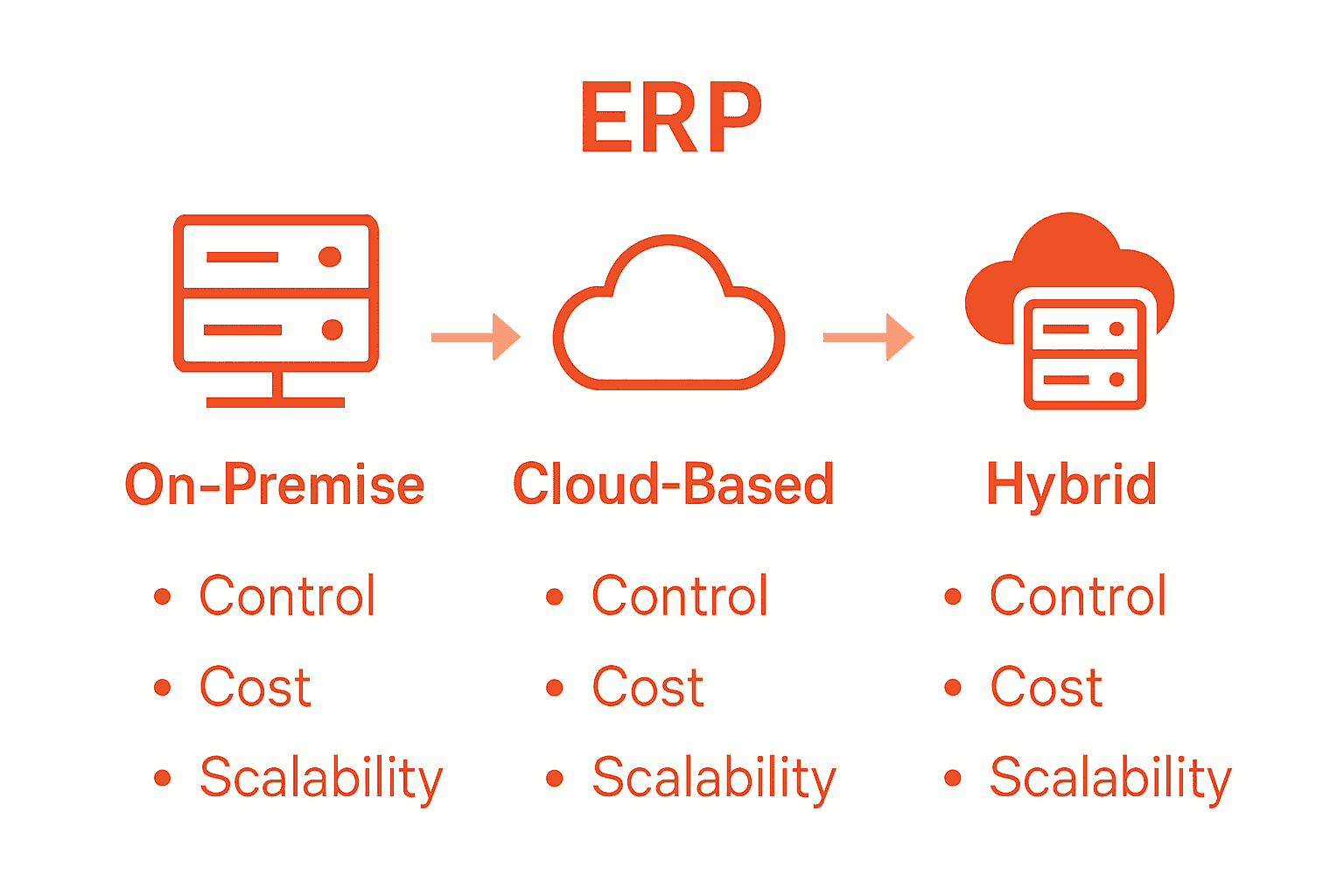
Infographic comparing on-premise, cloud-based, and hybrid ERP systems by control, cost, and scalability.

Here’s a comparison of the key ERP deployment models:

Deployment Model Control & Security Costs Scalability & Flexibility
On-Premise Full control
High security
High upfront investment Limited scalability
Cloud-Based Vendor-managed security Low initial cost Highly scalable
Flexible
Hybrid Balanced control and security Variable costs Customizable
Moderate scale
  • On-Premise ERP
    • Full control over data and infrastructure
    • Higher upfront capital expenditure
    • Requires dedicated IT personnel
    • Suitable for industries with strict data security requirements
  • Cloud-Based ERP
    • Lower initial investment
    • Automatic updates and maintenance
    • Scalable infrastructure
    • Accessible from multiple devices and locations
  • Hybrid ERP
    • Flexible architecture
    • Customizable integration
    • Balance between security and accessibility
    • Gradual digital transformation potential

For businesses seeking to understand which ERP solution aligns best with their strategic goals, best ERP for your business can provide nuanced insights into selection criteria. The right ERP system should not just manage current operations but also support future growth, technological adaptability, and competitive advantage.

Essential Features and How ERP Works

Enterprise Resource Planning (ERP) systems function as sophisticated digital nervous systems that seamlessly connect and coordinate multiple business processes through a centralized database. These intelligent platforms transform complex organizational operations by enabling real-time data sharing, automated workflows, and comprehensive visibility across different departments. The magic of ERP lies in its ability to break down traditional operational silos, creating a unified ecosystem where information flows smoothly and efficiently.

At the core of ERP functionality are several critical features that drive business performance. The centralized database serves as the system’s backbone, allowing different departments to access and update information instantaneously. When a sales team processes an order, for instance, the information automatically triggers updates in inventory management, accounting, and production planning modules. This interconnectedness eliminates redundant data entry, reduces human error, and provides leadership with accurate, up-to-the-minute insights into organizational performance.

erp in manufacturing

The essential features of modern ERP systems typically encompass:

  • Financial Management
    • Real-time financial reporting
    • Automated budgeting
    • Expense tracking
    • Multi-currency support
    • Comprehensive accounting tools
  • Supply Chain Management
    • Inventory tracking
    • Procurement automation
    • Vendor relationship management
    • Demand forecasting
    • Logistics coordination
  • Human Resources
    • Employee data management
    • Payroll processing
    • Performance tracking
    • Recruitment workflow
    • Training management

Businesses looking to understand how advanced technologies are revolutionizing ERP capabilities can explore AI-powered ERP solutions that are empowering businesses with intelligent automation. By integrating artificial intelligence and machine learning, modern ERP systems are not just managing current operations but predicting future trends, optimizing resource allocation, and providing strategic insights that drive competitive advantage.

Real-World ERP Applications and Business Impact

Enterprise Resource Planning (ERP) systems have transformed how businesses across diverse industries operate, delivering tangible improvements in efficiency, transparency, and strategic decision-making. From manufacturing and healthcare to retail and financial services, organizations are leveraging ERP technologies to streamline complex operational processes, reduce manual interventions, and create more agile, data-driven enterprises. The real-world applications of ERP extend far beyond simple software implementation, representing a fundamental shift in how companies manage and optimize their resources.

In practical terms, ERP systems deliver measurable business impacts across multiple dimensions. Manufacturing companies use ERP to synchronize production scheduling, inventory management, and supply chain logistics, enabling just-in-time production strategies that minimize waste and reduce operational costs. Retail organizations leverage ERP to integrate point-of-sale data, inventory tracking, and customer relationship management, creating seamless experiences that enhance both operational efficiency and customer satisfaction. Financial services firms utilize ERP to ensure regulatory compliance, streamline financial reporting, and provide real-time insights into complex financial ecosystems.

Key real-world applications of ERP systems include:

  • Manufacturing
    • Production planning optimization
    • Inventory management
    • Quality control tracking
    • Supply chain coordination
    • Resource allocation
  • Retail
    • Multi-channel inventory synchronization
    • Customer relationship management
    • Sales performance tracking
    • Procurement automation
    • Demand forecasting
  • Healthcare
    • Patient record management
    • Resource allocation
    • Regulatory compliance tracking
    • Supply chain management
    • Financial reporting

Businesses seeking a comprehensive understanding of ERP implementation strategies can explore ERP implementation phases and critical considerations to ensure successful digital transformation. By carefully selecting and implementing the right ERP solution, organizations can unlock unprecedented levels of operational efficiency, strategic insight, and competitive advantage in an increasingly complex business landscape.

Benefits, Costs, and Common Implementation Challenges

Enterprise Resource Planning (ERP) systems represent a significant strategic investment for businesses, delivering transformative benefits while simultaneously presenting complex implementation challenges. Organizations must carefully balance the potential operational improvements against initial implementation costs, technological complexity, and organizational change management requirements. Understanding this nuanced landscape is crucial for businesses considering digital transformation through ERP adoption.

The primary benefits of ERP implementation include substantial improvements in operational efficiency, data visibility, and strategic decision-making. By consolidating disparate business processes into a unified platform, companies can dramatically reduce manual work, eliminate redundant data entry, and create real-time insights across departments. Cost savings emerge not just from reduced administrative overhead, but from more intelligent resource allocation, improved inventory management, and enhanced productivity. However, these benefits are not automatic and require thoughtful planning, stakeholder engagement, and a comprehensive implementation strategy.

Key considerations for ERP implementation include:

  • Benefits
    • Streamlined business processes
    • Real-time data access
    • Reduced operational costs
    • Improved interdepartmental communication
    • Enhanced reporting capabilities
  • Implementation Challenges
    • High initial investment
    • Complex organizational change management
    • Potential resistance from employees
    • Technical integration complexities
    • Extended implementation timelines
  • Cost Factors
    • Software licensing
    • Hardware infrastructure
    • Customization expenses
    • Training and support
    • Ongoing maintenance

Businesses seeking a comprehensive understanding of the financial implications can explore detailed ERP implementation cost breakdowns to make informed strategic decisions. Successful ERP implementation requires not just technological investment, but a holistic approach that addresses organizational culture, employee training, and long-term strategic alignment.

Ready to Transform Your Business with the Power of ERP?

Understanding what ERP is and how it integrates key business functions like finance, supply chain, and human resources is just the first step toward operational excellence. If you are facing challenges such as disconnected processes, data silos, or inefficiencies slowing your growth, it is time to consider a tailored ERP solution that truly fits your company’s unique needs. Bista Solutions specializes in delivering innovative and scalable ERP implementations that simplify complexity and accelerate your path to success.


Schedule A Free Demo


    Take control of your digital transformation journey by partnering with a trusted leader. With over 350 successful ERP implementations and a recognized track record as the largest Odoo ERP implementer in North America, our expert team is ready to guide you from discovery to deployment. Don’t let costly delays or technical barriers hold your business back. Discover how our dedicated ERP consultants can provide customized strategies and 24/7 support designed for your long-term growth. Connect directly with us today via our contact page and learn more about the best ERP for your business to take the next crucial step forward.

    Frequently Asked Questions

    What is an ERP system?

    An ERP (Enterprise Resource Planning) system is a comprehensive software solution designed to integrate and streamline business operations across multiple departments, such as finance, human resources, manufacturing, and supply chain management, into a unified ecosystem.

    What are the key components of an ERP system?

    The core components of an ERP system typically include Financial Management, Human Resources, Supply Chain Management, Customer Relationship Management, and Manufacturing, which work together to enhance operational efficiency and data sharing across the organization.

    What are the different types of ERP deployment models?

    The three primary deployment models for ERP systems are on-premise, cloud-based, and hybrid. On-premise systems are hosted internally, cloud-based systems are hosted remotely, and hybrid systems combine both approaches to leverage flexibility and control.

    What are the major benefits of implementing an ERP system?

    Implementing an ERP system can lead to improved operational efficiency, real-time data visibility, reduced operational costs, enhanced interdepartmental communication, and better reporting capabilities, ultimately driving better strategic decision-making.


    Odoo ERP Predictive Maintenance in Manufacturing

    factory predictive maintenance

    Factories lose over $50 billion each year to unplanned downtime in the U.S. alone, putting enormous pressure on manufacturers to rethink how they care for their equipment. Equipment failures disrupt production, drive up costs, and cut into profits. By harnessing data, real-time monitoring, and connected technology, predictive maintenance is changing the way production floors run, helping businesses avoid surprise breakdowns and extend machinery life.

    Table of Contents

    Key Takeaways

    Point Details
    Predictive Maintenance Advantage Moves from reactive to proactive maintenance, leveraging real-time data to optimize equipment performance and reduce downtime.
    Odoo ERP Integration Provides a comprehensive platform for managing predictive maintenance, integrating with various manufacturing modules for enhanced operational efficiency.
    Implementation Strategy Requires careful planning, including asset assessment, technology selection, and integration of data workflows to transform maintenance processes.
    Challenges and Best Practices Involves navigating budget constraints and skill gaps while prioritizing real-time data integration and continuous improvement for successful execution.

    Defining Predictive Maintenance in Manufacturing

    Predictive maintenance represents a sophisticated technology-driven approach that transforms how manufacturers monitor and maintain industrial equipment. By leveraging advanced sensors, data analytics, and real-time monitoring, this strategy shifts traditional maintenance from reactive repairs to proactive performance optimization.

    At its core, predictive maintenance utilizes IoT-connected sensors strategically embedded in manufacturing equipment to continuously track critical performance metrics. These sensors gather comprehensive data on multiple parameters, including:

    • Temperature variations
    • Vibration patterns
    • Electrical consumption levels
    • Pressure fluctuations
    • Humidity conditions

    Through continuous monitoring, manufacturers gain unprecedented insights into equipment health, enabling them to predict potential failures before they occur. Read our guide on predictive analytics to understand how data transforms maintenance strategies.

    Unlike traditional maintenance models that rely on fixed schedules or respond only after equipment breaks down, predictive maintenance offers a smarter, more cost-effective approach. By analyzing real-time performance data, manufacturers can schedule maintenance precisely when needed, reducing unexpected downtime, minimizing repair costs, and extending equipment lifespan.

    maintenance comparison manufacturing This intelligent strategy not only improves operational efficiency but also represents a significant leap towards more sustainable and intelligent manufacturing practices.
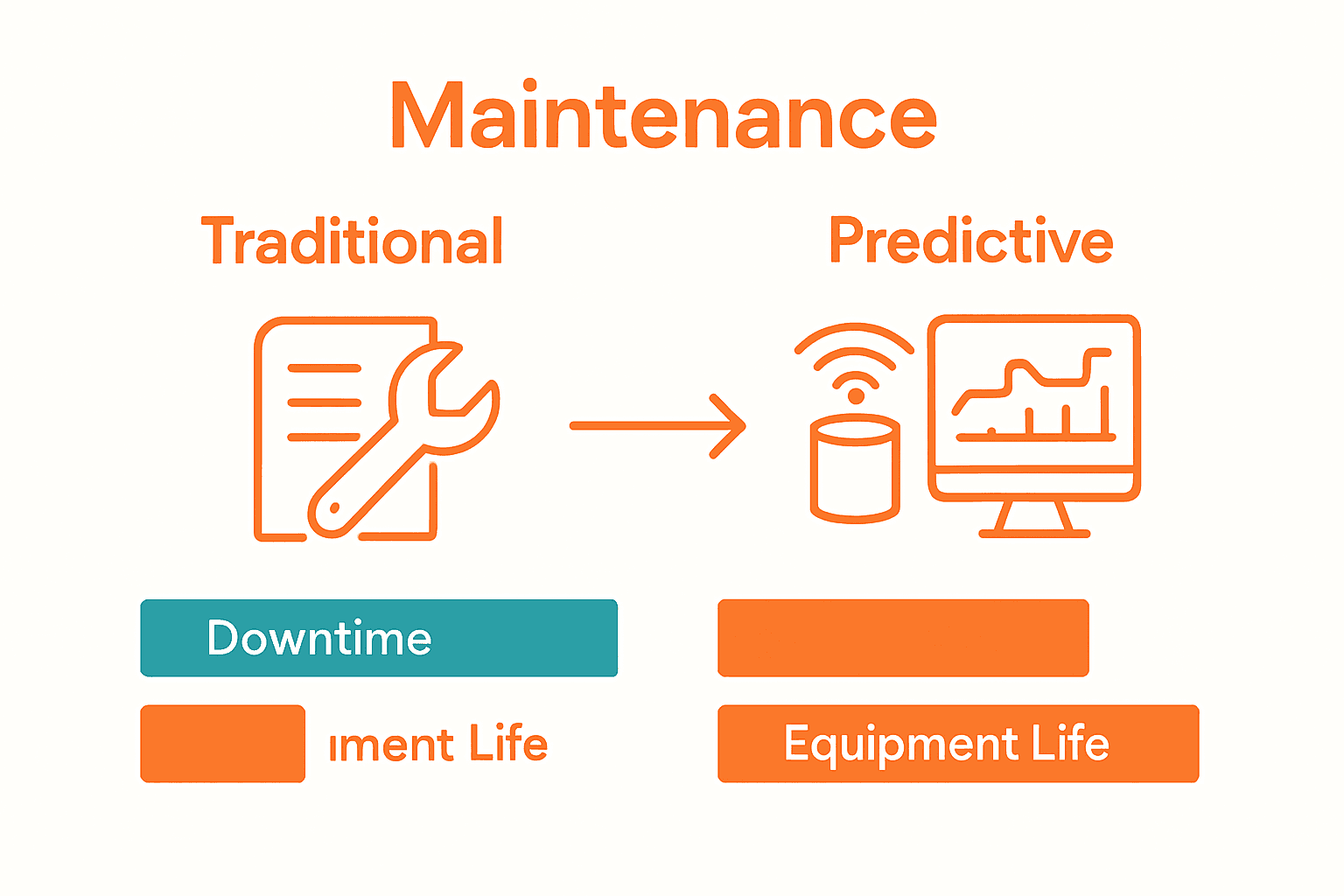


    Here’s a side-by-side look at traditional vs. predictive maintenance approaches:

    Infographic comparing traditional and predictive maintenance benefits.

    Aspect Traditional Maintenance Predictive Maintenance
    Approach Reactive or Scheduled Data-driven, Proactive
    Data Use Minimal, Manual logs Real-time sensor data
    Downtime High, often unplanned Reduced, more planned
    Cost Impact Higher long-term costs Lower maintenance costs
    Equipment Life Shorter lifespan Extended lifespan
    Maintenance Timing Fixed intervals or after failure Based on real equipment condition

    Core Features of Odoo ERP Maintenance

    Odoo ERP provides a comprehensive equipment management application specifically designed to transform maintenance workflows in manufacturing environments. At its core, the system offers manufacturers a sophisticated yet intuitive platform to manage and optimize equipment performance through intelligent maintenance strategies.

    The maintenance module features several powerful capabilities that streamline equipment management:

    • Drag-and-drop Kanban board for visual task management
    • Calendar view for scheduling maintenance activities
    • Automated preventive maintenance scheduling
    • Seamless integration with other Odoo MRP applications
    • Real-time tracking of equipment health and performance

    Learn more about ERP implementation strategies to understand how these features can be effectively deployed in your organization. Notably, the application supports both corrective and preventive maintenance requests, enabling manufacturing teams to increase overall equipment effectiveness (OEE) with unprecedented precision.

    Unique to Odoo’s approach is its ability to integrate maintenance management with adjacent operational modules like Manufacturing, Shop Floor, Quality, and Repairs. This holistic ecosystem allows manufacturers to create a comprehensive maintenance strategy that goes beyond simple equipment tracking. By providing actionable insights and automated workflows, Odoo ERP empowers businesses to proactively manage their assets, reduce unexpected downtime, and optimize operational efficiency across the entire manufacturing process.

    Integrating Odoo Predictive Maintenance Systems

    Successful integration of predictive maintenance systems requires a strategic approach that leverages Odoo ERP’s comprehensive ecosystem of interconnected applications. The platform’s unique architecture allows manufacturers to seamlessly connect maintenance modules with other critical operational systems, creating a holistic approach to equipment management and performance optimization.

    Odoo’s maintenance integration capabilities span multiple critical manufacturing domains:

    • Manufacturing Module synchronization
    • Shop Floor Management connection
    • Quality Control systems integration
    • Repair Management workflows
    • Inventory Tracking interconnectivity

    Learn more about Manufacturing Execution Systems to understand how these integrations transform operational efficiency. The system offers remarkable flexibility, supporting both on-premises deployment and cloud-based Software as a Service (SaaS) models, which enables manufacturers to adopt the integration strategy that best matches their existing technological infrastructure.

    The true power of Odoo’s predictive maintenance integration lies in its ability to create a unified data ecosystem. By connecting maintenance activities with real-time performance tracking, inventory management, and operational workflows, manufacturers gain unprecedented visibility into equipment health, potential failure points, and optimization opportunities. This integrated approach not only reduces unexpected downtime but also empowers businesses to make data-driven decisions about maintenance scheduling, resource allocation, and long-term equipment investment strategies.

    Implementation Steps and Key Requirements

    Implementing a predictive maintenance strategy in Odoo ERP requires a comprehensive and methodical approach that goes beyond simple technology deployment. Successful implementation demands a holistic strategy that aligns technological capabilities with organizational goals, ensuring that manufacturers can transform their maintenance processes from reactive to proactively intelligent.

    Key implementation steps include:

    1. Asset Identification and Criticality Assessment
      • Catalog all critical manufacturing equipment
      • Evaluate the potential impact of equipment failures
      • Prioritize assets for predictive maintenance monitoring
    2. Technology and Sensor Selection
      • Choose appropriate IoT sensors
      • Determine data collection points
      • Ensure compatibility with Odoo ERP infrastructure
    3. Data Collection and Integration
      • Configure real-time monitoring systems
      • Establish baseline performance metrics
      • Create automated data collection workflows

    Explore our guide on Manufacturing Execution Systems to understand the technological foundations of effective implementation. A robust predictive maintenance strategy serves as an ‘early warning’ system, enabling manufacturers to anticipate potential equipment failures before they disrupt production.

    The ultimate goal of implementation is to create a dynamic, responsive maintenance ecosystem that provides actionable insights. By establishing clear communication channels between maintenance teams, leveraging Odoo’s integrated modules, and developing a data-driven decision-making framework, manufacturers can transform equipment maintenance from a cost center into a strategic competitive advantage. This approach not only minimizes unexpected downtime but also optimizes resource allocation, extends equipment lifespan, and ultimately drives significant improvements in operational efficiency and profitability.

    Challenges, Costs, and Best Practices

    Implementing predictive maintenance systems in manufacturing environments presents a complex landscape of technological, financial, and operational challenges that require strategic planning and nuanced execution. Manufacturers must navigate limited resources, budget constraints, and the intricate balance between technology investment and potential returns.

    Key challenges in predictive maintenance implementation include:

    • Resource Allocation
      • Limited budget for advanced technology
      • Competing operational priorities
      • Skill gaps in data analytics and maintenance technology
    • Cost Considerations
      • Initial sensor and IoT infrastructure investments
      • Training and upskilling maintenance personnel
      • Software licensing and integration expenses
      • Ongoing system maintenance and upgrades

    Explore our guide on ERP implementation costs to understand the financial landscape of technological transformation. While initial investments might seem substantial, the long-term benefits of predictive maintenance are compelling, including minimized equipment downtime, extended asset lifespan, and optimized maintenance expenditures.

    Best practices for successful predictive maintenance revolve around creating a holistic, data-driven approach. Manufacturers should prioritize real-time sensor integration, leverage AI-driven analytics, develop comprehensive maintenance strategies, and foster a culture of continuous improvement. By treating predictive maintenance as a strategic investment rather than a pure technology expense, businesses can transform their operational efficiency, reduce unexpected failures, and gain a significant competitive advantage in an increasingly technology-driven manufacturing landscape.

    Unlock the Full Potential of Predictive Maintenance with Expert Odoo ERP Implementation

    Manufacturers aiming to reduce downtime and optimize equipment life face the common challenge of turning complex sensor data into actionable maintenance plans. The article highlights how predictive maintenance powered by real-time IoT data can transform your operations, but also shows how integrating this technology effectively remains a hurdle. If you relate to the struggle of managing costly unexpected repairs and want to extend your equipment lifespan through intelligent scheduling and seamless ERP integration, you are not alone.

    At Bista Solutions, we specialize in bridging this gap. As the largest Odoo ERP implementer in North America and a trusted Odoo Gold Partner, we know how to tailor predictive maintenance modules to match your unique operational needs. Our team of over 300 experts ensures end-to-end solutions from sensor integration to workflow automation that turn maintenance into a strategic advantage.

    Book A Free Odoo ERP Consultation

      Take control of your manufacturing future today. Discover how our proven ERP implementation strategies can empower your predictive maintenance efforts for higher asset effectiveness and minimized downtime. Contact us now at Bista Solutions to schedule a consultation and start transforming your equipment management. Don’t wait until costly failures happen—build a smarter, data-driven maintenance ecosystem with us.

      Frequently Asked Questions

      What is predictive maintenance in manufacturing?

      Predictive maintenance in manufacturing is a proactive maintenance strategy that utilizes IoT-connected sensors and data analytics to monitor equipment performance in real-time, allowing manufacturers to predict potential failures before they occur and perform maintenance when necessary.

      How does Odoo ERP support predictive maintenance?

      Odoo ERP supports predictive maintenance through its comprehensive equipment management module, which integrates real-time monitoring, automated maintenance scheduling, and performance tracking across various operational modules, streamlining the maintenance process.

      What are the key benefits of implementing predictive maintenance?

      The key benefits of implementing predictive maintenance include reduced unplanned downtime, lower maintenance costs, extended equipment lifespan, improved operational efficiency, and enhanced decision-making through data-driven insights.

      What steps are involved in implementing a predictive maintenance strategy using Odoo ERP?

      Implementing a predictive maintenance strategy using Odoo ERP involves several key steps: identifying critical assets, selecting appropriate IoT sensors and technology, configuring real-time data collection, and integrating the maintenance module with other operational systems to create a holistic maintenance ecosystem.

      7 Key Benefits of Odoo ERP for Promotional Product Distributors

      Odoo ERP distributors

      Did you know that distributors lose over 20 percent of potential sales due to outdated inventory and order management systems? For promotional product businesses juggling branded merchandise and custom items, efficiency can mean the difference between profit and missed opportunities. By using modern ERP solutions like Odoo, you gain real-time visibility, better order tracking, and smarter data insights—so you can keep customers happy and stay ahead of the competition.

      Table of Contents

      Quick Summary

      Takeaway Explanation
      1. Streamline Inventory Management with Odoo Odoo ERP enables real-time tracking of diverse product inventories, minimizing errors and improving stock control.
      2. Automate Order Processing Efficiently Automation in Odoo reduces manual tasks, improving order turnaround times and customer satisfaction significantly.
      3. Centralize Sales and Marketing Tracking Odoo consolidates all campaign data in one system, allowing for data-driven decisions and improved marketing strategies.
      4. Enhance Quoting and Pricing Accuracy Odoo provides dynamic quoting capabilities, ensuring accurate and competitive pricing based on real-time data.
      5. Simplify Supplier and Purchase Order Management Odoo streamlines procurement processes, enhances supplier relationships, and provides valuable insights for purchasing decisions.

      1. Streamline Inventory Management for All Product Types

      Promotional product distributors face constant challenges in managing diverse product inventories efficiently. Odoo ERP offers a comprehensive solution that transforms inventory management across all product categories, enabling businesses to track stock levels with unprecedented precision and control.

      Unlike traditional inventory systems, Odoo provides real-time tracking capabilities that allow you to monitor stock quantities across multiple warehouses simultaneously. By implementing Odoo inventory management, you gain powerful tools to automate replenishment processes and minimize costly stockouts.

      The system supports intricate inventory tracking for various product types common in promotional distribution:

      • Branded merchandise
      • Customized promotional items
      • Bulk order inventory
      • Corporate gift collections
      • Seasonal promotional products

      Odoo’s integrated reporting tools enable businesses to track critical metrics like shipment timelines, lead times, and precise stock movements. Research indicates that these advanced tracking capabilities can significantly reduce inventory management errors such as overstocking or unexpected stockouts.

      With Odoo, you can implement advanced inventory strategies like batch tracking and serial number monitoring. This means you can trace every single promotional item from initial receipt through final distribution tracking your entire product lifecycle with remarkable accuracy.

      Businesses using Odoo typically experience dramatic improvements in inventory management efficiency. By centralizing inventory data and providing real time insights, the system empowers promotional product distributors to make faster strategic decisions and maintain optimal stock levels across diverse product ranges.

      2. Automate Order Processing and Customer Fulfillment

      Promotional product distributors often struggle with complex order management processes that consume significant time and resources. Odoo ERP provides a powerful automation solution that transforms how businesses handle customer orders and fulfillment workflows.

      By leveraging AI powered ERP solutions, you can dramatically reduce manual intervention in order processing. Odoo automates routine tasks across multiple stages of order management, including:

      • Automatic order confirmation generation
      • Real-time inventory allocation
      • Instant customer communication triggers
      • Automated shipping label creation
      • Seamless payment processing

      Research indicates that automation through systems like Odoo can minimize human error and free up critical resources for strategic business activities. The platform eliminates repetitive tasks across departments, ensuring smoother workflows and enhanced operational efficiency.

      For promotional product distributors, this means faster order turnaround times and improved customer satisfaction. Odoo can automatically track order status, communicate with customers, and generate necessary documentation without manual input.

      The system intelligently manages complex scenarios like partial shipments, custom product configurations, and multilocation inventory distributions. By centralizing these processes, Odoo provides a comprehensive solution that adapts to your unique business requirements while maintaining maximum operational flexibility.

      3. Centralize Sales and Marketing Campaign Tracking

      Promotional product distributors need comprehensive visibility into their sales and marketing efforts to drive strategic growth. Odoo ERP provides an integrated platform that consolidates all campaign data into a single powerful management system.

      By implementing Odoo CRM, you gain the ability to track every aspect of your sales and marketing initiatives from a centralized dashboard. This approach eliminates data silos and provides real-time insights across your entire business ecosystem.

      Key tracking capabilities include:

      • Campaign performance metrics
      • Lead generation analysis
      • Customer interaction history
      • Revenue attribution
      • Conversion rate tracking

      The centralized data storage allows instant access to critical information spanning sales, inventory, and accounting. This means you can quickly analyze campaign effectiveness, identify successful strategies, and make data-driven decisions without switching between multiple systems.

      Odoo enables you to create comprehensive reports that show the complete journey of a marketing campaign from initial contact through final sale. You can monitor how different promotional product lines perform, track customer engagement, and understand which marketing strategies generate the highest return on investment.

      For promotional product distributors, this holistic approach transforms marketing from a guessing game into a precise strategic function. By having all data integrated, you can respond faster to market trends, allocate resources more effectively, and create more targeted campaigns that drive business growth.

      4. Enhance Quoting and Pricing Accuracy in Real Time

      Promotional product distributors know that accurate pricing can make or break a sale. Odoo ERP introduces a dynamic quoting system that transforms how businesses generate precise and competitive pricing in real time.

      By leveraging sales management tools, you can access an integrated platform that eliminates manual calculation errors and ensures instant pricing updates across all product lines. The system provides comprehensive analytics that help identify pricing trends and optimization opportunities.

      Key pricing and quoting capabilities include:

      • Automatic cost calculation based on current inventory
      • Dynamic pricing rules for volume discounts
      • Real-time margin protection mechanisms
      • Instant price adjustment tracking
      • Customizable quote templates

      Odoo’s integrated information flow dramatically reduces manual work and minimizes potential errors. The platform allows you to create detailed quotes that reflect exact product configurations, custom branding requirements, and current market pricing instantly.

      For promotional product distributors, this means the ability to generate professional, accurate quotes within minutes. You can quickly respond to customer inquiries, provide transparent pricing, and maintain competitive positioning without extensive manual calculations.

      The system goes beyond simple number crunching by providing analytical reports that help you understand pricing strategies. You can track quote conversion rates, identify which pricing models work best, and make data-driven decisions that directly impact your bottom line.

      5. Simplify Supplier and Purchase Order Management

      Managing supplier relationships and purchase orders can be a complex challenge for promotional product distributors. Odoo ERP introduces a comprehensive solution that transforms how businesses handle procurement and vendor interactions.

      By implementing Odoo purchase management tools, you gain an integrated platform that streamlines every aspect of supplier relationships and order processing. The system provides end-to-end management of purchasing activities from initial supplier selection through final payment.

      Key supplier management capabilities include:

      • Comprehensive vendor performance tracking
      • Automated purchase order generation
      • Real-time supplier information management
      • Integrated invoice and payment processing
      • Supplier relationship analytics

      Odoo enables businesses to track detailed supplier information, monitor purchase order statuses, and evaluate vendor performance with unprecedented precision. This means you can make data-driven decisions about which suppliers provide the best value for your promotional product inventory.

      The platform goes beyond simple transaction tracking by providing intelligent procurement suggestions. You can set up automated reorder points, monitor supplier lead times, and optimize your inventory acquisition strategy with minimal manual intervention.

      For promotional product distributors, this translates into more efficient procurement processes, reduced administrative overhead, and the ability to quickly adapt to changing market conditions. Odoo gives you the tools to build stronger supplier relationships while maintaining complete visibility into your purchasing ecosystem.

      6. Boost Reporting with Customizable Analytics Tools

      Promotional product distributors need powerful insights to make strategic business decisions. Odoo ERP delivers a robust reporting ecosystem that transforms raw data into actionable business intelligence.

      By leveraging report generation tools, you can create comprehensive analytics that provide deep visibility into your business performance. The system offers unprecedented flexibility in designing and customizing reports across multiple dimensions.

      Key reporting and analytics features include:

      • Interactive dashboard creation
      • Multi-format export options
      • Real-time performance tracking
      • Customizable visual reporting
      • Drill down data exploration

      Odoo provides regular updates every 6-7 months, ensuring that your reporting capabilities remain cutting-edge. Unlike closed source systems, Odoo allows you to adapt analytics tools precisely to your unique business requirements.

      The platform enables promotional product distributors to track critical metrics such as product performance, sales trend,s inventory turnover, and customer engagement. You can build complex reports that integrate data from multiple modules, giving you a holistic view of your business ecosystem.

      With Odoo, you are not just collecting data; you are transforming information into strategic insights. The system empowers you to make data-driven decisions quickly, efficiently, and with remarkable precision, tailored specifically to your promotional product distribution business.

      7. Support Business Growth with Scalable Odoo Integrations

      Promotional product distributors need flexible technology that grows alongside their business. Odoo ERP offers a modular architecture that adapts seamlessly to your evolving operational requirements.

      By leveraging Odoo ERP solutions, you gain access to a dynamic platform that can expand from a small startup to a large enterprise without disrupting your core business processes. The system provides unparalleled flexibility through its comprehensive integration capabilities.

      Key scalability and integration features include:

      • Seamless third-party application connections
      • Customizable module additions
      • Cloud and on-premises deployment options
      • Multilocation and multicurrency support
      • Extensible app ecosystem

      Odoo allows promotional product distributors to start with essential modules and progressively add functionality as their business needs change. This approach means you are not locked into a rigid system but can continuously optimize your technological infrastructure.

      The platform supports integrations with popular e-commerce platforms, marketing tools, accounting systems, and shipping providers. This means you can create a comprehensive business ecosystem that communicates effortlessly across different operational domains.

      For growing businesses, Odoo represents more than just software; it is a strategic partner that can scale dynamically. Whether you are managing a regional distribution network or planning national expansion, Odoo provides the technological flexibility to support your ambitious growth objectives.

      Below is a comprehensive table summarizing the key solutions and benefits provided by Odoo ERP for promotional product distributors as discussed in the article.

      Solution Area Key Features & Actions Benefits/Outcomes
      Inventory Management Real-time tracking, multiple warehouse monitoring, and automated replenishment Reduces stockouts, enhances control, and efficiency across diverse products
      Order Processing & Fulfillment AI-powered automation, instant customer communication, seamless payment processing Minimizes human errors, speeds up order turnaround times, and improves customer satisfaction
      Sales & Marketing Campaign Tracking Centralized data platform, campaign performance metrics, and real-time insights Eliminates data silos, supports strategic growth, and enhances campaign effectiveness
      Quoting & Pricing Accuracy Dynamic pricing rules, margin protection, customizable quote templates Provides accurate, quick pricing and improves competitive positioning
      Supplier & Purchase Order Management Automated purchase orders, vendor performance tracking, and integrated invoice processing Optimizes procurement, reduces overhead, and strengthens supplier relationships
      Reporting & Analytics Customizable reports, interactive dashboards, and data-driven decision making Enhances insights into business performance, supports strategic decision-making
      Scalable Integrations Modular architecture, seamless third-party connections, extensible app ecosystem Adapts to business growth, ensures technological flexibility, supports expansion objectives

      Unlock the Full Potential of Odoo ERP with Bista Solutions

      Promotional product distributors face daily challenges like inventory complexity, order automation, and precise pricing accuracy. The article highlights how Odoo ERP can revolutionize your business by streamlining processes such as inventory management, automated order fulfillment, and supplier relations, all tailored for your unique needs. If you seek to reduce costly errors and improve operational efficiency, these benefits are well within reach.

      Bista Solutions is the largest Odoo ERP implementer in North America and a trusted Gold Partner recognized for excellence year after year. With over 350 implementations and a dedicated team of over 300 experts, we deliver tailored, scalable solutions that address exactly the challenges you face—from dynamic quoting systems to comprehensive purchase order management and advanced reporting tools.

      If this sounds like the next step your business needs, don’t wait to transform your operations. Talk to us today and discover how to leverage Odoo ERP to gain precision, speed, and control.

      Book A Free Demo


        Experience why promotional product distributors trust Bista Solutions for end-to-end Odoo ERP expertise. Visit our contact page now for a personalized consultation. Let us help you turn Odoo’s powerful benefits into your competitive advantage starting now.

        Frequently Asked Questions

        What are the main benefits of using Odoo ERP for promotional product distributors?

        Odoo ERP streamlines inventory management, automates order processing, centralizes sales and marketing tracking, enhances quoting accuracy, simplifies supplier management, boosts reporting capabilities, and supports business growth through scalable integrations. To experience these benefits, consider implementing Odoo ERP to transform your distribution processes.

        How can Odoo ERP improve my inventory management efficiency?

        Odoo ERP provides real-time tracking of stock levels across multiple warehouses, enabling promotional product distributors to minimize stockouts and overstocking. Implement Odoo’s inventory tools to automate replenishment processes and boost accuracy within 30 days of integration.

        How does Odoo ERP automate order processing and customer fulfillment?

        Odoo ERP eliminates manual tasks in order management by automating order confirmations, inventory allocation, and customer communications. Streamline your fulfillment workflows by leveraging Odoo’s automation features, resulting in faster order turnaround times for your business.

        In what ways can Odoo ERP enhance my pricing and quoting accuracy?

        Odoo ERP uses dynamic pricing rules and automatic cost calculations to ensure accurate and competitive pricing is generated in real-time. Start using Odoo’s quoting tools to create precise quotes within minutes, improving your response rate to customer inquiries.

        How does Odoo ERP support supplier and purchase order management?

        Odoo ERP allows you to track supplier performance, automate purchase orders, and manage invoices all in one system. Take control of your supplier relationships by utilizing Odoo for comprehensive procurement processes, which can reduce administrative tasks by up to 30%.

        What reporting capabilities does Odoo ERP offer for promotional product distributors?

        Odoo ERP provides customizable reporting tools that turn raw data into actionable insights, allowing users to track key performance metrics. Create interactive dashboards and detailed reports within Odoo to enhance data visibility and inform your business decisions.

        7 Ways Odoo ERP Empowers Custom Merchandise Companies

        Odoo ERP custom merchandise
        • by Uzlifat Mir
        • Nov 11, 2025
        • 0
        • Category:

        Most custom merchandise companies lose valuable time managing complex orders and personalizations. Every missed detail or lag in communication can impact customer satisfaction and profits. With Odoo ERP shown to cut order processing time by up to 67%, businesses finally have a way to tackle these challenges head on. This guide breaks down how Odoo transforms custom order workflows, automates quotes, refines inventory tracking, and keeps your team connected from start to finish.

        Table of Contents

        Quick Summary

        Takeaway Explanation
        1. Streamline Order Management with Odoo ERP Odoo ERP simplifies complex product orders, reducing processing time by up to 67%.
        2. Automate Quotes for Personalization Automating pricing and quoting in Odoo improves accuracy and reduces quote time by 75%.
        3. Optimize Inventory Tracking for Custom Products Odoo ERP allows detailed tracking of unique items, cutting inventory costs by 22%.
        4. Enhance Production Scheduling Efficiency Dynamic scheduling in Odoo can improve manufacturing efficiency by 40%.
        5. Utilize Real-Time Reporting for Strategic Insights Odoo’s reporting tools facilitate quick decision-making and increase operational efficiency by 42%.

        1. Simplify Order Management for Custom Products

        Custom merchandise companies face unique challenges in managing complex product orders, but Odoo ERP provides a revolutionary solution for streamlining the entire order processing workflow. By leveraging advanced technology, Odoo transforms how businesses handle intricate customization requests from initial quote to final delivery.

        The platform offers an integrated approach that eliminates traditional order management bottlenecks. With Odoo Sales Management, companies can configure highly specific product variations, track custom order stages, and maintain real-time visibility across production cycles. This means no more lost communication, missed details, or manual tracking errors that typically plague custom product businesses.

        Key Order Management Features Include:

        • Automated quote generation for custom product specifications
        • Real-time inventory tracking for custom components
        • Integrated workflow from sales order to production planning
        • Seamless communication channels between sales and production teams

        Research from implementation studies demonstrates that companies using Odoo can reduce order processing time by up to 67%. By centralizing all order information in one platform, custom merchandise businesses eliminate redundant data entry, minimize human error, and accelerate their entire production cycle.

        Bista Solutions specializes in configuring Odoo ERP specifically for custom merchandise workflows, ensuring that each implementation is tailored to unique business requirements. Our expert team understands that no two custom product businesses are identical, which is why we provide personalized configuration strategies that align perfectly with your specific operational needs.

        2. Automate Quoting and Pricing for Personalization

        Custom merchandise companies require sophisticated pricing strategies that can adapt to complex personalization requests. Odoo ERP delivers an intelligent solution for automating quoting and pricing processes that eliminates manual calculations and reduces potential errors.

        The platform transforms how businesses approach product customization pricing through advanced configuration capabilities. By integrating instant quoting software for manufacturing, companies can dynamically generate accurate quotes based on specific product variations, material costs, labor requirements, and personalization complexity.

        Key Automated Pricing Features:

        • Dynamic price calculation based on custom product specifications
        • Real-time material and labor cost integration
        • Automatic markup and margin management
        • Customizable pricing rule configurations

        Research indicates that businesses implementing automated quoting systems can reduce quote generation time by up to 75% while improving pricing accuracy. Odoo enables your team to create standardized yet flexible pricing models that adapt to unique customer requirements without sacrificing profitability.

        Bista Solutions specializes in configuring Odoo ERP to create personalized quoting workflows that match your specific business model. Our expert implementation ensures that your pricing strategies remain both competitive and profitable while providing transparency and speed for your customers.

        3. Optimize Inventory Tracking for Unique Items

        Custom merchandise businesses face significant challenges in tracking specialized inventory for personalized products. Odoo ERP provides a comprehensive solution that transforms how companies manage complex and unique item inventories with unprecedented precision and efficiency.

        Traditional inventory management systems often struggle with the nuanced requirements of custom product tracking. Odoo resolves this by offering granular inventory control that adapts to the intricate nature of personalized merchandise. Companies can now track individual components, monitor specialized materials, and maintain real-time visibility into unique product variations.

        Inventory Tracking Capabilities Include:

        • Detailed component-level tracking
        • Real-time stock updates for custom materials
        • Automated reorder point calculations
        • Precise tracking of specialized inventory items

        By implementing Odoo auto vendor lead time calculation, businesses can anticipate material needs before stockouts occur. Research demonstrates that companies using advanced inventory tracking systems can reduce inventory holding costs by up to 22% while maintaining optimal stock levels.

        Bista Solutions specializes in configuring Odoo ERP to create tailored inventory management strategies that address the unique challenges of custom merchandise production. Our expert team ensures that your inventory tracking becomes a strategic advantage rather than an operational burden.

        4. Manage Production Schedules for Custom Orders

        Custom merchandise companies require sophisticated production scheduling that adapts to complex and unique order requirements. Odoo ERP revolutionizes this process by providing an intelligent platform that transforms how businesses manage intricate manufacturing workflows.

        Traditional production scheduling often struggles with the nuanced demands of personalized product creation. Odoo resolves these challenges by offering dynamic scheduling capabilities that provide real-time visibility into production processes. The system allows manufacturers to prioritize custom orders, allocate resources efficiently, and maintain precise control over manufacturing timelines.

        Production Scheduling Features Include:

        • Advanced order prioritization
        • Real-time resource allocation tracking
        • Automated workflow management
        • Customizable production sequence configurations

        By implementing Odoo Production Planning and Scheduling ERP, businesses can significantly reduce production bottlenecks. Research indicates that companies using advanced scheduling systems can improve manufacturing efficiency by up to 40% while maintaining exceptional product quality.

        Bista Solutions specializes in configuring Odoo ERP to create tailored production scheduling strategies that address the unique challenges of custom merchandise manufacturing. Our expert team ensures that your production workflows become a strategic advantage, enabling you to deliver personalized products with unprecedented speed and precision.

        5. Enhance Customer Experience With Self-Service Tools

        Custom merchandise companies can dramatically transform customer interactions through intelligent self service technologies. Odoo ERP provides a comprehensive platform that empowers customers with unprecedented access and control over their personalized product journey.

        Traditional customer service models often create frustration with limited visibility and complex communication channels. Odoo resolves these challenges by introducing intuitive self service portals that allow customers to track orders, view production status, and manage their entire purchasing experience without constant manual intervention.

        Self-Service Capabilities Include:

        • Real-time order tracking
        • Custom product design preview
        • Instant quote generation
        • Personalized order history access

        By implementing self-service business intelligence tools, businesses can reduce customer service response times by up to 65%. Research demonstrates that companies offering robust self-service options see a 20% increase in customer satisfaction and retention rates.

        Bista Solutions specializes in configuring Odoo ERP to create tailored self-service experiences that meet the unique expectations of custom merchandise customers. Our expert team ensures that your digital customer engagement becomes a seamless, intuitive journey that builds trust and loyalty.

        6. Integrate Sales Channels for Seamless Operations

        Custom merchandise companies often struggle with fragmented sales channels that create operational complexity and data inconsistency. Odoo ERP provides a comprehensive solution that unifies multiple sales platforms into a single intelligent ecosystem, enabling businesses to manage diverse sales channels with unprecedented efficiency.

        Traditional sales management approaches typically involve disconnected systems that require manual data reconciliation and create potential errors. Odoo resolves these challenges by creating a centralized platform where online marketplaces, direct sales, wholesale channels, and custom order portals communicate seamlessly and share real-time information.

        Sales Channel Integration Features Include:

        • Centralized order management
        • Synchronized inventory across platforms
        • Unified customer data tracking
        • Consistent pricing and product information

        By implementing AI-powered ERP solutions, businesses can reduce cross-channel operational errors by up to 78%. Research demonstrates that companies with integrated sales channels experience 35% faster order processing and significantly improved customer satisfaction.

        Bista Solutions specializes in configuring Odoo ERP to create tailored sales channel integration strategies that address the unique complexities of custom merchandise businesses. Our expert team ensures that your sales ecosystem operates as a cohesive intelligent network, maximizing efficiency and reducing operational friction.

        7. Analyze Performance With Real-Time Reporting

        Custom merchandise businesses require sophisticated performance tracking that delivers actionable insights instantaneously. Odoo ERP provides a comprehensive reporting ecosystem that transforms raw data into strategic intelligence, enabling businesses to make informed decisions with unprecedented speed and accuracy.

        Traditional reporting methods often suffer from significant time delays and fragmented information sources. Odoo resolves these challenges by creating dynamic dashboards that aggregate performance metrics from multiple business channels in real time. This allows managers to understand operational dynamics instantly and respond proactively to emerging trends and potential opportunities.

        Performance Reporting Features Include:

        • Customizable performance dashboards
        • Cross-departmental metric tracking
        • Automated data visualization
        • Detailed performance analytics

        By implementing project management reporting dashboards, businesses can reduce decision-making time by up to 55%. Research indicates that companies utilizing real-time reporting see a 42% improvement in operational efficiency and strategic planning accuracy.

        Bista Solutions specializes in configuring Odoo ERP to create tailored reporting strategies that transform complex data into clear, actionable insights. Our expert team ensures that your performance analysis becomes a powerful strategic tool, driving continuous improvement and competitive advantage.

        Below is a comprehensive table summarizing the key solutions and benefits of Odoo ERP for custom merchandise companies as discussed throughout the article.

        Component Description Benefits
        Order Management Streamlines order workflow, automates quotes, and improves communication. Reduces order processing time by 67% and minimizes errors.
        Quoting & Pricing Automates pricing based on custom specifications and cost factors. Reduces quote generation time by 75% and increases pricing accuracy.
        Inventory Tracking Provides component-level tracking and automated reorder calculations. Reduces holding costs by 22% and prevents stockouts.
        Production Scheduling Offers dynamic scheduling with advanced order prioritization. Improves manufacturing efficiency by 40% and ensures quality.
        Customer Experience Empowers customers with self-service tools for tracking and design preview. Increases customer satisfaction by 20% and reduces service times by 65%.
        Sales Channel Integration Unifies sales channels into a single ecosystem. Reduces operational errors by 78% and speeds up processing by 35%.
        Performance Reporting Delivers real-time insights with dynamic dashboards. Enhances strategic planning accuracy by 42% and reduces decision time by 55%.

        Unlock Powerful Growth with Bista Solutions and Odoo ERP

        Custom merchandise companies often grapple with the complex challenges of managing personalized orders, precise inventory tracking, and dynamic pricing. The path to operational excellence means embracing integrated solutions that eliminate inefficiencies and empower your team to deliver exceptional customer experiences. This article highlights how Odoo ERP addresses these pain points with streamlined order management, automated quoting, and real-time production scheduling.

        Bista Solutions is your trusted partner to bring this transformation to life. As the largest Odoo ERP implementer in North America and a multiple-time Best Partner award winner, we specialize in crafting tailored solutions that perfectly fit your unique business model. Our expertise includes configuring advanced features like Odoo Sales Management workflows and implementing responsive inventory systems such as Odoo auto vendor lead time calculation, to reduce costs and speed production.

        Elevate your custom merchandise business by integrating seamless operations and customer-centric tools today.

        Explore how our expert team can accelerate your growth and simplify complex workflows.

        Take action now to gain a competitive edge.

        Schedule A Free Demo


          Are you ready to experience the full benefits of Odoo ERP for your custom merchandise company? Reach out to Bista Solutions to schedule a consultation. Our dedicated experts are ready to design and implement an ERP system that empowers your business to thrive in a demanding market. Contact us today and start transforming your challenges into opportunities.

          Frequently Asked Questions

          How can Odoo ERP simplify order management for custom products?

          Odoo ERP streamlines the entire order processing workflow by automating quote generation and maintaining real-time visibility across production cycles. Implement Odoo’s order management features to eliminate communication gaps and reduce order processing time by up to 67%.

          What automated pricing features does Odoo ERP offer for custom merchandise?

          Odoo ERP provides dynamic pricing calculations based on custom product specifications, including material and labor costs. Set up automated pricing rules to increase pricing accuracy and reduce the time spent on quote generation by up to 75%.

          How does Odoo ERP help with inventory tracking for customized merchandise?

          Odoo ERP offers specialized inventory tracking capabilities that enable real-time monitoring of unique item inventories. Implement detailed component-level tracking to reduce inventory holding costs by approximately 22% while ensuring you never run out of essential materials.

          What are the benefits of using Odoo ERP for production scheduling in custom merchandise companies?

          Odoo ERP enhances production scheduling by providing real-time resource allocation and advanced order prioritization. Adjust your production timelines with Odoo to improve manufacturing efficiency by up to 40%.

          How can self-service tools in Odoo ERP enhance customer experience?

          Odoo ERP includes self-service capabilities that allow customers to track orders and view production statuses independently. Enable these tools to reduce customer service response times by up to 65%, enhancing customer satisfaction and loyalty.

          How does Odoo ERP integrate different sales channels for custom merchandise?

          Odoo ERP unifies multiple sales platforms, creating a centralized order management system that synchronizes inventory and customer data. Integrate your sales channels to reduce operational errors by up to 78%, streamlining processes and improving overall efficiency.


          Streamline Custom Orders with Odoo ERP: Step-by-Step Guide

          modern office custom orders
          • by Uzlifat Mir
          • Nov 11, 2025
          • 0
          • Category:

          Many businesses discover that nearly 60 percent of custom orders run into delays or errors before reaching the customer. Streamlining your custom order management is crucial if you want to deliver consistently and grow your reputation. Upgrading your workflows with Odoo ERP unlocks new ways to cut waste, speed up processes, and improve communication across your teams. This guide shows practical steps to transform your custom order workflow for better results and fewer headaches.

          Table of Contents

          Quick Summary

          Key Point Explanation
          1. Assess current workflows for bottlenecks Evaluate and document your custom order processes to find inefficiencies and prepare for Odoo ERP improvements.
          2. Configure Odoo ERP to fit needs Align Odoo settings with your custom order management requirements to enhance efficiency and workflow precision.
          3. Automate repetitive tasks Identify and set up automation for routine order processing activities to reduce errors and improve fulfillment speed.
          4. Integrate communication tools Connect various customer support and communication systems within Odoo for enhanced real-time collaboration and service.
          5. Continuous optimization through data insights Regularly analyze performance metrics and refine processes within Odoo to improve order management efficiency.

          Step 1: Assess current custom order workflows

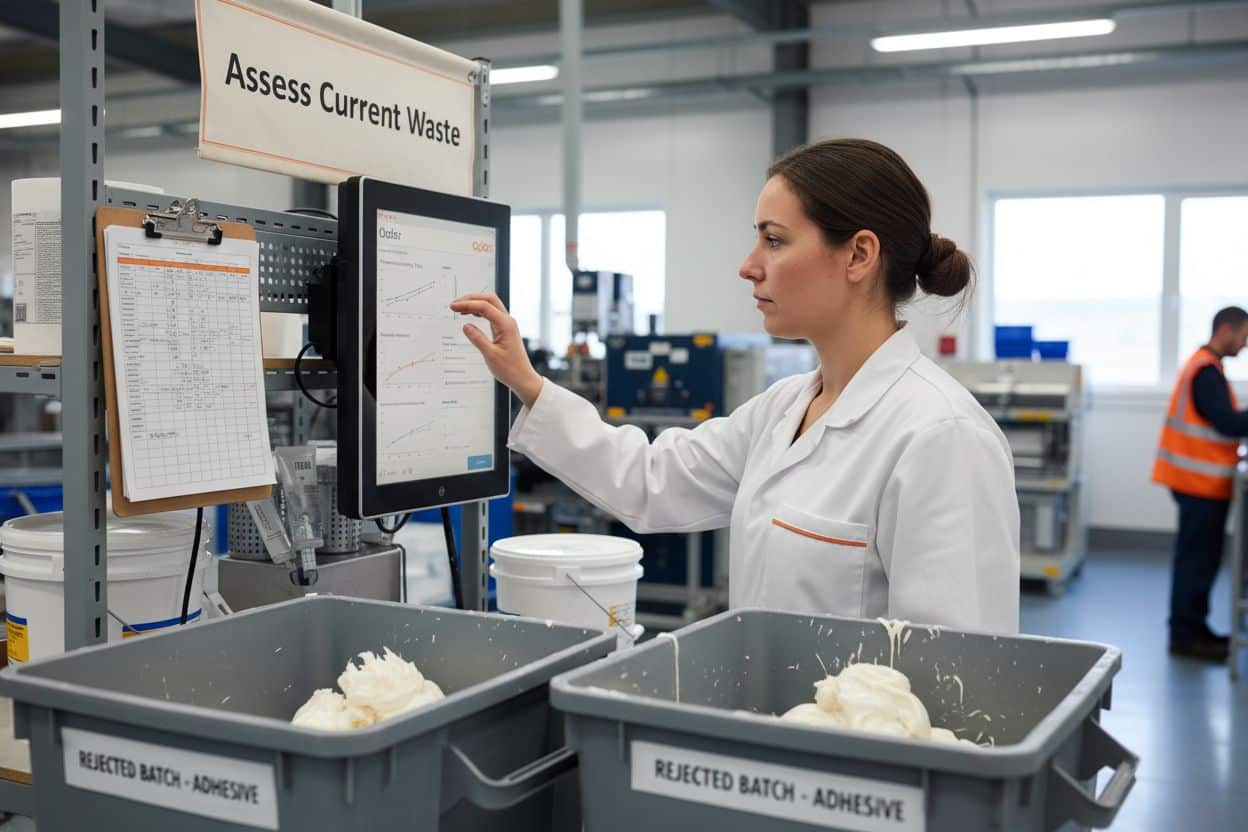
          In this critical first step, you will systematically evaluate your existing custom order processes to identify bottlenecks, inefficiencies, and opportunities for optimization. By thoroughly analyzing your current workflows, you can establish a baseline for understanding where Odoo ERP can deliver transformative improvements.

          Start by mapping out your entire custom order lifecycle from initial customer inquiry through final product delivery. Document each step meticulously, tracking how orders move through your organization. Pay special attention to critical transition points where information gets transferred between departments like sales, production, and shipping. Key areas to examine include order entry methods, communication protocols, approval processes, production scheduling, and tracking mechanisms. Workflow management insights can help you understand potential optimization strategies.

          One powerful technique is creating a visual workflow diagram that highlights each process step, responsible team members, typical time durations, and potential friction points. Research from manufacturing studies emphasizes the importance of understanding distributional shifts in order fulfillment. By generating a comprehensive process map, you will uncover hidden inefficiencies that might be constraining your operational performance. This diagnostic approach prepares you for implementing Odoo ERP as a strategic solution to streamline your custom order management.

          Pro Tip: Involve team members from multiple departments during this assessment. Their ground-level insights will provide nuanced perspectives that might not be immediately apparent from high-level documentation.

          Step 2: Configure Odoo ERP for custom order management

          In this step, you will strategically configure Odoo ERP to align with your unique custom order management requirements. The goal is to transform your standard sales processes into a robust system that can handle complex customization workflows with precision and efficiency.

          Begin by accessing the Odoo Sales module and setting up custom configuration parameters that reflect your specific business needs. Odoo Sales Management provides a foundation for tailoring your order management approach. Focus on configuring key elements such as custom product variants, specialized pricing structures, unique quotation templates, and workflow approval mechanisms. Research indicates that effective configuration involves developing specialized modules that can adapt to your organization’s specific order handling processes. Pay close attention to creating custom fields that capture critical information relevant to your unique order specifications.

          Next, map out your specific order stages within Odoo, including initial inquiry, design consultation, pricing approval, production scheduling, and final delivery. Implement custom statuses that accurately represent each stage of your order lifecycle. This granular approach allows for precise tracking and reporting. Utilize Odoo’s flexible workflow management tools to create automated rules that route orders through appropriate approval channels based on complexity, value, or specific customer requirements. By designing these configurations thoughtfully, you create a system that not only captures order details but also streamlines your entire custom order management process.

          ERP configuration workflow

          Pro Tip: Always test your configurations with sample orders representing your most complex scenarios. This ensures your Odoo ERP setup can handle real world variations in custom order requirements before full deployment.

          Step 3: Automate order processing tasks

          This step focuses on leveraging Odoo ERP to transform your manual order processing into an intelligent automated workflow. By implementing strategic automation, you will reduce human error, accelerate order fulfillment, and create a more responsive customer experience.

          Start by identifying repetitive tasks within your order processing cycle that are prime candidates for automation. AI powered ERP solutions can help you understand the potential for intelligent workflow optimization. Configure automatic triggers that initiate specific actions based on predefined conditions such as order value, customer type, or product complexity. For instance, create rules that automatically generate purchase orders when inventory reaches specific thresholds, route complex orders to specialized approval workflows, or send instant customer notifications at critical order stages.

          Utilize Odoo’s workflow builder to design comprehensive automation sequences that align with your unique business requirements. Research demonstrates that intelligent mobile fulfillment systems integrated with ERP can dramatically enhance operational efficiency. Configure automated email templates for different order statuses, set up automatic inventory adjustments, and establish seamless communication channels between sales, production, and shipping departments. By mapping out these interconnected automated processes, you create a dynamic system that responds quickly and accurately to changing order demands.

          Pro Tip: Always implement automation incrementally and include validation checkpoints. This approach allows you to fine tune your automated workflows while maintaining human oversight and ensuring process accuracy.

          Step 4: Integrate support systems and communication tools

          In this crucial step, you will transform your custom order management by seamlessly connecting various support systems and communication tools within the Odoo ERP ecosystem. The goal is to create a unified platform that enables real-time collaboration, enhances customer service, and ensures smooth information flow across your organization.

          Begin by exploring Odoo’s integrated communication modules and configuring them to match your specific business communication requirements. Odoo CRM features can help you understand the potential for comprehensive communication management. Connect your customer support channels, including email, live chat, phone support, and ticketing systems, directly into the Odoo platform. Set up automated routing rules that direct customer inquiries to the appropriate team members based on issue complexity, department, or customer priority level. Implement integrated messaging systems that allow instant communication between sales representatives, production teams, and customer support staff.

          Delve deeper into system integration by establishing robust communication protocols that link your custom order management workflow with external stakeholders. Research demonstrates the importance of creating access control mechanisms that facilitate secure and efficient collaboration. Configure user permissions that allow controlled information sharing with suppliers, contractors, and key customers. Develop standardized communication templates for different scenarios such as order confirmations, production updates, shipping notifications, and post delivery support. By creating these interconnected communication pathways, you build a responsive and transparent system that keeps all parties informed and engaged throughout the custom order lifecycle.

          Pro Tip: Regularly audit and update your communication integration settings to ensure they continue to meet evolving business needs and technological advancements.

          Step 5: Verify custom order processing and optimize

          In this critical final stage, you will systematically evaluate and refine your custom order processing workflow to ensure maximum efficiency and accuracy. The objective is to leverage data-driven insights and continuous improvement strategies to optimize your Odoo ERP implementation.

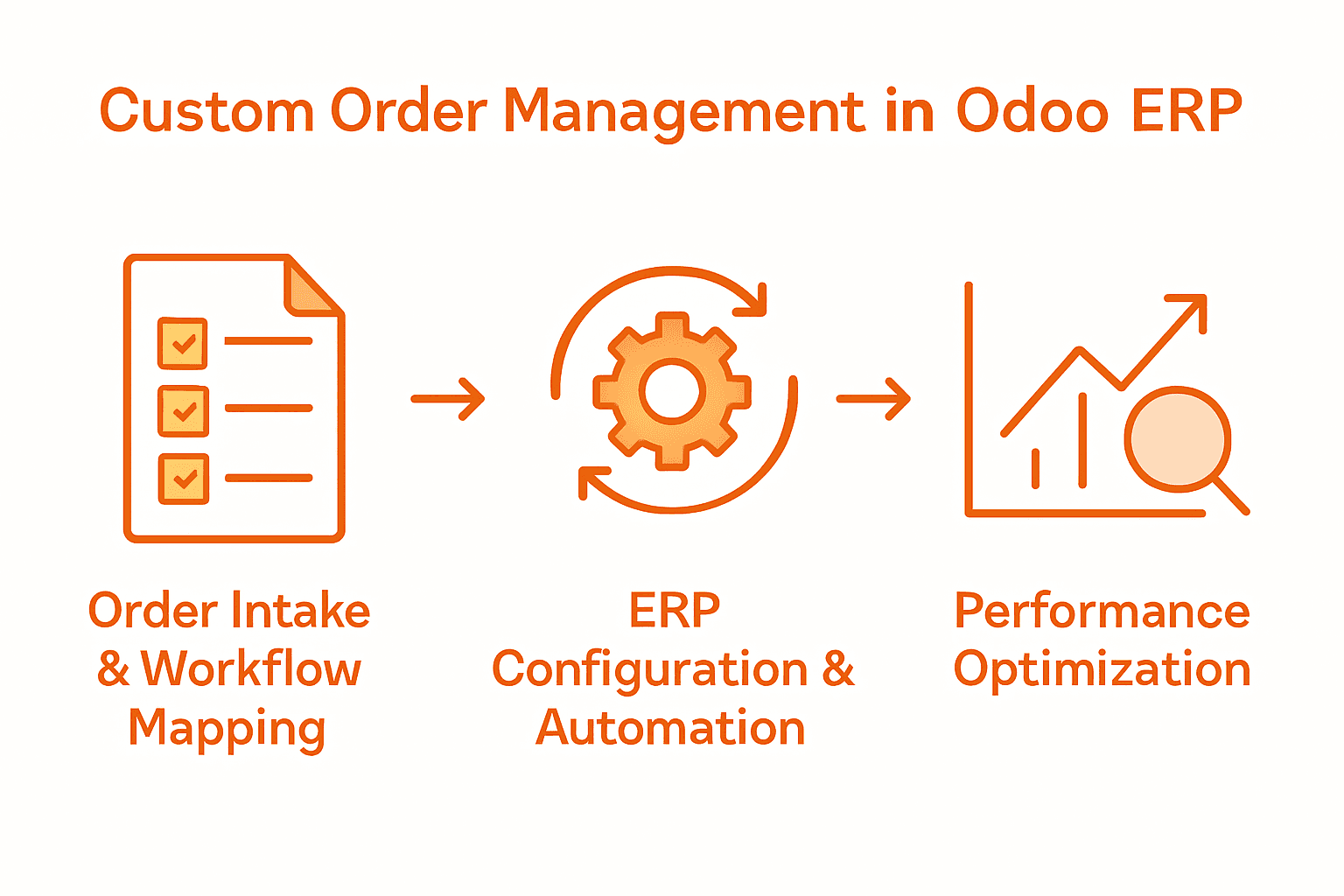
          Initiate a comprehensive review by generating detailed performance reports from your Odoo system. ERP implementation phases can provide context for understanding the optimization process. Analyze key performance indicators such as order processing time, error rates, customer satisfaction metrics, and resource utilization. Use Odoo’s advanced reporting tools to identify bottlenecks, recurring issues, and areas where your workflow can be streamlined. Compare actual performance against your initial benchmarks and explore opportunities for incremental improvements. Focus on examining each stage of the custom order lifecycle to pinpoint specific areas that require refinement.

          Develop a continuous improvement framework within your Odoo ERP system that allows for ongoing optimization. Research demonstrates the importance of data-centric workflow analysis in manufacturing and service industries. Implement feedback loops that capture insights from sales teams, production departments, and customer support. Create a systematic approach to testing and implementing process modifications that can enhance overall efficiency. Configure automated alerts and notifications that trigger when specific performance thresholds are not met, enabling proactive management of potential workflow challenges. By establishing this iterative optimization approach, you transform your custom order processing from a static system to a dynamic adaptive workflow that consistently evolves to meet changing business needs.

          Three-step Odoo ERP custom order management infographic

          Pro Tip: Schedule quarterly comprehensive reviews of your custom order processing system to ensure continuous alignment with your organization’s strategic objectives and technological capabilities.

          Unlock Seamless Custom Order Management with Expert Odoo ERP Support

          Managing complex custom orders reveals critical challenges like inefficient workflows, a lack of real-time communication, and error-prone manual tasks. This guide highlights how configuring and automating your order processing with Odoo ERP can transform these pain points into streamlined operations that keep your customers satisfied and your teams aligned. From mapping workflows to integrating communication tools, these steps require precise expertise to deliver the best results.

          Ready to accelerate your custom order management with a certified Odoo Gold Partner?

          Schedule A Free Demo


            Partner with Bista Solutions to implement tailored Odoo ERP solutions designed specifically for your unique workflows. With over 350 successful ERP implementations and industry-leading know-how, we help reduce errors, boost efficiency, and enable real-time collaboration across sales, production, and support. Don’t let custom order complexity hold your business back. Reach out today and discover how our comprehensive support and expert configuration can elevate your order processing system immediately. Contact us now at Bista Solutions Contact and take the first step towards operational excellence.

            Frequently Asked Questions

            How can I assess my current custom order workflows before implementing Odoo ERP?

            To assess your current custom order workflows, carefully map out the entire order lifecycle, from customer inquiry to product delivery. Document each step and identify any bottlenecks or inefficiencies to establish a baseline for improvement.

            What are the key elements to configure in Odoo ERP for custom order management?

            Focus on setting up custom product variants, pricing structures, and approval workflows within the Odoo Sales module. Also, create custom fields that capture important order information tailored to your specific needs.

            How do I automate repetitive tasks in my order processing using Odoo ERP?

            Identify repetitive tasks that can be automated, such as generating purchase orders or sending order notifications. Use Odoo’s automation tools to create rules that trigger actions based on specific conditions, reducing processing time by approximately 30%.

            What communication tools should I integrate with Odoo ERP for custom order management?

            Integrate your existing customer support channels like email, live chat, and phone support directly into Odoo ERP. Set up automated routing rules and templates to ensure seamless communication between sales, production, and support teams.

            How can I verify and optimize my custom order processing after implementing Odoo ERP?

            To verify and optimize your custom order processing, generate performance reports and analyze key metrics such as order processing times and error rates. Regularly review these insights to identify areas for improvement and implement feedback from team members for continuous optimization.

            Implement a systematic feedback loop that captures insights from all departments involved in custom orders. Schedule quarterly reviews to evaluate performance against benchmarks and test adjustments to enhance efficiency and accuracy.

            Reducing Waste and Improving Yield in Adhesive Production Using Odoo ERP

            Reducing Waste and Improving Yield in Adhesive Production Using Odoo ERP

            Manufacturers in the adhesive industry know that waste eats away at profits, yet many still underestimate the scale. Some companies find that over 10 percent of raw materials are lost as scrap, rejected batches, or cleaning waste during production. That sounds shocking, but the real surprise is how quickly those numbers can be turned around when you put the right digital systems in place.

            Table of Contents

            Quick Summary

            Key Point Explanation
            1. Assess Current Waste Levels Systematically evaluate material inputs and waste in production to identify key inefficiencies.
            2. Integrate Odoo ERP for Tracking Use Odoo ERP for real-time monitoring and improved waste management analytics.
            3. Analyze Production Data Thoroughly Examine collected data to discover patterns and improvement opportunities related to waste.
            4. Implement Targeted Waste Reduction Create tailored action plans based on analysis results to minimize wastage in production.
            5. Conduct Ongoing Quality Checks Establish quality control protocols to ensure consistency and reduce scrap rates throughout production.

            Step 1: Assess Current Waste Levels in Production

            Reducing waste in adhesive production begins with a comprehensive and systematic assessment of your current manufacturing processes. This critical first step provides the foundation for targeted waste reduction strategies and improved operational efficiency.

            To effectively gauge waste levels, start by conducting a thorough documentation and analysis of your entire production workflow. Track and record all material inputs, outputs, and wastage points across different stages of adhesive manufacturing. This means carefully measuring not just raw material consumption, but also examining scrap rates, rejected batches, cleaning waste, and inefficient processing that leads to product loss.

            Utilize Odoo ERP’s powerful tracking and reporting modules to create detailed waste tracking logs. The system allows you to input precise data about material usage, production run specifics, and waste generation at each manufacturing stage. By digitizing this information, you transform abstract waste concepts into concrete, measurable metrics that can drive strategic improvements.

            Infographic of adhesive waste tracking and Odoo ERP data entry process

            Key waste assessment metrics should include:

            • Total raw material consumption per production batch
            • Percentage of materials converted into the final product
            • Volume of rejected or unusable product
            • Time and resources spent on rework or cleaning processes
            • Energy and auxiliary material waste during production

            Odoo ERP’s integrated analytics will help you generate comprehensive reports that reveal hidden inefficiencies. Look beyond surface-level numbers and investigate the root causes of waste generation. Are inconsistent raw material qualities causing higher rejection rates? Do specific equipment setups lead to more material loss? Are there bottlenecks in your production process causing unnecessary waste?

            Successful waste assessment requires ongoing commitment and systematic documentation. Implement regular review cycles where production managers and quality control teams analyze waste data, identify trends, and develop targeted improvement strategies. By establishing a data-driven approach with Odoo ERP, you create a continuous improvement framework that transforms waste management from a reactive process to a proactive, strategic initiative.

            Below is a step overview table summarizing the main stages of reducing waste and improving yield in adhesive production with Odoo ERP, including each step’s focus and estimated outcome.

            Step Focus Key Outcome
            1. Assess Waste Levels Document all material usage and waste sources Establish baseline waste metrics
            2. Integrate Odoo ERP Implement real-time production monitoring Gain operational transparency
            3. Analyze Data Review production data for trends and inefficiencies Identify opportunities for improvement
            4. Implement Strategies Execute targeted waste reduction actions using Odoo Reduce scrap and material loss
            5. Monitor Yield Track yield and production effectiveness Achieve consistent efficiency gains
            6. Conduct Quality Checks Set up robust quality control at each stage Maintain high product reliability

            Step 2: Integrate Odoo ERP for Production Monitoring

            Successfully integrating Odoo ERP into your adhesive production workflow represents a transformative leap toward precise waste management and operational transparency. This critical step moves your manufacturing processes from fragmented tracking to a comprehensive, real-time monitoring system that captures every nuance of production performance.

            Begin by mapping your current production workflows and identifying all critical data points where waste and efficiency can be measured. Odoo Manufacturing Module provides a robust framework for capturing granular production data, enabling you to connect previously isolated manufacturing stages into a unified monitoring ecosystem. Learn more about Odoo Manufacturing ERP Solutions that can revolutionize your production tracking.

            Configuring Odoo ERP requires careful planning and strategic implementation. Work closely with your implementation team to customize modules that align precisely with your adhesive production processes. This involves setting up detailed tracking parameters for raw material consumption, production line performance, batch quality metrics, and real-time waste generation indicators.

            Key configuration steps include:

            • Establishing precise data input points across production lines
            • Creating custom dashboards for real-time waste and efficiency monitoring
            • Configuring automatic alerts for potential waste generation thresholds
            • Linking quality control metrics with production performance data

            The integration process demands collaboration between your production management, IT teams, and Odoo implementation specialists. Ensure that all team members understand how to input data accurately and interpret the generated reports. Training is crucial to transforming your ERP from a mere tracking tool into a strategic decision-making platform.

            Verify successful integration by running parallel tracking systems for several production cycles. Compare manual waste tracking records with Odoo ERP-generated reports to confirm accuracy and identify any discrepancies. A successful integration will provide unprecedented visibility into your production processes, enabling data-driven decisions that directly impact waste reduction and operational efficiency.

            Step 3: Analyze Data to Identify Improvement Areas

            Data analysis transforms raw production metrics into actionable insights that drive meaningful waste reduction strategies in adhesive manufacturing. After integrating Odoo ERP, this critical step involves deep examination of collected production data to uncover inefficiencies and potential optimization opportunities.

            Leverage Odoo ERP’s advanced reporting and analytics tools to conduct a comprehensive review of your production performance. Begin by generating comprehensive reports that highlight waste generation patterns, material consumption rates, and production line efficiency. Look beyond surface-level numbers to understand the underlying factors contributing to material loss and inefficient processes.

            Odoo’s visualization tools enable you to create detailed dashboards that map waste generation across different production stages. Examine variations in batch performance, identifying specific points where material waste consistently occurs. Pay special attention to correlations between equipment settings, raw material quality, and production output. Explore our detailed guide on manufacturing execution systems to enhance your analytical approach.

            Key areas to scrutinize during data analysis include:

            • Batch-to-batch variation in material consumption
            • Equipment performance and maintenance records
            • Raw material quality consistency
            • Production line setup and transition efficiency
            • Time and resource allocation across different manufacturing stages

            Engaging cross-functional teams during this analysis is crucial. Invite production managers, quality control specialists, and process engineers to review the data collaboratively. Their collective expertise will help interpret complex metrics and develop targeted improvement strategies. Look for patterns that might not be immediately apparent from numerical data alone.

            Successful data analysis requires a systematic approach. Document your findings comprehensively, creating a baseline for future improvement initiatives. Verify the effectiveness of your analysis by establishing clear metrics that demonstrate potential waste reduction opportunities. The goal is to transform raw data into a strategic roadmap for operational excellence, turning insights into concrete actions that drive continuous improvement in your adhesive production processes.

            Step 4: Implement Waste Reduction Strategies through Odoo

            Transforming data insights into actionable waste reduction strategies requires a systematic and strategic approach within your Odoo ERP framework. This pivotal step bridges analytical findings with practical implementation, turning potential efficiency gains into tangible operational improvements for adhesive production.

            Develop a comprehensive waste reduction action plan that leverages Odoo’s modular capabilities to target specific inefficiencies identified during your data analysis. Begin by prioritizing improvement areas with the most significant potential impact on material consumption and production efficiency. Learn more about optimizing warehouse management processes to enhance your overall strategy.

            Utilize Odoo’s manufacturing and inventory modules to implement precise control mechanisms. Configure automated alerts for material consumption thresholds, set up real-time tracking for batch-specific waste generation, and develop custom workflows that minimize unnecessary material handling. This might involve redesigning production line setups, adjusting equipment calibration parameters, or implementing more stringent quality control checkpoints.

            Critical implementation strategies include:

            • Establishing granular material tracking protocols
            • Creating automatic waste reduction recommendation triggers
            • Developing cross-departmental communication channels
            • Implementing continuous improvement feedback loops

            Collaboration is key to successful strategy implementation. Engage production teams, quality control specialists, and management in a collaborative approach that transforms waste reduction from an isolated initiative to a comprehensive organizational strategy. Odoo ERP provides the technological infrastructure to support this cultural shift, enabling real-time communication and transparent performance monitoring.

            Verify the effectiveness of your waste reduction strategies by establishing clear, measurable benchmarks. Compare current waste generation metrics against baseline data collected during initial assessment. Look for consistent improvements in material utilization, reduced scrap rates, and enhanced overall production efficiency. Remember that waste reduction is an ongoing process requiring continuous monitoring, adaptation, and refinement through your Odoo ERP system.

            The table below provides a checklist of key verification actions and monitoring points to ensure sustainable waste reduction and production yield improvement using Odoo ERP.

            Verification Step Purpose Frequency
            Review waste tracking logs Monitor real-time material loss and process waste Weekly
            Compare manual and ERP data Validate accuracy of automated monitoring Per cycle
            Analyze yield dashboard Track changes in efficiency and identify anomalies Monthly
            Conduct quality inspections Ensure consistency and identify potential issues early Each batch
            Assess improvement benchmarks Measure effectiveness of implemented strategies Quarterly
            Adjust process based on reviews Respond swiftly to deviations or trends As needed

            Step 5: Monitor Yield Performance and Adjust Accordingly

            Continuous performance monitoring represents the critical final stage in transforming waste reduction from a theoretical concept to a sustainable operational strategy. Odoo ERP provides the sophisticated tools necessary to track, analyze, and incrementally improve your adhesive production yield with unprecedented precision.

            Establish a comprehensive yield performance dashboard within Odoo that captures real-time metrics across multiple production parameters. This centralized monitoring system allows immediate visualization of production efficiency, material utilization, and waste generation trends. Configure custom widgets that highlight key performance indicators, enabling quick identification of potential optimization opportunities.

            Implement a structured review process where production data is systematically evaluated at regular intervals. Weekly and monthly performance reviews should involve cross-functional teams that can provide nuanced insights into performance variations. Leverage Odoo’s reporting capabilities to generate detailed comparative analyses that track performance improvements and highlight emerging efficiency opportunities.

            Critical monitoring elements include:

            • Batch-specific yield percentages
            • Material consumption rates
            • Quality control pass/fail ratios
            • Equipment performance metrics
            • Production line efficiency indicators

            Develop a responsive adjustment protocol that allows for immediate interventions when performance metrics deviate from established benchmarks. Odoo ERP’s flexibility enables rapid configuration of automated alerts and custom reporting mechanisms that support data-driven decision making. This approach transforms yield monitoring from a passive observation process into an active continuous improvement framework.

            Verify the effectiveness of your monitoring strategy by establishing clear performance benchmarks and tracking incremental improvements over time. A successful yield monitoring approach will demonstrate consistent reductions in waste generation, improved material utilization, and enhanced overall production efficiency. Remember that sustainable improvement is an ongoing journey requiring persistent attention, analytical rigor, and a commitment to operational excellence.

            Step 6: Conduct Quality Checks to Ensure Consistency

            Quality consistency represents the ultimate benchmark for successful adhesive production, transforming waste reduction efforts into tangible manufacturing excellence. Odoo ERP provides a comprehensive framework for implementing robust quality control processes that maintain high standards while minimizing material waste and production variability.

            Develop a multi-stage quality verification protocol that integrates seamlessly with your existing production workflow. Leverage Odoo’s quality management modules to create detailed inspection points that capture critical performance metrics at every production stage. This systematic approach ensures that potential inconsistencies are identified and addressed before they can compromise entire production batches.

            Implement precise testing mechanisms that go beyond surface-level assessments. Configure Odoo ERP to track granular quality indicators such as chemical composition, viscosity, adhesion strength, and material uniformity. Establish automated testing protocols that can immediately flag deviations from predetermined quality standards, enabling rapid intervention and minimizing potential waste generation.

            Key quality verification elements include:

            • Comprehensive raw material incoming inspection
            • In-process quality control checkpoints
            • Final product performance testing
            • Batch-specific traceability records
            • Automated non-conformance reporting

            Collaborate closely with quality control teams to refine and continuously improve your inspection processes. Odoo ERP’s flexible reporting tools allow for detailed documentation and analysis of quality metrics, transforming quality checks from a passive verification step into an active, continuous improvement mechanism. Encourage a culture of precision and accountability where every team member understands their role in maintaining production consistency.

            Verify the effectiveness of your quality control strategy by tracking key performance indicators such as rejection rates, rework frequency, and overall product consistency. A successful quality check implementation will demonstrate a progressive reduction in material waste, improved product reliability, and enhanced customer satisfaction. Remember that quality is not a destination but an ongoing journey of refinement and precision.

            adhesive production quality checks

            Find the Key to Smarter Adhesive Production with Bista Solutions

            Struggling with excessive waste and inconsistent yields in your adhesive manufacturing? You are not alone. Many companies face challenges tracking material flow, uncovering hidden inefficiencies, and converting raw data into real results. By leveraging powerful systems like Odoo ERP, you can tackle issues like high rejection rates, untracked losses, and unreliable quality control—turning them into opportunities for greater efficiency and profit. Read our detailed guide on optimizing warehouse management processes to see how integrated solutions can streamline every step.

            Schedule A Free Demo


              Ready to move beyond guesswork and manual monitoring? Discover how working with the largest Odoo Gold Partner in North America can transform your adhesive production. Contact Bista Solutions today for a no-obligation consultation, and let our team implement tailored solutions to help you reduce waste, raise yield, and improve operational consistency. Start your journey toward leaner, more profitable manufacturing by reaching us through our contact page.

              Frequently Asked Questions

              How can Odoo ERP help in assessing waste levels in adhesive production?

              Odoo ERP provides powerful tracking and reporting modules that allow you to document and analyze material inputs and waste generation at each production stage. Begin by using Odoo to create detailed waste tracking logs that can help you identify areas for improvement within 30 days.

              What key metrics should I track to reduce waste in adhesive production?

              Important metrics include total raw material consumption per batch, the percentage of materials turning into usable product, and the volume of rejected products. Focus on these indicators to identify waste trends and prioritize waste reduction efforts within your production cycles.

              How do I integrate Odoo ERP into my adhesive manufacturing workflow?

              Integrate Odoo ERP by mapping your current production workflows and configuring the system to capture critical data points. Collaborate with your implementation team to customize modules that directly align with your processes, ensuring a successful integration within a few weeks.

              What steps should I take to monitor yield performance effectively?

              Establish a comprehensive yield performance dashboard in Odoo that tracks key metrics like batch yield percentages and material consumption rates. Regularly review this data and adjust your production processes to improve efficiency, aiming for at least a 15% increase in yield over several production cycles.

              How can I ensure quality consistency in my adhesive production using Odoo?

              Implement a multi-stage quality verification protocol using Odoo’s quality management modules to capture critical performance metrics at each stage. Conduct regular inspections and automated testing to quickly identify and address deviations, reducing waste by approximately 20% while increasing product reliability.

              Complete Guide to Boosting Odoo ERP Performance

              How to boos Odoo ERP Performance and How to overcome Odoo performance issues
              • by Uzlifat Mir
              • Oct 28, 2025
              • 0
              • Category:

              Did you know that over 60 percent of ERP projects fall short of expected performance due to technical and process pitfalls? When systems slow down or fail, productivity takes a direct hit, and frustration grows across every department. Understanding the true sources of Odoo ERP performance problems empowers businesses to avoid costly setbacks and unlock smoother operations. Discover actionable insights that shed light on hidden issues and proven ways to maximize your Odoo system’s potential.

              Key Takeaways

              Challenge Area Common Issues
              Implementation Strategy Address long timelines and scope creep through better planning and alignment of business processes.
              Data Quality Management Ensure consistent data and clear requirements to enhance visibility and overall performance.
              Infrastructure Optimization Invest in adequate resources like RAM and optimized database configurations to prevent bottlenecks.
              Advanced Performance Monitoring Utilize observability tools to proactively identify and resolve potential performance issues for sustained system efficiency.

              Table of Contents

              Defining Odoo ERP Performance Challenges

              Odoo ERP implementations are complex journeys that can quickly become challenging when businesses encounter unexpected performance roadblocks. At the core, these challenges stem from three primary domains: technical complexity, business process misalignment, and implementation strategy.

              Here’s a summary of the main Odoo ERP performance challenges and their causes:

              Challenge Area Common Issues Root Causes
              Implementation Long timelines
              Scope creep
              Process misalignment
              Complex integrations
              Over-customization
              Poor planning
              Data/Business Processes Data quality issues
              Lack of visibility
              Inconsistent data
              Unclear requirements
              Technical/Infrastructure Inadequate servers
              Unoptimized databases
              Insufficient RAM/CPU
              Bad configuration
              Customization/Code Excess modules
              Poor custom code
              Technical debt
              Lack of code review

              Manufacturers and enterprises frequently struggle with data quality issues that directly impact system performance. Imagine trying to run critical production reports with inconsistent or incomplete data streams. Research indicates that poor visibility into production processes creates significant operational bottlenecks. Companies often discover that their ERP system isn’t just a software solution, but a comprehensive ecosystem requiring strategic planning and precise configuration.

              The most common performance challenges include:

              • Long implementation timelines with persistent scope creep
              • Complex integration requirements across multiple business units
              • Inadequate understanding of specific business process requirements
              • Over-customization that creates technical debt and system complexity
              • Limited visibility into real-time operational metrics

              Bista Solutions recognizes these challenges and offers strategic Odoo ERP implementation guidance that helps businesses navigate these potential pitfalls. By understanding these performance challenges early, organizations can design more robust, scalable ERP strategies that minimize disruption and maximize operational efficiency.

              Common Causes of Odoo Performance Issues

              Infrastructure limitations represent the most fundamental bottleneck in Odoo ERP performance. Many organizations unknowingly handicap their systems by deploying inadequate computational resources – imagine trying to run a marathon in tight shoes. Insufficient RAM, slow disk storage, and limited processing power create significant performance constraints that can dramatically reduce system efficiency and responsiveness.

              Database configuration emerges as another critical performance challenge. Research reveals that improperly tuned PostgreSQL parameters, a lack of proper indexing, and the absence of connection pooling can create substantial system lag. Businesses often overlook these technical nuances, resulting in databases that consume excessive computational resources and respond sluggishly to critical operational queries.

              Infographic showing Odoo performance bottlenecks: infrastructure, database, and code complexity.

              The most prevalent performance inhibitors include:

              • Inadequate server infrastructure
              • Unoptimized database configuration
              • Excessive or unnecessary installed modules
              • Poorly written custom code and integrations
              • Limited scheduled maintenance protocols
              • Inefficient connection and resource management

              Bista Solutions understands these complex challenges and offers comprehensive Odoo performance optimization strategies that address these critical technical considerations. By proactively identifying and resolving these performance bottlenecks, organizations can transform their Odoo ERP from a potential liability into a high-performance business acceleration tool.

              odoo erp it infrastructure

              Optimization Techniques for Faster Odoo ERP

              Hardware optimization stands as the foundational layer of Odoo performance enhancement. Smart infrastructure investments can dramatically transform system responsiveness. This means strategically upgrading to multi-core processors, investing in high-speed SSDs, and allocating substantial RAM to ensure your Odoo environment can handle complex computational tasks without breaking a sweat.

              Database tuning emerges as another critical optimization strategy. PostgreSQL, the powerful database engine behind Odoo, requires meticulous configuration to unlock peak performance. Advanced techniques like intelligent indexing, precise memory allocation (work_mem and shared_buffers), and regular database maintenance (vacuum and analyze operations) can significantly reduce query response times and overall system latency.

              The most powerful Odoo performance optimization techniques include:

              • Implementing load balancing with HAProxy or Nginx
              • Enabling advanced caching layers like Redis
              • Reducing view complexity in custom modules
              • Utilizing asynchronous job processing
              • Strategically disabling unused modules
              • Leveraging horizontal scaling techniques
              • Implementing front-end lazy loading mechanisms

              Bista Solutions provides comprehensive Odoo performance consulting that helps businesses transform their ERP from a potential bottleneck into a high-performance business acceleration platform. By applying these sophisticated optimization strategies, organizations can ensure their Odoo implementation remains agile, responsive, and perfectly aligned with their evolving business needs.

              Tools and Metrics for Performance Monitoring

              Performance monitoring in Odoo ERP is like having a sophisticated health checkup for your entire business ecosystem. Just as a doctor uses advanced diagnostic tools to understand a patient’s condition, modern businesses require comprehensive observability platforms to detect and diagnose potential system bottlenecks before they escalate into critical failures. Real-time monitoring provides unprecedented visibility into system health, resource utilization, and potential performance degradation points.

              Advanced observability platforms such as Prometheus, Grafana, and specialized Odoo performance dashboards offer granular insights into critical metrics. These tools track everything from memory consumption and database I/O performance to request processing times and error rates. By continuously monitoring these parameters, businesses can proactively identify performance anomalies, understand system behavior patterns, and make data-driven optimization decisions.

              Key performance monitoring tools and metrics include:

              • Real-time server resource tracking
              • Memory and CPU utilization monitoring
              • Database query performance analysis
              • Request response time measurement
              • Error log tracking and analysis
              • Developer mode profiling
              • Stress testing and load simulation
              • Network latency and throughput evaluation

              Bista Solutions offers comprehensive Odoo performance monitoring solutions that transform complex technical data into actionable business insights. By leveraging these advanced monitoring techniques, organizations can ensure their Odoo ERP remains a robust, responsive, and reliable business acceleration platform.

              Overcoming Persistent Odoo Performance Problems

              Scalability architecture represents the most sophisticated approach to resolving stubborn Odoo performance challenges. Modern enterprises must think beyond traditional infrastructure limitations, embracing dynamic strategies that allow systems to grow and adapt seamlessly. This means designing an ERP environment that can elastically expand computational resources, distribute workloads intelligently, and maintain peak performance under increasingly complex business demands.

              Advanced architectural strategies now offer unprecedented opportunities to transform persistent performance bottlenecks. Techniques like microservices architecture, serverless function offloading, and event-driven design enable organizations to create more resilient, responsive Odoo implementations. By breaking monolithic systems into modular, independently scalable components, businesses can achieve remarkable improvements in system flexibility, reducing the risk of performance degradation during critical operational periods.

              Key strategies for overcoming persistent Odoo performance problems include:

              • Implementing horizontal scaling techniques
              • Adopting a microservices architecture
              • Utilizing serverless computational models
              • Developing event-driven system designs
              • Applying AI-driven performance monitoring
              • Creating robust automation workflows
              • Establishing regular performance audit protocols
              • Designing for vertical and horizontal resource expansion

              Bista Solutions delivers comprehensive Odoo performance optimization strategies that transform complex technical challenges into streamlined, high-performance business solutions. By proactively addressing performance limitations, organizations can ensure their Odoo ERP remains a powerful, adaptive tool for continuous business innovation.

              Transform Your Odoo ERP Performance With Trusted Experts

              Is your business facing slow processing speeds, persistent technical bottlenecks, or complex Odoo customizations that impact growth? Many organizations experience these exact challenges when their ERP implementation falls short of peak performance. Your goals for improved visibility, faster response times, and reliable real-time data are too important to leave to chance.

              Schedule A Free Demo

                Take advantage of Bista Solutions’ proven expertise as the largest and most awarded Odoo ERP implementer in North America. Our team specializes in turning common pain points like insufficient infrastructure, data quality issues, and system complexity into real business advantages. We deliver end-to-end services—from Odoo ERP implementation guidance to comprehensive performance consulting—tailored to your unique needs. Do not let ongoing performance gaps hold your business back. Connect with us today at Bista Solutions Contact Us to secure the speed, visibility, and reliability your organization demands.

                Frequently Asked Questions

                What are the common performance challenges faced in Odoo ERP implementations?

                The common challenges include long implementation timelines, scope creep, complex integrations, data quality issues, and over-customization, which leads to technical debt and reduced system efficiency.

                How can I improve the performance of my Odoo ERP?

                Improving performance can be achieved through hardware optimization, database tuning, implementing caching layers, and regularly monitoring system health. Strategic upgrades to infrastructure and using efficient coding practices can also enhance performance.

                What tools are effective for monitoring Odoo ERP performance?

                Effective tools for monitoring Odoo ERP performance include Prometheus, Grafana, and specialized Odoo performance dashboards. These tools allow real-time tracking of memory consumption, database I/O performance, request response times, and error rates.

                How can scalability architecture help address persistent Odoo performance problems?

                Scalability architecture helps by allowing systems to elastically expand computational resources and distribute workloads intelligently, adapting to increasing business demands. Techniques like microservices architecture and event-driven design enhance system flexibility and performance.

                Why Packaging Manufacturers Choose Odoo ERP

                Why Packaging Manufacturers Choose Odoo ERP

                More than 60 percent of packaging manufacturers now seek alternatives to legacy systems that slow down their operations. Outdated technology often means clunky workflows and missed opportunities for growth, especially as markets demand more agility and integration. Modern solutions like Odoo ERP promise real-time insights, streamlined processes, and a competitive edge through unified business management. Choosing the right system can mean the difference between falling behind and driving sustained success.

                Key Takeaways

                Point Details
                Unified Platform Odoo ERP integrates all key business functions, eliminating silos and enabling real-time data access.
                Cost Efficiency Odoo ERP requires fewer licenses and lower overall operational costs compared to legacy systems.
                Scalable and Customizable Odoo offers a modular approach allowing for industry-specific customization and easy scalability to meet changing business needs.
                Improved Decision-Making Enhanced real-time analytics and automation capabilities support strategic decision-making and responsiveness to market changes.

                Table of Contents

                Odoo ERP Versus Legacy Packaging Systems

                Packaging manufacturers are increasingly abandoning traditional legacy systems in favor of comprehensive enterprise solutions like Odoo ERP. These outdated systems often create significant operational bottlenecks that can hinder growth, efficiency, and competitive advantage. Traditional packaging management platforms typically struggle with integrating multiple business functions, leading to fragmented workflows and limited visibility across departments.

                Odoo ERP offers a transformative alternative by providing a unified platform that seamlessly connects critical packaging manufacturing processes. Unlike legacy systems that operate in silos, Odoo enables real-time data synchronization across inventory management, production planning, quality control, and customer relationship management. Manufacturers can now track materials, monitor production schedules, manage complex supply chains, and generate precise reports from a single, intuitive interface.

                Comparison infographic illustrating key differences between Odoo ERP and legacy packaging systems.

                The key differences between Odoo and legacy systems become immediately apparent in several critical areas:

                Here’s a comparison of Odoo ERP and Legacy Packaging Systems:

                Feature Odoo ERP Legacy Packaging Systems
                Scalability Grows with business Fixed and limited
                Integration Unified across all functions Fragmented, siloed
                Cost-Effectiveness Single license, lower costs Multiple licenses, higher fees
                Customization Industry-specific, low-code changes Rigid, requires heavy coding
                Real-Time Visibility Yes, comprehensive Limited or delayed
                User Experience Intuitive single interface Complex, multiple interfaces
                • Scalability: Odoo grows with your business, unlike rigid legacy platforms
                • Cost-Effectiveness: Eliminates multiple software licensing fees
                • Integration: Connects manufacturing, sales, procurement, and accounting seamlessly
                • Customization: Allows industry-specific modifications without extensive programming

                By choosing Odoo ERP implementation, packaging manufacturers gain a competitive edge through enhanced operational transparency, reduced manual processes, and data-driven decision-making. Bista Solutions specializes in tailoring Odoo implementations specifically for packaging industry requirements, ensuring a smooth transition from legacy systems to a modern, integrated enterprise solution.

                Key Improvements Driving ERP Adoption

                The transformation of enterprise resource planning (ERP) systems has become a critical driver for packaging manufacturers seeking operational excellence. Modern technological advancements are fundamentally reshaping how businesses approach resource management, with Odoo ERP leading the charge in delivering comprehensive, flexible solutions that address complex manufacturing challenges.

                Key improvements in ERP technology are revolutionizing how packaging manufacturers optimize their operations. These advancements include enhanced real-time analytics, seamless cross-departmental integration, and unprecedented levels of process automation. Manufacturers can now leverage intelligent systems that provide instant insights into production efficiency, inventory management, and supply chain dynamics, enabling more strategic decision-making and rapid response to market fluctuations.

                The most significant improvements driving ERP adoption include:

                • Intelligent Automation: Reduces manual data entry and minimizes human error
                • Predictive Analytics: Enables proactive maintenance and demand forecasting
                • Cloud-Based Accessibility: Supports remote work and distributed team collaboration
                • Scalable Architecture: Allows businesses to expand capabilities without complete system replacement

                By exploring AI-powered ERP solutions, packaging manufacturers can transform their operational strategies. Bista Solutions understands that the future of manufacturing lies in adopting technologies that not only streamline current processes but also anticipate and adapt to emerging business challenges. Our Odoo ERP implementations represent a strategic investment in technological innovation and operational resilience.

                Steps for Migrating to Odoo ERP

                Migrating to a new Enterprise Resource Planning (ERP) system can seem daunting for packaging manufacturers, but with a structured approach, the transition to Odoo ERP becomes a strategic opportunity for operational transformation. The migration process requires careful planning, thorough assessment of current systems, and a comprehensive understanding of your organization’s unique manufacturing workflows and technological requirements.

                Successful ERP migration involves a multi-phase approach that ensures minimal disruption to existing operations. Bista Solutions recommends a systematic strategy that begins with an extensive discovery phase, where current business processes, data structures, and system integrations are meticulously analyzed. This initial assessment helps create a tailored migration roadmap that addresses specific packaging manufacturing challenges and aligns technological capabilities with strategic business objectives.

                The key steps for a successful Odoo ERP migration include:

                1. Comprehensive System Audit: Evaluate existing IT infrastructure and business processes
                2. Data Preparation: Clean, validate, and map legacy system data for seamless transfer
                3. Custom Configuration: Develop industry-specific Odoo modules for packaging manufacturing
                4. Phased Implementation: Roll out Odoo ERP in controlled stages to minimize operational disruption
                5. Extensive Training: Provide comprehensive team training on new system functionalities

                By understanding ERP implementation phases, packaging manufacturers can approach their digital transformation with confidence. Bista Solutions offers end-to-end support throughout the migration journey, ensuring that your transition to Odoo ERP is smooth, efficient, and strategically aligned with your business growth objectives. Our expert team specializes in customizing Odoo solutions that transform technological challenges into competitive advantages.

                Challenges and Solutions in ERP Transition

                Packaging manufacturers face numerous complex challenges when transitioning to a new enterprise resource planning system, with each hurdle presenting unique technological and organizational obstacles. The transformation journey requires a strategic approach that anticipates potential disruptions and proactively develops comprehensive mitigation strategies to ensure smooth operational continuity and minimal productivity loss during the implementation process.

                The most critical challenges in ERP transition typically revolve around data migration, employee resistance, and system integration complexities. Packaging manufacturers must address these challenges through meticulous planning, robust change management protocols, and a deep understanding of their existing technological ecosystem. Odoo ERP offers flexible solutions that can be customized to address these specific manufacturing industry pain points, providing adaptive implementation strategies that minimize operational disruptions and maximize technological potential.

                Key challenges and their targeted solutions include:

                • Data Migration Complexity: Develop comprehensive data mapping and cleansing protocols
                • Employee Skill Gaps: Implement extensive training and change management programs
                • System Integration Issues: Utilize Odoo’s modular architecture for seamless connectivity
                • Cultural Resistance: Foster a culture of technological innovation and continuous learning
                • Cost Management: Implement phased rollout to control implementation expenses

                By identifying early signs of ERP system needs, packaging manufacturers can proactively address potential transition challenges. Bista Solutions specializes in creating tailored ERP implementation strategies that transform technological challenges into strategic opportunities, ensuring that your packaging manufacturing operations leverage cutting-edge technological capabilities while maintaining operational excellence and minimizing transition-related risks.

                Comparing Odoo ERP to Other Modern Solutions

                The landscape of enterprise resource planning solutions has evolved dramatically, with packaging manufacturers demanding more flexible, comprehensive, and cost-effective technological platforms. While traditional ERP systems often present rigid, monolithic architectures, Odoo ERP emerges as a game-changing solution that offers unprecedented adaptability, seamless integration, and industry-specific customization capabilities that set it apart from conventional enterprise software approaches.

                Unlike many legacy and contemporary ERP solutions that require complex, expensive customizations, Odoo provides a modular ecosystem that enables packaging manufacturers to scale and modify their technological infrastructure with remarkable ease. The platform’s open-source architecture allows for unprecedented flexibility, enabling businesses to add or remove modules precisely aligned with their operational requirements, a stark contrast to the one-size-fits-all approach of many competing enterprise solutions.

                odoo erp customization

                Key comparative advantages of Odoo ERP include:

                • Modularity: Unmatched ability to customize without extensive programming
                • Cost-Effectiveness: Significantly lower total cost of ownership compared to traditional ERP systems
                • Integration Capabilities: Seamless connectivity across multiple business functions
                • User Experience: Intuitive interface that reduces training time and complexity
                • Scalability: Easily adaptable to businesses of varying sizes and complexity

                By exploring the comparison between Odoo and other ERP platforms, packaging manufacturers can make informed technological investment decisions. Bista Solutions stands at the forefront of this technological transformation, offering expert guidance in selecting and implementing the most appropriate ERP solution tailored specifically to the unique challenges and opportunities within the packaging manufacturing sector.

                Transform Your Packaging Business with a Trusted Odoo Gold Partner

                Are you frustrated with legacy packaging systems that limit your visibility and slow down your production? This article highlights how Odoo ERP breaks down silos and unifies your business operations, but making this leap can feel overwhelming without the right guidance. Bista Solutions has supported hundreds of packaging manufacturers through seamless Odoo ERP implementation, ensuring real-time data, easier workflows, and tailored solutions fit perfectly to your needs.

                Schedule A Free Odoo ERP Demo


                  Experience the confidence that comes from working with the largest Odoo implementer in North America. With over 350 successful projects and a dedicated team available around the clock, Bista Solutions turns complex transitions into smooth successes. Are you ready to leave your outdated system behind and unlock fast, scalable growth? Contact our experts today to discover what a personalized Odoo ERP solution can do for you. Don’t wait—technology-driven efficiency starts now.

                  Frequently Asked Questions

                  Why should packaging manufacturers choose Odoo ERP over legacy systems?

                  Odoo ERP offers scalability, integration across functions, and real-time visibility, making it a more flexible and efficient choice than traditional legacy systems, which often operate in silos and lack comprehensive functionality.

                  What are the key benefits of implementing Odoo ERP for packaging manufacturers?

                  The key benefits include reduced operational bottlenecks, enhanced data visibility, streamlined workflows, and the ability to generate precise reports from a unified platform, all of which contribute to improved decision-making and productivity.

                  How does Odoo ERP improve data management compared to legacy systems?

                  Odoo ERP provides real-time data synchronization and comprehensive analytics, which facilitate better inventory management, production planning, and supply chain monitoring, unlike legacy systems that often deliver limited or delayed data access.

                  What steps are involved in migrating from a legacy system to Odoo ERP?

                  Migrating to Odoo ERP typically involves conducting a comprehensive system audit, preparing data for transfer, customizing Odoo modules for specific industry needs, implementing the system in phases, and providing extensive training to employees for a smooth transition.


                  AI-Powered Factory Optimization for Maximum Efficiency

                  Why Growing SMEs Need Odoo ERP Explained
                  • by Uzlifat Mir
                  • Oct 28, 2025
                  • 0
                  • Category:

                  Did you know that over 70 percent of manufacturers using AI report major gains in efficiency and cost savings? The industrial world is undergoing a rapid transformation as factories embrace advanced technologies to stay ahead of global competition. By systematically assessing processes, choosing the best AI tools, and seamlessly tying new systems to existing operations, manufacturers can unlock precise, actionable improvements that drive real results.

                  Table of Contents

                  Quick Summary

                  Key Point Explanation
                  1. Assess current processes comprehensively Map workflows and collect detailed performance data for effective analysis and optimization opportunities.
                  2. Select appropriate AI tools Evaluate AI technologies specific to manufacturing challenges to maximize efficiency and compatibility with existing systems.
                  3. Seamless integration with ERP systems Connect AI solutions to current ERP platforms to enhance operations and maintain minimal disruption during the transition.
                  4. Implement robust monitoring frameworks Establish continuous performance tracking systems to identify anomalies and optimize operational efficiency effectively.
                  5. Continuously refine AI models Develop a systematic feedback loop to enhance AI capabilities through real-time data, ensuring adaptive learning and improved responses.

                  Step 1: Assess Current Factory Processes and Data

                  In this foundational step of AI-powered factory optimization, you will systematically evaluate your current manufacturing workflows and collect critical performance data. The goal is to create a comprehensive baseline that enables intelligent process improvements and strategic decision making.

                  Start by mapping out your entire production workflow from raw material entry to finished product shipment. Walk through each workstation and document every step using standardized observation techniques. Capture granular details, including cycle times, equipment utilization rates, worker movements, material handling procedures, and quality control checkpoints.

                  AI digital twin factory

                  Utilize multiple data collection methods to ensure accuracy. Recommended approaches include:

                  Here’s a summary of recommended data collection methods and what each captures:

                  Method Data Captured Advantages
                  Digital time tracking Cycle times
                  Worker productivity
                  Accurate
                  Automated reporting
                  Video recording Worker movements
                  Production steps
                  Visual validation
                  Identifies inefficiencies
                  Performance logs Individual worker stats
                  Task durations
                  Detailed insights
                  Historical trends
                  Equipment sensors Utilization rates
                  Downtime metrics
                  Real-time monitoring
                  Early alerts
                  Inspection records Quality control checkpoints
                  Defect rates
                  Ensures standards
                  Supports root cause analysis
                  • Digital time tracking software
                  • Video recording of production lines
                  • Worker performance logs
                  • Equipment sensor monitoring systems
                  • Quality control inspection records

                  Modern AI technologies like the NSF developed MaVila model can significantly enhance this assessment process. These advanced systems combine image analysis and natural language processing to help manufacturers detect operational inefficiencies, suggest targeted improvements, and provide real-time communication insights.

                  Pay special attention to bottlenecks, redundant steps, and process variations that might indicate opportunities for optimization. Look for moments where human workers spend disproportionate time on repetitive tasks or where equipment sits idle.

                  Pro Tip: Involve frontline workers during your assessment. They often have the most nuanced understanding of day to day operational challenges and can provide invaluable insights that automated systems might miss.

                  Once you have collected comprehensive data, you will be prepared to move into the next critical phase: analyzing your findings and identifying specific optimization opportunities using AI-powered tools and strategic recommendations.

                  Consider exploring our guide on how to improve manufacturing productivity for additional strategic insights into this process.

                  Step 2: Select the Right AI Tools and Technologies

                  In this critical stage of factory optimization, you will strategically evaluate and select AI technologies that precisely match your manufacturing ecosystem and performance improvement goals. The objective is to identify intelligent tools that transform your operational capabilities while delivering measurable efficiency gains.

                  Begin by comprehensively analyzing your specific manufacturing challenges and performance bottlenecks. Different AI technologies serve unique purposes, and selecting the wrong solution can result in wasted resources and limited impact.

                  Key AI technologies to consider include:

                  • Digital twin simulation platforms
                  • Machine learning predictive maintenance systems
                  • Computer vision quality control tools
                  • Generative AI process optimization engines
                  • Real-time production analytics dashboards

                  The NSF AI Research Institute recommends focusing on solutions that address synchronization challenges between supply chains and manufacturing systems. MIT Sloan Executive Education suggests prioritizing tools that offer adaptive and resilient capabilities across your production environment.

                  Evaluate potential AI tools through a structured assessment framework:

                  • Compatibility with existing manufacturing infrastructure
                  • Scalability and future growth potential
                  • Ease of integration with current systems
                  • Cost effectiveness and return on investment
                  • Technical support and implementation resources

                  Pro Tip: Do not chase trendy technologies. Select AI tools that solve specific, measurable operational challenges in your manufacturing process.

                  Consider conducting pilot tests with shortlisted technologies to validate their real world performance and alignment with your operational needs.

                  Learn how AI powered ERP solutions can transform your business operations for deeper insights into intelligent technology selection.

                  Step 3: Integrate AI Solutions With Existing ERP Systems

                  This critical phase transforms your manufacturing infrastructure by seamlessly connecting advanced AI technologies with your current enterprise resource planning ecosystem. Your goal is to create a unified intelligent system that enhances operational efficiency and provides unprecedented insights into your production processes.

                  Begin by conducting a comprehensive compatibility assessment of your existing ERP system. Understand its current architecture, data management capabilities, and potential integration points for AI technologies. Modern ERP platforms like Odoo offer flexible frameworks that can accommodate sophisticated AI solutions with minimal disruption.

                  Key integration strategies include:

                  • API based connectivity
                  • Middleware implementation
                  • Custom plugin development
                  • Cloud synchronization protocols
                  • Staged incremental integration approaches

                  The U.S. Department of Energy recommends treating AI methods as potential replacements for traditional physical models. This means looking beyond simple data tracking and moving towards predictive and adaptive systems that can learn and optimize in real time.

                  Prioritize integration approaches that minimize operational disruption:

                  • Start with non-critical production modules
                  • Develop robust testing environments
                  • Create fallback mechanisms
                  • Implement gradual rollout strategies
                  • Maintain parallel legacy systems during transition

                  Pro Tip: Work closely with your ERP vendor and AI solution providers to ensure smooth technical compatibility and minimal workflow interruption.

                  Successful integration requires ongoing monitoring and continuous refinement of your interconnected systems. Expect an evolutionary process where AI capabilities progressively enhance your manufacturing intelligence.

                  Discover the comprehensive guide to ERP implementation phases to support your integration strategy and maximize technological potential.

                  Step 4: Monitor AI Performance and Operational Outputs

                  In this crucial stage of your AI powered factory optimization journey, you will establish a robust monitoring framework to track and validate the performance of your intelligent manufacturing systems. The goal is to ensure continuous improvement and maintain peak operational efficiency through data-driven insights and proactive analysis.

                  Implement a comprehensive performance monitoring strategy that goes beyond traditional metrics. Advanced AI algorithms enable real-time analysis of production data, allowing you to identify anomalies, predict potential issues, and optimize operational outputs with unprecedented precision.

                  Key performance monitoring techniques include:

                  • Real-time production dashboard tracking
                  • Anomaly detection algorithms
                  • Predictive maintenance indicators
                  • Quality control performance metrics
                  • Operational efficiency benchmarking

                  According to the National Association of Manufacturers, 72% of manufacturers who deploy AI technologies experience significant cost reductions and operational improvements. This underscores the critical importance of developing a structured approach to monitoring AI performance.

                  Establish a multi-tiered monitoring framework:

                  • Define clear performance baseline metrics
                  • Create automated alert systems
                  • Implement continuous learning protocols
                  • Develop regular performance review cycles
                  • Design adaptive recalibration mechanisms

                  Pro Tip: Create a cross functional team that includes both technical experts and operational managers to ensure holistic performance evaluation and strategic insights.

                  Regular monitoring allows your AI systems to continuously learn, adapt, and improve. Expect an evolutionary process where your manufacturing intelligence becomes progressively more sophisticated and aligned with your operational goals.

                  Learn more about implementing effective manufacturing execution systems to enhance your AI performance tracking capabilities.

                  Step 5: Refine AI Models for Continuous Optimization

                  In this transformative phase of your AI-powered factory optimization strategy, you will develop a systematic approach to continuously improve and evolve your artificial intelligence models. The objective is to create adaptive learning systems that become progressively more intelligent and aligned with your specific manufacturing challenges.

                  Start by establishing a robust data feedback loop that captures real-time performance metrics, operational variations, and unexpected outcomes. This approach allows your AI models to learn from actual production experiences rather than relying solely on initial training datasets.

                  Key refinement strategies include:

                  • Implementing machine learning algorithms
                  • Conducting regular model performance audits
                  • Collecting granular operational feedback
                  • Developing adaptive learning protocols
                  • Creating comprehensive error analysis frameworks

                  The OECD reports emphasize the critical importance of identifying and testing AI capabilities systematically. This involves developing a structured evaluation framework that goes beyond surface-level performance metrics and delves into the nuanced capabilities of your AI systems.

                  Design a comprehensive model refinement process:

                  • Establish baseline performance benchmarks
                  • Create controlled experiment environments
                  • Develop iterative improvement mechanisms
                  • Implement rigorous validation protocols
                  • Design continuous learning pathways

                  Pro Tip: Treat AI model refinement as an ongoing scientific process. Every performance variation is an opportunity to enhance your manufacturing intelligence.

                  Successful AI model optimization requires patience, systematic analysis, and a commitment to continuous learning. Your models will gradually transform from static algorithms to dynamic intelligent systems that anticipate and adapt to your manufacturing ecosystem.

                  Infographic depicting steps of continuous AI model optimization in a factory.

                  Explore our comprehensive guide to ERP implementation phases to support your AI model refinement journey.

                  Unlock Maximum Efficiency with Expert AI and ERP Integration

                  Achieving true AI-powered factory optimization means overcoming challenges like process bottlenecks, integrating intelligent systems, and continuously refining your AI models. These key pain points require a tailored, scalable ERP solution that not only supports AI technologies but also enhances your entire manufacturing workflow with real-time insights and adaptive automation. If you want to turn data into action and transform your operations, working with experienced ERP implementers is essential.

                   Schedule A Free Consultation

                    Partner with Bista Solutions, the largest Odoo ERP implementer in North America and a trusted Gold Partner recognized for excellence year after year. Our dedicated team of 300+ specialists designs and implements customized ERP solutions that seamlessly integrate with AI tools to streamline your production, boost productivity, and reduce downtime. Explore our comprehensive guide to ERP implementation phases to see how a strategic approach drives continuous optimization. Ready to elevate your factory’s performance today? Contact us now at Bista Solutions and start your journey toward intelligent manufacturing success.

                    Frequently Asked Questions

                    What are the initial steps for AI-powered factory optimization?

                    Start by assessing your current manufacturing processes and collecting data on performance metrics. Map out the entire workflow and document each step to establish a solid baseline for future improvements.

                    How can I select the right AI tools for my factory’s needs?

                    Evaluate AI technologies based on your specific manufacturing challenges and performance goals. Focus on solutions that address identified bottlenecks to maximize efficiency gains in your production environment.

                    How should I integrate AI solutions with my existing ERP system?

                    Begin by assessing the compatibility of your current ERP system with prospective AI tools. Implement integration approaches that minimize disruption, such as API connectivity or middleware, to create a cohesive system.

                    What performance metrics should I monitor after implementing AI solutions?

                    Monitor real-time production data and key metrics such as operational efficiency, anomaly detection, and predictive maintenance indicators. This will help you identify issues and optimize production outputs effectively.

                    How can I continuously improve my AI models for better performance?

                    Establish a feedback loop that captures real-time data and operational variations to refine your AI models. Conduct regular audits and develop adaptive learning protocols to ensure your systems become progressively more efficient over time.

                    What role does frontline worker input play in AI implementation?

                    Involve frontline workers during assessments and implementation, as they provide crucial insights into day-to-day challenges. Their feedback can help identify inefficiencies and inform necessary optimizations.

                    Why Migrate From Sage 50 to Odoo ERP? Achieve Seamless Growth

                    Why Migrate From Sage 50 to Odoo ERP?

                    Did you know that over 70 percent of businesses face major challenges when scaling with legacy software like Sage 50? As companies grow, these limitations can hold back productivity and affect long term success. By systematically assessing your current system and planning a well-structured migration to Odoo ERP, you can overcome these hurdles and pave the way for efficient, data-driven growth.

                    Quick Summary

                    Key Point Explanation
                    1. Identify Sage 50 limitations Perform a thorough audit to reveal operational constraints affecting growth and scalability.
                    2. Prepare data meticulously Ensure all data is backed up, cleansed, and mapped correctly to avoid complications during the migration.
                    3. Implement a phased migration Execute the migration in stages to minimize disruptions and ensure continuous functionality during the transition.
                    4. Conduct comprehensive testing Test all functionalities in a controlled environment to validate system reliability and performance before full deployment.
                    5. Focus on post-migration optimization Regularly review system performance and implement ongoing improvements to sustain operational efficiency and growth.

                    Table of Contents

                    Step 1: Analyze Business Limitations with Sage 50

                    Understanding the inherent constraints of your current enterprise software is crucial for strategic business growth. In this step, you will systematically evaluate how Sage 50 might be restricting your organization’s potential and why transitioning to Odoo vs Sage could unlock transformative capabilities.

                    Start by conducting a comprehensive internal audit focusing on key operational domains. Assess how Sage 50 performs across critical business functions like accounting, inventory management, customer relationship management, and reporting. Pay special attention to scalability challenges that emerge as your business expands.

                    Look for specific indicators of software limitations:

                    • Difficulty adding new user licenses without substantial cost increases
                    • Lack of real-time cross-departmental data visibility
                    • Manual data entry requirements across different systems
                    • Performance slows down when processing increased transaction volumes
                    • Limited reporting and analytics capabilities

                    Specifically examine how current software constraints impact decision making.

                    Small and growing businesses often discover that Sage 50 creates data silos, preventing holistic organizational insights. These limitations can substantially hinder strategic planning and operational efficiency.

                    Here’s a comparison of common business limitations in Sage 50 and the advantages gained by migrating to Odoo ERP:

                    Infographic comparing Sage 50 limitations and Odoo ERP benefits

                    Operational Domain Sage 50 Limitation Odoo ERP Benefit
                    User Licensing Costly for each new user Scalable, flexible users
                    Data Visibility Limited, siloed data Real-time cross-department access
                    Data Entry Manual across systems Automated, unified workflows
                    Performance Slows with high volume Designed for scale and growth
                    Reporting & Analytics Basic, limited insights Advanced, customizable reports
                    Scalability Challenging as you grow Easily adapts to expansion

                    Warning: Do not underestimate the complexity of your current software ecosystem. Document each pain point meticulously to build a compelling case for migration.

                    The next step involves translating these findings into a strategic migration roadmap that aligns technological capabilities with your business growth objectives.

                    Step 2: Prepare Data and Stakeholders for Migration

                    Preparing for an Enterprise Resource Planning migration requires strategic planning and comprehensive stakeholder engagement. Your goal in this critical phase is to align technical requirements with organizational expectations while ensuring data integrity throughout the transition to Odoo.

                    Begin by assembling a dedicated migration team representing key departments. This cross-functional group will help identify specific data migration needs and potential challenges. Financial stakeholders are particularly crucial as they can provide insights into complex accounting and reporting requirements.

                    Key preparation steps include:

                    • Complete full system data backup, including databases and custom configurations
                    • Conduct thorough data cleansing to remove redundancies and inconsistencies
                    • Map existing financial data structures to match Odoo’s reporting frameworks
                    • Validate historical transaction records for accuracy
                    • Create comprehensive documentation of current system workflows

                    For financial migration specifics, carefully plan the transfer of critical elements like:

                    • Fiscal year logic
                    • Journal entry mapping
                    • Payroll liability tracking
                    • Inventory valuation methods
                    • Receivables reconciliation
                    • Tax calculation logic

                    Warning: Incomplete data preparation can lead to significant post-migration complications. Take time to meticulously review and validate every data point before migration.

                    Why Migrate From Sage 50 to Odoo ERP?

                    To ensure a smooth transition, leverage Sage to Odoo Migration resources that can provide additional guidance specific to your industry and business size.

                    The next phase involves creating a detailed migration blueprint that outlines technical implementation strategies and anticipated timelines.

                    Step 3: Execute Migration to Odoo ERP Efficiently

                    Successfully executing your Odoo ERP migration requires a strategic and methodical approach that minimizes business disruption while ensuring comprehensive system transformation. Your primary objective is to transition smoothly with minimal operational impact and maximum data integrity.

                    Implement a phased migration strategy that prioritizes critical business modules. Begin with foundational systems like accounting and inventory management, which form the core of your operational infrastructure. ERP implementation experts recommend this incremental approach to reduce potential risks and maintain continuous business functionality.

                    Key execution steps include:

                    • Create a detailed migration timeline with specific milestones
                    • Establish clear communication channels across all departments
                    • Perform preliminary system integration tests
                    • Develop comprehensive rollback procedures
                    • Conduct multiple data validation checks during each migration phase

                    Schedule your migration during off-peak hours to minimize operational disruptions. Consider implementing parallel run strategies where your existing Sage 50 system remains operational alongside the new Odoo ERP environment. This approach allows real time verification and smooth transition of critical business processes.

                    Warning: Rushing the migration process can lead to significant data integrity issues. Allocate sufficient time for thorough testing and validation at each implementation stage.

                    Ensure your implementation team maintains clear documentation of every migration step. This documentation will serve as a critical reference point for future system improvements and troubleshooting.

                    The final stage involves comprehensive system validation and preparing your team for full Odoo ERP adoption through targeted training and support mechanisms.

                    Step 4: Test and Validate Odoo ERP Implementation

                    Validating your new Odoo ERP implementation represents the critical checkpoint that determines the success of your entire migration strategy. Your goal is to ensure comprehensive system reliability and functionality across all critical business processes before full deployment.

                    Establish a dedicated sandbox or staging environment that precisely mirrors your production system. This controlled testing space allows your team to perform exhaustive validation without risking live operational disruptions. Odoo Testing methodologies recommend creating comprehensive test scenarios that cover every potential workflow and system interaction.

                    Key validation activities include:

                    • Comprehensive data migration integrity checks
                    • Functional testing of all module integrations
                    • Performance stress testing under peak load conditions
                    • Cross-departmental workflow simulations
                    • Security and access control validation
                    • Reporting and analytics functionality verification

                    Conduct systematic user acceptance testing by involving representatives from each department. Create structured testing templates that allow detailed documentation of system performance and potential improvement areas. This collaborative approach helps identify potential issues while simultaneously building user confidence in the new ERP system.

                    Warning: Incomplete or rushed testing can lead to significant operational disruptions. Allocate sufficient time and resources to thoroughly validate every system component before final deployment.

                    Ensure your testing documentation includes detailed notes on any discovered issues, proposed solutions, and successful test scenarios. This comprehensive record will serve as a valuable reference for future system optimization and troubleshooting efforts.

                    The final phase involves preparing for full system go-live, including final user training and creating a support framework for addressing potential post-implementation challenges.

                    Step 5: Optimize Processes Post-Migration

                    Post migration optimization represents the critical phase where your new Odoo ERP transforms from a technical implementation into a strategic business enabler. Your primary objective is to continuously refine and leverage the system to drive operational efficiency and unlock new growth potential.

                    Initiate a comprehensive performance monitoring strategy that goes beyond initial implementation. How to Analyze Business Processes experts recommend establishing regular performance audits and creating structured feedback mechanisms to identify continuous improvement opportunities.

                    Key optimization activities include:

                    • Conduct monthly system performance reviews
                    • Track key performance indicators across departments
                    • Implement employee feedback loops
                    • Explore advanced Odoo feature integrations
                    • Analyze workflow efficiency and bottlenecks
                    • Leverage AI-powered analytics capabilities

                    Focus on enabling automation across critical business processes. Look for opportunities to streamline invoicing workflows, reporting mechanisms, and cross-departmental communications. These strategic optimizations can generate substantial cost savings while improving overall operational stability.

                    Warning: Optimization is an ongoing process. Resist the temptation to consider your ERP implementation complete after initial deployment. Continuous learning and adaptation are key to maximizing your investment.

                    Encourage a culture of continuous improvement by creating cross-functional teams dedicated to exploring and implementing system enhancements. Document all process improvements and share insights across your organization to build collective knowledge and expertise.

                    The final stage involves developing a long-term strategic roadmap that aligns your Odoo ERP capabilities with evolving business objectives and technological advancements.

                    Ready to Break Free from Sage 50 Limitations? Accelerate Your Odoo ERP Migration with Proven Experts

                    Your company does not have to be held back by slow processes, manual data entry, or disconnected systems. The pains highlighted in this article—such as data silos, scalability roadblocks, and costly user expansions—are just some of the challenges we eliminate every day for businesses like yours. As the largest Odoo ERP implementer in North America, Bista Solutions specializes in seamless transitions from Sage 50, ensuring powerful automation, real-time insights, and effortless growth for your organization. Need help optimizing your migration steps, preparing clean data, or mapping workflows to maximize Odoo’s flexibility? We have delivered over 350 successful ERP projects globally—our track record speaks for itself.

                    Contact Us For A Free Demo


                      Do not let uncertainty or technical complexity stop your growth. Connect with our dedicated team for tailored guidance on your Sage to Odoo Migration, explore expert ERP implementation resources, or reach out right now for a personalized consultation at Bista Solutions Contact. Make your move today to secure a modern, scalable solution and start unlocking the full potential of your business.

                      Frequently Asked Questions

                      What are the main limitations of Sage 50?

                      Sage 50 often presents challenges such as high costs for new user licenses, limited real-time data access, and manual data entry across systems. To better understand these constraints, conduct a thorough internal audit of your business functions to identify specific areas of concern.

                      How can migrating to Odoo ERP improve my business processes?

                      Migrating to Odoo ERP can enhance your business by providing real-time data visibility, reducing manual entry through automation, and offering advanced reporting capabilities. Start by mapping your current processes to those available in Odoo, aiming to eliminate bottlenecks and increase efficiency within 30 days.

                      What steps should I take to prepare for migration from Sage 50 to Odoo ERP?

                      To prepare for migration, assemble a dedicated team, backup your data, and cleanse it to remove inconsistencies. Begin this process by documenting your current system workflows and validating your financial data structures to ensure a smooth transition.

                      How do I test and validate my new Odoo ERP system after migration?

                      Testing your new Odoo ERP involves creating a sandbox environment, conducting data integrity checks, and performing functional tests across all modules. Schedule testing sessions with team representatives and use structured templates to document findings, ensuring all issues are resolved before full deployment.

                      What should I focus on during the post-migration optimization phase?

                      In the post-migration phase, focus on performance monitoring and identifying areas for improvement through regular audits and employee feedback. Implement these strategies continuously to refine your system, aiming to enhance efficiency and reduce operational costs by approximately 20% over the next quarter.