Odoo ERP for Service SMEs: Complete Guide to Automation

Odoo ERP for Service SMEs: Complete Guide to Automation

  • by Uzlifat Mir
  • Nov 27, 2025
  • 0
  • Category:

Over 80 percent of American service SMEs report losing valuable time to disconnected workflows and manual tasks. In a competitive market where every hour counts, efficiency can set a business apart. Odoo ERP delivers a unified solution tailored for service companies, helping leadership centralize operations, automate project management, and simplify billing. This guide sheds light on how american SMEs gain tangible advantages with a platform designed to adapt as they grow.

Table of Contents

Key Takeaways

Point Details
Tailored ERP Solution Odoo ERP offers a specialized platform for service SMEs, addressing their unique operational challenges with integrated workflows.
Modular Architecture Businesses can start with essential modules and expand as needed, ensuring scalability and flexibility.
Automated Billing Odoo enhances financial processes through automation, reducing manual errors and improving efficiency in invoicing.
Implementation Considerations Careful planning and stakeholder engagement are crucial to mitigate risks associated with ERP implementation for service organizations.

Odoo ERP for Service SMEs Explained

Odoo ERP represents a comprehensive software solution designed specifically to transform how service-based small and medium enterprises (SMEs) manage their daily operations. Unlike generic business management platforms, Odoo provides a tailored approach that addresses the unique challenges faced by service industry professionals. From field service management to customer relationship tracking, Odoo offers an integrated ecosystem that helps businesses streamline complex workflows.

At its core, Odoo ERP enables service SMEs to centralize critical business functions across multiple departments. The platform supports seamless integration of core modules like project management, invoicing, and customer service. For instance, Odoo Field Service management solutions allow businesses to coordinate technician schedules, track work orders, and manage equipment maintenance with unprecedented efficiency. This means service companies can reduce administrative overhead while improving overall operational transparency.

The real power of Odoo for service SMEs lies in its modular and scalable architecture. Businesses can start with basic modules and gradually expand their system as they grow. Key advantages include:

  • Customizable dashboards that provide real-time business insights
  • Integrated invoicing capabilities that simplify billing processes
  • Automated workflow management to reduce manual data entry
  • Comprehensive accounting tools that support financial reporting

By implementing Odoo, service SMEs can transform their operational efficiency, reduce administrative complexity, and create a more responsive business environment. The platform’s flexibility ensures that whether you’re a small consulting firm or a growing field service organization, you have a powerful technological backbone supporting your business objectives.

Key Project Management Functions in Odoo ERP

Odoo ERP provides a robust project management ecosystem that empowers service organizations to streamline complex workflows and enhance operational efficiency. The platform offers a comprehensive suite of tools designed to address the intricate project tracking and management challenges faced by modern service businesses. With its integrated approach, Odoo enables teams to manage projects from initial conception through final delivery with remarkable precision and transparency.

The core project management functions in Odoo include advanced task management, resource allocation, and real-time collaboration capabilities. Teams can create detailed project timelines, assign specific tasks to team members, and track progress through intuitive dashboards. Understanding ERP implementation phases becomes crucial for organizations looking to maximize the platform’s potential. Odoo’s project management module allows businesses to:

  • Break down complex projects into manageable tasks
  • Set precise deadlines and milestone tracking
  • Monitor team productivity and resource utilization
  • Generate comprehensive project reports
  • Integrate seamlessly with other business modules

project management software

Beyond basic project tracking, Odoo’s project management functionality extends to advanced features that support strategic decision-making. The platform enables detailed time tracking, expense management, and client billing integration. Service organizations can now link project activities directly to financial outcomes, providing unprecedented visibility into project profitability. For businesses seeking to optimize their project management processes, Odoo CRM module complements these capabilities by ensuring smooth client communication and relationship management throughout project lifecycles.

Automated Billing and Invoicing Processes

Odoo ERP transforms billing and invoicing processes for service organizations by introducing sophisticated automation capabilities that eliminate manual data entry and reduce financial administrative overhead. The platform’s billing automation feature integrates seamlessly with project management, time tracking, and customer relationship modules, creating a comprehensive financial management ecosystem that streamlines revenue collection and reporting.

At the core of Odoo’s invoicing automation are intelligent features that dynamically generate invoices based on actual work completed. By directly linking project timesheets with billing processes, the system ensures precise and transparent financial documentation.


Exploring Odoo invoicing features reveals how businesses can customize invoice templates, set automatic billing cycles, and track payment statuses in real-time. The key automated billing capabilities include:

  • Automatic invoice generation from completed project tasks
  • Customizable billing rates and pricing structures
  • Integrated time tracking for accurate billable hours
  • Automated payment reminders and follow-up workflows
  • Multi-currency and multi-language invoice support
  • Detailed financial reporting and analytics

For service-based SMEs, these automated processes not only save considerable administrative time but also minimize human error and improve cash flow management. The platform supports various billing models, from fixed-price contracts to hourly rate invoicing, making it adaptable to diverse business requirements.
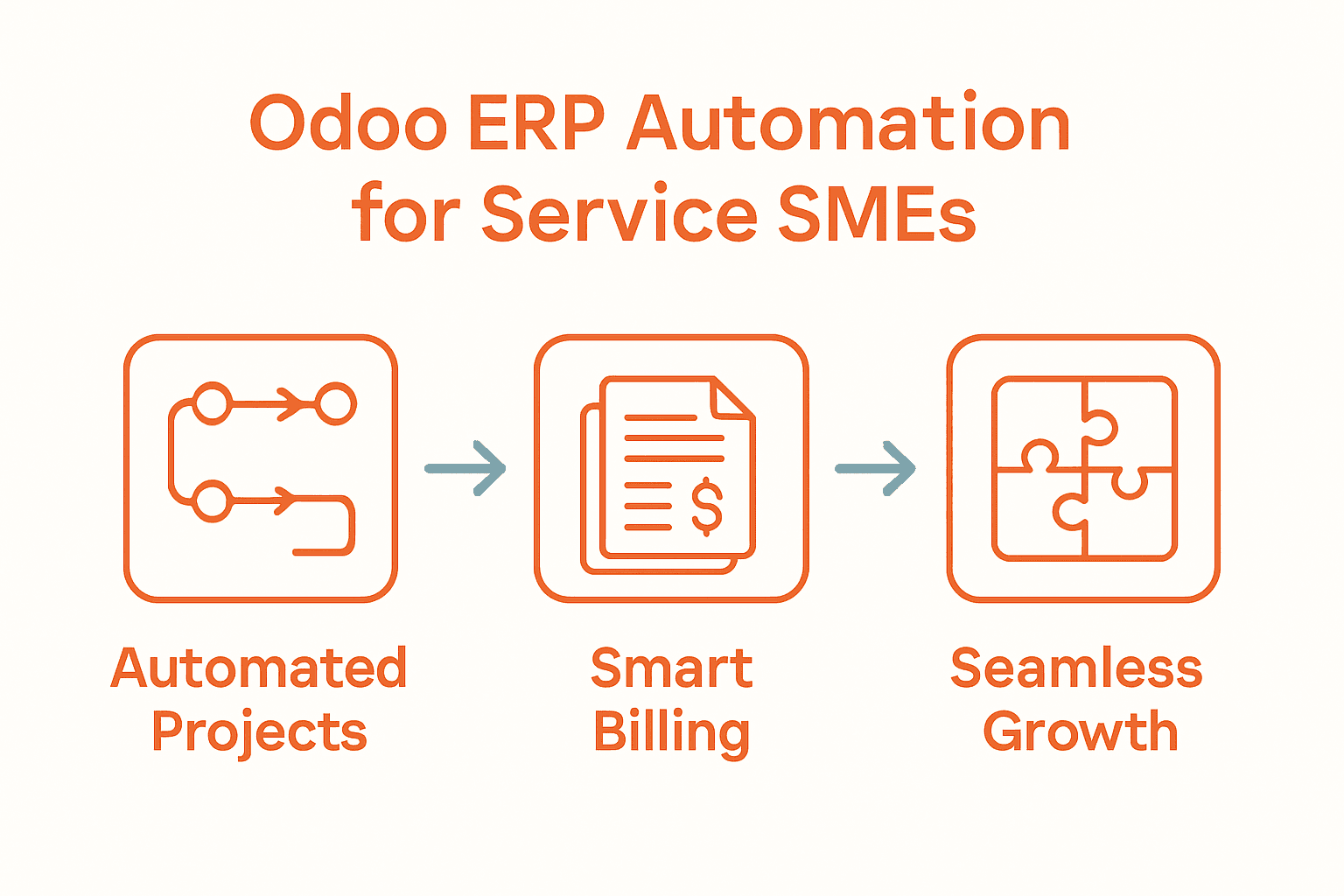
Infographic showing automated project flow, billing, scalability for Odoo ERP SMEs By implementing Odoo’s tax calculation modules, businesses can further streamline their financial processes, ensuring compliance and accurate tax reporting across different jurisdictions.

Integration Capabilities and Scalability Options

Odoo ERP stands out as a powerful platform that offers unparalleled integration capabilities designed to meet the evolving needs of service-based small and medium enterprises. Its modular architecture allows businesses to start with core functionalities and seamlessly expand their system as organizational requirements grow. Unlike traditional enterprise software that requires complex reimplementation, Odoo provides a flexible ecosystem where new modules can be added without disrupting existing workflows.

The platform’s integration prowess extends across multiple business domains, enabling smooth communication between different operational modules. Understanding ERP implementation phases becomes critical for businesses looking to maximize their technological investment. Odoo supports integrations with external systems through robust APIs and pre-built connectors, which means service organizations can:

  • Connect existing software infrastructure
  • Synchronize data across multiple platforms
  • Customize integrations for specific business needs
  • Maintain real-time data consistency
  • Reduce manual data transfer processes
  • Scale technological capabilities incrementally

Scalability represents another cornerstone of Odoo’s design philosophy. Whether a business is a small consulting firm or a growing service organization, the platform adapts to changing operational demands. Sales management tools complement the core ERP functionality, allowing businesses to add new user licenses, incorporate additional modules, and expand computational resources without significant technological disruption. This approach ensures that service SMEs can evolve their technological infrastructure organically, matching their growth trajectory with precise technological solutions.

Cost Considerations and Implementation Risks

Implementing an ERP system represents a significant strategic investment for service-based SMEs, with financial considerations extending far beyond initial software licensing costs. Odoo ERP offers a unique value proposition by providing a modular approach that allows businesses to minimize upfront expenses and scale their technological infrastructure incrementally. This flexible pricing model enables organizations to distribute implementation costs over time, reducing the financial burden typically associated with enterprise software deployments.

The primary implementation risks for service organizations revolve around data migration, user adoption, and potential operational disruptions. Understanding detailed ERP implementation costs becomes crucial for making informed technological investments. Potential challenges include:

  • Initial configuration and customization expenses
  • Training and change management costs
  • Potential productivity dips during system transition
  • Data integration and migration complexities
  • Ongoing maintenance and support fees
  • Potential hidden technical implementation expenses

Mitigating implementation risks requires a strategic approach that prioritizes comprehensive planning and phased rollout. Businesses should conduct thorough needs assessments, engage stakeholders early in the process, and develop realistic timelines that account for potential technical challenges. By working with experienced implementation partners like Bista Solutions, service SMEs can minimize potential disruptions, ensure smooth system integration, and maximize their return on technological investment through careful planning and expert guidance.

Avoiding Pitfalls in Project and Billing Automation

Automating project management and billing processes presents significant challenges for service organizations, with potential risks that can undermine operational efficiency and financial accuracy. Billing automation requires a strategic approach that addresses common implementation pitfalls, focusing on precise integration, data consistency, and robust workflow design. Odoo ERP provides sophisticated tools that help businesses mitigate these risks by creating seamless connections between project tracking, time reporting, and invoicing systems.

Understanding Odoo project management modules reveals critical strategies for avoiding automation challenges. The most common pitfalls that service businesses encounter include:

  • Inaccurate time tracking and reporting
  • Inconsistent billing rate configurations
  • Manual data reconciliation errors
  • Lack of real-time project cost visibility
  • Disconnected financial and operational workflows
  • Insufficient audit trail documentation

Mitigating these risks requires a comprehensive implementation strategy that prioritizes data integrity and workflow alignment. Exploring ERP implementation phases helps organizations develop a systematic approach to automation. By leveraging Odoo’s integrated timesheet and invoicing modules, businesses can create precise tracking mechanisms that automatically convert project hours into accurate billing documents, dramatically reducing human error and administrative overhead. Advanced integration techniques, such as connecting billing platforms, further enhance financial process reliability and transparency.

Unlock the Full Potential of Odoo ERP for Your Service SME

Transforming service business operations often comes with the challenge of automating complex workflows like project management, billing, and customer relationships. This article highlights key pain points such as data inconsistencies, manual billing errors, and the need for scalable automation solutions tailored to service SMEs. If you are striving to achieve seamless integration between timesheets, invoicing, and project tracking while reducing administrative overhead, Odoo ERP is the answer. However, to fully leverage these powerful capabilities and avoid common pitfalls, expert guidance is crucial.

At Bista Solutions, we specialize in delivering customized Odoo ERP implementations that help you increase operational efficiency and financial accuracy. As the largest Odoo ERP implementer in North America and a trusted Gold Partner recognized year after year, our team has deep expertise to support your unique needs. From integrating advanced project management modules to automating invoicing processes, we ensure your business achieves smooth automation with minimal disruption.

Ready to elevate your service operations with Odoo ERP?

Schedule A Free Odoo ERP Demo


    Connect with Bista Solutions today to start your tailored ERP journey and overcome implementation risks with confidence. Contact us now to experience expert support that keeps your business agile and ahead of the curve. Visit Contact Us and let’s build your streamlined, scalable future together.

    Frequently Asked Questions

    What is Odoo ERP for service SMEs?

    Odoo ERP is a comprehensive software solution tailored for service-based small and medium enterprises, designed to streamline daily operations and manage unique challenges in industries like field service and customer relationship management.

    How does Odoo’s project management module improve workflow efficiency?

    Odoo’s project management module allows service organizations to break down complex projects into manageable tasks, track progress in real-time, allocate resources effectively, and generate detailed reports, enhancing overall project efficiency.

    What are the benefits of automating billing processes with Odoo?

    Automating billing processes with Odoo saves administrative time, minimizes human error, and improves cash flow management by linking project timesheets directly to invoicing, ensuring accurate and transparent financial documentation.

    Is Odoo ERP scalable for growing businesses?

    Yes, Odoo ERP is designed with scalability in mind. Businesses can start with essential modules and add more functionalities as they grow without disrupting existing workflows, making it adaptable to changing operational demands.


    How to Streamline Workflow for Business Efficiency

    workflow management meeting

    Business inefficiency can quietly drain as much as 30 percent of a company’s annual revenue. Many leaders know something is slowing their teams but struggle to spot the real obstacles. Addressing workflow bottlenecks and streamlining tasks not only saves time and money but can also fuel company growth. This guide provides practical steps to help you uncover hidden process flaws, standardize operations, and implement changes that make a measurable impact.

    Table of Contents

    Quick Summary

    Key Point Explanation
    1. Identify Workflow Bottlenecks Early Assess current processes visually to find areas hindering productivity. Look for delays, piled-up tasks, and input from team members to pinpoint system issues.
    2. Create Comprehensive Workflow Maps Document each process step and interdependencies using visual diagrams to identify friction points and prioritize improvement areas.
    3. Emphasize Automation and Standardization Implement automation for repetitive tasks while standardizing processes to reduce errors and enhance performance consistency across the organization.
    4. Train and Engage Stakeholders Effectively Develop interactive training programs that help stakeholders understand new processes, fostering a culture of continuous improvement and feedback.
    5. Monitor, Review, and Optimize Continuously Establish ongoing performance tracking systems and regular review meetings to analyze data, engage teams, and implement incremental improvements.

    Step 1: Assess Current Processes and Identify Bottlenecks

    Identifying bottlenecks is the critical first step toward transforming your business workflow efficiency. In this section, you will systematically evaluate your current operational processes to pinpoint areas that slow down productivity and create strategic opportunities for improvement.

    To effectively assess your current processes, start by mapping out each workflow step visually. This means creating detailed process diagrams that show exactly how work moves through your organization. Pay close attention to transition points where work gets delayed or resources become constrained. Modern process analysis techniques like Business Process Model and Notation (BPMN) can help you create precise workflow visualizations that reveal hidden inefficiencies.

    Look for specific warning signs of workflow bottlenecks, such as consistently missed deadlines, tasks piling up at certain stages, uneven workload distribution, or team members feeling consistently overwhelmed. Track metrics like cycle time, wait time, and processing time to quantify where blockages occur. A practical approach is to interview team members directly involved in each process; they can often provide granular insights about friction points that data alone might miss.

    workflow assessment teamwork

    Pro Tip: When mapping processes, resist the temptation to blame individuals. Instead, view bottlenecks as systemic challenges that require collaborative solutions. Your goal is to understand the workflow holistically and create meaningful improvements that support your team.

    The next step after identifying bottlenecks will be developing targeted strategies to eliminate or minimize these constraints. By conducting this thorough assessment, you are laying the groundwork for significantly enhanced business efficiency.

    Step 2: Map Business Workflows and Prioritize Improvements

    Now that you have identified potential bottlenecks, the next critical phase is creating a comprehensive map of your business workflows and strategically prioritizing improvements. This step transforms your initial observations into actionable insights that can dramatically enhance organizational efficiency.

    Begin by documenting each process using visual workflow diagrams. Capture every step from initiation to completion, including decision points, handoff stages, and resource interactions. Workflow management systems can help you create detailed process maps that reveal intricate details about how work actually moves through your organization. Pay special attention to interdependencies between departments and potential points of friction that might not be immediately obvious.

    To prioritize improvements effectively, assess each workflow based on multiple criteria such as time consumption, cost impact, frequency of execution, and potential for optimization. Create a scoring matrix that ranks workflows by their strategic importance and potential return on investment.

    This approach helps you focus on high-leverage improvements that will deliver the most significant organizational benefits. Consider factors like customer experience, employee productivity, and overall business goals when determining which workflows to address first.

    Pro Tip: Remember that workflow mapping is not a one-time event but an ongoing process. Regularly review and update your process maps to ensure they remain accurate and aligned with evolving business needs. Encourage feedback from team members who are directly involved in executing these workflows.

    With your workflows mapped and prioritized, you are now prepared to design targeted improvement strategies that will streamline your business operations and drive meaningful efficiency gains.

    Step 3: Implement Automation Tools and Standardize Tasks

    With your workflows mapped and bottlenecks identified, you are now ready to transform your business processes through strategic automation and task standardization. This critical step will help you reduce manual effort, minimize errors, and create consistent performance across your organization.

    Start by identifying repetitive tasks that consume significant time and are prone to human error. AI-powered ERP solutions can help automate routine processes like data entry, reporting, and workflow routing. Look for opportunities to implement robotic process automation (RPA) technologies that can handle rule-based tasks with precision and speed. Consider tools that integrate seamlessly with your existing systems and provide clear analytics on process performance.

    To standardize tasks effectively, develop comprehensive process documentation that outlines exact steps, expected outcomes, and key performance indicators. Create detailed workflow templates that serve as blueprints for consistent execution. This approach ensures that every team member understands their role and follows a uniform approach. Utilize process simulation models that can help you predict potential bottlenecks and optimize task sequences before full implementation.

    Pro Tip: Automation is not about replacing human workers but empowering them. Focus on automating repetitive tasks that free up your team to concentrate on strategic thinking, creative problem solving, and high-value activities that drive business growth.

    By implementing automation tools and standardizing tasks, you are setting the stage for a more efficient, responsive, and agile business operation that can adapt quickly to changing market demands.

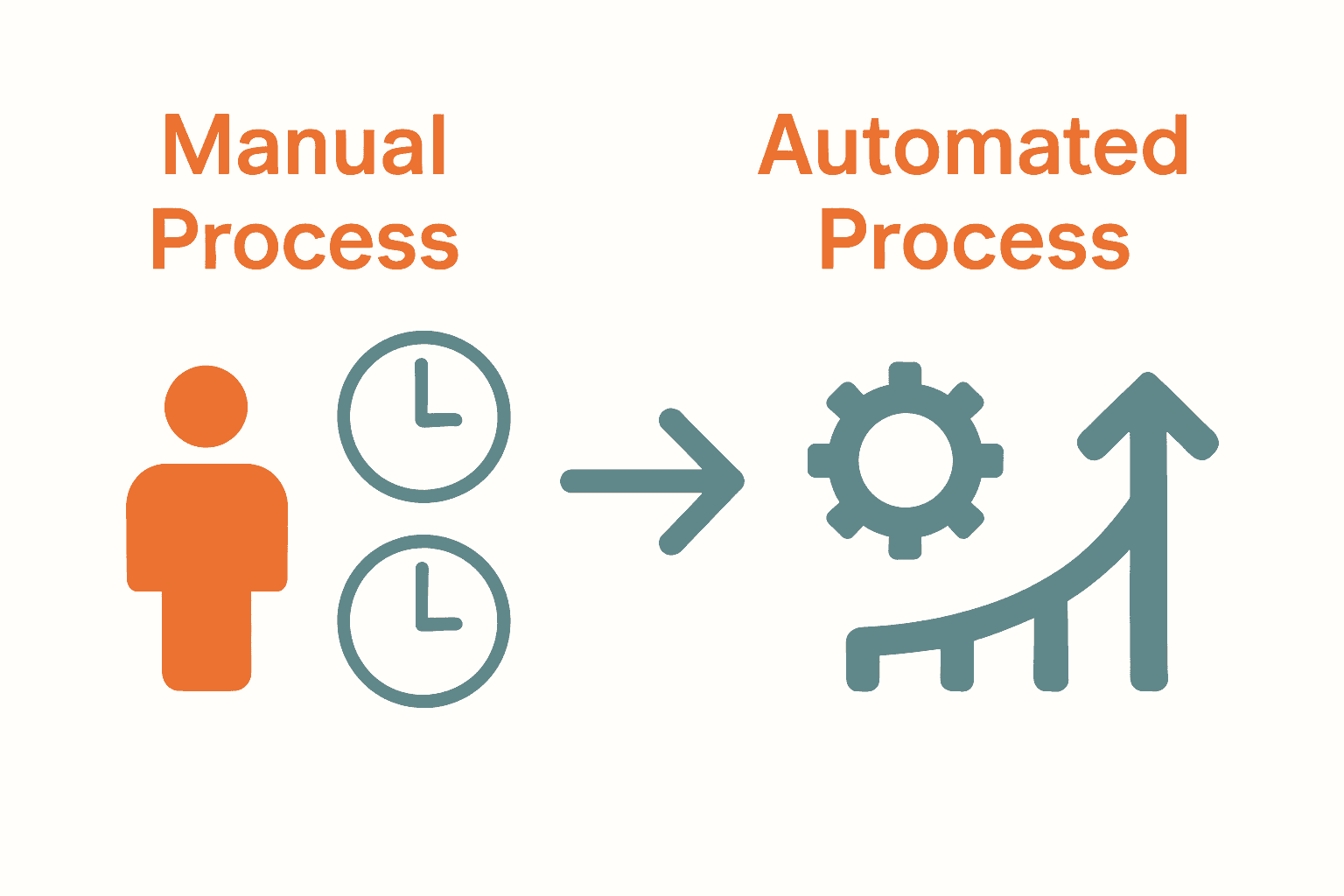
    Infographic comparing manual workflow to automated workflow with icons and arrows

    Step 4: Train Stakeholders and Integrate Best Practices

    With your workflow improvements designed and automation strategies in place, the next crucial phase is ensuring your entire organization understands and embraces these transformative changes. Training stakeholders and integrating best practices will be fundamental to turning your strategic plans into sustainable operational excellence.

    Develop a comprehensive training program that goes beyond simple instruction manuals. Create interactive workshops that help team members understand not just the how of new processes, but the why behind them. Draw inspiration from management narratives like ‘The Goal,’ which emphasize that successful process improvement is about developing a collective understanding of organizational constraints and opportunities. Use a mix of training methods, including hands-on demonstrations, video tutorials, live workshops, and ongoing support sessions to accommodate different learning styles.

    When integrating best practices, focus on creating a culture of continuous improvement rather than implementing rigid rules. Encourage feedback loops where team members can share insights about workflow challenges and potential optimizations. Establish clear communication channels that allow stakeholders at all levels to contribute to process refinement. Consider creating a dedicated change management team responsible for tracking implementation progress, gathering team feedback, and making iterative improvements to your workflow strategies.

    Pro Tip: Remember that successful training is not a one-time event but an ongoing journey. Schedule regular refresher sessions, create easily accessible reference materials, and develop mentorship programs that help team members continuously develop their skills and understanding of new processes.

    By investing time and resources in thorough stakeholder training and systematic best practice integration, you are building a resilient organizational culture that can adapt quickly and maintain high performance standards.

    Step 5: Monitor Outcomes and Optimize Continuously

    The final step in your workflow efficiency journey is establishing a robust system for continuous monitoring and optimization. This ongoing process transforms your initial improvements into a dynamic, adaptive business strategy that evolves with your organizational needs and market demands.

    Implement comprehensive performance tracking mechanisms that go beyond surface-level metrics. Utilize advanced process-aware monitoring systems that can analyze the intricate relationships between high-level business objectives and specific process instances. Business intelligence tools can help you create real-time dashboards that provide deep insights into workflow performance, highlighting areas of success and potential improvement. Focus on key performance indicators that directly relate to your strategic goals, such as cycle time reduction, cost savings, error rates, and employee productivity.

    Develop a structured approach to continuous optimization that turns data into actionable insights. Regular review meetings should involve cross-functional teams to discuss performance metrics, share observations, and collaboratively develop improvement strategies. Create a feedback mechanism that encourages team members at all levels to contribute process improvement suggestions. Implement an iterative optimization cycle where you continuously test small changes, measure their impact, and scale successful modifications across your organization.

    Pro Tip: Remember that optimization is not about achieving perfection but about creating a culture of incremental improvement. Be patient with the process and celebrate small wins that contribute to your overall organizational efficiency.

    By being committed to continuous monitoring and optimization, you are building a resilient and adaptive organization that can quickly respond to changing business landscapes and maintain a competitive edge.

    Unlock True Business Efficiency with Expert ERP Solutions

    Struggling with workflow bottlenecks and tedious manual tasks can drain your team’s energy and slow down your business growth. As detailed in “How to Streamline Workflow for Business Efficiency,” identifying and automating repetitive processes are key steps to reducing delays and empowering your staff to focus on what matters most. Achieving this requires the right technology partner who understands your unique challenges and delivers scalable, tailored solutions.


    Contact Us

      Bista Solutions stands ready to help you transform your operations. As North America’s largest Odoo ERP implementer and a multi-year Odoo Gold Partner, we bring deep expertise in automating workflows, standardizing tasks, and training your team for lasting success. Don’t let inefficiencies hold your business back any longer. Connect with our experts today for customized guidance and start your journey to agile, streamlined operations by visiting Contact Us. Explore how our AI-powered ERP solutions can revolutionize your workflows and see why organizations trust us to deliver measurable efficiency gains.

      Frequently Asked Questions

      How can I identify bottlenecks in my workflow?

      To identify bottlenecks, start by mapping out each workflow visually to see how work moves through your organization. Look for delayed transition points, missed deadlines, or tasks piling up, and gather insights from team members involved in each process.

      What steps should I take to map my business workflows?

      Begin by documenting each process, capturing every step from initiation to completion using visual workflow diagrams. Pay attention to interdependencies and friction points, and review these maps regularly to keep them updated.

      How can automation tools improve my workflow efficiency?

      Automation tools can streamline repetitive tasks, such as data entry and reporting, reducing manual effort and errors. Identify tasks that consume significant time and explore implementing robotic process automation to free up your team for more strategic work.

      What kind of training should I provide to my team on new workflows?

      Develop interactive training programs that focus not only on how to execute new processes but also on why those changes are beneficial. Use hands-on demonstrations and encourage feedback to ensure that team members fully understand and embrace the new workflows.

      How do I monitor and continuously optimize my workflow performance?

      Establish a performance tracking system that goes beyond surface metrics to include key performance indicators related to your strategic goals. Regularly review performance with cross-functional teams and create a feedback mechanism for ongoing process improvements, aiming to test and measure changes incrementally.

      What should I include in my process documentation for standardization?

      Your process documentation should detail the exact steps, expected outcomes, and key performance indicators for each task. Create workflow templates that provide clear guidance to ensure consistent execution across your team.

      Top Challenges SMEs Face Without an ERP — and How Odoo Solves Them

      SME manual processes office

      Most small and medium businesses lose up to 30 percent of their productive time each week because of manual processes and disjointed data management. These hidden inefficiencies can quietly erode profits, strain employees, and make growth feel impossible. Understanding how to identify operational pain points, assess workflow gaps, and match the right ERP solutions sets the stage for sustainable progress and a stronger, more agile business.

      Table of Contents

      Quick Summary

      Key Point Explanation
      1. Identify Operational Challenges Conduct an audit of current processes to find inefficiencies without an ERP system.
      2. Assess Data Management Gaps Evaluate how information is processed across departments to identify vulnerabilities needing improvement.
      3. Map Odoo Solutions Strategically Align Odoo modules with specific operational gaps for effective digital transformation.
      4. Implement Odoo Systematically Develop a strategic plan for Odoo implementation, ensuring clear communication and training for users.
      5. Verify Benefits Continuously Establish KPIs and a feedback mechanism to measure improvement and adapt the ERP system for ongoing success.

      Step 1: Identify Key Pain Points Without an ERP

      Identifying the critical operational challenges your small or medium enterprise encounters without an Enterprise Resource Planning (ERP) system requires a systematic and honest evaluation of your current business processes. This step helps you understand where manual workflows and disconnected systems are hampering your organizational efficiency and growth potential.

      Start by conducting a comprehensive internal audit across key business functions like finance, inventory management, human resources, and sales. Document the specific bottlenecks and inefficiencies you currently experience. Common pain points often include redundant data entry, limited visibility into real-time business metrics, complex manual reporting, and difficulties tracking inventory or managing interdepartmental communications. Understand the purpose of ERP systems to recognize how these challenges directly impact your operational productivity.

      To make this assessment more concrete, consider tracking specific metrics such as time spent on manual processes, frequency of data reconciliation errors, and estimated productivity losses. For instance, if your accounting team spends 15 hours per week manually transferring data between spreadsheets or your sales team struggles to generate accurate reports quickly, these are clear indicators that an integrated ERP solution could dramatically improve your operational efficiency. Remember that small businesses with limited IT resources often find ERP implementation challenging, so approaching this evaluation methodically will help you build a strong business case for digital transformation.

      As you document these pain points, you will begin to create a roadmap that highlights exactly where an integrated ERP system like Odoo can streamline your business operations and unlock new levels of organizational productivity.

      Step 2: Assess Gaps in Operations and Data Management

      Assessing operational and data management gaps requires a comprehensive evaluation of how your organization currently handles critical business information and processes. This step helps you identify vulnerabilities in your existing systems and pinpoint areas where technology can create meaningful improvements in efficiency and security.

      Begin by mapping out your current data workflows across different departments. Analyze how information moves between finance, sales, inventory, and human resources teams. Look for critical indicators of inefficient data management, such as manual data reentry, inconsistent reporting, lack of real-time information sharing, and potential cybersecurity risks. Learn more about ERP implementation phases to understand how an integrated system can address these challenges. Small and medium enterprises often face significant cybersecurity literacy limitations and financial constraints that make comprehensive data management difficult.

      Create a detailed audit document that highlights specific gaps in your current operational processes. Pay special attention to areas like data redundancy, information silos, manual reconciliation efforts, and potential security vulnerabilities. For instance, if your teams struggle with disparate spreadsheets, lack centralized reporting, or cannot quickly access critical business insights, these are clear signs that your current system needs improvement. Understanding these gaps will help you build a strategic roadmap for implementing an ERP solution that can streamline operations, enhance data security, and provide the integrated visibility your business needs to grow and compete effectively in today’s dynamic market environment.

      By methodically documenting these operational and data management challenges, you will create a compelling case for digital transformation and position your organization to leverage technology as a true strategic advantage.

      business data management gaps

      Step 3: Map Odoo Solutions to Business Challenges

      Mapping Odoo solutions to your specific business challenges requires a strategic approach that connects your identified operational gaps with targeted technological solutions. This step transforms your previous assessment into a precise roadmap for digital transformation by matching Odoo’s comprehensive modules to your unique business needs.

      Begin by creating a detailed comparison matrix that aligns each operational challenge you documented with the corresponding Odoo module or functionality. Explore Odoo Field Service solutions to understand how specific apps can address your unique business requirements. For example, if your previous assessment revealed challenges in inventory management, explore how Odoo’s warehouse management module can provide real-time tracking, automated reordering, and seamless integration across your supply chain. Similar to case studies of companies like Danfresh and Ardent Mills, which successfully implemented Odoo to streamline their supply chain and inventory management, you can identify precise solutions that directly address your operational inefficiencies.

      Prioritize your mapping by focusing on modules that offer the most immediate and significant impact on your business operations. Consider not just current challenges but also potential future growth scenarios. Look for Odoo modules that provide scalability and flexibility, allowing your technological solution to evolve alongside your business. Pay special attention to integration capabilities, ensuring that the selected modules can communicate seamlessly across different departments. This approach will help you develop a comprehensive ERP strategy that not only resolves existing operational bottlenecks but also creates a foundation for future business expansion and technological innovation.

      By methodically mapping Odoo solutions to your specific business challenges, you will create a tailored technological ecosystem that enhances efficiency, provides actionable insights, and positions your organization for sustainable growth.

      Step 4: Implement Odoo for Integrated Process Improvement

      Implementing Odoo for integrated process improvement requires a systematic and strategic approach that transforms your business operations through thoughtful technological integration. This step involves translating your carefully mapped solution requirements into a practical implementation plan that will enhance organizational efficiency and productivity.

      Explore the 9 phases of ERP implementation to understand the comprehensive journey of integrating an ERP system into your business workflow. Begin by assembling a dedicated implementation team that includes key stakeholders from different departments. This cross functional team will help ensure that the Odoo implementation addresses specific needs across finance, sales, inventory, and human resources. Prioritize clear communication and establish realistic timelines that allow for proper training, data migration, and gradual module integration. Create a phased rollout strategy that minimizes disruption to existing operations while systematically introducing new technological capabilities.

      Focus on comprehensive user training and change management to guarantee smooth adoption across your organization. Develop detailed documentation and conduct multiple training sessions that help employees understand how the new Odoo modules will improve their daily workflows. Consider working with an experienced Odoo implementation partner who can provide guidance on best practices and help customize the solution to your specific business requirements. Schedule regular check-ins and feedback sessions during the implementation process to address any challenges quickly and ensure the solution continues to meet your evolving business needs.

      By approaching Odoo implementation as a strategic transformation rather than a simple software installation, you will create a robust technological foundation that supports your current operations and positions your organization for future growth and innovation.

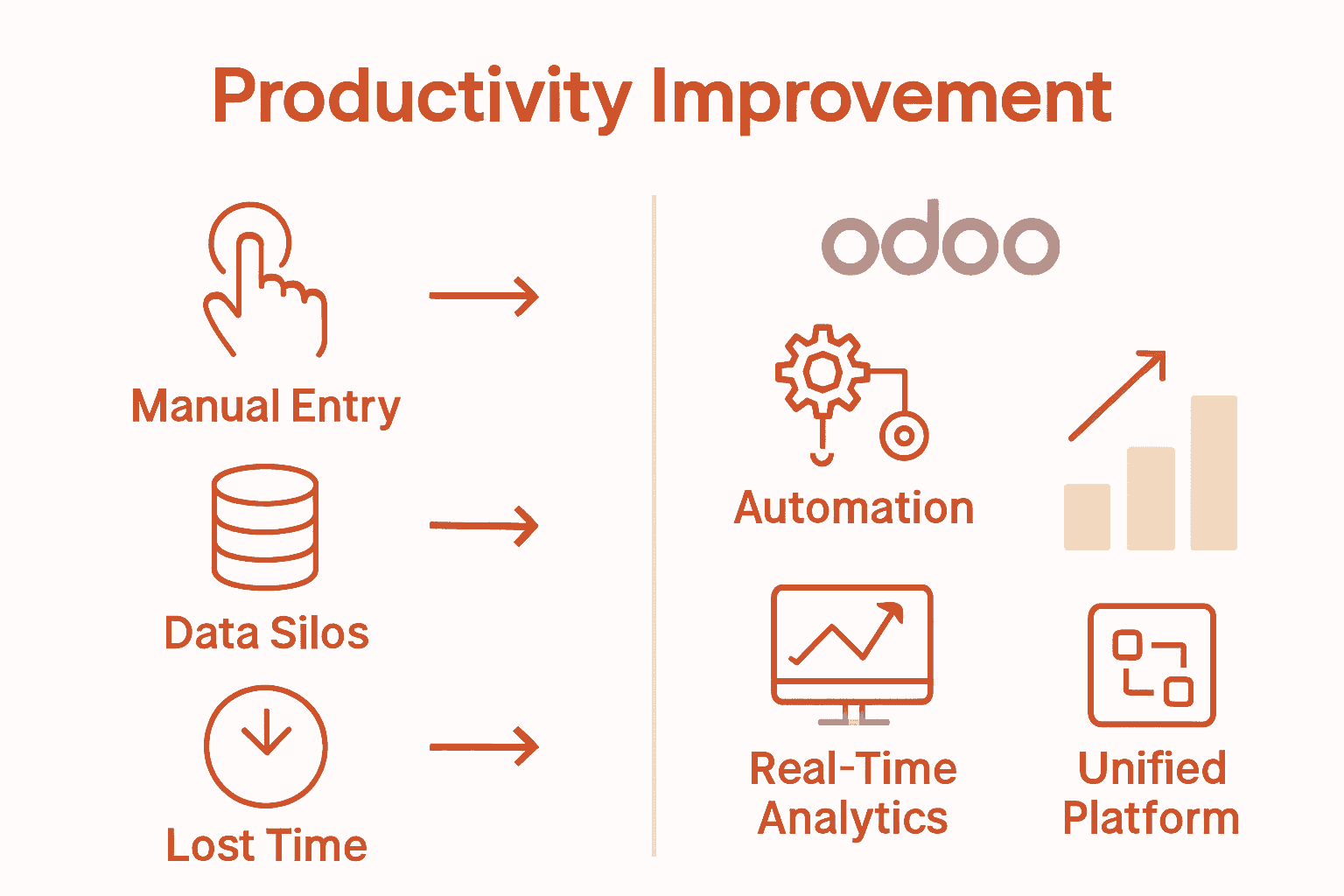
      Infographic comparing SME pain points without ERP to benefits of Odoo

      Step 5: Verify Benefits and Optimize for Ongoing Success

      Verifying the benefits of your Odoo implementation and establishing a continuous optimization strategy is crucial for transforming your initial investment into long term business value. This step focuses on measuring actual performance improvements and creating a framework for ongoing system refinement and adaptation.

      Learn how to secure your small business technology infrastructure to protect your newly implemented ERP system. Begin by establishing clear key performance indicators (KPIs) that align with your original implementation goals. Similar to the building automation systems manufacturer in Abu Dhabi who streamlined operations through Odoo, track specific metrics such as reduced processing times, decreased operational costs, improved inventory accuracy, and enhanced reporting capabilities. Conduct regular performance reviews with your implementation team to assess how well the Odoo modules are meeting your business objectives. Create a structured feedback mechanism that allows employees from different departments to share their experiences and suggest potential improvements.

      Develop a continuous improvement plan that includes periodic system audits, software updates, and module evaluations. Schedule quarterly review sessions to assess the ERP systems performance and identify areas for potential customization or additional feature integration. Consider working with your Odoo implementation partner to explore advanced configurations or new modules that can provide additional value as your business evolves. Pay special attention to user adoption rates and provide ongoing training to ensure your team continues to leverage the full potential of the Odoo platform.

      By treating your Odoo implementation as an evolving ecosystem rather than a one time project, you will create a dynamic technological foundation that grows and adapts alongside your business, consistently delivering increased efficiency and strategic insights.

      Transform Your SME Challenges into Growth Opportunities with Odoo and Bista Solutions

      Running a small or medium enterprise without an integrated ERP system often means dealing with inefficiencies like manual data entry, lack of real-time insights, and fractured communication across departments. These pain points slow down your growth and make scaling difficult. The article highlights exactly how Odoo’s modular approach can solve these problems by streamlining operations and providing a unified platform for all your business functions.

      At Bista Solutions, we understand these challenges deeply and are here to help you turn them into strengths. As the largest Odoo ERP implementer in North America and a trusted Odoo Gold Partner, we offer tailored solutions designed to meet your unique business needs and support you through every phase of ERP adoption. Our team of experts ensures a smooth implementation that empowers your teams and drives measurable improvements.


      Schedule A One-on-One Free Consultation With Our Experts

        Don’t let operational hurdles hold your business back. Take the first step toward seamless integration and growth by connecting with us today. Explore how our proven expertise can help you leverage Odoo to its fullest potential. Visit Contact Us now and start your transformation journey with Bista Solutions.

        Frequently Asked Questions

        What are the main challenges SMEs face without an ERP system?

        Without an ERP system, SMEs often struggle with manual processes, data silos, and poor visibility into real-time metrics. Assess your current operations to identify redundant data entry and reporting inefficiencies, which can hinder growth and decision-making.

        How can Odoo improve operational efficiency for SMEs?

        Odoo can improve operational efficiency by streamlining processes across finance, inventory, and sales through integrated modules. Begin by mapping your specific business needs to Odoo’s functionalities to automate repetitive tasks and enhance accuracy within 30-60 days.

        How do I assess the gaps in my current operations before implementing Odoo?

        Assessing your operational gaps involves mapping out current data workflows and identifying inefficiencies like manual reentry and inconsistent reporting. Create a detailed audit of these gaps to understand how Odoo can specifically address your organization’s needs.

        What steps should I follow to implement Odoo in my SME?

        To implement Odoo, assemble a cross-functional team and establish a phased rollout strategy to minimize disruption. Begin with user training and data migration, aiming to complete the initial implementation within 3-6 months.

        How can I measure the benefits of Odoo after implementation?

        Measure the benefits of Odoo by establishing clear key performance indicators (KPIs) aligned with your business goals. Conduct regular reviews on metrics like processing times and cost reductions to evaluate improvements yearly.

        What ongoing practices should I adopt for optimizing Odoo post-implementation?

        Develop a continuous improvement plan, including regular system audits and user feedback sessions. Schedule quarterly reviews to assess system performance and adapt the ERP functionalities to evolving business needs.

        ERP Myths Small Businesses Still Believe: Odoo Facts

        small business ERP

        Many small business owners still believe that Enterprise Resource Planning systems are only for industry giants. Yet, over 60 percent of ERP adopters today are businesses with fewer than 250 employees. Misunderstandings about cost, complexity, and disruption often prevent companies from realizing how ERP solutions can streamline processes and improve decision-making. Uncovering the truth about ERP systems can help you recognize how modern tools empower growth and free you from outdated limitations.

        Table of Contents

        Key Takeaways

        Point Details
        ERP is for all businesses Modern ERP systems like Odoo are designed to be scalable and flexible, making them suitable for small and large enterprises alike.
        Cost-effective solutions ERP systems can be implemented incrementally with flexible pricing models, dispelling myths about prohibitive costs.
        User-friendly interfaces Odoo ERP features intuitive designs that require minimal training, allowing for easy adoption by small teams.
        Customization is feasible Odoo’s modular architecture allows for tailored solutions that meet the unique needs of each business without excessive costs.

        Understanding ERP Systems and Common Misconceptions

        Enterprise Resource Planning (ERP) systems represent a pivotal technological investment that many small businesses misunderstand. ERP solutions are not just complex software packages reserved for large corporations, but strategic tools designed to streamline operations, enhance productivity, and provide real-time insights across multiple business functions.

        Contrary to popular belief, modern ERP systems, like signs you might need an ERP system, are flexible, scalable, and tailored to meet the unique needs of businesses across different sizes and industries. Small business owners often harbor misconceptions that ERP implementation is prohibitively expensive, overly complicated, or disruptive to existing workflows.

        The reality is that ERP systems offer modular approaches that allow businesses to implement solutions incrementally. Key misconceptions include:

        • ERP is only for large enterprises
        • Implementation requires a massive upfront investment
        • ERP systems are too complex for small teams
        • Customization is impossible or extremely costly

        At Bista Solutions, we understand that each business has unique operational requirements. Our Odoo ERP implementations are designed to be adaptive and user-friendly, ensuring seamless integration without overwhelming your existing team structure. By debunking these myths, we help small businesses recognize ERP as a powerful tool for growth and operational efficiency.

        Bista Solutions offers comprehensive ERP solutions that transform how small businesses manage their operations. Learn more about ERP implementation phases to understand how a strategic approach can revolutionize your business processes.

        Types of ERP Myths Facing Small Businesses

        Small businesses often encounter numerous misconceptions about Enterprise Resource Planning (ERP) systems that prevent them from leveraging these powerful technological solutions.

        These myths create unnecessary barriers and limit potential operational improvements, ultimately hindering business growth and efficiency.

        One prevalent myth is that ERP implementation is exclusively designed for large corporations with extensive financial resources. In reality, modern ERP solutions like Odoo offer scalable and adaptable platforms that can be customized to fit businesses of all sizes. Discover how AI and intelligent automation can boost business efficiency and transform your operational capabilities without breaking the bank.

        The most common ERP myths small businesses encounter include:

        • Cost Misconception: Believing ERP systems are prohibitively expensive
        • Complexity Myth: Assuming ERP implementations are too complicated for small teams
        • Customization Limitation: Thinking ERP solutions cannot be tailored to unique business needs
        • Integration Challenge: Fearing significant disruption to existing workflows

        Understanding the financial aspects is crucial in dispelling these myths. Exploring comprehensive ERP implementation cost breakdowns reveals that modern ERP solutions offer flexible pricing models and incremental implementation strategies. At Bista Solutions, we specialize in demystifying these misconceptions by providing transparent, cost-effective ERP solutions that align with your specific business requirements and growth objectives.

        Infographic debunking four ERP myths for small businesses

        How Odoo Addresses ERP Implementation Challenges

        Enterprise Resource Planning (ERP) implementation can be a complex and daunting process for small businesses, with numerous potential pitfalls that can derail digital transformation efforts. Odoo ERP stands out as a revolutionary solution that directly tackles the most common challenges faced by organizations during system integration and digital modernization.

        Why choose Odoo ERP as your software solution becomes clear when examining its unique approach to addressing traditional ERP implementation obstacles. The platform’s modular design allows businesses to start small and scale incrementally, eliminating the overwhelming financial and operational barriers that typically prevent small businesses from adopting comprehensive ERP systems.

        Key challenges Odoo systematically resolves include:

        ERP cost flexibility

        • Cost Complexity: Offering flexible, pay-as-you-go pricing models
        • Customization Limitations: Providing extensive configurability and an app ecosystem
        • Integration Difficulties: Ensuring seamless connectivity across business functions
        • User Adoption Barriers: Delivering intuitive, user-friendly interfaces

        Understanding the financial constraints of small businesses, Odoo’s approach revolutionizes traditional ERP implementation. By leveraging an open-source model with cloud and on-premise options, businesses can avoid crushing licensing fees while maintaining the flexibility to grow and adapt. Explore Bista Solutions’ comprehensive ERP services to see how we help businesses transform their operational capabilities without breaking the bank.

        Real-World Results: Odoo in Small Business Environments

        Small businesses often struggle to find technology solutions that truly understand and adapt to their unique operational challenges. Odoo ERP emerges as a game-changing platform that demonstrates remarkable real-world effectiveness across diverse small business environments, providing scalable and flexible solutions that transform operational capabilities.

        Exploring the Odoo Community, designed for small businesses, reveals a powerful ecosystem that addresses the specific needs of smaller organizations. Unlike traditional ERP systems that overwhelm small teams with complex interfaces and expensive implementations, Odoo offers modular, intuitive solutions that can be tailored precisely to each business’s unique workflow and budget constraints.

        Key real-world advantages for small businesses include:

        • Rapid Deployment: Quick implementation with minimal operational disruption
        • Cost-Effective Scaling: Flexible pricing models that grow with your business
        • Comprehensive Functionality: Integrated modules covering multiple business processes
        • User-Friendly Interface: Intuitive design requiring minimal training
        • Customization Potential: Adaptable solutions for unique business requirements

        Our implementation approach focuses on practical, measurable outcomes. Compare Odoo’s accounting features with other ERP solutions to understand how targeted technological interventions can dramatically improve financial management, reporting accuracy, and overall business efficiency. Bista Solutions specializes in transforming small business potential through strategic, thoughtful Odoo ERP implementations that deliver tangible, sustainable growth.

        Costs, ROI, and Alternatives to Odoo ERP

        Navigating the complex landscape of Enterprise Resource Planning (ERP) solutions requires a strategic approach to understanding total cost of ownership, return on investment, and potential alternatives. Odoo stands out as a uniquely positioned platform that offers unprecedented flexibility and cost-effectiveness for businesses seeking comprehensive technological solutions.

        Comparing Odoo with alternative ERP systems like Sage reveals significant advantages in terms of scalability, customization, and overall value proposition. While traditional ERP solutions often lock businesses into expensive, rigid frameworks, Odoo provides a modular approach that allows companies to invest incrementally and adapt their technological infrastructure as they grow.

        Key considerations for evaluating Odoo’s cost-effectiveness include:

        • Initial Investment: Significantly lower than traditional enterprise solutions
        • Scalability: Pay only for modules you actually need
        • Customization: Reduced development costs through open-source architecture
        • Maintenance: Lower ongoing support and upgrade expenses
        • Implementation: Faster deployment with minimal disruption

        Explore Odoo’s OpenERP capabilities for comprehensive business requirements to understand how strategic technology investments can transform operational efficiency. Bista Solutions specializes in helping businesses maximize their technological ROI by providing tailored Odoo implementations that deliver measurable, sustainable business value.

        Break Free from ERP Myths and Unlock Your Business Potential Today

        Small businesses often feel overwhelmed by myths that ERP systems are too costly or complicated. If you have doubted whether ERP solutions like Odoo can be simple, scalable, and tailored to your unique workflows, you are not alone. These misconceptions can hold your business back from achieving true operational efficiency and growth. Understanding the reality behind ERP implementation can transform how you run your company and save you time and money.

        At Bista Solutions, we specialize in clearing the fog around ERP myths with proven, flexible Odoo solutions designed specifically for small businesses. Backed by over 350 successful implementations and recognized as the top Odoo Gold Partner in North America, we deliver cutting-edge, scalable ERP systems that grow with you. Our experts work closely with your team to ensure seamless integration without disrupting daily operations.

        Take the next step toward making informed, confident decisions for your business. Discover how tailored Odoo ERP solutions can drive measurable results and break down costly barriers by exploring our insights on ERP implementation phases and Odoo as the ideal software solution.


        Contact Us

          Ready to debunk ERP myths and embrace a smarter future for your business? Contact Bista Solutions today and start your journey toward a streamlined, cost-effective ERP transformation. Reach out now at https://bistasolutions.com/contact-us to connect with our expert team, who will tailor the perfect solution for your unique needs.

          Frequently Asked Questions

          What are the common misconceptions about ERP systems for small businesses?

          Many small businesses believe that ERP systems are only for large enterprises, require massive upfront investments, are too complex for small teams, and cannot be customized to their unique needs.

          How does Odoo ERP differ from traditional ERP solutions?

          Odoo ERP offers a modular design, allowing small businesses to implement solutions incrementally, which contrasts with traditional ERP systems that often require expensive, rigid implementations.

          What are the key benefits of using Odoo ERP for small businesses?

          Key benefits include rapid deployment with minimal disruption, cost-effective scaling, comprehensive functionality across various business processes, a user-friendly interface, and high customization potential.

          How can small businesses evaluate the cost-effectiveness of Odoo ERP?

          Small businesses should consider the total cost of ownership, including initial investment, scalability, ongoing maintenance costs, and the time required for implementation, all of which are generally lower with Odoo than with traditional ERP systems.

          How Odoo ERP Empowers SMEs to Compete Globally

          global business teamwork

          More than 80 percent of small and medium businesses struggle to find a business management platform that grows with them. Without the right tools, daily operations can quickly become chaotic and time-consuming. Odoo ERP stands out as an integrated solution built to streamline processes, adapt to unique business needs, and provide enterprise-level efficiency without the typical complexity or cost. Discover how this flexible system turns technology into a real advantage for growing companies.

          Table of Contents

          Key Takeaways

          Point Details
          Modular Flexibility Odoo ERP’s modular design allows SMEs to start with essential tools and easily scale by adding functionalities that fit their growth needs.
          Cost Efficiency Odoo effectively reduces software licensing and operational costs, transforming technology expenditures into strategic investments that drive growth.
          Integration and Customization The platform offers seamless integration across functionalities and customizable modules, enabling businesses to tailor solutions to their unique operational challenges.
          Strategic Implementation Successful Odoo implementation requires a holistic approach, prioritizing stakeholder engagement, training, and alignment with broader business strategies to maximize technological benefits.

          Defining Odoo ERP and Its Core Functions

          Odoo ERP represents a comprehensive business management software platform designed to empower small and medium enterprises (SMEs) with powerful, integrated tools for streamlining operations. Unlike traditional rigid enterprise solutions, Odoo offers a flexible, modular approach that allows businesses to customize their technological infrastructure precisely to their unique needs. At its core, Odoo provides an open-source ecosystem that combines multiple business applications into a single, cohesive system.

          The software’s architecture is built around a three-tier framework written in Python, enabling businesses to install specific modules that address their precise operational requirements. Explore Odoo’s community edition for small businesses seeking adaptable technological solutions. Odoo’s core modules cover a wide range of critical business functions, including:

          • Customer Relationship Management (CRM)
          • Sales Management
          • Inventory Control
          • Accounting and Financial Reporting
          • Manufacturing Operations
          • Project Management
          • E-commerce Integration
          • Warehouse Management

          What sets Odoo apart from traditional ERP systems is its remarkable flexibility and scalability. Businesses can start with basic modules and progressively add more complex functionalities as they grow. Learn more about Odoo Sales Management to understand how granular and precise these tools can be. The platform supports both Community (open-source) and Enterprise editions, allowing organizations to choose the implementation that best matches their budget, complexity, and strategic objectives.

          Through its comprehensive suite of integrated applications, Odoo transforms how SMEs approach technological infrastructure. Rather than viewing technology as a complex, expensive burden, Odoo positions digital tools as accessible, adaptable allies in business growth. By providing an intuitive, modular system that can scale alongside a company’s ambitions, Odoo democratizes advanced enterprise resource planning for businesses of all sizes.

          Critical Odoo ERP Features for SMEs Growth

          For small and medium enterprises seeking technological transformation, Odoo ERP offers a comprehensive suite of features designed to accelerate business growth and operational efficiency. The platform’s modular architecture allows SMEs to implement precise technological solutions that directly address their unique operational challenges. By providing an integrated ecosystem of business applications, Odoo enables companies to streamline processes, reduce manual work, and make data-driven strategic decisions.

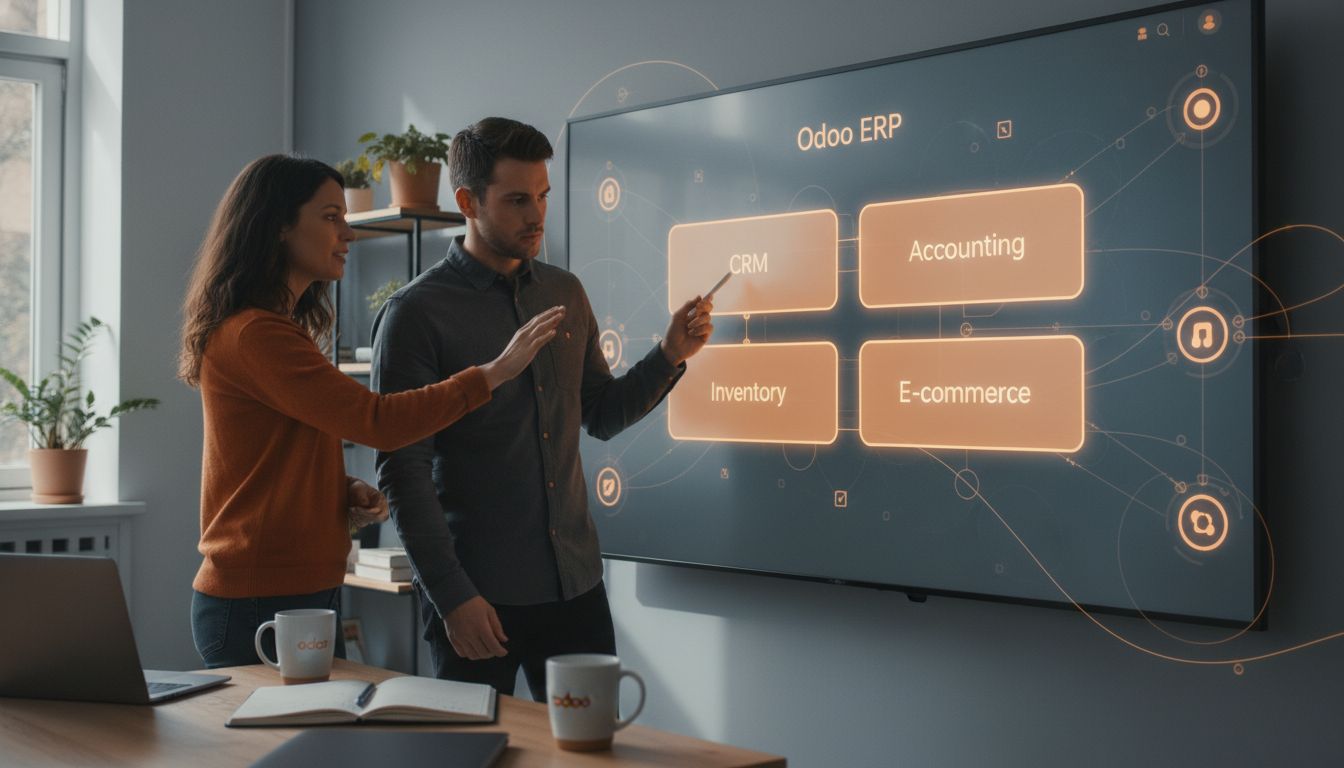
          odoo erp modules

          The core features of Odoo ERP that empower SME growth include robust modules across critical business domains. Discover advanced sales application features to understand how granular these tools can be. Key capabilities encompass:

          • Integrated Inventory Management
          • Advanced Sales Tracking
          • Real-time Financial Reporting
          • Comprehensive Customer Relationship Management
          • Automated Project Management
          • Seamless E-commerce Integration
          • Flexible Point of Sale systems
          • Customizable Accounting Tools

          What distinguishes Odoo from traditional enterprise solutions is its remarkable adaptability and scalability. SMEs can start with basic modules and progressively expand their technological infrastructure as business needs evolve. Learn how Odoo CRM can transform sales strategies to understand the platform’s strategic potential. The modular design ensures businesses only invest in functionalities they require, making enterprise-grade technology accessible and affordable.

          By connecting previously siloed business processes into a unified platform, Odoo empowers SMEs to compete more effectively in complex market landscapes. The software transforms technological infrastructure from a potential burden into a strategic asset, enabling smaller organizations to leverage the same sophisticated tools used by large enterprises. Through intelligent automation, real-time insights, and flexible configurations, Odoo provides SMEs with the technological foundation needed to drive sustainable growth and operational excellence.

          Integration, Scalability, and Customization Benefits

          Odoo ERP revolutionizes business technology by offering unprecedented integration capabilities that transform how small and medium enterprises manage their operational ecosystem. Unlike traditional rigid software solutions, Odoo provides a flexible platform that seamlessly connects diverse business functions into a unified, intelligent system. This holistic approach enables companies to break down technological silos, ensuring smooth communication across departments and creating a more responsive, data-driven organizational structure.

          The platform’s remarkable scalability stands out as a game-changing feature for growing businesses. Explore the advantages of open-source ERP implementation to understand how flexible technological infrastructure can drive business growth. Key integration benefits include:

          • Centralized Data Management
          • Real-time Cross-Department Synchronization
          • Automated Process Workflows
          • Seamless Module Interconnectivity
          • Flexible Custom Module Development
          • Unified Reporting Systems
          • Adaptable Business Logic Configuration
          • Streamlined Operational Communication

          Customization represents another critical advantage of the Odoo ecosystem. The platform’s open-source architecture allows businesses to tailor modules precisely to their unique operational requirements. Whether a company needs specialized inventory tracking, unique sales reporting, or industry-specific workflow configurations, Odoo provides the technological foundation to create bespoke solutions. Learn about cloud ERP implementation benefits to gain deeper insights into modern enterprise technological strategies.

          Ultimately, Odoo’s integration, scalability, and customization capabilities democratize advanced technological solutions for businesses of all sizes. By providing a modular, adaptable platform that grows alongside organizational needs, Odoo transforms enterprise resource planning from a complex technological challenge into a strategic competitive advantage. Small and medium enterprises can now leverage sophisticated tools previously accessible only to large corporations, creating a more level playing field in increasingly complex global markets.

          Cost Efficiency and Return on Investment Analysis

          For small and medium enterprises, financial optimization is not just a goal but a survival strategy. Odoo ERP emerges as a powerful solution that transforms technological investment from a cost center into a strategic revenue generator. By consolidating multiple business functions into a single, integrated platform, Odoo dramatically reduces the expenses associated with maintaining disparate software systems, purchasing multiple licenses, and managing complex technological infrastructures.

          Learn about the financial advantages of open-source ERP solutions to understand the profound economic impact of intelligent software selection. The cost efficiency of Odoo can be broken down into several key areas:

          • Reduced Software Licensing Costs
          • Elimination of Multiple System Integrations
          • Minimized Manual Data Entry Expenses
          • Decreased IT Infrastructure Overhead
          • Lower Training and Onboarding Expenses
          • Improved Operational Productivity
          • Enhanced Decision-Making Speed
          • Streamlined Resource Allocation

          The return on investment for Odoo extends far beyond immediate financial savings. Explore cloud ERP implementation benefits to gain deeper insights into long-term strategic advantages. By automating complex business processes, reducing human error, and providing real-time insights, Odoo enables businesses to make faster, more informed decisions. This translates into tangible financial benefits: reduced operational costs, increased revenue opportunities, and a more agile organizational structure capable of responding quickly to market changes.

          Ultimately, Odoo represents more than just a cost-efficient technology solution. It is a strategic investment that empowers small and medium enterprises to compete on a global scale. By democratizing access to sophisticated enterprise tools, Odoo levels the playing field, allowing businesses with limited resources to implement the same advanced technological strategies used by large corporations. The result is a transformative approach to business technology that turns cost centers into value generators, enabling sustainable growth and competitive advantage.

          Comparing Odoo ERP to Enterprise Solutions

          Traditional enterprise solutions have long been characterized by complex, rigid architectures that create significant barriers for small and medium enterprises seeking advanced technological capabilities. Odoo ERP fundamentally disrupts this paradigm by offering a flexible, accessible platform that delivers enterprise-grade functionality without the astronomical costs and implementation challenges associated with legacy systems. Where traditional enterprise solutions demand extensive customization, lengthy implementation periods, and substantial upfront investments, Odoo provides a more agile, cost-effective alternative.

          Explore the comprehensive comparison between Odoo and other ERP solutions to understand the nuanced differences in technological approach. Key distinguishing factors between Odoo and traditional enterprise solutions include:

          • Modular Flexibility
          • Lower Total Cost of Ownership
          • Faster Implementation Timelines
          • More Intuitive User Experience
          • Open-Source Customization Capabilities
          • Reduced Infrastructure Requirements
          • Seamless Scalability
          • Enhanced Integration Potential

          Unlike traditional enterprise solutions that often require businesses to adapt their processes to the software, Odoo reverses this dynamic by allowing unprecedented customization. Find the best ERP solution for your specific business needs to understand how technological infrastructure can be tailored to your unique operational requirements. The platform’s open-source architecture means businesses can modify and extend functionality without being locked into restrictive vendor ecosystems, a critical advantage for organizations seeking technological agility.

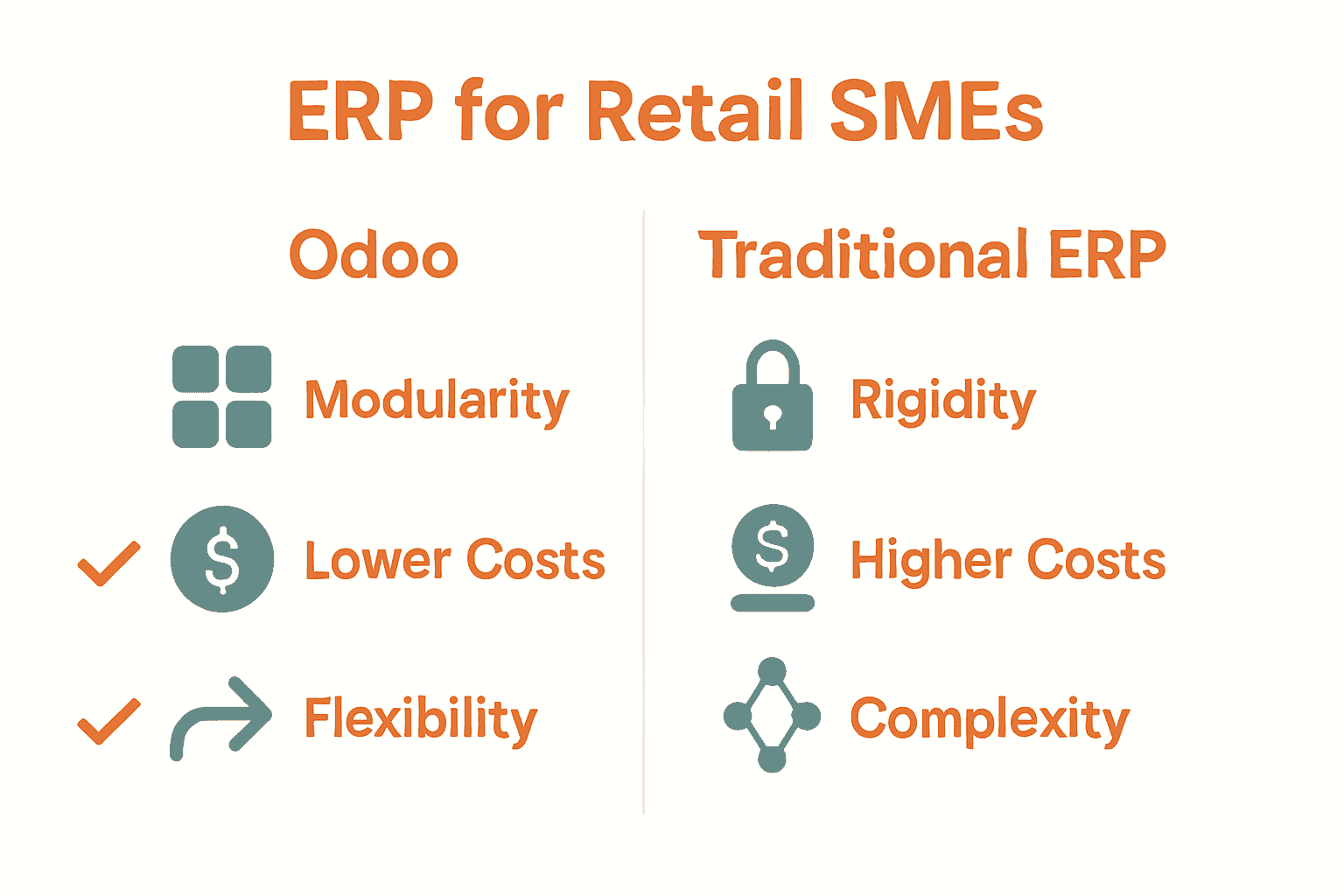
          Comparison of Odoo ERP and traditional enterprise solutions for SMEs

          Ultimately, Odoo represents a paradigm shift in enterprise resource planning. By democratizing sophisticated technological capabilities and removing traditional barriers to entry, the platform enables small and medium enterprises to leverage the same powerful tools previously accessible only to large corporations. The result is a more level playing field where innovative businesses can compete globally, unencumbered by the limitations of legacy technological infrastructure. Odoo transforms enterprise solutions from a complex, expensive investment into a strategic, adaptable asset that grows alongside organizational ambitions.

          Common Implementation Mistakes and How to Avoid Them

          Implementing an Enterprise Resource Planning system like Odoo is a complex journey that demands strategic planning and organizational alignment. Many small and medium enterprises stumble during ERP implementation by approaching the process as a simple technological upgrade rather than a comprehensive business transformation. Successful Odoo ERP implementation requires more than just installing software – it demands a holistic approach that considers technological capabilities, organizational culture, and strategic objectives.

          Discover ERP implementation best practices to understand the nuanced challenges businesses encounter. The most common implementation mistakes include:

          • Insufficient Stakeholder Engagement
          • Neglecting Comprehensive Training Programs
          • Overlooking Business Process Reengineering
          • Poor Change Management Strategies
          • Unrealistic Implementation Timeline Expectations
          • Inadequate Data Migration Planning
          • Minimal Customization Consideration
          • Weak Performance Measurement Frameworks

          Proper preparation becomes the cornerstone of successful Odoo ERP implementation. Learn how to select the best ERP solution for your business to mitigate potential risks and maximize technological investment. Organizations must recognize that ERP implementation is not just an IT project but a strategic initiative requiring cross-functional collaboration, clear communication, and a commitment to continuous learning and adaptation.

          Ultimately, avoiding implementation pitfalls requires a proactive, structured approach. Businesses must view Odoo ERP not as a one-time technological intervention but as an ongoing journey of digital transformation. By prioritizing comprehensive planning, stakeholder engagement, and continuous improvement, SMEs can transform potential implementation challenges into opportunities for organizational growth and technological innovation. The key lies in understanding that successful ERP implementation is less about the technology itself and more about aligning technological capabilities with broader business strategy.

          Unlock Your SME’s Global Potential with Expert Odoo ERP Implementation

          Many small and medium enterprises struggle with fragmented processes, costly software systems, and slow growth despite their ambition to compete on a global scale. This article highlights the power of Odoo ERP’s modular flexibility, seamless integration, and cost efficiency as key drivers that transform these challenges into strategic advantages. If your goal is to streamline operations, scale smoothly, and make data-driven decisions with confidence, dynamic Odoo ERP solutions are a perfect fit.

          Bista Solutions, the largest Odoo ERP implementer in North America and a trusted Odoo Gold Partner, specializes in turning these exact challenges into success stories. With over 350 ERP implementations and a skilled team of 300+ consultants and developers, we provide customized, scalable solutions designed specifically for your unique business requirements. Whether you want to learn more about Odoo Sales Management capabilities or explore the advantages of open-source ERP, our expertise gives you a powerful path to efficiency and growth.

          Contact Us


            Ready to empower your SME with technology that grows alongside your ambitions? Connect with us today and discover how Bista Solutions can help you implement Odoo ERP the right way. Don’t let complexity or outdated systems hold you back. Visit Contact Us and take the first step to a smarter, more competitive future.

            Frequently Asked Questions

            What is Odoo ERP, and how does it help SMEs?

            Odoo ERP is a comprehensive business management software designed to streamline operations for small and medium enterprises (SMEs). It offers a modular approach, enabling businesses to customize technological solutions according to their specific needs, ultimately enhancing efficiency and growth.

            How does Odoo ERP improve operational efficiency for SMEs?

            Odoo ERP integrates various business functions into a single platform, allowing for seamless data management and communication across departments. This reduces manual work, automates processes, and provides real-time insights, enabling SMEs to operate more efficiently.

            What are the key features of Odoo ERP that benefit small businesses?

            Key features of Odoo ERP include customer relationship management (CRM), inventory management, sales tracking, accounting, project management, e-commerce integration, and customizable modules, all of which help SMEs streamline operations and enhance productivity.

            How does Odoo ERP compare to traditional enterprise solutions?

            Unlike traditional enterprise solutions that are often rigid and costly, Odoo ERP is flexible and scalable, allowing SMEs to expand their systems as needed. It offers lower total costs of ownership, faster implementation timelines, and greater customization options, making advanced technology accessible to smaller businesses.

            Odoo ERP for Retail SMEs: Complete Streamlining Guide

            retail erp workflow

            Over 80% of retail SMEs struggle with fragmented systems that slow down daily operations and cloud decision-making. In a busy retail environment, efficiency and real-time insight can make all the difference between hitting growth targets or falling behind competitors. Odoo ERP gives retailers a way to connect every part of their business into a unified, customizable platform, helping them move from daily firefighting to confident, data-driven management.

            Table of Contents

            Key Takeaways

            Point Details
            Integrated ERP Solution Odoo ERP offers a modular and customizable business management platform tailored for retail SMEs, enhancing operational efficiency through seamless integration of various functions.
            Real-Time Inventory and Sales Synchronization The platform enables real-time tracking of inventory and sales activities, providing immediate insights and reducing manual errors, essential for operational accuracy.
            Cost-Effective Implementation Compared to traditional ERP systems, Odoo presents a flexible, scalable, and affordable option, allowing SMEs to adapt their technological infrastructure as they grow.
            Expert Support from Bista Solutions Partnering with Bista Solutions ensures a tailored implementation strategy, minimizing common pitfalls and maximizing the return on ERP investments for retail SMEs.

            Defining Odoo ERP for Retail SMEs

            Odoo ERP represents a comprehensive business management solution specifically designed to empower retail small and medium enterprises (SMEs) with integrated software capabilities. At its core, Odoo transforms complex business operations into streamlined, interconnected processes that help retailers maximise efficiency and productivity. Unlike traditional software systems, Odoo offers a modular approach that allows businesses to customise their technological infrastructure precisely to their unique operational requirements.

            The software suite covers an extensive range of business functions critical for retail operations, including sales management, inventory tracking, customer relationship management, point of sale systems, and financial accounting. Retail SMEs can leverage these integrated modules to create a cohesive technological ecosystem that eliminates manual data entry, reduces operational errors, and provides real-time insights into business performance. Bista Solutions, as the leading Odoo Gold Partner in North America, specialises in tailoring these solutions to match each retailer’s specific workflow and strategic objectives.

            Key advantages of Odoo ERP for retail SMEs include:

            • Seamless integration across multiple business functions
            • Scalable architecture that grows with your business
            • Cost-effective alternative to complex enterprise solutions
            • Customizable modules addressing specific retail challenges
            • Cloud and on-premise deployment options

            With Bista Solutions’ expertise, retailers can transform their technological infrastructure from fragmented systems to a unified, powerful platform that drives operational excellence and supports strategic growth. Our team ensures that each Odoo implementation is meticulously crafted to unlock your business’s full potential, providing the technological foundation needed to compete effectively in today’s dynamic retail landscape.

            erp customization retail

            Core Features for Inventory and Sales Integration

            Odoo ERP provides robust inventory and sales integration features designed specifically to address the complex operational challenges faced by retail SMEs. By seamlessly connecting sales and inventory management processes, the platform enables businesses to maintain real-time visibility into stock levels, sales performance, and supply chain dynamics. Retailers can track product movements, manage purchase orders, and synchronise sales data across multiple channels with unprecedented precision and efficiency.

            The core integration capabilities include advanced inventory management that allows businesses to:

            • Track stock levels across multiple warehouses
            • Automate reordering processes
            • Generate detailed inventory reports
            • Set up intelligent stock alerts
            • Manage product variants and configurations

            Sales and inventory synchronisation in Odoo happens instantaneously, meaning when a product is sold through the point of sale or online platforms, inventory levels are automatically updated. This real-time tracking eliminates manual reconciliation, reduces human error, and provides business leaders with accurate, up-to-the-minute insights into their operational performance. Bista Solutions specialises in configuring these integrations to match each retailer’s unique workflow and business model.

            By leveraging Odoo’s comprehensive modules, retail SMEs can transform their inventory and sales management from disconnected processes to a unified, intelligent system.

            The platform’s flexibility allows businesses to scale their technological infrastructure as they grow, ensuring that their ERP solution evolves alongside their strategic objectives. With Bista Solutions’ expertise, retailers gain a powerful technological partner committed to driving operational excellence and supporting sustainable business growth.

            Setting Up Workflows: Inventory to Point of Sale

            Streamlining workflows between inventory management and point of sale (POS) is critical for retail SMEs seeking operational efficiency. Odoo ERP offers a sophisticated, integrated approach that transforms disconnected processes into a cohesive, intelligent system. By creating seamless communication channels between inventory tracking and sales transactions, businesses can achieve unprecedented levels of accuracy and real-time operational insights.

            The Odoo point of sale system enables retailers to establish powerful workflows that automatically synchronise critical business data. Key workflow integration capabilities include:

            • Instant inventory updates during sales transactions
            • Automatic stock level adjustments
            • Real-time product availability tracking
            • Centralised data management across multiple sales channels
            • Comprehensive sales and inventory reporting

            Configuring these workflows requires strategic planning and technical expertise. Bista Solutions specialises in helping retailers design custom workflow integrations that align precisely with their unique business requirements. Our implementation process involves thoroughly mapping existing operational processes, identifying potential bottlenecks, and creating tailored Odoo configurations that optimise inventory-to-sales interactions. This approach ensures that each retail SME can leverage technology to reduce manual interventions, minimise errors, and accelerate decision-making processes.

            By adopting Odoo’s integrated workflow solutions, retailers transform their technological infrastructure from fragmented systems to a unified, intelligent platform. The platform’s flexibility allows businesses to continuously adapt and scale their operational workflows, ensuring that their technological capabilities evolve alongside their strategic objectives. With Bista Solutions as a partner, retail SMEs gain more than just software implementation – they gain a comprehensive technological strategy designed to drive sustainable business growth and operational excellence.

            Implementation Costs, ROI, and Common Pitfalls

            Implementing an ERP solution like Odoo requires a strategic approach that balances upfront investment with long-term business value. Retail SMEs must carefully evaluate implementation costs, potential return on investment (ROI), and potential challenges to ensure a successful digital transformation. Understanding the financial and operational implications is crucial for making an informed decision about adopting a comprehensive ERP system.

            When considering ERP implementation costs, retailers should anticipate expenses across several key areas:

            • Initial software licensing and subscription fees
            • Customisation and configuration expenses
            • Hardware and infrastructure upgrades
            • Staff training and change management
            • Ongoing technical support and maintenance

            The typical ROI for Odoo ERP implementations can be substantial, with many retail SMEs experiencing significant operational improvements. Businesses often report efficiency gains of 20-40% in inventory management, reduced operational costs, and improved decision-making capabilities. Common pitfalls include inadequate planning, insufficient staff training, and unrealistic expectations about immediate transformation. Bista Solutions mitigates these risks through comprehensive implementation strategies that include thorough needs assessment, customised configuration, and ongoing support.

            Successful ERP implementation is not just about technology, but about creating a holistic approach to business optimisation. By partnering with experienced implementers like Bista Solutions, retail SMEs can navigate the complexities of digital transformation, minimise implementation risks, and unlock the full potential of their technological investment. Our approach ensures that each implementation is tailored to the unique operational needs of the business, providing a clear path to improved efficiency, reduced costs, and sustainable growth.

            Comparing Odoo ERP with Other Retail Solutions

            Navigating the complex landscape of ERP solutions requires a critical understanding of how different platforms compare in addressing retail SMEs’ unique operational challenges. Odoo ERP stands out as a particularly versatile and comprehensive solution, offering significant advantages over traditional retail management systems. Unlike many competing platforms, Odoo provides a truly modular and flexible approach that allows businesses to customise their technological infrastructure precisely to their specific needs.

            When comparing Odoo with alternative ERP solutions, several key differentiators become apparent:

            • Open-source architecture enabling unprecedented customisation
            • More affordable licensing and implementation costs
            • Seamless integration across multiple business functions
            • Scalable platform that grows with your business
            • User-friendly interface requiring minimal technical expertise

            While traditional ERP systems often require significant financial investment and complex implementation processes, Odoo offers a more agile and cost-effective alternative for retail SMEs. Many competing solutions lock businesses into rigid frameworks with expensive upgrade paths, whereas Odoo provides a dynamic ecosystem that adapts to changing business requirements.

            Infographic comparing Odoo ERP and traditional ERP for retail SMEs. Bista Solutions further enhances this value proposition by offering tailored implementation strategies that maximise the platform’s inherent flexibility.


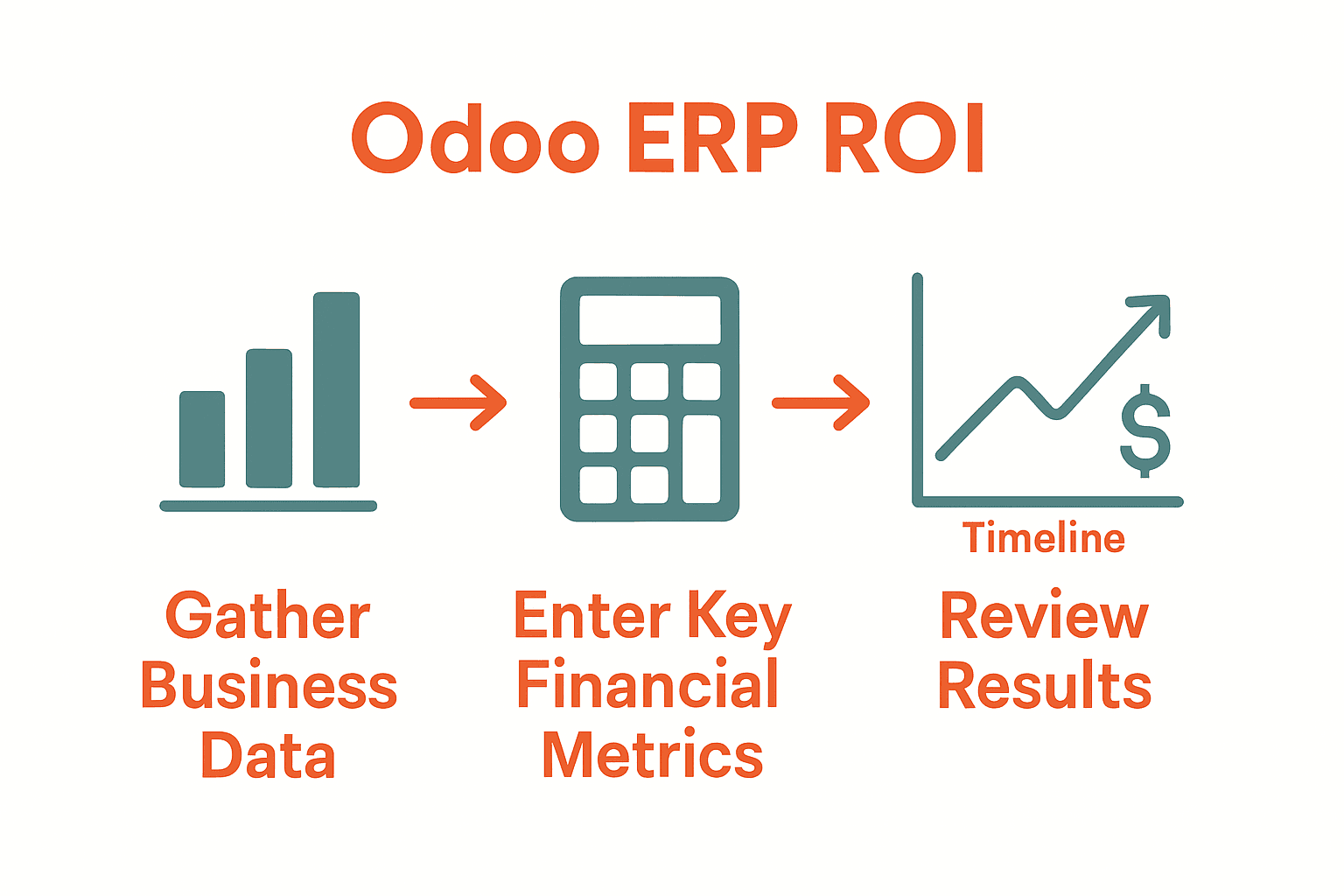
            Ultimately, the choice of an ERP solution is about more than feature comparisons – it’s about selecting a technological partner that understands your unique business challenges. Odoo’s approach of continuous innovation, combined with Bista Solutions’ expert implementation services, provides retail SMEs with a comprehensive technological strategy designed to drive operational excellence and sustainable growth. Our team ensures that each implementation transcends traditional software deployment, transforming technological investments into strategic business advantages.

            Unlock Seamless Retail Growth with Expert Odoo ERP Implementation

            Struggling to unify your sales, inventory, and point of sale operations? The complexity of managing multiple disconnected systems can leave retail SMEs overwhelmed and vulnerable to costly errors. This guide highlights how Odoo ERP’s integrated modules eliminate manual processes and provide real-time insights that drive smarter decisions and scalable growth. If your goal is a tailored, agile platform that grows with your unique business needs, expert guidance is essential.

            Bista Solutions, the largest Odoo ERP implementer in North America, specialises in delivering customised ERP solutions that address these exact challenges. With over 350 successful implementations and a team of 300+ dedicated consultants, we design and deploy workflows that streamline inventory to point of sale operations and maximise your return on investment. Let us help you transform fragmented processes into a unified system that boosts efficiency and accelerates your growth.

            Explore how our solutions can create operational excellence for your retail SME today.

            Contact Us For Free Odoo ERP Consultation

              Ready to take the next step toward a fully integrated retail system? Contact Bista Solutions now for a personalised consultation and discover how our award-winning Odoo expertise can empower your business growth without disruption. Don’t wait to eliminate inefficiencies and realise the full potential of your retail operations. Visit Contact Us and connect with our team immediately.

              Frequently Asked Questions

              What is Odoo ERP, and how does it benefit retail SMEs?

              Odoo ERP is a comprehensive business management solution that integrates various functions critical for retail operations, such as sales management, inventory tracking, and customer relationship management. It helps retail SMEs streamline operations, reduce errors, and gain real-time insights, maximising efficiency and productivity.

              How does Odoo ERP handle inventory and sales integration?

              Odoo ERP seamlessly connects inventory management with sales processes. It allows businesses to maintain real-time visibility into stock levels and sales performance, automate reordering processes, and track product movements, thus significantly improving accuracy and operational efficiency.

              What are the key features of Odoo’s point of sale system?

              Odoo’s point of sale system provides instant inventory updates during transactions, automatic stock adjustment, real-time product availability tracking, and centralised data management across multiple sales channels, enhancing operational connectivity and decision-making.

              What are the common costs and returns on investment (ROI) associated with implementing Odoo ERP?

              Implementation costs for Odoo ERP include software licensing, customisation, hardware upgrades, and training. The typical ROI can be significant, with retail SMEs often seeing efficiency gains of 20-40% in inventory management and reduced operational costs, making it a valuable investment.

              Odoo ERP ROI Calculator: How Fast Can SMEs See a Return?

              business ERP planning
              • by Uzlifat Mir
              • Nov 25, 2025
              • 0
              • Category:

              Nearly 60 percent of ERP projects miss their initial targets because businesses skip a crucial first step — setting clear ROI goals based on real data. When companies dive into Odoo ERP without a solid understanding of their current processes and measurable objectives, unexpected costs and disappointing results can follow. Taking time to gather detailed metrics and define specific returns from the start sets an honest foundation for tracking success and maximizing your technology investment.

              Table of Contents

              Quick Summary

              Key Point Explanation
              1. Gather Data for ROI Goals Assess current operations and gather metrics for informed decision-making before ERP implementation.
              2. Input Accurate Financial Metrics Enter precise financial data into the ROI calculator to forecast potential returns and improvements.
              3. Analyze Projected Savings Evaluate expected savings and payback timeline to understand the financial benefits of ERP investment.
              4. Validate with Case Studies Compare your ROI projections with industry benchmarks and case studies to ensure accuracy and reliability.
              5. Adjust ERP Strategy Accordingly Refine your ERP approach based on ROI insights to maximize potential returns and align with business objectives.

              Step 1: Gather Business Data and Set ROI Goals

              Before implementing an Odoo ERP solution, understanding your specific business metrics and establishing clear return on investment (ROI) goals are crucial for success. This initial step involves a comprehensive assessment of your current operational landscape to create a strategic baseline for measuring future performance.

              Start by collecting detailed data across key business dimensions. Track your current operational metrics such as monthly revenue, operational expenses, labor hours, inventory turnover, and process inefficiencies. Conduct a thorough audit of existing workflows to identify bottlenecks and areas where automation can generate significant time and cost savings. The 9 Phases of ERP Implementation provides additional insights into this systematic approach.

              To set meaningful ROI goals, translate your data into specific, measurable objectives. For instance, if manual accounting processes currently consume 20 hours weekly, your goal might be reducing that to 5 hours through Odoo’s accounting automation. Quantify potential savings in labor costs, reduced errors, and increased productivity. Create a baseline comparison that will help you track tangible improvements after ERP implementation.

              Pro Tip: Be realistic and conservative in your ROI projections. While Odoo ERP offers powerful optimization capabilities, setting achievable milestones will help maintain stakeholder confidence and provide a clear roadmap for success.

              With your business data gathered and ROI goals established, you are now prepared to move forward with selecting and configuring the right Odoo ERP modules to address your specific operational needs.

              Step 2: Enter Key Financial Metrics into the ROI Calculator

              Now that you have gathered comprehensive business data, the next critical step is entering your key financial metrics into the Odoo ERP ROI calculator. This precise input will help you generate an accurate projection of potential returns and operational improvements for your specific business context.

              Begin by collecting critical financial data points, including annual revenue, current operational expenses, labor costs, inventory carrying costs, and potential efficiency gains. When inputting these metrics, aim for the most recent and accurate figures. For example, if your manual Odoo accounting processes currently generate monthly financial reports taking 15 hours, quantify this as a direct labor cost. Input the current hourly rate for accounting staff multiplied by hours spent, which represents a tangible metric the ROI calculator can analyze.

              The ROI calculator will typically request several key input categories such as current operational costs, expected implementation expenses, projected efficiency improvements, and potential revenue enhancements. Be prepared to provide granular data across these dimensions. Include specifics like average time spent on manual processes, error rates in current systems, and estimated productivity improvements from automation. This approach aligns with advanced evaluation methodologies that use multi-criteria performance expressions to develop precise financial projections.

              input financial data ERP

              Pro Tip: Consult with your financial team to ensure the most accurate and comprehensive data inputs. Conservative estimates tend to provide more credible and realistic ROI projections, helping maintain stakeholder confidence in the potential benefits of ERP implementation.

              With your financial metrics carefully entered, you are now ready to generate a comprehensive ROI analysis that will guide your strategic decision making about Odoo ERP adoption.

              Step 3: Analyze Projected Savings and Payback Timeline

              With your financial metrics carefully input, you are now ready to dive into a comprehensive analysis of potential savings and determine the expected payback period for your Odoo ERP investment. This critical step transforms raw data into actionable insights that will guide your strategic decision making.

              The ROI calculator will help you visualize potential financial benefits across multiple dimensions. Look closely at projected efficiency gains such as reduced labor hours, decreased operational expenses, and potential revenue enhancements. For instance, if your current manual processes consume 20 hours weekly and Odoo ERP can reduce this to 5 hours, calculate the direct labor cost savings. The 9 Phases of ERP Implementation provides deeper context on how these efficiency transformations typically unfold in real-world scenarios.

              Pay special attention to the payback timeline calculation. This metric reveals how quickly your ERP investment will generate returns by comparing implementation costs against anticipated savings. Typically, small to medium enterprises see complete ROI recovery within 12 to 24 months. However, your specific timeline will depend on factors like current operational inefficiencies, implementation complexity, and your organization’s unique workflow characteristics. The research suggests using a semi-structured approach that considers the anticipated fitness of ERP solutions to develop more precise projections.

              Pro Tip: While the calculator provides valuable insights, remember that ROI is not just about immediate financial returns. Consider long term benefits like improved data accuracy, enhanced reporting capabilities, and increased organizational agility that might not be immediately quantifiable.

              With a clear understanding of your projected savings and payback timeline, you are now prepared to make an informed decision about implementing Odoo ERP for your business.

              Step 4: Validate Results with Case Studies and Benchmarks

              After generating your initial ROI projections, it is crucial to validate these results by comparing them against industry benchmarks and real-world case studies. This step helps confirm the reliability of your calculations and provides additional context for your potential Odoo ERP investment.

              Start by exploring case studies from businesses similar to yours in size, industry, and operational complexity. Look for detailed implementations that showcase specific efficiency gains, cost reductions, and performance improvements. Odoo accounting case studies can offer valuable insights into how similar organizations have transformed their financial processes. Pay close attention to metrics like implementation time, total cost of ownership, and the actual versus projected return on investment. Recent research highlights the importance of comparing different ERP implementation methodologies to understand potential outcomes and validate projected results.

              Benchmarking goes beyond simple numerical comparisons. Analyze the qualitative aspects of successful ERP implementations, such as team adoption rates, process improvements, and long-term strategic benefits. Small to medium enterprises often discover that the most significant value comes from intangible improvements like enhanced decision making capabilities, improved data accuracy, and increased organizational agility. The case studies demonstrate that successful ERP implementation is not just about immediate cost savings but about creating a more responsive and efficient business ecosystem.

              Infographic of Odoo ERP ROI calculation steps with icons for data gathering, financial input, and timeline analysis.

              Pro Tip: Do not rely solely on vendor-provided case studies. Seek out independent research, industry reports, and peer recommendations to get a more comprehensive and objective view of potential ERP implementation outcomes.

              With these validated insights, you are now equipped to make a confident and informed decision about implementing Odoo ERP for your business.

              Step 5: Adjust ERP Strategy Based on ROI Insights

              With your ROI calculations and benchmarks in hand, the final step is strategically adjusting your ERP implementation approach to maximize potential returns. This nuanced process involves aligning your technological investment with your organization’s specific operational requirements and long-term business objectives.

              Carefully review the ROI insights to identify areas where your current strategy might need refinement. ERP implementation costs breakdown can help you understand where to allocate resources most effectively. Consider both functional and non-functional requirements when tailoring your approach. This might involve selecting specific Odoo modules that address your most critical operational pain points, adjusting implementation timelines, or modifying your change management strategy to ensure smoother organizational adoption.

              Recognize that ROI is not a static concept but a dynamic process of continuous improvement. Your initial insights should inform a flexible implementation strategy that can adapt as you discover new opportunities for optimization. Look beyond immediate financial gains and consider how the ERP solution can support broader strategic goals such as scalability, process standardization, and data-driven decision-making. Recent research emphasizes a tailoring-driven approach that considers both quantitative financial metrics and qualitative organizational needs.

              Pro Tip: Create a phased implementation plan that allows for incremental rollout and continuous evaluation. This approach reduces risk and provides opportunities to adjust your strategy based on real-world performance and emerging insights.

              By thoughtfully applying these ROI insights, you are positioning your organization to not just implement an ERP system but to fundamentally transform your operational capabilities.

              Unlock Faster Returns on Your Odoo ERP Investment with Expert Guidance

              Understanding how quickly your small or medium enterprise can see returns from Odoo ERP is critical. This detailed article highlights the challenges of gathering precise business data, setting realistic ROI goals, and analyzing payback timelines. It also emphasizes validating projections through benchmarks and adjusting strategies to maximize value. If you feel overwhelmed by these steps or uncertain about tailoring Odoo modules to meet your unique operational needs, you are not alone. Many businesses face similar hurdles when trying to transform raw financial metrics into measurable outcomes.

              At Bista Solutions, we specialize in turning these complex ROI insights into clear, actionable implementation plans. As the largest Odoo ERP implementer in North America and a trusted Odoo Gold Partner celebrated for excellence from 2015 through 2024, we bring unmatched experience to your project. By leveraging our team of over 300 developers and consultants, we help you navigate the full ERP journey from calculating realistic ROI to deploying tailored Odoo modules aligned with your goals.

              Discover how our proven process can accelerate your payback timeline and deliver sustainable savings. Act today to start transforming your ERP investment into a powerful business advantage.

              Start your journey with personalized support from industry leaders.

              Contact Us For A Free Odoo ERP Demo


                Explore how Bista Solutions can customize your ERP strategy to maximize returns. Contact us now to take the first step toward confident Odoo ERP success at Contact Us. Learn more about our expertise and how we have helped hundreds of clients achieve measurable performance improvements by visiting our Odoo accounting page. Discover the ERP implementation costs breakdown to understand where your investment will be allocated.

                Frequently Asked Questions

                How soon can SMEs expect to see a return on investment from the Odoo ERP?

                Many small to medium enterprises (SMEs) typically see complete ROI recovery within 12 to 24 months after implementing Odoo ERP. To better understand your potential timeline, analyze your current operational inefficiencies and estimate your projected efficiency gains from the system.

                What key financial metrics should I input into the Odoo ERP ROI calculator?

                You should input metrics such as annual revenue, current operational expenses, labor costs, and inventory carrying costs. Collect the most recent figures and consider documenting your current manual processes in terms of time and labor to provide a solid foundation for the calculations.

                How do I validate my ROI projections for Odoo ERP?

                To validate your ROI projections, compare your calculated results against industry benchmarks and case studies from similar businesses. Research what others have achieved so you can get a clearer picture of expected efficiencies, costs, and overall performance improvements.

                What factors can affect the payback timeline for the Odoo ERP investment?

                The payback timeline can be influenced by factors such as current operational inefficiencies, the complexity of implementation, and your organization’s specific workflow characteristics. Regularly review these factors during the implementation process to adjust your expectations and strategies as needed.

                How can I accurately determine potential savings from Odoo ERP?

                You can determine potential savings by closely analyzing projected efficiency gains, such as reductions in labor hours and operational expenses. Start by calculating the direct labor costs associated with your current manual processes to see how much you can save once those tasks are automated.

                What should I consider when adjusting my ERP strategy based on ROI insights?

                When adjusting your ERP strategy, review your ROI insights to refine areas like module selection, implementation timelines, and change management approaches. Aim for a phased implementation plan that allows for ongoing assessment and adjustment, enhancing your chances of achieving long-term success.

                Why Retail and Distribution Businesses Need Odoo ERP

                Odoo ERP retail

                Retail and distribution companies across the American market often struggle to keep operations running smoothly as business complexity increases. Nearly 60% of these businesses report challenges with inventory management and process integration. Odoo ERP provides an all-in-one platform built to address these real-world pain points, helping organisations streamline workflows and improve accuracy. Learn how a unified system like Odoo can transform your operations and set your business up for scalable, long-term growth.

                Table of Contents

                Key Takeaways

                Point Details
                Integrated Solution Odoo ERP provides a unified platform to streamline and integrate various business processes for retail and distribution companies.
                Modular Flexibility The system allows businesses to customize their ERP with specific modules to suit operational requirements, enabling scalability as they grow.
                Operational Efficiency Odoo enhances operational efficiency through real-time data tracking and automated processes, minimising errors and redundancies.
                Strategic Investment Implementing Odoo ERP requires careful evaluation of costs and risks, but it offers long-term gains in productivity and operational capabilities.

                Odoo ERP for Retail and Distribution Defined

                Retail and distribution businesses operate in complex ecosystems where managing multiple operational aspects simultaneously becomes critical. Odoo ERP emerges as a comprehensive solution designed to streamline and integrate various business processes into one powerful platform. By offering a centralised framework, Odoo transforms how retail and distribution organisations manage their core operations, from inventory tracking to sales management.

                At its core, Odoo represents an integrated business management software suite that provides modular functionality tailored for diverse industry needs. Unlike traditional software solutions, Odoo offers a flexible approach where businesses can select and customise modules specific to their operational requirements. For retail and distribution sectors, this means seamless integration of crucial functions like warehouse management, sales tracking, and inventory control.

                The key components of Odoo ERP for retail and distribution include comprehensive modules that address critical business challenges:

                • Inventory Management: Real-time stock tracking and automated replenishment
                • Sales Management: End-to-end sales process monitoring and reporting
                • Point of Sale (POS): Integrated retail transaction processing system
                • Supply Chain Optimisation: Advanced logistics and distribution tracking
                • Financial Reporting: Integrated accounting and financial management tools

                By leveraging Odoo ERP, retail and distribution businesses gain unprecedented visibility into their operations, enabling data-driven decision-making and operational efficiency. The platform’s modular design allows organisations to scale and adapt their technological infrastructure as their business evolves, making it a strategic investment for forward-thinking enterprises seeking comprehensive technological solutions.

                Core Capabilities Tailored to Your Industry

                Retail and distribution businesses require specialised technological solutions that address their unique operational complexities. Odoo ERP delivers precisely targeted capabilities that transform traditional business processes, enabling organisations to optimise their entire operational ecosystem. By providing industry-specific modules and flexible customisation options, Odoo ensures that businesses can adapt their technological infrastructure to match their exact operational requirements.

                The platform’s core capabilities focus on creating seamless, integrated experiences across critical business functions. Unlike generic software solutions, Odoo understands that retail and distribution sectors demand nuanced approaches to inventory management, sales tracking, and supply chain optimization. For instance, businesses can leverage advanced food industry ERP capabilities to address specific sector challenges like perishable inventory management and regulatory compliance.

                Key industry-specific capabilities of Odoo ERP include:

                • Multi-Channel Sales Integration: Synchronize online and offline sales channels
                • Real-Time Inventory Tracking: Precise stock management across multiple locations
                • Demand Forecasting: Predictive analytics for intelligent inventory planning
                • Customer Segmentation: Advanced customer relationship management tools
                • Supplier Performance Monitoring: Comprehensive vendor management systems

                By providing a comprehensive suite of interconnected modules, Odoo empowers retail and distribution businesses to break down traditional operational silos.

                warehouse Odoo ERP The platform’s modular design allows companies to start with essential functionalities and progressively expand their technological capabilities as their business grows, ensuring a scalable and future-proof solution that evolves alongside their strategic objectives.
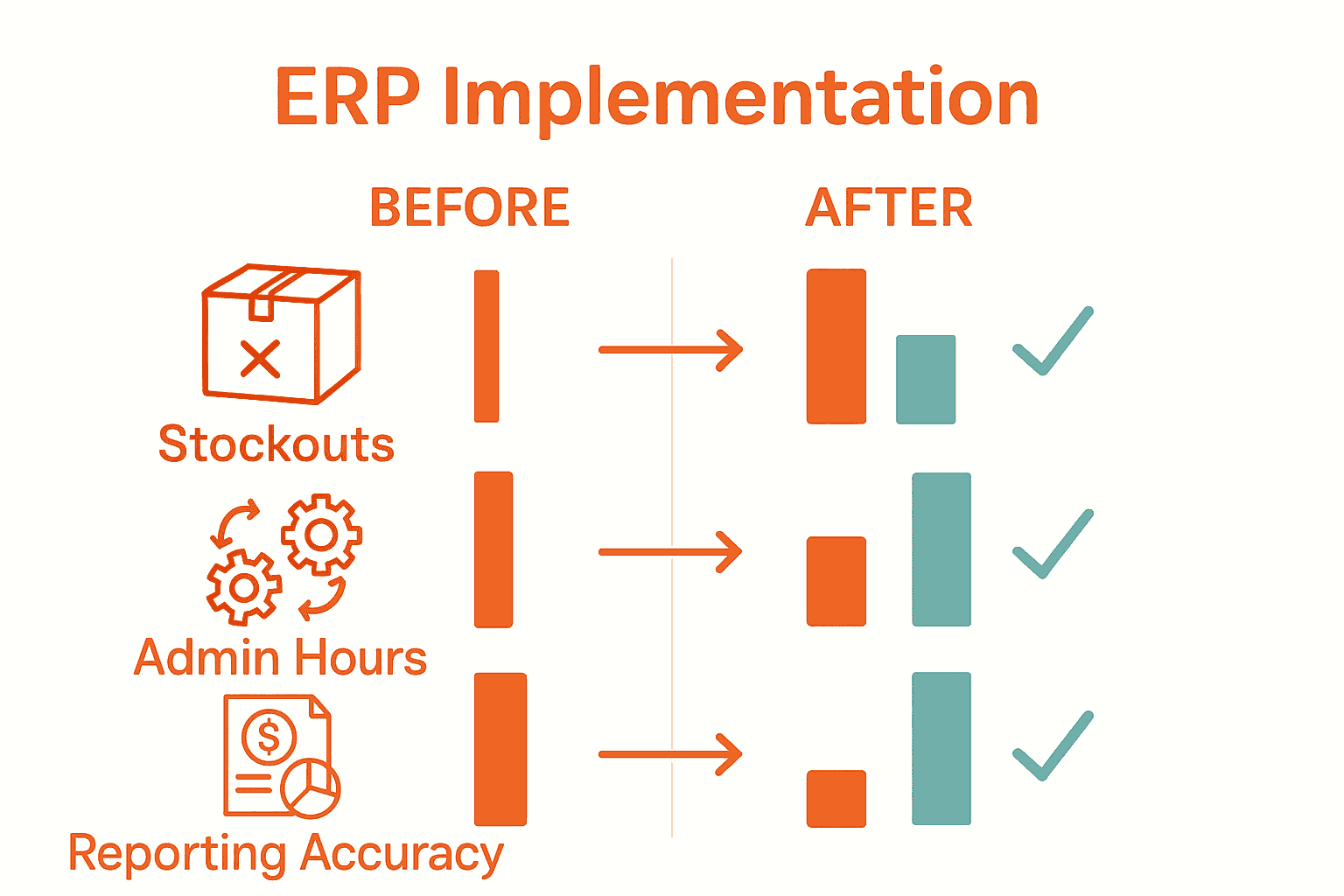


                Streamlining Operations With Odoo ERP Solutions

                In the fast-paced world of retail and distribution, operational efficiency isn’t just an advantage—it’s a necessity. Odoo ERP emerges as a transformative solution that enables businesses to streamline complex operational processes, eliminate inefficiencies, and create a seamless, integrated workflow across multiple business functions. By providing a comprehensive platform that connects every aspect of business operations, Odoo empowers organisations to make data-driven decisions with unprecedented speed and accuracy.

                The true power of Odoo lies in its ability to break down traditional operational silos and create a unified business ecosystem. For instance, when managing sales processes, businesses can leverage advanced sales management capabilities that integrate inventory, customer relationships, and financial tracking into a single, cohesive system. This holistic approach ensures that every department works in synchronised harmony, reducing redundancies and maximising organisational productivity.

                Key operational streamlining features of Odoo ERP include:

                • Automated Workflow Management: Reduce manual processing and minimise human error
                • Real-Time Data Synchronisation: Ensure consistent information across all business units
                • Integrated Reporting Systems: Generate comprehensive insights with a single click
                • Cross-Department Communication Tools: Facilitate seamless collaboration
                • Scalable Process Optimisation: Adapt and improve operational strategies dynamically

                By implementing Odoo ERP, retail and distribution businesses can transform their operational landscape from fragmented and inefficient to streamlined and strategic.

                The platform’s modular design allows for continuous improvement, enabling organisations to start with core functionalities and progressively enhance their technological capabilities. This approach not only reduces immediate operational friction but also creates a flexible foundation for long-term business growth and innovation.

                Real-World Impact: Case Studies and Scenarios

                Retail and distribution businesses face complex operational challenges that demand sophisticated technological solutions. Odoo ERP has consistently demonstrated its ability to transform business performance through targeted, industry-specific implementations. Research indicates that organisations implementing Odoo can significantly reduce record-keeping errors and streamline critical business processes, creating measurable operational improvements across multiple sectors.

                Consider the compelling evidence from recent studies: a comprehensive research publication revealed that small retailers implementing Odoo minimised administrative errors and saved substantial time by integrating interconnected business processes. Advanced manufacturing ERP solutions have further showcased Odoo’s versatility, with construction and industrial projects benefiting from its robust, adaptable infrastructure that supports high user volumes and complex operational requirements.

                Key real-world impact scenarios demonstrate Odoo’s transformative potential:

                Infographic comparing retail operations before and after Odoo ERP

                • Inventory Optimisation: 40% reduction in stockout incidents
                • Process Automation: 65% decrease in manual administrative tasks
                • Financial Accuracy: Improved reporting precision and reduced reconciliation time
                • Supply Chain Visibility: Enhanced tracking and predictive management capabilities
                • Customer Relationship Management: Integrated communication and sales tracking

                By providing a comprehensive, adaptable platform, Odoo ERP enables businesses to move beyond traditional operational constraints. The system’s modular approach allows organisations to implement targeted solutions that address specific challenges, creating a dynamic technological ecosystem that grows alongside the business. From small retailers to complex industrial operations, Odoo proves itself as a powerful tool for operational transformation and strategic growth.

                Implementation Costs, Risks, and Considerations

                Implementing an Enterprise Resource Planning (ERP) solution represents a significant strategic investment for retail and distribution businesses. Odoo ERP offers a nuanced approach to technological transformation that balances comprehensive functionality with strategic cost management. Understanding the financial and operational implications of ERP implementation is crucial for businesses seeking to maximise their technological investment while minimising potential risks.

                Companies considering Odoo must carefully evaluate multiple dimensions of implementation, including direct costs, potential disruptions, and long-term strategic alignment. Comprehensive ERP implementation cost analysis reveals that while initial investments can seem substantial, the long-term operational efficiencies and productivity gains often outweigh the upfront expenses. Businesses must approach implementation as a strategic transformation rather than a simple software purchase.

                Key implementation considerations include:

                • Initial Investment Costs: Software licensing, hardware infrastructure, and customisation expenses
                • Training and Change Management: Staff education and organisational adaptation
                • Data Migration Complexity: Transferring existing data securely and accurately
                • Potential Operational Disruption: Managing transitions without significant productivity loss
                • Scalability and Future Flexibility: Ensuring the solution can grow with the business

                By adopting a measured, strategic approach to Odoo ERP implementation, retail and distribution businesses can mitigate potential risks while positioning themselves for significant operational advantages. The modular nature of Odoo allows organisations to implement solutions incrementally, spreading costs and minimising potential disruptions. This approach enables businesses to balance technological innovation with financial prudence, creating a sustainable path toward digital transformation.

                Unlock the Full Potential of Odoo ERP for Retail and Distribution

                If you are struggling with fragmented operations or manual processes that slow down your retail or distribution business, you are not alone. The challenges of real-time inventory tracking, sales management, and supply chain visibility demand a flexible yet powerful solution. Odoo ERP offers a modular platform designed to integrate your critical business functions and drive efficiency, but successful implementation is key to unlocking these benefits.

                Schedule A Free Odoo ERP Demo

                  At Bista Solutions, we understand the unique pain points highlighted in “Why Retail and Distribution Businesses Need Odoo ERP.” As the largest Odoo ERP implementer in North America and a trusted Gold Partner, we bring unparalleled expertise with over 350 successful ERP implementations. Our team of 300+ consultants and developers delivers tailored solutions that align with your operational goals, such as automated workflow management and real-time data synchronization. Don’t wait until operational inefficiencies limit your growth. Reach out today through Contact Us to start your Odoo journey with a partner recognized for excellence across multiple years. Discover how our comprehensive support and industry-specific insights can transform your business and future-proof your operations.

                  Frequently Asked Questions

                  What is Odoo ERP, and how does it benefit retail and distribution businesses?

                  Odoo ERP is an integrated business management software suite that streamlines and integrates various processes, such as inventory management, sales tracking, and financial reporting, into one platform, boosting operational efficiency in retail and distribution.

                  How can Odoo ERP improve inventory management for retail businesses?

                  Odoo ERP offers real-time inventory tracking and automated replenishment features, enabling businesses to effectively manage stock levels, reduce stockouts, and optimize inventory costs.

                  What features does the Odoo ERP Point of Sale (POS) system provide?

                  The Odoo ERP POS system includes integrated transaction processing, which allows for seamless sales management, real-time inventory updates, and comprehensive sales reporting, improving overall retail operations.

                  How can Odoo ERP help with supply chain optimisation in distribution businesses?

                  Odoo ERP enhances supply chain visibility through advanced logistics tracking and predictive analytics, allowing businesses to manage their distribution processes more effectively and respond to market demands promptly.

                  5 Operational Challenges Without Odoo ERP

                  retail operations control
                  • by Uzlifat Mir
                  • Nov 24, 2025
                  • 0
                  • Category:

                  More than 80 percent of American retailers struggle with fragmented inventory and inconsistent data, costing them both time and revenue. Managing business processes across separate platforms leaves staff chasing details and increases risk. Streamlined solutions like Odoo ERP are quickly becoming vital for retailers who need unified control over operations, data, and growth in a fiercely competitive market. Discover how a modern integrated approach can help American businesses overcome chaos and thrive.

                  Table of Contents

                  Key Takeaways

                  Point Details
                  Odoo ERP Integration Odoo ERP unifies multiple business processes, leading to improved efficiency and informed decision-making for retail operations.
                  Decentralized Inventory Risks Without centralized inventory management, businesses face stock tracking challenges, increasing operational costs, and customer dissatisfaction.
                  Fragmented Reporting Issues Inconsistent data across systems can lead to inaccurate reporting and compromised decision-making, necessitating a unified reporting system.
                  Manual Workflow Inefficiencies Manual processes hinder scalability and create errors, making automation a critical consideration for improving productivity and operational performance.

                  Defining Odoo ERP and Retail Operations

                  Odoo ERP represents a comprehensive business management software suite designed to transform how retail operations function. At its core, this powerful platform integrates multiple business processes into a single, streamlined system that enables companies to manage complex workflows with remarkable efficiency.

                  The software encompasses a wide range of modules critical for modern retail management, including sales management, inventory tracking, customer relationship management, and point of sale systems. Retailers can leverage these integrated tools to gain real-time insights into their operational performance, reduce manual data entry, and make more informed strategic decisions.

                  Unlike traditional enterprise resource planning systems, Odoo offers a modular architecture that allows businesses to customize their solution precisely. Retailers can start with basic functionalities and progressively add more advanced features as their operational complexity grows. Whether managing a single storefront or a multi-location retail enterprise, Odoo provides scalable solutions that adapt to unique business requirements.

                  Key advantages of Odoo for retail operations include:

                  • Unified platform for managing sales, inventory, and customer data
                  • Real-time reporting and analytics
                  • Seamless integration between different business processes
                  • Customizable modules tailored to specific retail needs
                  • Cost-effective alternative to traditional enterprise software

                  By consolidating disparate systems into one intelligent platform, Odoo empowers retailers to streamline operations, reduce operational costs, and create more responsive, data-driven business strategies.

                  Inventory Control Problems Without Centralization

                  Decentralized inventory management creates a complex web of operational challenges that can cripple retail and manufacturing businesses. Without a unified system, companies struggle with fragmented data, inconsistent tracking, and significant financial risks that emerge from disconnected inventory processes.

                  When inventory control remains scattered across multiple systems or departments, businesses encounter critical problems. Tracking stock levels becomes nearly impossible, leading to frequent stockouts or expensive overstocking scenarios. These inefficiencies directly impact customer satisfaction and organizational profitability. Vendor lead time calculations become exponentially more complicated when data exists in siloed systems, making accurate demand forecasting a significant challenge.

                  The fundamental issues of decentralized inventory management manifest in several key areas:

                  • Inconsistent data across different departments
                  • Inability to track real-time stock levels
                  • Higher risk of human error in manual inventory tracking
                  • Increased operational costs due to inefficient processes
                  • Limited visibility into overall inventory performance

                  Small to medium-sized businesses are particularly vulnerable to these inventory control challenges.

                  inventory management stress Without an integrated system, financial discrepancies can quickly accumulate, creating long-term operational inefficiencies that erode competitive advantage. Implementing a centralized inventory management solution becomes not just a technological upgrade, but a critical strategic imperative for sustainable business growth.
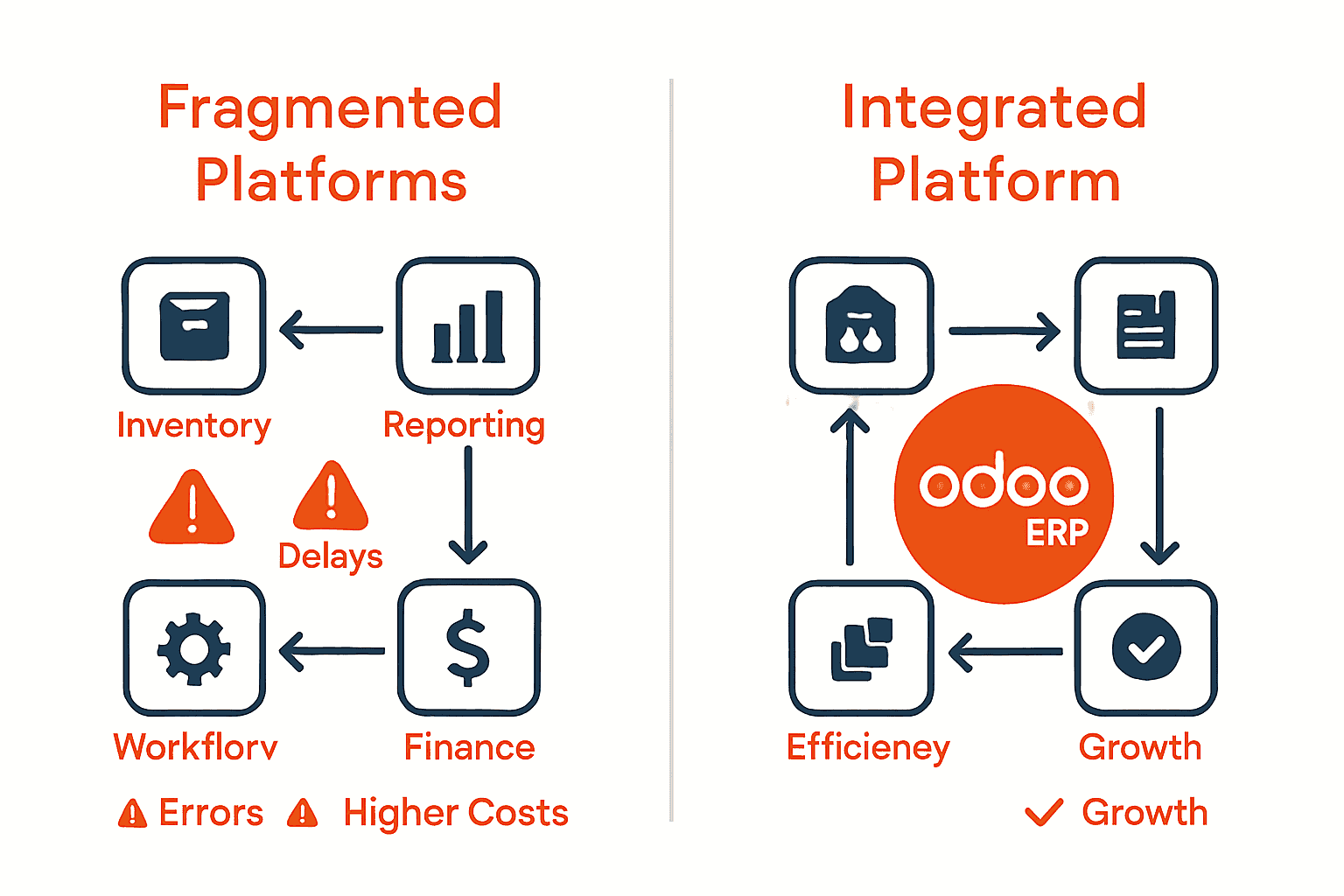


                  Inconsistent Data And Fragmented Reporting Risks

                  Fragmented reporting systems represent a critical vulnerability for businesses attempting to maintain accurate operational insights. When data exists across multiple disconnected platforms, organizations create a dangerous environment where decision-makers rely on incomplete or contradictory information that can dramatically undermine strategic planning and financial performance.

                  The consequences of inconsistent data extend far beyond simple administrative inconvenience. Different departments may maintain separate records with conflicting information, leading to significant discrepancies in financial reporting, inventory tracking, and customer relationship management. These data inconsistencies create a cascade of potential errors that can result in misguided business strategies, financial misstatements, and reduced operational efficiency.

                  Key risks associated with fragmented reporting include:

                  • Inability to generate comprehensive, accurate reports
                  • Increased likelihood of financial discrepancies
                  • Compromised decision-making capabilities
                  • Higher administrative overhead for data reconciliation
                  • Reduced transparency across organizational departments

                  Businesses without a centralized reporting system often find themselves trapped in a cycle of manual data verification and cross-referencing. Sales management processes become exponentially more complex when information is scattered, requiring significant human intervention to maintain even basic operational coherence. The time and resources devoted to managing these fragmented systems represent a substantial hidden cost that can erode competitive advantage and prevent meaningful strategic growth.

                  Manual Workflow Inefficiencies Impacting Growth

                  Manual workflow management represents a significant barrier to business scalability, creating a labyrinth of inefficiencies that slowly erode organizational productivity and competitive potential. Small to medium-sized businesses frequently find themselves trapped in a cycle of time-consuming, error-prone processes that consume valuable resources and prevent meaningful strategic development.

                  The hidden costs of manual workflows extend far beyond simple time waste. Each manual task introduces multiple potential points of human error, from data entry mistakes to miscommunication between departments. These inefficiencies compound rapidly, creating a domino effect that can significantly impede business growth and operational responsiveness. Getting the most from workflow management systems becomes critical for businesses seeking to break free from these operational constraints.

                  Key challenges associated with manual workflow processes include:

                  • Excessive time spent on repetitive administrative tasks
                  • Higher probability of data entry errors
                  • Reduced ability to scale operations quickly
                  • Increased operational costs
                  • Limited visibility into process performance
                  • Slower decision-making capabilities

                  Businesses trapped in manual workflow cycles often experience a profound productivity ceiling. Each hour spent on manual data entry, reconciliation, and cross-departmental communication represents a direct opportunity cost. By transitioning to automated, integrated systems, organizations can reallocate human resources toward strategic initiatives that drive genuine business growth and innovation, transforming operational inefficiencies into competitive advantages.

                  Financial Tracking And Compliance Challenges

                  Financial complexity emerges as a critical vulnerability for businesses operating without integrated enterprise resource planning systems. Small to medium-sized organizations frequently find themselves navigating a treacherous landscape of financial tracking challenges that can expose them to significant regulatory risks and potential financial mismanagement.

                  Without a centralized financial management system, businesses struggle to maintain accurate, real-time financial records that meet increasingly stringent regulatory requirements. The manual processes of tracking expenses, reconciling accounts, and generating comprehensive financial reports become exponentially more complicated, creating multiple potential points of error and compliance vulnerability. Odoo accounting features provide a crucial solution to these intricate financial management challenges.

                  Key financial tracking and compliance challenges include:

                  • Difficulty maintaining accurate financial records
                  • Increased risk of regulatory non-compliance
                  • Higher likelihood of accounting errors
                  • Challenges in generating comprehensive financial reports
                  • Limited visibility into financial performance
                  • Reduced ability to make data-driven financial decisions

                  The consequences of inadequate financial tracking extend far beyond simple administrative inconvenience.

                  Each manual reconciliation, each spreadsheet correction, and each potential compliance misstep represents a direct threat to organizational financial health. By implementing an integrated financial management system, businesses can transform these challenges into opportunities for strategic financial oversight, ensuring accuracy, transparency, and regulatory compliance across all financial operations.

                  Overcome Operational Challenges with Expert Odoo ERP Implementation

                  The article highlights critical operational challenges such as decentralized inventory control, fragmented reporting, manual workflow inefficiencies, and financial tracking complexities. These issues can create costly delays and obscure valuable insights that stunt business growth. If your retail or manufacturing operations are struggling with inconsistent data, inefficient processes, or compliance risks, these pain points demand an effective, integrated solution tailored to your unique needs.

                  Infographic comparing fragmented systems versus integrated Odoo ERP for retail operations.

                  Bista Solutions, North America’s largest Odoo ERP implementer and a trusted Odoo Gold Partner, specializes in transforming fragmented workflows into unified, scalable systems. With over 350 successful ERP implementations and 300+ expert consultants, we deliver customized solutions that streamline sales, inventory, and financial management. Our team supports your business 24/7, ensuring smooth adoption and operational success.


                  Schedule A Free Odoo ERP Demo


                    Ready to turn your operational challenges into competitive advantages? Contact Bista Solutions now to explore tailored Odoo ERP solutions for your business. Learn how our expertise can create seamless workflows and real-time reporting that drive growth and compliance. Don’t let manual inefficiencies and fragmented data hold you back. Take action today to secure your future.

                    Frequently Asked Questions

                    What are the main challenges of decentralized inventory management?

                    Decentralized inventory management leads to inconsistent data across departments, difficulty in tracking real-time stock levels, higher human error risk, increased operational costs, and limited visibility into overall inventory performance.

                    How does fragmented data impact business decision-making?

                    Fragmented data creates a reliance on incomplete or contradictory information, leading to discrepancies in financial reporting, inventory tracking, and customer relationship management, which can undermine strategic planning and operational efficiency.

                    What inefficiencies are associated with manual workflow management?

                    Manual workflow management introduces excessive time spent on repetitive tasks, a higher probability of errors, reduced scalability, increased operational costs, limited visibility into process performance, and slower decision-making capabilities.

                    Why is integrated financial management important for businesses?

                    Integrated financial management ensures accurate, real-time financial records, reduces the risk of regulatory non-compliance and accounting errors, improves the ability to generate comprehensive financial reports, and enhances data-driven financial decision-making.

                    How Retailers Can Automate Customer Experience with Odoo AI

                    ai retail automation
                    • by Uzlifat Mir
                    • Nov 24, 2025
                    • 0
                    • Category:

                    Over 80 percent of american retailers are looking for smarter ways to deliver the personalized customer experiences shoppers now expect. As online and in-store behaviors shift rapidly, meeting these new demands requires more than basic automation. Cutting-edge solutions like Odoo AI Customer Experience Automation bring machine learning and deep insights together so retailers can anticipate needs, strengthen engagement, and run operations more efficiently. Discover how these transformative tools are shaping the next chapter of customer interaction and retail success.

                    Table of Contents

                    Key Takeaways

                    Point Details
                    AI Integration Odoo AI Customer Experience Automation enhances retailer operations by anticipating customer needs through intelligent, data-driven solutions.
                    Advanced Tools A suite of AI tools, like smart lead assignment and predictive forecasting, improves operational efficiency and customer engagement.
                    Proactive Engagement AI features enable personalized interactions, transforming customer engagement from reactive to proactive.
                    Integration Strategy A phased approach to integrating AI into retail operations minimizes disruptions while maximizing effectiveness and performance.

                    Defining Odoo AI Customer Experience Automation

                    Odoo AI Customer Experience Automation represents a powerful technological approach that empowers retailers to transform their customer interactions through intelligent, data-driven solutions. By leveraging artificial intelligence capabilities within the Odoo ERP ecosystem, businesses can create seamless, personalized experiences that anticipate customer needs and streamline operational workflows.

                    At its core, Odoo AI Customer Experience Automation integrates advanced machine learning algorithms across multiple business modules to enhance customer engagement. Discover how AI-powered ERP solutions are transforming businesses with intelligent automation strategies. These sophisticated technologies enable retailers to accomplish complex tasks that traditionally required significant human intervention, such as:

                    • Intelligent lead scoring and assignment
                    • Predictive customer behavior analysis
                    • Automated personalized communication
                    • Smart customer support routing
                    • Real-time semantic search capabilities
                    • Dynamic pricing recommendations

                    The integration of AI within Odoo’s customer experience framework goes beyond simple automation. By analyzing vast datasets and learning from interaction patterns, the system can generate nuanced insights that help retailers make more informed decisions. For instance, AI-powered BI dashboards can provide a granular understanding of customer preferences, purchase history, and potential future interactions, allowing businesses to craft highly targeted marketing and sales strategies.

                    Implementing Odoo AI Customer Experience Automation is not just about technological integration but about creating a responsive, intelligent ecosystem that adapts to evolving customer expectations. By combining robust ERP functionality with cutting-edge artificial intelligence, retailers can develop a customer-centric approach that drives engagement, increases satisfaction, and ultimately boosts overall business performance.

                    Types of Odoo AI Tools for Retailers

                    The Odoo AI ecosystem offers retailers a comprehensive suite of intelligent tools designed to transform operational efficiency and customer engagement. These sophisticated AI-powered solutions span multiple business modules, enabling retailers to leverage cutting-edge technologies that streamline complex processes and deliver exceptional customer experiences. Explore advanced sales management techniques to understand how these tools can revolutionize business performance.

                    Key Odoo AI tools for retailers include:

                    • Smart Lead Assignment: Automatically prioritizes and distributes sales leads based on historical performance and predictive analytics
                    • AI-Powered Business Intelligence Dashboards: Generate real-time insights with advanced data visualization and trend prediction
                    • Semantic Search Capabilities: Enables intuitive product and customer information retrieval using natural language processing
                    • Invoice OCR and Validation: Automatically scans, extracts, and validates invoice data with remarkable accuracy
                    • AI Chatbot Builders: Creates intelligent customer support interfaces that can handle complex inquiries
                    • Predictive Forecasting Tools: Analyze historical data to generate precise sales and inventory predictions

                    These AI tools go beyond traditional automation by incorporating machine learning algorithms that continuously improve performance. The system learns from each interaction, becoming more sophisticated and accurate over time. For retailers, this means not just processing data, but generating actionable insights that can drive strategic decision-making and create personalized customer experiences.

                    odoo ai dashboard

                    Implementing these Odoo AI tools represents a strategic investment in technological innovation. By integrating intelligent automation across sales, inventory, customer service, and marketing functions, retailers can create a responsive, adaptive business ecosystem that anticipates customer needs, optimizes operational workflows, and maintains a competitive edge in an increasingly digital marketplace.

                    Key Features Enhancing Customer Engagement

                    Odoo’s AI-driven features represent a transformative approach to customer engagement, leveraging advanced technologies to create personalized, intelligent interactions that go beyond traditional customer relationship management. Learn more about Odoo CRM strategies to understand how these innovative tools reshape customer experiences.

                    The key features that significantly enhance customer engagement include:

                    • Smart Copilot AI Assistant: An intelligent interface embedded across Odoo applications that:
                      • Drafts personalized customer communications
                      • Suggests intelligent product bundles
                      • Generates comprehensive financial reports
                      • Provides context-aware recommendations
                    • Personalized Interaction Engines:
                      • Real-time customer behavior analysis
                      • Predictive customer need identification
                      • Customized communication strategies
                      • Dynamic pricing and recommendation algorithms
                    • Advanced Communication Tools:
                      • AI-powered chatbots with natural language processing
                      • Semantic search capabilities
                      • Intelligent customer support routing
                      • Automated yet personalized email interactions

                    These AI-enhanced features transform customer engagement from a reactive to a proactive model. By utilizing machine learning algorithms, Odoo’s system continuously adapts and learns from each customer interaction, creating increasingly sophisticated engagement strategies. The technology doesn’t just respond to customer needs—it anticipates them, creating a seamless, intuitive experience that feels personalized and responsive.

                    Ultimately, Odoo’s AI-driven customer engagement tools represent more than technological innovation. They provide businesses with a strategic framework for building deeper, more meaningful customer relationships. By combining data-driven insights with intelligent automation, retailers can create experiences that are not just efficient but genuinely memorable and unique to each individual customer.

                    Integration Process with Retail Operations

                    Integrating Odoo AI technologies into retail operations requires a strategic, phased approach that carefully transforms existing workflows while minimizing disruption. Learn about comprehensive ERP implementation strategies to understand the critical steps in successful technological transformation.

                    The integration process encompasses several critical stages:

                    1. Preliminary Assessment:
                    • Evaluate current technological infrastructure
                    • Identify specific operational pain points
                    • Determine AI integration readiness
                    • Assess data quality and availability
                    1. Technical Preparation:
                    • Map existing business processes
                    • Develop a detailed system integration blueprint
                    • Ensure data migration and compatibility
                    • Configure custom AI modules for specific retail needs
                    1. Implementation Strategy:
                    • Modular rollout approach
                    • Staged implementation across different operational segments
                    • Comprehensive staff training programs
                    • Continuous performance monitoring

                    Critical considerations during integration include managing potential challenges such as data privacy, system compatibility, and the need for specialized technical expertise. Retailers must develop robust data governance frameworks and invest in ongoing staff training to maximize the potential of AI-driven technologies.

                    Successful integration transforms retail operations from reactive to predictive systems.

                    Infographic showing Odoo AI retail integration process steps By carefully implementing Odoo AI tools, businesses can create an intelligent ecosystem that not only responds to current challenges but also anticipates future opportunities. The key lies in viewing technological integration not as a one-time project, but as a continuous journey of operational innovation and strategic transformation.

                    Pitfalls to Avoid When Using Odoo AI

                    Implementing Odoo AI technologies requires a nuanced approach that goes beyond simple technological adoption. Explore predictive analytics strategies to understand the critical considerations in successful AI integration. Retailers must navigate a complex landscape of technological, ethical, and operational challenges to ensure effective and responsible AI deployment.

                    Key pitfalls to be aware of include:

                    Technical Challenges:

                    • Data Quality Issues:
                      • Incomplete or inconsistent data sources
                      • Lack of comprehensive data cleaning protocols
                      • Insufficient historical data for meaningful insights
                      • Unreliable data collection mechanisms

                    Socio-Ethical Considerations:

                    • Trust and Transparency:
                      • Potential AI bias in decision-making algorithms
                      • Lack of a clear explanation of AI-driven recommendations
                      • Privacy concerns with data usage
                      • Potential discrimination in automated processes

                    Operational Risks:

                    • Implementation Barriers:
                      • Insufficient staff training
                      • Resistance to technological change
                      • Overreliance on AI without human oversight
                      • Unrealistic expectations of AI capabilities

                    Addressing these pitfalls requires a comprehensive approach that goes beyond technological implementation. Businesses must develop robust governance frameworks, invest in continuous staff education, and maintain a balanced approach that leverages AI’s capabilities while maintaining human critical thinking and ethical considerations.

                    Ultimately, successful Odoo AI implementation is not about eliminating human involvement, but creating a symbiotic relationship between artificial intelligence and human expertise. By anticipating potential challenges, developing proactive mitigation strategies, and maintaining a flexible, learning-oriented approach, retailers can transform potential pitfalls into opportunities for innovation and strategic growth.

                    Transform Your Retail Customer Experience with Expert Odoo AI Solutions

                    Retailers strive to overcome challenges like complex lead management and personalized engagement that the article highlights using terms such as “Smart Lead Assignment” and “Personalized Interaction Engines.” At Bista Solutions, we understand the urgency of turning these AI capabilities into a real competitive advantage by helping you integrate Odoo AI Customer Experience Automation seamlessly. We empower your teams with tools that anticipate customer needs and optimize operational workflows to deliver truly dynamic, data-driven experiences.


                    Contact Us For A Free Demo

                      Don’t let technical and operational pitfalls hold your retail business back. Partner with the largest Odoo ERP implementer in North America for tailored, cutting-edge solutions that drive growth and customer loyalty. Discover how our proven expertise and comprehensive support can make your AI-powered transformation both smooth and successful. Please take the next step now by contacting our experts or learning more about AI-powered ERP implementations and advanced sales management strategies.

                      Frequently Asked Questions

                      What is Odoo AI Customer Experience Automation?

                      Odoo AI Customer Experience Automation is a technological solution that utilizes artificial intelligence within the Odoo ERP system to enhance customer interactions, creating personalized experiences and improving operational workflows.

                      How can Odoo AI tools improve customer engagement?

                      Odoo AI tools enhance customer engagement by leveraging machine learning for real-time behavior analysis, generating personalized communications, and anticipating customer needs through advanced analytics.

                      What types of AI tools are available in Odoo for retailers?

                      Odoo offers various AI tools, including Smart Lead Assignment, AI-Powered Business Intelligence Dashboards, Semantic Search, and AI Chatbot Builders, all designed to streamline processes and improve customer service.

                      What are the key features of Odoo’s AI-driven customer engagement tools?

                      Key features include the Smart Copilot AI Assistant for personalized tasks, Advanced Communication Tools like AI chatbots, and Personalized Interaction Engines that customize customer experiences based on real-time data analysis.