Why Migrate From Sage 50 to Odoo ERP? Achieve Seamless Growth

Why Migrate From Sage 50 to Odoo ERP?

Did you know that over 70 percent of businesses face major challenges when scaling with legacy software like Sage 50? As companies grow, these limitations can hold back productivity and affect long term success. By systematically assessing your current system and planning a well-structured migration to Odoo ERP, you can overcome these hurdles and pave the way for efficient, data-driven growth.

Quick Summary

Key Point Explanation
1. Identify Sage 50 limitations Perform a thorough audit to reveal operational constraints affecting growth and scalability.
2. Prepare data meticulously Ensure all data is backed up, cleansed, and mapped correctly to avoid complications during the migration.
3. Implement a phased migration Execute the migration in stages to minimize disruptions and ensure continuous functionality during the transition.
4. Conduct comprehensive testing Test all functionalities in a controlled environment to validate system reliability and performance before full deployment.
5. Focus on post-migration optimization Regularly review system performance and implement ongoing improvements to sustain operational efficiency and growth.

Table of Contents

Step 1: Analyze Business Limitations with Sage 50

Understanding the inherent constraints of your current enterprise software is crucial for strategic business growth. In this step, you will systematically evaluate how Sage 50 might be restricting your organization’s potential and why transitioning to Odoo vs Sage could unlock transformative capabilities.

Start by conducting a comprehensive internal audit focusing on key operational domains. Assess how Sage 50 performs across critical business functions like accounting, inventory management, customer relationship management, and reporting. Pay special attention to scalability challenges that emerge as your business expands.

Look for specific indicators of software limitations:

  • Difficulty adding new user licenses without substantial cost increases
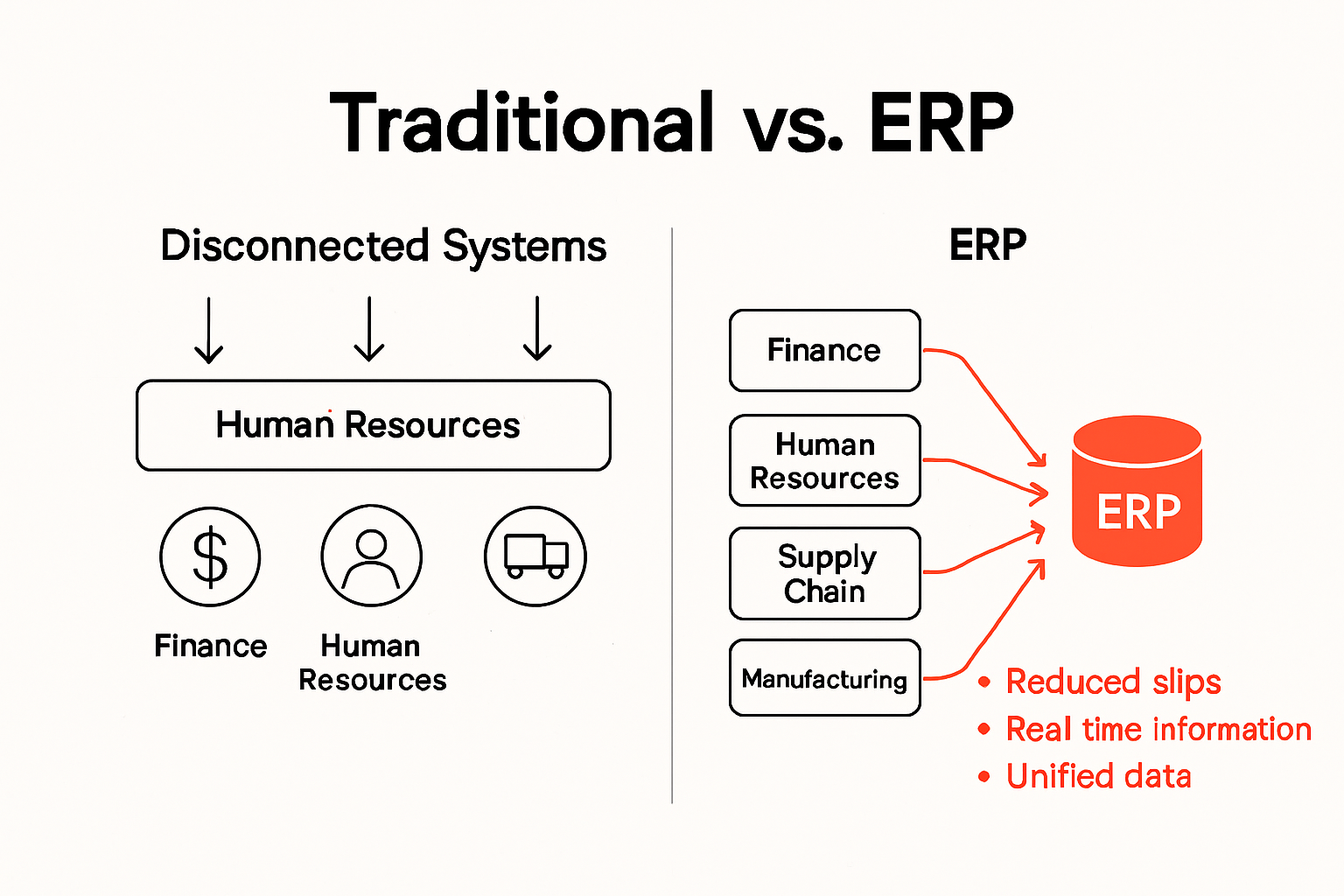
  • Lack of real-time cross-departmental data visibility
  • Manual data entry requirements across different systems
  • Performance slows down when processing increased transaction volumes
  • Limited reporting and analytics capabilities

Specifically examine how current software constraints impact decision making.

Small and growing businesses often discover that Sage 50 creates data silos, preventing holistic organizational insights. These limitations can substantially hinder strategic planning and operational efficiency.

Here’s a comparison of common business limitations in Sage 50 and the advantages gained by migrating to Odoo ERP:
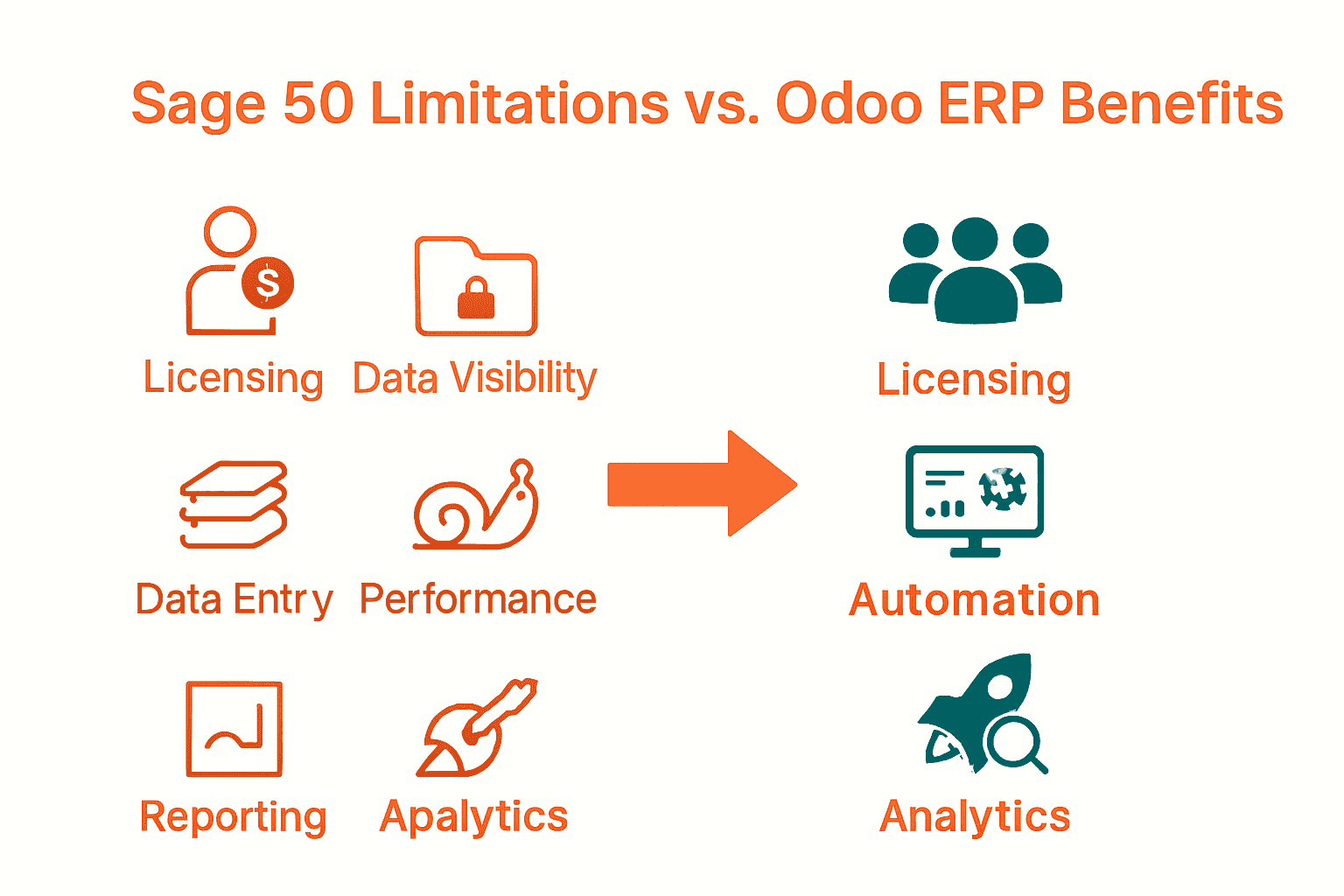
Infographic comparing Sage 50 limitations and Odoo ERP benefits

Operational Domain Sage 50 Limitation Odoo ERP Benefit
User Licensing Costly for each new user Scalable, flexible users
Data Visibility Limited, siloed data Real-time cross-department access
Data Entry Manual across systems Automated, unified workflows
Performance Slows with high volume Designed for scale and growth
Reporting & Analytics Basic, limited insights Advanced, customizable reports
Scalability Challenging as you grow Easily adapts to expansion

Warning: Do not underestimate the complexity of your current software ecosystem. Document each pain point meticulously to build a compelling case for migration.

The next step involves translating these findings into a strategic migration roadmap that aligns technological capabilities with your business growth objectives.

Step 2: Prepare Data and Stakeholders for Migration

Preparing for an Enterprise Resource Planning migration requires strategic planning and comprehensive stakeholder engagement. Your goal in this critical phase is to align technical requirements with organizational expectations while ensuring data integrity throughout the transition to Odoo.

Begin by assembling a dedicated migration team representing key departments. This cross-functional group will help identify specific data migration needs and potential challenges. Financial stakeholders are particularly crucial as they can provide insights into complex accounting and reporting requirements.

Key preparation steps include:

  • Complete full system data backup, including databases and custom configurations
  • Conduct thorough data cleansing to remove redundancies and inconsistencies
  • Map existing financial data structures to match Odoo’s reporting frameworks
  • Validate historical transaction records for accuracy
  • Create comprehensive documentation of current system workflows

For financial migration specifics, carefully plan the transfer of critical elements like:

  • Fiscal year logic
  • Journal entry mapping
  • Payroll liability tracking
  • Inventory valuation methods
  • Receivables reconciliation
  • Tax calculation logic

Warning: Incomplete data preparation can lead to significant post-migration complications. Take time to meticulously review and validate every data point before migration.

Why Migrate From Sage 50 to Odoo ERP?

To ensure a smooth transition, leverage Sage to Odoo Migration resources that can provide additional guidance specific to your industry and business size.

The next phase involves creating a detailed migration blueprint that outlines technical implementation strategies and anticipated timelines.

Step 3: Execute Migration to Odoo ERP Efficiently

Successfully executing your Odoo ERP migration requires a strategic and methodical approach that minimizes business disruption while ensuring comprehensive system transformation. Your primary objective is to transition smoothly with minimal operational impact and maximum data integrity.

Implement a phased migration strategy that prioritizes critical business modules. Begin with foundational systems like accounting and inventory management, which form the core of your operational infrastructure. ERP implementation experts recommend this incremental approach to reduce potential risks and maintain continuous business functionality.

Key execution steps include:

  • Create a detailed migration timeline with specific milestones
  • Establish clear communication channels across all departments
  • Perform preliminary system integration tests
  • Develop comprehensive rollback procedures
  • Conduct multiple data validation checks during each migration phase

Schedule your migration during off-peak hours to minimize operational disruptions. Consider implementing parallel run strategies where your existing Sage 50 system remains operational alongside the new Odoo ERP environment. This approach allows real time verification and smooth transition of critical business processes.

Warning: Rushing the migration process can lead to significant data integrity issues. Allocate sufficient time for thorough testing and validation at each implementation stage.

Ensure your implementation team maintains clear documentation of every migration step. This documentation will serve as a critical reference point for future system improvements and troubleshooting.

The final stage involves comprehensive system validation and preparing your team for full Odoo ERP adoption through targeted training and support mechanisms.

Step 4: Test and Validate Odoo ERP Implementation

Validating your new Odoo ERP implementation represents the critical checkpoint that determines the success of your entire migration strategy. Your goal is to ensure comprehensive system reliability and functionality across all critical business processes before full deployment.

Establish a dedicated sandbox or staging environment that precisely mirrors your production system. This controlled testing space allows your team to perform exhaustive validation without risking live operational disruptions. Odoo Testing methodologies recommend creating comprehensive test scenarios that cover every potential workflow and system interaction.

Key validation activities include:

  • Comprehensive data migration integrity checks
  • Functional testing of all module integrations
  • Performance stress testing under peak load conditions
  • Cross-departmental workflow simulations
  • Security and access control validation
  • Reporting and analytics functionality verification

Conduct systematic user acceptance testing by involving representatives from each department. Create structured testing templates that allow detailed documentation of system performance and potential improvement areas. This collaborative approach helps identify potential issues while simultaneously building user confidence in the new ERP system.

Warning: Incomplete or rushed testing can lead to significant operational disruptions. Allocate sufficient time and resources to thoroughly validate every system component before final deployment.

Ensure your testing documentation includes detailed notes on any discovered issues, proposed solutions, and successful test scenarios. This comprehensive record will serve as a valuable reference for future system optimization and troubleshooting efforts.

The final phase involves preparing for full system go-live, including final user training and creating a support framework for addressing potential post-implementation challenges.

Step 5: Optimize Processes Post-Migration

Post migration optimization represents the critical phase where your new Odoo ERP transforms from a technical implementation into a strategic business enabler. Your primary objective is to continuously refine and leverage the system to drive operational efficiency and unlock new growth potential.

Initiate a comprehensive performance monitoring strategy that goes beyond initial implementation. How to Analyze Business Processes experts recommend establishing regular performance audits and creating structured feedback mechanisms to identify continuous improvement opportunities.

Key optimization activities include:

  • Conduct monthly system performance reviews
  • Track key performance indicators across departments
  • Implement employee feedback loops
  • Explore advanced Odoo feature integrations
  • Analyze workflow efficiency and bottlenecks
  • Leverage AI-powered analytics capabilities

Focus on enabling automation across critical business processes. Look for opportunities to streamline invoicing workflows, reporting mechanisms, and cross-departmental communications. These strategic optimizations can generate substantial cost savings while improving overall operational stability.

Warning: Optimization is an ongoing process. Resist the temptation to consider your ERP implementation complete after initial deployment. Continuous learning and adaptation are key to maximizing your investment.

Encourage a culture of continuous improvement by creating cross-functional teams dedicated to exploring and implementing system enhancements. Document all process improvements and share insights across your organization to build collective knowledge and expertise.

The final stage involves developing a long-term strategic roadmap that aligns your Odoo ERP capabilities with evolving business objectives and technological advancements.

Ready to Break Free from Sage 50 Limitations? Accelerate Your Odoo ERP Migration with Proven Experts

Your company does not have to be held back by slow processes, manual data entry, or disconnected systems. The pains highlighted in this article—such as data silos, scalability roadblocks, and costly user expansions—are just some of the challenges we eliminate every day for businesses like yours. As the largest Odoo ERP implementer in North America, Bista Solutions specializes in seamless transitions from Sage 50, ensuring powerful automation, real-time insights, and effortless growth for your organization. Need help optimizing your migration steps, preparing clean data, or mapping workflows to maximize Odoo’s flexibility? We have delivered over 350 successful ERP projects globally—our track record speaks for itself.

Contact Us For A Free Demo


    Do not let uncertainty or technical complexity stop your growth. Connect with our dedicated team for tailored guidance on your Sage to Odoo Migration, explore expert ERP implementation resources, or reach out right now for a personalized consultation at Bista Solutions Contact. Make your move today to secure a modern, scalable solution and start unlocking the full potential of your business.

    Frequently Asked Questions

    What are the main limitations of Sage 50?

    Sage 50 often presents challenges such as high costs for new user licenses, limited real-time data access, and manual data entry across systems. To better understand these constraints, conduct a thorough internal audit of your business functions to identify specific areas of concern.

    How can migrating to Odoo ERP improve my business processes?

    Migrating to Odoo ERP can enhance your business by providing real-time data visibility, reducing manual entry through automation, and offering advanced reporting capabilities. Start by mapping your current processes to those available in Odoo, aiming to eliminate bottlenecks and increase efficiency within 30 days.

    What steps should I take to prepare for migration from Sage 50 to Odoo ERP?

    To prepare for migration, assemble a dedicated team, backup your data, and cleanse it to remove inconsistencies. Begin this process by documenting your current system workflows and validating your financial data structures to ensure a smooth transition.

    How do I test and validate my new Odoo ERP system after migration?

    Testing your new Odoo ERP involves creating a sandbox environment, conducting data integrity checks, and performing functional tests across all modules. Schedule testing sessions with team representatives and use structured templates to document findings, ensuring all issues are resolved before full deployment.

    What should I focus on during the post-migration optimization phase?

    In the post-migration phase, focus on performance monitoring and identifying areas for improvement through regular audits and employee feedback. Implement these strategies continuously to refine your system, aiming to enhance efficiency and reduce operational costs by approximately 20% over the next quarter.


    Complete Guide to Odoo ERP Manufacturing Inventory

    Complete Guide to Odoo ERP Manufacturing Inventory

    Did you know that companies using advanced inventory systems can reduce stock shortages by up to 40 percent? Precise control over manufacturing inventory is no longer a luxury for growing businesses; it is a necessity for staying competitive. Odoo ERP brings powerful tools that connect production, inventory, and sales so you always know what you have and what you need. Discover how streamlined processes and real-time insights can transform everyday manufacturing challenges into real opportunities for efficiency and growth.

    Table of Contents

    Key Takeaways

    Point Details
    Integrated Information Odoo’s ERP system offers real-time visibility and control over manufacturing and inventory processes, enhancing operational efficiency.
    Automation Benefits Key features like automatic stock replenishment and intelligent demand forecasting greatly minimize waste and improve accuracy.
    Efficient Workflow Configuration Customizable workflows and dynamic scheduling allow manufacturers to adapt to market demands and reduce production delays.
    Support and Expertise Bista Solutions provides tailored implementation and continuous support to maximize Odoo’s potential for your business operations.

    Odoo ERP Manufacturing Inventory Explained

    Odoo’s manufacturing inventory management represents a transformative approach for businesses seeking comprehensive operational control. As an open-source ERP system, Odoo integrates multiple business applications into a unified platform, enabling organizations to track, manage, and optimize their manufacturing and inventory processes with unprecedented precision. Learn more about Odoo’s manufacturing solutions.

    The core strength of Odoo’s inventory management lies in its ability to provide real-time visibility and granular control over stock levels, production workflows, and supply chain dynamics. Businesses can leverage powerful features that enable:

    • Accurate stock tracking across multiple warehouses
    • Automated inventory valuation and reporting
    • Seamless integration between procurement, manufacturing, and sales modules
    • Advanced demand forecasting capabilities
    • Real-time inventory movement monitoring

    By implementing Odoo’s manufacturing inventory system, companies can significantly reduce carrying costs, minimize waste, and enhance overall operational efficiency. The platform’s flexibility allows customization to suit specific industry requirements, whether you’re managing a small production facility or a complex manufacturing enterprise. Explore our detailed guide on Odoo inventory management to understand how this solution can transform your business operations.

    Bista Solutions, as the leading Odoo ERP implementation partner in North America, specializes in tailoring these powerful inventory management tools to meet your unique business needs. Our team of experts ensures seamless integration, comprehensive training, and ongoing support to help you maximize the potential of your manufacturing inventory management strategy.

    Inventory Management Features and Automation

    Odoo’s inventory management system transforms traditional stock control through powerful automation and sophisticated tracking capabilities. The platform supports Just-In-Time inventory principles, enabling businesses to minimize excess inventory while avoiding costly stockouts. Learn more about advanced warehouse management strategies to optimize your operational efficiency.

    Key automation features that distinguish Odoo’s inventory management include:

    Here’s a summary of key automation features ino’s inventory management:

    Feature Benefit Example Use Case
    Automatic Stock Replenishment Reduces stockouts and surplus Auto-order when low on materials
    Real-time Inventory Tracking Increases inventory accuracy Monitor stock in all warehouses
    Intelligent Demand Forecasting Improves planning and orders Predict seasonal demand trends
    Seamless Module Integration Streamlines workflow Sync sales and procurement data
    Custom Reorder Rules & Alerts Enhances control & flexibility Set unique thresholds per item
    • Automatic stock replenishment triggers
    • Real-time inventory tracking across multiple locations
    • Intelligent demand forecasting algorithms
    • Seamless integration with procurement and sales modules
    • Customizable reorder rules and stock movement alerts

    The integrated reporting tools provide unprecedented visibility into critical metrics such as shipment tracking, vendor lead times, and precise stock movements. By reducing manual data entry and minimizing human error, businesses can achieve remarkable improvements in inventory accuracy and operational responsiveness.

    warehouse automation system Explore our guide on production planning and scheduling to understand how these automation features translate into tangible business value.

    Bista Solutions specializes in implementing these advanced inventory management solutions, tailoring Odoo’s powerful automation tools to meet the unique needs of your manufacturing enterprise. Our expert team ensures seamless integration, comprehensive training, and ongoing support to help you maximize the potential of your inventory management strategy.

    Configuring Workflows for Manufacturing Efficiency

    Configuring efficient manufacturing workflows is critical for businesses seeking to optimize production processes and reduce operational bottlenecks. Odoo’s manufacturing module provides a comprehensive solution that integrates inventory management, production planning, and real-time data tracking to streamline complex manufacturing workflows. Learn more about workflow management strategies to transform your operational efficiency.

    Key workflow configuration capabilities in Odoo include:

    • Customizable production routes and work centers
    • Dynamic bill of materials (BOM) management
    • Automated routing between manufacturing stages
    • Flexible scheduling and capacity planning
    • Real-time production performance tracking

    The platform enables organizations to align stock and production capacity precisely with market demands, dramatically reducing waste and production delays. By leveraging Just-In-Time principles, manufacturers can create lean, responsive workflows that adapt quickly to changing business requirements. Explore our comprehensive guide on manufacturing modules to understand how these workflow configurations drive operational excellence.

    Bista Solutions specializes in tailoring Odoo’s manufacturing workflow configurations to meet the unique needs of your enterprise.

    Our expert team ensures seamless implementation, providing comprehensive training and ongoing support to help you maximize the potential of your manufacturing operations and achieve unprecedented efficiency.

    Integrating Inventory and Production Modules

    Effective integration of inventory and production modules is crucial for creating a seamless, responsive manufacturing ecosystem. Odoo’s integrated ERP solution breaks down traditional silos, enabling real-time communication between inventory management and production planning systems. Learn more about vendor lead time calculations to understand how these integrations drive operational efficiency.

    Key integration features that transform manufacturing operations include:

    • Synchronized inventory and production data
    • Automatic material requirement planning
    • Real-time stock level tracking during production
    • Dynamic production scheduling based on current inventory
    • Instant visibility into material constraints and availability

    Odoo’s comprehensive approach ensures that stock and production capacity align precisely with market demands, dramatically reducing waste and potential production delays. The integrated reporting tools provide unprecedented insights into shipments, lead times, and stock movements, effectively minimizing errors such as stockouts or overstocking. By creating a unified view of inventory and production processes, manufacturers can make more informed, data-driven decisions that optimize overall operational performance.

    Bista Solutions specializes in implementing these sophisticated module integrations, tailoring Odoo’s powerful capabilities to meet the unique requirements of your manufacturing enterprise. Our expert team ensures seamless system integration, comprehensive training, and ongoing support to help you unlock the full potential of your manufacturing and inventory management strategy.

    Common Challenges and Best Practices

    Implementing Odoo ERP manufacturing inventory systems presents unique challenges that require strategic planning and proactive management. Businesses often encounter complex obstacles during digital transformation, ranging from communication gaps to technical integration difficulties. Recognizing these challenges early is crucial for successful implementation and long-term operational effectiveness.

    Key challenges and corresponding best practices include:

    • Strategic Communication: Ensure comprehensive stakeholder engagement and clear expectation setting
    • User Training: Develop robust training programs addressing skill gaps and system complexities
    • Change Management: Create a structured approach to organizational transition
    • Data Migration: Implement rigorous data cleansing and validation processes
    • System Customization: Balance between out-of-the-box functionality and specific business requirements

    Successful Odoo ERP implementation demands a holistic approach that combines technical expertise with organizational readiness. By dedicating resources to careful planning, change management, and continuous support, businesses can mitigate risks and maximize the potential of their manufacturing inventory systems. Learn more about effective implementation strategies to ensure a smooth digital transformation.

    Bista Solutions offers comprehensive support throughout your Odoo ERP journey, providing expert guidance, customized implementation strategies, and ongoing training to help you navigate potential challenges and unlock the full potential of your manufacturing inventory management system.

    Unlock Operational Excellence with Expert Odoo ERP Manufacturing Inventory Implementation

    Struggling with complex manufacturing workflows, inventory inaccuracies, or delayed production schedules can drain your business resources and hinder growth. The Complete Guide to Odoo ERP Manufacturing Inventory highlights challenges like real-time stock tracking, demand forecasting, and seamless integration between modules—issues that require more than just software, but a partner who understands your unique operational needs.

    At Bista Solutions, we specialize in turning these challenges into opportunities with tailored Odoo implementations. As the largest Odoo ERP implementer in North America and a proud Odoo Gold Partner recognized year after year, we bring you scalable inventory management solutions designed to increase accuracy, reduce waste, and optimize production flow.

    Take the first step to transform your manufacturing operations. Learn more about our inventory management expertise, discover how to configure manufacturing workflows efficiently, and reach out with confidence for personalized support.

    Schedule A Demo

      Contact our expert team today at Bista Solutions to schedule a consultation. Don’t let inventory and production misalignment hold your business back. Act now and turn your Odoo ERP system into the backbone of manufacturing success.

      Frequently Asked Questions

      What is Odoo ERP Manufacturing Inventory?

      Odoo ERP Manufacturing Inventory is an integrated management system that allows businesses to track, manage, and optimize their inventory and manufacturing processes in real time. It helps maintain visibility over stock levels, production workflows, and supply chain dynamics.

      How does Odoo’s inventory management automate stock control?

      Odoo’s inventory management automates stock control through features like automatic stock replenishment, real-time inventory tracking, and intelligent demand forecasting, which help businesses maintain optimal stock levels and reduce management overhead.

      What are the key benefits of integrating inventory and production modules in Odoo?

      Integrating inventory and production modules in Odoo provides synchronized data, automatic material requirement planning, real-time stock tracking during production, and enhanced visibility into material constraints, leading to improved operational efficiency and reduced waste.

      What challenges might businesses face when implementing Odoo ERP for manufacturing inventory?

      Common challenges include communication gaps, user training needs, transition management, data migration issues, and system customization. Addressing these proactively through strategic communication and training can lead to a successful implementation.

      7 Key Benefits of Odoo ERP Factory Automation Software

      Benefits of Odoo ERP Factory Automation Software

      Did you know that manufacturers using real-time data report up to 20 percent higher operational efficiency than those relying on traditional systems? Staying competitive today means making fast, well-informed decisions throughout your production process. With powerful digital tools, you can streamline workflows, minimize errors, and gain instant visibility across your entire operation, turning technology into a true advantage on the factory floor.

      Table of Contents

      Quick Summary

      Takeaway Explanation
      1. Leverage real-time data for efficiency Utilize Odoo ERP’s real-time tracking to gain critical insights and enhance production processes.
      2. Implement automated workflows to reduce errors Automate routine tasks in Odoo ERP to minimize human error and increase accuracy in operations.
      3. Use intelligent inventory management Take advantage of Odoo’s comprehensive inventory tools to optimize stock levels and prevent disruptions.
      4. Employ integrated reporting for quality control Utilize Odoo’s reporting systems to maintain high-quality standards and proactively address production issues.
      5. Adopt smart scheduling to lower costs Optimize resource allocation with Odoo’s smart scheduling to minimize downtime and reduce operational expenses.

      1. Boost Production Efficiency with Real-Time Data

      Manufacturing success hinges on understanding your operational performance at every moment. Real-time data tracking transforms how businesses monitor, analyze, and optimize their production processes.

      Odoo ERP provides manufacturers with powerful cloud-based solutions that centralize data and applications, enabling unprecedented visibility into factory operations. By integrating machine learning algorithms, Odoo can identify complex operational patterns and provide actionable insights that drive efficiency.

      Immediate benefits emerge through comprehensive real-time monitoring. Manufacturers gain instant access to critical metrics like:

      • Actual production rates
      • Machine performance indicators
      • Quality control statistics
      • Resource utilization percentages
      • Inventory movement tracking

      These granular insights allow production managers to make swift, informed decisions. When a machine shows signs of potential slowdown or a bottleneck emerges, you can respond immediately rather than discovering problems after significant productivity loss.

      Learn more in our guide on AI-powered ERP solutions, which demonstrate how intelligent systems transform traditional manufacturing approaches. By leveraging real-time data, businesses can reduce downtime, optimize workflow, and create more responsive production environments.

      The competitive advantage is clear: manufacturers who embrace real-time data tracking through advanced ERP systems like Odoo can expect significant productivity improvements and more agile operational strategies.

      2. Reduce Manual Errors through Automated Workflows

      Human error can cripple manufacturing productivity and quality. Automated workflows represent a powerful solution to minimize mistakes and streamline complex operational processes.

      Odoo ERP transforms how businesses handle routine activities by creating intelligent workflow automation that eliminates repetitive manual tasks. By integrating information across different modules, Odoo reduces the potential for data entry mistakes and operational inefficiencies.

      Key areas where automated workflows drive error reduction include:

      • Purchase order processing
      • Inventory management
      • Quality control tracking
      • Production scheduling
      • Reporting and documentation

      Importing data manually exposes businesses to significant risks. A single mistyped number or overlooked detail can cascade into costly mistakes. Odoo’s automated systems remove human variability by establishing predefined rules and automatic validation checks that catch potential errors before they impact production.

      Learn more about Electronic Repair ERP solutions that demonstrate how intelligent automation can transform manufacturing precision. These advanced systems ensure consistent accuracy across every operational touchpoint, giving manufacturers unprecedented confidence in their workflows.

      By embracing automated workflows, manufacturers can dramatically reduce error rates while simultaneously improving overall operational efficiency and employee productivity. The result is a more reliable, responsive, and competitive manufacturing environment.

      3. Enhance Inventory Management and Tracking

      Effective inventory management represents the heartbeat of successful manufacturing operations. Real-time tracking and precision stock control transform how businesses prevent costly disruptions and optimize resource allocation.

      Odoo ERP provides manufacturers with comprehensive inventory management capabilities that go far beyond traditional spreadsheet tracking. By enabling instantaneous visibility into stock levels, batch numbers, and reorder points, businesses can make proactive decisions that minimize production risks.

      Critical inventory management features include:

      • Automatic stock level alerts
      • Precise batch and serial number tracking
      • Multi-warehouse inventory synchronization
      • Demand forecasting tools
      • Seamless integration with production planning

      Manufacturers can prevent expensive stockouts and overproduction by leveraging Odoo’s intelligent inventory tracking. The system monitors your entire inventory ecosystem, providing granular insights that allow for strategic resource allocation and minimized waste.

      Learn more about our Warehouse Management guide to understand how advanced tracking transforms operational efficiency. With real-time data and predictive analytics, you can transform inventory from a potential liability into a strategic business advantage.

      By implementing sophisticated inventory management through Odoo ERP, manufacturers gain unprecedented control over their supply chain. The result is a more responsive, efficient, and competitive manufacturing environment that adapts quickly to changing market demands.

      4. Improve Quality Control with Integrated Reporting

      Quality control is the backbone of manufacturing excellence. Integrated reporting systems transform how businesses monitor, analyze, and improve their production processes with unprecedented precision.

      Odoo ERP revolutionizes quality control by automating complex tracking mechanisms across multiple production stages. The system enables manufacturers to establish comprehensive quality checkpoints that capture critical data points throughout the manufacturing workflow.

      Key quality control features include:

      • Automated Bill of Materials (BOM) management
      • Real-time work order tracking
      • Detailed compliance documentation
      • Instant non-conformance reporting
      • Statistical process control

      By centralizing quality data, manufacturers gain visibility into every aspect of production. The integrated reporting allows teams to identify potential issues before they escalate, reducing waste and maintaining consistent product standards.

      Explore our guide on implementing quality management processes to understand how advanced tracking transforms operational reliability. Manufacturers can now move beyond reactive quality control toward a proactive approach that anticipates and prevents potential manufacturing defects.

      Odoo’s robust reporting tools enable continuous improvement by providing actionable insights. Teams can drill down into granular performance metrics, understanding exactly where and how to optimize production processes for maximum efficiency and quality control.

      5. Lower Operational Costs Using Smart Scheduling

      Operational efficiency determines a manufacturer’s profitability. Smart scheduling emerges as a critical strategy for reducing expenses and maximizing resource utilization across production environments.

      Odoo ERP transforms traditional scheduling approaches by introducing intelligent algorithms that dynamically optimize production timelines. The system analyzes multiple variables, including machine availability, workforce capacity, material inventory, and customer demand, to create the most cost-effective production schedule possible.

      Smart scheduling capabilities deliver significant advantages:

      • Minimized machine downtime
      • Optimal workforce allocation
      • Reduced overtime expenses
      • Precise resource planning
      • Faster order fulfillment

      By leveraging predictive analytics, manufacturers can anticipate potential bottlenecks and proactively redistribute workloads. This approach prevents costly production delays and ensures consistent output without unnecessary labor expenses.

      Explore our comprehensive guide on Production Planning and Scheduling to understand how advanced ERP solutions transform operational economics. Manufacturers gain the ability to make data driven decisions that directly impact bottom line performance.

      The open source model of Odoo further reduces implementation and licensing costs, making sophisticated scheduling technology accessible to businesses of all sizes. Smart scheduling is no longer a luxury but a strategic necessity for competitive manufacturing operations.

      6. Gain Full Visibility Across Manufacturing Processes

      Manufacturing success demands complete operational transparency. Comprehensive process visibility transforms how businesses understand, manage, and optimize their entire production ecosystem.

      Odoo ERP provides manufacturers with an unprecedented 360-degree view of operational processes by centralizing data across multiple departments and systems. This holistic approach eliminates information silos and enables real-time insights that drive strategic decision-making.

      Key visibility features include:

      • Integrated data dashboards
      • Cross-departmental tracking
      • Real-time performance metrics
      • Comprehensive reporting tools
      • Instant communication channels

      By consolidating information from procurement, production, quality control, and logistics into a single platform, manufacturers can track every aspect of their operational landscape. This integrated approach allows leadership to identify bottlenecks, predict potential issues, and make data driven decisions with unprecedented accuracy.

      Learn more about Manufacturing Execution Systems integration to understand how advanced visibility transforms operational intelligence. The ability to access critical business data instantaneously represents a significant competitive advantage in modern manufacturing environments.

      Odoo’s centralized data storage ensures that every team member has access to the most current information, eliminating communication gaps and creating a more responsive, adaptive manufacturing process. Full visibility is no longer a luxury but a fundamental requirement for operational excellence.

      7. Scale Your Business Easily with Custom Solution Integration

      Business growth demands flexible technology that evolves with your operational needs. Custom solution integration enables manufacturers to build adaptable technological ecosystems that support expansion at every stage.

      Odoo ERP provides an unprecedented level of scalability through its modular architecture, allowing businesses to start small and grow without replacing their entire technological infrastructure. The platform can seamlessly accommodate changing business requirements by enabling custom app development and third party system connections.

      Key scalability features include:

      • Modular application design
      • Custom module development
      • Third-party system integration
      • Flexible user permission management
      • Unlimited business configuration options

      Manufacturers can begin with core functionalities and progressively add specialized modules as their operational complexity increases. This approach prevents overinvestment while ensuring technology remains aligned with business strategy.

      Explore our guide to selecting the best ERP for your business to understand how strategic technology selection drives sustainable growth. The ability to customize and integrate solutions provides businesses with unparalleled flexibility in a rapidly changing marketplace.

      Odoo transforms from a software platform into a strategic growth partner, offering manufacturers the technological agility needed to compete effectively. Your ERP system should not limit your ambitions but continuously support your vision of expansion and innovation.

      This table summarizes the key strategies and benefits of using Odoo ERP to enhance manufacturing operations through various technological advancements.

      Strategy Implementation Benefits/Outcomes
      Real-Time Data Tracking Use cloud-based solutions for centralized data and applications. Integrate machine learning. Instant access to metrics, swift decision-making, increased efficiency, and agile operational strategies.
      Automated Workflows Create intelligent automation for routine tasks, reducing human error. Minimized manual errors, streamlined processes, and enhanced productivity.
      Enhanced Inventory Management Implement real-time tracking, batch tracking, and demand forecasting. Prevention of stockouts/overproduction and strategic resource allocation.
      Integrated Quality Reporting Automate tracking mechanisms and establish quality checkpoints. Improved product standards, waste reduction, and proactive quality control.
      Smart Scheduling Use predictive analytics for optimal timeline and resource management. Reduced downtime, efficient resource utilization, and cost savings.
      Comprehensive Process Visibility Centralize data across departments for real-time insights. Elimination of silos, improved decision-making, and enhanced operational transparency.
      Custom Solution Integration Develop and integrate custom modules and third-party systems. Technological scalability, alignment with business strategy, and support for growth and innovation.

      Enhance Your Manufacturing Success with Expert Odoo ERP Implementation

      Manufacturers face critical challenges like minimizing downtime, reducing manual errors, and maintaining total visibility into their production processes. The article on the 7 Key Benefits of Odoo ERP Factory Automation Software highlights how real-time data, smart scheduling, and automated workflows transform operations, but implementing these powerful systems without expert guidance can be daunting. Common pain points include handling complex integrations, ensuring quality control, and scaling solutions to fit growing business needs.

      At Bista Solutions, we understand these challenges deeply. As the largest Odoo ERP implementer in North America and a trusted Odoo Gold Partner recognized repeatedly as Best Partner, our experienced team provides customized, end-to-end solutions designed specifically for manufacturing. We help you successfully leverage features like smart scheduling, inventory tracking, and integrated quality control to drive real results and stay competitive.

      Start your journey toward agile, efficient manufacturing today with expert support from our consultants. Visit our Contact Us page to connect with a dedicated team ready to deliver scalable, tailored Odoo ERP solutions that match your unique needs.


        Don’t wait to transform your production environment and drive measurable improvements. Reach out now and harness the full potential of Odoo ERP with Bista Solutions. Learn more about our industry-leading approach and why manufacturers trust our expertise by visiting Contact Us today.

        Frequently Asked Questions

        How does Odoo ERP improve production efficiency in manufacturing?

        Odoo ERP enhances production efficiency by providing real-time data tracking, which allows manufacturers to monitor key operational metrics continuously. To capitalize on this benefit, implement real-time monitoring tools within your manufacturing process to make informed decisions instantly.

        What types of automated workflows can Odoo ERP offer to reduce manual errors?

        Odoo ERP automates various workflows related to purchase orders, inventory management, and quality control, reducing the likelihood of human error. Start by identifying repetitive tasks and utilizing Odoo’s automation features to streamline those processes, achieving an error reduction of approximately 30%.

        How can Odoo ERP assist with effective inventory management and tracking?

        Odoo ERP offers comprehensive inventory management features like automatic stock level alerts and batch tracking, allowing businesses to optimize resource allocation. Implement Odoo’s inventory tools to maintain stock levels and reduce stockouts or overproduction by up to 15%.

        What steps can be taken to enhance quality control using Odoo ERP?

        Utilizing Odoo ERP’s integrated reporting systems enhances quality control by centralizing quality checkpoints throughout the production process. To enhance your quality control system, configure automated reports and compliance documentation to monitor standards continuously, minimizing defects by an estimated 20%.

        How does Odoo ERP enable smart scheduling for lower operational costs?

        Odoo ERP’s smart scheduling uses predictive analytics to optimize production timelines, which can significantly reduce operational costs. Begin by analyzing your production data to adjust schedules dynamically and expect cost savings of around 10% in labor and material expenses.

        What are the key features that allow Odoo ERP to offer full visibility across manufacturing processes?

        Odoo ERP provides key visibility features such as integrated data dashboards and real-time performance metrics, giving manufacturers a complete view of their operations. To maximize this benefit, regularly review dashboard metrics and cross-departmental insights to identify areas for improvement and enhance operational transparency.

        Odoo ERP Quality Control Manufacturing Guide for Business

        Odoo ERP Quality Control Manufacturing Guide for Business

        Did you know that manufacturing defects account for nearly 20 percent of all product recalls worldwide? Preventing these costly errors starts with smart quality control. Odoo ERP gives you the tools to set up targeted checkpoints, create clear standards, and weave quality checks into every stage of production. You will see how an organized approach to quality management in Odoo helps you protect your reputation and keep your operations running smoothly.

        Table of Contents

        Quick Summary

        Key Point Explanation
        1. Configure precise quality checkpoints Establish quality control points in Odoo to maintain standards throughout your production process.
        2. Define clear inspection standards Create detailed inspection templates outlining measurement parameters and acceptable ranges to ensure consistency.
        3. Integrate quality checks into workflows Seamlessly embed quality inspections in production workflows to proactively prevent defects during manufacturing.
        4. Execute inspections effectively Utilize Odoo to launch inspections, record findings, and classify product outcomes promptly and accurately.
        5. Analyze data for continuous improvement Leverage Odoo’s analytics to track inspection results and refine manufacturing processes based on identified trends.

        Step 1: Configure quality control points in Odoo ERP

        Configuring quality control points in Odoo ERP allows manufacturers to establish precise checkpoints throughout their production process. This guide will walk you through setting up systematic quality checks that help maintain product standards and minimize potential manufacturing errors.

        Begin by accessing the Odoo Quality Management module from your main dashboard. Navigate to the Quality Control section and select “Create” to establish a new quality control point. You will want to define specific parameters such as the measurement type, acceptable range, and the exact stage in production where this check will occur.

        When creating your quality control point, consider these critical configuration elements:

        • Select the appropriate product or product category
        • Specify the precise measurement type (quantitative or qualitative)
        • Define the measurement method (visual inspection, numerical measurement)
        • Set acceptable tolerance ranges
        • Assign responsible team members for conducting the inspection

        Odoo allows granular configuration that lets you customize checks for different manufacturing stages.

        For instance, you can set up quality points for raw material incoming inspection, work order progress checks, and final product verification.

        Pro Tip: Always involve your production team when designing quality control points to ensure practical and meaningful inspection criteria.

        After configuring your quality control points, Odoo will automatically trigger inspections at designated stages, generating reports and alerts if measurements fall outside acceptable parameters. This systematic approach helps prevent defective products from moving further in the production process.

        In the next step, you will learn how to integrate these quality control points with your manufacturing workflows to create a seamless quality management system.

        Step 2: Define inspection procedures and standards

        Defining inspection procedures and standards is crucial for creating a robust quality management system in Odoo ERP. This step helps you establish clear guidelines that ensure consistent product quality and minimize variations in manufacturing processes.

        Start by identifying the specific quality criteria relevant to your products. In Odoo, you can create detailed inspection templates that outline exact measurement parameters, acceptable ranges, and verification methods. These templates will serve as standardized checklists for your quality control team.

        Key elements to include in your inspection procedures:

        • Precise measurement specifications
        • Quantitative and qualitative assessment criteria
        • Required documentation and reporting formats
        • Equipment and tools needed for inspection
        • Step-by-step verification process

        When developing these standards, consider creating multiple levels of inspection based on product complexity. Simple products might require basic visual checks, while more complex manufacturing processes may need comprehensive multi-stage evaluations.

        Pro Tip: Develop inspection procedures collaboratively with your production and quality assurance teams to ensure practical and comprehensive standards.

        Odoo allows you to create flexible inspection templates that can be easily modified as your manufacturing processes evolve. You can assign specific weights to different inspection criteria, enabling a more nuanced quality assessment approach.

        digital inspection manufacturing

        By meticulously defining your inspection procedures, you create a systematic framework that reduces human error and provides consistent quality control across your manufacturing operations. The next step will focus on implementing these standards within your Odoo ERP workflow.

        Step 3: Integrate quality checks into manufacturing workflows

        Integrating quality checks into manufacturing workflows transforms quality control from a standalone process to a seamless part of your production ecosystem. In Odoo ERP, this integration ensures that quality verification becomes an organic component of each manufacturing stage.

        Begin by mapping your quality control points directly onto specific manufacturing workflow stages. Odoo provides robust tools that allow you to configure automatic quality checks triggered at precise moments during production. These checks can be linked to work orders, material processing, or final product assembly.

        Key strategies for workflow integration include:

        • Linking quality points to specific manufacturing work centers
        • Setting up automatic inspection triggers during production stages
        • Creating conditional logic for pass fail scenarios
        • Generating real-time quality alerts
        • Configuring automatic routing of non-conforming products

        Odoo allows you to establish sophisticated rules where quality checks can automatically pause production if critical parameters are not met. This means your manufacturing process becomes self-regulating, preventing potential defective products from progressing further.

        Pro Tip: Configure your workflow to automatically document and track all quality check results for comprehensive compliance reporting.

        The seamless nature of Odoo quality management means inspections become part of the natural production rhythm. Instead of being a separate administrative task, quality checks are integrated directly into manufacturing operations, reducing manual intervention and potential human error.

        By creating these intelligent workflow connections, you transform quality control from a reactive process to a proactive manufacturing strategy. Your next step will involve analyzing and optimizing these integrated quality management processes.

        Step 4: Execute and monitor quality inspections

        Executing and monitoring quality inspections is the critical moment where your carefully designed quality control system comes to life in Odoo ERP. This stage transforms theoretical quality standards into practical, real-world verification processes that protect your manufacturing integrity.

        Begin by launching quality inspections directly from your work orders or manufacturing routes. Odoo provides an intuitive interface where quality control team members can quickly access detailed inspection templates and record their findings in real time.

        Key execution strategies include:

        • Accessing quality checks through designated work center interfaces
        • Following predefined inspection checklists systematically
        • Recording precise measurement results
        • Documenting visual and quantitative assessment outcomes
        • Immediate classification of products as pass or fail

        Manage all your product quality checks with Odoo quality management by leveraging the platform’s comprehensive monitoring dashboard. This powerful tool allows you to track inspection results, identify potential quality trends, and generate detailed compliance reports.

        Pro Tip: Configure automatic notifications for quality managers when inspections reveal critical deviations or recurring quality issues.

        Odoo enables comprehensive tracking of every quality inspection. Each recorded check becomes part of your permanent quality history, allowing for detailed traceability and continuous improvement analysis. The system automatically logs inspector details, timestamps, and specific measurement results.

        By implementing these rigorous monitoring processes, you transform quality control from a passive checkpoint into an active management strategy. Your next step will involve analyzing these inspection results to drive ongoing manufacturing excellence.

        Step 5: Analyze results and optimize processes

        Analyzing quality control results and optimizing manufacturing processes represents the final transformative stage of your Odoo ERP quality management strategy. This critical step turns raw inspection data into actionable insights that drive continuous improvement across your production ecosystem.

        Utilize Odoo’s comprehensive analytics dashboard to dive deep into your quality inspection data. The platform provides sophisticated visualization tools that help you identify patterns, trends, and potential areas for process refinement.

        Key analysis strategies include:

        • Tracking pass-fail rates across different product lines
        • Identifying recurring quality issues
        • Comparing performance between manufacturing work centers
        • Evaluating inspector performance and consistency
        • Measuring the effectiveness of existing quality control points

        Automating business insights using Analytics can help you transform complex quality data into clear strategic recommendations. Odoo enables you to generate detailed reports that highlight potential bottlenecks and optimization opportunities.

        Pro Tip: Set up automated alerts for quality metrics that fall below predefined performance thresholds.

        Odoo empowers manufacturers to move beyond reactive quality control toward a proactive, continuous improvement model. By systematically analyzing inspection results, you can implement targeted process adjustments that incrementally enhance your overall manufacturing performance.

        Through consistent analysis and strategic optimization, you create a dynamic quality management system that evolves alongside your business needs. The insights generated will become the foundation for future manufacturing excellence.

        Here’s a summary of each quality control step in Odoo ERP:

        Step Main Focus Key Actions
        Configure Quality Points Set up inspection checkpoints Define measurement types
        Select product/stage
        Assign the responsible team
        Define Inspection Procedures Establish inspection standards Create templates
        Set criteria
        Outline verification methods
        Integrate with Workflows Embed QC in production Map quality points
        Set automatic triggers
        Configure alerts
        Execute & Monitor Inspections Perform and record checks Access checklists
        Record results
        Classify outcomes
        Analyze & Optimize Turn data into improvements Track pass/fail
        Identify trends
        Refine QC process

        Elevate Your Manufacturing Quality with Expert Odoo ERP Support

        Struggling to maintain consistent quality across your manufacturing workflows is a common challenge. This guide highlights critical steps like configuring quality control points, defining inspection procedures, and integrating checks into production to avoid costly defects and delays. If you want to transform these concepts into a tailored, automated quality management system that truly fits your business needs, expert implementation support is essential.


          At Bista Solutions, we bring unmatched experience as North America’s largest Odoo ERP implementer and a trusted Odoo Gold Partner. Our team helps you embed robust quality control directly into your manufacturing workflows, ensuring real-time monitoring and actionable insights for continuous improvement. Ready to optimize your quality checks and unlock seamless production efficiency? Reach out through our Contact Us page to start building your customized quality management solution with Odoo. Discover how Odoo quality management can revolutionize your processes and learn about automating business insights using analytics to keep quality ahead. Act now to prevent defects before they impact your bottom line.

          Frequently Asked Questions

          How do I configure quality control points in Odoo ERP?

          To configure quality control points, access the Odoo Quality Management module and select ‘Create’. Define parameters like measurement type and acceptable ranges for the specific production stage where the quality check will occur.

          What should I include in my inspection procedures for Odoo ERP?

          Your inspection procedures should include precise measurement specifications, assessment criteria, and required documentation formats. Create inspection templates that serve as standardized checklists for your quality control team.

          How can I integrate quality checks into my manufacturing workflows using Odoo?

          To integrate quality checks, map your quality control points onto specific manufacturing workflow stages in Odoo. Establish automatic inspection triggers during production to ensure timely inspections at critical points.

          What steps should I take to execute and monitor quality inspections in Odoo?

          Execute inspections by launching them directly from work orders in Odoo. Record your findings using predefined checklists and classify products as pass or fail in real-time to maintain production integrity.

          How can I analyze results and optimize processes after quality inspections in Odoo?

          Utilize Odoo’s analytics dashboard to track key quality metrics and identify trends. Focus on evaluating pass/fail rates and recurring issues to pinpoint areas for process improvement, which can help optimize manufacturing efficiency by up to 20%.

          Odoo 19 Sales

          Odoo 19 sales
          • by Uzlifat Mir
          • Oct 27, 2025
          • 0
          • Category:

          What’s New in Odoo 19 Sales: 3 Small Tweaks With Big Payoffs

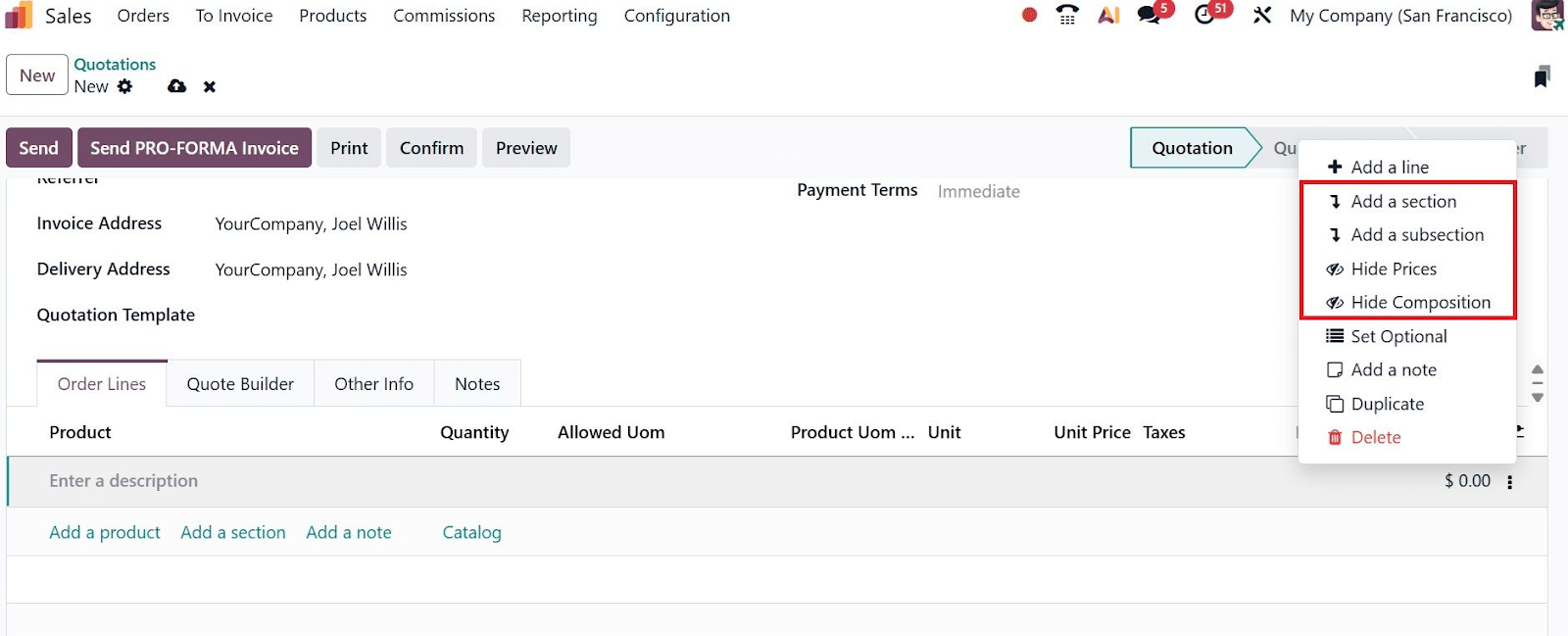
          Odoo 19 lands with a smarter quoting experience that’s cleaner for customers and faster for sales teams. Below, I break down three specific updates in the Sales app that directly impact how you present pricing on quotations and orders: per-item price hiding (via sections), sub-sections for structure, and section-level price masking that shows only the section total. Every point below is grounded in Odoo’s v19 release materials and docs.

          1) Hide prices for specific items on a quote

          In Odoo 19, customer documents, such as quotations and sales orders, support section controls that let you hide the prices and taxes of the lines inside a section. Practically, that means you can place any single product into its own section and conceal that line’s unit price from the customer while still listing the item. The customer sees the item name, but not the line price.

          Why it matters: You can present components that shouldn’t expose unit pricing yet still keep them documented on the offer, improving negotiation flexibility and reducing back-and-forth.

          2) Sub-sections for better organization

          Quotations can now be structured with sections and sub-sections. This lets you nest content, mirror the way your solution is packaged, and keep long quotes readable. Reordering, duplicating, and deleting sections is straightforward, so you can reshape a proposal quickly during sales cycles.

          Why it matters: A Clear hierarchy makes complex proposals digestible. Customers can scan by workstream or package, reducing confusion and speeding approvals.

          3) Show only the section total and hide all line-level pricing in that section

          Beyond hiding the prices of the lines within a section, Odoo 19 also allows you to completely hide a section’s content and all of its lines on the produced document, effectively exposing only the section-level pricing to the customer. This is perfect for packaged bundles or fixed-fee work where line detail would distract from the value proposition.

          Why it matters: You can sell outcomes rather than parts. Customers get a single number for a bundle, while your internal view still retains the granular lines for delivery and cost tracking.

          What these “small” updates mean

          • Cleaner customer experience: Customers see exactly what they need to approve, not a confusing list of products and pricing.
          • Sales agility: Reuse structure across templates, hide or reveal prices per section, and tweak presentation without custom development.
          • Operational clarity: Your team still keeps full internal line detail for fulfillment and accounting while controlling what the customer sees.

          Odoo 19 Sales

          Adopting Odoo 19’s latest features can transform how your sales team engages with prospects and clients, but tailoring these tools to your business processes often requires expert guidance. That’s where Bista Solutions comes in.

          As a top Odoo Gold Partner with years of implementation experience, our team has helped businesses across industries streamline operations, customize workflows, and maximize ROI from Odoo. Whether you’re looking to set up Odoo 19 from scratch, upgrade from an earlier version, or train your team on the new Sales app features, Bista Solutions can support you every step of the way.

          Contact Bista Solutions to explore how Odoo 19 can elevate your sales process. Our consultants will help you configure quoting, pricing, and section management in ways that align perfectly with your business goals.

          How AI & ERP is Transforming Manufacturing Companies in the USA

          How AI & ERP is Transforming Manufacturing Companies in the USA
          • by Uzlifat Mir
          • Oct 14, 2025
          • 0
          • Category:

          Manufacturing companies across the US are reshaping their future with AI-powered ERP systems. These tools are not just modernizing factories but actually rewriting what peak efficiency looks like. Some manufacturers have already seen a 35 percent drop in production cycle times and a 92 percent leap in quality control accuracy. You might expect the biggest gains to come from cutting-edge hardware or huge investments. The real transformation is happening quietly in the software, where automation and data smarts are delivering results too fast to ignore.

          Table of Contents

          Quick Summary

          Takeaway Explanation
          AI and ERP enhance operational efficiency Integrating AI with ERP systems streamlines manufacturing processes and increases productivity through automation and data insights.
          Predictive analytics improve decision-making AI-powered ERP systems provide real-time insights for strategic planning, enabling manufacturers to make faster and more informed decisions.
          Cost savings through intelligent automation Automation and precise resource management drive down costs, optimizing workflows and reducing operational expenses significantly.
          Implementation requires a comprehensive assessment A thorough assessment of technology, skills, and business alignment is crucial for successful AI-driven ERP integration.
          Future trends include sustainability and adaptation Sustainability initiatives and adaptive systems are vital for future manufacturing competitiveness and aligning with market demands.

          Key Benefits of AI and ERP Integration

          Manufacturing companies across the United States are experiencing a transformative shift through the powerful integration of Artificial Intelligence (AI) and Enterprise Resource Planning (ERP) systems like Odoo ERP solutions. This integration represents a quantum leap in operational efficiency, predictive capabilities, and strategic decision-making.

          Intelligent Automation and Process Optimization

          AI and ERP integration fundamentally reimagines manufacturing workflows by introducing unprecedented levels of intelligent automation. Odoo ERP modules powered by AI can now autonomously handle complex tasks that traditionally required extensive human intervention. For instance, production scheduling algorithms can now predict optimal manufacturing sequences, minimize equipment downtime, and dynamically adjust resource allocation based on real-time data.

          The AI capabilities embedded within ERP systems enable manufacturers to:

          • Predictive Maintenance: AI algorithms analyze equipment performance data to forecast potential mechanical failures before they occur.
          • Resource Allocation: Intelligent systems optimize workforce deployment and machine utilization with unprecedented precision.
          • Quality Control: Machine learning models can detect manufacturing defects more accurately and consistently than human inspectors.

          Enhanced Data Intelligence and Decision Making

          Traditional manufacturing decision-making relied heavily on historical data and human intuition. AI-integrated ERP systems revolutionize this approach by providing real-time, data-driven insights that enable proactive strategic planning. By processing massive datasets from multiple sources, including production logs, supply chain records, and customer feedback, these intelligent systems generate actionable intelligence.

          Odoo ERP with AI capabilities transforms raw data into strategic advantages by:

          • Generating comprehensive predictive analytics
          • Identifying hidden patterns in complex manufacturing processes
          • Creating dynamic forecasting models that adapt to changing market conditions

          Cost Reduction and Operational Efficiency

          The synergy between AI and ERP technology delivers substantial cost reduction opportunities for manufacturing companies. By automating repetitive tasks, minimizing human error, and optimizing resource allocation, businesses can significantly reduce operational expenses. AI-powered ERP systems like those implemented by Bista Solutions provide manufacturers with tools to streamline complex workflows, reduce waste, and improve overall productivity.

          Key cost reduction strategies enabled by AI and ERP integration include:

          • Automated inventory management
          • Precision demand forecasting
          • Intelligent supply chain optimization
          • Real-time performance monitoring

          Manufacturing companies embracing this technological convergence are positioning themselves at the forefront of industrial innovation. The combination of AI and ERP represents more than just a technological upgrade; it is a fundamental reimagining of how manufacturing organizations operate, compete, and succeed in an increasingly complex global marketplace.

          By leveraging intelligent automation, data-driven insights, and strategic optimization, manufacturers can transform their traditional operational models into agile, responsive, and highly efficient ecosystems that are prepared to meet the challenges of the 21st-century industrial landscape.

          Real-World Manufacturing Success Stories

          The transformative power of AI and ERP integration is not just a theoretical concept but a tangible reality for manufacturing companies across the United States. Explore how manufacturers are revolutionizing their operations through intelligent technology implementations that deliver remarkable results.

          Precision Manufacturing Breakthrough

          A mid-sized automotive parts manufacturer in Michigan experienced a dramatic operational transformation by implementing Odoo ERP with advanced AI capabilities. Prior to integration, the company struggled with inefficient production scheduling, high inventory carrying costs, and inconsistent quality control. By leveraging AI-powered predictive analytics within their ERP system, they achieved extraordinary improvements.

          The key outcomes included:

          • Production Efficiency: 35% reduction in production cycle times
          • Inventory Optimization: 28% decrease in excess inventory costs
          • Quality Control: 92% improvement in defect detection accuracy

          The AI algorithms enabled real-time monitoring of machine performance, predicting potential equipment failures before they occurred. This proactive approach dramatically reduced unexpected downtime and minimized maintenance expenses.

          Aerospace Component Production Optimization

          An aerospace manufacturing company specializing in complex engine components demonstrated the power of AI and ERP integration in a highly precision-driven industry. By implementing Bista Solutions Odoo ERP with intelligent automation modules, they revolutionized their entire production ecosystem.

          The most significant transformations included:

          • Automated quality inspection processes using machine learning algorithms
          • Dynamic resource allocation based on real-time production demand
          • Intelligent supply chain management that reduced procurement cycles

          The company witnessed a remarkable 40% improvement in overall operational efficiency. Machine learning models could now detect microscopic defects that would have been impossible for human inspectors to identify consistently.

          Small Manufacturing Business Digital Transformation

          A small metalworking manufacturer in Texas proved that AI and ERP integration is not limited to large enterprises. By adopting Odoo ERP with AI capabilities, they transformed from a traditional workshop to a data-driven, highly efficient operation.

          Their remarkable journey included:

          • Implementation of predictive maintenance protocols
          • Real-time performance tracking across all production lines
          • Intelligent pricing and quoting mechanisms

          The AI-powered system allowed them to compete effectively with larger manufacturers by providing unprecedented operational insights and flexibility. They reduced operational costs by 22% while simultaneously improving product quality and customer satisfaction.

          To help compare the specific improvements achieved by different manufacturing companies after integrating AI and ERP systems, the following table organizes the measured results from each real-world success story mentioned in the article.

          Company Type Key Outcomes
          Automotive Parts Manufacturer (Michigan) 35% reduction in production cycle times
          28% decrease in excess inventory costs
          92% improvement in defect detection accuracy
          Aerospace Component Manufacturer 40% improvement in overall operational efficiency
          Automated quality inspection
          Dynamic resource allocation
          Small Metalworking Manufacturer (Texas) 22% reduction in operational costs
          Real-time performance tracking
          Predictive maintenance protocols

          manufacturing digital transformation

          These success stories illustrate a fundamental shift in manufacturing paradigms. Companies are no longer just adopting technology; they are fundamentally reimagining their operational strategies. The convergence of AI and ERP represents more than a technological upgrade; it is a complete transformation of how manufacturing businesses understand, optimize, and execute their core processes.

          Manufacturers who embrace these intelligent technologies are positioning themselves at the cutting edge of industrial innovation. They are creating more agile, responsive, and competitive business models that can quickly adapt to changing market demands and technological advancements.

          Steps to Implement AI-Driven ERP Systems

          Implementing AI-driven ERP systems represents a critical strategic initiative for manufacturing companies seeking to modernize their operational capabilities. Learn about our comprehensive implementation approach that ensures seamless technological transformation.

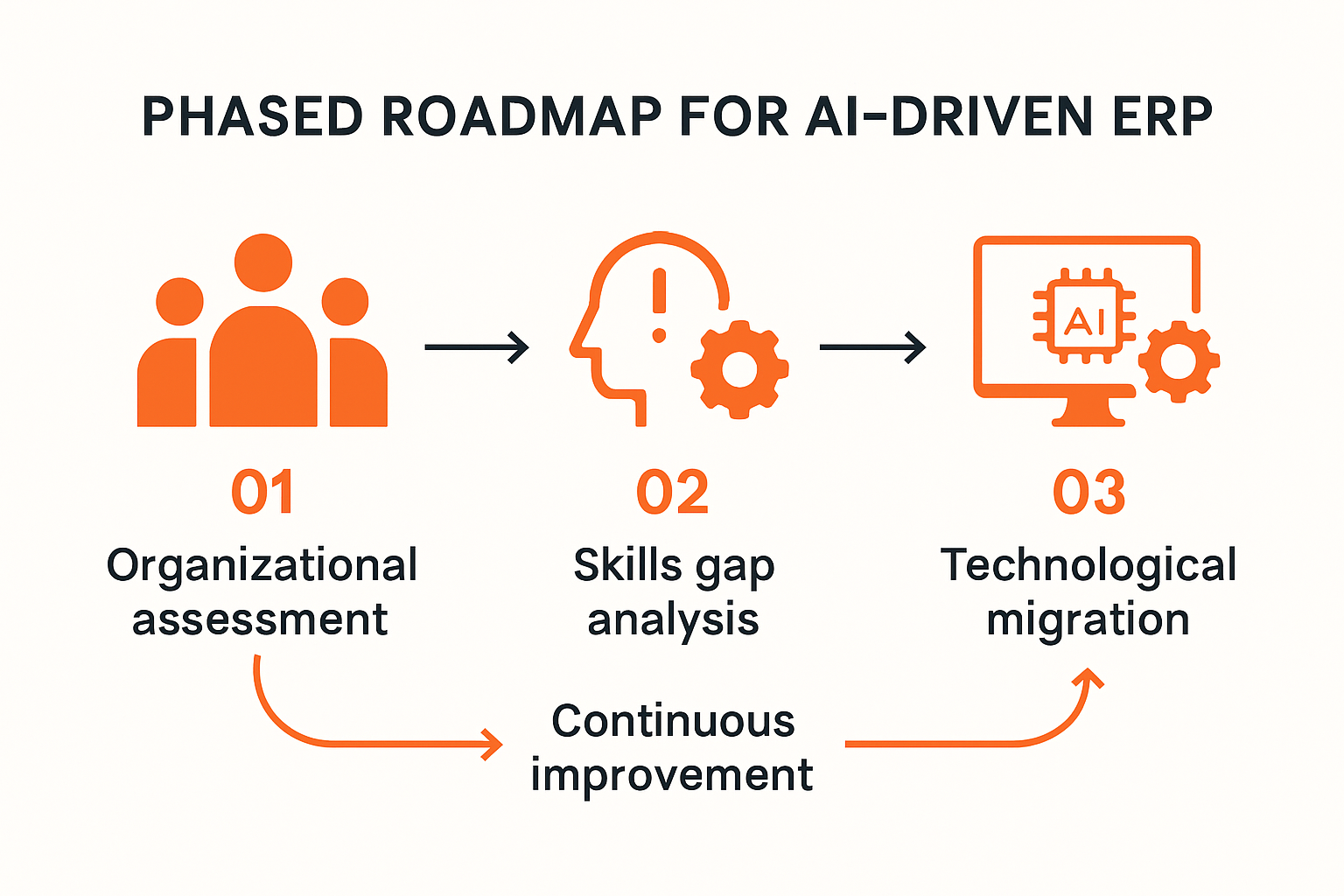
          Comprehensive Organizational Assessment

          Successful AI and ERP integration begins with a thorough organizational readiness evaluation. Manufacturers must conduct a comprehensive diagnostic of their existing technological infrastructure, operational workflows, and organizational culture. This critical first step involves:

          • Technology Infrastructure Analysis: Evaluating the current system’s compatibility
          • Skill Gap Identification: Assessing workforce technological capabilities
          • Strategic Alignment: Determining how AI ERP solutions match business objectives

          Bista Solutions recommends a multi-dimensional assessment that goes beyond technical considerations. Understanding the human element is crucial. Companies must gauge their team’s adaptability, technological literacy, and willingness to embrace transformative technologies.

          Strategic Implementation Planning

          Developing a meticulous implementation roadmap is fundamental to successful AI and ERP system integration. This phase requires creating a detailed project blueprint that addresses technological, operational, and human factors. Odoo ERP implementation strategies typically involve:

          Infographic of AI ERP implementation steps for manufacturers

          • Establishing clear technological migration timelines
          • Creating phased deployment approaches
          • Developing comprehensive training programs
          • Designing robust change management protocols
          • Identifying key performance indicators for measuring success

          Manufacturers must recognize that AI-driven ERP implementation is not a one-size-fits-all process. Each organization requires a customized approach that considers its unique operational complexities, technological maturity, and strategic objectives.

          Continuous Learning and Optimization

          Implementation of AI-powered ERP systems is not a destination but a continuous journey of technological evolution. Successful manufacturers view this as an ongoing process of learning, adaptation, and refinement. Critical elements of this stage include:

          • Regular system performance evaluations
          • Continuous employee skill development
          • Iterative technological enhancements
          • Proactive identification of optimization opportunities
          • Maintaining flexibility in technological adaptation

          The most successful manufacturing organizations approach AI and ERP integration as a dynamic, iterative process. They understand that technological transformation is not about perfect implementation but about creating adaptive, responsive systems that can evolve with changing business requirements.

          By following a structured, strategic approach to AI and ERP implementation, manufacturers can effectively navigate the complex landscape of technological transformation. The goal is not merely to adopt new technologies but to fundamentally reimagine operational capabilities, drive efficiency, and create sustainable competitive advantages.

          Manufacturers must view this implementation not as a technological upgrade but as a holistic business transformation strategy. Success requires a balanced approach that combines technological innovation, strategic planning, and a commitment to continuous organizational learning and adaptation.

          The manufacturing landscape in the United States is on the cusp of a technological revolution driven by AI and ERP integration. Discover the next generation of manufacturing innovation that promises to redefine industrial capabilities and competitive strategies.

          Intelligent Automation and Workforce Transformation

          The future of manufacturing will be characterized by a profound symbiosis between human workers and intelligent technologies. AI and ERP systems are not replacing human workers but augmenting their capabilities, creating a more dynamic and adaptive workforce. Odoo ERP solutions are at the forefront of this transformation, enabling manufacturers to develop more sophisticated, skill-oriented work environments.

          Key workforce evolution trends include:

          • Upskilling Initiatives: Comprehensive training programs to develop AI interaction skills
          • Collaborative Intelligence: Human workers managing and interpreting AI-generated insights
          • Advanced Role Creation: Emergence of new job roles focused on AI system management and optimization

          Manufacturers will increasingly invest in human capital development, recognizing that technological advancement requires parallel investment in workforce capabilities. The most successful companies will be those that create seamless integration between human creativity and machine intelligence.

          Predictive and Adaptive Manufacturing Ecosystems

          Future manufacturing will transcend traditional reactive models, moving towards fully predictive and self-adapting production systems. AI-powered ERP solutions will enable manufacturers to create intelligent ecosystems that can anticipate market changes, optimize resource allocation, and dynamically adjust production parameters in real time.

          Critical capabilities of these adaptive manufacturing systems will include:

          • Instantaneous demand forecasting
          • Autonomous supply chain reconfiguration
          • Real-time quality control and optimization
          • Proactive equipment maintenance prediction
          • Intelligent energy and resource management

          Bista Solutions recognizes that these advanced systems will require robust data infrastructure, sophisticated machine learning algorithms, and comprehensive integration strategies. Manufacturers must view these technologies not as optional upgrades but as fundamental competitive necessities.

          Sustainability and Technological Innovation

          Environmental sustainability will become a core driver of technological innovation in manufacturing. AI and ERP systems will play a crucial role in helping companies reduce carbon footprints, optimize resource consumption, and develop more environmentally responsible production methodologies.

          Sustainability driven technological trends will include:

          • Carbon emission tracking and reduction
          • Circular economy production models
          • Intelligent energy consumption optimization
          • Waste reduction through precision manufacturing
          • Advanced materials development and recycling

          Manufacturers who successfully integrate sustainability with technological innovation will gain significant competitive advantages. These organizations will not only reduce operational costs but also appeal to increasingly environmentally conscious consumers and investors.

          The convergence of AI, ERP systems, and manufacturing represents more than a technological shift it signifies a fundamental reimagining of industrial capabilities. US manufacturers who embrace these transformative technologies will position themselves at the global forefront of innovation, efficiency, and sustainable production.

          As the manufacturing landscape continues to evolve, adaptability, continuous learning, and technological integration will become the hallmarks of successful industrial enterprises. The future belongs to organizations that can seamlessly blend human expertise with intelligent technological solutions.

          Frequently Asked Questions

          What are the benefits of integrating AI with ERP systems in manufacturing?

          Integrating AI with ERP systems enhances operational efficiency, improves decision-making through predictive analytics, reduces costs via intelligent automation, and transforms data into strategic insights for manufacturers.

          How does AI improve quality control in manufacturing?

          AI improves quality control by utilizing machine learning models that can detect defects more accurately than human inspectors, leading to higher defect detection accuracy and reduced waste.

          What steps should manufacturers take to implement AI-driven ERP systems?

          Manufacturers should conduct a comprehensive organizational assessment, develop a strategic implementation plan, and focus on continuous learning and optimization to successfully implement AI-driven ERP systems.

          Future trends include intelligent automation enhancing workforce capabilities, the creation of adaptive manufacturing ecosystems for real-time adjustments, and a strong focus on sustainability driven by technological innovation.

          Transform Your Manufacturing with Award-Winning AI and ERP Solutions

          Is process bottlenecks, slow production cycles, or unpredictable downtime holding your manufacturing business back? The article shows how real companies are now driving higher efficiency, precision, and cost savings with integrated AI and ERP systems. Imagine predictive maintenance, automated quality control, and data-driven insights tailored to your unique needs. If your operation struggles with outdated workflows or missed opportunities, true digital transformation is within reach—starting with the right partner.


            Let Bista Solutions show you the impact of smart ERP. As the largest Odoo implementer in North America and a multi-year Best Partner award-winner, we deliver proven, tailored solutions for manufacturers ready to lead their industry. Start your journey now. Contact our team today and see how our Odoo ERP implementations can revolutionize your factory. Take the next step toward a smarter, more resilient business. Your competitors are already adapting. Will you?

            How Odoo ERP Solution Automates Distribution Companies: Key Modules for 2025

            How Odoo ERP Solution Automates Distribution Companies: Key Modules for 2025

            Distribution companies are racing to keep up with rising demand and customer expectations. Shocking as it sounds, Odoo ERP systems can cut order processing times from hours to minutes by connecting sales, inventory, and shipping in one automated workflow. Yet what surprises most leaders is how these systems do more than just save time—they offer real-time business insights that can actually transform your decision-making for the future.

            Table of Contents

            Quick Summary

            Takeaway Explanation
            Integrate Odoo ERP for automation Odoo ERP automates inventory and order processes, enhancing operational efficiency in distribution companies.
            Utilize advanced inventory management Real-time tracking and automatic reordering reduce stockouts and optimize inventory costs.
            Leverage business intelligence tools Odoo’s reporting capabilities provide actionable insights into performance, aiding in strategic decision-making.
            Implement modules strategically Selecting relevant Odoo modules tailored to business needs is crucial for maximizing operational efficiency.
            Focus on continuous training and optimization Ongoing employee training and system optimization ensure effective use of Odoo ERP, enhancing overall productivity.

            Odoo ERP Automation for Distribution Companies

            Distribution companies face complex operational challenges that demand sophisticated technological solutions. Odoo ERP represents a comprehensive automation platform designed to transform how distribution businesses manage their core processes. By integrating multiple business functions into a unified system, Odoo provides unprecedented operational efficiency and real-time insights.

            Streamlining Inventory Management

            Inventory control represents the critical backbone of distribution operations. Odoo ERP offers advanced tracking mechanisms that enable businesses to monitor stock levels, predict demand, and minimize wastage. The system allows automatic reordering triggers, ensuring companies never experience stockouts while preventing unnecessary overstock situations. Real-time inventory tracking means distribution managers can make data-driven decisions instantly, reducing manual reconciliation efforts and potential human errors.

            The platform’s intelligent algorithms analyze historical sales data, seasonal trends, and market fluctuations to generate precise inventory forecasts. Companies utilizing Odoo can optimize their warehouse management, reducing carrying costs and improving overall operational responsiveness. Learn more about our advanced inventory management strategies for distribution businesses.

            Automating Order Processing and Logistics

            Order processing represents another critical area where Odoo ERP delivers substantial automation benefits. The system seamlessly integrates sales, procurement, and shipping functions, creating a streamlined workflow that minimizes manual intervention. Distribution companies can configure automated rules for order routing, shipping label generation, and customer communication – reducing processing times from hours to minutes.

            By implementing intelligent routing algorithms, Odoo helps businesses optimize delivery schedules, select the most cost-effective shipping methods, and provide customers with accurate tracking information. The platform’s ability to connect with multiple shipping carriers and generate real-time shipping quotes ensures distribution companies maintain competitive pricing and operational flexibility.

            Enhanced Reporting and Business Intelligence

            Beyond operational automation, Odoo ERP provides robust reporting capabilities that transform raw data into actionable business intelligence. Distribution managers can access comprehensive dashboards displaying key performance indicators, financial metrics, and operational bottlenecks. These dynamic reports enable leadership to make strategic decisions based on accurate, up-to-the-minute information.

            The system’s advanced analytics tools allow businesses to drill down into granular performance data, identifying trends, opportunities, and potential areas for improvement. By consolidating information from various departments – sales, inventory, logistics, and finance – Odoo creates a holistic view of business performance that traditional management approaches cannot match.

            For distribution companies seeking comprehensive automation solutions, Odoo ERP represents a transformative technology platform. By integrating sophisticated modules that address inventory management, order processing, and business intelligence, the system empowers organizations to operate with unprecedented efficiency and strategic insight.

            Must-Have Odoo Modules for Distributors in 2025

            As distribution businesses evolve in 2025, selecting the right Odoo ERP modules becomes critical for maintaining competitive advantage. Bista Solutions recognizes that strategic module selection can transform operational efficiency, enabling businesses to streamline processes, reduce costs, and enhance customer satisfaction.

            Inventory and Warehouse Management Modules

            Distribution companies require robust inventory control mechanisms to succeed. Odoo’s advanced inventory management module provides comprehensive tracking capabilities that go beyond traditional stock management. The system enables real-time monitoring of product quantities, automatic reordering points, and multi-location inventory tracking. Companies can configure intelligent rules that trigger purchase orders when stock levels drop below predetermined thresholds.

            Specialized features like serial number tracking, lot management, and quality control inspections ensure precise inventory accuracy. The module integrates seamlessly with barcode scanning technologies, allowing warehouse staff to update inventory instantaneously. Explore our comprehensive inventory management strategies that can revolutionize your distribution operations.

            Sales and Procurement Automation

            Effective distribution relies on sophisticated sales and procurement modules that simplify complex business processes. Odoo’s integrated sales module enables businesses to manage customer relationships, track sales pipelines, and generate accurate quotations with unprecedented speed. The procurement module complements sales functions by automating vendor selection, comparing price lists, and generating purchase orders based on predefined business rules.

            Advanced features like automatic vendor lead time calculation help distribution companies optimize their supply chain management. The system analyzes historical purchasing data to predict optimal ordering schedules, reducing carrying costs and minimizing potential stockout scenarios. By connecting sales forecasts with procurement strategies, businesses can maintain lean and responsive inventory management.

            Reporting and Business Intelligence

            In 2025, data-driven decision-making separates successful distribution companies from their competitors. Odoo’s reporting and business intelligence modules provide comprehensive dashboards that transform raw operational data into actionable insights. Managers can access real-time analytics covering inventory turnover, sales performance, procurement efficiency, and financial metrics.

            Customizable reporting tools allow businesses to create specific dashboards tailored to their unique operational requirements. Whether tracking key performance indicators, analyzing seasonal trends, or identifying potential bottlenecks, these modules empower leadership with accurate and timely information. The ability to generate detailed reports across multiple departments ensures a holistic business understanding.

            Choosing the right Odoo modules represents a strategic investment in operational excellence. By carefully selecting and implementing modules that address inventory management, sales automation, and business intelligence, distribution companies can create a robust technological ecosystem that drives growth and innovation. Bista Solutions remains committed to helping businesses navigate this technological transformation, ensuring they leverage Odoo ERP’s full potential.

            To provide a clear overview, the following table summarizes the essential Odoo ERP modules for distributors and highlights their key features as discussed in this section:

            Module Key Features
            Inventory & Warehouse Management Real-time tracking, auto-reordering, multi-location inventory, barcode integration, QA inspections
            Sales Automation Customer management, sales pipeline tracking, and fast quotation generation
            Procurement Automation Vendor selection, price list comparison, PO generation, lead time calculation
            Business Intelligence & Reporting Real-time dashboards, KPI tracking, custom analytics, department-wide reporting

            Real Business Benefits for US Manufacturers and Distributors

            Odoo ERP represents a transformative technology solution for US manufacturers and distributors seeking operational excellence. By integrating sophisticated automation capabilities, the platform delivers measurable business benefits that directly impact bottom-line performance and competitive positioning.

            Cost Reduction and Operational Efficiency

            Manufacturers and distributors face constant pressure to optimize operational expenses while maintaining high-quality outputs. Odoo ERP addresses these challenges through comprehensive process automation that eliminates manual interventions and reduces human error. The system streamlines complex workflows across procurement, inventory management, production scheduling, and logistics, enabling businesses to significantly reduce administrative overhead.

            Automated processes translate into tangible cost savings. Companies can minimize inventory carrying costs through intelligent demand forecasting, reduce procurement expenses by optimizing vendor selection, and eliminate redundant administrative tasks. These efficiency gains allow businesses to reallocate resources toward strategic growth initiatives. Discover how our ERP solutions drive operational transformation for manufacturers and distributors.

            Enhanced Decision Making and Competitive Intelligence

            In today’s rapidly evolving business environment, real-time data and actionable insights become critical competitive advantages. Odoo ERP provides comprehensive business intelligence tools that transform raw operational data into strategic insights. Executives can access dynamic dashboards displaying key performance indicators across multiple business functions, enabling rapid and informed decision-making.

            The platform’s advanced analytics capabilities allow businesses to identify performance trends, predict potential bottlenecks, and develop proactive strategies. By consolidating information from sales, inventory, production, and financial departments, Odoo creates a holistic view of organizational performance. Manufacturers can track production efficiency, analyze product profitability, and optimize resource allocation with unprecedented precision.

            Schedule A Demo


              Scalability and Technological Adaptability

              Odoo ERP scalability

              US manufacturers and distributors require flexible technological solutions that can evolve alongside their business needs. Odoo ERP’s modular architecture provides exceptional scalability, allowing companies to add or modify functionalities as they grow. Whether expanding product lines, entering new markets, or adapting to changing regulatory requirements, businesses can customize their ERP system without massive technological overhauls.

              The platform’s cloud-based infrastructure ensures seamless updates and integration with emerging technologies. Artificial intelligence and machine learning capabilities can be progressively incorporated, enabling businesses to stay at the forefront of technological innovation. This adaptability means manufacturers are not locked into rigid systems but can continuously optimize their technological ecosystem.

              By implementing Odoo ERP, US manufacturers and distributors can transform their operational capabilities. The platform offers more than traditional software solutions it provides a comprehensive technological framework for business growth. Through intelligent automation, data-driven insights, and unparalleled flexibility, Odoo empowers companies to navigate complex market dynamics with confidence and strategic agility. Bista Solutions remains committed to helping businesses unlock their full potential through cutting-edge ERP technologies.

              The following table summarizes the main business benefits Odoo ERP brings to US manufacturers and distributors, making it easier to see the direct impact in each operational area:

              Operational Area Business Benefit
              Cost Reduction Lower admin overhead, reduced inventory and procurement expenses, minimized manual tasks
              Operational Efficiency Streamlined workflows, automated processes, fewer errors
              Decision Making Real-time dashboards, strategic business intelligence, and performance trend analysis
              Scalability & Adaptability Modular architecture, cloud infrastructure, AI/ML integration, easy system customization

              How to Implement Odoo ERP for Seamless Operations

              Implementing an Enterprise Resource Planning system represents a transformative journey for distribution companies. Bista Solutions understands that successful Odoo ERP implementation requires strategic planning, comprehensive analysis, and a methodical approach tailored to each organization’s unique operational requirements.

              Assessment and Strategic Planning

              Successful Odoo ERP implementation begins with a thorough organizational assessment. Distribution companies must conduct an in-depth analysis of existing business processes, identifying current inefficiencies, bottlenecks, and specific operational challenges. This diagnostic phase involves comprehensive stakeholder interviews, workflow documentation, and detailed system requirements gathering. Learn more about our comprehensive ERP implementation strategy to understand the critical initial steps.

              Key evaluation areas include current technology infrastructure, data management practices, interdepartmental communication mechanisms, and specific industry-specific operational nuances. Businesses should map their existing processes against potential Odoo modules, determining precise customization requirements and integration strategies. This strategic alignment ensures that the ERP solution addresses specific operational needs rather than forcing businesses to adapt to generic software configurations.

              Phased Implementation and Custom Configuration

              Odoo ERP implementation follows a structured, modular approach that minimizes operational disruption. Rather than attempting a comprehensive system-wide transformation, Bista Solutions recommends a phased rollout strategy. This methodology allows businesses to implement modules progressively, validate performance, and make necessary adjustments before full-scale deployment.

              Custom configuration represents a critical implementation component. Distribution companies require tailored solutions that reflect their unique business models. Odoo’s flexible architecture enables extensive customization, allowing businesses to develop industry-specific workflows, reporting mechanisms, and integration protocols. Technical experts work closely with organizational stakeholders to design custom modules that seamlessly align with existing operational frameworks.

              Training and Continuous Optimization

              Technological implementation extends beyond software installation; technological transformation requires comprehensive organizational change management. Successful Odoo ERP deployment demands extensive training programs that empower employees to leverage new technological capabilities effectively. Bista Solutions develops customized training modules addressing various organizational roles, ensuring smooth technological adoption and minimal productivity disruption.

              Continuous optimization represents the final implementation phase. Distribution companies must establish robust feedback mechanisms, monitoring system performance, identifying potential improvements, and adapting configurations to evolving business requirements. Regular system audits, performance assessments, and stakeholder consultations enable businesses to maximize their Odoo ERP investment.

              Implementing Odoo ERP is more than a technological upgrade; it represents a strategic organizational transformation. By following a structured, methodical approach that prioritizes strategic planning, custom configuration, and continuous learning, distribution companies can unlock unprecedented operational efficiency. Bista Solutions remains committed to guiding businesses through this complex but rewarding technological journey, ensuring that each implementation delivers measurable, sustainable business value.

              Frequently Asked Questions

              What is Odoo ERP and how does it benefit distribution companies?

              Odoo ERP is an integrated software solution that automates various business processes, including inventory management, order processing, and logistics for distribution companies. It improves operational efficiency by minimizing manual interventions and providing real-time insights.

              How does Odoo ERP automate order processing?

              Odoo ERP automates order processing by integrating sales, procurement, and shipping functions into a single workflow. It allows for automated order routing, shipping label generation, and customer communication, significantly reducing processing times from hours to minutes.

              What key modules should distributors focus on when implementing Odoo ERP in 2025?

              Distribution companies should focus on key modules such as Inventory and Warehouse Management, Sales & Procurement Automation, and Reporting & Business Intelligence to enhance operational efficiency and decision-making capabilities.

              How does Odoo ERP improve inventory management for distribution companies?

              Odoo ERP enhances inventory management by providing real-time tracking, automatic reordering triggers, and the ability to monitor stock levels across multiple locations. This ensures companies can manage their inventory effectively and reduce stockouts or overstock situations.

              Ready to Unlock Real Savings and Automation in Distribution?

              Distribution businesses today cannot afford to waste time on manual processes or miss out on critical business insights. As highlighted in this article, the pain of stockouts, order delays, and a lack of real-time data often holds back ambitious companies from reaching new growth. Odoo ERP is designed to automate inventory management, streamline order processing, and generate the actionable intelligence that modern distributors demand.


                Bista Solutions is not just another technology provider. We are the largest Odoo implementer in North America and an award-winning Odoo Gold Partner. With hundreds of successful ERP projects for distributors and manufacturers, our team understands your industry’s unique requirements. Take advantage of our expertise and let us show you how to transform your operations with proven solutions. Act now to discover a smarter way to manage your supply chain, cut costs, and stay ahead of your competition. Get started by contacting us through our expert team or exploring how our ERP implementation strategy delivers real results for distribution leaders. Do not let this opportunity for game-changing automation pass your business by.

                Enterprise Resource Planning Explained for US Manufacturers 2025

                Enterprise Resource Planning Explained for US Manufacturers 2025

                US manufacturers are turning to enterprise resource planning to stay ahead in a tough market. Surprisingly, while ERP often gets described as just another back-office tool, its real impact is much more dramatic. Studies show manufacturers can cut operational costs by up to 23% after adopting the right ERP system, which flips the script on what most companies expect from their business software and sparks a conversation about smarter, more profitable operations.

                Table of Contents

                Quick Summary

                Takeaway Explanation
                ERP integrates all business processes Centralizes operations across various departments for streamlined efficiency.
                Improves operational efficiency and reduces costs Automates tasks, reducing manual input and administrative overhead significantly.
                Enhances production planning and inventory management Provides visibility into inventory and production dynamics, fostering informed decisions.
                Facilitates strategic decision-making Offers real-time analytics, enabling rapid insights and responsive actions to market changes.
                Choosing the right ERP is critical Essential to assess technological compatibility, customization, and strategic implementation for success.

                What Is Enterprise Resource Planning

                Enterprise resource planning (ERP) represents a comprehensive software solution that enables manufacturers to integrate and manage their core business processes in one centralized system. At its foundation, ERP connects different departments and functions within an organization to create a streamlined operational environment.

                Core Components of Enterprise Resource Planning

                Modern ERP systems function as the central nervous system for manufacturing businesses. These platforms consolidate critical operational areas including finance, human resources, supply chain management, manufacturing, and customer relationship management into a single integrated framework. Our comprehensive ERP guide reveals how these interconnected modules eliminate data silos and enable real-time information sharing across an organization.

                The primary goal of enterprise resource planning is to transform fragmented business processes into a cohesive digital ecosystem. By providing a unified view of business operations, manufacturers gain unprecedented visibility into their entire organizational workflow. Odoo ERP exemplifies this approach by offering modular solutions that can be customized to match specific manufacturing requirements.

                Infographic showing ERP integration benefits for manufacturers

                Strategic Value for Manufacturing Businesses

                For US manufacturers, enterprise resource planning goes beyond simple software implementation. It represents a strategic approach to operational excellence. These systems enable businesses to:

                • Data Integration: Combine information from multiple departments into a single source of truth
                • Process Optimization: Automate routine tasks and reduce manual data entry errors
                • Decision Making: Generate real time analytics and reporting for faster strategic decisions

                Bista Solutions understands that each manufacturing business has unique operational needs. Our expertise in Odoo ERP implementation ensures that enterprise resource planning solutions are precisely tailored to address specific industry challenges. By leveraging advanced ERP technologies, manufacturers can enhance productivity, reduce operational costs, and maintain a competitive edge in an increasingly complex business environment.

                The evolution of enterprise resource planning has transformed from basic accounting software to sophisticated platforms that provide predictive insights and intelligent automation. Modern manufacturers recognize that ERP is no longer optional but a critical tool for sustainable growth and operational efficiency.

                As we approach 2025, enterprise resource planning continues to revolutionize how manufacturing businesses operate. The ability to integrate complex business processes, provide real time insights, and support data driven decision making makes ERP an indispensable strategic asset for forward thinking manufacturers across the United States.

                Key Benefits of ERP for US Manufacturers

                Enterprise resource planning delivers transformative advantages for US manufacturers seeking operational excellence and competitive advantage. By integrating complex business processes into a unified system, ERP solutions provide manufacturers with unprecedented capabilities to optimize performance and drive strategic growth.

                Operational Efficiency and Cost Reduction

                Manufacturers gain substantial operational benefits through comprehensive ERP implementation. These systems dramatically reduce manual data entry and administrative overhead by automating routine tasks across multiple departments. learn about intelligent automation strategies to understand how advanced ERP technologies streamline business processes.

                Odoo ERP exemplifies how manufacturers can achieve remarkable efficiency gains. By centralizing data and eliminating redundant processes, companies can reduce operational costs by up to 23% and dramatically improve resource allocation. The ability to track real-time performance metrics enables leadership to make informed decisions quickly and accurately.

                Enhanced Production Planning and Inventory Management

                Advanced ERP systems revolutionize production planning for US manufacturers. These platforms provide granular visibility into inventory levels, production schedules, and supply chain dynamics. Manufacturers can:

                • Demand Forecasting: Predict product requirements with unprecedented accuracy
                • Inventory Optimization: Minimize excess stock while preventing stockouts
                • Resource Allocation: Intelligently distribute manufacturing resources based on precise data insights

                Bista Solutions understands that each manufacturing business requires a unique approach to resource management. Our expertise in Odoo ERP ensures that implementation strategies are precisely tailored to address specific industry challenges and organizational requirements.

                Strategic Decision Making and Competitive Advantage

                Enterprise resource planning transforms data into actionable business intelligence. By consolidating information from finance, sales, production, and customer relationship management, manufacturers gain a holistic view of their operational ecosystem. This comprehensive perspective enables leadership to:

                • Identify potential inefficiencies before they impact performance
                • Develop proactive strategies based on predictive analytics
                • Respond rapidly to market changes and customer demands

                As we approach 2025, ERP systems represent more than technological solutions. They are strategic assets that enable US manufacturers to navigate complex business environments with agility and precision. The integration of advanced analytics, artificial intelligence, and real-time reporting creates unprecedented opportunities for innovation and growth.

                Modern manufacturers recognize that enterprise resource planning is no longer optional but essential for sustainable success. By leveraging sophisticated ERP technologies, businesses can transform operational challenges into opportunities for expansion and competitive differentiation.

                To help readers scan the primary business benefits of ERP for manufacturers mentioned in the article, here is a summary table of key advantages:

                Key Benefit Description
                Operational Efficiency Automates routine tasks, cuts administrative costs, and optimizes workflows
                Cost Reduction Lowers operational expenses by up to 23% through streamlined processes
                Enhanced Production Planning Improves accuracy in demand forecasting and production scheduling
                Inventory Management Reduces excess stock, prevents stockouts, and optimizes component tracking
                Real-Time Data and Analytics Enables rapid, data-driven decision-making with comprehensive business intelligence
                Quality Control and Compliance Supports regulatory requirements and detailed audit trails
                Strategic Agility Boosts the ability to respond swiftly to market changes and customer demands

                How ERP Solves Challenges for Auto Parts and Equipment Businesses

                Auto parts and equipment manufacturers face complex operational challenges that demand sophisticated technological solutions. Enterprise resource planning emerges as a critical tool for addressing these intricate business requirements, transforming potential operational obstacles into opportunities for strategic growth and efficiency.

                Inventory and Supply Chain Management

                The auto parts and equipment sector requires precise inventory tracking and seamless supply chain coordination. explore intelligent automation strategies to understand how advanced ERP technologies revolutionize inventory management. Odoo ERP provides manufacturers with real-time visibility into inventory levels, enabling businesses to:

                • Component Tracking: Monitor critical parts across multiple warehouses
                • Supplier Management: Evaluate and manage vendor performance dynamically
                • Demand Forecasting: Predict future inventory requirements with exceptional accuracy

                By centralizing inventory data, manufacturers can reduce carrying costs, minimize stockouts, and optimize procurement processes. The ability to track each component from acquisition to final product installation represents a significant competitive advantage in the fast-moving auto parts industry.

                Regulatory Compliance and Quality Control

                Auto parts and equipment businesses operate in a highly regulated environment with stringent quality standards. Enterprise resource planning systems provide comprehensive tools for maintaining compliance and ensuring product quality. Bista Solutions recognizes that manufacturers need robust systems to:

                • Document every stage of production
                • Generate detailed quality control reports
                • Maintain comprehensive audit trails
                • Track product variations and potential defects

                Our expertise in Odoo ERP enables businesses to implement rigorous quality management processes that meet or exceed industry standards. By automating compliance documentation, manufacturers can reduce human error and create transparent records that protect both the business and its customers.

                Operational Efficiency and Cost Management

                Enterprise resource planning transforms how auto parts and equipment businesses approach operational efficiency. These integrated systems break down departmental silos, creating a unified platform that connects production, sales, finance, and customer service. Manufacturers gain unprecedented insights into:

                • Production workflow optimization
                • Resource allocation strategies
                • Real-time performance metrics
                • Cost reduction opportunities

                As we approach 2025, ERP technologies continue to evolve, offering more intelligent and predictive capabilities. For auto parts and equipment manufacturers, these systems are no longer optional but essential tools for maintaining competitiveness. The ability to rapidly adapt to market changes, optimize resource utilization, and make data-driven decisions positions businesses for sustainable growth.

                Modern manufacturers understand that enterprise resource planning represents more than software implementation. It is a strategic approach to transforming operational challenges into opportunities for innovation and market leadership. By leveraging advanced ERP technologies, auto parts and equipment businesses can create more agile, responsive, and efficient organizations.

                Below is a table organizing the main challenges for auto parts and equipment manufacturers and corresponding ERP solutions as discussed in the section above:

                Challenge ERP Solution
                Inventory & Component Tracking Centralized, real-time inventory and component monitoring
                Supplier/Vendor Management Dynamic supplier evaluation and management tools
                Regulatory Compliance Automated documentation, audit trails, and compliance reporting
                Quality Control Quality management modules and defect tracking
                Workflow and Operational Efficiency Unified platform connecting departments, breaking data silos
                Forecasting and Demand Planning Advanced analytics for accurate demand and inventory forecasting
                Cost Management Resource optimization and cost reduction strategies

                Choosing the Right ERP System in 2025

                Selecting the appropriate enterprise resource planning system represents a critical strategic decision for manufacturers in 2025. The evolving technological landscape demands a comprehensive approach to ERP selection that goes beyond traditional software evaluation and focuses on future readiness, scalability, and transformative potential.

                Technology and Compatibility Considerations

                Modern manufacturers must evaluate ERP systems through a multifaceted lens that considers technological integration and future adaptability. discover implementation best practices to understand the nuanced approach required for successful ERP selection. Odoo ERP exemplifies next-generation solutions by offering modular architectures that enable seamless technological integration.

                Key technological factors manufacturers should assess include:

                • Cloud Compatibility: Ensure systems support hybrid and cloud deployment models
                • AI and Machine Learning Integration: Validate advanced predictive analytics capabilities
                • Scalability: Confirm the system can grow with business complexity
                • API Openness: Verify robust integration potential with existing technological ecosystems

                Bista Solutions recognizes that technological compatibility extends beyond immediate functional requirements. The right ERP system should serve as a strategic platform for continuous innovation and operational transformation.

                Industry Specific Customization

                Enterprise resource planning solutions in 2025 must offer unprecedented levels of industry-specific customization. Manufacturers require systems that understand their unique operational nuances and can be tailored to address specific workflow challenges. Odoo ERP stands out by providing flexible modules that can be precisely configured for different manufacturing segments.

                Critical customization considerations include:

                • Workflow Adaptability: Systems must support complex manufacturing processes
                • Reporting Flexibility: Robust analytics that provide actionable insights
                • Regulatory Compliance: Built-in mechanisms for industry-specific standards
                • User Experience: Intuitive interfaces that minimize training requirements

                Strategic Implementation and Change Management

                Choosing the right ERP system transcends technological selection. Successful implementation requires a holistic approach that encompasses organizational culture, change management, and strategic alignment. Manufacturers must view ERP not as a software purchase but as a transformative organizational initiative.

                Key implementation strategies include:

                • Comprehensive stakeholder engagement
                • Phased rollout approaches
                • Continuous training and skill development
                • Dedicated change management resources

                As we approach 2025, enterprise resource planning represents more than technological infrastructure. It is a strategic enabler of operational excellence and competitive differentiation. Manufacturers who approach ERP selection with a forward-thinking, comprehensive perspective will position themselves to thrive in an increasingly complex and dynamic business environment.

                The future of manufacturing belongs to organizations that can seamlessly blend technological innovation with strategic vision. By carefully evaluating ERP systems through a multidimensional lens, businesses can transform potential technological challenges into opportunities for unprecedented growth and efficiency.

                ERP warehouse cost management

                Frequently Asked Questions

                What is Enterprise Resource Planning (ERP), and how does it benefit manufacturers?

                Enterprise Resource Planning (ERP) is a comprehensive software system that integrates and manages core business processes in one centralized platform. For manufacturers, ERP can reduce operational costs, enhance productivity, and streamline processes across various departments, leading to significant business efficiencies.

                How can ERP help with production planning and inventory management?

                ERP systems provide real-time visibility into inventory levels, production schedules, and supply chain dynamics. This enables manufacturers to accurately forecast demand, optimize inventory levels, and intelligently allocate resources, thus improving overall production efficiency.

                What challenges do auto parts manufacturers face that ERP systems can solve?

                Auto parts manufacturers often struggle with complex inventory tracking, supply chain coordination, regulatory compliance, and quality control. ERP systems address these challenges by providing centralized inventory management, automation of compliance processes, and enhanced data visibility to streamline operations.

                What should manufacturers consider when choosing an ERP system in 2025?

                Manufacturers should evaluate ERP systems based on technological compatibility, scalability, industry-specific customization, and change management strategies. It’s essential to choose a system that can adapt to future needs, integrate with existing technologies, and cover specific operational requirements.

                Take Charge of Your Manufacturing Future with Award-Winning Odoo ERP Expertise

                Are you struggling with disconnected systems, manual processes, and a lack of real-time insight that holds your manufacturing business back? The article “Enterprise Resource Planning Explained for US Manufacturers 2025” highlighted the real pain of managing complex operations without an integrated approach. Missing out on streamlined operations, automated production planning, and effective inventory control can put your company at a disadvantage in an increasingly competitive landscape.


                  Bista Solutions stands as North America’s most trusted Odoo Gold Partner, recognized for delivering ERP solutions that directly address these challenges. Our team understands how vital it is to transform siloed data into unified, actionable intelligence. From implementing industry-tailored modules to providing 24/7 support, our experts have a record of 350+ successful projects and cutting-edge Odoo ERP implementation. If operational efficiency and agile growth are your goals for 2025, let us help you build a platform for long-term success. Connect with our specialists through our contact page and begin your journey toward an optimized manufacturing operation today. Act now to ensure your business is ready for the future of enterprise resource planning.

                  7 Top Challenges in Field Services & How Odoo ERP Solves Them

                  7 Top Challenges in Field Services & How Odoo ERP Solves Them

                  Field service teams face more than just a few daily hiccups. They wrestle with confusing schedules, paperwork mountains, and constant communication gaps. Yet, despite all this chaos, most teams still rely on outdated tools and manual methods. That seems wild when the numbers show that manual workflow errors can increase administrative costs by up to 30 percent. Turns out, technology is not the sidekick anymore. It is now the only real way to cut through those obstacles and completely transform how field service gets done.

                  Table of Contents

                  Quick Summary

                  Takeaway Explanation
                  Implement digital platforms for communication. Digital communication platforms enhance real-time information sharing and reduce operational bottlenecks for field service teams.
                  Adopt intelligent scheduling solutions. Intelligent scheduling systems optimize technician assignments and improve response times, transforming scheduling into a competitive advantage.
                  Streamline inventory management systems. Advanced inventory management technologies enable real-time tracking, reducing carrying costs and enhancing operational efficiency.
                  Utilize automated invoicing tools. Automated invoicing systems improve accuracy, speed up payment processing, and reduce administrative burdens significantly.
                  Leverage data analytics for decision-making. Implementing advanced analytics platforms helps organizations transform data into actionable insights, supporting strategic planning and operational improvements.

                  1: Understanding Common Field Service Challenges

                  Field service organizations encounter numerous complex challenges that can significantly impact operational efficiency, customer satisfaction, and overall business performance. These challenges are often multifaceted, requiring sophisticated technological solutions to address effectively.

                  Traditional field service management has been plagued by communication gaps, inefficient scheduling, and limited real-time tracking. Organizations frequently struggle with coordinating technicians, managing work orders, and maintaining accurate customer records. The manual processes that many businesses rely on create substantial bottlenecks in service delivery.

                  Key challenges in field services include:

                  • Inconsistent communication between the office and field teams
                  • Difficulty in tracking technician locations and performance
                  • Complex scheduling and resource allocation
                  • Manual paperwork and documentation errors
                  • Limited visibility into service history and customer interactions

                  Field service professionals are often overwhelmed by administrative tasks that detract from their primary responsibility: providing high-quality customer service. Technicians spend considerable time managing paperwork, updating spreadsheets, and navigating fragmented communication channels instead of focusing on resolving client issues.

                  Technology has emerged as a critical solution to these persistent challenges. Modern enterprises recognize the need for integrated digital platforms that can streamline operations, enhance communication, and provide real-time insights. Discover advanced field service solutions that can transform your operational efficiency and customer experience.

                  The complexity of field service management requires a holistic approach that addresses both technological and human factors. Successful organizations understand that solving these challenges is not just about implementing new software, but about creating a comprehensive strategy that empowers technicians, improves communication, and ultimately delivers exceptional service to customers.

                  2: Improving Real-Time Communication for Teams

                  Effective communication stands as the backbone of successful field service operations. Modern businesses recognize that traditional communication methods create significant operational bottlenecks and reduce overall team productivity. Field service teams require instantaneous information sharing and seamless collaboration to deliver exceptional customer experiences.

                  The communication challenges in field service environments are complex and multifaceted. Technicians often operate in remote locations, making real-time coordination extremely difficult. Paper-based systems and disconnected communication channels lead to delays, misunderstandings, and reduced service quality.

                  Critical communication barriers include:

                  • Geographical dispersion of field technicians
                  • Lack of centralized information management
                  • Inconsistent reporting mechanisms
                  • Limited mobile communication platforms

                  Field service organizations need integrated solutions that transcend traditional communication limitations. Digital communication platforms enable teams to share critical information instantly, track work orders in real-time, and maintain comprehensive documentation of service interactions.

                  Technological solutions like Odoo Field Service ERP Software provide comprehensive communication tools that transform how teams interact. These platforms offer mobile-responsive interfaces, instant messaging capabilities, and centralized information repositories that ensure every team member has access to the most current data.

                  The implementation of advanced communication technologies goes beyond mere information exchange. It represents a fundamental shift in how field service teams collaborate, plan, and execute their responsibilities. By breaking down communication silos, organizations can create more responsive, agile, and customer-centric service models that adapt quickly to changing operational demands.

                  Successful communication strategies integrate technological solutions with human-centered design, recognizing that effective collaboration requires both robust digital tools and a culture of transparent, proactive information sharing.

                  3: Streamlining Scheduling and Dispatching Activities

                  Scheduling and dispatching activities represent critical operational challenges for field service organizations. The complexity of managing technician assignments, optimizing routes, and ensuring timely service delivery can overwhelm traditional management approaches.

                  Field service managers frequently struggle with manual scheduling processes that consume significant administrative time and introduce substantial inefficiencies. Unpredictable service demands and dynamic workforce requirements create additional layers of complexity that manual systems cannot effectively manage.

                  The most significant scheduling challenges include:

                  • Inefficient route planning and optimization
                  • Difficulty matching technician skills with specific job requirements
                  • Limited real-time visibility into technician availability
                  • Complex workforce management across multiple locations

                  Successful organizations recognize that intelligent scheduling goes beyond simply assigning technicians to jobs. It requires a comprehensive approach that considers technician expertise, geographical proximity, job complexity, and customer priority levels.

                  Learn about advanced production planning strategies that can transform your operational efficiency. Automated scheduling systems enable businesses to make data-driven decisions, reducing response times and improving overall service quality.

                  Digital dispatching platforms provide real-time insights that allow managers to dynamically adjust assignments based on emerging priorities. These systems eliminate guesswork by presenting clear, actionable information about technician locations, skill sets, and current workloads.

                  The ultimate goal of streamlined scheduling is not just operational efficiency but creating a predictable and responsive service environment. By leveraging intelligent technologies, field service organizations can transform scheduling from a logistical challenge into a strategic competitive advantage that delights customers and empowers technicians.

                  4: Enhancing Inventory Management Techniques

                  Inventory management represents a critical challenge for field service organizations, where inefficient tracking and inadequate stock control can significantly disrupt operational performance. Traditional inventory management approaches often result in excessive carrying costs, unexpected stockouts, and inefficient resource allocation.

                  Complex inventory dynamics require sophisticated management strategies that go beyond simple stock tracking. Field service teams must navigate intricate supply chains, manage diverse equipment requirements, and maintain precise parts inventories across multiple locations.

                  The most prevalent inventory management challenges include:

                  • Inconsistent parts tracking and documentation
                  • High carrying costs for excessive inventory
                  • Difficulty predicting accurate parts requirements
                  • Limited visibility into stock levels across different locations

                  Successful inventory management demands a comprehensive technological approach that provides real-time insights and predictive capabilities. Organizations need systems that can automatically monitor stock levels, forecast future requirements, and streamline procurement processes.

                  Explore advanced warehouse management solutions that can revolutionize your inventory control strategies. Modern ERP systems enable businesses to implement intelligent inventory tracking mechanisms that reduce waste, optimize resource allocation, and improve overall operational efficiency.

                  Digital inventory management platforms offer unprecedented transparency, allowing field service managers to make data-driven decisions. These systems provide granular insights into parts usage, equipment lifecycle, and potential supply chain disruptions, enabling proactive management strategies.

                  The ultimate goal of enhanced inventory management is not just tracking stock but creating a dynamic, responsive inventory ecosystem. By leveraging intelligent technologies, field service organizations can transform inventory from a potential operational liability into a strategic asset that drives business performance and customer satisfaction.

                  5: Optimizing Customer Relationship Management (CRM)

                  Customer Relationship Management (CRM) stands as a critical component of successful field service operations. Organizations frequently struggle with fragmented customer interactions, inconsistent data management, and limited insights into customer preferences and service histories.

                  Traditional CRM approaches often fail to provide the comprehensive, real-time insights necessary for delivering exceptional customer experiences. Field service teams require sophisticated tools that can track, analyze, and predict customer needs with precision and efficiency.

                  Key challenges in customer relationship management include:

                  • Disconnected communication channels
                  • Inefficient customer data tracking
                  • Limited personalization capabilities
                  • Difficulty maintaining comprehensive service histories

                  Successful CRM strategies demand intelligent technological solutions that transform raw customer data into actionable insights. Modern field service organizations need platforms that can seamlessly integrate customer interactions across multiple touchpoints, providing a holistic view of customer relationships.

                  Discover comprehensive CRM management techniques that can revolutionize your customer engagement strategies. Advanced CRM systems enable businesses to create personalized service experiences, anticipate customer needs, and build long-term loyalty.

                  Digital CRM platforms provide unprecedented transparency, allowing field service managers to track customer interactions, preferences, and service histories with remarkable granularity. These systems eliminate information silos, creating a unified customer profile that empowers technicians to deliver targeted, efficient service.

                  The ultimate goal of optimized CRM is not just managing customer data but creating a dynamic, responsive customer engagement ecosystem. By leveraging intelligent technologies, field service organizations can transform customer relationships from transactional interactions into strategic, value-driven partnerships that drive business growth and customer satisfaction.

                  6: Automating Invoicing and Payments Processes

                  Invoicing and payment processes represent critical financial operations that can significantly impact field service organizations. Traditional manual approaches to billing and payment collection are riddled with inefficiencies, errors, and time-consuming administrative tasks that drain organizational resources.

                  Complex financial workflows create substantial challenges for field service teams, where accurate and timely invoicing directly correlates with revenue generation and customer satisfaction. Manual processes frequently lead to delayed payments, inconsistent billing, and increased administrative overhead.

                  Critical challenges in invoicing and payment processes include:

                  • Inconsistent invoice generation and tracking
                  • Delayed payment processing times
                  • High manual data entry errors
                  • Limited financial reporting capabilities

                  Successful organizations recognize the need for comprehensive financial automation that streamlines billing cycles and reduces administrative complexity. Intelligent invoicing systems provide real-time tracking, automated payment reminders, and seamless integration with existing financial infrastructure.

                  Explore advanced Odoo accounting solutions that can transform your financial management strategies. Modern ERP platforms enable businesses to create precise, instantaneous invoices directly from service completion records, eliminating redundant data entry and reducing human error.

                  Digital invoicing platforms offer unprecedented financial transparency, allowing field service managers to monitor cash flow, track outstanding payments, and generate comprehensive financial reports with minimal manual intervention. These systems provide granular insights into revenue streams, payment patterns, and potential financial bottlenecks.

                  The ultimate goal of invoicing automation is not just processing payments but creating a dynamic, intelligent financial ecosystem. By leveraging sophisticated technological solutions, field service organizations can transform financial operations from administrative burdens into strategic assets that drive business growth and operational efficiency.

                  7: Gaining Insights from Data Analytics and Reporting

                  Data analytics and reporting represent the cornerstone of modern field service management, transforming raw operational information into strategic business intelligence. Organizations frequently struggle with extracting meaningful insights from complex, fragmented data sources that fail to provide comprehensive operational perspectives.

                  Traditional reporting mechanisms often create significant limitations, generating static reports that offer minimal context and fail to support real-time decision making. Field service teams require sophisticated analytics platforms that can translate complex data into actionable, forward-looking insights.

                  Critical challenges in data analytics and reporting include:

                  • Disconnected data sources and information silos
                  • Limited predictive analysis capabilities
                  • Complex data visualization and interpretation
                  • Insufficient real-time reporting mechanisms

                  Successful organizations recognize the need for intelligent data management systems that can aggregate, analyze, and visualize information across multiple operational dimensions. Advanced analytics platforms enable businesses to uncover hidden performance patterns, predict potential challenges, and optimize resource allocation.

                  Explore automated business insights strategies that can revolutionize your operational intelligence. Modern ERP solutions provide comprehensive dashboards that transform complex data into intuitive, actionable visualizations, empowering managers to make informed decisions quickly.

                  Digital reporting platforms offer unprecedented operational transparency, allowing field service managers to monitor key performance indicators, track efficiency metrics, and identify improvement opportunities with remarkable precision. These systems eliminate guesswork, providing data-driven insights that support strategic planning and continuous improvement.

                  The ultimate goal of advanced data analytics is not just generating reports but creating a dynamic, intelligent operational intelligence ecosystem. By leveraging sophisticated technological solutions, field service organizations can transform raw data into strategic assets that drive innovation, efficiency, and competitive advantage.

                  The table below summarizes the core challenges faced by field service organizations and the ways Odoo ERP addresses each issue, providing a comprehensive overview of the article’s main points and solutions.

                  Field Service Challenge Description of Challenge How Odoo ERP Solves It
                  Communication Gaps Inefficient, inconsistent communication between field and office teams Integrated digital communication platforms enable real-time info sharing and updates
                  Scheduling & Dispatching Complexity Manual scheduling, route planning, and resource allocation lead to inefficiencies and delayed service delivery Automated, intelligent scheduling optimizes assignments and improves response times
                  Inventory Management Issues Poor parts tracking, stockouts, and excessive inventory holding Real-time inventory monitoring and predictive analytics for optimal stock control
                  CRM and Customer Data Fragmentation Disconnected customer interactions and incomplete service histories reduce service quality and personalization Unified CRM streamlines customer data and enables personalized, efficient service
                  Invoicing & Payment Process Inefficiencies Manual billing leads to errors, delayed payments, and increased admin workload Automated invoicing and payment tracking for accuracy and faster revenue cycles
                  Lack of Actionable Data & Reporting Fragmented data makes it hard to gain insights, plan, and continuously improve operations Advanced analytics and reporting visualize metrics and support data-driven decisions
                  Administrative Overload & Manual Paperwork Excessive administrative tasks reduce technician efficiency and customer satisfaction End-to-end digital workflows eliminate paperwork, centralize documentation, and free up staff for value-added tasks

                  Transform Field Service Challenges Into Operational Success with Bista Solutions

                  Are you facing bottlenecks with scheduling, paperwork overload, or disconnected team communication in your field service operations? As highlighted in the article, persistent challenges like manual administrative tasks, fragmented customer data, and inefficient inventory tracking can stall your growth and lower customer satisfaction. With Bista Solutions, you gain access to the leading Odoo ERP implementation partner in North America, offering expertise proven by multiple Odoo Best Partner awards. Our tailored solutions resolve issues such as real-time communication gaps, resource allocation headaches, incomplete service histories, and disjointed invoicing systems. Discover how our approach can transform your operations and customer relationships by exploring our in-depth knowledge on Odoo Field Service ERP Software and advanced warehouse management techniques.


                    Ready to eliminate inefficiencies and move towards seamless field service management? Connect with our expert team at Bista Solutions. Contact us now to discuss your unique challenges and see how our dedicated ERP specialists can help your organization thrive.

                    Frequently Asked Questions

                    What are the common challenges faced in field service management?

                    Field service management often encounters challenges like inconsistent communication, inefficient scheduling, limited real-time tracking, administrative bottlenecks, and difficulties in managing customer interactions and service histories.

                    How can Odoo ERP enhance communication among field service teams?

                    Odoo ERP provides integrated digital communication tools that enable field service teams to share critical information instantly, track work orders in real-time, and maintain comprehensive documentation, greatly improving overall communication.

                    In what ways does Odoo ERP streamline scheduling and dispatching for field service organizations?

                    Odoo ERP uses automated scheduling systems that optimize technician assignments based on skills, geographic proximity, and job complexity, providing real-time insights for dynamic dispatching and resource management.

                    How does Odoo ERP improve customer relationship management for field service users?

                    Odoo ERP integrates customer interactions across multiple touchpoints, enabling field service teams to track service histories, manage customer data efficiently, and deliver personalized service experiences, which fosters long-term customer loyalty.

                    7 Essential Tips for ERP for HVAC Service Companies – Streamlining Operations

                    ERP HVAC operations collaboration

                    ERP software is transforming how HVAC service companies manage everything from scheduling to inventory. Some systems help technicians manage over 100 service calls a day without missing a beat. Most people assume ERP is just about simplifying paperwork, but it actually unlocks entirely new ways for HVAC businesses to grow faster and serve customers better.

                    Table of Contents

                    Quick Summary

                    Takeaway Explanation
                    Implement ERP to streamline operations ERP systems centralize data, automate tasks, and enhance efficiency, making them essential for HVAC service companies.
                    Focus on critical ERP features Look for real-time scheduling, inventory tracking, and mobile accessibility to boost performance and responsiveness.
                    Measure success beyond financials Evaluate ERP impact through operational efficiency, customer satisfaction, and employee feedback to ensure comprehensive benefits.
                    Engage the team in training programs Customized training equips employees to utilize ERP effectively, turning software into a strategic asset for enhanced workflows.
                    Stay updated on ERP trends Keep abreast of AI, IoT, and advanced analytics integrations that will shape the future of ERP in HVAC services.

                    1: Understanding the Basics of ERP for HVAC

                    ERP (Enterprise Resource Planning) for HVAC service companies represents a technological breakthrough in managing complex operational challenges. These specialized software solutions transform how heating, ventilation, and air conditioning businesses handle their daily workflows, integrating multiple critical functions into a unified system.

                    At its core, ERP for HVAC provides comprehensive management capabilities that address the unique demands of service-based industries. By centralizing data and processes, these systems enable companies to optimize scheduling, track inventory, manage customer relationships, and streamline financial reporting with unprecedented efficiency.

                    Key components of an effective HVAC ERP solution typically include:

                    • Scheduling and Dispatch Management: Intelligent tools for coordinating technician assignments and tracking service calls
                    • Inventory Control: Real-time tracking of parts, equipment, and supplies across multiple locations
                    • Customer Relationship Management: Detailed client interaction histories and communication tracking
                    • Financial Reporting: Integrated accounting modules for precise revenue and expense tracking

                    The primary goal of implementing an ERP system in an HVAC service company is to eliminate manual processes and reduce operational friction. By automating routine tasks, businesses can allocate more resources toward service quality and customer satisfaction. Learn more about ERP implementation phases to understand how these transformative systems can be successfully integrated.

                    Successful ERP adoption requires careful planning and a strategic approach. Companies must evaluate their specific operational needs, select a solution that offers flexibility, and prepare their team for a comprehensive digital transformation. The right ERP system can turn complex operational challenges into streamlined, data-driven opportunities for growth and improvement.

                    2: Key Features to Look for in ERP Software

                    Selecting the right ERP software for an HVAC service company requires careful evaluation of features that directly impact operational efficiency and business growth. A powerful ERP solution transforms complex business processes into streamlined, data-driven workflows that enable smarter decision-making.

                    Modern HVAC service companies need comprehensive ERP software that goes beyond traditional management tools. The most effective systems provide integrated functionality that addresses multiple operational requirements simultaneously.

                    When evaluating ERP solutions, consider these critical features:

                    • Real-Time Scheduling and Dispatch Management: Advanced systems that enable instant technician assignment and route optimization
                    • Comprehensive Inventory Tracking: Precise monitoring of parts, equipment availability, and automatic reordering capabilities
                    • Advanced Reporting and Analytics: Detailed insights into business performance, service metrics, and financial health
                    • Mobile Accessibility: Field service applications that allow technicians to access work orders, customer information, and update status in real-time

                    The most sophisticated ERP platforms offer seamless integration across multiple business functions. This means connecting accounting, customer relationship management, inventory control, and field service operations into a unified ecosystem. Explore intelligent automation solutions to understand how modern technology can transform your operational capabilities.

                    Beyond technical specifications, the ideal ERP solution should provide scalability, allowing your business to grow without outgrowing the software. Customization options, user-friendly interfaces, and robust support infrastructure are equally important considerations that separate exceptional ERP platforms from merely adequate ones.

                    Ultimately, the right ERP software acts as a strategic partner, enabling HVAC service companies to reduce operational friction, improve customer satisfaction, and drive sustainable business growth.

                    3: Benefits of ERP Systems for HVAC Service Companies

                    ERP systems represent a transformative technology for HVAC service companies, offering a comprehensive approach to managing complex business operations. These integrated platforms deliver substantial strategic advantages that go far beyond traditional management tools, enabling businesses to operate with unprecedented efficiency and precision.

                    The implementation of an ERP system fundamentally reshapes how HVAC service companies approach their daily workflows. By centralizing data and automating critical processes, businesses can dramatically reduce administrative overhead and minimize human error.

                    Key benefits of ERP systems for HVAC service companies include:

                    • Improved Operational Visibility: Comprehensive real-time insights into all aspects of business performance
                    • Enhanced Resource Allocation: Intelligent scheduling and workforce management capabilities
                    • Accurate Financial Tracking: Streamlined accounting and precise revenue monitoring
                    • Customer Service Optimization: Integrated customer management and communication tracking

                    Technological integration becomes a strategic differentiator for modern HVAC service businesses. These systems provide a unified platform that connects scheduling, inventory management, financial reporting, and customer relationship management into a seamless ecosystem. Learn about signs you might need an ERP system to understand the transformative potential of these solutions.

                    Moreover, ERP systems offer remarkable scalability, allowing businesses to adapt and grow without significant technological reinvestment. As HVAC service companies expand, their ERP platform can evolve alongside their operational requirements, providing a flexible and future-proof solution.

                    The most sophisticated ERP platforms go beyond mere data management. They transform raw information into actionable insights, empowering business leaders to make data-driven decisions quickly and confidently. By eliminating manual processes and reducing operational friction, HVAC service companies can focus more energy on delivering exceptional customer experiences and driving sustainable growth.

                    4: Steps to Implement ERP in Your HVAC Business

                    Implementing an ERP system requires strategic planning and methodical execution. HVAC service companies must approach this technological transformation with a comprehensive and carefully structured strategy to ensure successful integration and minimal operational disruption.

                    The implementation process involves multiple critical stages that demand careful consideration and precise execution. Business leaders must recognize that ERP adoption is not merely a technical upgrade but a fundamental reimagining of operational workflows.

                    Key implementation steps for HVAC businesses include:

                    • Comprehensive Business Assessment: Thoroughly evaluate current operational processes and identify specific technological requirements
                    • Vendor Selection: Research and select an ERP solution that aligns with HVAC industry-specific needs and business scale
                    • Stakeholder Engagement: Secure buy-in from leadership and prepare team members for technological transition
                    • Phased Rollout Strategy: Implement the system incrementally to minimize operational disruption

                    Successful ERP implementation demands a holistic approach. Companies must invest time in understanding their unique operational challenges and selecting a solution that provides flexible, scalable functionality. Explore the detailed phases of ERP implementation to gain deeper insights into this transformative process.

                    Preparing your team is equally crucial. Comprehensive training programs ensure that employees understand the new system’s capabilities and can leverage technological tools effectively. This human-centric approach transforms ERP from a mere software solution into a powerful operational catalyst.

                    Additionally, businesses should establish clear performance metrics and regularly assess the ERP system’s impact. Continuous monitoring allows for ongoing optimization, ensuring that the technological investment delivers tangible business value. By approaching ERP implementation as a strategic journey rather than a one-time technology upgrade, HVAC service companies can unlock unprecedented operational efficiency and competitive advantage.

                    5: Training Your Team on ERP Software

                    Effective ERP software training represents a critical investment in your HVAC business’s technological transformation. The success of an enterprise resource planning implementation hinges not just on the software’s capabilities, but on your team’s ability to leverage its full potential.

                    Training must be comprehensive, targeting every level of organizational interaction with the new system. From field technicians to administrative staff, each team member requires a nuanced understanding of how the ERP platform will reshape their daily workflows.

                    Consider these essential training strategies:

                    • Role-Specific Training Modules: Develop customized learning paths tailored to different job functions within your organization
                    • Hands-On Practical Sessions: Provide interactive training that allows employees to practice using the system in simulated work scenarios
                    • Ongoing Learning Support: Establish continuous training resources and support mechanisms for long-term skill development
                    • Performance Tracking: Implement methods to measure training effectiveness and individual user proficiency

                    Successful training programs transform technological tools into strategic business assets. The goal extends beyond basic system navigation to cultivating a culture of technological adaptability and continuous improvement. Learn about specialized ERP applications to understand the depth of potential technological integration.

                    Management must actively demonstrate commitment to the training process. This involves allocating sufficient time and resources, creating a supportive learning environment, and recognizing employees who quickly adapt to and master the new system.

                    Additionally, consider a phased training approach that allows gradual system exposure. Start with core functionalities and progressively introduce more advanced features. This strategy prevents information overload and helps employees build confidence in their technological skills incrementally. By investing thoughtfully in team training, HVAC service companies can ensure that their ERP implementation becomes a powerful catalyst for operational excellence.

                    6: Measuring Success After ERP Implementation

                    Measuring the success of an ERP implementation requires a comprehensive and strategic approach that goes beyond simple financial metrics. HVAC service companies must develop a nuanced evaluation framework that captures both quantitative performance improvements and qualitative organizational transformations.

                    A successful ERP implementation assessment involves tracking multiple dimensions of operational performance. Business leaders must establish clear, measurable benchmarks that reflect the system’s impact across various organizational functions.

                    Key performance indicators to consider include:

                    • Operational Efficiency Metrics: Reduction in administrative time, improved resource allocation, and streamlined workflow processes
                    • Financial Performance Indicators: Cost savings, revenue growth, and improved financial reporting accuracy
                    • Customer Service Enhancements: Faster response times, increased service quality, and improved customer satisfaction ratings
                    • Technological Adoption Rates: Employee proficiency, system utilization levels, and overall technological integration

                    The evaluation process should be dynamic and continuous. Regular performance reviews enable businesses to identify areas of improvement and make necessary adjustments. Understand the comprehensive breakdown of ERP implementation costs to contextualize your investment and performance expectations.

                    Technological ROI extends beyond immediate financial gains. HVAC service companies must consider long-term strategic advantages, such as improved decision-making capabilities, enhanced operational visibility, and increased competitive adaptability. The true measure of success lies in the system’s ability to transform operational complexity into strategic opportunity.

                    Additionally, businesses should collect qualitative feedback from employees at all levels. Frontline technicians, administrative staff, and management each provide unique insights into the ERP system’s practical impact. This holistic approach ensures that technological implementation is not just a technical upgrade but a meaningful organizational transformation that drives sustainable business growth.

                    The landscape of ERP technology for HVAC service companies is rapidly evolving, driven by technological innovation and changing business requirements. Emerging trends are transforming how businesses approach operational management, integrating cutting-edge technologies to create more intelligent, responsive systems.

                    The future of ERP in HVAC services will be characterized by unprecedented technological integration and advanced data-driven decision-making capabilities. Business leaders must stay ahead of these transformative trends to maintain competitive advantage.

                    Key emerging trends in ERP for HVAC services include:

                    • Artificial Intelligence Integration: Advanced predictive maintenance algorithms and intelligent scheduling systems
                    • Internet of Things (IoT) Connectivity: Real-time equipment monitoring and proactive service management
                    • Cloud-Based Flexible Platforms: Scalable solutions that enable remote work and instant data accessibility
                    • Advanced Analytics: Sophisticated reporting tools that transform raw data into actionable business insights

                    Technological convergence will define the next generation of ERP solutions. Modern systems will move beyond traditional management tools to become comprehensive business intelligence platforms. These solutions will offer unprecedented levels of operational visibility and strategic adaptability.

                    The integration of machine learning and predictive analytics will revolutionize service delivery. HVAC companies can expect systems that not only track current performance but anticipate future maintenance needs, optimize resource allocation, and identify potential operational inefficiencies before they become problematic.

                    By embracing these emerging technologies, HVAC service companies can transform their operational models.

                    Below is a comprehensive summarization table that highlights the main topics, key features, benefits, implementation steps, and future trends of ERP for HVAC service companies discussed in the article.

                    Topic/Section Key Points and Takeaways
                    ERP Basics for HVAC ERP centralizes data, automates processes, and integrates scheduling, inventory, CRM, and financial reporting.
                    Key Features to Seek Real-time scheduling, inventory tracking, advanced analytics, mobile access, seamless integration, scalability.
                    Main Benefits for HVAC Companies Improves operational visibility, resource allocation, and financial accuracy, and enhances customer service.
                    Steps for Effective Implementation Assess business needs, select the right vendor, ensure stakeholder buy-in, use phased rollout, and monitor results.
                    Team Training Use role-specific modules, hands-on learning, ongoing support, and performance tracking for user proficiency.
                    Measuring ERP Success Track efficiency, financial gains, customer satisfaction, system adoption, and collect continuous feedback.
                    Future ERP Trends in HVAC AI integration, IoT connectivity, cloud flexibility, and advanced analytics shape ERP’s evolving capabilities.

                    Overcome HVAC ERP Challenges with a Trusted Implementation Partner

                    Are you struggling with inefficient operations, manual data entry, or difficulty scaling as your HVAC business grows? The article outlines the pressing need for integrated ERP solutions to simplify scheduling, streamline inventory management, and optimize customer service. These pain points can leave your team feeling overwhelmed and limit your ability to deliver superior service. That is where Bista Solutions steps in.


                      As the largest Odoo ERP implementer in North America, Bista Solutions has helped over 350 companies transform their HVAC operations with robust, tailored ERP systems. Our award-winning team brings deep industry expertise, end-to-end customization, and 24/7 support so you see results from day one. Do not delay the chance to move beyond outdated processes. Contact our ERP experts today and let us show you how a strategic partner can unlock growth, eliminate operational headaches, and put your company ahead of the competition. For more information about our approach, explore our detailed ERP implementation phases or see signs your business is ready for an ERP upgrade. Let’s take your HVAC company to the next level together.

                      Frequently Asked Questions

                      What is an ERP system for HVAC service companies?

                      An ERP (Enterprise Resource Planning) system for HVAC service companies is a specialized software that integrates various operational functions, such as scheduling, inventory management, customer relationship management, and financial reporting, into a single platform to enhance efficiency.

                      What are the key features to look for in HVAC ERP software?

                      When selecting ERP software for HVAC services, important features include real-time scheduling and dispatch management, comprehensive inventory tracking, advanced reporting and analytics, and mobile accessibility for field technicians.

                      How can ERP systems improve operational efficiency in HVAC companies?

                      ERP systems improve operational efficiency by centralizing data, automating routine tasks, reducing manual errors, and providing real-time visibility into various business processes, which helps streamline workflows and optimize resource allocation.

                      What steps are involved in implementing an ERP system in an HVAC business?

                      Implementing an ERP system involves several steps, including conducting a comprehensive business assessment, selecting a suitable vendor, engaging stakeholders, and using a phased rollout strategy to minimize disruption and ensure effective adoption.