7 Ways How Odoo ERP Ensures ATF & DEA Compliance in the Arms & Ammunition Industry

7 Ways How Odoo ERP Ensures ATF & DEA Compliance in the Arms & Ammunition Industry

Managing compliance in the arms and ammunition industry is more than ticking boxes and filing paperwork. Regulatory agencies like the ATF and DEA can hit businesses with substantial financial fines or even criminal prosecution for missing crucial details. Yet relying on outdated manual systems might be putting your business at far greater risk than the regulations themselves. Odoo ERP changes the game by transforming compliance from a source of stress into an operational advantage that can protect and even strengthen your company.

Table of Contents

Quick Summary

Takeaway Explanation
Implement Odoo ERP for Compliance Odoo ERP helps arms businesses meet ATF and DEA regulations efficiently by centralizing data and automating reporting processes.
Optimize Inventory Management Use Odoo ERP’s features for real-time inventory tracking, ensuring accurate documentation of firearms and controlled substances.
Utilize Automated Record Keeping Odoo ERP automates documentation and audit trails, safeguarding against human error while ensuring compliance.
Streamline Reporting Procedures Leverage Odoo’s reporting tools to generate accurate compliance reports effortlessly, reducing administrative burdens.
Invest in Continuous Staff Training Ongoing training modules within Odoo help employees stay informed and adept at managing regulatory compliance effectively.

1: Understand the Importance of ATF & DEA Compliance

In the arms and ammunition industry, regulatory compliance is not just a legal requirement but a critical operational cornerstone. The Bureau of Alcohol, Tobacco, Firearms, and Explosives (ATF) and the Drug Enforcement Administration (DEA) enforce stringent regulations that demand meticulous record keeping, tracking, and reporting for businesses dealing with firearms, ammunition, and controlled substances.

Businesses in this sector face significant challenges in maintaining comprehensive documentation and ensuring every transaction meets federal guidelines. Non-compliance can result in severe penalties, including substantial financial fines, potential business license revocation, and even criminal prosecution. This makes implementing a robust Enterprise Resource Planning (ERP) system like Odoo an essential strategy for managing complex regulatory requirements.

Learn more about firearms industry ERP solutions that address these critical compliance needs.

Key compliance areas that businesses must carefully manage include:

  • Accurate inventory tracking of firearms and controlled substances
  • Detailed transaction records and audit trails
  • Real-time monitoring of sales and distribution channels

Odoo ERP provides a comprehensive solution that transforms these challenging compliance requirements from potential liability into a streamlined, manageable process. By centralizing data, automating reporting, and creating transparent documentation workflows, Odoo helps arms and ammunition businesses maintain strict adherence to ATF and DEA regulations while maintaining operational efficiency.

The complexity of these regulations demands more than manual record keeping. Sophisticated technological solutions are now essential for businesses to survive and thrive in this highly regulated industry. Odoo ERP offers the technological backbone that enables businesses to confidently navigate these regulatory landscapes, ensuring they remain compliant while focusing on their core business objectives.

2: Streamline Inventory Management with Odoo ERP

In the arms and ammunition industry, precise inventory management is not just a business requirement but a critical regulatory mandate. Odoo ERP provides a comprehensive solution that transforms complex inventory tracking into a seamless, compliant process. The system enables businesses to maintain real time visibility and control over their entire inventory landscape, ensuring every firearm, ammunition component, and controlled substance is meticulously documented.

Explore our advanced warehouse management capabilities that support regulated industries.

Odoo ERP’s inventory management features address the unique challenges faced by arms and ammunition businesses by offering robust tracking mechanisms that align with ATF and DEA regulatory requirements. The system enables businesses to:

  • Create granular serial number tracking for individual firearms
  • Implement multi-location inventory management
  • Generate automated compliance reports

By leveraging advanced technological capabilities, Odoo ERP enables businesses to transform inventory management from a potential compliance risk into a strategic operational advantage. The system provides instantaneous tracking of all inventory movements, creating transparent and auditable records that can withstand the most rigorous regulatory scrutiny.

The platform’s ability to integrate multiple data points means businesses can track the entire lifecycle of their inventory. From initial procurement through sales and potential transfers, every transaction is recorded with precision. This level of detailed documentation is not just beneficial; it is essential for maintaining compliance in a highly regulated industry.

Moreover, Odoo ERP’s flexibility allows businesses to customize inventory management protocols specific to their operational needs. Whether managing a small firearms dealership or a large ammunition manufacturing facility, the system adapts to provide tailored solutions that meet both operational efficiency and regulatory compliance requirements.

3: Automate Record Keeping for Compliance

Automated record keeping represents a critical technological solution for arms and ammunition businesses navigating complex ATF and DEA compliance requirements. Odoo ERP provides a robust digital infrastructure that transforms manual documentation processes into efficient, error-resistant digital workflows.

Learn about our comprehensive compliance tracking solutions that minimize regulatory risks.

The system’s automated record-keeping capabilities address multiple critical compliance challenges by ensuring:

  • Instantaneous digital documentation of all transactions
  • Permanent, unalterable digital audit trails
  • Comprehensive tracking of firearm and controlled substance movements

Traditional paper based record keeping exposes businesses to significant risks, including human error, document loss, and incomplete documentation. Odoo ERP eliminates these vulnerabilities by creating comprehensive digital documentation that meets the most stringent regulatory standards. Every transaction becomes a traceable, verifiable digital record that can withstand intense regulatory scrutiny.

The platform’s advanced features enable businesses to automatically generate compliance reports, track serial numbers, monitor inventory transfers, and maintain detailed transaction histories. These capabilities go beyond simple record storage; they provide intelligent documentation management that proactively supports regulatory compliance.

Moreover, Odoo ERP’s automated record-keeping solution integrates seamlessly across multiple business functions. From initial procurement through sales and potential transfers, the system creates a continuous, transparent documentation process that provides regulatory agencies with the detailed insights they require.

By implementing Odoo ERP, arms and ammunition businesses can transform record keeping from a potential compliance liability into a strategic operational advantage. The system not only ensures regulatory adherence but also provides businesses with unprecedented visibility and control over their critical documentation processes.

4: Simplify Reporting Procedures through Odoo

Reporting is a critical component of regulatory compliance for arms and ammunition businesses, requiring precision, thoroughness, and timeliness. Odoo ERP revolutionizes this complex process by providing a comprehensive reporting solution that transforms regulatory documentation from a burdensome task into a streamlined, efficient workflow.

Discover our advanced sales management reporting capabilities that support complex industry requirements.

The platform’s robust reporting features address the intricate requirements set forth by ATF and DEA by enabling businesses to generate detailed, accurate reports with minimal manual intervention. Key reporting capabilities include:

  • Automated generation of federal compliance reports
  • Real-time tracking of inventory and transaction histories
  • Customizable reporting templates for different regulatory agencies

Odoo ERP eliminates the traditional challenges associated with manual reporting. The system automatically compiles and formats required documentation, reducing the risk of human error and ensuring that every report meets the exacting standards of regulatory agencies. By integrating data from multiple business functions, Odoo creates a holistic view of business operations that simplifies the reporting process.

The platform’s flexibility allows businesses to create specialized reporting workflows tailored to their specific operational needs. Whether tracking firearm sales, monitoring controlled substance inventory, or preparing detailed transaction logs, Odoo provides the technological infrastructure to support comprehensive regulatory reporting.

Moreover, the system’s advanced analytics capabilities mean businesses can go beyond simple compliance reporting. Intelligent data visualization and trend analysis provide deeper insights into operational performance, transforming reporting from a regulatory requirement into a strategic business tool. Businesses can now view compliance reporting as an opportunity for operational improvement rather than a bureaucratic burden.

5: Ensure Secure Data Management with Odoo ERP

In the arms and ammunition industry, data security is not merely a technological consideration but a critical regulatory requirement. Odoo ERP provides a comprehensive data management framework that protects sensitive information while ensuring full compliance with ATF and DEA stringent security protocols.

Explore our advanced compliance management strategies that prioritize data protection.

The system’s robust security architecture addresses multiple dimensions of data protection, focusing on:

  • Multi-level user access controls
  • Encrypted data storage and transmission
  • Comprehensive audit trail mechanisms

Odoo ERP recognizes that businesses in the arms and ammunition sector handle extremely sensitive information involving firearms transactions, customer details, and controlled substance inventories. The platform implements advanced security measures that go beyond standard data protection protocols, creating multiple layers of defense against potential breaches or unauthorized access.

By implementing granular user permissions, Odoo ensures that employees can only access data directly relevant to their specific roles. This approach minimizes internal security risks and provides a transparent mechanism for tracking all system interactions. Each data access point becomes a traceable event, creating an unbroken chain of accountability.

The system’s encryption protocols protect data both at rest and during transmission, ensuring that sensitive business information remains confidential. Advanced authentication mechanisms, including multi-factor verification, add an additional layer of security that meets the highest industry standards.

Moreover, Odoo ERP’s data management capabilities extend beyond mere protection. The platform provides intelligent monitoring tools that can detect and alert businesses to potential security anomalies in real time. This proactive approach transforms data security from a passive defensive strategy into an active, intelligent protection mechanism that adapts to evolving technological threats.

6: Conduct Regular Compliance Audits using Odoo

Regulatory compliance in the arms and ammunition industry demands more than just initial setup it requires continuous, meticulous monitoring and verification. Odoo ERP provides a powerful audit management framework that transforms compliance audits from a periodic administrative burden into a strategic, ongoing process of continuous improvement.

Explore our comprehensive audit tracking solutions that support regulatory verification.

The platform’s audit capabilities address the complex requirements of ATF and DEA regulations by enabling businesses to:

  • Generate comprehensive audit trail documentation
  • Perform real-time compliance status checks
  • Create automated compliance verification reports

Odoo ERP’s audit management system goes beyond traditional record keeping. Intelligent tracking mechanisms capture every transaction, user interaction, and system modification, creating an immutable record that can withstand the most rigorous regulatory scrutiny. This approach ensures that businesses can quickly identify and address potential compliance gaps before they become significant issues.

The system’s advanced analytics provide unprecedented visibility into operational compliance. Businesses can generate detailed reports that not only demonstrate adherence to current regulations but also highlight potential areas of improvement. This proactive approach transforms compliance audits from a defensive mechanism into a strategic tool for operational optimization.

Moreover, Odoo ERP’s flexibility allows businesses to customize audit protocols specific to their unique operational requirements. Whether managing firearms inventory, tracking controlled substance transactions, or monitoring sales channels, the platform provides a tailored solution that adapts to the complex regulatory landscape of the arms and ammunition industry.

By implementing Odoo ERP, businesses can shift from reactive compliance management to a proactive, intelligent audit strategy that minimizes risk and maximizes operational efficiency. The system turns regulatory compliance from a challenging requirement into a competitive advantage.

7: Train Your Staff on Compliance Best Practices

In the arms and ammunition industry, technological solutions alone cannot guarantee regulatory compliance. Human knowledge and understanding play a critical role in maintaining the complex regulatory landscape mandated by ATF and DEA regulations. Odoo ERP provides comprehensive training and knowledge management tools that empower staff to become active participants in maintaining compliance.

The platform recognizes that staff training is not a one time event but an ongoing process of education, awareness, and skill development. By integrating training modules directly within the ERP system, Odoo creates a continuous learning environment that keeps employees informed about the latest regulatory requirements and best practices.

Key training focus areas include:

  • Understanding ATF and DEA reporting requirements
  • Proper documentation and record-keeping protocols
  • Recognizing and responding to potential compliance risks

Odoo ERP’s training capabilities go beyond traditional learning management systems. The platform offers interactive simulation environments where employees can practice compliance procedures in a risk-free digital setting. This approach allows staff to develop muscle memory for complex regulatory processes without risking real world compliance violations.

The system’s adaptive learning technology tracks individual employee progress, identifying knowledge gaps and automatically recommending targeted training modules. This personalized approach ensures that each team member receives the specific training they need to excel in their role and contribute to overall regulatory compliance.

Moreover, Odoo provides comprehensive documentation, video tutorials, and real-time support resources that employees can access instantly. This on-demand learning approach acknowledges that compliance training is most effective when it is immediately relevant and easily accessible.

By implementing Odoo ERP, businesses transform compliance training from a mandatory requirement into a strategic advantage.

The table below provides a comprehensive summary of how Odoo ERP supports ATF and DEA compliance in the arms and ammunition industry, outlining key features, benefits, and strategic outcomes described throughout the article.

Compliance Strategy Key Actions & Features Benefits for Arms & Ammunition Industry
Centralized Compliance Management Integrates inventory, record keeping, and reporting into a unified system Simplified adherence to regulatory requirements
Real-Time Inventory Tracking Serial number tracking, multi-location inventory control Accurate documentation and reduced compliance risk
Automated Record Keeping Instant digital documentation, permanent audit trails Minimizes human error, safeguards against data loss
Streamlined Reporting Automated federal reports, customizable templates, integrated analytics Reduces administrative burden and enables fast audits
Secure Data Management Encrypted storage, multi-level access controls, and audit logs Protects sensitive information, supports regulatory audits
Continuous Compliance Auditing Real-time status checks, automated verification reports, and detailed audit trails Proactively identifies compliance gaps, streamlines audits
Ongoing Staff Training Integrated training modules, adaptive learning, and real-time resources Ensures team is prepared and up-to-date on requirements

Confidently Navigate ATF & DEA Compliance with Bista Solutions

Managing ATF and DEA regulations in the arms and ammunition industry is challenging. From rigorous inventory tracking and automated record keeping to secure data management, your business faces strict requirements that can lead to costly mistakes and compliance risk. You need clear audit trails, real-time monitoring, and streamlined reporting to protect operations and maintain your licenses—all while avoiding operational slowdowns.

When you trust Bista Solutions, you gain expertise proven by years of Odoo ERP excellence. We understand the unique pain points of regulated industries and deliver solutions that centralize compliance, strengthen data security, and empower your team with best-in-class tools tailored for your needs. Explore how our compliance management strategies and deep experience as the largest Odoo ERP implementer in North America can transform your business.


    Ready for robust compliance, ongoing support, and peace of mind? Connect with our experts for a personalized consultation at Bista Solutions and let us help you turn compliance challenges into strategic growth opportunities. Reach out now—your next audit could arrive any day, and your business deserves to be prepared.

    Frequently Asked Questions

    How does Odoo ERP help maintain ATF and DEA compliance?

    Odoo ERP assists businesses in the arms and ammunition industry by providing comprehensive compliance solutions such as automated record keeping, real-time inventory tracking, and detailed reporting to meet ATF and DEA regulations.

    What features of Odoo ERP enhance inventory management for firearms and ammunition?

    Odoo ERP offers features like granular serial number tracking, multi-location inventory management, and automated compliance reports, ensuring that all inventory movements are accurately documented for regulatory compliance.

    How can Odoo ERP simplify the reporting process for compliance?

    Odoo ERP streamlines the reporting process by automatically generating federal compliance reports, tracking inventory and transaction histories in real-time, and offering customizable reporting templates tailored to different regulatory agencies.

    Why is automated record-keeping important for compliance in the arms and ammunition industry?

    Automated record keeping minimizes human errors, ensures complete documentation, and creates permanent digital audit trails, which are essential for meeting the stringent requirements set by the ATF and DEA.


    Advanced Accounting Package for Odoo ERP

    Adavnced Accounting Package For Odoo ERP

    Bista Solutions’ Advanced Accounting Package for Odoo ERP

    Transforming Accounting with Enterprise-Grade Precision

    Bista Solutions has taken Odoo Accounting to the next level with a comprehensive, enterprise-ready accounting suite designed to handle complex financial operations with ease. This advanced package integrates automation, compliance, analytics, and multi-entity capabilities into one unified system, making it a powerful solution for organizations managing diverse financial landscapes.

    Robust Accounting Package

    The Bista Advanced Accounting Package for Odoo is an all-in-one suite featuring:

    • General Ledger (GL), Accounts Receivable (AR), and Accounts Payable (AP) automation
    • Bank reconciliation, tax management, and analytics
    • Multi-country and multi-company configuration support
    • Unified financial consolidation across multiple entities and jurisdictions

    By bringing all accounting functions into a single platform, organizations gain control and transparency over financial operations while streamlining compliance and reporting processes.

    General Ledger & Journal Management

    A reliable ledger is the backbone of any accounting system, and Odoo’s enhanced General Ledger and Journal Management capabilities provide unmatched flexibility:

    • Unlimited custom journals with batch posting for faster processing of large volumes of entries
    • Full audit trail that records every transaction, ensuring transparency and compliance
    • Attachment support for invoices, receipts, and supporting documents, allowing easy reference during audits or reviews

    This ensures every accounting entry is traceable and verifiable, creating a solid foundation for accurate financial reporting.

    Accounts Receivable & Payable Automation

    The package streamlines the entire AR/AP cycle to help finance teams work smarter and faster:

    • Automated invoices to minimize manual effort
    • Vendor bill management to simplify payables
    • Configurable payment terms to optimize cash flow
    • Automated follow-ups to reduce outstanding receivables
    • Multi-acquirer payment routing for seamless handling of multiple payment gateways

    These automation features eliminate repetitive work, reduce errors, and improve operational efficiency.

    Bank & Cash Management

    Managing cash and banking transactions is made simple and intelligent:

    • Secure bank feeds for real-time synchronization
    • AI-powered import for automated transaction matching
    • One-click transaction reconciliation to close books faster

    With smart reconciliation and AI assistance, finance teams can focus on analysis rather than data entry.

    Real-Time Reporting & Analytics

    Odoo’s advanced reporting engine enables data-driven financial management through:

    • Interactive dashboards that provide at-a-glance insights
    • Drill-down reports for Profit & Loss statements
    • Cash flow monitoring to maintain liquidity
    • Aging metrics to track receivables and payables effectively

    Finance leaders gain real-time visibility into performance, empowering proactive decision-making.

    Strategic Advantages of Bista’s Accounting Platform

    Bista’s accounting enhancements extend Odoo’s native capabilities by embedding best-of-breed functionality and industry-proven practices:

    • Extends Odoo Functionality: Enterprise-grade tools for streamlined accounting operations
    • Industry Best Practices: Proven methodologies ensure a seamless transition and system stability
    • Built on Years of Expertise: Decades of financial domain experience integrated into every module
    • US & Canada Compliance: Full support for US GAAP and Canadian tax and accounting regulations
    • Robust Operational Features: Advanced budgeting, multi-currency cash management, and granular expense controls

    These capabilities ensure compliance, scalability, and performance across multiple business environments.

    Module Features – Checks & Balances

    To maintain financial integrity, the system incorporates essential control mechanisms:

    • Access Controls: Role-based permissions to ensure only authorized users access financial data
    • Preventative Measures: Validation rules to prevent entry errors and data inconsistencies
    • Consistency Audits: Built-in audit trails and periodic data integrity checks

    These features provide confidence that every transaction is accurate, verified, and compliant.

    Module Features – Advanced Functionality

    Beyond standard accounting, Bista’s advanced package adds depth to financial management:

    • General Accounting: Enhanced automation and process optimization in accounting workflows
    • Costing: Detailed tracking and allocation of costs in manufacturing and inventory transactions
    • Banking: Advanced handling of transaction processing and bank integrations for smoother financial operations

    This combination ensures that accounting data aligns perfectly with operational realities across departments.

    Module Features – Reporting

    Powerful reporting tools make it easy to track, forecast, and troubleshoot financial performance:

    • Operational Monitoring: In-depth financial reports for analysis and compliance
    • Planning & Forecasting: Tools to forecast cash flow and budget with precision
    • Troubleshooting: Wizards and functionality to trace human errors and inconsistencies

    The reporting engine helps finance teams stay ahead of potential issues and plan effectively for growth.

    Package Advantages

    Partnering with Bista Solutions brings exclusive benefits that go beyond software implementation:

    • The Bista Warranty: Continuous module upgrades and maintenance as part of the support contract
    • Bundled Pricing Plan: No additional licensing costs, only hours for implementation
    • Customer Success Stories: Proven track record of helping organizations streamline operations through Odoo

    Bista’s commitment to long-term support and client success ensures a future-ready accounting environment.

    Get Started with Bista’s Advanced Accounting Package

    With more than 350 successful ERP implementations, Bista Solutions has earned recognition as an 8-time Odoo Best Partner for North America (2015–2025). Our proven record in advanced Odoo solutions and customizations, combined with deep accounting domain knowledge, makes us a trusted partner for businesses seeking accuracy, efficiency, and compliance.

    Bista maintains a global presence with offices across the U.S. and Canada, as well as offshore delivery centers that provide continuous support and scalability. Our dedicated post-implementation support, rapid deployment methodology, and value-driven approach ensure that every project achieves measurable results.

    Choosing Bista means partnering with a leader who not only implements Odoo Accounting but transforms it into a strategic financial management tool tailored to your organization’s goals.

    Contact Bista Solutions Today

    If your organization is ready to elevate its financial operations, it’s time to explore Bista Solutions’ Advanced Accounting Package for Odoo ERP. Experience automation, compliance, and control like never before with a partner that understands both technology and accounting.

    Contact Bista Solutions today to learn how our award-winning Odoo expertise can streamline your accounting operations and drive your organization toward financial excellence.

    How Odoo ERP Transformed Mid-Size Businesses: Benefits & Automation

    Odoo ERP transformation office
    • by Uzlifat Mir
    • Sep 30, 2025
    • 0
    • Category:

    Odoo ERP is reshaping how mid-size businesses run their daily operations. Its modular platform means you can automate sales, HR, and inventory with the exact tools you want, not a one-size-fits-all solution. Most people assume tech-driven change is all about software features and complex installs. The real difference comes from a clear-eyed look at what slows your team down and a deep commitment to building something that actually fits your unique workflow. That is where transformation starts—not just with new tech, but with real strategy.

    Table of Contents

    Quick Summary

    Key Point Explanation
    1. Assess operational needs thoroughly Conduct a detailed review of business processes to identify inefficiencies and specific needs for Odoo ERP implementation.
    2. Understand Odoo ERP features deeply Explore available modules to select essential tools that align with your business operations and future scalability.
    3. Customize Odoo ERP to fit workflows Tailor the software to meet unique organizational requirements, enhancing usability and efficiency with specific configurations.
    4. Ensure comprehensive team training Develop a multi-faceted training program that addresses various learning styles and provides ongoing support for system adoption.
    5. Regularly evaluate performance metrics Establish a system for tracking and reviewing key performance indicators post-implementation to ensure continuous improvement.

    Step 1: Assess Your Business Needs and Goals

    Transforming your mid-size business with Odoo ERP begins with a comprehensive assessment of your current operational landscape. This critical first step determines the foundation for successful digital transformation, ensuring that your technology investment directly addresses specific organizational challenges.

    Starting your assessment requires a holistic review of existing business processes across all departments. Examine your current systems and workflows meticulously, identifying inefficiencies, bottlenecks, and areas where manual intervention consumes excessive time and resources. Map out every critical business function – from sales and inventory management to human resources and financial reporting.

    Engage stakeholders from different departments during this evaluation. Their insights will reveal nuanced operational pain points that might not be immediately apparent. Schedule collaborative sessions where team leaders can candidly discuss current system limitations, reporting challenges, and desired improvements. These conversations help create a detailed blueprint of your technological requirements.

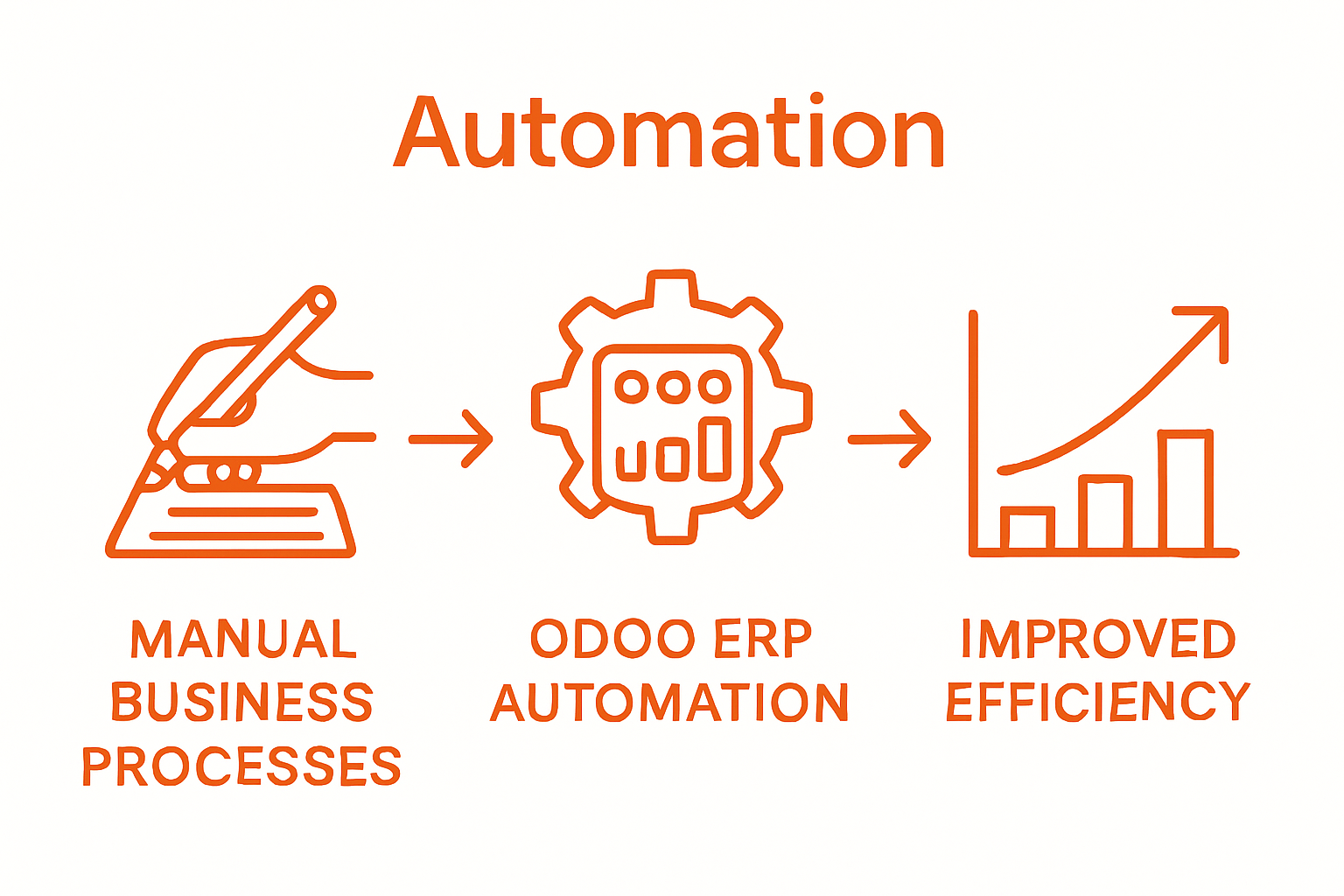
    Infographic shows manual to automated business process sequence

    Document your findings systematically. Create a comprehensive overview that highlights specific gaps in your current business processes. Focus on quantifiable metrics like time spent on manual tasks, frequency of data entry errors, reporting delays, and interdepartmental communication challenges. Learn more about ERP implementation phases to understand how detailed documentation supports successful system integration.

    Define clear, measurable goals for your Odoo ERP implementation. These objectives should be specific, realistic, and aligned with your broader business strategy. Consider goals such as:

    • Reducing operational costs by 20% through process automation
    • Improving reporting accuracy and generating real-time insights
    • Enhancing cross-departmental communication and data visibility
    • Streamlining inventory management and reducing stock discrepancies

    Successful goal setting requires honest self-assessment and a forward-looking perspective. Your objectives should stretch your capabilities while remaining achievable. Remember that Odoo ERP is not just a software solution but a strategic tool for organizational transformation. By thoroughly understanding your current state and envisioning your ideal operational model, you set the stage for a successful digital evolution that can propel your mid-size business toward sustainable growth and competitive advantage.

    Step 2: Research Odoo ERP Features and Modules

    Once you have comprehensively assessed your business needs, the next crucial phase involves diving deep into Odoo ERP’s robust ecosystem of features and modules. This exploration helps you understand how the platform can be tailored to address your specific operational requirements. Odoo’s modular architecture allows businesses to select and implement precisely the tools they need.

    Begin your research by exploring Odoo’s core modules that form the foundation of its enterprise resource planning capabilities. These fundamental modules cover critical business functions like accounting, sales, inventory management, human resources, and customer relationship management. Each module offers unique capabilities designed to streamline specific operational processes and provide comprehensive business insights.

    Learn more about Odoo accounting modules to understand how financial management can be transformed through integrated reporting and real-time financial tracking. Pay special attention to how different modules interact and create a unified business management ecosystem. The interconnected nature of Odoo’s modules means that data flows seamlessly between departments, eliminating manual data entry and reducing potential errors.

    Here is a summary table of essential Odoo ERP modules, their primary functions, and how they contribute to business transformation.

    Odoo Module Main Function Business Impact
    Accounting Financial management & reporting Real-time financial tracking, improved accuracy
    Sales Sales order processing & customer management Streamlined sales cycles, enhanced insights
    Inventory Management Stock tracking & control Reduced discrepancies, efficient stock handling
    Human Resources Employee data & HR processes Centralized records, faster HR operations
    Customer Relationship Mgmt Managing leads, opportunities, and interactions Improved customer tracking, better engagement
    Reporting & Analytics Generating business insights Data-driven decisions, increased visibility
    Workflow Automation Automating repetitive manual tasks Reduced labor, minimized entry errors

    During your research, consider the scalability and customization potential of each module. Mid-size businesses require flexible solutions that can adapt as their operational complexity grows. Evaluate modules not just for their current functionality but for their potential to support future business expansion. Look for modules that offer:

    • Comprehensive reporting and analytics capabilities
    • Easy integration with existing business systems
    • Potential for custom field creation and workflow modifications
    • Mobile accessibility and cloud synchronization

    Engage directly with Odoo implementation partners who can provide detailed demonstrations and insights into module functionality. These experts can help you understand nuanced features that might not be immediately apparent from standard product descriptions. They can also recommend specific module combinations tailored to your industry and business model.

    Verify your research by creating a detailed comparison matrix that maps Odoo modules against your specific business requirements. This document should clearly illustrate how each selected module addresses a particular operational need, providing a clear roadmap for your ERP implementation strategy. A thorough, methodical approach to module research ensures that your Odoo ERP solution becomes a powerful catalyst for business transformation.

    Step 3: Customize Odoo ERP for Your Business

    Customization transforms Odoo ERP from a generic software solution into a powerful, tailored business tool that precisely matches your organizational workflow. The true power of Odoo lies in its remarkable flexibility, allowing businesses to adapt the platform to their unique operational requirements rather than forcing teams to modify their processes to fit standard software configurations.

    Begin the customization process by conducting detailed workshops with key stakeholders from each department. These collaborative sessions will help identify specific workflow nuances, reporting needs, and unique business rules that require custom configurations. Capture every intricate detail about how your teams currently operate and where existing systems create friction or inefficiencies.

    Explore our comprehensive sales management customization guide to understand how module-specific adaptations can significantly improve operational efficiency. During customization, focus on creating custom fields, developing specialized reports, and designing workflow automation that reflects your precise business logic. This might involve creating unique approval processes, developing specialized dashboards, or integrating custom calculations that align with your specific industry requirements.

    Your customization strategy should balance three critical considerations: functionality, user experience, and future scalability. Avoid over-customizing by implementing only modifications that provide clear, measurable business value. Unnecessary complexity can introduce system maintenance challenges and potential integration difficulties during future upgrades.

    Consider the following key customization approaches:

    • Develop role-based access controls tailored to your organizational hierarchy
    • Create custom reporting templates that match your specific performance metrics
    • Design workflow automation that reduces manual intervention
    • Implement specialized dashboards reflecting your unique business KPIs

    Work closely with experienced Odoo implementation partners who understand both technical possibilities and business strategy.

    Their expertise can help you navigate complex customization challenges, ensuring that your modifications are technically sound and strategically aligned. A thoughtful, measured approach to customization ensures that your Odoo ERP becomes a true strategic asset, driving efficiency and providing actionable insights that propel your business forward.

    Odoo ERP customization workflow

    Step 4: Implement Odoo ERP System

    Implementing your Odoo ERP system marks the critical transition from planning to active transformation. This phase represents the most significant operational shift for your mid-size business, requiring meticulous planning, strategic execution, and comprehensive team engagement. The implementation process is not merely a technical deployment but a comprehensive organizational change management initiative.

    Begin by developing a detailed implementation roadmap that breaks down the entire process into manageable phases. Start with a pilot implementation targeting one or two departments that are most adaptable to change. This approach allows your team to identify and resolve potential challenges before full-scale rollout. Select departments with clear, measurable processes that can demonstrate early wins and build organizational confidence in the new system.

    Learn about the latest Odoo migration strategies to ensure smooth system integration and minimize operational disruptions. Establish a dedicated implementation team that includes both internal stakeholders and external Odoo implementation experts. This cross-functional team should include representatives from IT, each major department, and senior management to provide comprehensive oversight and support.

    Data migration represents a critical sub-process within implementation. Carefully audit and clean existing data before transferring it into the new Odoo ERP system. This involves standardizing data formats, removing duplicate entries, and ensuring historical records are accurately translated. Conduct multiple test migrations to validate data integrity and identify potential translation issues before the final system cutover.

    Consider these essential implementation strategies:

    • Develop a comprehensive training program for all user groups
    • Create detailed documentation of new processes and system workflows
    • Establish clear communication channels for reporting implementation challenges
    • Design a phased rollout with specific milestone checkpoints

    Schedule intensive training sessions that go beyond basic system navigation. These sessions should focus on helping team members understand how the new ERP system transforms their specific workflows, demonstrating practical applications that make their daily work more efficient. Encourage hands-on learning and provide ongoing support resources like video tutorials, quick reference guides, and dedicated support contacts.

    Verify successful implementation by conducting thorough system testing, comparing operational metrics before and after deployment, and gathering comprehensive user feedback. A successful implementation is not just about technical functionality but about creating a more streamlined, data-driven organizational ecosystem that empowers your team to work more strategically and efficiently.

    This checklist table helps ensure you have completed the crucial steps involved in implementing Odoo ERP for your mid-size business.

    Implementation Step Completion Criteria Responsible Party
    Assess business needs and goals Needs documented, goals defined Department Leaders
    Research and select the required modules Modules matched to business requirements Project Manager
    Customize Odoo ERP Configurations and workflows tailored Implementation Partner
    Migrate and verify business data Data cleaned, migrated, and validated IT/Data Specialist
    Train team members Training delivered, resources provided Trainers, Team Leads
    Evaluate post-launch performance Performance metrics tracked and reviewed Management, IT

    Step 5: Train Your Team on Using Odoo ERP

    Training your team represents the critical bridge between technical implementation and operational excellence. Successful Odoo ERP adoption hinges entirely on your team’s ability to effectively leverage the new system. This step transforms software from a mere tool into a strategic business accelerator, requiring a comprehensive and empathetic approach to learning and change management.

    Design a multi-tiered training program that acknowledges the diverse learning styles and technological comfort levels within your organization. Begin with role-specific training sessions that demonstrate how Odoo ERP directly impacts each team member’s daily workflow. Explore our comprehensive CRM module training resources to understand how targeted learning can dramatically improve system adoption. Focus on practical, scenario-based learning that helps employees see tangible benefits rather than presenting abstract technical instructions.

    Create a blended learning approach that combines multiple training methods. Develop interactive workshops, record detailed video tutorials, prepare comprehensive written guides, and establish a mentorship program where technologically adept employees can support their colleagues. This diverse approach ensures that every team member has multiple pathways to understanding and mastering the new system.

    Establish a robust support infrastructure that extends beyond initial training. Designate internal Odoo ERP champions from each department who can provide ongoing guidance, answer questions, and help troubleshoot challenges. These champions will serve as critical bridges between technical implementation and practical, day-to-day usage, fostering a culture of continuous learning and system optimization.

    Consider implementing these key training strategies:

    • Develop role-specific training modules
    • Create a digital knowledge repository with searchable resources
    • Establish regular refresher training sessions
    • Design a feedback mechanism for continuous improvement

    Monitor training effectiveness through multiple assessment methods. Conduct skills assessments, track system usage metrics, and gather qualitative feedback from team members. Pay close attention to both quantitative performance indicators and the emotional response to the new system. Successful training is not just about technical proficiency but about building confidence and enthusiasm for the new technological ecosystem.

    Remember that training is an ongoing process. As Odoo ERP evolves and your business needs change, continuous learning becomes paramount. Approach team training as a dynamic, iterative journey that empowers your employees to become more strategic, data-driven professionals who can leverage technology to drive organizational success.

    Step 6: Evaluate Performance and Measure Success

    Evaluating the performance of your Odoo ERP implementation represents the critical final stage that transforms technological investment into measurable business value. Success measurement goes far beyond basic system functionality, focusing instead on comprehensive organizational transformation. This step requires a strategic, data-driven approach that objectively assesses the true impact of your ERP implementation across multiple business dimensions.

    Begin by establishing a comprehensive baseline of pre-implementation performance metrics to create a meaningful comparison point. Collect detailed data on key operational indicators such as process completion times, reporting accuracy, interdepartmental communication efficiency, and overall productivity. These quantitative measurements will provide an objective framework for understanding the tangible benefits delivered by your Odoo ERP system.

    Develop a holistic performance evaluation framework that encompasses both technical performance and strategic business outcomes. This involves creating dashboards that track critical key performance indicators (KPIs) across different departments. Look beyond surface-level metrics to understand how the ERP system has fundamentally transformed your business processes, decision-making capabilities, and operational agility.

    Encourage open and honest feedback from team members at all organizational levels. While quantitative data provides objective insights, qualitative input from employees offers a nuanced understanding of system effectiveness. Conduct structured interviews, design anonymous surveys, and create feedback channels that allow team members to share their experiences, challenges, and suggestions for further system optimization.

    Consider these critical evaluation strategies:

    • Develop comprehensive performance dashboards
    • Conduct quarterly system performance reviews
    • Compare pre- and post-implementation operational metrics
    • Gather cross-departmental feedback on system effectiveness

    Recognize that performance evaluation is an ongoing process, not a one-time event. Schedule regular review sessions to continuously assess and refine your Odoo ERP implementation. These reviews should be collaborative, involving representatives from different departments and levels of the organization. The goal is to create a culture of continuous improvement that views the ERP system as a dynamic tool for organizational growth.

    Successful performance evaluation ultimately demonstrates that your Odoo ERP implementation is more than a technological upgrade. It represents a strategic transformation that empowers your team to work more efficiently, make data-driven decisions, and continuously adapt to changing business landscapes. By maintaining a rigorous, comprehensive approach to measuring success, you ensure that your ERP system remains a powerful catalyst for ongoing business innovation and growth.

    Ready to Transform Your Mid-Size Business With Odoo ERP?

    You have seen how step-by-step ERP implementation and automation can eliminate wasted time, reduce manual errors, and unite your business with real-time insights. Many businesses like yours struggle with disconnected workflows, overwhelming manual processes, and stalled growth. The article showed that tailoring, training, and ongoing evaluation make all the difference. With Bista Solutions, these benefits are within reach.


      As the most awarded Odoo Gold Partner and the leading implementer in North America, our expert team helps you turn every pain point into measurable results. Reach out now if you want a trusted partner who delivers fully customized solutions and around-the-clock support. Contact our Odoo specialists today and start your journey to seamless automation, smarter decisions, and a growth-ready business future. Don’t wait to unlock your company’s potential

      Frequently Asked Questions

      What are the primary benefits of implementing Odoo ERP for mid-size businesses?

      Implementing Odoo ERP provides mid-size businesses with various benefits, including streamlined operations, improved reporting accuracy, automation of manual tasks, enhanced cross-departmental communication, and better overall data visibility. These advantages contribute to increased efficiency and reduced operational costs.

      How does Odoo ERP support automation in business processes?

      Odoo ERP supports automation through its modular architecture that allows businesses to implement specific tools tailored to their needs. This includes automating repetitive tasks, such as data entry and inventory management, which saves time and reduces errors.

      What steps should be taken to properly assess business needs before adopting Odoo ERP?

      Before adopting Odoo ERP, businesses should conduct a thorough assessment of their existing processes, gather insights from key stakeholders across departments, document inefficiencies, and define clear, measurable goals that align with their broader business strategy.

      How can I ensure my team is effectively trained to use Odoo ERP?

      To ensure effective training, develop a multi-tiered training program that includes role-specific sessions, interactive workshops, and ongoing support resources. Designate internal champions in each department to assist their colleagues and encourage a culture of continuous learning for ongoing system optimization.

      7 Ways How Odoo ERP Helps Chocolate Manufacturers Stay FDA & Food Safety Compliant

      chocolate manufacturing, ERP compliance, food safety

      Chocolate manufacturers have to juggle strict FDA rules while making sure every piece that leaves the factory is safe to eat. Most would expect a mountain of paperwork and frantic manual tracking just to keep up. But with Odoo ERP, compliance gets a total makeover. Odoo ERP can automate FDA-required reports, manage ingredient traceability, and create a digital audit trail that meets rigorous food safety standards. This completely changes how chocolate makers stay one step ahead of regulations and surprises anyone who thinks regulatory compliance has to be a nightmare.

      Table of Contents

      Quick Summary

      Takeaway Explanation
      Leverage Odoo ERP for FDA Compliance Odoo ERP centralizes tracking and documentation to help chocolate manufacturers adhere to stringent FDA regulations efficiently.
      Automate Ingredient Tracking Processes Use Odoo ERP to create detailed profiles for ingredients, improving monitoring and quality control in sourcing.
      Streamline Compliance Reporting Automate critical documentation and reporting with Odoo to ensure timely and accurate submissions for regulatory requirements.
      Enhance Supplier Quality Management Implement Odoo ERP’s features to evaluate and monitor supplier quality, fostering transparent and compliant partnerships.
      Integrate Quality Control into Production Use Odoo ERP to embed real-time quality checks in production, ensuring consistency and safety for chocolate products.

      1: Understand FDA Regulations for Food Safety

      Chocolate manufacturers face complex food safety regulations that demand meticulous tracking, documentation, and compliance. The FDA Food Safety Modernization Act requires comprehensive monitoring of production processes, ingredient sourcing, and potential contamination risks. Odoo ERP emerges as a critical tool for navigating these intricate regulatory landscapes, providing chocolate manufacturers with an integrated system to manage and document their food safety protocols.

      The FDA mandates strict guidelines that chocolate manufacturers must follow to ensure consumer safety. These regulations cover multiple aspects of production, including:

      • Ingredient traceability from source to final product
      • Detailed record keeping of manufacturing processes
      • Comprehensive hygiene and sanitation documentation
      • Temperature and storage monitoring records

      Odoo ERP’s robust platform allows manufacturers to centralize and automate these complex compliance requirements. By creating a unified digital ecosystem, businesses can generate real-time reports, track batch histories, and maintain precise documentation that meets FDA standards.

      Key challenges in food safety compliance include managing multiple data points, maintaining accurate records, and responding quickly to potential safety issues. Odoo ERP addresses these challenges by providing integrated modules that track every stage of chocolate production. The system enables manufacturers to create detailed audit trails, monitor critical control points, and generate comprehensive reports that demonstrate ongoing regulatory adherence.

      With Bista Solutions implementation of Odoo ERP, chocolate manufacturers gain a powerful ally in navigating FDA regulations. The platform’s flexibility allows customization to specific manufacturing workflows while maintaining the highest standards of food safety documentation and traceability.

      2: Track Ingredients and Raw Materials Efficiently

      In chocolate manufacturing, precise tracking of ingredients and raw materials is not just a best practice but a critical regulatory requirement. Odoo ERP provides manufacturers with a comprehensive solution for managing complex ingredient supply chains, ensuring transparency, quality, and safety at every production stage. By implementing sophisticated tracking mechanisms, chocolate producers can maintain rigorous control over their raw material sourcing and inventory.

      The challenge of ingredient tracking involves multiple critical aspects:

      • Documenting precise origin of each raw material
      • Monitoring ingredient quality and freshness
      • Maintaining real time inventory updates
      • Tracking potential allergen cross contamination risks

      Odoo ERP’s advanced tracking modules enable manufacturers to create detailed digital profiles for every ingredient, capturing essential information such as supplier details, batch numbers, production dates, and quality certifications. This level of granular documentation helps businesses quickly respond to potential food safety concerns and implement targeted recalls if necessary.

      With our comprehensive Odoo auto vendor lead time calculation module, manufacturers can optimize raw material procurement processes. The system automatically calculates optimal ordering timelines, reducing waste and ensuring consistent ingredient quality. Integrated quality management tools allow real time monitoring of ingredient specifications, enabling proactive quality control measures.

      By centralizing ingredient data, Odoo ERP transforms complex supply chain management into a streamlined, transparent process. Chocolate manufacturers gain unprecedented visibility into their raw material ecosystem, supporting compliance with FDA regulations and maintaining the highest standards of food safety. The platform’s ability to generate instant reports and trace ingredient histories provides a robust defense against potential contamination risks and regulatory challenges.

      3: Automate Compliance Reporting with Odoo ERP

      Compliance reporting represents one of the most complex and time-consuming aspects of chocolate manufacturing. Odoo ERP transforms this challenging process by automating critical documentation and reporting requirements, enabling manufacturers to generate precise regulatory reports with unprecedented efficiency.

      The FDA mandates extensive documentation across multiple operational domains, including:

      • Production batch tracking
      • Temperature monitoring records
      • Ingredient sourcing verification
      • Quality control inspection logs
      • Sanitation and hygiene documentation

      Odoo ERP’s integrated reporting modules eliminate manual data entry and reduce human error by automatically capturing and organizing critical compliance information. The system generates comprehensive reports that meet FDA guidelines, providing manufacturers with real-time insights into their operational performance and regulatory adherence.

      Our Odoo accounting implementation strategies further enhance compliance reporting capabilities by ensuring financial documentation aligns with food safety regulatory requirements. The platform’s ability to create customizable report templates means chocolate manufacturers can quickly adapt to changing regulatory landscapes.

      By centralizing data collection and leveraging advanced analytics, Odoo ERP enables proactive compliance management. Manufacturers can set up automated alerts for potential compliance gaps, track historical documentation, and generate audit-ready reports at a moment’s notice. The system’s robust tracking mechanisms provide a transparent, verifiable record of all production activities, serving as a critical defense against potential regulatory challenges.

      Moreover, the automated reporting features significantly reduce administrative overhead, allowing chocolate manufacturing teams to focus on product quality and innovation rather than getting bogged down in paperwork. Odoo ERP transforms compliance reporting from a burdensome requirement into a strategic advantage, providing manufacturers with the tools to demonstrate their commitment to food safety and regulatory excellence.

      4: Maintain Clean Records of Production Processes

      Maintaining immaculate production records is crucial for chocolate manufacturers navigating complex FDA regulations. Odoo ERP provides a comprehensive digital solution that transforms record-keeping from a manual burden into a streamlined, automated process. By creating a centralized system for documenting every aspect of chocolate production, manufacturers can ensure transparency, traceability, and regulatory compliance.

      Effective production record management requires tracking critical information such as:

      • Equipment sanitization logs
      • Production batch details
      • Temperature and environmental monitoring
      • Employee training and hygiene records
      • Quality control checkpoints

      Odoo ERP’s advanced documentation modules enable manufacturers to capture real-time data across multiple production stages, generating comprehensive digital records that meet stringent FDA requirements. The platform’s ability to automatically timestamp and store production information eliminates manual errors and creates an unbreakable chain of documentation.

      Our equipment manufacturing ERP solutions further enhance the capability to maintain precise production records. By integrating equipment performance data, maintenance schedules, and operational parameters, Odoo ERP provides a holistic view of the manufacturing environment.

      The system’s robust record-keeping capabilities extend beyond simple documentation. Manufacturers can quickly generate detailed reports, conduct internal audits, and respond to potential regulatory inquiries with unprecedented speed and accuracy. Automated alerts and notifications ensure that any deviations from standard operating procedures are immediately flagged and addressed.

      By digitizing and centralizing production process records, Odoo ERP empowers chocolate manufacturers to transform record-keeping from a compliance requirement into a strategic asset. The platform provides not just documentation, but actionable insights that can drive continuous improvement in food safety, quality control, and operational efficiency.

      5: Manage Supplier Quality and Safety Standards

      Supplier management represents a critical control point in chocolate manufacturing’s food safety ecosystem. Odoo ERP provides manufacturers with a comprehensive platform to rigorously evaluate, monitor, and manage supplier quality and safety standards, transforming supplier relationships into strategic compliance partnerships.

      Effective supplier quality management involves multiple critical components:

      • Comprehensive supplier certification tracking
      • Regular performance and quality assessments
      • Risk evaluation of ingredient sourcing
      • Automated compliance documentation
      • Transparent communication channels

      The platform enables chocolate manufacturers to create detailed supplier profiles that capture essential information beyond traditional procurement metrics. Odoo ERP allows businesses to establish precise quality benchmarks, track supplier performance in real-time, and generate automated alerts when potential compliance risks emerge.

      Our Odoo quality management solutions enhance supplier evaluation processes by providing granular insights into ingredient sourcing, production standards, and potential contamination risks. The system’s integrated approach means manufacturers can quickly identify and address potential quality deviations before they impact production.

      By centralizing supplier data, Odoo ERP transforms supplier management from a reactive process to a proactive strategy. Manufacturers gain unprecedented visibility into their supply chain, enabling them to make data-driven decisions that prioritize food safety and regulatory compliance. Automated scoring mechanisms and comprehensive reporting tools allow businesses to maintain consistently high standards across their entire ingredient procurement ecosystem.

      The platform’s ability to generate detailed supplier scorecards, track historical performance, and maintain comprehensive audit trails provides chocolate manufacturers with a robust defense against potential food safety challenges. Odoo ERP ensures that supplier quality management becomes a strategic advantage, not just a regulatory requirement.

      6: Implement Traceability Features for Products

      Product traceability is a fundamental requirement for chocolate manufacturers seeking to maintain FDA compliance and consumer safety. Odoo ERP delivers an advanced traceability system that enables manufacturers to track every chocolate product from raw ingredient to final consumer, creating an unbroken digital chain of accountability.

      Comprehensive product traceability involves tracking multiple critical data points:

      • Complete ingredient origin documentation
      • Batch production timestamps
      • Manufacturing equipment used
      • Quality control inspection records
      • Distribution and shipping details

      Odoo ERP’s sophisticated tracking modules generate unique identifiers for each production batch, allowing manufacturers to instantly retrieve comprehensive product histories. This digital traceability mechanism provides rapid response capabilities in case of potential product recalls or safety investigations.

      The platform’s ability to create granular tracking extends beyond basic record keeping. Manufacturers can generate instant genealogy reports that map the entire lifecycle of each chocolate product, providing unprecedented transparency and regulatory documentation.

      Our Odoo auto vendor lead time calculation module further enhances traceability by integrating procurement timelines with production tracking. This means manufacturers can understand not just where a product has been, but precisely how and when each ingredient entered the production process.

      By implementing robust traceability features, chocolate manufacturers transform potential compliance challenges into strategic advantages. Odoo ERP enables businesses to demonstrate their commitment to food safety, build consumer trust, and maintain the highest standards of regulatory compliance. The system’s real-time tracking capabilities ensure that every chocolate product can be instantly and comprehensively documented, providing a powerful tool for quality assurance and regulatory defense.

      7: Integrate Quality Control Checks into Production

      Quality control represents the final critical barrier between potential food safety risks and consumer protection. Odoo ERP transforms quality control from a manual, disconnected process into an integrated, automated system that seamlessly monitors every stage of chocolate production. By embedding sophisticated quality checks directly into manufacturing workflows, chocolate producers can ensure consistent product safety and regulatory compliance.

      Comprehensive quality control integration involves tracking essential parameters:

      • Temperature monitoring during production
      • Ingredient purity verification
      • Equipment sanitization validation
      • Sensory and texture consistency checks
      • Packaging integrity assessment

      Odoo ERP’s quality management modules create dynamic, real-time quality control checkpoints that automatically document and validate each production stage. The system enables manufacturers to establish precise quality thresholds, generating immediate alerts when potential deviations occur.

      Our Odoo quality management solutions provide chocolate manufacturers with powerful tools to standardize and automate quality control processes. By creating digital inspection workflows, businesses can ensure that every batch meets stringent FDA requirements and internal quality standards.

      The platform’s advanced analytics capabilities allow manufacturers to track quality control data over time, identifying trends, potential improvement areas, and maintaining a comprehensive historical record of production quality. Automated reporting features generate detailed documentation that serves both regulatory compliance needs and internal continuous improvement initiatives.

      By integrating quality control checks directly into production processes, Odoo ERP empowers chocolate manufacturers to transform quality management from a reactive compliance requirement into a proactive strategy for maintaining exceptional product standards. The system provides real-time visibility, precise documentation, and the tools necessary to consistently deliver safe, high-quality chocolate products to consumers.

      Below is a comprehensive table summarizing how Odoo ERP helps chocolate manufacturers maintain FDA and food safety compliance, covering the article’s main steps, features, and benefits.

      Key Compliance Area Odoo ERP Solution & Benefit
      Understanding FDA Regulations Centralizes compliance management; streamlines tracking, reporting, and audit trails to meet FDA food safety rules.
      Ingredient & Raw Material Tracking Offers detailed ingredient profiles, tracks origin, quality, freshness, and helps prevent allergen contamination.
      Automated Compliance Reporting Automates documentation, batch tracking, quality logs, and generates real-time, FDA-ready compliance reports.
      Production Record Maintenance Digitizes and automates production documentation including sanitization, temperature logs, and employee records.
      Supplier Quality & Safety Management Evaluates supplier certifications, quality, risks, and performance, creating transparent and compliant partnerships.
      Product Traceability Tracks every batch from raw ingredient to consumer, enabling fast recalls and detailed genealogy reports.
      Integrated Quality Control Checks Embeds real-time quality checkpoints in production, ensures adherence to standards, and alerts on deviations.

      Get Rid of FDA Compliance Stress with Odoo ERP Experts at Your Side

      Is your chocolate manufacturing business feeling overwhelmed by complicated FDA food safety rules, endless production records, and the daily demand for spotless traceability? The risks of non-compliance or a surprise audit can weigh heavily, especially when manual processes or outdated systems hold you back. With centralized documentation, automated ingredient tracking, and integrated compliance reporting, as highlighted in our article, there is a better way to regain peace of mind.


        Bista Solutions is the largest Odoo ERP implementer in North America and a multi-time Odoo Best Partner award recipient. We bring nationwide expertise, a proven track record, and deep understanding of the challenges you face in FDA and food safety compliance. Connect with us now at Bista Solutions Contact Us to schedule your tailored Odoo ERP consultation. Start your journey toward easier, safer, and audit-ready chocolate production today. Do not wait until the next compliance headache hits—discover how leading manufacturers are transforming their processes with Odoo and Bista’s support.

        Frequently Asked Questions

        How does Odoo ERP ensure compliance with FDA regulations for chocolate manufacturers?

        Odoo ERP helps chocolate manufacturers comply with FDA regulations by providing a comprehensive platform for tracking production processes, documenting ingredient sourcing, and maintaining hygiene and sanitation records. It streamlines compliance reporting and automates real-time data capture to ensure adherence to safety standards.

        What features does Odoo ERP offer for tracking ingredients in chocolate production?

        Odoo ERP offers advanced tracking modules that allow manufacturers to document the origin, quality, and freshness of each ingredient. It includes real-time inventory updates and allergen cross-contamination risk tracking, helping ensure transparency and safety in the supply chain.

        How can Odoo ERP automate compliance reporting for chocolate manufacturers?

        Odoo ERP automates compliance reporting by capturing critical data across various operational areas, eliminating manual data entry, and generating reports that meet FDA guidelines. This setup provides real-time insights into regulatory adherence and operational performance, saving time and reducing errors.

        What role does Odoo ERP play in maintaining production process records?

        Odoo ERP maintains clean and detailed production process records by automating documentation of equipment sanitization, production batches, and quality control checkpoints. It centralizes data storage, promotes accuracy, and provides manufacturers with immediate access to records for audits and regulatory inquiries.

        Smarter Vendor Selection with Odoo AI Agent: Meet the Sourcing Advisor

        In procurement, choosing the right supplier can make or break business efficiency. Poor vendor performance leads to delayed deliveries, inflated costs, compliance issues, and quality risks. While Odoo provides strong vendor management tools, procurement teams often rely on subjective judgment or manual data checks when awarding purchase orders.

        That’s why we developed the Sourcing Advisor Odoo AI Agent — an AI-powered assistant designed to automate vendor scoring, ranking, and recommendations directly inside Odoo.

        Why Supplier Scoring Matters in Procurement

        Procurement isn’t just about finding the lowest cost supplier. Businesses must balance price, lead times, product quality, vendor capacity, and compliance. By turning these factors into measurable criteria, procurement teams can standardize vendor evaluation and make fair, consistent sourcing decisions.

        The Sourcing Advisor Odoo AI Agent transforms this into a repeatable, data-driven process that improves supplier reliability and reduces risks.

        How the Sourcing Advisor Odoo AI Agent Works

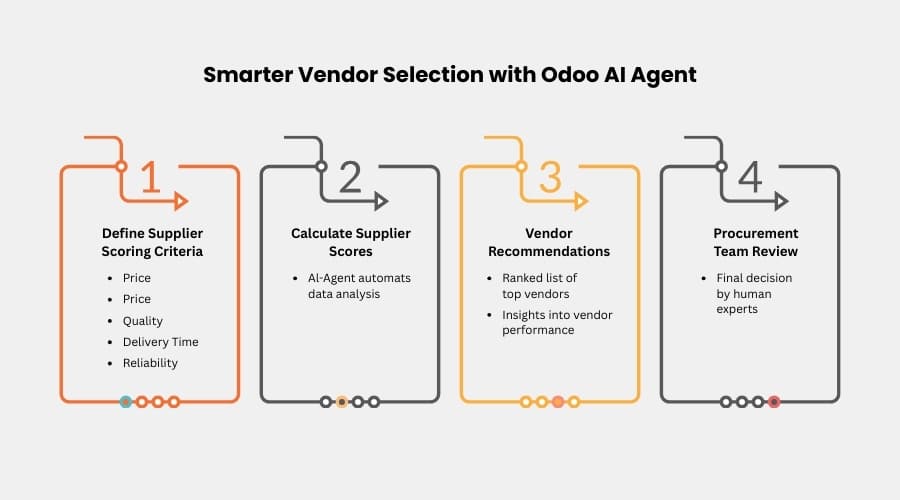
        Step 1: Define Supplier Scoring Criteria

        Set up weighted criteria such as:

        • Price
        • Lead Time
        • Quality Performance
        • Capacity Fulfillment
        • Compliance History

        This ensures suppliers are evaluated against what matters most for your business.

        Step 2: Calculate Supplier Scores

        The AI Agent analyzes historical purchase and delivery data in Odoo. It scores each vendor across all criteria, applies the defined weights, and generates a ranked supplier list from best to worst.

        Step 3: Vendor Recommendations

        From the scores, the Sourcing Advisor provides insights such as:

        • Who your top-performing vendors are
        • Which vendors are underperforming
        • Which suppliers to prioritize for upcoming orders

        Step 3A: Vendor Check for Draft Purchase Orders

        For purchase orders that are in draft but not yet confirmed, the AI Agent compares the selected vendor against the scoring model.
        If it finds a better-performing supplier, it suggests switching vendors before the PO is finalized.

        This feature helps procurement teams avoid costly mistakes by validating sourcing decisions in real-time.

        Step 4: Procurement Team Review

        Finally, the recommendations are sent to the procurement staff, who can:

        • Accept the AI’s vendor suggestions
        • Override them if there are special circumstances
        • Confirm and finalize the purchase orders

        This keeps procurement both data-driven and human-controlled.

        Smarter Vendor Selection with Odoo AI Agent

        Business Benefits of the Sourcing Advisor

        Benefit What It Means for Your Business
        Cost Optimization Select suppliers who offer the best balance of price and quality
        Reduced Risk Avoid unreliable vendors and prevent late deliveries
        Consistency Standardized scoring removes bias from vendor selection
        Efficiency Save time with AI-assisted recommendations inside Odoo
        Strategic Sourcing Build long-term partnerships with top-performing vendors

        Final Thoughts

        With the Sourcing Advisor AI Agent, businesses can transform procurement from a reactive, manual task into a strategic advantage. By combining Odoo’s vendor management features with AI-driven insights, you’ll always know which suppliers to trust and when to adjust.

        At Bista Solutions, we specialize in building AI-powered Odoo agents that drive operational efficiency. Whether you’re managing complex supply chains or scaling your procurement process, our solutions make sourcing smarter and faster.

        Ready to make better sourcing decisions? Contact us today to see how the Sourcing Advisor Odoo AI Agent can optimize your vendor management.

        Smarter Payables & Vendor Tracking with Odoo AI Agent: Introducing the Purchase Order Monitor

        Introducing the Purchase Order Monitor

        Efficient procurement doesn’t just mean generating purchase orders—it means tracking, validating, and paying them accurately and on time. Manual monitoring across PO, invoice, and goods receipt channels is time-consuming and prone to errors, leading to payment delays, vendor disputes, and compliance issues.

        Enter the Purchase Order Monitor Odoo AI Agent, your AI-powered assistant that automatically tracks open purchase orders, performs three-way matching, scores vendor compliance, and recommends corrective actions—all seamlessly within Odoo.

        Why Purchase Order Monitoring Matters

        Unchecked, open purchase orders can cause:

        • Missed deliveries — delayed or partial shipments affecting production
        • Invoice mismatches — paying for wrong quantities or prices
        • Vendor non-compliance — no clear view of vendor reliability
        • Reduced financial control — risk of penalties or overpayment

        The Purchase Order Monitor Odoo AI Agent elevates visibility and accelerates action at every stage of procurement.

        Smarter Payables & Vendor Tracking with Odoo AI Agent: Introducing the Purchase Order MonitorHow the Purchase Order Monitor AI Agent Works


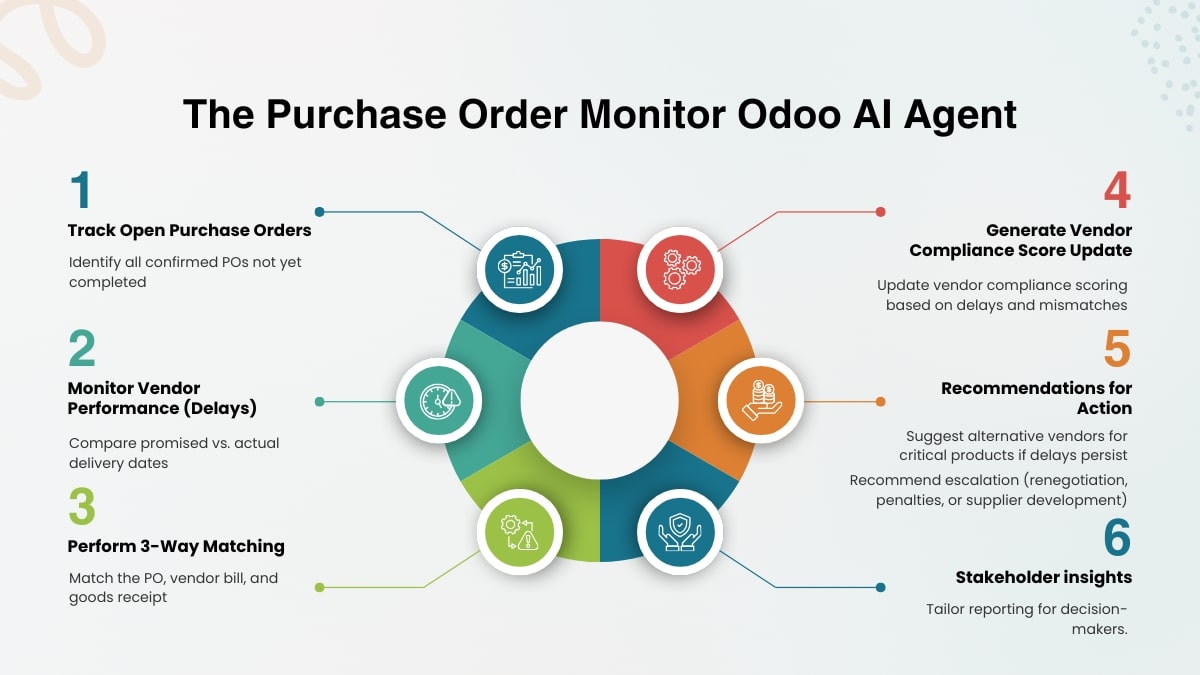
        Step 1: Track Open Purchase Orders

        Automatically identify all confirmed POs not yet completed. The AiAgent tracks expected delivery dates, received quantities, and outstanding items.

        Step 2: Monitor Vendor Performance (Delays)

        The AiAgent compares promised delivery dates with actual receipt dates to flag vendors with consistent delays or partial deliveries.

        Step 3: Perform 3-Way Matching

        Match the PO, vendor invoice, and goods receipt.

        • If all match → the invoice is automatically approved.
        • If there’s a mismatch (e.g., quantity, price, date) → the AiAgent flags it for manual review.

        Step 4: Generate Vendor Compliance Score Update

        The AiAgent updates vendor compliance scores—reducing scores for frequent delivery issues or mismatches. This provides a trust metric for future procurement decisions.

        Step 5: Recommendations for Action

        For persistent delivery issues, the AiAgent suggests:

        • Switching to alternative vendors for critical products
        • Escalation actions (e.g., renegotiation, penalty clauses, supplier development)
        • Holding payable invoices until discrepancies are resolved

        Step 6: Procurement Team Review

        Finally, flagged orders are sent to the procurement team to review and decide corrective action—keeping a human in control while benefiting from AI-supported insights.

        How This Enhances Native Odoo Capabilities

        Odoo supports basic purchase tracking and approval workflows. However, it lacks intelligent automation for three-way matching and dynamic vendor compliance scoring. The AiAgent fills this critical gap by streamlining validation, reducing manual errors, and speeding up the procure-to-pay cycle—without leaving the Odoo platform.

        Business Benefits at a Glance

        Benefit Result for Your Business
        Improved Matching Accuracy Less time on invoice reconciliation, fewer mistakes
        Faster Payments & Approval Accelerates procure-to-pay cycle
        Vendor Accountability Compliance scores incentivize timely, accurate fulfillment
        Cost & Risk Control Catch delivery anomalies before paying invoices
        Human + AI Collaboration AI flags, humans decide — optimizing control

        Final Thoughts & Next Steps

        The Purchase Order Monitor Odoo AI Agent addresses a critical procurement pain point: keeping purchase orders accurate, vendors compliant, and payments on point. By integrating intelligent tracking and validation into Odoo, your team can focus on strategy, not spreadsheet revalidation.

        At Bista Solutions, we specialize in building such AI-driven enhancements to elevate Odoo’s utility and streamline operations. Ready to transform your procurement process and sharpen financial control?

        Contact us today to see how the Purchase Order Monitor Odoo AI Agent can help your business.

        Celebrating Excellence: Bista Solutions Awarded Best Odoo Partner North America 2025

        Bista Solutions is Awarded The Best Odoo Partner North America 2025

        A testament to our unwavering commitment to client success, innovation, and the Odoo ecosystem.

        It is with immense pride and excitement that we, Bista Solutions, have been awarded the Best Odoo Partner in North America for 2025. This esteemed recognition, presented directly by Odoo S.A., is not just an award; it’s a powerful validation of the hard work, dedication, and client-first philosophy that every single member of our team lives by.

        This accolade places us at the pinnacle of the Odoo partner network across the entire continent, highlighting our exceptional performance in delivering transformative business solutions that drive growth, efficiency, and innovation for our clients.

        What Does “Best Odoo Partner” Really Mean?

        The title of “Best Odoo Partner” is awarded based on a rigorous set of criteria that measure a partner’s overall impact and excellence. This isn’t a popularity contest; it’s a data-driven assessment of performance across key areas:

        • Client Success & Satisfaction: Our highest priority has always been the success of our clients. This award reflects the overwhelmingly positive feedback, successful go-lives, and tangible ROI our clients have achieved through our partnership.
        • Sales Growth & Performance: We have demonstrated significant and consistent growth, bringing the power of Odoo to a diverse range of businesses across North America, from budding startups to established enterprises.
        • Technical Expertise & Certification: Our team boasts some of the most certified and skilled Odoo experts in the industry. This deep reservoir of knowledge ensures we can tackle any business challenge, no matter how complex.
        • Contribution to the Odoo Community: We believe in giving back. Through developing innovative modules, sharing knowledge via webinars and blogs, and actively participating in the Odoo community, we strive to push the platform forward for everyone.

        This Award is For Our Clients

        While we are honored to accept this award, we see it first and foremost as a testament to our clients’ success. Your trust in us to be your digital transformation partner is the fuel that drives our innovation. Your challenges become our projects, and your successes become our milestones. Thank you for partnering with us on this journey. This award is as much yours as it is ours.

        A Look Back at the Journey: The Pillars of Our Success

        This achievement is the result of a deliberate strategy built on a foundation of core values:

        1. Deep Industry Knowledge: We don’t just implement software; we solve business problems. Our consultants take the time to understand your industry’s unique nuances, ensuring your Odoo system is tailored for your specific needs.
        2. The Bista Advantage: Our proprietary project methodology ensures implementations are on time, on budget, and exceed expectations. We emphasize clear communication, collaborative planning, and comprehensive training.
        3. Innovation as a Standard: Our dedicated development center continuously innovates, creating custom solutions and integrations that extend Odoo’s functionality to meet even the most specialized requirements.
        4. A Culture of Partnership: We view ourselves as an extension of your team. Our long-term support and advisory services are designed to ensure your Odoo investment continues to deliver value as your business evolves.

        The Future is Integrated, The Future is Bright

        Being named the Best Odoo Partner 2025 is an incredible milestone, but it is not the destination. It is a springboard for the future. This award reinforces our commitment to:

        • Pushing the Boundaries of ERP: We will continue to invest in R&D, exploring the potential of AI, IoT, and deeper analytics within the Odoo framework.
        • Expanding Our Reach: We are more determined than ever to help businesses across North America unlock their potential with integrated, scalable, and affordable ERP solutions.
        • Setting a Higher Standard: We will continue to raise the bar for what it means to be a true strategic partner, setting new standards for excellence in the ERP implementation space.

        Ready to Experience the Best?

        Are you considering Odoo for your business? Or perhaps your current implementation isn’t living up to its promise? Partner with the best.

        Let us show you why we were awarded this honor. Contact Bista Solutions today for a free consultation and discover how our award-winning team can drive your business forward.

        Understanding How Odoo ERP Enables Lean Manufacturing and JIT

        Odoo ERP lean manufacturing

        Odoo ERP is often praised for its flexibility and open-source roots, letting companies manage everything from accounting to inventory in one place. Yet, what surprises most people is just how much it can be customized—Odoo offers hundreds of modules, letting you tailor the system to match any workflow. Most business software forces you into rigid processes but Odoo flips the script and lets your business call the shots, not the other way around.

        Table of Contents

        Quick Summary

        Takeaway Explanation
        Odoo ERP offers flexible, modular solutions Companies can customize Odoo ERP to fit unique operational processes and improve efficiency across departments.
        Lean manufacturing minimizes waste effectively Lean principles focus on identifying and eliminating waste, ensuring resources are used efficiently while maximizing productivity.
        Just-in-Time production improves resource allocation JIT manufacturing aligns production schedules with demand, reducing excess inventory and enhancing responsiveness to market changes.
        Integration of Odoo ERP with lean practices enhances performance Utilizing Odoo ensures data-driven decision-making and precise management of lean methodologies, leading to operational excellence.
        Real-time insights drive strategic transformation Odoo ERP’s capabilities provide detailed analytics that support proactive management and continuous improvement initiatives in manufacturing.

        What is Odoo ERP and How Does It Function?

        Odoo ERP represents a comprehensive, integrated software solution designed to help businesses streamline their operational processes across multiple departments. As an open-source enterprise resource planning platform, Odoo provides organizations with a flexible and scalable system that can adapt to diverse business requirements.

        Core Architecture and Functionality

        At its foundation, Odoo ERP functions as a modular platform that enables businesses to manage critical operations through interconnected applications. These applications cover essential business domains such as:

        • Accounting and financial management
        • Customer relationship management (CRM)
        • Human resources and payroll
        • Manufacturing and inventory control
        • Sales and purchase management
        • Project tracking and collaboration

        The system’s unique architecture allows seamless integration between these modules, creating a unified ecosystem where data flows smoothly across different organizational functions. Unlike traditional rigid ERP systems, Odoo offers unprecedented customization capabilities, enabling businesses to tailor the platform precisely to their operational workflows.

        Understanding Odoo’s Technical Framework

        Odoo operates on a powerful technical framework built using Python programming language and PostgreSQL database management system. This combination provides robust performance, security, and scalability. The platform supports multiple deployment models including on-premise, cloud-based, and hybrid configurations, giving businesses the flexibility to choose an implementation strategy that best suits their technological infrastructure.

        For businesses seeking comprehensive ERP solutions, learn more about Odoo’s powerful modular approach and how it can transform organizational efficiency. Bista Solutions specializes in helping companies implement and optimize Odoo ERP systems, ensuring seamless digital transformation and operational excellence.

        By offering an integrated, adaptable platform, Odoo ERP empowers organizations to centralize their data, automate complex processes, and make informed strategic decisions with real-time insights and comprehensive reporting capabilities.

        The Principles of Lean Manufacturing Explained

        Lean manufacturing is a systematic approach to production that focuses on minimizing waste while maximizing productivity and value creation. Originating from Toyota’s production philosophy in the mid-20th century, this methodology has transformed manufacturing processes across global industries by emphasizing efficiency, continuous improvement, and waste elimination.

        Core Philosophical Foundations

        At its essence, lean manufacturing is built on five fundamental principles that guide organizational transformation. These principles are not merely operational strategies but represent a comprehensive philosophy of production and organizational management:

        • Value Identification: Understanding what customers truly value
        • Value Stream Mapping: Analyzing and optimizing entire production processes
        • Creating Continuous Flow: Eliminating interruptions and bottlenecks
        • Establishing Pull Systems: Producing only what is immediately required
        • Pursuing Continuous Improvement: Constantly seeking operational enhancements

        These principles challenge traditional manufacturing paradigms by shifting focus from mass production to precision-driven, customer-centric manufacturing. Instead of generating excessive inventory, lean manufacturing aims to create exactly what customers need, precisely when they need it.

        Waste Reduction Strategies

        Waste reduction represents the cornerstone of lean manufacturing. Organizations practicing lean methodologies systematically identify and eliminate eight primary forms of waste: overproduction, waiting times, transportation inefficiencies, excessive processing, inventory surplus, unnecessary movement, defects, and underutilized human potential.

        By exploring advanced lean manufacturing techniques, businesses can transform their operational models. The goal is not merely cost reduction but creating a responsive, adaptive manufacturing ecosystem that continuously evolves to meet changing market demands.

        The table below summarizes the eight types of waste targeted by lean manufacturing, as described in the article, and gives a brief explanation of each.

        Type of Waste Explanation
        Overproduction Making more than is needed or before it is needed
        Waiting Times Idle time caused by delays between production steps
        Transportation Unnecessary movement of materials or products
        Excessive Processing Performing more work or using more resources than required
        Inventory Surplus Holding extra raw materials, work-in-progress, or finished goods
        Unnecessary Movement Extra motion by people, equipment, or machinery
        Defects Errors or flaws that require rework or result in waste
        Underutilized Potential Not using employee skills, talents, or ideas effectively

        Lean manufacturing transcends traditional cost-cutting approaches. It represents a holistic philosophy of organizational excellence, emphasizing respect for human resources, continuous learning, and systemic efficiency. Through disciplined implementation, companies can achieve remarkable improvements in productivity, quality, and customer satisfaction.

        Understanding Just-in-Time (JIT) Manufacturing

        Just-in-Time (JIT) manufacturing represents a revolutionary production strategy that fundamentally transforms traditional inventory management and manufacturing processes. By focusing on producing goods exactly when they are needed and in the precise quantities required, JIT challenges conventional mass production paradigms and delivers unprecedented operational efficiency.

        Core Principles and Methodology

        JIT manufacturing operates on several critical principles that distinguish it from traditional production approaches:

        • Minimal Inventory: Maintaining only essential materials and components
        • Precise Production Scheduling: Manufacturing products based on immediate demand
        • Reduced Waste: Eliminating excess inventory and associated storage costs
        • Streamlined Supply Chain: Creating direct, responsive connections between production and customer needs
        • Quality-Driven Processes: Emphasizing defect prevention over defect detection

        The fundamental goal of JIT is to transform manufacturing from a push-based to a pull-based system.

        This means production is triggered by actual customer demand rather than speculative forecasting, dramatically reducing waste and improving resource allocation.

        Side-by-side comparison of traditional manufacturing vs lean JIT with Odoo ERP using icons

        Strategic Implementation and Benefits

        Successful JIT implementation requires sophisticated coordination across multiple organizational functions. Manufacturers must develop robust communication channels, precise demand forecasting capabilities, and agile production systems. Explore advanced manufacturing optimization techniques to understand how technology enables these complex operational strategies.

        By adopting JIT principles, organizations can achieve significant competitive advantages. The approach reduces capital tied up in inventory, minimizes storage expenses, improves product quality, and creates a more responsive manufacturing ecosystem. Companies implementing JIT often experience reduced production cycle times, lower operational costs, and enhanced ability to meet rapidly changing market demands.

        While JIT manufacturing presents complex challenges, its potential to revolutionize production processes makes it an increasingly critical strategy for businesses seeking operational excellence in competitive global markets.

        This table provides a side-by-side comparison of Lean Manufacturing and Just-in-Time (JIT) Manufacturing based on principles and focus areas highlighted in the article.

        Concept Primary Focus Key Principles Main Outcomes
        Lean Manufacturing Waste reduction, process efficiency Value Identification, Flow, Pull, Continuous Improvement Higher productivity, reduced waste
        JIT Manufacturing Producing only as needed, inventory minimization Minimal Inventory, Demand-based Production, Streamlined Supply Chain Lower inventory costs, faster response to demand

        The Integration of Odoo ERP with Lean Manufacturing

        Odoo ERP represents a powerful technological solution that seamlessly aligns with lean manufacturing principles, offering manufacturers an integrated platform to optimize production processes, reduce waste, and enhance operational efficiency. By providing comprehensive tools that support continuous improvement and real-time data management, Odoo transforms traditional manufacturing approaches.

        Technological Alignment with Lean Principles

        The integration of Odoo ERP with lean manufacturing creates a sophisticated ecosystem that enables organizations to implement core lean strategies with unprecedented precision:

        • Real-Time Inventory Tracking: Monitoring material usage and consumption
        • Automated Production Planning: Generating precise manufacturing schedules
        • Waste Identification: Detecting inefficiencies through comprehensive analytics
        • Resource Optimization: Allocating human and material resources strategically
        • Performance Measurement: Tracking key performance indicators continuously

        Odoo’s modular architecture allows seamless customization, enabling manufacturers to design workflows that precisely match their unique operational requirements. This flexibility transforms traditional manufacturing management from reactive to proactively predictive.

        Advanced Manufacturing Capabilities

        Through its robust manufacturing module, discover comprehensive manufacturing execution strategies that enable businesses to implement sophisticated lean principles. Odoo provides advanced features like Bill of Materials management, work order tracking, and production planning that directly support lean methodologies.

        The platform’s ability to integrate multiple operational functions creates a holistic approach to manufacturing management. By connecting inventory, procurement, production, and sales modules, Odoo ensures that every organizational process contributes to waste reduction and continuous improvement.

        Ultimately, Odoo ERP does more than manage manufacturing processes. It becomes a strategic partner in organizational transformation, empowering businesses to adopt lean principles with technological precision and data-driven insights.

        Real-World Benefits of Odoo ERP for Lean and JIT

        Odoo ERP delivers transformative benefits for manufacturers seeking to implement lean and Just-in-Time (JIT) production strategies. By providing a comprehensive technological ecosystem, Odoo enables businesses to dramatically improve operational efficiency, reduce waste, and create more responsive manufacturing environments.

        Odoo ERP factory efficiency

        Operational Performance Enhancement

        The practical advantages of implementing Odoo ERP in lean manufacturing contexts extend across multiple critical business dimensions:

        • Inventory Precision: Reducing excess stock and associated carrying costs
        • Production Flexibility: Rapidly adapting manufacturing schedules to demand changes
        • Resource Allocation: Optimizing human and material resources with unprecedented accuracy
        • Waste Minimization: Identifying and eliminating inefficiencies in real time
        • Cost Reduction: Streamlining processes to decrease overall operational expenses

        Granular data tracking represents a fundamental breakthrough, allowing manufacturers to make informed decisions based on comprehensive, instantaneous insights. This capability transforms traditional reactive management into a proactive, predictive approach.

        Strategic Business Transformation

        Explore advanced warehouse management strategies that demonstrate how technology can revolutionize manufacturing operations. Odoo’s integrated platform goes beyond traditional ERP functionality, serving as a strategic partner in organizational transformation.

        By connecting multiple operational modules including procurement, inventory, production, and sales, Odoo creates a holistic ecosystem where every process contributes to continuous improvement. Manufacturers gain the ability to implement lean principles with technological precision, reducing manual interventions and minimizing human error.

        Ultimately, Odoo ERP empowers businesses to transcend traditional manufacturing limitations. It provides a robust, flexible framework that supports lean and JIT methodologies, enabling organizations to compete more effectively in increasingly complex global markets.

        Unlock Real Results With Odoo ERP and Bista Solutions

        Struggling to bring true lean manufacturing and Just-in-Time (JIT) efficiency to your production floor? Many companies hit roadblocks when trying to minimize waste, streamline data, or react quickly to market changes. This article explained how the integration of Odoo ERP with lean and JIT strategies solves these challenges by connecting processes, cutting inefficiencies, and delivering actionable insights. But success depends on the right expertise and technology partner.


          Experience what seamless implementation feels like. Bista Solutions is the largest Odoo ERP partner in North America with a proven record of transforming operations through comprehensive manufacturing execution and advanced warehouse management strategies. Our award-winning team has helped 350+ companies achieve real-time inventory precision and flexible production with Odoo. Ready to finally achieve your lean and JIT goals? Contact Bista Solutions now and see how we can turn efficiency into your competitive edge.

          Frequently Asked Questions

          What is Odoo ERP and how does it relate to lean manufacturing?

          Odoo ERP is an integrated software solution that helps businesses optimize their operational processes. It aligns with lean manufacturing principles by providing tools for waste reduction, real-time data tracking, and continuous improvement.

          How does Odoo ERP support Just-in-Time (JIT) manufacturing?

          Odoo ERP supports JIT manufacturing by allowing businesses to maintain minimal inventory levels, produce items based on immediate demand, and streamline supply chain processes to minimize waste.

          What are the key features of Odoo ERP that enhance lean manufacturing?

          Key features include real-time inventory tracking, automated production planning, waste identification through analytics, and performance measurement capabilities that promote continuous improvement in manufacturing operations.

          Can Odoo ERP be customized to fit specific lean manufacturing needs?

          Yes, Odoo ERP’s modular architecture allows for extensive customization, enabling businesses to tailor the platform to their unique operational workflows and lean manufacturing practices.

          DEA Compliance

          DEA Compliance with Odoo ERP
          • by Uzlifat Mir
          • Sep 16, 2025
          • 0
          • Category:

          DEA Compliance

          Why DEA Compliance Matters

          The Controlled Substances Act (CSA) gives the Drug Enforcement Administration (DEA) authority over the management of controlled substances. This responsibility covers registration, licensing, record-keeping, reporting, storage, security, and disposal. In simple terms, the DEA ensures that any organization or individual handling controlled substances does so under strict rules to protect public safety.

          Pharmacies and prescribing practices must maintain complete and accurate inventories of all prescription drugs. These records must not only be kept up to date at all times but also preserved for at least two years. Failure to comply with these requirements can lead to serious consequences, including civil fines and the loss of DEA registration.

          Whether a drug is being prescribed in a clinic, dispensed at a pharmacy, or stored in a healthcare facility, compliance with the CSA is mandatory.

          Core Compliance Requirements

          Registration: Any provider who wishes to prescribe or handle controlled substances must be registered with the DEA in the state or jurisdiction where they practice. Without registration, prescribing controlled substances is not legally permitted.

          Record-keeping: Every DEA registrant is responsible for keeping detailed and accurate records of all controlled substances they manufacture, receive, distribute, sell, or dispose of. This includes documenting every step, from procurement to dispensing. Common compliance failures often stem from incomplete or inaccurate records, which is why systems like our Portal are designed to support error-free documentation.

          Accurate record-keeping means tracking inventory levels, expiration dates, dispensing histories, and patient information. Prescriptions must meet federal requirements, clearly specifying drug quantities, patient details, and storage locations. This level of precision reduces risks and ensures compliance.

          Security: Our Portal enhances security by requiring prescribers to digitally sign prescriptions using a NIST-validated cryptographic module. Prescription data is encrypted and decrypted through trusted hashing, ensuring integrity.

          In addition, every prescriber must use DEA-compliant two-factor authentication before issuing controlled prescriptions. We integrate Identrust with the HID Approve app for secure 2FA. The Portal automatically handles refill limits and enforces federal and state rules. All activity is logged at both the record and field level, creating reliable audit trails.

          Key DEA EPCS Compliance Features

          To meet Electronic Prescriptions for Controlled Substances (EPCS) requirements, the system incorporates several safeguards:

          • Role-based access controls
          • Configurable user permissions
          • Digital signing and secure archiving
          • Validated cryptographic modules
          • Prescriber DEA number display
          • Controlled access to prescription data
          • Comprehensive audit logs
          • Secure backups with long-term retention
          • Full system certification

          Security and Oversight

          Access Control: Role-based access ensures that only authorized individuals, such as prescribers and pharmacists, can create, modify, or dispense prescriptions. Each user’s access rights are tailored to their responsibilities, preventing misuse of sensitive functions.

          Digital Signing and Validation: Every prescription must be digitally signed to verify authenticity. The system uses government-approved cryptographic modules to confirm the validity of each signature. Any missing or invalid signatures are flagged as compromised.

          Dispensing Controls: The system enforces strict federal rules for controlled substances. Schedule II prescriptions cannot be refilled, while Schedule III and IV prescriptions can only be refilled as permitted by law. Any attempt to exceed these limits is automatically blocked.

          Audit and Reporting: The Portal tracks every significant event, including prescription creation, modification, and access attempts. Logs capture user IDs, timestamps, and actions taken. Security incidents such as failed logins are also recorded. Audit logs are securely maintained for at least two years, ensuring they are available for investigations or compliance reviews.

          System Reliability: All records are time-stamped using synchronized NIST-approved sources to maintain accuracy. Prescriptions are backed up securely to prevent data loss from technical failures or cyberattacks. If the system is hosted externally, the service provider must uphold strong safeguards for reliability and accuracy.

          Safeguarding Trust Through Compliance

          DEA compliance is more than a regulatory requirement; it is a framework that protects patient safety, preserves prescription integrity, and upholds accountability in healthcare. A secure prescription management system must integrate accurate record-keeping, strong access controls, digital verification, and detailed audit tracking. By combining these measures, providers can operate confidently, knowing they meet both federal standards and ethical responsibilities.

          At Bista Solutions, we understand the complexity of maintaining strict DEA compliance and the risks that come with even minor oversights. Our solutions are built to support secure prescription workflows, robust record-keeping, and audit-ready reporting, all while streamlining day-to-day operations for healthcare providers. Whether you are looking to strengthen your existing systems or implement a new compliance framework, Bista has the tools and expertise to make it happen. 

          Contact us to learn more about how we can help your organization achieve and sustain DEA compliance.

          Understanding The Hidden Costs of ERP Implementation: A Guide to Budgeting. Why Bista Solutions is Better ERP Implementor and Don’t Hide Any ERP Cost

          ERP implementation hidden costs

          ERP implementation sounds like a straightforward tech upgrade every company should eventually tackle. But here’s a shocker. Nearly half of all ERP projects run into hidden costs and unplanned budget overruns. Most leaders expect a simple digital transformation yet find themselves caught by surprise expenses and complex organizational changes. The real story is not just about installing software. It’s about navigating unpredictable financial waters that can either sink your project or turn it into a strategic advantage if you know where to look.

          Table of Contents

          Quick Summary

          Takeaway Explanation
          ERP implementation is complex and strategic. It involves more than just software; it requires careful planning, alignment, and integration of business processes.
          Understand hidden costs in ERP projects. Consider expenses like staff training, system integration, and productivity losses, which often exceed initial budget estimates.
          Plan for budget flexibility. Comprehensive financial forecasting is essential to accommodate unexpected costs and ensure a smoother implementation process.
          Choose the right ERP implementation partner. Selecting experienced consultants can enhance your implementation success by aligning technology with organizational culture and goals.
          Learn from real-world ERP challenges. Analyzing case studies can prepare businesses for potential financial surprises and complexities in their own implementation journeys.

          What is ERP Implementation and Why It Matters

          Enterprise Resource Planning (ERP) implementation represents a comprehensive digital transformation strategy that enables businesses to centralize and streamline their operational processes across multiple departments. At its core, ERP implementation involves deploying an integrated software system that connects various business functions like finance, human resources, supply chain management, and customer relationship management into a single, unified platform.

          Understanding ERP Implementation Complexity

          ERP implementation is far more than just installing new software. It is a strategic process that requires careful planning, organizational alignment, and significant technological infrastructure. Businesses undertake this complex journey to achieve several critical objectives:

          • Consolidate disparate business processes into a single, integrated system
          • Enhance operational efficiency and reduce manual data entry
          • Provide real-time insights and reporting capabilities
          • Standardize workflows across different organizational units

          Implementing an ERP system demands substantial investments in technology, training, and organizational change management. Companies must carefully evaluate their current processes, identify potential gaps, and design a comprehensive implementation strategy that minimizes disruption while maximizing technological benefits.

          The Strategic Importance of ERP Implementation

          Modern businesses operate in an increasingly complex and competitive environment where agility and information accuracy are paramount. Learn more about our comprehensive ERP implementation approach to understand how Bista Solutions transforms technological challenges into strategic opportunities.

          ERP systems serve as the technological backbone for organizations, enabling them to make data-driven decisions quickly and efficiently. By integrating multiple business functions into a cohesive platform, companies can:

          • Reduce operational redundancies
          • Improve cross-departmental communication
          • Enhance financial reporting and compliance
          • Scale business processes more effectively

          While ERP implementation represents a significant undertaking, the potential benefits far outweigh the initial challenges. Organizations that successfully implement ERP solutions gain a competitive advantage through improved operational visibility, streamlined processes, and the ability to adapt rapidly to changing market dynamics.

          Choosing the right implementation partner becomes crucial in this transformative journey. Experienced ERP consultants like Bista Solutions understand that successful implementation goes beyond technical deployment and requires a holistic approach that considers organizational culture, existing workflows, and long-term strategic goals.

          Identifying Hidden Costs in ERP Implementation

          ERP implementation involves substantial financial investments that extend far beyond the initial software licensing and deployment expenses. Many organizations underestimate the comprehensive financial commitment required for a successful digital transformation, leading to budget overruns and unexpected financial strain.

          Unseen Expenses in ERP Implementation

          Businesses often focus on direct software costs while overlooking the multifaceted financial implications of comprehensive ERP integration. Learn more about detailed ERP implementation cost breakdown to understand the nuanced financial landscape of enterprise technology investments.

          The hidden costs of ERP implementation typically emerge across several critical areas:

          • Extensive staff training and skill development programs
          • Custom software configuration and integration expenses
          • Data migration and system compatibility investments
          • Hardware infrastructure upgrades
          • Potential productivity losses during transition periods

          Financial Impact and Strategic Considerations

          Enterprise technology transformation requires a holistic financial perspective that goes beyond simple software acquisition. Organizations must anticipate and budget for indirect expenses that can significantly impact overall implementation costs. These expenses often include:

          • Organizational change management initiatives
          • Ongoing technical support and maintenance
          • Potential consultant and implementation partner fees
          • Additional software modules or functionalities
          • Continuous employee skill enhancement

          Successful ERP implementation demands a comprehensive financial strategy that accounts for both immediate and long-term investments. Proactive financial planning involves creating flexible budgets that accommodate unexpected challenges and technological adaptations.

          Enterprise leaders must recognize that ERP implementation is not a one-time expense but a continuous investment in organizational efficiency and technological capabilities.

          Below is a comparison table summarizing common hidden ERP implementation costs and their impacts, helping readers visualize areas that often lead to budget overruns.

          Hidden Cost Category Description Potential Impact
          Staff Training Expenses for upskilling employees on new ERP systems Increased project duration and costs
          Custom Configuration & Integration Costs for adapting ERP to unique business requirements Scope creep and higher technical expenses
          Data Migration Resources for transferring and validating legacy data Project delays and unexpected fees
          Hardware Upgrades Investment in servers and technical infrastructure Capital outlay beyond software costs
          Productivity Loss During Transition Reduced efficiency as teams adjust to new processes Short-term revenue or operational impact
          Change Management Initiatives Programs to support organizational adaptation Extra consulting and training fees
          Ongoing Support & Maintenance Post-launch technical support and system updates Continued operational expenditure

          The Impact of Underestimating ERP Budgets

          Underestimating ERP implementation budgets can create significant financial and operational challenges for organizations. What begins as a strategic technological investment can quickly transform into a complex and costly endeavor that strains organizational resources and disrupts business continuity.

          Financial Risks of Budget Miscalculation

          The consequences of inadequate budget planning extend far beyond simple monetary constraints. Learn more about ERP implementation considerations for specific industries to understand the nuanced financial implications across different business contexts.

          Businesses that fail to comprehensively assess implementation costs often encounter substantial financial risks:

          • Unexpected technology integration expenses
          • Extended implementation timelines
          • Increased consulting and technical support fees
          • Potential operational disruptions
          • Unplanned software customization costs

          Operational and Strategic Implications

          Budget underestimation can trigger a cascading series of operational challenges that compromise an organization’s technological transformation objectives. The financial strain created by unexpected expenses can lead to:

          • Reduced implementation scope
          • Compromised system functionality

          Poor financial planning transforms ERP implementation from a strategic investment into a potential organizational liability. Comprehensive budget forecasting becomes crucial in mitigating potential risks and ensuring successful technological integration.

          Successful ERP implementation requires a holistic approach that anticipates potential financial challenges and creates flexible budgetary frameworks. Organizations must move beyond traditional linear budgeting models and develop dynamic financial strategies that accommodate technological complexity and organizational variability.

          Enterprise leaders must recognize that ERP budgets are not static documents but living financial frameworks that require continuous refinement and strategic adaptation. By adopting a proactive and comprehensive approach to financial planning, businesses can transform potential budget challenges into opportunities for technological innovation and organizational growth.

          Bista Solutions: Transparency in ERP Costs

          Bista Solutions distinguishes itself in the ERP implementation landscape through an unwavering commitment to financial transparency and comprehensive cost management. By prioritizing clear communication and detailed cost breakdowns, the company helps organizations navigate the complex financial terrain of enterprise technology investments.

          A Holistic Approach to Cost Transparency

          Discover our top strategies for managing ERP implementation costs and understand how Bista Solutions transforms potential financial challenges into strategic opportunities. The company’s approach goes beyond traditional implementation models by providing clients with:

          • Comprehensive initial cost assessments
          • Detailed breakdown of direct and indirect expenses
          • Proactive financial risk management strategies
          • Continuous budget tracking and optimization
          • Transparent communication throughout the implementation process

          Infographic comparing ERP hidden costs versus transparent costs

          Mitigating Financial Uncertainties

          Bista Solutions recognizes that ERP implementation represents a significant organizational investment. The company’s unique methodology focuses on eliminating financial surprises by developing meticulously crafted implementation frameworks that account for potential variabilities and unexpected challenges.

          Key elements of Bista Solutions’ transparent cost management include:

          • Preliminary comprehensive financial assessments
          • Customized budgeting frameworks
          • Regular financial progress reporting
          • Adaptive cost management strategies
          • Detailed post-implementation financial reviews

          By providing clients with a clear, predictable financial pathway, Bista Solutions transforms ERP implementation from a potentially risky venture into a strategic, well-managed technological investment. The company’s commitment to transparency ensures that organizations can make informed decisions, minimize financial risks, and achieve their technological transformation objectives with confidence.

          Enterprise leaders seeking a reliable ERP implementation partner will find Bista Solutions’ approach refreshingly direct and strategically comprehensive.

          The following table compares Bista Solutions’ approach to ERP cost transparency with common industry practices, highlighting how Bista addresses financial uncertainties that often challenge organizations.

          Aspect Typical Industry Approach Bista Solutions Approach
          Initial Cost Assessment Limited or high-level estimate Comprehensive and detailed breakdown
          Expense Transparency Often unclear, possible hidden charges Full disclosure of direct & indirect expenses
          Budget Tracking Infrequent updates Regular progress reporting
          Risk Management Reactive to challenges Proactive, adaptive strategic planning
          Communication Ad hoc or only when issues arise Continuous and transparent communication
          Post-Implementation Review Rarely included Detailed post-implementation financial review

          ERP cost transparency meeting

          Real-World Examples of ERP Cost Surprises

          Real-world ERP implementation experiences reveal the complex financial challenges organizations encounter when transitioning to integrated enterprise systems. These case studies underscore the critical importance of comprehensive budget planning and anticipating potential hidden expenses.

          Unexpected Financial Challenges

          Recognize the signs that indicate your business needs an ERP system to understand the potential transformative and financial implications of technological investments. Organizations across various sectors have experienced significant budget overruns due to unforeseen implementation complexities:

          • Higher education institutions reporting 30-50% budget increases
          • Government agencies experiencing multi-million dollar cost escalations
          • Manufacturing companies encountering substantial unexpected integration expenses
          • Healthcare organizations facing extended implementation timelines
          • Financial service providers struggling with customization costs

          Financial Impact Analysis

          Multiple organizations have documented substantial financial challenges during ERP implementation. Comprehensive cost surprises often emerge through several critical areas:

          • Underestimated training and change management expenses
          • Complex data migration requirements
          • Extensive system customization needs
          • Additional hardware and infrastructure investments
          • Prolonged implementation periods

          These real-world examples demonstrate that ERP implementation is rarely a straightforward process. Financial surprises can dramatically impact an organization’s technological transformation strategy, potentially compromising operational efficiency and strategic objectives.

          Successful ERP implementation requires a proactive approach that anticipates potential financial challenges. Organizations must develop flexible budgetary frameworks, maintain open communication channels with implementation partners, and continuously reassess technological investment strategies.

          Enterprise leaders must recognize that ERP implementation represents a complex, multifaceted financial journey. By learning from others’ experiences and adopting a strategic, comprehensive approach to budgeting, businesses can minimize financial risks and maximize technological investment returns.

          Take the Guesswork Out of ERP Costs With Bista Solutions

          Many organizations begin their ERP journey only to discover hidden costs and financial surprises that threaten their budgets and progress. If you have struggled with confusing quotes or unexpected expenses during ERP implementation, you are not alone. The article reveals how underestimated budgets, unclear financial planning, and surprise fees can hold your business back. Our proven transparency and dedication eliminate these unknowns so you can focus on results.

            Let Bista Solutions show you what real cost clarity looks like. As the largest Odoo ERP implementer in North America and a recognized Odoo Gold Partner, we break down each expense so there are no unpleasant surprises. We offer a detailed approach from initial assessment through to support, helping you make strategic decisions with confidence. Want to understand exactly what you will invest and why? Discover our transparent ERP cost management or contact our team now for your comprehensive cost breakdown. If you are ready to protect your budget and accelerate success, reach out today.

            Frequently Asked Questions

            What are the hidden costs associated with ERP implementation?

            Hidden costs can include extensive staff training, custom software configuration, data migration expenses, hardware upgrades, and potential productivity losses during the transition period.

            How can businesses effectively budget for ERP implementation?

            Businesses should conduct a comprehensive financial assessment, anticipate indirect expenses, and create flexible budgets that accommodate unexpected challenges to ensure successful ERP implementation.

            Why is it important to choose the right ERP implementation partner?

            Choosing the right partner like Bista Solutions is crucial as they provide a holistic approach, considering organizational culture, existing workflows, and long-term strategic goals while ensuring transparency in cost management.

            What can organizations do to mitigate financial uncertainties during ERP implementation?

            Organizations can mitigate financial uncertainties by developing meticulous budgeting frameworks, maintaining clear communication with implementation partners, and continuously reassessing financial strategies throughout the implementation process.